“You’re Coming With Me,” Said the Rancher to a Lost Chinese Woman
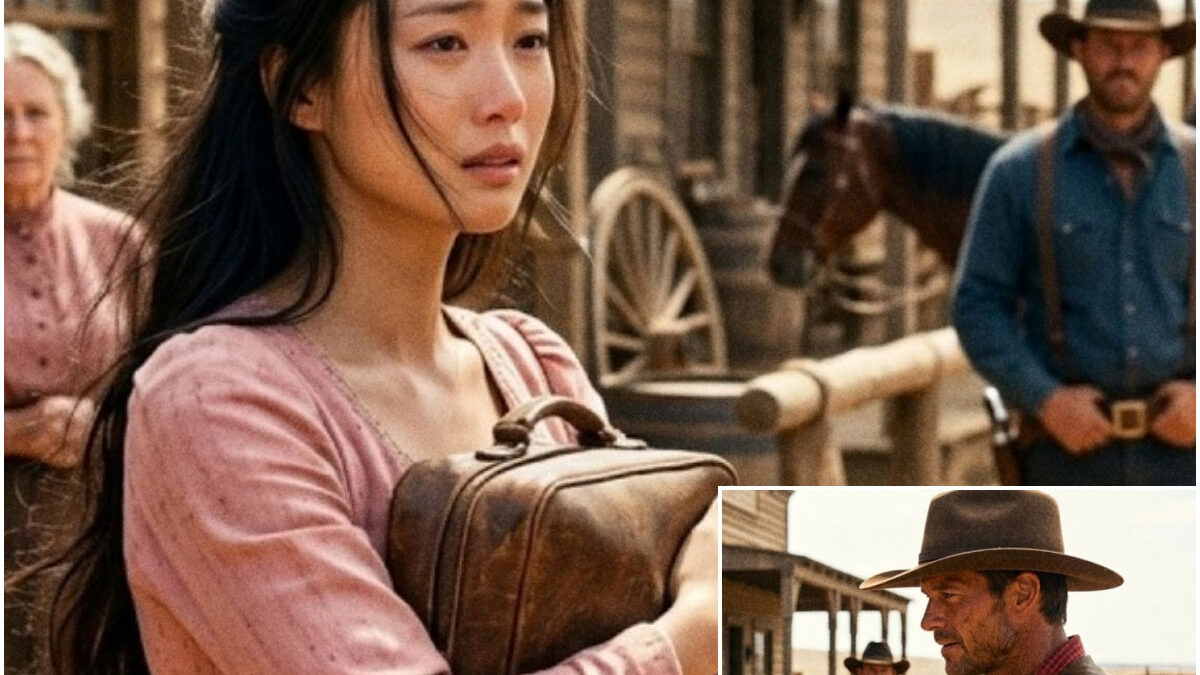
“You’re Coming With Me,” Said the Rancher to a Lost Chinese Woman
The dust had not yet settled from the wagon wheels when Lin Way realized the driver had called out the wrong name for her stop.
And by the time she understood her mistake, the wagon was already a shrinking shape on the road behind her, rattling off toward a town that was not the one written on the paper in her sleeve.
She was 26 years old, a seamstress by trade, and she had traveled from San Francisco to join her cousin’s household in a mining town called Prosper Creek, where a letter had promised her steady work and a room of her own above a laundry.
But the freight driver had misheard the name through the noise of the depot, setting her down instead in a town called Harlo’s Bend, Colorado territory, in the thick heat of late July 1877.
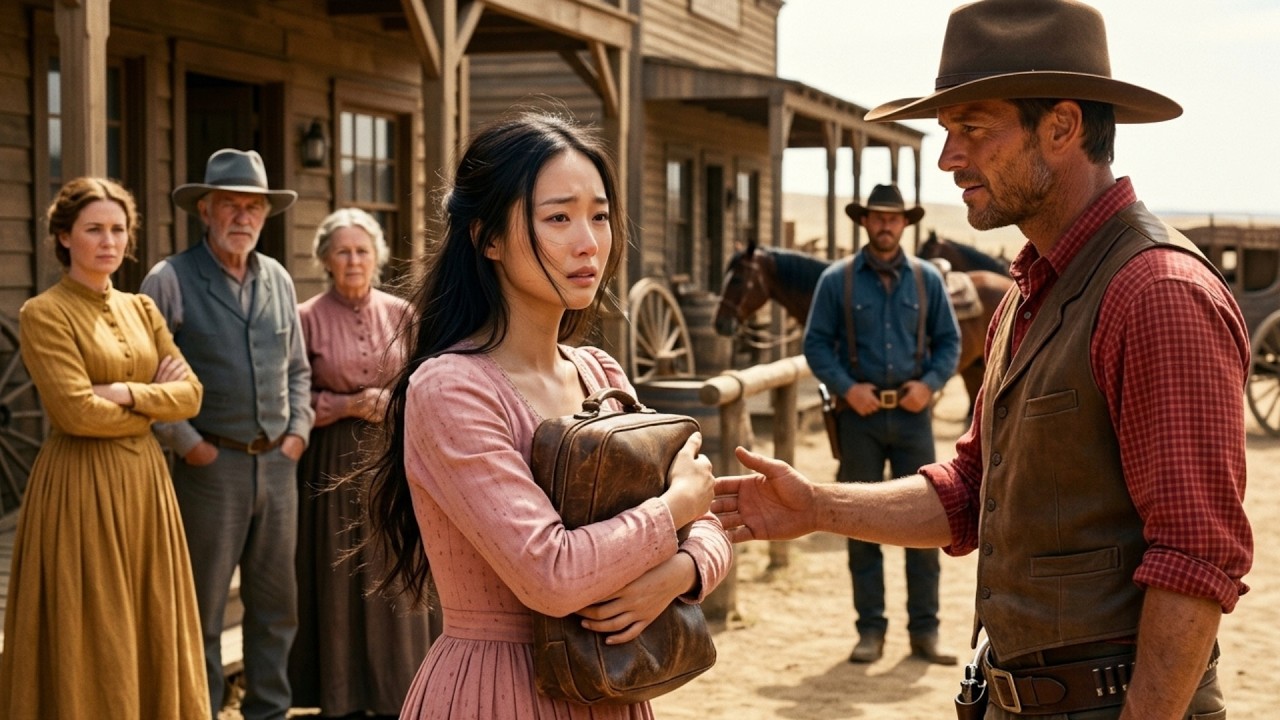
With no cousin waiting, and no clear notion of which direction might lead her back toward the rail line, the street around her churned with a noise she was not prepared for.
Freight wagons groaned past, loaded with lumber and barrels.
Men called out prices from open storefronts.
A dog barked somewhere behind the merkantile, and every so often a rider passed close enough that she had to step back sharply to keep from being struck.
She held her small cloth bag against her chest and turned in a slow circle, searching the painted signboards for anything that matched the letter folded inside her sleeve.
But every word swam together into shapes she could not read fast enough, and the sun bore down without mercy on the crown of her head.
A woman in a wide bonnet crossed the street to avoid walking near her.
Two men outside the saloon stopped talking to stare, one of them saying something low to the other that made them both laugh in a way that had nothing kind in it.
Lyn Wei kept her eyes down and kept walking because moving felt safer than standing still, though she had no notion of where she was walking to.
That was when she heard the voice.
Ma’am, you look like you’re loSt. She turned to find a man standing beside a chestnut horse at the hitching poSt. Sunweathered skin and a plain shirt gone soft with wear, watching her with none of the mocking curiosity the others in the street had shown.
He was perhaps 30, tall through the shoulders in the way of a man who worked outdoors for a living, and his eyes, when she finally met them, held nothing but plain, unhurried concern.
I do not know this place,” she said, her English careful and precise, learned from a missionary school years before, but rarely tested against a voice with this particular frontier flatness to it.
I was to go to Prosper Creek.
The man’s brow drew together.
Prosper Creek’s near 40 miles west of here.
Wagon put you down in the wrong town.
Yes, she said, and felt for the first time since stepping off the wagon the full weight of how far wrong the day had gone.
Somewhere behind her, one of the men from the saloon had drifted closer, and his voice carried easy and loud across the street.
“Best not get too friendly, Wickham.
Don’t know where that one’s been.”
The rancher did not turn around immediately.
He set his jaw, finished tying off his horse’s lead with two unhurried motions, and only then looked over his shoulder at the man who had spoken, his expression giving away nothing at all.
“Don’t recall asking your opinion, Merrick,” he said, and something in the flatness of his voice made the man called Merik’s smile falter just slightly before he shrugged and turned back toward the saloon door.
Lyn Wei stood very still through the exchange, her heart beating fast against her ribs, uncertain whether she had traded one danger for another, simply by standing near this stranger.
But when he turned back to her, his face had softened again, and he held out one hand, not to touch her, only to gesture toward the horse behind him.
“Name’s Ezra Whitam,” he said.
I’ve got a ranch a few miles out from here.
You’re not going to find safe lodging standing in this street.
And there’s no wagon back toward the rail line until Thursday next.
Don’t cry.
You’re coming with me if you’ll have it.
And we’ll sort out how to get you where you’re headed.
If you’re already wondering what she decides, go ahead and hit that like button because this story has a good long way left to travel.
Lenway had not realized until he said the word that her eyes had gone bright and wet, and she pressed the back of her wrist quickly against her cheek before the tears could fall properly, embarrassed at having let a stranger see even that much.
She looked at the horse, at the dusty road stretching in both directions with no answer in either, and then at the man’s face, which held nothing but the plain patience of someone waiting for a decision rather than demanding one.
I do not know you, she said.
No, ma’am, you don’t, Ezra agreed.
But you don’t know Harlo’s Bend either, and I’d wager it knows you even less kindly than it looks like it already has.
He nodded toward the saloon where Merrick had disappeared back inside, though a few other faces still lingered in the doorway watching.
My housekeepers out at the ranch, widow woman named Agnes Trundle.
She’ll see you settled proper, and come morning, I can take you into town again to send word to your cousin by telegraph.
Let them know where you’ve landed.”
The word telegraph struck her as a small mercy, a thread of practicality in a day that had offered her nothing but confusion, and she found herself nodding before she had entirely decided to.
“Thank you,” she said.
“I accept.”
He helped her up onto the wagon seat beside his saddle horses lead, guiding his own mount alongside, and they rode out of Harlo’s bend as the last of the noon heat pressed down over the rooftops, the noise of the town fading slowly behind them into the wide, dry hush of open country.
Lyn Wei kept her bag in her lap and her eyes forward, watching unfamiliar hills roll past, gold grass and scattered pine, and did not speak again until the town was well out of sight.
“Why did you stop for me?”
She asked finally.
“The others did not.”
“Zra was quiet a moment, his eyes on the road ahead.”
Because nobody ought to be left standing alone in a street full of strangers, he said.
My mother used to say that kindness costs a man nothing but his pride, and pride’s the cheapest thing a person owns.
He glanced sideways at her.
Besides, you look like someone who’d traveled a long way to get somewhere and gotten put down in the wrong place through no fault of your own.
Seemed the least I could do was point you the right direction.
She did not answer, but something in his plain, unadorned reasoning eased the tightness that had sat in her chest since the wagon rolled away without her.
The ranch, when they reached it an hour later, was modest but well-kept, a low, clabbered house with a wide porch, a barn behind it, weathered gray by seasons of sun, and a corral where two horses stood swishing flies in the afternoon heat.
Agnes Trundle, a stout woman with iron gray hair pulled back tight and hands that looked permanently reened from work, came out onto the porch at the sound of the wagon, and took one look at Lin Wei before her expression shifted from surprise to a brisk, practical welcome that asked no questions Lin Wei was not ready to answer.
“Well, come on in out of that sun,” Agnes said.
You look like you haven’t had a proper meal since sunup.
She had not, and the simple truth of the offer brought a fresh sting to Lin Wei’s eyes that she blinked away as she followed the older woman inside.
The house was plain and clean, and Agnes set a plate in front of her without ceremony.
Cornbread and beans and a strip of salted pork.
And Lenway ate slowly, aware of Ezra standing near the doorway, watching with the same quiet, unobtrusive attention he had shown her in the street, as though he was simply making certain, without making a show of it, that she was truly being cared for.
“You’ll stay in the room off the kitchen tonight,” Agnes said.
“It’s small, but it’s clean, and the door locks from the inside, if that eases your mind any.”
It does,” Lynway said quietly.
“Thank you.”
That evening, once the dishes were cleared and the house had settled into the particular hush of a frontier evening, crickets loud beyond the windows and the last orange light fading over the hills.
Lenway sat on the porch step, a little apart from where Ezra was mending a length of harness leather by lamp light, and found herself watching his hands work, steady and sure.
The same hands that had gestured so plainly toward his horse that afternoon instead of reaching for her.
“You did not have to bring me all this way,” she said.
“A stranger.”
“Didn’t have to,” Ezra agreed, not looking up from the leather.
“Wanted to.”
He tied off a knot and set the harness aside, finally meeting her eyes across the dim porch.
“Man ought to be judged by what he does when nobody’s asking him to do anything at all.
That’s what my father used to say before he passed.
I’ve tried to hold to it.
She thought of the man in the street, Merrick, and the ugly ease with which he had spoken about her, and the sharp immediate way Ezra had shut the comment down without raising his voice at all.
Something in the contrast settled into her chest like a small warm stone, and she did not have words yet in this new language still unfamiliar on her tongue for the shape of what she was beginning to feel.
The following morning, Ezra rode with her back into Harlo’s bin to send word by telegraph to Prosper Creek.
And it was there, standing at the counter of the small telegraph office, while the operator tapped out her message, that the town’s true temperament revealed itself more sharply than it had the day before.
A man named Otto Dunore, who Lyn Weey would later learn owned the freight company whose wagons ran the very route she had been misplaced on, stood near the counter, watching her with an expression of open calculation that made her skin go cold in a way the summer heat could not explain.
That’s the one wandered off the wagon yesterday, Dunore said to the operator, though his eyes stayed fixed on Lynn Way.
Heard talk about her already.
No family here, no papers to speak of, I’d wager.
Woman like that’s easy trouble for a town like this.
She’s got a cousin waiting in Prosper Creek, Ezra said, stepping up beside Lyn with a stillness that carried more weight than any raised voice could have.
And she’s got papers same as any traveler does.
Whatever trouble you’re imagining, Dunore, it isn’t standing in this office.
Dunore’s mouth curled into something that was not quite a smile.
Didn’t say I was imagining anything, Wickham.
Just making an observation.
A woman alone, no husband, no protector out here in the territory.
Things have a way of happening to folks like that.
He let the sentence hang there, deliberate and unfinished, before touching the brim of his hat and walking out into the street.
The telegraph operator, an older man who had watched the whole exchange with visible discomfort, finished sending the message without further comment.
But Lenway noticed the way his hands moved a little faster than before, eager perhaps to have the uncomfortable transaction finished and the difficult customers gone from his counter.
Outside, walking back toward the horses, Ezra’s jaw was set tight enough that a muscle worked visibly along the side of his face.
“Don’t pay Dunore any mind,” he said.
“Man spent his whole life deciding who belongs and who doesn’t based on nothing but his own convenience.”
He sounded as though he meant to do something, Lynway said, not merely speak.
Ezra did not answer right away, and the silence between them, brief as it was, told her more than any reassurance could have.
“I’ll not let anything happened to you while you’re under my roof,” he said finally.
“That’s all I can promise, but I mean it.”
The message came back from Prosper Creek two days later, carried out to the ranch by a writer the telegraph operator paid to make the trip, and it brought news that complicated matters far more than either of them had expected.
Her cousin’s household, the letter explained in careful, worried script, had been struck by a fever that had swept through the mining camp weeks before, and though her cousin had survived, the household could no longer take in another mouth to feed.
Not until the debts from the sickness were settled, and the camp’s economy steadied.
There was no money enclosed for a return fair east, and no clear invitation forward either, only an apology, heartfelt, but useless against the plain fact that Lynway now had nowhere certain to go.
She read the letter twice on the porch steps, the paper trembling slightly in her hands.
And when Agnes came out to check on her, and found her sitting there with her face carefully composed, but her eyes bright with unshed tears, the older woman said nothing at first, only sat down beside her and waited.
“I have nowhere,” Lynway said finally, the words coming out smaller than she intended.
No family here, no money for passage back to the coast that would not leave me with nothing at all when I arrived.
I do not know what I am meant to do.
“You’re meant to stay here a while and think it through proper,” Agnes said in the same brisk, unadorned tone she used for everything.
“Nobody’s putting you back on a wagon tomorrow.
This ranch has room, and there’s work enough for another set of hands, if you’re willing.
Seamstress work, especially since half the shirts in this house have been mended by my own poor eyesight for longer than they ought to have been.
It was not charity exactly the way Agnes offered it, but something closer to plain practicality, and Lyn found she could accept it more easily for that reason.
When Ezra returned from checking the fence line that evening and heard the news, his reaction was quieter than Agnes’, but no less certain.
Stay as long as you need, he said.
There’s no shame in a plan changing shape.
But the piece of that arrangement did not last more than a week before Dunore’s interest in Lin Way hardened into something more deliberate.
It began with a rumor carried into town by one of Dunore’s own freight drivers that the woman staying out at the Witham Ranch had no legal standing in the territory at all, no proof of honest passage, no sponsor beyond a rancher who had taken her in on nothing more than a whim.
The rumor grew teeth as it traveled, and by the following Sunday, when Ezra brought Lin Wei into town for supplies, the whispers had become open enough that a shopkeeper refused to serve her at his counter, claiming with a politeness that made the refusal more insulting rather than less, that he could not extend credit to someone whose situation in the territory was, in his words, unclear.
Lyn Wei stood very still in the doorway of the Merkantile, her basket half-filled, and said nothing, because she had learned already, in the short time since stepping off that wrong wagon, that arguing with such politeness only sharpened its edge.
But something in her stillness, in the way she simply set the basket down on the counter, and turned to leave without a word of protest, struck Ezra harder than any outburst could have.
You’ll take her coin same as you’d take mine,” he said to the shopkeeper, his voice low and even.
“Or you’ll explain to every rancher in this valley why witcom business doesn’t come through your door anymore.”
The shopkeeper’s face reened, caught between his prejudice and the plain economic threat of losing a customer whose trade mattered to half the county.
And after a long, tense moment, he rang up the goods without further comment, though his eyes never once met Lyns, as he did.
Outside, walking back toward the wagon, Lyn finally spoke what had been building in her chest since the telegraph office days before.
This is happening because of me, she said.
Dunore, the shopkeeper.
You are making enemies you did not have before because I am standing beside you.
I had enemies before you arrived.
Ezra said Dunore has been angling for my water rights on the north pasture for two years now.
Ever since the creek shifted course and put half his grazing land dry.
He’d have found some reason to make trouble sooner or later.
You just gave him a target he thought would be easier to hit.
And is it?
Lenway asked.
Easier.
Ezra looked at her for a long moment.
Something steady and certain in his gaze that had nothing to do with the argument at hand.
No, he said, “It isn’t.”
That night, sitting again on the porch, while Agnes hummed quietly over her mending inside, Lynway found the courage to ask him something that had sat unspoken between them for days.
“Why do you keep defending me?”
She said.
“Truly, it is not only kindness anymore.
A man does not risk his water rights, his trade, his standing in this town only for kindness.”
Ezra set down the piece of rope he had been coiling and was quiet long enough that she thought he might not answer at all.
“The day I found you in that street,” he said finally.
“You looked like someone who’d been let down by every person who ought to have looked out for her, and you were still standing straight through it, not asking for pity, just trying to find your way.”
He turned to face her fully.
I’ve spent a long while out here alone since my wife passed of fever three years back.
Told myself I didn’t need company, that the ranch and the work were enough.
But there’s a particular kind of quiet that settles into a house after a loss like that, and it doesn’t lift on its own.
It lifted some the day you sat down at my table.
Lenway’s breath caught, and she was quiet a long moment before she answered, her voice steadier than she expected it to be.
I did not think when I stepped off that wagon in the wrong town that I would find anything worth staying for, she said.
But I find I am no longer in a hurry to leave.
Neither of them moved to close the distance between them that night, the moment settling instead into something quieter and more certain, a shared understanding that did not need to be rushed toward its conclusion.
But the piece of it did not last long, because three days later Dunore’s patience finally ran out entirely.
He arrived at the ranch in the late afternoon with two of his freight hands flanking him, and though his manner remained outwardly courteous, the threat beneath it was unmistakable from the moment he swung down off his horse.
“Witkam,” he said.
“Come to make you an offer regarding the north pasture water rights.”
“Generous one, given the circumstances.”
“Not selling,” Ezra said, stepping down off the porch to meet him in the yard.
Might reconsider,” Dunore said.
“Once the territorial marshall hears there’s an unregistered foreign woman living on your property with no sponsor and no clear papers could make things complicated for a man standing.”
Having that kind of trouble attached to his name might make a man more willing to talk sense about water rights once the marshall starts asking questions.
Lyn Wei, standing in the doorway with Agnes just behind her, felt the threat land in her stomach like a physical blow.
But it was Ezra’s response, quiet and immediate, that steadied her more than any reassurance could have.
She’s got a letter from her cousin in Prosper Creek proving family sponsorship filed proper at the telegraph office, Ezra said.
And she’s been keeping the ranch’s books and mending half the county shirts for honest pay this past fortnight, which any judge in this territory would call gainful lawful occupation.
You want to send the marshall out here, Dunmore?
You go right ahead.
I’d wager he finds considerably more to question about your freight manifests than he ever will about her.
Something flickered across Dunore’s face.
A brief calculating uncertainty that told Lyn Wei the threat about the manifests had landed somewhere true.
And after a long tense silence, he mounted back up without another word, though his eyes lingered on Lynn Wei with a coldness that promised the matter was far from finished.
He did not return to speak of water rights again.
Instead, a week later, word reached the ranch that one of Dunore’s freight wagons had been found deliberately run off the North Road in the middle of the night.
Its cargo of feed grain scattered and ruined across the ditch, and that Dunore had wasted no time telling anyone who would listen that the sabotage must have come from Wickham land, given the dispute between them, and that a woman with no ties to the territory made for a convenient culprit if the marshall came asking.
Lynn Wei learned of the accusation from Agnes, who delivered it with her jaw set tight and barely restrained anger, and she felt the ground shift beneath her in a way that made the earlier insults in town feel small by comparison.
This was not whispered prejudice now.
This was a crime laid deliberately at her feet by a man with every reason to want her gone, and every means to make the accusation stick.
I did not touch his wagon, she said, her voice tight with a fear she had not let herself show until now.
Nobody who knows you believes otherwise, Ezra said, though the grim set of his mouth told her he understood exactly how little that mattered if Dunore pressed the accusation formally before the marshall.
That evening brought the larger danger of Lin Wei’s time in the territory, though neither she nor Ezra anticipated how quickly it would arrive.
Two of Dunore’s hired men rode out to the ranch after dark, ostensibly to inspect the property for evidence, but their manner, from the moment they dismounted, carried none of the formality such a visit should have required.
One of them, a broad shouldered man named Otis Pratt, crossed the yard toward the house with a torch in hand, its flame throwing long shadows across the dry summer grass, and made no effort to disguise the threat implicit in carrying open fire so close to a barn full of hay in the driest month of the year.
Just having a look around, Pratt said when Ezra stepped out onto the porch to meet them, rifle held loose but ready in his hands.
Dunore wants to know what a search might turn up.
You’ve got no warrant, Ezra said.
And you’ll put that torch out before it’s within 10 ft of my barn, or I’ll put it out myself.
Pratt smiled, unpleasant and slow, and took one more deliberate step toward the barn instead of backing away.
It was Len Wei who moved first, stepping past Ezra before he could stop her, crossing the yard with a speed that startled both hired men into stillness, and seizing the water bucket left beside the well pump, dashing its contents directly across the dry grass at Pratt’s feet before he could take another step closer to the hay stored inside the barn doors.
The sudden splash of water, dark and immediate, against the pale summer grass, doused the most dangerous patch of tender, dry ground between the torch and the barn.
And in the startled pause that followed, Ezra closed the remaining distance and forced the torch from Pratt’s hand, grinding its flame out beneath his boot heel with three hard, deliberate stamps.
Get off my land,” Ezra said, and his voice carried none of its earlier restraint now, only a low, dangerous certainty that made both hired men take an immediate step back toward their horses.
Tell Dunore if he wants to search this property, he’ll bring a marshall and a proper warrant, and he’ll come himself instead of sending men to threaten a barn full of hay with an open flame in the middle of a drought summer.
That’s a hanging offense in half the territories I’ve ridden through, and I expect he knows it.”
The men rode off without further argument, though the threat in their retreat carried its own uneasy weight, and Len Way stood in the yard afterward with her hands trembling, not from fear now, but from the aftermath of having acted without thinking, the empty bucket still hanging from her fingers.
You could have been hurt, Ezra said, turning to her once the riders had disappeared into the dark.
So could you, Lenway said, and the barn and Agnes asleep inside.
She set the bucket down carefully, steadying her hands against the well’s stone rim.
I did not think.
I only saw the fire near the hay, and I moved.
That’s exactly what courage looks like, Ezra said quietly.
Most folks freeze.
You didn’t.
The following morning, Ezra rode into Harlo’s Bend himself, alone this time, and returned by midday with news that shifted the entire balance of the conflict.
He had gone directly to the territorial marshall’s office, laid out the full account of Dunore’s accusation, the visit from Pratt and his torch, and the water rights dispute that had clearly motivated the whole affair.
And the marshall, a measured man named Josiah Callaway, who had little patience for freight companies playing at private justice, had ridden out to Dunore’s own property that same afternoon to investigate the sabotaged wagon for himself.
What Callaway found once he examined the ruined feed grain and the tracks leading away from the wrecked wagon told a story entirely different from the one Dunore had been spreading through town.
The wheel ruts leading from the wagon showed clear signs of having been deliberately cut, not run off the road by accident or sabotage from outside.
And further questioning of Dunore’s own drivers revealed that the grain shipment had been insured for considerably more than its market value, a detail that raised the Marshall suspicion of fraud rather than any wrongdoing on Whitam land.
Dunore was brought in for questioning within the week, and though the full resolution of the insurance matter would take the territorial court considerably longer to settle, the accusation against Lynn Wei evaporated entirely under the Marshall scrutiny, and the whispered rumors that had followed her through Harlo’s Bend since her first confused morning in its streets began slowly to quiet.
Three months passed after that, and the season turned from the dry heat of summer into the first cooling edges of autumn.
The grass along the ranch’s north pasture growing back thick and green now that the water dispute had settled in Ezra’s favor once and for all.
Dunore’s fraud charges having cost him both his standing in town and any further appetite for contesting water rights with a neighbor who had a territorial marshall’s good opinion behind him.
Lyn Wei’s seamstress work had grown steadily through those months.
First mending shirts for the ranch, and then as word spread through the valley of her careful, precise handiwork, taking in commissions from families across the county, who had once eyed her with the same suspicion Dunore had tried to weaponize, and now simply saw a skilled tradeswoman worth paying fairly.
She kept the ranch’s books alongside Agnes, the two of them settling into an easy companionable rhythm that filled the house with a warmth that had not held, Ezra admitted one evening, since long before his wife’s passing.
The letter from Prosper Creek came again in late September.
Her cousin’s household recovered now from the fever and the debts it had left behind, offering once more the room and the work Lenway had originally traveled west to find.
She read it on the porch steps in the fading gold light of an early autumn evening, the same steps where she had first cried three months before over a very different letter.
And when Ezra came to sit beside her, she did not need to explain what the paper said before he understood the choice sitting in her hands.
“You could go,” he said.
“Nobody would think less of you for wanting the family you set out to find in the first place.”
I could, Lenway agreed.
But I find the family I was looking for was not waiting in Prosper Creek after all.
She folded the letter carefully and set it aside.
It was standing in a dusty street in the wrong town entirely, telling a frightened stranger not to cry.
Ezra reached over and took her hand, calloused and steady.
The same hands that had ground out a torch flame beneath his boot heel and coiled harness leather by lamp light and never once in three months reached for anything that had not first been freely offered.
Then stay, he said, not because you’ve nowhere else to go, because you’ve somewhere you’d rather be.
I would rather be here, Lyn said, and meant it entirely.
They were married the following spring in a small ceremony at the ranch.
Agnes, standing witness, with tears she pretended were only allergies, and the north pasture that Dunore had once tried to claim through threats and fire, ran thick with cattle by the following summer, watered by the creek that had never once, in all the trouble it caused, belonged to anyone but the family who had earned the right to it honestly.
And that brings us to the end of this one.
If you stayed with me all the way through, thank you.
Stories like this only get told because folks like you sit down and listen.
If you liked what you heard, go ahead and hit that like button.
And if you want more stories from the old frontier, subscribe so you don’t miss the next one.
Until then, take care of yourself and thanks again for being








