Wealthy Rancher Pretended to Be Poor to Find a Wife – Only the Most Rejected Woman Chose Him

Wealthy Rancher Pretended to Be Poor to Find a Wife – Only the Most Rejected Woman Chose Him
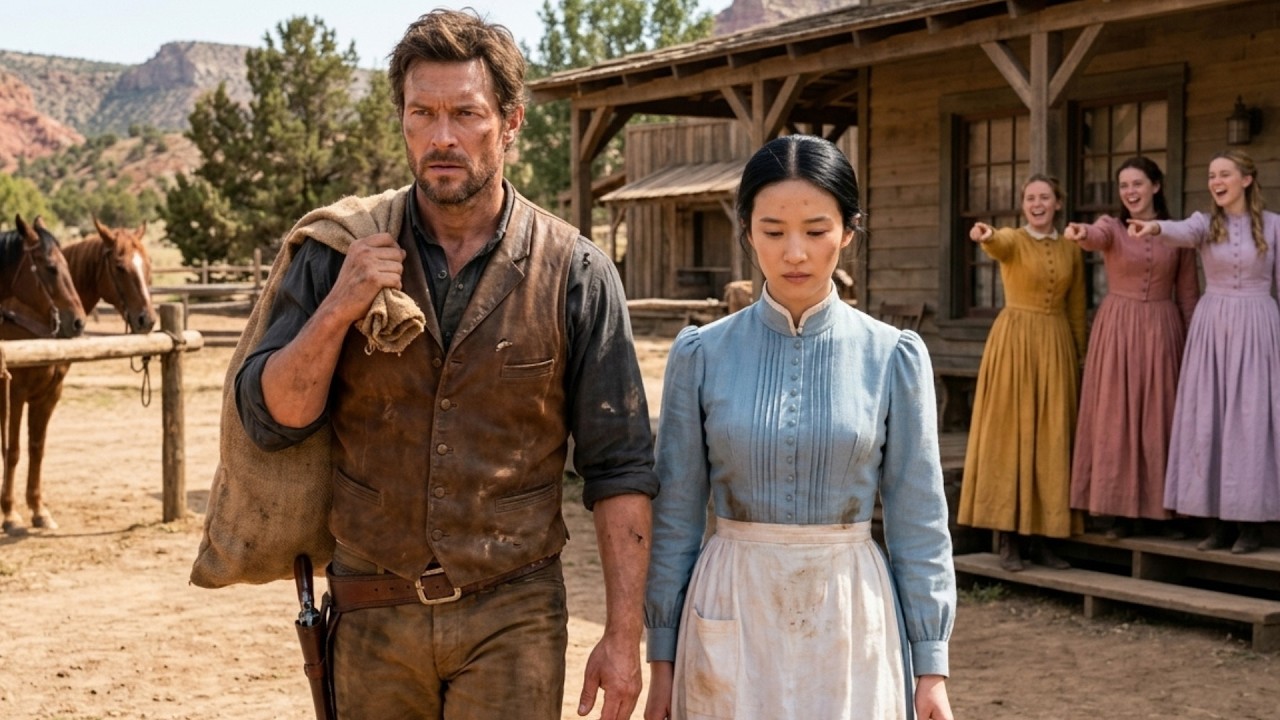
The dust on his boots was three days old, and Nathaniel Cross had made sure of it.
He stood at the edge of Milbrook, Wyoming in the summer of 1878, wearing a shirt he had deliberately dragged through the corral mud that morning.
His vest was missing two buttons.
His hat had a tear along the brim that he had put there himself with a pocketk knife.
Underneath all of it, folded into a strong box back at his ranch house, sat the deed to 14,000 acres of grazing land and a bank account in Cheyenne that most men in this territory would not see in three lifetimes.
But none of that showed.
That was the point.
He walked into town with a canvas sack over his shoulder, the same one he used to carry feed, and he let the dirt on his hand speak before he did.
Nathaniel was 36 years old, broad through the shoulders from 20 years of ranch work that had nothing to do with pretending, and he had buried a wife 11 years back, who had married him for exactly the wrong reasons.
He had watched her eyes go flat every time she looked at their house instead of at him.
He had watched her spend money like it was the only thing keeping her present in the marriage.
When the fever took her, he had grieved.
But he had also learned something he could not unlearn.
Money changed how people looked at a man.
It changed what they said and how quickly they said it.
So this time he would find out who a woman was before she knew what he had.
The town of Milbrook did not know what to make of him.
He had arrived a stranger, giving his name simply as Nathaniel.
No mention of the cross ranch or the herds that grazed 40 miles west.
He said he was looking for work and eventually a wife.
He said it plainly the way a poor man says a thing.
He is embarrassed to need.
And the town, as towns do, decided quickly what kind of man he was.
They decided wrong.
But it would take the rest of the summer to prove it.
The first place he tried was the dry goods store, where three women stood at the counter comparing bolts of calico.
He asked, had in his dirty hands, whether any of the local women might be interested in meeting a rancher looking to settle down proper.
The tallest of them, a woman named Bess Whitfield, looked him over from his scuffed boots to his torn hat brim, and did not bother lowering her voice.
“A rancher,” she said, and the word came out like she was testing whether it might be a joke.
With that outfit, I’d wager you’re hurting chickens, not cattle.”
The other two women laughed, the kind of laugh that wants an audience, and Nathaniel felt the heat climb his neck.
But he had asked for this.
He touched his hatbrim, said a polite good day, and left the store with the bell over the door ringing behind him like a small mocking bell of judgment.
He did not stop.
Across the street at the boarding house, he tried again.
The proprie, a widow herself named Constance Ryder, looked at him through the screen door and did not open it.
“We don’t take charity cases here,” she said.
“And I don’t know any woman fool enough to marry one.”
By noon, he had been turned away from four households and laughed out of the general store twice.
The town’s unmarried women, of which there were perhaps a dozen of marrying age, had apparently compared notes over the course of the morning, because by the time he reached the church social happening on the green that afternoon, his reputation had outrun him.
Word was that a ragged drifter was going doortodo, proposing marriage like a peddler selling 10 pans.
He stood at the edge of the church social, a gathering of maybe 40 towns folk under a stand of cottonwood trees, holding lemonade nobody had offered him, and watching families laugh at tables he had not been invited to join.
A group of young women near the punch bowl noticed him and did not lower their voices either.
“There he is,” one of them said.
“The chicken rancher.”
The name had stuck, and it stung more than he expected, given that he had built it himself, brick by dirty brick.
But something in him, some old, stubborn thing that had survived a war, a first marriage, and 11 years alone, would not let him walk away yet.
It was a woman named My Linhao, who did not laugh.
She stood apart from the crowd near the edge of the churchyard where the shade ran thin, holding a basket of mending she had clearly brought to sell or trade rather than to socialize.
She was perhaps 30 years old, a widow, her husband having died two years prior building track for the railroad crews that had come through the territory, and in the manner of men who die building things other men profit from, left behind very little except a debt and a reputation nobody in town seemed eager to honor.
She worked as aress and seamstress, taking in mending from ranch hands and shirts from the merkantile, living in a small room behind the Chinese laundry at the edge of town that she ran with an elderly relation.
Nathaniel had noticed her twice already that day, once outside the dry goods store and once passing the boarding house.
And both times she had kept her eyes down and her pace steady.
The practiced walk of someone who had learned that being noticed rarely brought anything good.
But at the social, when the young women’s laughter reached its sharpest pitch, and Nathaniel stood alone holding lemonade with nowhere to sit, she was the one who crossed the grass toward him.
“You look thirsty for something besides that lemonade,” she said.
Her voice was quiet, careful, the English precise in the way of someone who had built it deliberately rather than inherited it.
There is water at the well behind the church.
It is cooler.
He looked at her surprised enough that he nearly forgot to answer.
That so it is so.
She did not smile exactly, but something in her face eased.
You have been rejected four times today.
I counted from the boarding house window.
That is enough for one man in one day.
You were counting.
I was watching.
She said it was hard not to.
Bess Whitfield’s voice carries.
He almost laughed.
The first real laugh he had allowed himself since he’d started this foolish plan.
I reckon it does.
She introduced herself as my Lynn and she did not ask him what he owned or what he was worth or where his people came from.
Questions that every other woman in Milbrook had managed to work into the first 30 seconds of conversation.
She asked him if he had eaten, and when he admitted he had not, she offered half of the rice and dried fish from a small cloth bundle she carried food she had clearly packed for her own dinner and nothing more.
He hesitated, aware of what it meant for a woman with almost nothing to offer half of it away.
But her face told him refusing would insult her more than accepting would cost her.
They sat on a low stone wall at the edge of the churchyard while the social continued without them.
And for the better part of an hour, Nathaniel Cross, who owned more land than anyone in three counties, ate rice from a Chinese widow’s dinner and said almost nothing about himself, and felt for the first time in 11 years that a conversation was not a transaction.
But the ease of that hour did not last sundown.
Word travels fast in a town where everyone already knows everyone’s business.
And by the time Nathaniel walked my back toward the laundry at the edge of town, three of the young women from the social had gathered on the boarding house porch to watch.
Bess Whitfield’s voice, true to its reputation, carried clean across the street.
“Well, would you look at that,” she said, loud enough to be heard by design.
The chicken ranchers found himself a match.
A washerwoman for a beggar.
Seems about right.
Milin’s spine went straight, but she did not slow her walk, and she did not answer.
Nathaniel felt something hot and immediate rise in his chest, an old instinct toward the girl on the porch that he would have acted on in another life, back when his name alone could silence a room.
But he had chosen to be a poor man this summer, and a poor man did not get to silence anyone.
He clenched his jaw instead and kept walking beside her.
“You did not need to hear that,” he said quietly once they were out of earshot.
“I have heard worse,” Mellin said.
“And from people who mattered more to me than she does.”
Her voice did not shake, but something in it had gone careful again.
The same careful precision she used with her English, as though she was choosing to keep her feelings folded small and out of sight.
“You should not walk with me tomorrow.
It will only make things harder for you.”
“Harder for me,” he repeated.
“You are trying to find a wife in this town,” she said.
“That will not happen if they see you standing beside me.”
She stopped at the edge of the laundry building, its clabbered walls patched with mismatched wood.
A lantern already lit inside, where an elderly woman, her aunt by marriage, moved between hanging lines of drying linen.
Good night, Mr. Nathaniel.
She went inside before he could argue, and he stood in the dust of the street a long while, turning over a fact he had not expected to learn this summer.
He had come to Milbrook to test which woman would treat him decently without knowing what he owned.
He had not expected to find that the answer might cost her more than it cost him.
He returned the next morning anyway.
He found her already at work elbow deep in a wash tub of gray water, her sleeves rolled and her hands red from the lie soap.
He offered to carry water for her, and when she protested that he need not, he pointed out that he had nothing else pressing him, and would rather be useful than idle.
She allowed it, mostly, he suspected, because refusing him twice in two days would have taken more energy than she had to spare.
Over the following two weeks, a pattern set in that the town watched with a mixture of amusement and disapproval.
Nathaniel returned to the laundry most mornings, hauling water, splitting firewood for the boiling kettles, mending the fence around the small garden plot where Mlin grew vegetables to supplement what the laundry earned.
He never asked for payment, and she never fully stopped protesting that he shouldn’t be there, though her protests grew softer each time, more ritual than resistance.
He learned things about her in pieces, the way a person learns a country by walking it rather than reading a map of it.
Her husband, Weihao, had come west with the railroad crews in 1874, and she had followed a year later, arriving in a territory that offered her almost nothing beyond the right to work herself raw for barely enough to eat.
When Weey died in a rock slide during grading work outside town, the railroad company had paid her nothing, citing a contract clause about assumption of risk that she had not been able to read at the time she or her husband had signed it.
The town’s bank had refused to extend her credit to keep the laundry running on account of her being both a widow and Chinese, two facts that in combination apparently disqualified a woman from being trusted with debt in the eyes of Milbrook’s loan officer.
She had survived through sheer stubbornness and the goodwill of a handful of ranch hands who paid fair prices for mending and did not ask questions about her past.
“Why do you stay?”
Nathaniel asked her one evening, sitting on the low bench outside the laundry while the sun went down orange behind the hills.
In a town that treats you the way this one does.
Mlin considered the question longer than he expected.
Because I built something here, she said finally.
It is small.
It is not much to anyone else, but it is mine and I earned it with my own hands and nobody gave it to me and nobody can take it from me.
Unless they burn it down.
She looked at him sideways.
Why do you stay in a town that laughed at you the first day you arrived?
He almost told her the truth.
Then the words sat right behind his teeth, ready to explain the strong box, the deed, the 14,000 acres, the reason none of the laughter had actually touched anything real in him, because none of it had been aimed at anything true.
But something stopped him.
Some instinct that the truth delivered too early would change how she looked at him in a way he was not ready to see.
He had learned already that Mlin did not perform kindness for an audience or a reward.
If he told her now he would never fully know whether that kindness had been for him or for the story he’d been wearing like borrowed clothes.
I reckon I found a reason to, he said instead, and left it there.
It was three days later that the second crisis found them both, the kind that could not be walked away from with a careful non-answer.
A man named Otis Greer, who ran the freight line through Milbrook, and who had, in the manner of men accustomed to being obeyed, decided some months back that Min’s small laundry building sat too close to his loading yard, rode up to the property with two of his hired hands on a Tuesday afternoon, and informed her that the lot was needed for freight storage.
He had, he claimed, a legal right to the ground, citing a boundary survey from years back that predated her husband’s claim and had never been properly resolved by the territorial land office.
You’ve got until the end of the week, Greer said, not bothering to dismount his horse.
To clear your things, I’ve been patient enough already.
Min stood her ground, her chin level, despite the three men looking down at her from horseback.
This land was surveyed and filed by my husband in 1874.
She said, “I have the paper in the house.
You are welcome to see it.”
“Paper filed by a dead China don’t mean much when the man holding the counter claim is standing right in front of you,” Greer said, and one of his hands laughed low and ugly.
“Best you start packing.”
It was Nathaniel splitting firewood at the side of the building, who set down the axe and walked into the yard at the sound of raised voices.
He said nothing threatening, made no sudden move, but something in the way he crossed the distance, unhurried and utterly unafraid, made even Greer’s hired hands go quiet.
“Show me the paper,” Nathaniel said.
“Both of you, hers and yours.”
Greer looked him over.
The same dismissive onceover the town’s women had given him weeks before.
Torn hat and dirty vest and all.
“This ain’t your business, Drifter.”
“Making it my business,” Nathaniel said.
And something in his voice, low and level, and entirely without the false humility he’d been performing for weeks, made Greer’s horse shift under him.
“Territorial land office is two days ride from here.
I’ll go myself and pull the original filing if I have to, but I’d wager the lady’s paper is good, and you’re counting on nobody having the time or the money to check.
For a long moment, nobody moved.
Then Greer spat into the dust, wheeled his horse, and told Min she had until Friday, paper or no paper, before he came back with more men.
He rode off with his hands trailing him, and the yard went quiet, except for the sound of Min’s breathing, which had gone shallow and fast in a way she was clearly working hard to control.
“You should not have done that,” she said once the dust of their departure had settled.
“Men like Greer remember who stood against them.”
“Let him remember,” Nathaniel said.
She looked at him then really looked.
The way a person looks at someone they are reconsidering.
Who are you?
She said quietly.
Not quite a question and not quite an accusation.
A poor man does not talk to Otis Greer that way and walk away with his teeth.
He knew standing in that yard with the smell of lie soap and cut wood in the air that the lie had reached the end of what it could carry.
But he was not ready.
Not yet to say it plainly.
And he told himself it was because Friday was coming and there were more urgent things to solve than his own conscience.
I’ll explain, he said, once this is settled.
I give you my word on that.
She did not look satisfied, but she let it stand because there was no time that week for anything but the paper and the deadline bearing down on them both.
The land office ride took two days there and back, and Nathaniel made it in one, pushing his horse harder than he had any right to, arriving at the territorial office in Laram, dustcovered and half frantic, to find the original filing before Greer’s counter claim could be pressed.
He found what he needed by the second morning.
We Jou’s filing was recorded properly, dated 18 months before whatever paper Greer claimed to hold, and the clerk, once Nathaniel had made clear he intended to see the matter through with legal force, if necessary, was willing to issue a certified copy on the spot.
He rode back into Milbrook on Thursday evening, with the paper folded in his coat, and a plan already forming that would require at last the truth.
He found Greer at the saloon holding cord among a handful of freight men, and he walked in, still trail dusted, still wearing the same torn hat, and set the certified copy on the bar in front of him.
Filed 1874, Nathaniel said, 18 months before whatever you’re holding.
The land’s hers, clean and clear.
And if you or your men set foot on that lot again, I’ll have the territorial marshall out here inside a week, and I’ll pay whatever it costs to make sure he stays until the matters settled proper.
Greer looked at the paper, then at Nathaniel, and something calculating crossed his face.
Big talk for a man living off odd jobs and firewood money.
It was here that Nathaniel Cross, for the first time in five weeks, told the truth in Milbrook.
“My name is Nathaniel Cross,” he said loud enough that the whole saloon went still around him.
“I own the cross ranch 40 miles west of here.
14,000 acres, 6,000 head of cattle, and an account in Cheyenne that could buy your entire freight operation twice over without me noticing the withdrawal.
I’ve been dressed like a poor man for five weeks because I wanted to know which woman in this town would treat a man decent without knowing what he had.
Turns out it was the one you just tried to run off her own land.
The saloon did not merely go quiet.
It went the particular kind of silent that comes when a room realizes it has badly misjudged something, and there is no way to take back the misjudging.
Greer’s face went through several colors before settling on something pale and uncertain.
You’re lying.
Ride to Cheyenne and ask,” Nathaniel said.
“Or better yet, stay in this town another week and watch what happens when I start signing my real name to things.”
He picked up the certified copy from the bar.
“The land is hers.
It was always hers.
You knew that when you rode up with two men in a lie, because you figured a widow with no money and no standing in this town wouldn’t fight back.”
You figured wrong.
He left the saloon without waiting for a response, and the story of what had happened inside it reached every corner of Milbrook before the sun rose the next morning.
But he did not go looking for my Lin that night.
He rode instead to her building at first light, uncertain for the first time in five weeks of what kind of welcome he’d find.
She was standing outside when he arrived.
Already dressed for the day’s work, and her face told him she had heard.
It is true, then, she said.
Not a question.
It’s true.
He dismounted, held his hat in his hands, the same hands that had carried her water, and split her firewood for five weeks without her knowing what those hands were worth.
I should have told you the day Grier came.
I should have told you before that if I’m honest.
I let it run longer than I meant to because I did not want to see your face change when you learned it.
Why would my face change?
She said, and there was an edge in it now.
The first real anger he had seen from her in five weeks of knowing her.
Do you think I was kind to you because I hoped you were rich?
Do you think that is the only reason a person is kind to a stranger?
No, he said quickly.
That’s not what I meant.
Then what did you mean?
She crossed her arms, and he saw her hands were shaking slightly, though her voice stayed steady.
You let this whole town believe you were a beggar.
You let them mock you.
You let them mock me for standing beside you, and the entire time you carried a fortune in your pocket that could have silenced every one of them the first day.
Was that a test for them, Mr. cross or a test for me?
He had no good answer because she had found the true shape of the thing before he had fully admitted it to himself.
Both, I reckon, he said finally.
I told myself it was about the town, but somewhere along the way it became about you specifically, and I let it run on too long because I was afraid that once you knew, you’d wonder if any of it was real.
The water I carried, the firewood I split, the hours we sat on that bench watching the sun go down.
Something in her face shifted, though the anger had not fully left it.
And was it real?
Every hour of it, he said.
I’ve got 14,000 acres and more money than I know what to do with.
And none of it kept me warm the way that hour on the churchyard wall did, eating rice out of a cloth bundle with a woman who didn’t ask me a single question about what I owned.
He took a step closer.
I don’t expect you to forgive the lie quick.
I don’t reckon I’ve earned that yet, but I’d ask you to let me try earning it the same way I’ve been trying these five weeks, minus the part where I hide who I am.
Min did not answer right away.
She looked past him toward the road that led out of town, toward the direction of a ranch she had never seen, and a life she had not been raised to imagine for herself.
Then she looked back at him, and something in her had softened, though not entirely.
You will start, she said, by telling me everything.
All of it.
No more pieces.
All of it, he agreed.
Every acre.
She did not smile.
Not yet.
But she stepped aside and gestured him toward the bench outside her door, the same bench where they had sat most evenings for five weeks.
And he understood that this was not forgiveness, but the beginning of the road toward it, and that the road, like most honest things in this territory, would need to be walked slowly and in daylight.
Three months passed before the church bells of Milbrook rang for a wedding that half the town had weeks earlier considered impossible.
The land dispute with Otis Grier had been settled in full.
The certified filing standing without further challenge, and Grier himself had quietly sold his freight operation and left the territory rather than face the marshall.
Nathaniel had in fact arranged to have visit.
The laundry building still stood at the edge of town, though it had been expanded that autumn with new lumber and a proper foundation funded by Mlin’s own earnings and at her insistence no more than that.
She had made clear early on that she would not become a woman who lived entirely off her husband’s name, and Nathaniel, who had learned by then not to argue with her on matters of pride, had respected it.
Bess Whitfield, who had once called her a washerw woman in the street loud enough for the whole block to hear, attended the wedding in the second pew, her expression carefully neutral, and offered a stiff congratulations afterward that Mlin accepted with more grace than the moment strictly required.
The church itself, small and white collaborative at the center of Milbrook, was full that August morning.
The same summer heat pressing through the open windows that had pressed down on the town the day Nathaniel Cross first walked in wearing torn clothes and dirty boots.
Min wore a dress of pale blue cotton she had sewn herself, simple and unadorned.
And when she walked the short aisle toward the front of the church, Nathaniel found that his hands, which had carried water and split wood and signed deeds worth more money than this entire town would see in a decade, were shaking for the first time in longer than he could remember.
The preacher spoke the vows plainly, the way frontier preachers did, without much ornament, and when he asked whether anyone present objected to the union, the church stayed silent, the same silence that had once greeted the revelation of Nathaniel’s fortune in a saloon, except this silence carried no shock in it, only the settled quiet of a town that had watched two people earn something the hard way, and had no honest grounds left to mock it.
Afterward, standing outside the church in the bright noon sun, Mlin looked up at her husband and asked him, quiet enough that only he could hear whether he still had the torn hat.
“I do,” he admitted.
Kept it in the strong box next to the deed.
“Good,” she said.
“I want it kept somewhere I can see it, so neither of us forgets what a person looks like when nobody thinks they’re worth kindness.
And so we remember to give it anyway.
He did not have a clever answer for that, only reached for her hand, calloused now from months of shared work on the ranch she had begun helping him run, and held it the way he had once carried water for her, without knowing what either of them was building.
And that brings us to the end of this one.
If you stayed with me all the way through, thank you.
Stories like this one only get told because folks like you sit down and listen.
If you liked what you heard, go ahead and hit that like button.
And if you want more stories from the old frontier, subscribe so you don’t miss the next one.
Until then, take care of yourself and thanks again for being








