Final Seconds – The Explosion That EVAPORATED a Warship Into Dust | Disaster Documentary
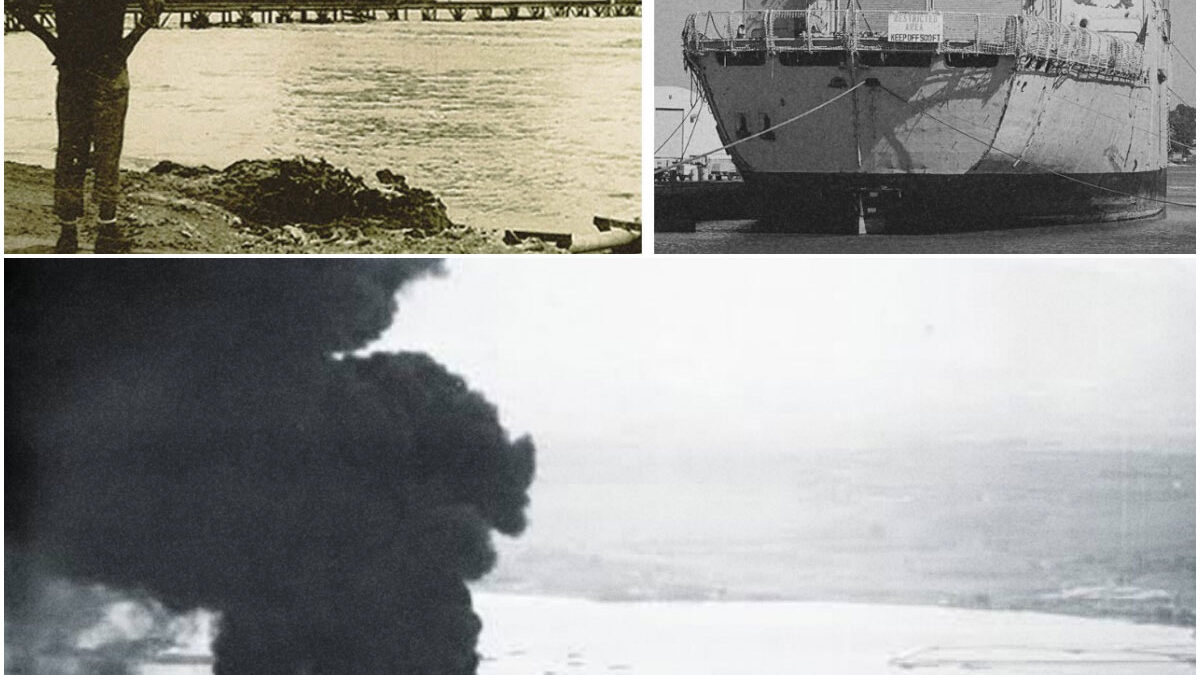
Final Seconds – The Explosion That EVAPORATED a Warship Into Dust | Disaster Documentary
November 10th, 1944.
Seeadler Harbor, Manus Island.
A calm Pacific morning shimmers with heat as hundreds of ships rest at anchor.
Then at 8:55 a.m., the world turns white.

A shockwave rips across the harbor.
Metal shreaks, masts snap, and sailors are thrown from decks into boiling water.
In the place where the USS Mount Hood once floated, there is only a rising column of fire and smoke.
No hull, no crew, no trace, just a crater in the sea where a ship used to be.
So, how could an entire vessel simply vanish?
The USS Mount Hood was born in urgency.
A product of war’s unrelenting hunger for firepower.
Lay down in the spring of 1943, she was an ammunition ship, a vessel designed not for battle, but for supply.
Her mission was to carry the lifeblood of war, explosives, to the fleets pushing across the Pacific.
To the Navy, she was a logistical marvel.
To her crew, she was a steel coffin waiting for a spark.
By the autumn of 1944, Mount Hood had crossed thousands of miles of open ocean.
She was young, barely a year old, yet already burdened with a deadly purpose.
Her holds were packed floor to ceiling with every kind of ordnance imaginable.
Shells, depth charges, aerial bombs, fuses, rockets, more than 3,800 tons of explosives filled her decks.
In calm weather, she looked ordinary enough.
Gray hull, white numbers, crew leaning on the rails.
But every man aboard knew the truth.
One mistake, one cigarette, one dropped crate, and she would vanish in a flash.
Ammunition ships were necessary, but never beloved.
They operated under quiet isolation, often anchored away from the fleet.
Sailors called them floating bombs, and with good reason.
In an era before specialized safety systems, their decks were stacked with danger.
Yet young men still volunteered, or were assigned to them, drawn by the same sense of duty that filled every branch of the service.
Many came straight from boot camp with barely a month’s experience at sea.
They scrubbed decks and loaded crates, unaware that their ship carried enough explosive power to erase a small town.
Mount Hood’s namesake, a snow-capped mountain in Oregon, stood as a symbol of endurance and calm.
The irony was not lost on her officers.
Beneath the placid name lay a vessel one spark away from annihilation.
Her commanding officer, Lieutenant Commander John Swemmerit, ran a disciplined but easy-going ship.
His men respected him.
He kept the routine steady, the mood light.
“She’s burning, but stable,” one sailor joked days earlier, watching another ship offload ammunition nearby.
It was gallows humor, common in those days.
Everyone knew what could happen.
Few truly believed it would.
In early November 1944, Mount Hood reached Seeadler Harbor, part of the Admiralty Islands in the Bismarck Sea.
The harbor was crowded with life.
Hundreds of ships, repair docks, patrol boats, floating hospitals.
For months, the Allies had used it as a forward base, a resting point before the assault on the Philippines.
Here, the Mount Hood anchored peacefully among friends.
Around her, the tropical air shimmered, filled with the clank of chains and the buzz of work details.
The war, for a moment, felt far away.
She was to spend the week resupplying smaller vessels, a routine mission that promised quiet work and early liberty.
For the 350 men aboard, it felt almost safe.
They were tired, sunburned, and ready for the next letter home.
The sea was calm.
The sky unbroken blue.
Everything was normal.
And that, in the Pacific of 1944, was often the most dangerous illusion of all.
What life was like in Seeadler Harbor.
In November 1944, Seeadler Harbor was one of the busiest naval anchorages in the Pacific.
It stretched across a turquoise bay ringed by palm-covered hills, the air thick with heat and the smell of oil.
From dawn to dusk, the water was alive with movement.
Landing craft, tugs, and motor launches weaving among great gray silhouettes at anchor.
Destroyers, repair ships, transports, and tankers all crowded together in a floating city of steel.
To a newcomer, it looked almost peaceful.
The war reduced to distant thunder on the horizon.
For the men stationed there, life had settled into a rhythm of weary efficiency.
Mechanics repaired hulls scorched from combat.
Medical ships tended to the wounded from Leyte Gulf.
In the evenings, mess decks buzzed with radio music from home.
The faint crackle of swing bands carried through the humid air.
Sailors lounged on decks, shirts off, talking about liberty or the next shipment of mail.
The harbor had become a pocket of routine amid chaos, a place where the machinery of war caught its breath.
The Mount Hood lay near the center of this vast anchorage, a nondescript freighter among giants.
Few paid her much attention.
To nearby crews, she was just the ammo ship.
Most kept their distance, a precaution drilled into every sailor.
You didn’t tie up close to a vessel carrying thousands of tons of explosives.
But curiosity and convenience sometimes outweighed caution.
Launches from other ships came alongside for supplies or to drop off ordnance for storage.
Men came aboard briefly to help with loading.
Some lingered too long, chatting with friends or watching the careful ballet of crates and pulleys.
They could never have known those small visits would seal their fate.
Conditions aboard were hot and cramped.
The crew worked in thin khakis and sweat-stained undershirts, moving shells and depth charges in steady rhythm.
The air inside the holds was thick with cordite and fuel fumes.
Every man had been warned.
No smoking, no sparks, no shortcuts.
But human nature erodes even the strictest orders.
After weeks of monotony, safety could blur into background noise.
The Mount Hood’s decks gleamed with oil and sunlight.
The danger beneath them became something distant, theoretical.
Nearby ships had their own routines.
The destroyer Mindanao anchored just 350 yards away.
Its crew engaged in maintenance and minor repairs.
To them, the Mount Hood was just part of the scenery.
They would watch her cranes swing slowly in the heat, or see ammunition barges tied up to her side.
Some men joked about what might happen if she ever went up.
Laughter, then a shrug.
It was easier not to imagine.
At night, the harbor glowed with scattered lights.
Reflections shimmered across calm water, broken by the distant thrum of generators.
Even the mosquitoes seemed to move slower in the heat.
Letters home described Manus Island as quiet, safe, a paradise after combat zones.
For many aboard the Mount Hood, this harbor was supposed to be a respite, a brief sun-drenched pause before returning to war.
They didn’t know that their war would find them here.
Friday, November the 10th, 1944 began as a routine morning.
The day began like any other in Seeadler Harbor.
Thick heat, glassy water, the low hum of engines carrying across the bay.
The Mount Hood’s crew rose early as they always did.
Reveille sounded at 0600.
Men filed into the galley for powdered eggs and coffee, then to their stations.
Some wrote letters home describing calm seas and blue skies.
Others scrubbed decks or checked loading gear.
The ship had been anchored for 6 days.
Routine had taken over, and routine was comfort.
By mid-morning, the work details were in full swing.
Ammunition barges lay tied alongside the Mount Hood’s starboard side.
Sailors moved bombs and shells from the ship’s holds, securing them for transfer to smaller vessels.
Cranes creaked, ropes tightened, and the smell of diesel drifted through the air.
It was meticulous, physical work, repetitive but essential.
To those watching from nearby ships, it looked like any other day in port.
The heat was oppressive.
Men wiped sweat from their eyes, shirts clinging to their backs.
Somewhere below deck, a cargo crew worked deep in hold two, where rows of 500-lb bombs sat stacked like silent steel barrels of doom.
They worked carefully, but even careful work can’t remove every risk.
Fuses and detonators lay in separate storage.
But the proximity of so much power left little margin for error.
It was like moving a mountain of lightning and hoping no one slipped.
At 8:30 a.m., the Mount Hood’s commanding officer, Lieutenant Commander Merrett, went ashore for a conference with the harbor command.
He left orders for the crew to continue unloading operations.
The decks buzzed with motion, but there was no tension, no sense of danger.
A launch from the repair ship Mindanao approached to pick up supplies.
On deck, a few men leaned against the rails, chatting idly as they watched the small boat draw closer.
A tropical breeze stirred through the harbor, the kind that made the surface of the water shimmer like glass.
From the nearby ships, the Mount Hood looked calm, steady.
Her cranes moved with mechanical precision.
The clang of metal on metal echoed faintly.
To sailors aboard the Mindanao, it was just another morning.
One man later remembered, “There wasn’t anything unusual.”
Then the whole world turned white.
At precisely 8:55 a.m., something happened deep inside the Mount Hood’s forward holds.
Perhaps a dropped bomb, a spark, or a defective fuse.
There was no time to react.
No alarm, no shouts, no warning.
Just one flash, blinding, soundless for an instant, followed by a roar that tore the sky apart.
In that moment, more than 350 men ceased to exiSt. The Mount Hood’s entire midsection detonated with the force of nearly 4,000 tons of TNT, vaporizing the ship, the barges alongside her, and everyone within reach.
One heartbeat, there was work and laughter.
The next, there was nothing.
The flash that erased a ship, the explosion tore through the Sea Otter Harbor with the fury of a small volcano.
Witnesses aboard ships miles away described a sudden flash of pure white, brighter than the sun, followed by a rising wall of flame.
The Mount Hood was gone before anyone could understand what had happened.
Where her 459-ft hull had floated moments before, a pillar of smoke and molten debris now clawed at the sky.
The initial blast was estimated at the equivalent of nearly 4,000 tons of TNT.
It punched a crater 300-ft long and 50-ft deep into the seafloor.
The air shock alone shattered windows 10 miles away.
A column of fire and smoke rose nearly 7,000 ft towering over the harbor like a thunderhead.
For a moment, even the tropical wind stopped as if the island itself recoiled.
Nearby ships took the full brunt of the shock wave.
The repair ship Mindanao, just 350 yd away, was ripped open by flying steel.
Its decks buckled, guns torn from mounts, bulkheads collapsed.
92 men aboard were killed instantly and more than 100 wounded.
Farther out, smaller craft were lifted from the water as if by a giant hand, flipped, and dropped in burning fragments.
One officer aboard a destroyer 3 miles distant wrote, “It felt like the sky fell on us.”
The heat hit seconds later, like standing too close to a furnace door.
Debris rained across the harbor for minutes afterward.
Shards of steel weighing hundreds of pounds embedded themselves in surrounding ships.
Hot fragments pierced hulls, tore through rigging, and hissed into the sea.
A 5-in shell casing landed more than 2 miles away.
Sailors stood in stunned silence watching black smoke curl upward where a ship had been.
The concussion still echoed in their chests.
The only sound afterward was the crackle of fires and the distant clang of alarMs. On the water’s surface, there was almost nothing left to see.
The Mount Hood had not sunk.
She had ceased to exiSt. No bow, no stern, not even wreckage large enough to identify.
The sea boiled with oil, ash, and splintered timbers.
Small fires burned on the water fed by floating debris.
Pieces of clothing drifted paSt. Men in nearby boats scanned the chaos, shouting for survivors, but there were none.
One survivor would later describe the scene as like the end of the world.
The air was thick with the smell of cordite and burned fuel.
The tropical blue of the harbor turned gray and black.
Waves rolled outward from the blast, slapping at distant hulls as if the ocean itself was shuddering.
It was over in seconds, yet the shock would ripple through the fleet for months.
At 8:55 a.m., the USS Mount Hood had vanished, erased so completely that only the crater beneath the harbor marked her passing.
For those who witnessed it, that moment would divide time itself into two parts, before the flash and after.
When the smoke cleared, the harbor was full of the dead.
For several long minutes after the blast, no one moved.
The air itself seemed stunned.
Smoke rolled across the harbor like storm clouds blotting out the sun.
Then came the sound of groaning steel, splashing debris, faint cries from nearby ships.
Men emerged from below decks to find chaos spreading in every direction.
Fires burned across the water.
Pieces of ship plating, still glowing red hot, rained down into the sea.
In every direction, the harbor was filled with fragments of metal, of wood, of men.
The ships nearest to Mount Hood were the worst hit.
The repair ship Mindanao lay a mangled ruin.
Its decks gutted and superstructure twisted into black silhouettes.
Her surviving crew scrambled to contain fires and tend to the wounded, their faces pale and stunned.
The destroyer escort Weaver had its forward guns blown apart.
The Argon, a communication ship half a mile away, was peppered with steel shards, its signal masts shredded like paper.
Across the anchorage, men stared at the rising smoke column, a towering gray funnel reaching far above the clouds, and realized that the Mount Hood was gone.
Within minutes, small boats began converging on the site of the explosion.
Medical launches, patrol boats, even lifeboats from neighboring ships cut through the oily water, but there was nothing to rescue.
The sea was littered with shreds of uniforms, splintered wood, and empty life jackets.
Oil slicks burned on the surface, sending up pillars of black smoke that stung the eyes.
The rescuers pulled aboard whatever they could, twisted metal, floating debris, the occasional unrecognizable fragment of human remains.
The Mount Hood’s entire crew, more than 350 men, had been obliterated.
From the shore, officers of the harbor command stared in disbelief.
The explosion had been so violent that even the coral beneath the ship had been pulverized.
Divers sent down later would report a massive crater gouged into the seabed, strewn with fragments no larger than a man’s hand.
It was as though the ship had evaporated.
One report later described her as having ceased to exist as a recognizable entity.
On the Mindanao, survivors fought to stay alive amid fire and smoke.
The decks were slick with fuel and blood.
Men crawled from the wreckage dazed, ears ringing from the concussion.
Some tried to help their shipmates.
Others simply stared at the space where the ammunition ship had been, now a boiling void of flame and wreckage.
A petty officer later recalled, “There wasn’t a piece of her left bigger than a mattress.”
By noon, the smoke began to thin.
The harbor was eerily quiet.
Ships sat at anchor, listing slightly from the force of the blast, their crews staring into the distance.
The tropical air carried the faint crackle of burning oil and the acrid tang of explosives.
The once bustling harbor, a hub of energy and confidence, had become a grave.
In the span of one heartbeat, Sea Otter Harbor had transformed from a haven of safety into a floating cemetery.
The rescuers searched the waves, but there were no survivors.
In the minutes that followed the explosion, the harbor filled with the sound of engines, shouting, and the slap of oars cutting through oil-streaked water.
Rescue parties were everywhere.
Launches from nearby ships, medics in small boats, even cooks and mechanics thrown suddenly into chaos.
They steered toward the epicenter of the blast, expecting to find survivors clinging to debris, but as they approached the cratered void where the Mount Hood had been, they realized there were none to be found.
The water was thick with debris and the smell of burning fuel.
It shimmered in the sunlight like black glass, broken by drifting fragments.
A shoe, a torn life jacket, a twisted piece of deck plate.
The heat was still unbearable.
Men covered their faces with rags as they scanned the surface.
“Not a single body,” one sailor later said, “just pieces.”
The blast had been total, instantaneous.
Everyone aboard the Mount Hood, more than 350 sailors and visiting crew, had been vaporized in the first millisecond.
Nearby ships counted their dead in dozens.
The Mindanao’s decks looked like a battlefield.
Sailors with burned skin and torn uniforms stumbled among fires, calling out names that would never be answered.
Corpsmen moved from man to man, their bandages soaked through before they could be tied.
The cries of the wounded carried across the water, echoing in the silence that followed the blaSt. On distant decks, men stood frozen.
Some still holding tools or coffee cups.
No one spoke.
The scale of the destruction defied language.
By midmorning, the entire harbor had mobilized.
Smoke still rose thousands of feet into the air, forming a column visible from miles away.
Patrol boats roped off the area, and divers prepared to descend into the murky depths.
Below, they found what little remained, shattered ammunition cases, twisted steel, fragments of human bone no larger than coins.
The crater itself was immense, its edges littered with unexploded shells that had been hurled outward by the blaSt. Each dive was a risk.
One wrong movement could trigger another explosion.
As reports filtered back to the command post, the scale of the disaster became clearer.
Every man aboard the Mount Hood was presumed dead.
Of the surrounding vessels, at least 372 men were injured, and 82 confirmed killed.
The harbor, once a symbol of logistical strength, was now paralyzed.
Every ship’s crew felt the same uneasy truth.
If it could happen to them, it could happen to anyone.
By noon, a grim calm returned to Sea Otter Harbor.
Fires still burned on the Mindanao, and oily smoke hung low over the water.
Rescue boats drifted aimlessly now, engines idling.
The search was over.
There was nothing left to find.
The sea had swallowed the Mount Hood whole, her men, her cargo, her very name, as if the ocean itself wanted to erase the memory of what had happened.
In a war defined by destruction, this was something else entirely, the complete and sudden disappearance of a ship and of every man aboard her.
The investigators came, but the truth sank with the ship.
In the days that followed the explosion, Sea Otter Harbor became a place of silence.
The smoke had cleared, but the air still carried the smell of cordite and burned oil.
Ships that had once bustled with routine now drifted in uneasy stillness.
On deck, men scrubbed soot from bulkheads that would never be clean again.
A board of investigation arrived within hours of the blaSt. Officers and ordnance specialists summoned from across the Pacific.
Their task was clear.
To explain how an entire ship could vanish without warning.
The evidence, however, had vanished with it.
There was no hole to examine, no wreckage to study, no survivors to question.
The Mount Hood’s deck logs, cargo records, and safety checklists had all been reduced to ash.
The investigators could only collect fragments, a few twisted plates, a bent crane hook, and eyewitness accounts from the surrounding ships.
Men described seeing smoke just before the explosion.
Others swore there was none.
Some said a spark came from a winch cable.
Others mentioned a muffled pop in the forward hold.
None of it fit together.
The official conclusion, when it came, was cautious.
The Navy ruled that the cause was unknown.
The most likely scenario, they said, was the accidental detonation of a fused bomb or the careless handling of high explosives.
But behind the formal language lay the truth.
No one would ever really know.
The Mount Hood had simply ceased to exist too quickly to leave evidence behind.
In the following weeks, divers continued to search the blast crater.
They recovered fragments of ordnance and small personal iteMs. A watch face, a twisted spoon, a dented piece of dog tag chain, nothing intact, nothing that could tell a story.
The seafloor was carpeted with debris, much of it still dangerous.
Hundreds of shells and bombs lay scattered across the bottom, many live and unstable.
For weeks, they detonated them in controlled blasts, sending smaller echoes through the harbor, grim reminders of the force that had destroyed the ship.
The Navy issued statements of condolence, and casualty lists were drawn up for next of kin.
But even the paperwork was uncertain.
With no remains, no witnesses, and no definitive cause, families received little more than a telegram, missing and presumed killed in action.
Some clung to the word missing as if it meant their sons might still be alive somewhere in the Pacific.
The truth was crueler.
There was nothing to bury, nothing to bring home.
For those who had seen the explosion firsthand, the questions lingered.
Could it have been prevented?
Was it a spark, a cigarette, a fuse left armed too soon?
Each man carried his own theory and his own guilt.
Survivors from the Mindanao blamed their proximity.
Ordnance officers blamed lax inspection.
But in the end, all theories dissolved into the same silence that now hung over the harbor.
The Mount Hood had taken her secrets to the bottom.
The war moved on, but the mystery endured.
Sealed beneath the waves, the explosion changed the Navy before anyone could count the dead.
The loss of the Mount Hood rippled far beyond Seeadler Harbor.
Within hours, word reached the Pacific Fleet’s high command, a coded message reporting a catastrophic ammunition detonation.
No ship name at first, just numbers, tons destroyed, men missing, ships damaged.
It sounded clinical, detached, almost routine.
But those who read it understood the gravity immediately.
The Navy had lost not just a vessel, but an entire ammunition station, the very heart of its Pacific supply chain.
Admiral Chester Nimitz ordered a full safety review of every ammunition ship in operation.
Across the Pacific, ordnance officers combed through manifests, storage procedures, and safety drills.
Smoking bans were reinforced.
Ammunition ships were pushed farther from the fleet, anchored in isolation zones away from populated harbors.
The ammo ship rule became law overnight.
No vessel within 2,000 yd.
On paper, it was policy.
In practice, it was fear, the kind that lingers in the back of a sailor’s mind long after the smoke clears.
On the decks of other ammunition ships, discipline hardened.
Men now worked with the awareness that any mistake could erase them as completely as the Mount Hood’s crew.
Safety briefings grew longer, inspection more rigid.
Officers began to speak in whispers around the holds, their voices subdued by the weight of what had happened.
No one joked about floating powder kegs anymore.
At Seeadler Harbor, cleanup and repair became an enormous task.
Damaged ships were patched, fuel slicks burned off, and divers continued to detonate unexploded ordnance.
The seafloor became a graveyard of scattered bombs and metal shards.
Each piece a reminder of the day the harbor turned to fire.
Local islanders on Manus, miles inland, reported hearing the blast like a thunderclap rolling through the jungle.
For weeks afterward, they found blackened debris washing up on their shores.
In Washington, the Navy’s Bureau of Ships quietly reviewed the incident.
Ammunition handling procedures, long considered adequate, were rewritten line by line.
More distance between work details, better ventilation in holds, mandatory cooling for powder storage.
The Navy had learned through tragedy a pattern that is old as war itself.
Among sailors, stories of the Mount Hood spread quickly.
Some spoke of seeing her vanish in a blinding light.
Others swore they saw the sea rise up like a wall and then collapse in silence.
The details shifted with each telling, but the meaning remained the same.
The explosion was a warning.
It reminded every man afloat that death did not always come from enemy fire.
Sometimes it waited quietly within their own ships.
By the end of the year, new ammunition ships were being fitted with additional safety equipment.
Bulkheads were reinforced.
Loading procedures were doubled in duration.
But the memory of Mount Hood endured not through regulations nor reports.
It lived in the unspoken glances between sailors, the careful movements, the silence before handling a fuse.
The Navy had changed.
It had no choice.
The men who vanished left families who would never know.
Why?
In the weeks that followed, letters from the Navy began arriving across America.
They came in identical envelopes printed in black ink and sealed with official precision.
Inside each was a single sheet of paper, a formal notification that a son, husband, or brother had been lost in action.
The name of the ship was listed, USS Mount Hood AE-11.
The date was November 10th, 1944.
The words were simple, cold, and final.
No explanation, no details, just loss.
For many families, that name meant nothing.
The Mount Hood had never been in the news, never part of a great battle.
It was a support vessel, one of hundreds that worked unseen behind the front lines.
Mothers and fathers had to look it up, often asking at local recruiting offices what kind of ship it was.
When they learned it was an ammunition ship, the silence deepened.
They began to imagine what lost in action might mean.
In Oregon, the ship’s namesake state, newspapers carried short columns about the explosion.
A few hundred words buried beneath headlines from Europe.
“Ammunition ship destroyed in Pacific,” one read.
“All hands loSt.” There were no photograph.
There was nothing to photograph.
No wreck, no survivors, no images of rescue.
Only the official statement, “No remains were recovered.”
For the families, grief had no anchor.
Without bodies to bury or graves to visit, the loss felt suspended, unreal.
Many of the crew were barely adults.
The average age was 22.
Some had joined the Navy just months earlier, trained as loaders, gunners, or machinist’s mates.
One had written home days before the blast promising to send souvenirs from a quiet harbor in the South Pacific.
Another had sent a Christmas card early, certain he’d be back before the New Year.
The mail arrived weeks later, long after the telegraMs. For many mothers, the handwriting on those envelopes was the last tangible trace of their sons.
Shipmates from nearby vessels later compiled lists of names, fragments of memory preserved in notebooks and after-action reports.
They recalled small details, a cook who sang during breakfast duty, a signalman who drew portraits of the crew, a young sailor from Kansas who carried a lucky coin in his boot.
Each story ended the same way, a bright flash, then nothing.
The men had vanished, leaving behind only the echoes of ordinary lives interrupted.
The Navy eventually erected a memorial at the naval base in Manus, and later at the National Memorial Cemetery of the Pacific in Honolulu.
The inscription was brief.
“In memory of those lost aboard USS Mount Hood AE-11.
Their duty done, their memory eternal.”
Yet for the families, the questions lingered.
What caused the blast?
Did anyone suffer?
Did anyone even have time to understand what was happening?
There were no answers, only faith, faith that their sons had served with honor, and that somewhere beneath the calm Pacific, the ocean itself was keeping their memory.
The sea forgot the ship, but the story refused to die.
Decades passed, and Seeadler Harbor returned to calm.
The war ended, the ships moved on, and the tropical waters slowly covered what little remained of the Mount Hood.
Coral began to grow over the crater, softening the scars on the seafloor.
Palm trees swayed once again above a harbor that looked as peaceful as the day before the explosion.
To anyone visiting Manus Island now, there is no sign of the fire that once lit up the Pacific sky.
The sea has forgotten, as seas always do.
But the story carried by the memory and paper refused to vanish.
For years, sailors who had witnessed the blast carried it with them in silence.
Some never spoke of it.
Others have it only in fragments.
A flash, a sound that felt like the air had caught fire.
One man who’d been below deck on a nearby ship recalled, “We didn’t even know what hit us.
We came up and she was gone.
Just gone.”
That word, gone, became the only fitting description.
How do you describe something that no longer exists?
In naval history, the Mount Hood occupies a strange space.
She was not sunk by enemy fire, nor lost in storm or combat.
Her destruction came from within.
A single instant of human error or mechanical chance that erased an entire ship.
The blast was recorded as one of the most powerful non-nuclear explosions of World War II.
Yet she remains largely forgotten, overshadowed by the vast scale of the conflict that surrounded her.
In a war of millions lost, a few hundred sailors aboard a supply ship could easily slip from memory.
But memory has a way of surviving where wreckage cannot.
The families of the Mount Hood’s crew kept her name alive in letters, photographs, and folded flags tucked into drawers.
Some visited the memorials years later, standing quietly before a list of names carved into stone.
Names that once filled a ship with laughter, routine, and hope.
They brought flowers, whispered prayers, and watched the wind move through palm trees that sounded like waves.
In 1990, divers returned to Seattle Harbor for the first time in decades.
They found little.
Scattered fragments half-buried in sand, rusted beyond recognition.
The sea had consumed everything.
Yet even there, beneath the layers of coral and time, the silence felt heavy.
As if the ocean itself still remembered.
The Mount Hood’s story endures not because of mystery or spectacle, but because of what it revealed.
That even far from the front lines, the cost of war was absolute.
These were men who never saw combat, who served behind the curtain of battle.
Yet they paid the same price as any who stormed a beach or flew through flak.
On that morning in 1944, a ship and her crew disappeared in a single flash of light.
The harbor healed, the war moved on, but their story remains.
A reminder that some sacrifices are so sudden, so complete, they can only be remembered in silence.








