Two Bigfoot Appear On A Girl’s Porch, What Happens Next Will Make You Cry
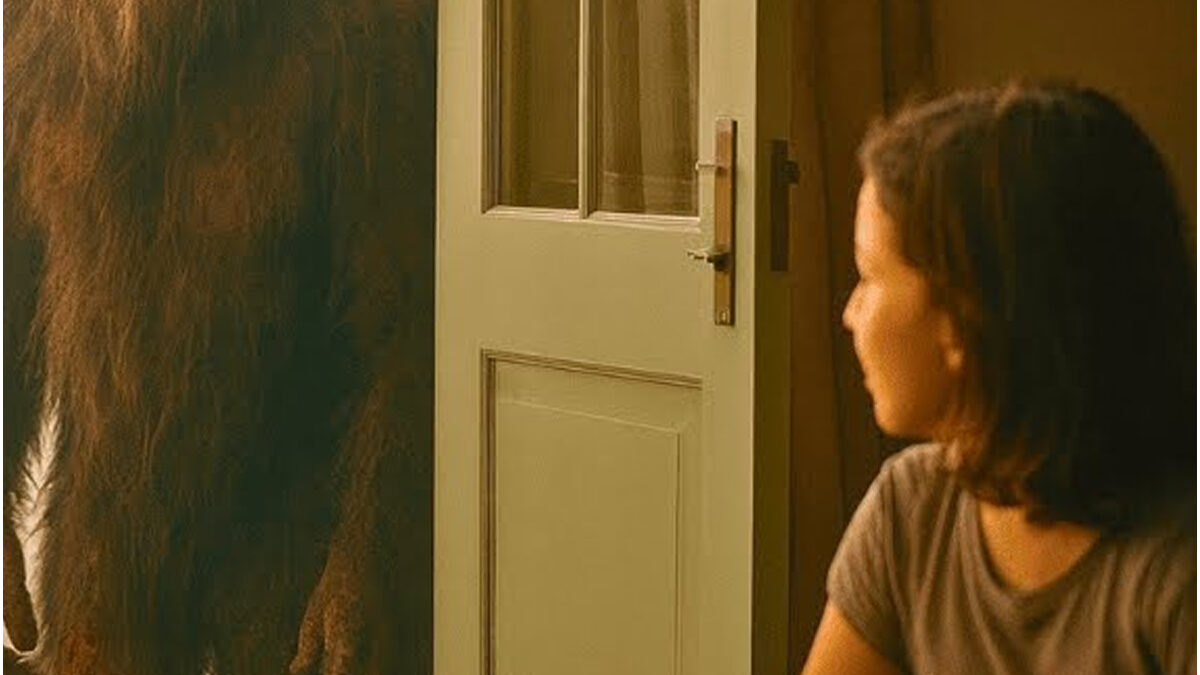
Two Bigfoot Appear On A Girl’s Porch, What Happens Next Will Make You Cry
What would you do if one freezing autumn morning, a massive female Bigfoot appeared silently on your porch and gently laid an injured young one at your feet?
No growl, no attack, just a quiet gaze, begging for help.
The truth is, Bigfoot remembers.

Bigfoot feels.
Bigfoot has family.
And she, this solemn creature, was the very one Hank Ryland had spared 15 years ago deep in the foreSt. Now she had returned to entrust her bloodline to him.
Hank, a reclusive Vietnam veteran, knows the silence of the woods better than moSt. He’s seen things no one else would believe and kept them buried.
But this time, he begins to witness something extraordinary.
A bond that defies species.
A trail of signs pointing to a hidden sanctuary and a moment so sacred.
Three generations of Bigfoot embracing at sunset.
Then comes the twiSt. A lost child’s bracelet found near a bloodless deer carcass.
And the realization that Bigfoot may have once saved humans, not hunted them.
If you skip this story, you’ll miss one of the most hauntingly beautiful tales of trust, memory, and silent loyalty ever whispered from the wild.
And you might never look at the forest the same way again.
It was the kind of cold that crept into your bones before you even noticed the wind.
October had rolled in harsh that year.
No soft rustle of leaves, no golden light slipping through the treetops.
Just gray, just quiet, just cold.
The kind of morning where even the birds stayed silent.
Hank Ryland stood in his socks at the cabin door, fingers wrapped around a chipped mug of coffee, breath fogging up the glass before him.
He hadn’t opened the door yet, just stared through it.
Something had woken him.
A sound, maybe, or maybe just a feeling.
Either way, he was up before dawn.
The air inside still holding the chill of night and something was out there.
He cracked the door open an inch.
A hiss of wind bit through.
He opened it wider slowly, instinct tightening in his gut.
Decades of training flickering to life in his joints.
Then he saw it.
A shape on the porch.
Big slumped forward.
Breathing barely covered in moss and mud like it had crawled from the forest floor itself.
At first, his brain went to bear.
That would make sense up here in Cold Water Ridge.
Bears did strange things when desperate.
But this wasn’t right.
The limbs were too long.
Shoulders rounded like a man crouching under the weight of something ancient.
And the eyes, dear God, the eyes.
When they looked at him, they held something no bear ever did.
Grief.
It didn’t move.
Just knelt there like it had placed something down at his feet and was now waiting.
Hank’s eyes dropped.
There, bundled in what looked like soaked moss, shivering so hard it made no sound, was something smaller.
A child.
No, not human.
Long limbs, fur matted and streaked with blood.
Breathing but shallow.
One leg twisted, the fur clotted in dark brown.
A baby Bigfoot.
No mistaking it.
No second-guing.
Hank’s fingers tightened around the doorframe.
It couldn’t be.
Not again.
Not after all these years.
The larger creature didn’t snarl.
Didn’t charge.
Just backed away so slowly it felt like time itself was bending around her.
And then she vanished into the fog.
Gone.
Like she’d never been there.
Except the little one was still lying there, half dead on his porch.
He didn’t hesitate, not because he wasn’t scared.
He was Every damn cell in his body was on fire with the knowledge of what he was doing.
But something else overrode the fear.
Something that had haunted him for years.
Something about silence and promises and war and regret.
He stepped out barefoot, ignoring the cold.
Wrapped the baby creature in the old Green Army blanket from his cot, the one he hadn’t washed in weeks, and carried it inside like he would have carried a wounded soldier, back into the warmth, into the firelight.
The moment the door closed behind him, Hank let out the breath he hadn’t realized he’d been holding.
The creature was light, lighter than it should have been for its size, bones too close to the surface.
It hadn’t eaten in days, maybe weeks.
Whatever chased it had done more than wound it.
It had nearly broken it.
He laid it down by the fire, careful not to touch the twisted leg, just enough to keep it warm.
The old blanket still smelled like campfire smoke and cedar.
He knelt beside it, hands hovering, then reaching for the first aid kit tucked beneath the sink.
Still had the same contents from 15 years ago.
Same thread, same iodine, same hesitation.
His fingers were clumsy with age, but steady with memory.
Stitch by stitch, inch by inch, he cleaned the blood from its fur.
Wrapped the leg as gently as he could.
Wasn’t sure if Bigfoot bones healed like ours.
Didn’t matter.
The creature never cried out.
Just lay there breathing.
Watched him with dark eyes.
Old eyes.
Not in years, but in weight.
The way people look when they’ve seen too much, too young.
Something about those eyes.
He knew them.
He’d seen them once, 16 years ago, in another place.
In another kind of silence.
The fire popped.
The wind hissed through the gaps in the old timber walls.
And out there, beyond the porch, beyond the clearing, stood something still.
He didn’t have to look to know she was there.
He could feel her.
The same presence, the same gravity, like a prayer waiting to be answered.
16 years ago, in a rain-s forest in Washington, Hank had come across something impossible.
A creature caught in a hunter’s snare.
Legs shredded, blood pooling in the moss.
It should have been a trophy.
A kill.
Instead, he sat with it for 3 days.
Never touched his rifle, just watched, waited, tried to prove to himself that not everything needed to die to be understood.
He’d named her in silence.
She who waits because that’s all she did.
Stared at him with those deep ancient eyes.
Never blinked, never growled, just waited until finally he’d cut the wire.
Let her go.
No one believed him when he came back.
They chocked it up to PTSD, hallucinations, too many nights in the bush, too much death.
He stopped telling the story after a while, let it rot in the corners of his memory like everything else.
But now she was back, and she brought him her child.
The baby stirred beside the fire, letting out a sound halfway between a breath and a sigh.
Hank leaned in.
The wound wasn’t as bad as it had looked.
Still ugly, still deep, but survivable.
He wiped his hands clean on an old rag, then stood slowly, knees cracking like dry twigs.
He stepped to the window outside beneath the towering Douglas fur at the edge of the clearing.
The shape stood still, unmoving, watching, not threatening, just waiting.
She hadn’t left.
She wouldn’t.
And Hank, against all reason, against every instinct that screamed this was insane, found himself placing his hand flat against the glass, not waving, not signaling, just acknowledging.
They’d both come full circle.
He didn’t know why.
He didn’t need to.
Some things you don’t question.
Some debts get repaid without words.
Some promises outlive the people who made them.
Behind him, the baby exhaled.
A soft low sound like it finally let go of whatever pain it had carried this far, like it had made it home.
The fog outside thickened.
The light dimmed.
But that shadow on the porch.
That wasn’t just a shadow anymore.
It was something more.
And it wasn’t leaving.
Not tonight.
Maybe not ever.
And in that strange still space between breath and silence, Hank felt less alone than he had in decades.
And outside in the mist, something waited without fear, without words, only trust and time.
The fire had burned low by the time the baby stirred again.
Coals pulsed like a dying heartbeat in the hearth, and the cabin smelled faintly of pine resin, old wool, and antiseptic.
Hank sat beside the small body, knees bent, elbows on his thighs, hands cupped like he was holding something fragile, even though they were empty now.
He hadn’t moved much in hours.
His back hurt.
His right leg had gone numb.
But he didn’t get up.
Not while that little chest kept rising and falling.
The wound on its leg was packed with clean gauze, bound by a strip of torn cotton undershirt.
Not ideal, but good enough to hold for the night.
Hank had worked on it by the flicker of fire light.
His hands steadied by old muscle memory.
40 years gone, and he still remembered how to clean a wound without blinking.
Some things don’t fade.
They just go quiet until you need them again.
He looked down at the creature lying beneath the army blanket.
Its face had softened now that the pain was managed, no longer tensed up or twitching.
The features were strange, but not alien, more like the blurry edge of something familiar.
Its fur, once caked with dirt, had dried in coarse tufts.
The pads on its hands were thick and cracked.
Under the left ear, barely visible in the shadows, was a scar, crescent-shaped, precise.
Hank’s breath caught, not from fear, from something deeper, recognition.
He leaned in, careful not to startle it.
The scar was old, fully healed, but unmistakable.
He’d seen that exact mark before.
He swallowed hard, throat thick with a memory that hadn’t stirred in years.
1973, a monsoon drenched jungle in the highlands of Vietnam.
Then later after the war, the woods of Olympic Peninsula, deep enough in that map stopped being useful.
That was where it happened.
Not in battle, not in fire, but in silence.
He’d been tracking a cougar, or thought he was.
Instead, he found something else.
Something caught in a steel jawed trap meant for predators.
The creature had thrashed at first, screamed in a voice that didn’t belong to any known animal.
But when Hank stepped into view, it stopped.
Locked eyes with him.
No flinch, no plea, just waiting.
She didn’t bleed out.
He watched her for 3 days.
Rain soaked everything.
He lit no fire, made no sound.
He just sat there, rifle across his lap, legs crossed in the ferns, watching.
On the third morning, he couldn’t take it anymore.
He cut the trap’s cable.
Her leg was a mess, but she didn’t attack.
She limped three paces, turned, looked at him one last time, and then disappeared into the miSt. He never told anyone the real story.
Told the rangers he found a bear trap with blood in it, nothing more.
He’d tried once at a VFW bar in Portland, half drunk, voice shaking.
They laughed.
Said he’d seen a dirty hippie in a ghillie suit and had a flashback.
One guy said maybe he’d caught a glimpse of Bigfoot’s girlfriend and should write a book.
Hank never spoke of it again.
But now, years later, that same scar stared back at him from the ear of a child.
The baby wasn’t hers.
It was hers.
The thought settled heavy in his cheSt. She’d survived.
She’d had a child, and she’d brought it to him.
Why?
He looked toward the window, but the fog had thickened outside.
No movement, no outline of anything waiting at the treeine.
But he felt her out there.
He knew she hadn’t gone far.
She was watching, trusting.
Hank stood, joints cracking, and shuffled to the sink, poured water into the kettle, set it on the wood stove.
Every movement slow, deliberate, not just from age, but from weight.
The kind that lives in your ribs.
The kind that doesn’t leave even when the noise stops.
He opened the small tin of instant coffee, the same brand he drunk since ‘ 68.
It tasted like burnt metal, but it kept his hands warm.
While it brewed, his eyes kept drifting back to the bundle by the fire.
The blanket had slipped, revealing more of the creature’s face.
Its mouth was open slightly, small, square teeth, not all that different from his grandsons, back before the divorce took him to New Mexico.
He hadn’t seen the boy in 7 years.
He pulled a chair over, sat down again.
The silence inside the cabin was thick as snow.
Outside, the wind had died completely.
The air pressed down.
He took a sip of coffee and let the warmth spread through his cheSt. I remember you,” he muttered to the creature, even though he didn’t expect it to understand.
“I never forgot.”
The creature shifted under the blanket, but didn’t wake.
A small sigh escaped its chest, followed by a barely audible clicking sound, like a tiny breath language he couldn’t quite parse.
Something comforting, maybe instinct, maybe communication, maybe both.
His eyes burned suddenly and without warning.
He stood, needing to move.
His boots were still by the door.
He slipped them on, grabbed his coat, and stepped onto the porch.
The cold hit his skin like it meant something.
Sharp, real across the clearing under the massive limbs of the Douglas fur.
She stood exactly where she’d been before.
She hadn’t moved an inch.
Hank walked down the steps slowly, coat flapping at his sides.
He didn’t approach, didn’t speak, just stood halfway between her and the cabin, letting her see him, letting her know he understood.
She didn’t flinch, just watched.
Then, ever so slightly, she crouched, hands brushing the ground.
A posture of humility or mourning, or maybe something older than both.
She looked at the porch, at the door, then back to him, and she stepped backward, one pace, then two, disappearing into the fog, like a breath being held.
Hank stood there for a long time.
When he turned back inside, the baby was awake.
Its eyes were open, watching him from the floor.
No panic, no cry, just presence, like it already knew it wasn’t in danger, like it already recognized him.
The fire crackled.
The coffee steamed.
And as Hank knelt beside it, adjusting the blanket, checking the bandages, he saw something new in those dark eyes.
Not pain, not confusion, but memory.
Like maybe it remembered him, too.
Or at least remembered what trust looked like.
And outside, somewhere in the silence, a figure waited.
Not as a threat, not as a ghost, but as something far more rare, a promise kept.
And that silence so heavy, so dense.
It wasn’t just quiet anymore.
It was something sacred, something held.
And the waiting was far from over.
The fog never really lifted.
It just curled tighter around the treetops, thickening into a kind of stillness that made sound feel dishoneSt. Even the birds seemed to hold their breath.
Three days passed like that, without sun, without wind, without change.
And outside Hank’s cabin, beneath the leaning limbs of that old Douglas fur, she stood unmoving, unshaken, a silhouette cut from silence.
Hank hadn’t seen her eat, hadn’t seen her drink.
He left food on a flat stone at the edge of the clearing, cold meat, apples, even a slice of cornbread wrapped in wax paper, but it remained untouched.
Only the small tin cup of water would sometimes be found empty, but even then he couldn’t be sure if it was the fog soaking in or something more.
She never came closer, never approached the porch.
But every morning before the light had a chance to spread itself thin across the gravel path.
Hank would see her.
Same spot, same posture, shoulders low, arms hanging, watching.
The baby, meanwhile, was healing.
Slowly.
It slept often, curled into the wool blanket like it had always known the smell of ash and cedar.
It wasn’t afraid of him, not the way wild things usually are.
It watched him with calm eyes, blinked when he blinked, breathed when he breathed.
There was something old in that gaze, something that didn’t belong to a creature who should have barely survived.
Hank began to talk to it, not because he expected a response, but because silence started getting under his skin.
He talked about the mountain, about the weather, about a time when he used to laugh easier.
He didn’t tell it about the war, not directly, but his voice would catch sometimes.
He’d pause in the middle of lighting the fire or setting the pot to boil, and his eyes would drift toward the treeine where she still waited.
She never made a sound.
But late at night, when Hank lay half asleep on the old cot, the room lit by nothing but embers and moonlight, he heard something through the wall.
Not a cry, not a call, something lower, deeper, like a hum pressed into the soil, a rhythm, a song with no melody, almost like someone was whispering to the trees in a language the wind understood.
It was only when he stepped outside one night after the fire had died and the baby was asleep that he caught her doing it.
She wasn’t standing anymore.
She was crouched low, forehead touching the earth, arms stretched forward in front of her, fingers spled wide, not praying, not begging, just being as if the act of touching the ground connected her to something beneath it.
Hank didn’t move.
He didn’t want to disturb whatever that was.
She stayed that way for nearly 10 minutes before rising again, slow and deliberate, and returning to her post under the tree.
He stepped back inside, shut the door gently.
The air in the cabin felt thinner after that.
On the third night, something changed.
Not outside, inside.
The baby stirred more often, moving its limbs with greater purpose, rolling toward the fire, tugging at the edge of the blanket with surprising dexterity.
When Hank checked the bandage, the wound was already forming new skin.
A thick puckered scar was sealing the worst of it.
He cleaned it again, not because it needed it, but because the act steadied his hands.
That same night, while washing the bloodied cloth in a pale outside, he noticed something different in the dirt.
Tracks, not hers, not the babies.
Others, three, maybe four sets, all smaller than hers, but larger than the babies, one with a distinct limp.
Another seemed to pace in half circles like it wasn’t comfortable standing still.
The third had toes that spled unnaturally wide.
Hank crouched, brushing away leaves, tracing the impressions with his finger.
They’d been here during the night, close, closer than she’d ever come.
He turned toward the forest, heart thutting against his ribs.
The fog wasn’t as thick now.
He could see farther, but no shapes moved.
No eyes gleamed.
Still, they were out there.
He didn’t sleep that night.
Sat in the rocker with the 3030 across his lap.
Not because he planned to use it, but because it felt like an anchor, something to hold on to in the face of the unknown.
The baby slept soundly, twitching once or twice in its dreaMs. By morning, the tracks were gone, swept clean, no wind, no rain, but they were gone just the same.
He stepped out, coffee in hand, the steam curling like the fog used to.
And she was there, right where she’d always been, except now her head was tilted slightly, watching him more intently, waiting.
He felt the weight of it all then.
The pattern, the timing, the quiet coordination that didn’t feel random anymore.
This wasn’t an isolated act.
This was a ritual, a passing, a placement.
And he was part of it.
Not by accident, not by pity, by choice.
Hers.
She was trusting him with something more than blood.
With legacy, he stood there for a long time.
Coffee forgotten in his hand.
The heat fading just like his doubt.
And in the stillness between them, two silhouettes separated by space and years and memory.
Something unspoken passed.
An understanding.
He went back inside, checked on the child.
It opened its eyes, blinked once, and reached toward him.
Not with fear, not with confusion, but with certainty.
And far beyond the clearing, just out of sight, another presence shifted.
Soft footsteps.
A breath held too long.
More watchers.
More witnesses.
They didn’t come closer.
Not yet.
But he could feel the ring closing.
Not as a trap, but as a circle.
And in that circle, he stood old, alone, and somehow no longer either.
The waiting, it seemed, was no longer hers alone.
It was his, too.
And whatever came next, he would face it with eyes wide open.
The candles flickered like they were holding their breath.
Shadows trembling across the faded maps and dogeared notebooks spread across the worn table between them.
The walls of the rectory were lined with old himnels, sunbleleached photographs, and a faint scent of cedar and dust that seemed permanent.
Father Whitaker hadn’t changed much in the 20 years since Hank last saw him.
Still tall and thin, still wore those cracked wireframe glasses, still spoke like every word carried weight, even if most folks stopped listening a long time ago.
The priest poured two mugs of black coffee without asking, and Hank didn’t bother thanking him.
They’d known each other too long for pleasantries.
The room was lit only by lamp light and fire, and outside, the wind moaned against the stone chimney like it remembered something it shouldn’t have.
Hank reached into his coat pocket and slid the weathered leatherbound notebook across the table.
The priest stared at it for a moment before opening it gently, fingers tracing the ink smudged entries with something between reverence and pain.
“These are yours?”
The priest asked without looking up.
“They’re hers.”
Father Whitaker paused.
He knew who Hank meant without explanation.
His daughter Laya had vanished in these woods almost two decades ago.
No remains, no evidence.
Just a coat found snagged in a bramble bush near Hollow Creek and a spiral journal filled with drawings too strange to understand.
“She wrote things down,” Hank said, voice low.
“Things most folks would have laughed off, but you didn’t.”
The priest exhaled slow and steady, the way a man does when memory starts rising too fast in his throat.
He opened the journal, turned a few pages, then stopped.
His fingers hovered over a sketch, rough, smudged, but unmistakable.
A tall creature hunched over a snare, head bowed, hands curled into fists at its sides.
Tears had been drawn into the dirt at its feet.
She saw her.
The priest whispered.
I think she did, Hank said.
Same one I saw back then.
Same one who brought me that child.
The priest closed the journal slowly, resting both hands on top of it.
He looked older now, years heavier than the moment before.
The loss of a child never aged out.
It just deepened.
Laya used to walk the woods with me.
Sketch, take notes.
She believed there were lines we couldn’t see, natural ones, not just rivers or ridges.
Something deeper.
Boundaries.
Hank reached into his other pocket and pulled out a folded map creased from years of use.
Ink faded but still legible.
He flattened it on the table.
There were markings, red X’s, small pencil notes, and faded circles.
Some were decades old, others more recent.
They stared at it in silence.
I started marking the footprints years ago.
Hank said, “Every time I found one, every time I felt watched, figured it was just superstition, something left over from war nerves.”
The priest added a page from Laya’s journal, laying it gently beside the map.
Her marks lined up with Hanks.
Not perfectly, but close enough to chill the room another few degrees.
Together they formed a loose ring, a boundary that wrapped around Cold Water Ridge.
Not random, not coincidence, a perimeter.
And at the center of that ring, dead center, was Hank’s cabin.
Father Whitaker stared at the map like he was seeing it for the first time, even though he’d been walking those woods his whole life.
His mouth moved, but no words came at firSt. When they did, they sounded more like prayer than theory.
Maybe she wasn’t just drawing lines, he said.
Maybe she was documenting a territory.
Hank nodded.
I think they’ve been circling for years, not hunting, not running, just watching, guarding something.
The priest leaned back, fingers steepled against his chin.
And now they’ve stepped inside.
“They left that child on my porch,” Hank said.
“Not just out of desperation.
It was placement, a choice.
And they knew you’d care for it,” the priest murmured.
They knew who you were.
There was a silence that followed, thick and long, pressing against the walls like the air itself was listening.
“You ever think,” the priest said finally.
“Maybe all this time it was about truSt.” Hank didn’t answer right away.
His eyes were fixed on the map, on the points that converged and curved like veins beneath the skin of the land.
He thought of the songs in the night, the figures just out of view, the way the baby had reached for him like it already knew his scent, his rhythm, his heart.
“It’s not about proving anything anymore,” he said.
“It’s not about being believed.
It’s about not breaking what’s been given.”
The priest rose, walked slowly to a cabinet tucked into the corner of the room.
He unlocked it with a small brass key and returned with another notebook, thicker, older.
He placed it beside Hanks and opened it to the center.
More maps, handdrawn, more circles.
One entry, dated July 2nd, 1971, caught Hank’s eye.
Laya’s last field day.
The priest said she left that morning after breakfaSt. Said she had a dream about a creature kneeling in the trees.
Said it wasn’t scary.
Said it was sad.
Hank looked closer.
The entry noted a single word beside the sketch.
Waits.
The candles burned lower.
The clock on the mantle ticked like distant thunder.
Hank folded his map slowly, his fingers trembling now.
Not from fear, from clarity.
Whatever they are, he said, voice quiet.
They remember.
The priest nodded, his gaze far away now.
And maybe that’s the only miracle left worth holding on to.
When Hank stepped out into the cold night air, the fog had thinned and stars were beginning to flicker through the black.
He looked toward the ridge, toward home, toward whatever waited still among the trees, and far off, almost too faint to trust, came the sound of something low and steady.
Not a growl, not a cry, a home, a voice in the dark, not speaking, remembering.
It was almost midnight when the baby stirred.
Not with a jolt or a cry, but with a stillness so complete it made Hank sit up straight in his chair.
The fire had burned down low, barely more than a pulse of orange beneath the logs, casting just enough light to see the rise and fall of that small furred cheSt. Then the little one moved slow, careful, like it wasn’t waking up for the first time, but returning to something it had always known.
Hank didn’t say a word.
He watched as the creature sat up, swaying a little from the effort, blinking into the flickering half light.
Its shoulders rose and fell with steady breath.
One hand lifted, touched the edge of the army blanket, then dropped.
Then its eyes found him, not startled, not confused, just present, like it had always known he’d be sitting right there.
The moment didn’t feel like waking up.
It felt like remembering.
Hank slowly stood, boots scuffing the wooden floor, careful not to move too faSt. He knelt beside the cot, looked into those dark almond-shaped eyes.
The scar near the ear looked clean now, less red, more healed.
The bandage was still firm, but the way the creature held itself upright.
There was strength returning.
He didn’t reach out.
Didn’t need to.
There was no panic in that gaze, no fear, only one quiet question.
Now what?
He pulled on his coat, then reached down and lifted the little one into his arMs. The body was warm, heavier than it looked, muscles coiled tight under fur that smelled faintly of smoke and pine.
It didn’t resist, didn’t squirm, just curled against his chest like it had done this before, like the rhythm of his breath matched something he had understood.
He opened the cabin door.
Outside, the night was black velvet, moonless, thick with cold and a kind of ancient hush.
No wind, no sound, just the weight of something waiting beyond the treeine.
She was there.
She’d been there the whole time.
He could feel her before he saw her.
A tall shadowed figure beneath the Douglas fur, still silent, rooted to the earth like she belonged to it.
He stepped out onto the porch, felt the boards creek beneath his boots.
The baby stirred, eyes locked on the foreSt. A low sound hummed in its chest, something between a sigh and a tone.
Hank descended the stairs, crossed the clearing, boots crunching softly through frostbitten grass.
Halfway to the treeine, he stopped.
She stepped forward, and from behind her, another figure emerged.
This one was different, smaller than her, more upright, sleeker build.
Its fur reflected the starlight, brighter, cleaner, almost golden in spots.
A mother, but not the mother who’d waited in silence.
This one moved with sharpness, not somnity.
There was purpose in every step.
And when the child in Hank’s arm saw her, it didn’t hesitate.
It leapt, arms out, a low, soft sound bursting from its throat.
The mother caught it with both hands.
The movement was seamless.
No panic, no stumble, just instinct.
They clung to each other like breath and body.
Faces pressed close, hands tracing lines down backs and arms, fingers threading through fur like a language of touch.
No noise, no ceremony, just the kind of reunion that didn’t require translation.
Hank stood still.
He didn’t blink, didn’t move.
The older figure stepped forward slowly.
She didn’t touch the mother, didn’t touch the child, just stood behind them, her chest rising, arms hanging loose by her sides like a witness, like a bridge between what had been and what had just come home.
Then she turned to Hank, took one step toward him.
He didn’t back away.
She reached out, not fast, not threatening, and placed her palm against her own chest, right over the heart, held it there, then moved forward one more step, stopped, placed that same hand gently, slowly against Hank’s chest, right over his heart.
Her hand was massive, calloused, warm.
She held it there for a moment, not long, just enough.
Then she lowered it and bowed her head.
The gesture didn’t feel symbolic.
It felt earned.
He didn’t know what to do.
Didn’t know what to say, so he didn’t move.
Didn’t speak because he understood.
This wasn’t thanks.
This was something deeper.
Recognition and maybe something close to forgiveness.
Behind her, the mother turned.
Child now wrapped tightly in one arm.
Their faces unreadable.
But they didn’t run, didn’t vanish.
They stood together.
Three generations, three silhouettes in the cold night beneath the furs.
And Hank, standing on the edge of the only clearing he’d ever called home, saw something he hadn’t seen since he returned from the jungle with blood on his boots and ghosts in his head.
A family, and he wasn’t afraid.
He stepped back just one pace.
Let them have the space, the ground, the silence.
They lingered a while longer, shapes barely visible in the starlight.
Then without a sound, they turned and faded into the woods.
Not into shadows, into memory.
He didn’t go inside right away.
He stayed out there for a long time.
Just stood there staring into the trees where they disappeared.
The air still held the warmth of her hand against his cheSt. That moment wouldn’t leave.
Not ever.
And long after they were gone, he realized something strange.
He hadn’t just been part of their story.
They’d been part of his.
He’d thought he was the one watching, but maybe all this time he’d been the one who was seen.
Night in Whisper Hollow was never fully silent anymore.
The mountains carried whispers like old wounds, passing them from ridge to ridge, and Hank could feel it settling under his skin.
It had been only a few days since that night, when three generations of something far older than men had stood beneath the furs and left without a word.
He thought the quiet afterward would feel like peace.
Instead, it felt like pressure, like the forest was holding its breath.
Then the rumors started.
Someone at the general store mentioned giant tracks down near the creek.
A rancher swore he’d heard something howl across the canyon.
Not coyote, not bear.
By the end of the week, a group of young men from town had their rifles out and their egos running hotter than their brains.
Hank heard them while he was filling up his old Ford at the gas station.
Their voices carrying loud and careless, talking about Quarry, about taking down the beaSt. They laughed like it was a hunting trip, like the world didn’t hold things beyond their understanding.
He said nothing at firSt. He just stood there, the pump clicking slow, jaw tight, eyes fixed on the cracked pavement.
But when one of them, big kid with a red ball cap, started boasting about putting its head on display, Hank couldn’t hold it in.
He stepped up, told them they were chasing shadows they didn’t understand, told them the woods weren’t theirs to conquer.
They laughed in his face, called him a crazy old vet, said, “Maybe the war scrambled his head.”
“Better sit this one out, Grandpa.”
The red cap sneered.
We’re the ones protecting this town.
The words stuck like a thorn in Hank’s cheSt. Protecting.
They didn’t even know what they were walking into.
They weren’t hunters.
They were fools swinging matches in a forest of dry leaves.
That night, Hank couldn’t sit still.
He watched from his porch as the moon climbed, a pale scar across the sky.
Somewhere beyond the treeine, he felt movement, not hostile, but alert, like eyes following the air currents.
He thought of the mother, the grandmother, and the small one now safe in their arMs. He thought of how easily a trigger-happy kid could end it all, so he followed.
The group had left campfires scattered along the ridge, smoke curling against the black sky like signal flares.
They shouted, shot into the dark just to hear the echo.
It made Hank sick.
He moved through the brush behind them, his steps quiet, his breath shallow.
He wasn’t as fast as he used to be, but the woods still remembered him.
He used the shadows, the dips in the land.
He stayed out of sight.
One of the boys, a skinny one with a nervous laugh, kept glancing over his shoulder like maybe he felt the weight of something bigger than himself.
But the others kept moving, hammering through the night, snapping branches, leaving the stink of fear and arrogance behind.
Then sometime past midnight, they found blood.
It wasn’t fresh.
A deer neck twisted clean.
No claw marks, no bite, just broken, and laid out deliberately at the edge of their path.
They whooped like it was proof of the monster they came to kill.
Hank saw it for what it was, a message, a warning, maybe even a plea.
They didn’t understand.
He wanted to yell to drag them back to town before it was too late.
But he knew that would only push them further.
So he trailed them, heart pounding harder with each step they took deeper into the trees.
Hours passed.
The fire light from their torches bounced wild against trunks and shadows.
They were close to his cabin now, though they didn’t know it.
Close to where the baby had been, close to where they shouldn’t be.
That’s when Hank heard it.
A sound that froze the marrow in his bones.
A knock, not from a gun, not from a branch.
Three slow knocks, heavy and deliberate, on the hollow trunk of a fallen tree.
The men stopped, looked at each other.
One raised his rifle.
The knock came again, this time from behind them.
Panic rippled like a crack in ice.
The red cap turned, aimed into the dark, but fired before thinking.
The shot split the night, sent a crow storming out of the canopy.
The sound rolled through the woods like thunder.
For a long moment, nothing else moved.
Then everything did.
Shapes in the shadows, tall, silent, watching.
One of them growled low, a sound that vibrated through the soil like a living engine.
The men faltered.
Even the red cap’s bravado drained from his face.
Hank stepped out then.
He had no weapon in his hands, just his voice.
Enough, he barked, the words slicing through the panic like a blade.
You don’t belong here, the young man turned, startled.
Old man, what the hell?
One started, but stopped when another shadow shifted just beyond the torch light.
Two glowing eyes hovered there, steady as coals, watching, judging.
You need to leave, Hank said low and firm.
Now the red cap tried to speak, but whatever he saw in Hank’s face or in the eyes beyond made him falter.
One by one, they lowered their rifles.
No one fired again.
The forest didn’t move.
It just waited.
Hank led them back down the trail, his steps slow but certain, like he knew these woods better than they knew themselves.
When they reached the gravel road, the boys scattered, muttering excuses, blaming the dark, blaming their nerves.
They didn’t thank him.
They didn’t need to.
They were just glad to leave.
Hank stayed.
He walked back alone, back to the clearing, back to the porch where the night seemed to breathe differently.
That’s when he saw it.
Just off the trail, near the edge of the cabin’s yard, a bracelet half buried in dirt, tarnished, but still readable.
A name scratched into the metal.
A child’s name, the same one he’d heard whispered years ago when the story of a boy gone missing was passed around town, dismissed as another tragedy swallowed by the woods.
Hank knelt, picked it up, and felt his chest tighten.
He turned it over in his palm, eyes scanning the trees.
What had they been protecting all this time?
The thought came slow but heavy, like an avalanche starting with one stone.
Maybe the real danger had never been out there in the dark.
Maybe it had always been the people who came looking for it with guns.
He didn’t sleep that night.
He sat on the porch with the bracelet in his hand, the forest breathing slow around him, and felt something watching him again.
Not with fear, not with hate, with warning, and maybe a little hope that he’d finally understand.
The storm came in hard, riding the back of a cold front that swept down off the cascades like a warning.
Wind pushed through the trees like it meant to rip something loose.
Rain slashing sideways against the cabin windows, hammering the tin roof in wild rhythMs. Hank hadn’t seen a sky like that since the war.
The clouds didn’t just roll.
They crouched low and heavy like they were holding back more than water.
He stayed inside, listening to it.
Fire light dancing across the logs, coffee going cold in his hand.
The woods had gone quiet again, but not like before.
This was a different silence.
The kind that felt like watching, waiting, remembering.
When the storm broke the next morning, the world outside had that washed clean look like someone had wiped the glass of the earth.
Everything gleamed, even the mud.
Trees still dripped.
Mist clung to the hollows.
And under the dappled morning light, Hank stepped onto his porch and saw something that stopped him in his tracks.
Tracks, two sets, not scattered, not confused, but side by side, one large, one smaller.
They started near the edge of the woods and ended just a few feet from his steps, as if whoever or whatever left them had stood there for a long time, looking.
He didn’t see anyone in the trees.
Not right away, but he didn’t need to.
He felt it.
That old gravity again, that weight in the air, not fear, something older.
He crouched beside the prince.
The large ones matched the pattern he knew by now.
The grandmother, the matriarch, deep impressions, broad toes, spled weight.
But the second set, lighter, narrower, the stride still wide, but not yet fully grown.
The child, they’d come back.
Not in crisis, not in desperation, just returned.
Hank stood, hands on his knees, and let that thought settle into his bones.
Then he saw it off to the side of the porch, near the base of the birch tree, a stone, round, smooth, placed deliberately on the flattened pine needles.
And resting at top that stone, almost impossibly still despite the night storm, was a small brass windchime, bent, dented, but unmistakable.
He stared at it for a long time.
It was his.
He hadn’t seen that chime in decades.
Thought he’d lost it when he was 14, out near Cold Hollow Lake with his uncle’s fishing party, lost in the brush.
He remembered the sound it made.
High, clear, one note that always felt like it didn’t belong in the woods.
He had never found it until now.
There was no way they could have known it mattered.
No way they could have known it was his, but they had.
He reached down, fingers brushing the cool brass, heart thudding, a gift, not a tool, not a threat.
Something carried through the storm just to be laid gently at his feet.
That night after the sky went dark again and the fire popped and hissed low behind him, he heard it.
Three knocks, not on the door, on the trunk of the sugar pine across the yard, soft, rhythmic, like an echo from deep in memory.
Then silence, then again, three more, hollow, ancient, familiar.
Hank sat forward in his chair, his fingers curled around the edge of the table, that rhythm.
Three knocks.
That had been his signal during recon in Nam.
Used it when pinned down, when radios failed.
Tapped three times on a rock or a branch to let someone know, “I’m here.
I’m alive.
I see you.”
No one outside his old unit would have known that.
No one but ghosts.
And something in that moment chilled his lungs and warmed his chest all at once.
They’d been listening, not just to now, but to then he stepped out into the night.
The cold hitting his face like a forgotten name.
The moon hung low, smeared behind cloud gauze, and the trees whispered without moving.
He crossed the yard slowly, boots sinking into wet grass, and stood beside the pine, reached up, knocked back, three soft hits, slow even, he waited.
Nothing answered, but something eased inside him like a knot untied.
The next day, the tracks were gone.
Rain hadn’t returned.
No wind, but they were just gone.
Not erased, lifted.
A few weeks passed like that.
Sometimes he’d find a fresh bundle of pine needles twisted into a coil left on the porch.
Once an old pair of wire glasses, not his, but carefully placed beside a chipped rock that looked like it had been polished by hand.
And once under the old wood pile, a folded square of flannel cloth, the exact same pattern as the scarf his wife used to wear.
That one made him sit down, made him breathe slow.
He held that piece of flannel to his chest and let something old break open.
They remembered her, too.
And somehow, in ways he couldn’t explain, they’d been there for all of it.
Not always seen, but present.
One morning, after another long stretch of quiet, he went to check the snares out past the south trail.
Not to trap, he hadn’t used them in years, but just out of habit.
When he got there, the snare was gone.
In its place, a small stack of stones had been arranged into a spiral.
Perfect symmetry, each rock smaller than the one beneath it.
It looked like nothing.
It felt like everything.
When he turned back toward the cabin, something in the trees moved.
Just a shift, just a breath.
But it followed him all the way home.
He didn’t look back.
He didn’t need to because he knew now.
They came not just when things were broken.
They came when they chose to.
And they kept coming.
Month after month.
Season after season.
The prince would reappear now and then.
Sometimes only one pair, sometimes three.
Sometimes only in the places he’d already walked, like shadows stepping into his footprints.
No pattern, no promise, but never gone.
He stopped marking them in his journal.
Started just living with them instead.
Not every visitor comes through the front door.
Some leave their footprints only in the places they know you’ll look.
And some just come back to say, “We remember.”
The snow had almost melted off the ridge when Hank planted the flowers.
It wasn’t much.
A patch of soil beneath the old tree where the grandmother used to stand, right at the edge of the clearing where the fog used to stall.
He knelt slow, joints cracking, hands pressed into the cold dirt like it owed him nothing.
He didn’t bother with rows or markers.
Just bulbs, purple cone flowers, hearty, stubborn, the kind that came back year after year, even when the ground forgot them.
He called it the waiting place, though no one else knew that.
Not that there was anyone left to tell.
The cabin sat quiet behind him, windows open just enough to let in spring air and the smell of damp bark.
There was no music playing, just the soft hush of wind moving through the high branches, brushing the needles like a breath that never quite let go.
Hank stayed there longer than he meant to, kneeling, then sitting, then just listening.
The woods had changed, not in shape or shadow, but in rhythm.
The silence didn’t feel like distance anymore.
It felt like presence, like something was always nearby, even if it never stepped into the light.
He’d stopped logging the footprints, stopped tracking the gifts, not because they’d stopped, but because they’d become part of the landscape, like sunrise, like froSt. Sometimes it was a new braid of vine wrapped around the door knob.
Sometimes a single pine cone placed in the center of the porch.
Sometimes nothing.
But that nothing had weight.
He never questioned it.
He’d learned not to.
He spent more time in the cabin now, not hiding, just quieter.
His world had shrunk to a few acres, but it never felt small.
He filled notebooks without worrying who would read them.
Recorded the weather, the shape of dreams, the way the chimes would stir with no breeze, and the names.
He started giving them names, not to the creatures, but to the moments, the days they came, the nights they waited, the places they never touched.
He wasn’t alone.
Not really, not anymore.
One night, long after the snow was gone and the creek had risen high with spring melt.
He dreamed something that didn’t feel like dreaming.
In the vision, he sat near a fire.
Not his, not the one inside the cabin.
This one burned low and blue and silent.
No smoke, no heat.
Around it, shadows sat in a ring.
Not men, not monsters, just shapes.
Furlined, heavy breathing, slowb blinking shapes.
And they watched him, not with suspicion or fear, but with memory.
And across the fire from him, a child, the same child he’d carried that night, older now, stronger, eyes clear.
He didn’t speak, but his gaze locked with Hanks, and Hank felt something pass between them.
Not words, not visions, but himself.
Images flickered like static across the fire light.
Not from Hank’s mind, but from theirs.
They were showing him what they remembered.
The cabin, the blanket, the trembling hand that didn’t flinch, and more than that, older things.
The war, the mangled leg he’d freed in 73, the night he screamed into the jungle and no one came.
They remembered him, every moment, every hurt, every silence.
And then the fire dimmed, and the circle closed, and Hank woke up with tears on his cheeks and the smell of ash in his mouth.
He wrote none of that dream down.
He didn’t need to.
From that day on, he never tried to explain anything again, not even to himself.
Years passed like the creek.
Sometimes fast, sometimes frozen.
And one winter when the cold came earlier than expected, and the power line into town snapped under a branch.
They didn’t come for weeks.
No prints, no signs, just wind.
He didn’t panic, but he noticed.
Every day the silence returning like an old wound pressed too deep.
Then one morning, the first snow fell, light, almost polite, and Hank stepped out to find nothing but stillness.
No offerings, no footprints, just that crisp white silence you could break with a breath.
And on the front door, drawn in soot and frost, a shape, three vertical lines.
The symbol he used in his old field notes to mean, “I see you.”
He touched it with his fingers and whispered, “I see you, too.”
He wasn’t young anymore.
The pain in his knees never left.
The nights grew longer.
The firewood needed chopping more often than he had the strength to finish.
But none of that scared him.
Not like before, because he knew when it came time, when he no longer had breath or voice, he wouldn’t be buried alone.
Not truly, the last page of his journal was never filled.
But someone would.
He believed that now.
Someone would remember what he saw, what he chose, what he protected, even when no one believed him.
He passed in his sleep, peaceful, no struggle, no call for help.
When the sheriff from Whisper Hollow came up to check, the cabin door was shut but unlocked.
The fire had gone cold, but everything else was in order.
A teacup still sat on the table.
His boots by the bed.
The windows cracked open just enough to let in the breeze.
And on the far wall of the cabin, drawn not in ink, but in black and ash, was a picture.
No signature, no date, but clear as daylight.
A man standing with his back turned, looking into the woods.
And behind him, three towering figures, half shadowed, half real.
They weren’t posed.
They weren’t threatening.
They were with him, watching.
And the man, he wasn’t afraid.
He wasn’t loSt. He was exactly where he was supposed to be.
The deputy said nothing.
Just closed the door behind him and let the snow fall.
And back beneath the old Douglas fur at the edge of the ridge, the cone flowers had bloomed again, out of season, against the frost, but stubborn as memory.
The waiting place never stayed empty for long.
Sometimes the stories that stay with us the longest aren’t the loud ones.
They don’t come dressed in fanfair or explained in clean lines.
They come quietly through the creek of an old floorboard, the hush of wind through trees, the soft thump of something moving just beyond the line of sight.
These stories don’t beg to be told.
They just linger, like the echo of a promise never broken.
There are places in this world where logic runs thin, where silence speaks louder than words, and where something ancient and tender still survives beneath the noise.
Places where understanding doesn’t come from proof, but from presence.
And sometimes those places aren’t marked on any map.
Sometimes they live in a clearing, in a glance, in a gesture, in the decision to sit still instead of run, to listen instead of judge, to hold space for something we don’t fully understand and love it anyway.
It’s easy to fear what we don’t know, to label it, to chase it, to cage it.
But the truth is, there’s power in restraint.
In letting go of the need to explain everything and learning instead to trust what we feel, what we sense.
Compassion in its truest form isn’t about who deserves it.
It’s about offering it anyway, even when no one’s watching, even when it seems foolish, especially then.
Because sometimes the most extraordinary connections happen in the quietest moments.
Not through words or blood or even shared experience, but through choice, through trust, through the unspoken knowing that there are truths bigger than language.
That memory, when held with kindness, can become a bridge across any divide.
We live in a world that often teaches us to doubt, to demand evidence.
But maybe not everything sacred fits inside the lines of science or belief.
Maybe some things exist simply because we’ve seen them or because they’ve seen us.
And maybe that’s enough.
If this story found you, stayed with you, or stirred something you can’t quite name, thank you.
Thank you for walking into the quiet with open ears.
Thank you for carrying the silence with care.
And if something in these shadows made you feel a little less alone tonight, you’re not.
If you feel moved, share your thoughts in the comments.
Let us know how it sat with you.
And if you’d like to walk deeper into stories like this, ones that live in the hush between what’s real and what’s remembered, go ahead and follow, subscribe, and stay close.
There’s always more waiting in the trees.








