He Saved a Baby Bigfoot From Poachers – Three Bigfoots Appeared Before At Home
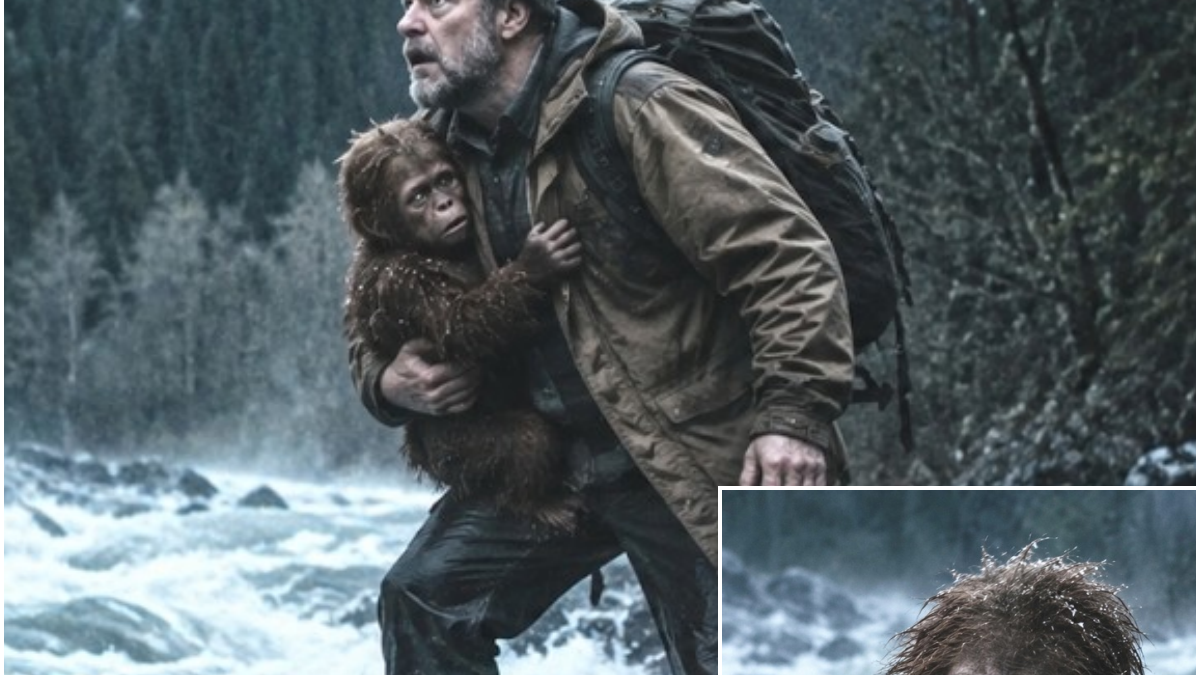
He Saved a Baby Bigfoot From Poachers – Three Bigfoots Appeared Before At Home
Bigfoot came out of the fog.
Three of them now, tall as the dead spruce along the ridge.
Come for the small one, I held against my chest in the dark before dawn.
I had been a forest ranger in West Virginia for 19 years by then, and I had told myself I did not believe in them.

Like a man tells himself a thing, he has already stopped believing he disbelieves.
But there is no arguing with three of them walking out of the treeine at once, silent on ground that should have cracked under any weight.
Come for the poachers camp, where a baby the size of a 4-year-old child lay curled in a wire cage with a rope around its neck.
I had cut that rope 10 minutes before.
I had the little one wrapped in my Ranger coat, its heart fast against my hand, and I stood up when I heard the first low sound roll down the mountain, and I knew in one breath that I was either about to die or about to be trusted, and that the difference was going to come down to what I did in the next 30 seconds.
My name is EMTT Grover.
I went to work for the forest service in the spring of 1966.
And I spent the better part of my life inside the Manonga National Forest, which covers the highest and roughest country in West Virginia, up along the spine of the Alagany Mountains, where the Red Spruce still grows the way it grew before the timber companies came through and cut nearly all of it flat.
Between 1890 and 1920, my district ran through the Cranberry back country and the headwaters of the Williams River and out toward Gory Mountain, and there were stretches of it in those years that a man could walk into and not cross another human track for a week.
I knew that country like the inside of your own house in the dark.
I knew where the water was, and which way a spooked deer would run before it ran.
And for the first 18 of my 19 years, I would have told you flatly that the biggest thing living up there was a black bear, and that anybody who said otherwise had been drinking or wanted to sell you something.
The last of those 19 years taught me otherwise, and it taught me all at once in a single October, and there has been no unlearning it since.
That is what happened to me.
I had walked that ground so long and seen so little that I had let my own eyes talk me out of my own ears.
And that is a thing a man can do for years without noticing he is doing it until the night the doing of it nearly gets him killed.
I grew up in Richwood, down at the foot of that country, the son of a man who cut timber and then cut it no more when his back gave out, and a mother who took in sewing and kept a garden that fed six of us through more than one hard winter.
I was the third of four.
I was never much of a talker.
My father used to say I could sit a whole afternoon on the porch and not spend a word, and he meant it kindly.
I went into the army at 18 and came home at 21 and did not care to talk about the between and the quiet suited the forest service fine because the work I liked best was the work you did alone walking a line marking a boundary counting what was there to be counted.
I married a Richwood girl named Verer in 1968, and we had one daughter, Goldie, and Verer understood from the start that I needed the woods the way some men need a church, and she never once made me apologize for it.
The forest I walked was not empty country, though it looked it.
There were old logging grades grown over with brier, the stone peers of splash dams broken up 80 years before, and here and there the caved in mouth of a coal bank some family had dug for their own stove and then forgotten.
There were places the old people in Richwood would not go, and would not say why, only that their grandparents had told them to stay off this ridge or that hollow after dark, and I had filed it under the ordinary superstition of people who had lived close to a big, dark forest for 200 years.
I know better now.
Some of what those old people knew, they knew because it was true, and they had wrapped it in a warning, because a warning is easier to hand down than an explanation.
The first thing that ever made me wonder came in the fall of 1979.
I was up on the Williams River doing a timberand exam, camped alone, and in the middle of the night the whole hollow went quiet in a way I had never heard.
I had spent 13 years sleeping in that forest and knew its night sounds like a clock in your own hallway.
The owls, the mice in the leaves, the wind working the spruce.
And all at once it stopped.
Every bit of it.
Like a room going quiet when a stranger walks in the door.
I lay in my bag and listened to nothing for the better part of an hour.
And then, a long way off, up toward the head of the drainage, I heard a sound come down the mountain that I could not fit into any box I owned.
It started low, lower than a bull elk, and there were no elk in West Virginia then anyway, and it climbed up and up and held at the top for a long breath and came back down in a set of knocks, almost like a man beating a locust post against a hollow log.
Then quiet again.
I did not sleep.
In the morning, I told myself it had been a bobcat, because a bobcat is the thing every countryman blames when he cannot name what he heard.
And I broke camp and walked out and did not write it in my report because there was no line on the form for it.
There is no human throat that can make it.
Once you have heard it roll down a dark mountain and felt it in your own ribs, you do not mistake it for anything else again.
I did not hear it again for 2 years, and by then I had half convinced myself I had dreamed the first time.
But in the summer of 81, I found the first track.
I was working a section up a feeder branch off the cranberry in ground so thick with roodendron that you crawled more than walked.
And I came out into a little seep meadow where a spring kept the mud soft all summer and pressed into that mud, plain as a signature, was a footprint longer than my own boot by half again.
And my boot is a size 11.
Five toes, a clear arch, no claw.
It had sunk deep, deeper than my weight sank, and I am a big man.
I stood over that print for a long while.
I had seen bear tracks by the thousand.
I had seen where a bear stands up and leaves a hind print that a scared hunter will swear was made by a man.
This was not that.
A bear’s hind foot has a little toe on the outside, and the toes curl, and there are claw marks out ahead of them always.
This had none of it.
This was the print of a foot built like mine and grown to a size mine would never reach.
I did a thing then I am neither proud nor ashamed of.
I looked at it and I looked at the timber all around that meadow and I felt the hair come up on my arms and neck and I stepped back out of that meadow the way I had come and I did not measure the print or cast it or photograph it.
I left it alone.
I understood without deciding to that this was a thing that did not want a form filled out about it.
I told no one.
I did not measure that print or cast it or photograph it.
And I have been asked since why a trained man threw away the proof of a lifetime.
And the truth is that some part of me already knew the proof was the very thing that would get them killed.
I went home and held my daughter and did not sleep well for a week.
After that, I began to notice what I had been walking past for years.
Once you have a name for a thing, even a name you will not say out loud, you start to see its work everywhere.
I found trees twisted off at a height no bear reaches.
The green wood rung apart like a wet rag, and rocks turned over in a creek in a line too regular to be floodwork.
I found one October a kind of shelter back in a spruce thicket.
Three long poles leaned together and woven through with boughs, and inside it the ground pressed flat, and a smell hanging in it that I have never smelled anywhere else.
Heavy and warm and earthy, like the inside of a den, like wet ground and something living all at once.
It was not foul.
I want to be plain about that because people expect it to be foul and it was not.
It was the smell of a big warm body that lived in the woods and belonged there, and I would come to know it as well as I know coffee.
I never saw one in those years.
I want you to understand the shape of it.
For most of a decade I lived alongside them, the way you live alongside a neighbor whose face you never see, but whose lights come on at dusk.
I knew they were there.
I knew from the tracks and the sound and the twisted trees that there was more than one, that they moved through my district on some circuit of their own, that they favored the high spruce and the wetest, roughest hollows, where no road went, and no hunter bothered to climb.
And I learned to keep their secret without ever having agreed to keep it because every instinct I had told me that the moment I spoke, I would bring down on that country exactly the kind of men who should never be let near it.
I had seen what happens to a place once people decide there is something in it worth taking.
That is the piece of this you have to understand before I tell you about the night the poachers came.
Because it is the reason I did what I did.
I had spent 19 years learning that there was something up in that forest that the world would tear the mountain apart to get its hands on.
And I had made up my mind quietly alone that as long as I wore the badge and walked that ground, I would be the thing that stood between them.
I want that clear before I go on because everything I did that night grew straight out of it.
I was a man who had spent the better part of a decade learning a hard and simple lesson which was that the shest way to destroy a rare thing is to let the world learn it is there.
I had decided long before the poachers came that this one thing would not be found on my watch.
Whatever it cost me and when the cost came due I paid it.
I want to go back and tell you about the years between the first track and the poachers because they are the years that taught me how to behave that night.
And without them, I would have done the wrong thing and gotten us both killed.
After I found that print in the seep meadow in 81, I did not go looking.
That is the part people never believe.
If you know a thing like that is up in the woods you walk every week, they think you must have spent your nights hunting it with a camera.
I did the opposite.
I let it be.
Something in me understood that the shest way to lose whatever slim trust I had stumbled into was to chase it.
And so I went about my ranger work and I let them come to the edges of my days on their own terMs. And slowly over years they did.
The way it worked was that I began to find things left for me, though it took me a long time to understand that was what they were.
The first was a heap of black cherries piled on a flat rock beside a line I was running late one August, so neat that no bird or bear had dropped them there.
I stood and looked at them, and I could not make them make sense.
And I ate a few, because it felt rude not to.
And I left the rest.
And when I came back that way in a week, they were gone.
And there was a single hen of the woods mushroom in their place, a good one, the kind my mother used to fry in butter.
I took it home, and Vera cooked it and asked me where I had found such a fine one, and I told her a spot up the cranberry, and did not say more.
That was the beginning of a trade I never named to anyone.
I started leaving things.
an apple, a handful of hard candy, once a wool sock, because it had come on to be a hard winter, and I did not know what else a body up there might want, and the sock was gone the next week, and I never knew what became of it, and I have smiled about that sock for 40 years.
That sock was the first thing I ever gave them that was not food.
The first time I treated them like neighbors and not like wildlife, and I have wondered ever since what a body up in that cold country did with one man’s wool sock, and I have decided to believe it kept some part of one of them warm through a bad night.
I never did figure out the right thing to leave for a body that big, living out in that weather.
So I left what a man leaves for a neighbor down on his luck.
Small things, honest things.
And I let the leaving say what I had no other way to say.
I never once in all those years saw the hand that took what I left or set down what I found.
They were that careful.
And I came to understand it was not shyness but wisdom.
They had watched what the world did to big rare things it found in its forests.
They had seen the roads come and the timber go and the hollows fill up with men and machines.
And they had drawn the only sane conclusion, which was to become smoke, to be everywhere in that country and nowhere a camera could find them, to trade mushrooms with one quiet ranger who had left their track alone and never with anyone else.
I was, I think, the nearest thing to a friend they had among my kind, and I had earned it by doing almost nothing, by being still, by leaving them be.
That was the whole of my qualification.
In a loud and grabbing world, I had turned out to be a man who could keep his hands to himself.
And it turned out that was the rarest thing I had.
The trouble started for real in the middle of October of 1985.
It had been a dry fall, which up in that country is unusual, and the dryness had brought people deeper into the woods than they usually came.
I began finding sign of a camp up toward the head of a hollow off the Williams that had no business having one, a mile from the nearest grade you could drive, on ground so steep and broken that nobody hauled gear up there to hunt in comfort, but somebody had.
I found the ashes of fires screamed with rock so the light would not show, and where a wall tent had been staked and struck more than once.
I found ruts where a winch cable had bitten into the bark of a big yellow birch.
And that was the thing that put a cold weight in my stomach.
Because a winch that far from a road is not for dragging out a deer.
A man drags a deer with his hands and a rope.
A winch is for something that fights back or something too heavy to lift or both.
I need to tell you what those years had already shown me about men who take things out of wild places because it is the reason I trusted no one with what I knew.
Twice in my career I had watched a beautiful thing get found and then destroyed by the finding.
Once it was a stand of jinseng up a hollow that a botney fellow from a college wrote a little paper about and inside 2 years it had been dug to nothing by men who read the paper and drove up with Matx.
Once it was a run of native brook trout in a headwater stream that got mentioned in a sportsman’s magazine, and the next spring there were beer cans in that stream, and the fish were gone.
I had learned, watching those things, that knowledge is a kind of key, and that there are men who, the moment they are handed the key to something rare, will use it only to empty the room.
I had decided a long time before 1985 that whatever lived up in my spruce would never be a line in a magazine, not while I drew breath.
So when I found that screened fire and those winch scars, my first thought was not to call it in.
My first thought was that the world had found the key anyway without my help and was already turning it in the lock.
The key was already in the lock, and the only question left to me was whether I would stand between them and what they had come to take or let it happen and live the rest of my life knowing I had let it.
Put that way, it was not much of a question.
The world had come up my mountain in a flatbed with a winch on the back, and it had come for the one thing I had spent 9 years keeping quiet, and there was no one to tell who would not make it worse.
And so it came down, as these things do, to one tired man, and what he was willing to do about it.
I started watching that camp.
I did not report it because I did not yet know what I was reporting, and because a part of me had already guessed, and did not want it written where another man might read it, and go up to see for himself.
For 3 weeks I climbed above that hollow before light, two and three mornings a week, and lay in the laurel with field glasses and watched.
The men came on weekends, four of them.
They drove a flatbed with West Virginia plates that I ran off the books through a friend in the sheriff’s department who owed me a favor and did not ask why.
And the truck came back registered to a man out of the southern part of the state who had a record for wildlife violations a page long.
The kind who sold bare gallbladders to a buyer he would not name and had done 90 days once for it.
That told me these were not deer hunters.
These were men who took living things out of the woods to sell and who had come a long way and climbed a hard mile to take something particular out of my forest.
I still did not know what they were after until the last weekend in October when I lay up in the cold before dawn and watched two of them come up the hollow from below dragging something on a game sled and it was making a sound.
I had heard a lot of animals in a lot of traps over 19 years.
I knew the scream of a rabbit and the cry of a fox and the ball of a bear cub and this was none of them and all of them.
And under it was a thing that stood the hair straight up off my body because the sound had grief in it.
It had the particular sound of a young thing calling for its mother in a voice that was not any animals voice.
And I lay there in the laurel with my glasses shaking against my eyes.
And I watched them haul a small dark shape up to their camp and put it in a cage made of hog panel and rebar.
And I knew exactly what I was looking at.
And I knew that everything I had spent 9 years quietly protecting had just come down to a single small captured child in a wire box, and to me, lying in the frost, the only one who knew.
I have heard a great many animals in a great many traps over a long life.
And the sound this one made went straight past my ears into some older part of me.
Because under the fear there was a shape to it, a reaching, and I knew as I lay there that whatever was in that cage was calling for its mother, and that its mother was somewhere on that mountain hearing it.
I did not go in that morning.
I have gone back over that decision 10,000 times in the years since, and I still think it was the right one, though it cost me a day I will never stop wishing I could have back.
There were four of them and one of me.
They had rifles leaned against a tree and pistols on their hips.
I had a service revolver I had fired maybe twice a year at a paper target and a body that was 58 years old and slower than it thought it was.
If I had walked into that camp in daylight and demanded they turn the little one loose, the best I could have hoped for was that they laughed and I lived.
The worst was that they put me down that hollow, and no one would have found me before spring, and the little one would have gone south on that flatbed to be sold to a man in a city who would keep it in a basement until it died.
So I did the hardest thing I have ever done, which was back out of that laurel, go home and wait for dark.
That was the longest day of my life.
I drove down to Richwood and I did not tell Verer what I had seen because I did not have the words and because I did not want her carrying it.
I told her I had a night patrol.
True enough.
I ate a supper I do not remember and cleaned and loaded my revolver and put together a pack in the shed with the door shut, moving slow, thinking it through the way I had been taught long before the forest service when the cost of doing it wrong was your life, bolt cutters, a good knife, a wool blanket, my coat, a flashlight with the lens taped to a slit so it threw a thin line and not a flood.
I did the arithmetic of the ground in my head, the mile up from the grade, the pitch of the hollow, the way the wind moved down it at night, cold air sinking, which meant if I came up from below, nothing would smell me, and I did not let myself think too hard about that last part.
I left the truck at the grade a little after 2:00 in the morning, and I walked up in the dark.
I have never been so awake.
Every root and rock of that hollow I knew and I went up it slow and quiet stopping every few minutes to listen and the forest was doing that thing again that total held breath quiet and I understood now what it meant.
It meant that the big ones knew.
They had known before I did.
They were somewhere up on that mountain in the dark and the whole forest had gone still around them.
The way it goes still around a fire that has not yet been lit.
I was awake in the way a man is only a few times in his life.
Every sense turned as high as it would go, and it is the only reason I did not put a foot wrong on ground where a wrong foot would have ended it.
I came up on the camp from below and downwind a little before 4.
One man was awake, sitting by the screened fire with a rifle across his knees, doing what men do at the end of a long watch, dozing and jerking awake and dozing again.
The other three were in the wall tent.
The cage sat off to the side near the birch with the winch scars.
And when the thin line of my light crossed it, I saw the little one, and my heart broke clean in half.
It was small, no bigger than my Goldie had been at four, though heavier built, and it was covered in dark hair matted with mud and its own filth, and it had a rope around its neck, run through the panel, and tied off short, so it could not lie down all the way.
Its eyes caught my light, and they were not an animal’s eyes.
I have looked into the eyes of every living thing in those hills, and those were not the eyes of a bear or a deer or a cat.
There was a person looking back at me out of that cage, a young, terrified, exhausted person, and it did not make a sound when it saw me.
And I have thought since that even that young, it already knew sound was the thing that had gotten it caught.
I have gone back to that look 10,000 times.
I was a foot away in the thin line of my light, looking into a face that looked back, and there was somebody home behind those eyes.
Fear and exhaustion, and when it saw I meant no harm, a thing I can only call hope.
I have met the eyes of every kind of wild thing that lives in those hills across a working lifetime.
And I know down in my bones the difference between a look that only sees you and a look that knows you.
And what came back at me out of that cage was the second kind.
And it has never once let me go.
I had a choice to make about the man by the fire.
And I made it the only way my raising would let me.
I came around behind him slow, and I did not hit him, though I got close enough to see he was truly more than half asleep, chin dropping.
And I made my decision to trust the dark and the quiet and my own hands over violence.
And I crept past him to the cage with my heart going like a hammer.
The little one watched me come.
I got the bolt cutters on the wire that held the door and hog panel is stiff and the cutters were loud.
One sharp crack as the first wire went, and I froze, and the man by the fire stirred and settled.
Two more cuts, slow, easing the tension so they would not sing, and the door came free.
The rope was the worst problem.
It was knotted tight and wet, and I did not dare pull on it.
So I got my knife under it, against the little one’s neck, feeling the warmth of it, and its fast breathing against the backs of my fingers.
And I soared through that rope a strand at a time, whispering to it the whole while, the kind of nothing words you say to a spooked horse.
Easy now.
Easy.
I have got you.
Easy.
And it let me.
That is the thing I still cannot fully account for.
A wild thing in a trap fights whoever comes near it.
This one held still under my knife and let a stranger’s hands work at its throat in the dark, and I think it had already read something off of me, as its kind reads people, and had decided in the space of a breath that I was not one of the men who had hurt it.
The rope parted.
I got my coat around it and lifted it, and it was heavy, 40 lb at least, of solid young body, and it turned its face into my chest, and gripped a fistful of my shirt with a hand of four fingers and a thumb, and more strength than any four-year-old ever had, and it held on.
And I stood up in that poacher’s camp with a stolen child against my heart, and I took one step toward the dark below.
And that was when the man by the fire came all the way awake and saw the empty cage and shouted, “I keep coming back to how it let me.
A wild thing in a trap fights every hand until it is free or dead.”
This one held still under a stranger’s knife and let me saw a wet rope off its throat a strand at a time.
And I have only one way to explain it.
It had read me as its kind reads people before I said a word and decided I was safe.
Everything happened at once.
Then the three in the tent came boiling out.
Somebody had a light and it swung across the camp and found me.
And I heard a man yell to get the gun.
Get the gun.
And I did the only thing there was to do, which was run downhill into the dark with the little one clamped to my chest and my taped flashlight bouncing a thin useless line off the trees.
I am a big man and I was not young and the ground was a nightmare of rock and root and laurel and I went down it faster than a sane man goes in daylight and behind me I could hear them coming and hear them cursing and hear once the flat crack of a pistol shot that went nowhere near me but told me everything about what these men would do to keep what they had caught.
I ran until my lungs were fire and my legs had stopped belonging to me.
And I got maybe 400 yardds down that hollow before my foot found nothing where I needed ground.
And I went down hard into the rocks of the creek, twisting to keep my body under the little one, and something gave in my ankle with a sound I heard more than felt, and the pain whited out the world for a breath.
I want you to understand that I had made my peace in those few seconds against the boulder with dying in that creek.
I was 58 and my ankle was broken and there were four armed men coming down the hollow and I had no way left to run and no real way left to fight.
I had gotten the child out of the box.
Whatever came next, that was done and it was enough to die on.
I could not run anymore.
I knew it the way you know a truth.
Your body tells you before your mind agrees.
I got myself against a boulder in the creek with the little one still gripping my shirt and got my revolver out with a hand that did not want to work.
And I looked back up the hollow at the lights of four men coming down through the trees to kill me.
And I understood that this was very likely the place and the hour that I was going to die.
And I was not as afraid as I would have guessed.
I had the little one’s heart going against my hand, and I thought, plain and simple, I got you out of the box.
Whatever comes now, I got you out of the box.
I thumbmed back the hammer and I waited for the lights.
And up the mountain above the men, above all of us, something answered the pistol shot.
It was the sound from 1979.
The sound I had spent six years telling myself was a bobcat.
It came down that mountain, and it was so loud and so deep that I felt it in the boulder at my back, in the water around my legs, in the cage of my own ribs.
It started low and climbed and held at the top, and the whole forest that had been so silent seemed to flinch under it.
And then from two other places on the black wall of the mountain, two more answered, one to the left and high, one to the right and lower, so that the men coming down the hollow stopped where they stood, their lights swinging up toward the sound, and I heard one of them say in a voice gone suddenly small, “What in God’s name is that?”
For a moment, nothing moved.
The men stood strung out down the hollow above me with their lights pointed up at the black mountain.
And I sat in the cold creek with my back against the boulder and my ankles screaming, and the little one clamped to my chest.
And every one of us, hunters and hunter alike, held still and listened to the silence that came down after those three calls.
It was a different silence than the held breath quiet.
I knew this one had a weight coming toward it.
I could hear, if I strained, a sound that was not wind, a heavy and unhurrieded movement high on the slope coming down, and it was not coming down toward me.
It was coming down toward the men.
The little one lifted its head off my chest when it heard the calls.
I felt it go from a frightened dead weight to something alert and straining, and it turned its face up toward the mountain, and it made a sound of its own, small and cracked and hopeful.
The same three- note cry I had heard it make in the cage.
And from up the slope, one of the voices answered it low and close and gentle in a way that could not be mistaken.
A sound a parent makes to a child across a dark house.
I hear you.
I am coming.
And the little one pushed against my arms, not to get away from me, I understood, but toward the voice.
And I held it and said, “Easy, easy, they are coming.
I have got you until they come.”
And I do not know if it understood the words, but it settled against me and waited.
And the two of us sat in that creek and waited together for the mountain to arrive.
I will tell you what it was.
It was a mother and a father and one more coming for their own.
And they had been up there the whole time following me down the mountain in the dark as I carried the little one, keeping pace with me the way I could never have kept pace with them, waiting to see.
I think now what I meant to do.
And when the man fired the pistol, they answered and they came.
I did not know that in the moment, of course.
In the moment, I knew only that the mountain had answered, that the thing I had spent nine years pretending not to believe in had raised its voice three times in the dark, and that the men above me had stopped dead in their tracks.
It was only afterward that I understood what those three voices were and why they had come.
They came out of the fog at the bottom of the hollow, three of them, and the men saw them before I did, because the men were higher up and facing that way.
And the first thing I knew of it was a man screaming, not yelling, screaming the way a grown man screams only a few times in his life if he is unlucky.
His lights swung wild and then dropped.
And I heard him crashing back up the hollow away from the creek.
And the other three lights broke and scattered.
And over the sound of men running for their lives came the sound of the three coming through the timber.
And it was not a crashing sound.
That is what I can never make anyone understand.
Three bodies, each of them taller than the dead spruce and heavier than a horse, moving down through blowown and laurel and rock in the dark.
And they made almost no sound at all, only a great soft rushing, like the wind that comes ahead of a storm.
And they went past me in the dark, not 10 ft away.
And I felt the ground move under me with their weight.
And I smelled that smell, that warm, heavy den smell, and then they were up the hollow among the men.
You expect something that big moving that fast to sound like a rock slide.
It did not.
It sounded like wind, like the front edge of a storm coming through the tops of the trees.
A great soft rushing that was somehow more frightening than any crash could have been because it meant they moved through the roughest country in the state like water moving downhill with no wasted motion and almost no sound at all.
I did not see everything that happened up there, and I would not tell all of it if I had.
There was more screaming, the sound of something heavy thrown, a big tree or a big rock coming down, one more pistol shot, and then a silence that had a terrible finality to it.
I have thought long about whether they killed those men.
I do not know.
In the morning, I found no bodies, and the flatbed was gone from the grade, so at least some of them lived to drive it out.
I know that the camp was destroyed so completely that when I climbed back up to it after light, there was almost nothing left to say a camp had ever been there.
The wall tent in shreds, the cage of hog panel and rebar twisted into a shape no man with tools could have made and driven halfway into the ground.
Whatever those three did to the men who had caged their child, they did it in about 90 seconds.
And then the hollow went quiet, and I waited to learn what they meant to do about me.
They came back down for the little one.
I heard them coming, and I made myself not reach for the revolver, which had gone into the creek somewhere in my fall anyway, and which would have been worse than useless.
I sat with my back to the boulder and the child in my arms, and I did the only thing my whole life had taught me to do in the presence of something that could end me, which was to be still, keep my hands where they could be seen, look down and not into their eyes, and wait.
The first one came out of the dark and crouched in front of me, and even crouched.
It was bigger than I am standing, and I felt the heat come off its body like an open stove door, and heard it breathing slow and deep and considering, close enough to touch the hair on its arm.
I did not move.
The little one in my coat lifted its head and made its cry, and the big one answered it, that same low, tender sound, and reached out one enormous hand, and I opened my arMs. The big one took the child from my arms as carefully as a woman lifts a sleeping baby off a bed.
I felt the little one’s grip leave my shirt, finger by finger.
And then the weight of it was gone, and the cold rushed into the place against my chest where it had been, and I looked up before I could stop myself, and I met her eyes.
I say her because I knew, the way you know a mother when you see one hold her own, that this was the little one’s mother.
Her face in the gray of that near dawn was broad and deeplined, and there was more in it than I had words for.
She held her child against her, and she looked at me, and I looked back, and neither of us moved.
And behind her, the other two stood in the dark, and watched us do it.
I have been looked at by a lot of things in a lot of woods, and I had never been looked at like that, weighed all the way to the bottom, and found after a long moment to be all right.
She made a sound then, “Lo, three soft notes aimed at me, and I did not know what it meant that morning, but I have decided since it was thank you, or the thing their kind has instead of it.”
Then she turned and the three of them went up the mountain into the fog with the child and the forest closed behind them like water and I was alone in the creek with a broken ankle and the first light coming gray over the ridge.
I have decided in the 40 years since that it was thank you plain and simple.
A being that had just come down a mountain in a fury and torn a poacher’s camp to splinters and that stood now with her stolen child safe against her turned before she left and made a sound at the man who had cut the rope.
Three soft notes aimed at me and no one else.
It took me until nearly noon to get myself down that hollow and out to my truck.
I crawled most of it.
I have never told anyone that part either.
The long slow morning of dragging myself over the rocks with an ankle the size of a stove pipe, stopping to rest and to shake because the shaking came in waves once the danger was passed and I could not stop it.
I drove myself one-footed to the clinic in Richwood and told them I had gone off a bank checking a boundary which was close enough to true and they wrapped the ankle broken in two places and asked how I had walked out on it and I said a man does what he has to.
Verer came and got me and she looked at my face and she did not ask me the real question and I loved her for it and it was 3 days before I could talk about any of it and even then I told her only that I had run some poachers out of the high country and hurt myself doing it.
The rest I carried alone for a long long time.
She is gone now, these six years.
And I told her the whole of it before the end, sitting by her bed, and she took my hand, and said she had always known there was a room in me she had never been in, and that she was glad to have seen inside it at last.
That is a different story, and a harder one, and I will keep it for myself.
That is its own story, the telling of it to Verer at the end, and a harder and more tender one than this.
And I will keep the most of it for myself, because some things a man says at his wife’s deathbed are not for a channel or a stranger.
They are for her and for him, and for the room they were said in.
I will only tell you that I told her, and that she was glad, and that I have been glad ever since, that I did not let her go without it.
I did not go back up that hollow until the following spring when the ankle had healed enough to take the climb.
I told myself I was going to survey the damage, close out the thing in my own mind.
But I know now I was going up to see if the trade was still on, whether the creek had ended it or changed it.
I climbed to the seep meadow where I had found the first track four years before and I sat down on the flat rock, the thing I had brought, which was a wool blanket, a good one, the warmest I owned, folded square.
I did not know if a blanket was a foolish thing to leave, but I thought of the little one in that cold cage, and a blanket was the truest thing I had to give.
I left it, and I climbed back down, and I did not come back for 2 weeks.
And when I came back, the blanket was gone, and on the rock in its place was a thing that stopped my breath.
It was a knot of hair, dark and coarse, bound around with a strip of green inner bark into a small tight bundle about the size of my thumb.
And I understood, holding it, that it had come off the little one, that this was a piece of the child I had carried, given back to me on purpose, and that I had just been handed the plainest thank you a body could give.
I stood in that meadow with it in my hand, and could not speak.
I had left a blanket to keep a small body warm, and they had answered with a piece of the very child that blanket was for.
There is no gift in this world before or since that has meant more to me.
I have it yet.
It is in a cedar box on my dresser, and will go to my daughter when I go.
After that spring, the trade came back, but it was different, deeper.
Before it had been mushrooms and cherries left in the ordinary run of things.
Now there began to be gifts that had thought behind them that answered things I had left.
I left a jar of Verer’s Blackberry jam, lid and all, up on the rock one July, half as a joke, wondering if they could work a lid.
And when I came back, the jar was there, empty, clean.
The lid set beside it, and next to it, a double handful of the biggest blackberries I ever saw, wild ones from some patch up high that only they knew.
They had understood the jam and answered it in kind, our berries for yours, and given me back the jar, because a jar is a useful thing, and they knew it.
I came to understand over those years that I was dealing with minds that missed nothing, that had simply chosen to spend as little of that mind as possible, where my kind could see it.
I saw them only a handful of times in all the years after, and each time it was their choosing, never mine.
The second time I ever laid eyes on one in daylight was in the fall of 1988, three years on from the creek.
I was up on the cranberry marking a boundary and I came around a shelf of rock and there she was the mother 40 yard off across a little bench of open spruce standing still watching me come.
I stopped with I did not raise my hands or my voice.
I did what I had learned.
I stood and I looked down and away and I waited and I let her decide.
She stood a long time.
Then she did a thing I have turned over in my mind for 37 years.
She reached down beside her and she brought up the little one, only it was not so little anymore, grown in 3 years to the size of a 10-year-old boy.
And she set her hand on its shoulder and turned it a little toward me as a mother turns a shy child to face a visitor.
And the young one looked at me across that bench with those same person’s eyes, and I understood that she had brought it to see me on purpose.
She was showing me that it had lived.
She was showing me that it had grown.
She was closing a circle that had opened in a wire cage in the dark, and she wanted me to see it closed.
I could not help it.
My eyes ran over, standing there on that rock in front of the two of them, and the young one tipped its head at me the way a dog does, at a sounded half nose.
And then the mother turned it back into the timber, and they were gone.
I sat down on that rock and wept like I have not wept many times in my life, from the sheer size of having been let see it.
I want to say something here about what they are because people always want that and because the words that get used are wrong and I have spent 40 years earning the right to correct them.
They are not an animal.
I have watched every animal that walks those hills for a working lifetime and I know the difference between a mind that reacts and a mind that reasons and theirs reasons.
They are not a monster.
The word turns my stomach when I hear it after what I have seen.
Because the only monsters that were ever up in that hollow came in a flatbed with a winch and a cage, and they are not a mystery to be solved, some prize for a man with a camera, or a college behind him to bag and bring down and make his name on.
They are a people older than mine in that country by a long reach, quieter than mine will ever learn to be.
And they have made across 10,000 years the same choice I made in one bad October, which is that some things are kept safest by not being told.
They have kept themselves.
I have only ever helped a little at the edges the way you hold a door.
The young one lived.
I know it lived because I went on seeing sign of it for the rest of my career.
And because the last time I ever saw the family, which was the spring I retired in 1985 plus 20 in the year 2005, there were four of them on the mountain instead of three.
And one of the four was young, a new one, small, and it was held by an adult I did not fully know, but whose size and whose way of moving I thought I recognized.
And I have let myself believe with no proof and no need of any that the child I carried out of the cage grew up and had a child of its own.
And that somewhere up in the high spruce of the cranberry, there is a young one alive today that would not be alive if a quiet ranger had not gone up a hollow in the dark with a pair of bolt cutters.
That is the kind of belief a man is allowed at 78.
I have earned it.
I will keep it.
I ought to tell you what became of the men, as much as I know, because I have been asked it in my own head a thousand nights.
In the week after that October, I did the careful work of a ranger who has decided to bury a thing rather than dig it up.
I went back to the camp in the daylight, and I took the ruined cage apart with my own hands, and I hauled the pieces out a load at a time, and I sank them in an old coal bank a mile away, where no one would ever look, because a twisted up cage is a question I did not want up in my woods.
I filed a short flat report that said I had found evidence of illegal camping and poaching in the high country, and had run the parties off, and that was true.
And it was also almost nothing, and it drew no interest, which was what I wanted.
I never learned the names of three of the four men.
The fourth, the one whose truck I had run, I watched for.
And here is a thing I will let you make of what you will.
In the spring of 1986, that man was found dead in the southern part of the state, and the paper said it was a hunting accident, and I have no reason on this earth to think it was anything else.
And I have never once managed to make myself fully believe it was.
And I have decided that some questions are better carried unanswered than answered wrong.
And I have carried that one unanswered for 40 years.
And I mean to keep carrying it right into the ground.
I have turned that over more nights than I can count.
And I have never been able to land on solid ground with it.
And I have finally decided that solid ground is not always to be had.
and that a wise man learns to stand on the ground he has.
I do not know what happened to that man.
I know only that he had caged a child and that he did not live out the year and that the two facts sit side by side in my memory and will not be pried apart and that I have stopped trying to pry them.
The rest of them, whoever they were, never came back.
I know that for certain because I watched that country like a hawk for the 20 years I had left in the service and I never again found a screamed fire or a winch scar or a game sled where a game sled had no business being.
Word gets around in the world those men lived in about a hollow that is bad luck.
I do not know what story they told the ones who lived.
I do not much care.
Whatever they told it worked because they told it to each other and not to a newspaper and my mountain stayed quiet and that was all I ever wanted out of it.
There was a bad stretch in the early 1990s when I thought the whole thing might come undone and it had nothing to do with poachers.
It had to do with a young biologist, a bright and decent young woman out of the university at Morgantown who came into the district office one summer with a grant to study black bear denning in the high country and who was going to spend three seasons walking exactly the ground I most needed no one to walk.
She was a good scientist and meant nothing but well, and I lay awake over her for a month, because I could not tell her, and I could not steer her without her wondering why an old ranger was so set against a study of bears in his own district.
What I did was the only thing I could think of.
I offered to guide her myself, and I spent the better part of three summers walking that young woman through the Manonga healer.
And I was the best and most helpful guide she ever had, and I took her to every good bear den in that forest, and I never once took her up the hollows that were not mine to show.
I sent her home after 3 years with a fine study, and no idea at all of the thing we had walked past the edges of a hundred times.
I have wondered since if I did her a wrong keeping a discovery of a lifetime out of her reach and I have decided I did not.
It was not mine to give and it would not have made her career.
It would have ended a whole people’s peace.
She has had a good long career on bears and I hope she never reads this.
And if she does I hope she understands why an old man once spent three summers walking her carefully around the truth.
Keeping a secret like this one is not the simple thing people think it is.
It is not a locked box you set on a shelf and forget, but a live thing you tend every day.
There is the daily small work of it.
The reports you write carefully, the questions you turn aside, the friends you let believe you are duller and more ordinary than you are.
And there is the deeper weight of it, which is that a secret this size makes you a stranger in your own life, a room in you no one you love can enter.
I loved my wife and my daughter with everything I had.
And there was a whole continent of me they could not visit, because to bring them there would have been to lay the weight on them too, and to widen the circle of people who knew.
And every person who knows a thing like this is another door it could get out through no matter how good they are.
So I carried it alone on purpose and the carrying made me quiet in a way that went past my nature and Vera felt it and was gracious about it.
And I have a grief in me to this day that I did not give her the whole of me sooner than her deathbed.
I tell you this not to complain.
I tell you because if you are ever handed a thing like this, you should know the price of it before you decide to keep it.
And you should decide to keep it anyway because the price of keeping it is paid by you and the price of telling it is paid by them and they never ask to be found.
I do not say this for pity.
I say it because it is the truest thing I know about keeping a secret of this size, and because if you ever find one set in your hands, you ought to know its shape before you agree to it.
It will make you a stranger in your own good life.
With a room in you, the people you love most cannot enter, and you will do it anyway if you are the right kind of person, because the alternative is worse, and because they never ask to be found.
I learned over the long middle years to read them the way I read weather, which is to say, never perfectly, but well enough to plan by.
I came to know their circuit through my district.
The way they favored the cranberry back country in the deep of winter, up where the spruce holds the snow off the ground, and makes a kind of shelter, and how they moved out toward the Williams headquarters when the berries came on in high summer, and how in the fall they were harder to find sign of than at any other time, which I decided meant the fall was when they were most careful, because the fall was when my kind came into the woods with guns.
I never wrote a word of this down.
It is all in my head and it will go with me except the little of it I am saying now.
And I have thought hard about whether even this much is too much.
And I have decided that a man of my age telling a story on a channel like this one with the ridges left unnumbered is not the same as drawing a map.
You could not find them from what I have told you.
I have made sure of that.
I love them too much to be careless even now.
I have weighed every sentence of this account on that scale, the scale of whether the saying of it could ever be turned into a map, and I have thrown out a great deal more than I have kept.
What is left, I believe, is safe.
I have made certain the where is not in here, only the what and the why.
The wear dies with me, as it should.
There was one winter, the winter of 94 into 95, that was the hardest I ever saw in that country, and it is the winter I think of when I want to remember what the trade between us came to mean.
It came on early and brutal.
There was ice in November that took down half the old spruce along one ridge, and then snow on the ice, feet of it, and then a January thor and freeze that put a crust over everything hard enough to walk a man, but not hard enough to hold what they weighed, which meant every step they took broke through.
And I knew from a lifetime in that forest that a winter like that starves things, even big, strong things, even them.
I did a thing that winter that a ranger is not supposed to do and that I would do again tomorrow.
I began hauling food up into the high country.
Not much, and too much would have drawn animals and questions.
But every week or two, all that terrible winter, I loaded a pack with what I could.
Dried corn, a slab of fatback, apples, a sack of the hard chestnuts I had gathered, and hoarded from the few old trees the blight had spared.
And I climbed up to the seat meadow on snowshoes, and I left it on the rock, and I climbed back down.
And every time the food was gone by my next trip, and every time, all winter, there was nothing left in its place.
And that told me more than any gift could have.
It told me they needed it.
A people who had answered every gift I ever left with a gift of their own were taking what I brought and giving nothing back because they had nothing to give that winter because they were as close to the bone as I had ever known them to be and they trusted me enough by then to let me see it to let me feed them.
That is a trust I do not have the words for.
When the spring finally came and the snow went off, and the woods came back to life, I climbed up one last time with the last of the chestnuts, and the food I had left the week before was gone as always.
And this time, on the rock, there was something waiting.
It was a single spruce cone, a big, perfect one, set upright in the center of the rock, placed there on purpose, plain as a word.
I have thought about that spruce cone for 30 years, and I believe it was the plainest sentence they knew how to write.
We lived.
Thank you.
The winter is over.
I brought it home.
It sits on my mantle.
It is the finest thing anyone has ever given me.
And no one who has seen it has ever known it for anything but a pine cone, an old man kept for no reason.
People ask me, the few I have ever said any of this to, whether I was not afraid all those years, living and working alongside something that could have torn me apart with one hand.
The honest answer is that after the creek, I was never afraid of them again.
Not once.
And it took me a while to understand why.
It was because of what they did that night.
Think it through the way I have had 40 years to think it through.
Three of them came down that mountain in a fury, faster and stronger than anything in this world.
And they came down onto a hollow that had two kinds of men in it.
The men who had caged their child, and me, who was carrying it, and in the dark, in 90 seconds, moving faster than my eye could follow.
They told those two kinds of men apart.
They did not touch me.
They went past me close enough that I felt the wind of them, and they did not so much as brush me, and they went up and dealt with the ones who had done the harm, and then they came back down and took their child gently out of my arMs. A blind animal in a rage does not make that distinction.
Only a mind makes that distinction.
Only a mind that had watched me come up that hollow in the dark and watched me cut a rope off a child’s neck with my own hands and understood exactly what it was seeing makes that distinction.
They knew what I was that night before I fully knew it myself.
They knew I was on their side.
And a thing that can tell friend from enemy in the dark, in a fury, and stay its hand is not a thing a good man needs to fear.
It is a thing a good man ought to be humbled by because it is better at the hardest thing than we are.
I retired from the forest service in the spring of 2005 at 68 with a bad ankle that had never set quite right and a back that had carried too many packs up too many mountains and a heart full of a thing I could tell no one.
They gave me a dinner and a plaque and some kind words.
And my supervisor, a good young fellow, said in his speech that I knew that forest better than any man alive.
And everybody laughed and agreed.
And only I knew how much truer it was than he meant it.
On my last week wearing the badge, I climbed up to the seat meadow one more time, slow, favoring the ankle, and I sat on the rock for a long while, and I did not leave anything, and nothing was there to find, and I had not expected there to be.
I had come up to say a thing, not to trade.
I sat on that rock, and I said out loud to the timber that I was done, that I would not be walking these ridges as their keeper any longer, and that I was sorry, and that I hoped whoever came after me in the green truck would have the sense to leave them be, and that I would carry them in me, until I died, and past it, if a man is let carry anything, past it.
I do not know if any of them heard me.
The forest was quiet, that ordinary daytime quiet, birds and wind.
But as I got up to go up on the ridge above me, a long way off, one of them called once, low, the sound rising and holding and coming back down in those soft knocks, and then it was still.
I have chosen to believe that call was for me.
I have chosen to believe it was a thing said back to a thing said.
I stood on that rock with my hat in my hands, and I let it be the last word between us, and I walked down off that mountain for the last time as a working man.
And I have not been able to climb up there in the years since, and it is the one grief of my old age that I cannot go up and sit on that rock one more time before the end.
It is the one real grief of my old age.
That broken ankle and this bad back between them have taken the mountain away from me and that I will most likely never sit on that rock again in this life.
I have made my peace with a great many losses.
I have not fully made it with that one.
But I carry the mountain in me.
All of it.
Every ridge and seep and spruce thicket.
And I visit it in my mind most every day.
And that will have to be enough.
And I have decided that it is.
I told Vera the whole of it in the last week of her life in the spring of 2019.
She had been failing for a while and we both knew the shape of where it was going.
And one evening when the pain was low and her mind was clear, she took my hand and said out of a long quiet, “Emtt, I have been your wife for 50 years, and there is a place in you I have never been, and I would like to go there before I go.”
And I sat down on the edge of her bed and I told her all of it.
The track and the trade, the poachers, the creek, the mother’s face, the young one grown and shown to me across the bench, the hard winter, and the spruce cone on the mantle.
She had dusted a hundred times and never asked about.
I talked most of the night.
She listened the way she had listened to me for 50 years, without pushing, letting me find the words.
And when I was done, she was quiet a while.
And then she said the thing I will hold on to until I follow her.
She said, “I always knew it was something like that.
I always knew you were keeping something too big and too good to say.
And I want you to know I never once minded because a man who could keep a secret that kindly for that long was exactly the man I wanted keeping me.”
She died 4 days later, easy, at home, with our daughter and me beside her.
And I have been glad every day since that I did not let her go without letting her into that last room of me.
Do not make the mistake I nearly made.
If you carry a great secret, and there is one person in this world who has earned the whole of you, do not wait until the last week to give it to them.
My daughter Goldie knows now too, most of it.
And she is the one this account is really for, though it will reach a good many strangers before it reaches her.
She is a grown woman with children of her own, and she has a level head and a kind heart, and I have decided she can be trusted with the map that no one else will ever get, which is not a map of ridges and hollows, but a map of how to behave, if the woods ever choose her the way they chose me.
Leave them be.
Keep your hands to yourself.
Trade honest and small.
Tell no one who has not earned the whole of you.
Feed them if they are hungry and ask nothing back.
And if the terrible night ever comes when there is a child of theirs in a cage and only you to get it out, go up the hollow in the dark and cut the rope and trust that the mountain is watching and that it can tell what you are.
I go back over the night in the creek more than any other memory I own.
And what stays with me is not the fear of it, though there was plenty, and not the pain of the ankle, though it was the worst pain of my life.
What stays with me is the minute before the mother took her child, when the little one was still gripping my shirt with that four-fingered hand, and I could feel its heart slowing down against my chest, as it understood some way I will never grasp, that it was safe now, that the men were gone, and the mountain had come, and the stranger holding it was a friend.
Nothing I have done in 78 years makes me prouder than the slowing of that small heart against my hand.
I did that.
A frightened, stolen child felt safe in my arms in the last minute before it went home.
If I have done nothing else worth the doing, I did that and it is enough and it is more than enough and it will be the last thing I think of, I hope, when my own time comes.
I have wondered, of course, what the world would be if I had done the other thing.
If I had called it in, if I had let the scientists and the reporters and the men from the agencies come up into my mountain with their cameras and their nets and their certainty, there would be a name for them in the books now.
There would be an entry in the encyclopedia.
There would be a documentary with slow music and a grave narrator.
And there would be no more of them.
And I have never once doubted that a people that has survived 10,000 years by being smoke does not survive being found.
The finding is the ending of them.
Every rare thing I ever watched get found got emptied by the finding.
The jinseng dug to nothing.
The trout hauled out, the old trees cut.
I chose on my own authority with no one to tell me it was right that these ones would not be added to that list on my watch.
I have never been given a medal for it and I never will be because the only proof of what I protected is the fact that you cannot prove it and I have made my peace with that.
Some things you do not do to be thanked.
You do them because you were the one standing there when they needed doing.
That is the arithmetic of a secret worth keeping.
The better you keep it, the less anyone knows there was anything to keep.
The only monument I will ever have to the thing I am proudest of in my life is the fact that you cannot find it.
And I have taught myself to be glad of that.
Because a monument you could find would be the very thing that got them killed.
Some work is like that.
You do it in the dark and you tell no one, and you take your pay in knowing, and knowing turns out to be plenty.
So here is the whole of it, laid down at last by an old man in a small house in Richwood, West Virginia, with a spruce cone on his mantle, and a knot of dark hair in a cedar box on his dresser, and a good deal more life behind him than a head.
There are people up in the high country of the Manonga healer.
Not creatures, not monsters, people older and quieter and gentler than my own kind, who took me for a friend because I could keep still.
And keep my hands to myself and keep my mouth shut.
And who once on a cold October morning came down out of the fog three at a time to take back a child and did not touch the man who was holding it because they could tell, even in a fury, even in the dark, that he was on their side.
I was on their side.
I am on their side still.
And I will be when I am gone.
And if there is any way at all for an old ranger to go on keeping a door held open from the other side of the ground, that is the work I mean to be about.
They are up there tonight.
The snow is starting on the high ridges by now this time of year.
And they are up in the spruce where it holds the weather off.
the ones I knew and the ones that came after.
The child I carried and its child and they are warm and they are together and they are safe and almost no one in the whole loud world knows they are there.
That is how they want it.
That is how I have kept it.
And now that I have told you, I am trusting you to keep it too, the way it was once trusted to me by three of them walking out of the fog before dawn.
Leave them be.
Let them have their mountain.
It is the last thing I will ask of anyone.
And it is the only thing I have ever asked.








