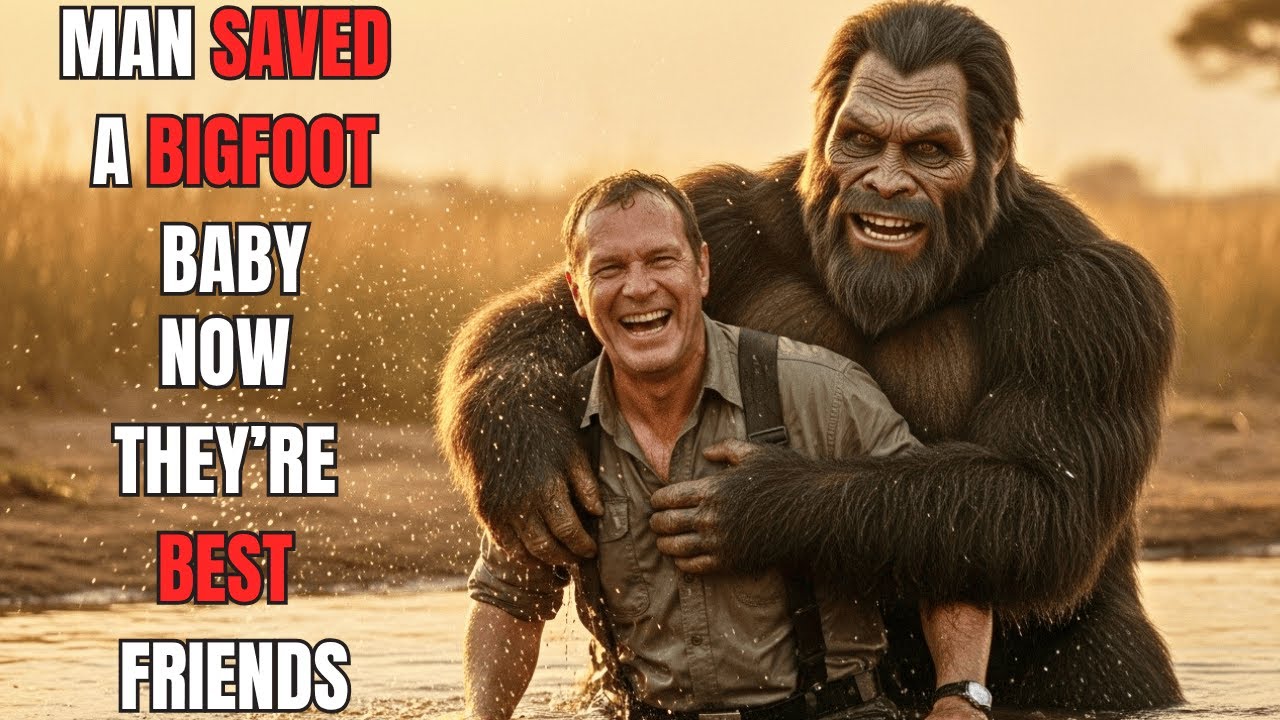
This Man Saved a Bigfoot Baby – Now They’re Best Friends
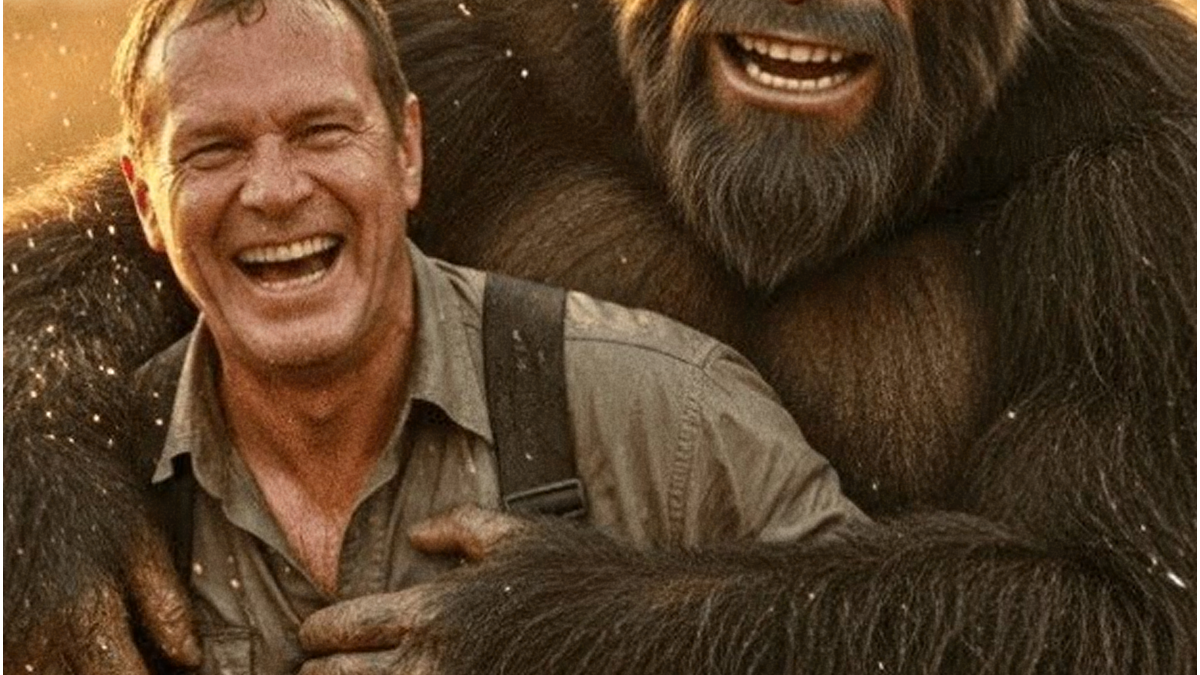
This Man Saved a Bigfoot Baby – Now They’re Best Friends
What would you do if Bigfoot showed up on your doorstep?
Not as a monster, but as a scared child bleeding in the rain.
In 1984, deep in the Blue Ridge Mountains, a reclusive biologist made a choice that would change everything.
He saved it.
Not with a trap, not with fear, but with kindness.
This is the story Nolan Avery left behind, discovered decades later in a weathered journal beneath an old oak tree.
A tale not just of myth, but of friendship, sacrifice, and the quiet redemption only the forest remembers.
For the next 15 minutes, you’ll witness a bond that defied nature, a family that was never meant to be, and a final gift from a creature the world said never existed until it returned.
Because sometimes the most human stories don’t come from humans at all.
Now, tell us, where are you watching from?
And how far can this story go if we share it with love?
From the heart of the forest to screens around the world, we send our warmest hello and thank you for listening.
In the damp hush that lingered after the rain, the Blue Ridge Mountains seemed to hold their breath.
Water clung to every surface.
Moss-slick stones, trembling laurel leaves, the rusted tin roof of a weather-worn cabin nestled deep in the woods of Western North Carolina.
It was 1984, late in the day.
The sky, low and milky, still smelled of thunder.
A mist rose in threads from the forest floor, curling through the trees like something alive.
You could hear the drip of water sliding from the canopy, the tired shuffle of deer moving unseen, but no birdsong, no frogs, just silence and the fading echo of rain.
Nolan Avery closed the cabin door behind him and stepped off the porch.
43, broad-shouldered and lean, he moved like a man who’d been outside too long to remember how to be indoors.
His boots made soft indentations in the soaked earth as he walked toward the edge of the clearing where the forest swallowed everything.
In one hand, he held a canvas satchel.
In the other, a fixed-blade knife dulled with use.
He wasn’t out here to hunt, not anymore.
These days, he spent most of his time undoing what others had done, checking the old snares left behind by poachers, disarming cruel leg traps, easing pain where he could find it.
He ducked beneath a low arc of rhododendron and kept walking.
There was a quiet rhythm to the forest he knew by heart.
Twigs breaking under weight, the rush of water down the gorge, the rustle of animals trying not to be seen.
But then came a sound that didn’t belong.
It was faint, strained, half-strangled.
A high, broken noise that prickled the skin behind his ears.
Not a deer, not a fox, too soft for a bear cub, too raw to be human.
It came again, from somewhere deeper.
Thin, rising like steam from under the laurel brush.
Nolan froze.
For a moment, the whole forest seemed to tilt.
Then he moved, fast and quiet, pushing through the slick undergrowth, heart suddenly knocking against his ribs.
The cry came again, closer now, like a child, but not.
He crested a small rise, eyes scanning, and saw it.
Tucked beneath the arching branches of a wild mountain laurel, half-hidden in shadow and mud, something squirmed.
It was small, 4 ft at most, and so soaked through it seemed carved from the rain itself.
Limbs tangled, breathing fast and shallow, its chest rising in desperate, erratic puffs.
A snarl of thin, translucent cord dug deep into its leg and wrist, the kind used by men who hunted for bounties, not food.
The trap had cut clean.
Bone was visible through the slick coat of fur, but it wasn’t the wound that made Nolan stop cold.
It was the face.
Not animal, not quite human, the creature looked up at him with eyes the color of smoldering amber, large, deep, unblinking.
There was something inside them that didn’t match the body, a long sadness, old and endless, like something lost trying to remember its way back.
Nolan crouched.
“It’s all right,” he said, though he knew words didn’t matter.
His voice came out low, hoarse from days without use.
The creature blinked, then whimpered again, softer now, as if it knew this man wasn’t here to hurt it.
He eased forward, one slow breath at a time, and reached for the cord.
The creature flinched.
“Easy,” Nolan murmured.
He drew the knife, pressed the flat edge against the snare, and began sawing carefully.
It took time.
The cord was industrial, nearly invisible in the low light, the kind used by men who sold what they caught.
When the final strand gave way, the creature collapsed into itself, trembling but free.
Nolan pulled a blanket from his satchel, wrapped it around the small body, and lifted it gently.
It weighed less than it should have.
Bones too close to the surface.
The fur was dark and matted, streaked with mud and blood.
Up close, he could see the structure of its face more clearly.
High cheekbones, human-shaped nose, the fur thinning near the brows and cheeks, revealing pale skin underneath.
It had a short, scruffy beard.
And those amber eyes never left his.
He didn’t speak again, just carried it.
The walk back to the cabin took longer than usual.
The rain had left the ground slick and untrustworthy, and Nolan was careful not to jostle the bundle too much.
By the time he reached the porch, the wind had picked up.
Laurel leaves danced in the gusts like flocks of small birds.
The mountains were sinking back into mist.
Inside, the cabin glowed dimly with the amber light of the wood stove.
Nolan set the creature down on a pile of folded blankets near the hearth, wrapped it tighter, and stoked the fire.
He didn’t light a lamp.
Let the dark corners stay dark.
The creature didn’t move, just watched him, breathing shallow, face unreadable.
Nolan fetched a bowl of clean water and placed it nearby.
Then he lowered himself into the worn armchair beside the fire.
His hands were shaking, though he didn’t notice.
He hadn’t touched another living thing in weeks.
The creature’s chest rose and fell, its eyes drooped, fighting sleep.
Nolan leaned back, one hand resting on his knee, the other still holding the knife, now forgotten.
He didn’t sleep, not really, just drifted in that uneasy way people do when they’re listening for something they can’t name.
Sometime past midnight, a sound stirred him, not from outside, from right beside him.
The creature had shifted.
Its thin arm stretched out from under the blanket, reaching slowly, trembling, and its long, human-like fingers brushed Nolan’s wrist.
Not a swipe, not a twitch, a touch, soft, deliberate.
The fire snapped.
Nolan’s breath caught.
It wasn’t instinct.
It wasn’t fear.
The creature, whatever it was, had chosen to reach for him.
Outside, the rain had returned in a soft drizzle, whispering against the roof.
But beneath that, Nolan heard something else, something heavy, rhythmic, footsteps, slow, measured, circling.
He didn’t move, only stared at the door.
The creature’s hand still rested against his skin, as if asking silently, “Will you keep me safe?”
The footsteps paused.
A long silence stretched.
Then a creak, floorboards, outside, just beyond the threshold, like someone, something testing the edge of the cabin’s protection.
Nolan set the knife down, rose quietly, and moved to the door.
He didn’t open it, just stood there listening.
His heart thudded in his ears.
Beyond the walls, the forest was alive with absence.
No howls, no rustling, only the sound of one presence, a massive one, moving through the trees, circling slow as thought.
Then nothing, just rain.
When he turned back, the creature was watching him.
Its amber eyes reflected the flicker of the firelight, deep and wary, but not afraid.
He didn’t ask questions, didn’t wonder what it was, didn’t need to.
Some truths don’t need names, not yet.
He stoked the fire, sat back down in the chair, and stayed that way until morning.
As the rain slipped down the cabin walls like time itself, the laurel outside still shimmered with droplets, each one catching the light like a held breath.
And in the hush that followed, the forest held its silence once more, but Nolan Avery knew something ancient had knocked on his door that night, and something else had heard the cry beneath the laurel.
The rain had stopped a week ago, but the forest still held the memory of it.
Every leaf in the Blue Ridge shimmered with leftover light, as if dew had replaced sorrow.
Mornings came slow and silver, the kind that made you pull your flannel tighter around your shoulders and watch your breath drift like smoke into the waking trees.
Nolan stepped outside before the sun had fully cleared the ridge.
The earth was soft beneath his boots, moss damp, fog clinging to his beard.
He didn’t speak.
He rarely did anymore.
Words had grown clumsy in his mouth since Marjorie passed.
Out here, the only thing that mattered was how still you could be, how long you could listen.
Inside the cabin, the creature stirred.
It had survived against odds Nolan didn’t dare calculate.
The small being had made it through the night, and the one after that, and then the next, curled close to the fire, unmoving but breathing, its chest rising in soft, shallow pulses.
He hadn’t touched it more than necessary, just tended the wounds, replaced the blanket when it soaked through, and waited.
It wasn’t a deer.
It wasn’t a boy.
And yet something about it felt like both and neither.
On the fifth day, the creature sat up, no sound, just movement, slow, deliberate.
Its eyes found Nolan’s from across the room and didn’t blink, amber like old glass, glinting with firelight.
It tilted its head, not like an animal assessing threat, but like someone trying to remember a face from long ago.
That night Nolan played the flute.
It was an old cedar pipe, hand-carved decades back, the kind Marjorie used to love hearing on evenings when the rain made conversation feel too heavy.
He hadn’t touched it since she died, but that night, as the fire danced low and the shadows stretched long across the cabin floor, his fingers reached for it.
The notes came out cracked at first, then steadier, a slow, aching tune that never had a name but always felt like home.
Across the room, the creature listened.
It didn’t flinch, didn’t hide.
Instead, it leaned slightly forward, face catching the glow of the fire, and tilted its head again.
This time, in rhythm.
The sound echoed softly between the walls, and in the stillness that followed, Nolan felt something shift, not outside, inside him, like a locked door creaking open for the first time in years.
The next morning, he gave it a name.
“Rowan,” he said quietly, almost to himself.
“That’s what I’ll call you.”
It made no move to object, just looked at him, eyes calm, almost curious.
There was no collar, no birth certificate, but the name felt right, like a promise, a tree Marjorie used to point out along the trails, red berries bright against the green, said to be a protector in old stories.
It fit this wild thing, half shadow, half child, that had chosen to stay.
Rowan didn’t speak, but it didn’t need to.
It learned by watching.
Every motion Nolan made, Rowan studied.
How he boiled water, how he cleaned a fish, how he stacked the logs with bark facing out.
And one morning, just before sunrise, Nolan opened the cabin door and found the creature already sitting on the porch, knees pulled tight, watching the fog lift off the trees like steam from a slow kettle.
It hadn’t run, hadn’t even tried.
Nolan followed its gaze.
Out there, the world was waking up soft.
Mist moved between the branches.
A hawk called once, then went silent.
Everything felt suspended.
He sat down beside Rowan, leaving a few inches of space between them, enough not to crowd, not to assume.
They stayed like that until the sun cleared the tree line and turned the morning gold.
Later that day, something small but startling happened.
Nolan was cleaning the old trap he dismantled the week before, no sharp edges, just metal and memory.
When he noticed something strange on the table, a circle, not drawn, not carved, but arranged.
Several leaves lay gently in a ring, laurel, fern, one small blossom from the mossy creek bank, deliberate, precise.
He looked up.
Rowan sat across the room, expression unreadable, eyes flickering to the leaves, then back to Nolan.
He didn’t ask why.
Some things you don’t question.
That night, he lit the stove early and made a pot of berry mash and honey.
Rowan ate slowly, hands careful, eyes flicking between each movement like trying to memorize a ritual.
After the meal, Nolan picked up the flute again, and this time, the notes came smoother.
Rowan leaned back against the logs, eyes half-lidded, head moving slightly to the rhythm, as if the sound stirred something just beyond reach.
Then came a knock, not at the door, at his memory.
A name he hadn’t heard in over a year.
Walt Cormac.
He showed up two nights later, boots heavy on the porch, a rucksack slung over his shoulder, wearing that same old canvas coat he refused to replace.
“Still breathing?”
Walt said as Nolan opened the door.
“Barely,” Nolan muttered.
The two men hadn’t spoken much since Marjorie’s funeral.
Walt meant well, but grief had its own geometry, and Nolan had retreated too far inside himself to leave room for anyone else.
But Walt didn’t push, just brought a bottle, sat near the fire, and waited.
It didn’t take long.
“There’s a crew out here,” Walt said, voice low, staring into the flames.
“Calls themselves Crow Summit.
Rich boys with guns.
They’re not hunting deer.”
Nolan tensed.
“Rumor is they’re tracking something strange,” Walt went on.
“Something they want to sell, taxidermy, maybe organs.
I didn’t ask.”
Nolan looked toward the back room.
Rowan wasn’t in sight, but the air had shifted, the way it does when something wild is listening.
“You seen anything?”
Walt asked.
Nolan shook his head.
“Just stories.”
Walt nodded, didn’t press, but the silence between them hung heavy.
After he left, Nolan walked the perimeter twice.
The traps were gone, but that didn’t mean the danger was.
When he returned to the cabin, Rowan was standing by the window, not frightened, just alert.
Like something inside him had recognized the word crew without ever hearing it before.
That night sleep was thin.
He woke to a gust of wind slamming against the cabin, the tin roof groaning.
For a second, he thought he saw light out in the trees, quick, like a match struck and snuffed, but then it was gone.
Still, he didn’t rest easy.
The forest had changed.
In the morning, there were new prints in the mud, not human, not Rowan’s, larger, wider set, more pressure on the heel.
Nolan crouched beside them, pressing his hand near one for scale.
It dwarfed him.
He stood slowly.
Rowan appeared beside him.
Neither said anything.
They just looked at the track together, a smear of damp earth, a shape, a message.
Back inside, Nolan double-locked the door, not that it would help much.
That evening, as the sun slipped behind the ridgeline, he noticed something else, a mark on the cabin door, a large handprint, muddy, fresh.
It wasn’t smudged or random.
It was placed, high, centered, deliberate.
The shape of it sent something cold crawling down Nolan’s spine, fingers long, too long, palm wide, like someone had reached out, not to enter, but to warn.
Nolan didn’t sleep that night either.
He sat in the armchair, listening to the stove pop and hiss.
Rowan stayed close, just inside the shadows, never far from the fire.
The flute lay untouched on the table, beside the leaf circle that had somehow stayed intact.
Outside, the forest breathed in, held it, didn’t let it out.
When dawn broke, it came like a secret, quiet, pale.
The mist held tighter than before.
Nolan stepped onto the porch and looked toward the tree line.
The air was clean, but the silence wasn’t peace.
It was a pause.
And deep in his bones, Nolan knew something had watched them.
Something had passed through, not to take, not yet, but to see, to mark, to remember.
Inside, Rowan was already awake, standing by the window again.
His amber eyes met Nolan’s, and in that moment, no words passed between them, but the message was clear.
Whatever was out there had come looking, and it wasn’t finished.
Spring came late to the Blue Ridge that year, as if the mountains themselves weren’t quite ready to thaw.
The rain slowed, the skies softened, and the trees began to green from the inside out.
By early April, the river banks had swollen with meltwater and young shoots crept between moss-covered rocks, their color so bright it hurt to look at.
The cold was still there in the mornings, rising in slow breaths from the ground, but by noon the air was warm enough to coax frogs from hiding and send lazy insects floating through beams of sunlight.
It was the kind of season that reminded you life didn’t always end.
Sometimes it paused.
Sometimes it slept.
But sometimes, if you waited long enough, it came back in pieces.
That spring, Rowan walked beside Nolan.
Not close, not holding his hand like a child, but near enough to feel a presence, a rhythm.
When Nolan stepped over a fallen log, Rowan paused, watching the ground first, then followed.
When the trail dipped toward a steep bank, Rowan glanced back once before letting Nolan take the lead.
There was caution in the way he moved, but not fear.
Not anymore.
They didn’t speak.
They didn’t need to.
Most days, the only sound was the river.
It ran wide and fast this time of year, fed by snowmelt from peaks farther north.
Nolan had set out to check the old traps, though truth be told, he hadn’t laid any since winter.
Not real ones.
Just flags, trails, pieces of scrap meant to throw off anyone else tracking through these woods.
The real reason for the walk was movement, muscle, breath, memory, the kind you build when you’ve carried too much grief for too long.
The river glittered in the sun like broken glass.
They followed it upstream, keeping to the tree line, stepping over roots and through patches of soft wild onion.
Nolan kept his eyes sharp for signs, snapped branches, fresh scat, boot prints.
But more than once, it was Rowan who spotted things first.
A bit of frayed twine knotted around a cedar root, a strip of black plastic stuck to a sapling, a smell on the wind that made him stop, nostrils flaring slightly, shoulders squaring.
Nolan had seen it before, in wolves, in wounded dogs.
The moment instinct took over.
But Rowan never bolted.
He stood, studied, then carried on.
Until the afternoon, Nolan slipped.
It happened quick.
One bad step on the mossy edge of a rock near the river, a sound like the world pulling back its hand.
His boot slid out, his body pitched forward, and in a flash, he was down the bank and into the current.
Cold.
Shockingly cold.
The river wasn’t deep, but it was fast, and it hit like a stone wall.
He went under once, came up gasping, tried to find footing, but couldn’t.
The current dragged him sideways toward a knot of half-submerged branches.
His arm scraped across something sharp.
Blood bloomed dark in the water.
For a moment, the panic rose, wild, feral, blinding.
Then something pulled him back.
Not the river, not chance, a hand, long-fingered, strong, human-like, but not human.
The grip closed around Nolan’s wrist with quiet force, and in one breathless surge, he was hauled from the current, dragged through the mud, coughing water and gasping as he hit the bank.
Rowan stood above him, chest heaving, fur soaked to the skin.
For a second, neither of them moved.
Water ran in rivulets down Rowan’s arm.
His face, his human-like wildman face, was drawn with something close to worry.
His eyes weren’t wide, they were steady, old, measured.
Nolan stared back at him, stunned.
Not by the rescue, not even by the strength, but by the look in Rowan’s eyes.
Concern.
Not the kind bred into animals, not the protective twitch of a mother bear, or the cautious watch of a buck over its herd.
This was different.
This was knowing.
This was care.
That evening, back at the cabin, Nolan built the fire up higher than usual.
His ribs ached, and there was a cut across his forearm that needed boiling water and clean cloth.
Rowan sat nearby, arms wrapped around his knees, not looking away even as Nolan winced with each pass of the rag.
Outside, the trees creaked in the wind.
Inside, something else was taking root.
From that day on, Rowan moved differently.
He was still quiet, still watchful, but he began bringing things.
Not just twigs or leaves.
Real things.
A fish, cleaned, head still intact.
A pair of paw prints marked in mud on a flat stone, as if to say, “I saw this here.”
A bundle of berries wrapped in broadleaf.
Each time Nolan opened the door and found something waiting, he paused.
He hadn’t taught that.
Hadn’t asked for it.
It was gift-giving, an imitation, or maybe something older.
Once, he followed Rowan out into the trees, curious where he disappeared to.
Not far from the cabin, tucked beneath a crooked pine, he found him crouched beside a young deer.
Its leg was twisted, broken clean, but it wasn’t bleeding.
Rowan had piled brush overhead to make a crude shelter.
The creature lay on a bed of moss, blinking slowly, body shivering.
Rowan sat beside it, one hand resting lightly on its shoulder, not holding it down, just keeping it still.
Nolan didn’t speak.
He watched from a distance, unseen, and when Rowan looked up, he didn’t flinch.
Just met Nolan’s gaze, then turned back to the fawn.
Later that night, Nolan left a tin of ointment and gauze on the porch.
By morning, it was gone.
Time softened the days.
The forest changed with the season, greener, louder, more alive.
But underneath that bloom, a kind of quiet unease ran like a current beneath still water.
It started with the smell of oil, not much, just enough.
One morning, Nolan came back from the ridge and caught the sharp tang in the air.
Machine, man-made, not old like the traps, fresh.
He crouched near the river and found tire tracks, wide, heavy.
ATV, maybe, or a small truck.
The mud was marked with white dust, lime, maybe chalk, some kind of marking powder.
Worse, the tracks led along the same trail Nolan and Rowan used.
Not exactly, but close enough.
He followed them for a while.
The scent of gas clung to the brush.
He saw broken twigs, a strip of cloth snagged on barbed wire.
And then, halfway back to the cabin, he found the bait line.
Industrial cord, metal lures, some kind of meat still frozen at the center.
Not for deer, not bear.
Too low, too hidden.
The kind of trap you only lay for something walking upright.
His throat dried.
Back at the cabin, Rowan was already there, crouched by the wood pile.
He didn’t say anything, but his body was tight, still.
When Nolan stepped onto the porch, Rowan looked up briefly, then glanced past him toward the trees.
East.
That direction again.
Later, as the sun began to fall, Nolan boiled water for tea.
Rowan stayed outside.
He didn’t wander far anymore, not unless Nolan came, too.
But that evening, just before dusk, Nolan turned to speak, and Rowan was gone.
No sound.
No prints.
Just gone.
Nolan waited.
Hours passed.
The stove burned down low.
A wind rose in the rafters.
Then a sound, wood creaking slow and heavy.
Not inside.
The cabin door shuddered once, just a nudge, then silence.
Nolan stepped forward, knife in hand, heart in his ears.
He opened the door to nothing.
Darkness, forest, mist low over the ground.
But the silence wasn’t empty.
It was watching.
He didn’t sleep.
Just sat in the chair with his coat pulled tight, the lamp low, the knife resting on his lap.
At some point in the night, he must have dozed, because when he opened his eyes again, the sky was paling, and Rowan wasn’t back.
The dread hit slow, like a knot in the gut.
He grabbed his pack, water, knife, matches.
He followed the trail east.
The sun rose behind him.
By midmorning, he found blood.
Not much, just a smear on a mossy stone.
Then more, arcing toward the edge of a cliff that overlooked the gorge.
The wind bit sharper there.
Trees twisted in strange ways near the edge.
Nolan stepped carefully.
Something glinted on the ground, a patch of fur, dark, matted, still damp.
Next to it, half-buried in mud, a canvas button with a stitched emblem.
CS.
Crow Summit.
His hands closed around the fur.
His eyes stung.
There was no body, no sign of struggle, just absence.
He buried the fur in an old tin and lit the lantern as the sky darkened again.
The flame flickered as he sat beside it, the metal warm in his hands.
He didn’t cry, not then.
Just stared out the window into the trees that didn’t move.
“If you’re alive,” he said softly, voice breaking, “I’ll wait.”
And he did, but the woods went still after that, too still.
Summer thickened the forest like breath against glass.
The trees swelled with heat and chlorophyll, their leaves deepening to that heavy, saturated green that always came before thunder.
Crickets and cicadas droned like power lines strung through the hills, constant and pulsing.
Even the birds fell silent most afternoons, as if the air itself had weight now and carrying song took too much effort.
Nolan felt it, too, in his joints, in his lungs, in the way time moved like syrup.
The grief had dulled to something flatter, but the silence was still loud.
It had been weeks since Rowan vanished.
Each morning Nolan waited longer before stepping outside, and each night he stayed up later, holding his breath against every shift in the wind.
The cabin had grown too quiet.
No footsteps on the porch, no rustle near the woodshed, no wet palm prints on the railing.
It was as if Rowan had been erased instead of taken, like nature had swallowed him whole and smoothed over the evidence.
But Nolan knew better.
Something had happened, something precise.
Someone had taken him.
The signs had started piling up.
Birds had stopped nesting near the clearing.
Deer paths had vanished from the thickets.
The usual softness of summer underbrush had been replaced by a harshness.
Broken stems, torn bark, the sour scent of metal and sweat left hanging in the shade.
Nolan began to map it, walking wider circles through the brush each day, turning over stones in his head.
The traps had returned.
Not old ones this time, new, polished, crueler.
Spring-loaded snares baited with spoiled meat, nylon trip lines disguised beneath pine needles, scents that didn’t belong, WD-40, tobacco spit, old beef jerky.
He found them near the creek, under the bluff, even near the place where Rowan used to lay out leaf circles.
Each one more brazen than the last.
And all of them marked with the same stitched letters burned into Nolan’s memory.
CS.
Crow Summit.
They weren’t hiding anymore.
One afternoon, in the thick of the heat, Nolan found a small camp left behind.
Half-buried beneath camouflage netting and brush, just off an old switchback trail that hadn’t seen a ranger in years.
The site had been abandoned in a hurry.
Empty propane canisters still warm to the touch, a crushed pack of chewing tobacco, spent shell casings near the firepit.
But what made him stop cold was the gear, draped over a split log bench, tangled in pine sap and hair.
Industrial-strength netting, steel cable, and in the dirt, half-scuffed by boot heels, a bloodstain that hadn’t yet gone black.
Nolan stood there too long.
The woods seemed to close in tighter the longer he stared.
Not with darkness, with intent, with memory.
He made no sound as he left, just walked.
Back at the cabin, he scrubbed his hands raw beneath the pump.
The water came out red at first, then clear, then red again.
His mind spiraled between two anchors, Rowan’s amber eyes and the ghost image of that canvas button in his palm, the one with the letter C, frayed at the edges like something old pretending to be new.
That evening, thunder pressed at the rim of the horizon.
Storms teased the ridgeline, but didn’t cross it.
Nolan lit a lantern early.
The window sweated.
The house creaked.
He sat in his chair, eyes on the door, knife in his lap, and waited.
The first sound came after dark.
Not a knock, not a voice, the slam of wood.
The kind you hear when someone shoulders a door not meant to be opened.
Nolan stood slow, silent.
The lantern swayed on its hook.
Another thud, harder this time.
From the rear.
He crossed the floor, careful not to make the boards cry out.
At the back wall, he pressed his ear to the paneling.
For a second, there was only the sound of his own blood rushing.
Then, movement.
Something dragging.
Something pacing.
A growl, far off.
Not a bear, not coyote, something longer, raspier, pained.
Then silence.
He didn’t sleep.
The next morning brought a low gray sky and air so heavy it felt like walking through soup.
Nolan packed what he needed.
Canteen, compass, rope, matches, the tin box that held the scrap of fur and the button, a first-aid kit he hadn’t touched since Marjorie died.
He followed the sound of the night before, back toward the ridge, then east again, skirting the old railbed and the bluff beyond.
The forest felt wrong.
Not empty, but unsettled.
The cicadas were silent again.
By midday, he found blood.
This time fresh, just a smear low on a rock face and a drag mark into the brush.
He followed it, slower now.
The trail climbed, then dipped.
Saplings bent back, ferns crushed.
The further he went, the thicker the heat hit.
Sweat soaked through his shirt.
Bugs clung to his neck.
Still, he didn’t stop.
A mile on, the brush opened to a ledge, and there, just at the edge, half-obscured by fog and brush, was a stain of matted hair, brown-black, wet, glistening with blood.
He stepped forward.
It wasn’t a body, just a clump, torn loose, but unmistakable.
Rowan.
He knelt, hands shaking.
Next to it, buried in mud, a strip of canvas.
Not a full pack, just a piece, but enough to catch the light.
A single stitched letter remained.
S.
Nolan’s knees gave.
He sat hard in the dirt, cradling the fur like it was a piece of his own heart.
The woods around him didn’t move, didn’t offer a sound.
He looked up, eyes stinging.
There was nothing left to chase, only air.
He buried the fur in the tin box right there on the ridge, next to a half-dead pine, covered it with river rocks, lit a match, and whispered, “If you’re out there, if you’re breathing, I’ll wait.
I swear it.”
The match burned out in his fingers.
He stayed until dusk, then walked home through a forest that felt hollowed, like something sacred had been pulled from it.
Back at the cabin, the world had changed.
No owl calls, no fox prints near the woodpile.
The wind moved slower, like even the trees were mourning.
Nolan lit the lantern, set it in the window.
A beacon, a prayer.
And from that night forward, the forest didn’t speak, not once.
It held its breath like it was waiting, too.
The years folded in on themselves like paper left too long in rain.
Two summers passed, two winters, and still, Nolan kept the same rhythm.
Rise before light, tea on the stove, check the tree line for tracks that weren’t there.
He had grown thinner, his hair now more silver than ash, beard peppered with white.
He didn’t count days anymore, just listened.
Sometimes to the wind, sometimes to the silence beneath it.
And every now and then, to the long, low sounds he swore he could still hear from the east woods.
He wrote them down when they came, low resonance, like a moan caught in the belly of the earth, almost rhythmic, like breath held too long and then let go.
Most nights, he sat by the oil lamp and wrote those sounds phonetically in his journal, even though he knew no one would read them.
Not anymore.
They weren’t proof.
They were prayer.
On the first full moon of autumn 1987, the wind changed.
It came in soft, colder than it should have been for early October, brushing the tops of the poplars and carrying with it a hush Nolan hadn’t felt in years.
Not absence, not grief, anticipation.
He’d spent the better part of the day chopping firewood, though truth be told, he didn’t need that much.
Just needed the movement, the work, the weight of something in his hands besides memory.
At dusk, he lit the lantern early, made a stew of root vegetables and marrow, and left the window cracked, even though the air had turned.
Something was different.
The woods weren’t heavy tonight.
They were listening.
He sat on the porch after supper, a faded wool blanket over his knees, eyes on the clearing that stretched into the dark.
The moon climbed slow and full, casting silver across the wet leaves and turning the dirt path pale as bone.
The trees stood perfectly still, and in that stillness, Nolan didn’t breathe.
Not until the knock came.
It wasn’t a knock in the way doors receive guests.
It was deeper, thicker.
A low vibration that trembled through the porch boards, up into his boots, like someone had placed their whole palm against the wood and pressed.
A second passed, then another, then the sound again, closer, a shift in the air, the scent of wet bark, and breath.
He stood, didn’t speak, didn’t even bring his hand to the latch, just stepped forward and opened the door.
And there he was, Rowan, taller now.
Not the childlike figure he once carried from a snare beneath the laurel.
This was a being full-grown, 8 and 1/2 ft at least, shoulders wide as a barn door, chest rising in slow, deliberate breaths.
The fur was darker than before, streaked with gray along the shoulders, but it was the face that stopped Nolan cold.
That same wildman face, still expressive, still human-like beneath a thin veil of dark fur.
The skin beneath the eyes, visible now in the moonlight, looked weathered but aware.
And those eyes, deep amber, met Nolan’s without blinking.
But Rowan wasn’t alone.
Behind him stood another figure, smaller, still towering, but thinner.
A female.
Her posture more curved, her shoulders drawn slightly inward as if she was fighting the cold or pain or both.
She leaned against Rowan, and Nolan saw it then.
The wound.
High on her shoulder, just beneath the collarbone, dried blood.
A gash too deep for an animal fight, the kind men leave behind.
Her eyes fluttered.
She was swaying.
Rowan turned toward her.
“K’nault.”
He didn’t speak.
Just placed one hand against her back and used the other to gently push her forward, toward Nolan, toward the door.
A gesture not of surrender, but trust, a plea.
Help her.
Nolan didn’t hesitate.
He stepped aside, let them pass into the cabin without a word.
The moment she crossed the threshold, the air shifted, the logs creaked, the oil lamp flickered, and for a moment, the whole house felt smaller.
She collapsed gently onto the floor near the stove, breathing shallow.
Rowan hovered near, arms at his sides, unsure.
Nolan moved on instinct.
Grabbed the old first aid kit, lit a second lamp, brought out clean towels, a basin, and the bottle of medicinal alcohol he’d kept since ’82.
He spoke to her the way he’d once spoken to scared horses.
Low, steady, no sharp movements.
When he touched her shoulder, she didn’t flinch.
Just looked at him with eyes not unlike Rowan’s, softer somehow, as if the pain was known but accepted.
He cleaned the wound, washed away dirt and dried blood.
It was deep, but not mortal.
Not yet.
And when he wrapped her shoulder with layers of cloth, she finally let her head rest against the woven rug, eyes closing, breath slowing.
Rowan sat beside her, knees bent, one hand resting lightly on her ankle, protective, reverent.
They stayed like that long into the night.
Nolan didn’t sit.
He watched, watched the rise and fall of her chest, the way Rowan shifted closer when the wind howled through the eaves.
And he noticed something else.
A scar, faint, healed, running across Rowan’s inner forearm, right where the snare had once cut, the same place Nolan had freed him.
When Rowan looked up, their eyes met again.
And in the quiet that followed, Rowan reached into the small woven pouch tied around his waist, and pulled out something small, delicate.
He set it on the table beside Nolan without a sound.
It was a button, a small wooden button, worn at the edges, the thread hole chipped slightly.
Nolan knew it instantly, one of his own, from a flannel shirt lost years back.
A favorite.
The one Marjorie had sewn for him the winter before her illness.
He’d always thought it had been torn off in the woods, maybe by a branch, maybe during a fall, but Rowan had kept it for years.
And now, he was giving it back.
Nolan didn’t touch it, just looked down at the button, heart thudding.
Outside, movement caught his eye, far off near the tree line, lights.
Small at first, then more.
Flashlights, lanterns, the artificial kind, sweeping, searching.
Crow Summit.
They were back.
Nolan doused the lamp, stepped to the window.
The forest trembled under those lights, even from a distance.
He watched one beam flick up across the ridge, slicing through fog like a knife.
Rowan stood beside him now, watching, too.
His jaw tensed, breath slow.
Then, soft behind them, a new sound, a whimper.
The female stirred, sat up slightly.
Her hand came to rest on her abdomen, lower this time.
Nolan followed the movement with his eyes and saw it.
A third shadow in the doorway, small, silent, a child, covered in a blanket of moss and hide.
Its face just barely visible in the moonlight.
Big amber eyes, thin arms, a baby.
Nolan’s chest tightened.
He didn’t speak, just knelt.
The child looked at him, didn’t blink, didn’t run.
Behind them, Rowan stepped between the window and the family, body tensing.
Outside, one flashlight swung wide, closer now.
Then voices, male, sharp.
“Over there, see that clearing?
They’re close.”
Nolan stood, grabbed his coat, moved fast, gathering supplies, latching shutters, dousing lamps.
He looked back once.
Rowan stood over Sarah.
He didn’t know her name yet, but the way she looked at Rowan said enough.
This wasn’t random.
This was bond.
Rowan met his gaze.
They both understood.
Crow Summit wouldn’t stop, not until blood was spilled.
Nolan stepped out onto the porch.
The moonlight felt colder now.
His boots hit the wood with weight.
Far off, the voices moved, searching, circling, but he didn’t flinch.
Inside, behind the closed door, a family rested, bruised, quiet, breathing.
And for the first time in years, Nolan felt something new stirring inside him.
Not grief, not rage, purpose.
But the lights out there were getting closer, and the night wouldn’t hold them off forever.
So, he reached for the iron latch and whispered to the dark, “I’ve seen what you are.”
Then closed the door and locked it.
Not to keep the wild out, but to keep something sacred in.
And somewhere deep in the trees, the forest shifted its weight again, watching, waiting, holding its breath for what came next.
Winter came early in 1988, like it was trying to bury something.
The first snow fell quiet and heavy, draping the mountain in a hush so complete, even the creeks seemed to move more slowly.
Shady Gap disappeared beneath a sheet of white.
Pines sagged under the weight.
The wind carved hollows through the hills and left everything rimmed in frost.
There were no tracks near the cabin except Nolan’s, and even those vanished overnight, like the mountain didn’t want anyone to remember where he’d been.
He moved carefully now, slower than before.
His shoulder ached when he lifted too much wood.
His breath fogged in the mornings long after the kettle began to whistle.
There were new lines around his eyes, but his mind hadn’t dulled.
And neither had the memory of what he’d seen that night under the moonlight.
Rowan standing tall beside the wounded female, the child half-hidden in shadow.
It had stayed with him every step since.
They didn’t return, but they left signs.
At first, small things.
A pine cone on the railing.
Bark arranged into a spiral by the creek.
Once, in the early hours of a snowfall, he found a fish laid gently at the cabin’s threshold, half-frozen but fresh.
And always the same spacing between the prints in the snow.
Three sets, one large, one smaller, and one only the length of a man’s forearm.
They were moving together, still alive, still watching.
He stopped calling it hope.
He didn’t need to.
By late January, the snow deepened.
The path to the ridge line iced over.
He had to use his walking stick to steady himself each time he went down to the lower trap lines.
Not for catching, just for checking.
He hadn’t set a real snare in almost 4 years.
He didn’t believe in them anymore, but others still did.
And then came the tracks he didn’t recognize.
Too many boots, too deep.
Gasoline in the air.
Frozen branches split at odd angles.
And the scent of smoke.
Crow Summit had returned.
Only this time, they weren’t looking to track.
They were closing in.
Nolan found the first of the new snares just north of the creek bend.
Industrial steel, low to the ground, baited with spoiled venison.
Nearby was a used coffee filter, still wet.
The kind men used when they didn’t think they were being watched.
He didn’t panic, just walked home slower, thought harder.
That night he didn’t sleep.
By the second morning he’d set the plan.
He spent the day marking false trails through the backwoods, dragging old hides soaked in possum blood across moss and snow.
He doubled back at odd angles, laid branches in shapes he remembered Rowan using, built decoys from tree limbs and cloth, and left them where the snow thinned, places easily visible from high ground.
He opened his tin of old ranger signal gear and polished the brass mirror he hadn’t used in a decade.
And when he was done, he sat down at the edge of the woodline, pulled out a strip of flannel, and whispered something low into it before tying it to the highest branch he could reach.
That was his message.
That night they came.
The first gunshot cracked just after midnight.
A second one answered from farther up the ridge.
Nolan didn’t run.
He crouched near the rock outcrop where he’d placed the mirror and used it to catch the moonlight, angling it toward the hidden bluff across the valley, signaling slow and steady.
From the forest below, a roar answered.
Not mechanical, not human, something primal, low, carried by the wind.
Nolan didn’t smile, but his eyes didn’t blink.
Sarah was moving, the baby would be with her.
He knew Rowan wouldn’t leave them again.
The next volley of shots came closer, echoing off stone and ice.
A voice shouted commands, muffled by the trees, then footsteps, fast, heavy, moving too quick for this terrain.
That meant panic.
Nolan stood at the ridge’s edge and waited.
And then Rowan appeared.
He didn’t burst from the brush.
He stepped out slowly, body large, shadow stretching long behind him in the moonlight.
His fur was dusted with snow, breath curling from his mouth in long white ribbons.
His human-like face was grim, focused.
His eyes caught the moonlight and glowed like polished amber.
Sarah followed behind him carrying the child against her chest, wrapped in hide.
Her limp was visible now.
The wound still healing.
Nolan stepped aside without a word.
Rowan didn’t nod, didn’t need to.
They passed behind him, moving quick toward the western ravine, the one no truck could follow.
Then came the noise, boots, branches snapping, men shouting, chasing.
Nolan stood in the open, let them see him.
He raised one hand, slow, deliberate, and waited.
The first of the crew rounded the curve, rifle slung low.
He froze when he saw Nolan, shouted something backward to the others.
Two more came behind him.
One carried a map, one had a flare gun.
Nolan said nothing, just turned his back and walked up the rise.
They followed, right into the rockfall.
He had planned it weeks ago in case they came back, loosened the base stones with a pry bar, studied the slope, chose the tree roots to cut.
When the fifth boot stepped past the marker, the weight shifted.
The slope groaned, and the ledge collapsed.
Snow and shale poured down like thunder.
It didn’t bury them, but it trapped them.
A wedge of broken forest now between them and the trail beyond.
And then came the final sound, sirens, distant at first, then closer.
Walt Cormack, old friend and now deputy wildlife officer, stepped out of the woods with three others behind him, state troopers and one federal.
“Step away from the man,” Walt called out.
The crew froze.
No shots were fired, not that night.
As they were led away, Nolan stood in the snow, eyes on the dark beyond the ridge, not speaking, not moving, just watching.
Because in the distance, barely visible between the pines, Rowan stood still.
The child clung to his chest.
Sarah leaned against his side.
And for one breath, Rowan looked back.
Their eyes met across the white.
Then Rowan turned and walked into the trees.
That was the last time Nolan saw him, but it wasn’t goodbye.
It was something else, like the end of a promise kept.
The first wind of spring moved through the trees that night.
It didn’t make a sound, but Nolan heard it all the same.
And the forest, for once, exhaled.
By the early ’90s, Nolan had retreated deeper into quiet, not out of grief anymore, but rhythm.
He moved like the mountain did, slow, steady, holding memory in every step.
The small house he’d built down in Shady Gap was nothing like the old cabin, but it had a wrap-around porch and a single oak tree out front that reminded him of home.
He didn’t talk much in town, just picked up dry goods once a month, nodded to the girl at the post office, left a few coins in the donation jar by the feed store.
The locals called him Mr. Avery, or just that quiet fellow in the flannel.
Nobody asked questions, and he gave them no reason to.
He kept a small journal, same as before, thick paper, cloth cover.
Marjorie’s handwriting still marked the first few pages, recipes, pressed ferns, a grocery list from a life that didn’t fit anymore.
The rest was his, filled with symbols, notations, dates.
Not research, not exactly, more like testaments, little reminders of things he’d seen.
A handprint on frost, a single cedar cone turned sideways on the railing, a low hum in the trees when no wind was moving.
He didn’t try to explain these things anymore.
He just recorded them.
Once a month, he walked into the woods, not far, just beyond the old quarry where the moss grew thick and the air held the scent of iron and rain.
There, beneath the big oak, he left two offerings, a glass jar of wild honey, and the cedarwood flute.
He never saw them taken, but they never stayed.
There were no footprints, no sound of retreat, just the absence, the space cleared by hands that knew how to step around the noise of the world.
And every time he returned, the earth felt still, not empty, still, like breath held in reverence.
Sometimes on those walks, he swore he heard a low whistle, not bird, not wind, a call too steady for accident, but it always faded.
He didn’t chase it.
He just listened.
One night in early summer, a storm came hard through the valley.
Flash flood warnings lit up the radio, and the wind shook the porch rails until the screws groaned.
Nolan sat by the window, watching the branches bend like they remembered being young.
Rain came sideways.
The creek near his property rose fast, bubbling brown and violent through the covert.
And sometime near midnight, the latch on his window snapped open.
He froze.
Rain pelted the sill, but inside, nothing moved.
He stepped over, shut the window, locked it, then turned around and stopped.
On the table sat a scarf, wool, old, faded red and cream, clean, dry, Marjorie’s.
His breath caught in his throat like a fishhook.
He hadn’t seen that scarf in over 10 years, thought it had been lost on a logging road somewhere west of Boone.
He reached out, slow, fingertips trembling, and lifted it from the table.
It was warm, as if someone had just set it down with care.
He sank into the chair beside it, held the fabric close to his chest, said nothing.
The rain slowed to a hush.
The wind gave way to soft thunder.
And in that silence, he knew they had been near, not just watching now, returning.
In the morning he found more, the map, his old surveyor’s parchment from the Blue Ridge Wildlife Project, edges curled, graphite fading, but there it was, rolled and left at his doorstep.
A single new mark in fresh pencil circling the north face of the bluff where Rowan had last vanished.
Beneath that mark, no name, just a circle, dark, precise, safe.
Outside the porch, in the damp earth where the dew hadn’t yet burned off, he found two prints, one large, one small.
No shoe tread, no human arch, not animal either.
He didn’t need proof anymore.
He knew what he’d seen, what he’d held, what he’d helped heal.
He knew what walked these woods.
That afternoon, he packed a basket, canned peaches, dried corn, a bundle of dried yarrow from his windowsill, and he placed them under the same oak tree where the flute once rested.
Then he stepped back and waited.
By dusk, they were gone.
But in their place, laid carefully in a pattern only someone with reverence could have made, were four stones, each the size of a palm, warm to the touch, as if they’d been carried long, arranged in a crescent facing east.
Nolan didn’t touch them.
He sat down nearby, watched the moon rise behind the ridgeline, and for the first time in a long while, he spoke.
“I hope he’s still playing that flute.”
The wind didn’t answer, but something in the air shifted.
Later that year, a hiker passed through Shady Gap, young, early ’20s maybe, carried a field notebook and wore her boots wrong.
Nolan saw her at the general store, her cheeks sunburned, hair tucked under a ragged cap.
She asked directions to the old river trail.
He gave them without hesitation.
Didn’t think much of it until a week later when he found a piece of yellow paper pinned under a stone on his porch.
Her handwriting.
“Do you know anything about the flute I heard?”
He didn’t write back.
Just placed a new jar of honey under the oak the next morning with a note, “Listen longer.”
He never saw her again, but he started leaving extra jars just in case.
The days grew quieter again, but never empty.
And in his journal, the pages kept filling.
Not with research, not with evidence, but with moments.
Dandelions plucked clean, a braid of dried grass on his railing.
One morning, a smooth river stone placed squarely on top of his mailbox, marked with three scratches down the middle.
Not claw, tool.
Communication.
He wrote down everything because memory, he believed, wasn’t just for humans.
It lived in places, in trees, in the hush after snowfall, in the call of a night bird stopping mid note.
He wrote, “If they remember me the way I remember them, that’s enough.”
Years went by.
He let the world think what it wanted, that he was just a quiet man, just a loner with old stories and a soft spot for wild things, that he’d gone strange in the woods like so many do.
But every month he walked to that oak, and every month something changed.
The offerings never stayed long.
The footprints were always fresh.
And sometimes, just sometimes, he found a single line drawn in the dirt behind the tree.
Three dots beneath it, and he’d kneel beside it, hand trembling, heart caught in the space between joy and sorrow because it meant Rowan had been here, still remembering, still keeping his promise.
Spring came soft in Shady Gap in ’96, like a breath let out after a long-held sorrow.
Wildflowers crept up the hillsides in hushes of purple and yellow, and the grass underfoot stayed cool long afternoon.
The sun didn’t demand anything.
It just warmed what was already there.
Birds nested low in the hollies.
The river ran gentle.
And on the south edge of the valley, where the oaks bent a little east from years of wind, a group of graduate students unpacked their gear beneath the quiet gaze of the mountains.
Ivy Corwin wasn’t used to silence.
Born and raised in a city where sound never stopped, she found herself blinking too much here, like her body was waiting for noise to fill the empty space.
But the stillness didn’t scare her, not really.
It was expectant, like the forest was listening.
She liked that.
She was 29, fresh off her thesis at Appalachian State, and ready to map what she thought would be a mostly uneventful watershed.
The records on Shady Gap were thin, patchy with decades of missing notes, and no one had studied the ecological shifts in this valley since the Carter administration.
It was the kind of quiet corner of the state where funding died.
But Ivy liked quiet.
She trusted it more than talk.
By the third day, her boots were soaked with dew before sunup, and the field journal she carried was already stained with sap and sweat.
Her team, three students and one ornery assistant professor, had fanned out through the ridgeline that morning to gather soil samples.
She stayed behind near the north bluff to study the oak clusters.
That’s where she found it.
Just off the trail, tucked under the twisted roots of an old tree, a tin box half-buried in loam and time, the kind that once held fishing lures or matches.
She wouldn’t have noticed it if the morning sun hadn’t glinted off the edge.
She crouched, brushed the dirt away, fingers trembling in a way she hadn’t expected.
Inside, a journal wrapped in waxed cloth, soft with years.
She opened it slowly.
The handwriting was tight, deliberate, clean lines on thick paper.
A name scratched faintly into the first page, Nolan Avery.
She didn’t know it yet, but her breath caught anyway.
She sat on a rock and started reading.
At first, it sounded like notes, wildlife, weather, tree markings.
But then the entries turned longer, slower, filled with moments.
A cry in the forest, eyes in the dark, a creature with a human-like face and amber eyes carried from a trap and laid before fire.
She kept reading, page after page, nights by the stove, gifts of pine cones and fish, circles made of laurel leaves, Rowan, Sarah, the child.
She read until the sun dipped low and her legs went numb beneath her.
Then she closed the journal, hands wrapped tight around it like it might vanish if she looked away.
That night, long after the others fell asleep, she sat outside the tent staring at the treeline.
The wind was warm, but there was something underneath it, a breath, not hers.
And when she finally lay down, half dreaming, half awake, the sound came again.
Not a voice, not a growl, breath, deep, measured, just beyond the trees.
She sat up.
There, on the far edge of the field, against the light of the half moon, three shadows, large, slow, moving not through the grass but with it, like they belonged to the ground itself.
Two tall, one small.
She didn’t speak, didn’t move, just watched.
They passed like smoke across the ridge, gone before she could be sure.
But the grass stayed bent where they’d walked.
The next morning, she returned to the tree, knelt, set the journal down exactly where she’d found it.
She didn’t need to take it with her, but someone else already had.
Because when she opened it again, there was something new, a line on the last page, different handwriting, a pencil mark, slightly shakier.
Rowan brought it back.
Marjory forgave.
The forest remembers.
She ran her finger across the words like she was touching skin.
Behind her, wind stirred the leaves, not strong, just enough to let her know they were still here.
Later that week, when her team packed up, she didn’t say a word about what she’d seen.
Let them believe the trip had been ordinary.
Let the paperwork say what it needed to.
But that last morning, she stood on the porch of the old ranger shack they’d used as base camp and found something waiting.
A scarf, red and cream, folded neatly.
And across it, a single reed of dry grass placed with care.
Not by accident, by memory.
She picked it up with both hands, held it to her chest, and from somewhere deeper than understanding, the sound of a flute carried on the wind, soft, broken, beautiful.
A farewell, a thank you, a promise.
She didn’t cry, not until she got home.
And even then, it was the kind of crying that feels like sunlight on frost, not pain, release.
And for years after, every time she passed through a forest that felt too quiet, or saw a stone circle along a trail that shouldn’t have been there, she remembered.
Not the story, the silence after it.
Because silence, she’d come to learn, was the sound of something sacred remembering you.
And though no one ever said it aloud, the mountain carried it anyway, like a breath it had never stopped holding.
And somewhere, deep beyond the reach of trail maps and satellite photos, a cedar branch still leaned against an old cabin wall, a flute still rested beside the hearth, and in the trees, just out of view, the forest waited.
Not for fear, not for belief, just for someone to remember how to listen.
Some stories were never meant to be shouted.
They’re whispered into the quiet, passed hand to hand in moments when no one’s watching, when the light softens through the trees, or the night grows still enough that the heart begins to hear what the world has always tried to say.
These stories aren’t about proving what’s real.
They’re about remembering what’s sacred.
And sometimes, the most sacred things are the ones we cannot name, only feel.
This was never just a tale about the wilderness.
It was about what the wilderness reveals in us, how silence can speak louder than words, how the smallest act of care, a blanket offered, a wound tended, a flute played under a trembling roof, can echo longer than any shout.
In a world that rushes to forget, these moments ask us to slow down, to notice, to listen, because there’s something quietly heroic in simply being kind.
There are things that live just beyond the edge of our understanding, not because they want to hide, but because they’re waiting for us to approach gently, not with judgment, but with reverence, not to conquer, but to witness.
In that space between fear and faith, compassion finds a home.
And maybe that’s what this story was really about.
Not monsters, not mysteries, but mercy, the kind that shows up not as a grand gesture, but as a quiet refusal to turn away, the kind that says, “You matter.”
Even if the world won’t see you, I will.
There’s a kind of truth that only appears in the dark.
When the lantern burns low and the wind leans close, that’s where we learn what it means to be human.
Not in the headlines, but in the hush.
In how we carry others and how we let ourselves be carried and how we choose, again and again, to keep the fire going for someone who may never knock on our door, but who just might be out there, cold and hoping.
And if we’re lucky, maybe one day the ones we thought we lost find their way back.
Not always with words, not always in daylight, but with a sign, a gift, a quiet return.
What we send into the world, our gentleness, our care, our courage to believe in more than what’s visible, it comes back to us.
Maybe not quickly, maybe not even clearly, but it does.
Kindness echoes.
It builds bridges no one else can see.
And sometimes, just sometimes, it saves us.
So, the next time the forest goes still, the next time the wind shifts and the light catches just so, remember not all miracles are loud.
Some walk on two feet and leave no trail.
Some don’t ask to be seen, only remembered.
Thank you for listening to this story.
If it stirred something in you, if it reminded you of something long buried or made you feel a little less alone, we’d love to hear your thoughts.
Leave a comment below, share your reflections, or tell us what moment stayed with you most.
And if stories like this speak to your heart, we invite you to subscribe and join us for the next quiet journey.
There’s always more waiting in the trees.
Until then, take care of one another and never stop listening.








