“Please If They Come Back, Save My Sister” – The Rancher Made a Promise That Changed Everything
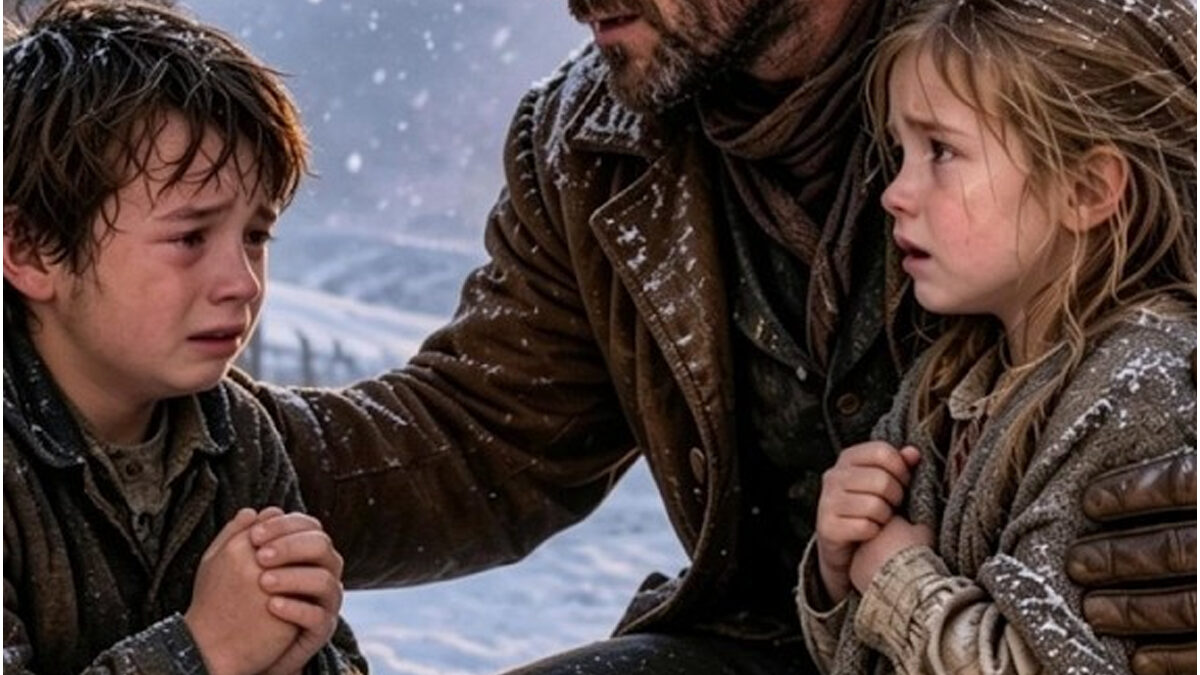
“Please If They Come Back, Save My Sister” – The Rancher Made a Promise That Changed Everything
The snow had been falling for 3 hours and the world had gone quiet in the way that only a Montana blizzard can make quiet.
Not peaceful, but erased.
The wind didn’t howl, it moaned.
The trees didn’t sway, they bowed.
And inside the lean-to that had been their home for 11 days, the boy sat with his back against the wall and his sister’s hand in his, listening to the sound of horses.

Not one horse, two.
He knew the rhythm of those hooves.
He’d heard them before.
He’d heard them the night his mother died.
The boy’s name was Thomas Finch, though no one had called him that in weeks.
He was 12 years old and he had been carrying his sister Ruth since she was born.
Not metaphorically, though that was also true, but literally in his arms across 3 miles of frozen ground after their mother had whispered her last words and gone still on the floor of their cabin.
Ruth was three.
She [clears throat] had their mother’s dark eyes and their father’s stubborn chin and she had not spoken a word since the night the men came.
Not one word.
She ate when Thomas put food in her mouth.
She followed when Thomas took her hand.
She slept curled against his chest, her thumb in her mouth, her breathing shallow and careful as if even in sleep she understood that the world was not safe.
Thomas understood it, too.
He had understood it since he was eight, when his father went to work the copper mines and never came back.
Since he was 10, when he became the man of the house because there was no one else.
Since he was 12, when two men with hard faces and a legal document came to their door and explained that the land his father had bought with 10 years of labor did not, in fact, belong to his family anymore.
His mother had argued.
She had shown them the papers.
She had cried.
The men had been patient.
They had explained that the papers didn’t matter.
That a lawyer in Helena had filed something.
That the land had been sold to someone else.
That they had until the end of the month to leave.
His mother had died three days after they left.
Not from the argument.
From the pneumonia she’d been hiding for two months, working through, not resting because resting meant not eating, and not eating meant the children didn’t eat.
The men hadn’t killed her, but they had taken the last thing she had to fight for, and without it her body had let go.
Thomas had buried her himself in the frozen ground behind the cabin using a shovel he’d found in the barn and his own bleeding hands.
He had said the words he remembered from church.
He had held Ruth while she screamed, the first and last sound she had made since that night.
Then he had taken what they could carry and walked.
The horses were closer now.
Thomas could hear them through the wind, the creak of leather, the muffled clop of hooves in snow.
Two riders, coming slow, coming certain, coming [clears throat] the way men come when they know exactly where they’re going.
Ruth stirred against him.
She didn’t open her eyes, but her hand tightened on his fingers.
“It’s okay,” Thomas whispered.
“I’m here.”
He lied.
He was not enough.
He was 12 years old and hungry and cold, and he had a knife that had been his father’s, but it was not a fighting knife.
It was a whittling knife, for making toys and mending harness.
If the men wanted to take Ruth, he could not stop them.
If they wanted to take him, he could not stop them.
If they wanted to do worse, and Thomas was old enough to know that men could do worse, he could not stop them.
He had stopped them once before, not with the knife, with running, with hiding, with the desperate luck of a boy who knew the land better than men who came from Helena with papers and patience.
But they had found the cabin, and now they had found the lean-to.
The door, a piece of canvas hung across the opening, moved in the wind.
Thomas saw the shadow of the first horse pass across the snow outside.
He held his breath.
He held Ruth’s hand.
He prayed, though he wasn’t sure anymore that God listened to boys who had buried their mothers with their own hands.
The canvas lifted.
A man stood in the doorway, not one of the men from before.
This man was older, broader, wearing a coat that was heavy with snow, and a hat that shadowed his face.
He had a rifle slung across his back, not pointed.
He stood still, looking at Thomas and Ruth with an expression that Thomas couldn’t read in the dim light.
“Easy,” the man said.
His voice was low, rough, the voice of someone who didn’t use it often.
“I’m not with them.”
Thomas didn’t move.
Ruth didn’t move.
The man’s eyes went to the knife in Thomas’s hand.
Thomas hadn’t realized he’d drawn it.
And then to Ruth, curled against her brother’s cheSt. “How long you been out here?”
The man asked.
“11 days,” Thomas said.
His voice [clears throat] came out harder than he meant it to, the voice of a child trying to sound like an adult.
“Since our cabin.”
The man nodded, as if this answered a question he hadn’t asked.
“The two riders behind me, you know them?”
Thomas felt something cold in his stomach.
“They’re coming?
They’re looking?
I passed them on the trail.
They were asking about a boy and a little girl, said they had legal business.”
The man paused.
“I told them I hadn’t seen anyone, but this storm won’t last forever, and when it clears, they’ll keep looking.
Thomas looked at Ruth.
Her eyes were open now, watching the man with the blank, careful stare that had become her only expression.
She didn’t trust him.
Thomas didn’t trust him.
But the man was standing in the doorway of their lean-to, and the riders were behind him, and there was nowhere left to run.
“Please,” Thomas said.
The word came out of him like something broken, something he hadn’t used in a long time.
“If they come back, save my sister.”
The man went very still.
It was the kind of stillness that Thomas recognized.
The stillness of someone who had heard something that mattered, not the words, the choice behind them.
Thomas had not asked for himself.
He had asked for Ruth.
He had made the calculation that a man might save a 3-year-old girl, even if he wouldn’t save a 12-year-old boy.
The man crouched down, bringing himself to Thomas’s level.
His face came into the light from the small fire Thomas had managed to keep burning.
He was [clears throat] older than Thomas had thought, maybe 50, with gray in his beard and lines around his eyes that looked like they had been carved by something harder than weather.
His eyes were pale, almost colorless, the kind of eyes that saw a long way.
“What’s your name?”
The man asked.
“Thomas.”
“And your sister?”
“Ruth.”
The man looked at Ruth for a long moment.
She looked back at him, unblinking, her thumb still in her mouth.
“My name is Silas Drummond,” the man said.
“I have a ranch 12 miles north of here.
It’s not much, but it’s warm, and it’s mine, and no one comes there without my say-so.”
He paused.
“I’m going to take you there, both of you.
And if those men come looking, they’ll have to come through me.”
Thomas felt something in his chest that he didn’t have a name for.
It wasn’t hope.
Hope was dangerous.
It was something quieter, something that felt like the first warmth after being cold for so long you forgot what warm felt like.
“Why?”
Thomas asked.
“Why would you help us?”
Silas Drummond looked at him with those pale eyes.
“Because you asked for her,” he said, “not for yourself.
That tells me everything I need to know about who you are.”
He stood up.
“Can you walk?”
“I can carry her.”
“I know you can, but you don’t have to, not anymore.”
He held out his arMs. Ruth looked at them.
She looked at Thomas.
Thomas nodded, the smallest movement, and Ruth, who had not gone to anyone since their mother died, let Silas Drummond lift her.
She went stiff at first, her small body rigid with fear, but he held her against his chest with one large hand supporting her back, and she felt the warmth of him through his coat, and slowly, incrementally, she relaxed.
Her thumb stayed in her mouth.
Her eyes stayed wide, but she didn’t struggle.
Thomas stood up.
His legs were unsteady.
11 days of cold and hunger and sleeping on frozen ground, and Silas saw it.
He reached out with his free hand and steadied Thomas’s shoulder.
The touch was firm, not gentle.
[clears throat] The touch of a man who understood that gentleness was sometimes an insult to someone who had been surviving.
“Follow me,” Silas said.
“My horse is tied behind the lean-to.
We’ll ride double, you behind me, your sister in front.”
They went out into the snow.
The wind hit them like a physical thing, and Thomas felt Ruth flinch against Silas’s cheSt. But the man didn’t hurry.
He moved with the deliberate patience of someone who who learned that rushing in a blizzard was how you died.
His horse, a big gray with a coat thick as a bear’s, stood where he’d left it, blowing steam into the cold air.
Silas mounted first, settling Ruth in front of him, wrapping his coat around her.
Then he reached down and pulled Thomas up behind him.
The saddle was warm from the horse’s body.
The leather smelled of oil and use.
Thomas put his arms around Silas’s waist and felt the solid reality of him.
A man, a horse, a direction, a promise.
They rode north.
The snow swallowed the sound of their passage.
Thomas watched the world disappear behind them.
The lean-to, the trail, the last landmarks of a life that had ended 11 days ago.
He didn’t look back.
He had learned not to look back.
But he listened.
He listened for the sound of other horses, other riders, the men with the papers and the patients who had taken everything from his family and were still not satisfied.
He listened until his ears ached with listening, and he heard nothing but the wind and the horse’s breathing and the creak of saddle leather.
12 miles in a blizzard took 3 hours.
By the time they reached the ranch, Thomas couldn’t feel his feet, and Ruth had fallen asleep against Silas’s chest, her small face hidden in the folds of his coat.
The ranch appeared out of the snow like a dream.
A low house with smoke rising from the chimney, a barn that was larger than the house, a corral with horses standing hip-deep in snow, their heads down, waiting out the storm.
A woman came to the door as they rode up.
She was older than Silas, with white hair pulled back in a severe bun, and a face that looked like it had been handsome before worry carved it into something else.
She wore a man’s wool coat over her dress, and she held a lantern that threw a circle of yellow light into the falling snow.
“Silas,” she said, not a question, a statement that contained a question.
“Found them in the old Macalester lean-to,” Silas said.
He dismounted carefully, keeping Ruth cradled against him.
“Two children.
The girl’s not speaking.
The boy’s been carrying her for 11 days.”
The woman, Thomas would later learn her name was Cora, and that she had been Silas’s housekeeper for 20 years, and that she had lost her own children to fever 30 years ago, looked at Ruth’s face, then at Thomas’s.
“Get them inside,” she said.
“I’ll heat water.”
The house was warm.
That was the first thing Thomas noticed, the warmth, the shocking, overwhelming warmth of a room that had been heated by a wood stove for hours, the air thick with the smell of coffee and something cooking that made his stomach clench with a hunger he hadn’t allowed himself to feel.
Cora took Ruth from Silas’s arms and carried her to a chair by the stove, unwrapping her with the efficient tenderness of someone who had done this before, who had held cold children and warmed them back to life.
Thomas stood in the doorway, unsure what to do with himself.
He was filthy.
11 days in a lean-to had left him covered in ash and sweat and the grime of survival.
He was hungry.
His stomach was making sounds he couldn’t control.
He was exhausted.
His body was shaking with the aftermath of cold and fear and the sudden dangerous safety of this room.
“Sit,” Silas said.
He pointed to a chair.
Thomas sat.
Silas poured coffee from a pot on the stove, real coffee, not the chicory Thomas had drunk at home, and put it in front of him.
Then he put bread on the table, real bread, not the hardtack Thomas had been rationing, then butter.
Want to see what happens next?
Go to the comment section and click the link in the pinned comment.
It’s the very first comment you’ll see.
The story continues exactly where this video ends.
I’ll see you there.








