The Frozen Bigfoot Mother Begs For Shelter – What Happens Next Leaves Everyone In Tears!
The Frozen Bigfoot Mother Begs For Shelter – What Happens Next Leaves Everyone In Tears!
Have you ever felt like the world just forgot about you?
This old man had lost his wife, his daughter, and for 18 long years he lived alone in a frozen cabin deep in the Bitterroot Mountains with no one but his dog and memories carved into wood.
But one night, in the middle of a brutal snowstorm, something impossible appeared outside his frostcovered window.
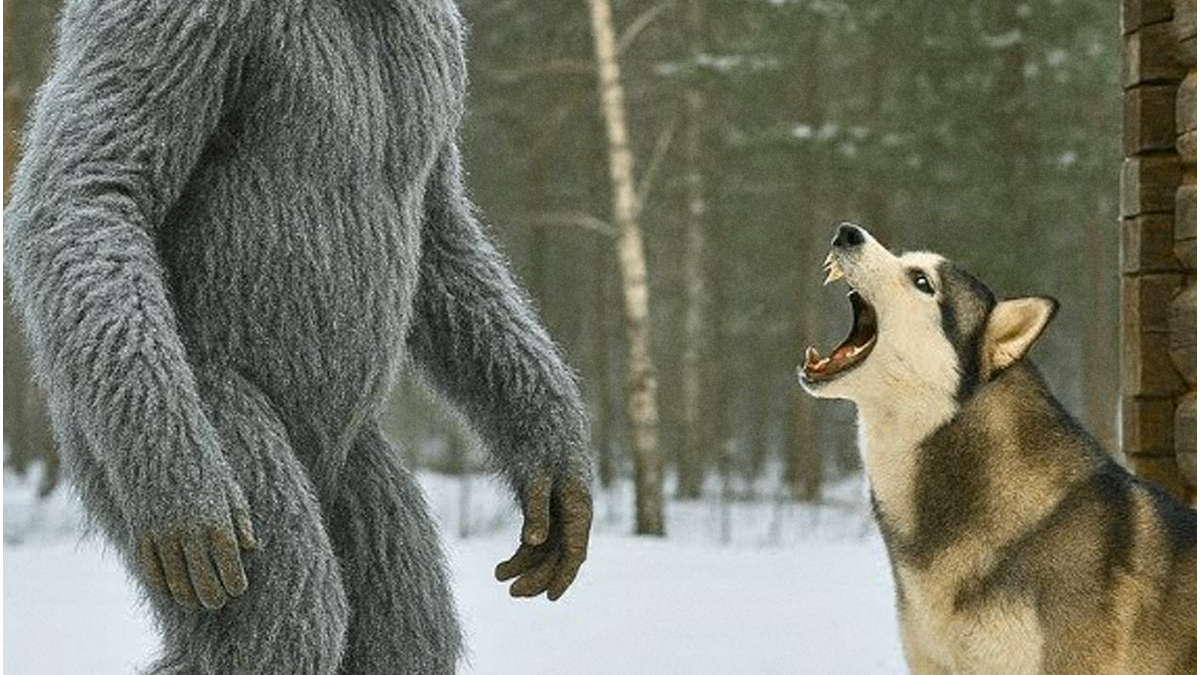
A massive creature, a Bigfoot, staring at him, not with rage, but desperation.
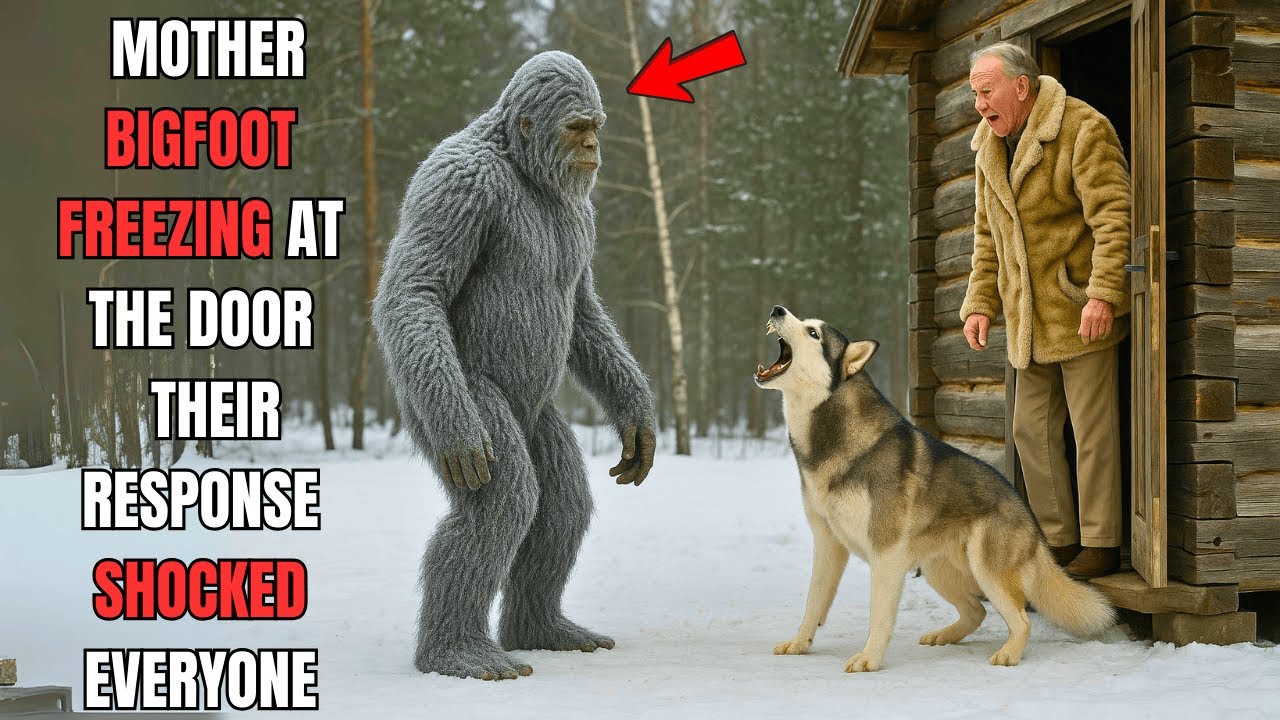
It didn’t come to harm him.
It came to beg for help.
Here’s the truth no one tells you.
Sometimes it’s the monsters that teach us how to love again.
He wrapped a freezing baby Bigfoot in his wife’s old sweater.
He cried for the first time in decades when the mother left behind a bundle of moss, her way of saying goodbye.
And in the end, he carved a statue and wrote one word beneath it.
Home.
If you’ve ever believed happiness might never return.
Watch this before you missed the one story that could restore your hope.
The wind howled like a wounded thing, dragging snow sideways across the crooked porch railings, tearing through every crack in the cedar boards of the cabin walls.
The air outside was all teeth and no mercy.
Chewing at the mountains like it wanted to flay the earth down to bone.
Inside, the fire cracked slow and steady in the cast iron stove.
Shadows rocking back and forth across the cabin walls like tired dancers who didn’t know when to stop.
Nate Harlo sat at his workbench, the oil lamp casting a soft amber halo around the carving knife in his hand.
His fingers were stiff with age, but steady, working the edge of the blade along the grain of a half-finished block of pine.
The shape of a small bird was coming to life there, wings tucked close, head bowed low.
Whisper lay curled on the rag rug near the stove, ears twitching every time the wind rattled the old window panes.
Her fur was thick, blue gray, almost silver in the fire light, but her eyes stayed open, watching, always watching.
Nate didn’t say much anymore, but the dog had learned to understand what mattered without words.
She knew the silence in that house wasn’t empty.
It was full of things he couldn’t say.
The storm had come down fast from the north, the way winter storms did in the bitter roots, like it was angry about something and had picked this little cabin in Alder Creek to take it out on.
Snow piled high against the window sills.
The old maple out front bent low under ice, groaning in the wind like it might give up altogether.
Nate wiped the sweat from his brow with the back of his sleeve and set the carving knife down.
His joints achd.
His breath made little clouds that hung in the air before fading away.
He reached for the oil can, gave the blade a drop, then turned his eyes to the window and stopped.
On the inside of the frosted pane, three trails of breath had formed.
Not handprints, not condensation from inside.
These had come from the other side, perfectly spaced, two long, one short.
His breath caught.
He stayed still, one hand on the bench.
The marks didn’t smear or melt.
They stayed.
Whisper let out a low, uncertain growl.
Not the kind that meant danger.
The kind that meant something was wrong, but not evil.
Nate stood slowly.
Every joint felt like it had sand in it.
He crossed the room, eyes locked on those ghostly lines on the glass.
The cold radiated through the pain.
He raised his hand, touched the glass gently from the inside.
The pain was colder than it should have been, like something enormous had been standing just inches away for a long time.
Then movement.
A slow, heavy shadow shifted just beyond the porch.
Not a man.
Too tall.
Shoulders too broad.
But it wasn’t trying to hide.
It wasn’t crashing through the woods or slamming fists.
It was just waiting.
Whisper moved to his side now, tail low but steady, standing between him and the door like a question.
The wind pulled hard at the walls again.
Nate reached for the latch.
His fingers paused, then drifted to the coat hook by the door.
He pulled down an old wool coat.
It was too small for him now.
The color had dulled from rust red to earth brown along the seam of the left sleeve.
The stitching was uneven, done by hand years ago with thread that didn’t quite match.
Lily had sewn it.
After her mother passed, she’d tried to take care of him in all the little ways she knew how.
She was 12.
She’d used embroidery thread.
That sleeve had never held right since.
He didn’t wear it anymore, but he hadn’t thrown it out either.
He held it tight, then opened the door.
The wind punched into the cabin like a wave, flinging dry snow across the floor and blowing out one of the lamp flames.
Whisper didn’t flinch, standing there just beyond the threshold.
Was something too big for this world, covered in wet, matted hair the color of wet bark with shoulders that rose nearly to the top of the door frame.
Its eyes, dear God, those eyes weren’t wild.
They weren’t glassy or animal.
They were heavy with fatigue, red around the rims, not from rage, from cold, from wind, from time.
It didn’t move forward.
It didn’t roar or stop or reach.
It just met his gaze.
Nate held the coat in his hand, the weight of it suddenly unbearable.
Behind him, the fire hissed and crackled.
Before him, the creature blinked snow from its lashes.
Its arms hung at its sides.
Every breath it took fogged the air, trailing out slow and weak.
Whisper took one step forward.
Not toward it, not at it, just forward.
Then she stopped.
Her tail flicked once, then still.
She looked back at Nate and lowered her ears just slightly.
Not fear, not warning.
Permission.
Nate stepped aside.
The thing didn’t enter.
It didn’t even raise a foot.
It stood there shivering like it didn’t expect to be let in, but had come anyway.
The storm raged on behind it.
Snow swirled around its feet.
Nate looked down at the wool coat, then at the figure in front of him.
The coat was too small, but it was warm.
He raised it slowly, not to offer.
To remember.
He stepped forward just past the doorway and draped it over something that wasn’t built to wear it, but didn’t resist.
The creature let out a breath, not a sound, just a warm sigh into the cold.
Whisper stepped to the edge of the doorway and sat.
One paw forward, watching, Nate pointed to the side of the porch, where the roof still gave some shelter from the worst of the snow.
A wooden bench, old but strong.
The creature moved, limping, shoulders slumped.
It sat.
Its hands were thick as Nate’s calves, but they lay flat in its lap, palms down, still not threatening.
The snow kept falling inside.
The shadows danced again.
He didn’t know what the hell was going on.
He just knew that something had come through a blizzard for something it couldn’t ask for.
And for the first time in years, Nate didn’t close the door all the way.
He left it a jar, just enough to catch the warmth, just enough to hear the breath beyond it, just enough to know he wasn’t alone in the storm anymore.
By morning, the snow would freeze solid again, and the world would go back to pretending it didn’t see things like this.
But tonight, the wind knew better, and so did he.
Beside the step, melting into the floorboards, a faint pool of water grew, not just from snow melt, from blood or exhaustion.
Something had come a long way, and it wasn’t done yet.
The wind had softened by morning, but the cold had not.
It clung to every surface, every breath, every bone, settling deep like a silence that didn’t want to leave.
Nate stood at the doorway again, staring out at the figure hunched on the bench beneath the overhang.
The snow had drifted up halfway along the legs of the bench, crusting around the creature’s ankles, but it hadn’t moved.
Its shoulders were bowed, not in fear, not even in defeat, just stillness.
The coat he draped over her was soaked through now, sagging from the weight of melted snow.
Whisper sat like a statue beside him, tail curled neatly around her front paws, eyes never leaving the figure outside.
She didn’t growl.
She didn’t twitch, but she hadn’t blinked in a long while either.
Nate stepped out slowly, boots crunching on the packed snow.
He didn’t speak.
He knew whatever this was didn’t belong to words.
His breath steamed out in puffs, mingling with the faint mist still rising from the creature’s fur.
She wasn’t gone, but she was near some edge he couldn’t name.
He crouched beside the bench, pulled back the coat a bit, and saw it now.
Blood seeping slow from a tear along the upper arm, mixed with patches of skin rubbed raw from wind and ice.
The kind of wounds you don’t scream about.
The kind you just carry until you fall.
He went back in without looking at her face.
Whisper followed, but only to the threshold.
Nate moved with a quiet precision of someone who’d lived long enough to know what needed doing didn’t need drama.
He retrieved a tin box from a high shelf, its label long, worn off.
Inside strips of old cloth, a roll of hand cut gauze, a small tin of rendered deer fat from a hunt years ago, maybe the last one.
The smell was faintly sweet and sharp with age.
He dipped his fingers into the salve, testing the consistency, nodding once to himself, then returned to the door.
She hadn’t moved, not an inch.
He motioned low with one hand, not to invite, but to signal.
I’m coming back.
I’m not a threat.
When he stepped closer, Whisper padded out behind him.
She didn’t intervene, just hovered, always at the side, always watching.
He knelt, gently lifted the injured arm, surprised by the weight.
The fur there was thick, tangled with mud, blood, and burrs.
Underneath, torn skin, muscle bruised a deep red purple.
She made a sound then.
Not a growl, not a whimper, just the softest exhale, like pain acknowledged without demand.
He worked carefully, as if repairing a cracked beam.
Clean the wound.
Apply the fat.
Bind it tight.
Not too tight.
The motion was old, familiar, from a time when Lily had fallen from a tree and gashed her thigh.
And he’d panicked until her mother took his hand and said, “Just breathe, Nate.
Breathe.”
And do.
That memory hadn’t come to him in years, but it sat beside him now, uninvited, steady.
He slid the salve back into his coat pocket and looked up at the eyes watching him.
There was no fear in them.
No expectation, only the slow, patient ache of something that had learned to endure.
He stood and motioned toward the corner of the porch.
She shifted just slightly, and he laid the blanket there, then pulled a sheet of old canvas, stiff and cracked from years of sun, from the tool shed.
He rigged it up along the side of the porch, draping it from the eaves down to the railing, breaking the wind just enough to turn the porch into something close to a shelter.
He set the bench back against the wall.
Then, with the same rhythm he used when arranging wood for the fire, he dragged out the thinned ladderback chair and the worn saworse, laying them on their sides between the open doorway and the bench.
A line, not a wall, but clear enough.
He didn’t explain it, just made it, then stepped back.
She didn’t test it.
Instead, she lay back down on the bench, one arm draped across her middle, the other curled protectively near her side.
Her eyes blinked slow, then closed.
A moment later, they opened again, sharp but calm, fixed on Whisper, who had not moved.
Whisper now lay stretched across the threshold, not blocking, just marking.
Her head on her front paws, ears flicking only slightly at the wind.
The creature watched her.
Whisper watched back.
There was no growl.
No challenge, just a silent negotiation.
Neither Nate nor the world was meant to interrupt.
Nate stepped inside and closed the door most of the way, but not all.
He returned to the stove, refilled the kettle, and set it at top the grate.
The fire hummed and water began to bubble with soft anticipation.
He prepared two tin cups, filled one with hot water, and stepped back to the door.
He pushed the door open gently, reached across the low barrier he’d made, and placed the cup on the porch floor just at the edge of the canvas shadow, then stepped back again.
She didn’t reach for it immediately.
She sniffed the steam first, then sat up just enough to curl one enormous hand around the cup.
The ceramic looked small in her grip.
She didn’t drink much, just a sip, then another, then held the cup between both palms like it was something sacred.
Whisper didn’t flinch.
The quiet was complete.
Inside, Nate leaned against the counter, one hand curled around his own cup, eyes drawn to the shelf above the stove.
The wooden statue of Lily stood where it always had, tucked beside a pair of dried flowers in an old jelly jar.
Her face was young in the carving.
Forever 12, forever unfinished.
He stared at it now.
Not with longing, but with a question.
If it were you, he murmured barely above breath.
What would you want me to do?
The stove popped, splitting a log, and the room shifted just slightly with the sound.
Nate set his cup down and reached for the tin of oats.
Familiar motion.
A pinch of salt.
Water.
Stir slow.
Let it thicken.
No need to rush.
Behind him, whisper shifted.
Her ears stood straight up.
Nate turned.
The creature was still on the bench, but now her body was leaning ever so slightly to the side.
Not out of balance.
Listening, her nostrils flared once, Nate stepped toward the door again, careful not to startle.
Then he heard it, too.
A sound faint, scratching, not claws, softer, lighter, from beyond the edge of the porch, just outside the line of sight.
Whisper was standing now, not growling, not bristling, just alert.
Her body blocked the space between the door and the stairs.
Nate stepped out following the gaze.
There was nothing in the snow yet.
No shape, no shadow.
Then he heard it again.
A soft sound like something brushing against wood.
A small hollow knock.
Not deliberate, accidental.
He moved slowly toward the edge of the porch, handbrushing the door frame.
The storm hadn’t covered all the old prints yet.
Some were half buried.
Some were new.
The creature on the bench did not rise, but her breath had quickened slightly.
Her chest moved with more urgency now.
Whisper looked up at Nate.
Then she stepped forward and placed one paw against the door.
A soft scrape once, twice, then sat down, facing the woods, waiting.
Nate’s fingers tightened on the edge of the door frame.
The air felt heavier again.
Not colder, just fuller, like something was nearby that wasn’t supposed to be alone.
He didn’t move.
He just listened.
And in the hush that followed, with snow still whispering across the shingles and the kettle starting to hiss behind him.
Nate understood.
Something else was out there, something small.
And the silence wasn’t done speaking.
The storm hadn’t stopped.
It had only shifted into something quieter, more dangerous.
The kind of cold that crept instead of howled, that waited instead of chased.
Nate stood with his back against the door frame, boots laced tight, coat zipped halfway up, wool’s scarf looped once around his neck.
Whisper paced near the threshold, nose twitching, her every step drawing a shallow line across the packed snow.
Her ears twitched, not from noise, but from instinct.
There was a rhythm to her now.
A movement she used when tracking.
She didn’t bark.
She didn’t look back.
Just caught once.
Soft, short, and sharp.
A sound Nate hadn’t heard since the winter lily went missing.
He grabbed his gloves.
The deer fat tin was still warm from the stove, tucked into his inner coat pocket beside a folded strip of cloth.
The same kit he’d used last night.
The same hands, but they felt older this morning, heavier, like something beneath the skin had changed.
Outside, the Bigfoot mother sat curled under the canvas, her eyes trained not on Nate, but on Whisper, watching, waiting.
Her shoulders were hunched, fur crusted with ice at the tips, but she didn’t move, didn’t follow.
She didn’t need to.
She had already given permission.
The way her body had leaned ever so slightly toward the forest when whisper had first stirred.
The way her massive hands had opened at her sides, not as a gesture of peace, but of surrender, a kind of pleading without motion.
Nate followed Whisper down the slope, boots crunching along the edge of the trail he hadn’t used in weeks.
The snow was thigh deep in places, but Whisper zigzagged like she knew where it thinned.
Her body cut into the drifts with purpose.
Each step a decision.
They climbed a ridge low and jagged where wind had swept the snow into thin sheets.
Nate used his hand to brace against a birch tree, panting hard.
Whisper waited ahead, head low, eyes forward.
Then the wind changed.
It hit his face and brought with it something warm.
Not heat, a scent, animal sharp, but muted.
Not rot, not fresh blood.
Living something alive.
Whisper crouched.
Her front paw lifted, then planted softly.
She turned slightly, locking eyes with Nate.
And then he saw it.
Just below the ridge, nestled in a shallow pocket of snow, too clean, too round to be natural.
There was steam rising, barely visible, a weak pulse of warmth pressing through the cold.
Nate slid down the bank, knees hitting the snow, palms dragging in.
The edges of the drift gave way easily like breath.
He dug with his hands, not fast, but deliberate.
He remembered what shock could do to an injured thing.
He remembered holding Lily after the creek had swept her away, and how he’d screamed not because she was gone, but because her skin was still warm.
Now he moved like he was carving a cradle, not a grave.
His fingers struck something dense.
He paused, brushed away another layer.
Fur soaked, matted, gray brown like the mothers, but finer, softer.
It twitched once under his palm.
The body beneath was no larger than a child, maybe 50 lb, maybe more.
He got both hands under its arms, pulled it slowly into his lap.
Its limbs flopped like soaked rope, lips dark, almost blue.
Eyes closed, whisper pressed in behind him, her body a shield against the wind.
She didn’t make a sound.
She just pressed closer, her chest heaving slow and deep.
Nate pulled off his scarf, wrapped it around the creature’s upper body, then reached inside his coat and pulled out the wool jacket, the same one from the porch.
Still damp, but still warm with memory.
He wrapped it around the small body, pressing it tight against his own chest.
He whispered something, though he didn’t know what.
Maybe just breath.
Maybe just grief echoing backward through time.
Whisper led them back.
The route shifted slightly, avoiding the ridge, moving through the treeine where the wind couldn’t tear at their faces.
Nate carried the creature with one arm around its back, one under its knees.
The weight was awkward, not because it was heavy, but because it felt like something unfinished, like setting down a half-carved piece of wood you weren’t ready to give shape to yet.
By the time the cabin came into view, Nate’s legs were trembling.
The Bigfoot mother hadn’t moved.
But when she saw them coming, her body straightened.
She didn’t rise.
She didn’t roar.
She just sat up taller and reached her arms out.
Not to take, but to receive.
Nate stepped onto the porch, knees wobbling.
He knelt slowly, letting the weight slide from his arMs. The creature rolled gently into its mother’s lap, limp, but breathing.
She cradled it with care that made Nate’s throat tighten.
Her eyes met his, not for thanks, not for debt, but in something far older, far harder.
Recognition than her hand moved.
Not fast, not aggressive.
She reached forward and placed one massive palm on Nate’s shoulder.
It was warm.
Not from body heat, from something else.
Time, maybe.
Grief, hope.
He didn’t flinch.
He just breathed.
And she did, too.
Then he stood, went inside, stoked the fire, set a small cast iron pot on the stove, and poured in water and oats.
He stirred with a wooden spoon, the handle worn smooth by decades.
When it thickened, he added a touch of salt, stirred again, then ladled a small scoop into a tin bowl.
He cut the mixture with more water, cooled it down.
Not too hot, not too fast.
He stepped back out and crossed the line of chairs and makeshift barriers.
Whisper didn’t move.
The creature on the mother’s lap stirred now, mouth twitching slightly.
Nate dipped the spoon, lifted a small bite, and held it near the child’s mouth.
The mother didn’t pull away.
She didn’t intervene.
She watched.
The spoon touched the lips.
They parted barely.
He offered a second bite.
A third, each movement smaller than the last.
Measured, earned.
Whisper shifted closer to the edge of the porch, her nose lifting, ears flicking once.
A breeze swept across the steps.
It carried with it something Nate hadn’t noticed until now.
A scent, not strong, not threatening, but different.
Milk, faint, wild, like the ghost of something familiar blown in from a 100 miles away.
Whisper stood.
Her head turned toward the woods again.
She didn’t bark, didn’t growl, but her tail stiffened, and her paws dug slightly into the snow.
The Bigfoot mother’s breath hitched just once, then returned to normal.
But her eyes followed the same direction.
And Nate knew this wasn’t over.
Not yet.
Something else was still out there, still waiting.
The light had shifted again.
Not warmer, not yet.
But clearer.
The sky above Alder Creek had traded its angry gray for something pale, almost translucent, like a sheet of ice stretched thin over hidden current.
Nate felt it on his skin before he saw it.
The way the air seemed to lift just enough to allow breath without pain.
He didn’t trust it.
The mountains never softened without reason.
Not in March, not in a storm like this.
But Whisper had already made up her mind.
She’d stood by the door for nearly 15 minutes, ears flicking toward the forest, tail low but certain.
Every few seconds, her nose twitched and she turned her head slightly toward the break in the ridge.
The same spot they’d come from yesterday.
But this wasn’t memory.
This was something new.
Knight zipped his coat up higher, slipped a dried cord of fatwood into his back pocket, checked the bandages in the small tin he’d refilled at dawn.
The second Bigfoot child had survived the night barely.
Fever had settled in just before sunrise, and he’d sat for hours with a damp cloth pressed gently to the furred forehead, watching the chest rise and fall in shallow waves.
The mother hadn’t slept.
She hadn’t moved either, just held her child with both arms, rocking in a rhythm that didn’t match the wind or the breath of fire.
Something older, something that pulsed with a grief too patient to scream.
Now she stood near the edge of the porch, her massive shoulders hunched, one hand resting lightly against the beam of the doorway, not leaning for balance, but as if holding on to something invisible.
She looked toward Whisper, not at Nate, not at the cabin, toward the dog.
Then she took a single step forward and stared into the trees.
That was enough.
Whisper trotted down the steps, paused at the bottom, and glanced back only once.
Nate followed.
The snow had crusted overnight, thin and brittle on top, but slushy beneath.
Each step cracked through with a soft crunch, like stepping through old bones.
The climb to the ridge wasn’t long, but it was slick.
Nate grabbed the exposed roots of a twisted pine to brace himself, muttered under his breath when one slipped loose.
Whisper was already ahead, her body weaving low, pressing through tight gaps between frozen brush.
The path curved north, then cut east, where the ridge narrowed to a seam of frozen shale.
Nate stopped just short of the edge, leaned forward, and felt the cold snake up his spine.
The ravine opened up below him like a wound, narrow and steep.
The bottom lined with driftwood and shattered branches.
Somewhere down there, something moved.
Not loud, not frantic, but weak, sinking.
The edges of the slope were iced over in places, the sheen thin and deceptive.
Whisper winded now, softly, pawing at the earth near his feet.
Her nose pointed toward the far side, where a cluster of rock and snow had caved in, slightly, just enough to swallow something small.
Nate stepped forward and slipped only a few feet, but the ground beneath him broke like glass and he landed hard on his side, sliding a few yards before catching himself with his elbow.
His breath knocked out, eyes blinking against the sting of cold.
He tasted blood at the edge of his lip.
Before he could push himself up, he felt a hand grab his sleeve.
Not whisper, something large, something warm.
Fingers like branches wrapped around the cuff of his coat, then pulled.
He was yanked backward, not fast, not violent, but with strength that defied resistance.
His boots scraped against packed snow, his body dragged halfway up the slope until he could scramble on his own.
He looked up.
The mother stood over him, arm outstretched, chest heaving slightly.
Her breath steamed like smoke, and for a moment, her face hovered inches from his.
Her eyes locked on his.
They weren’t just wild.
They were alive, calculating, urgent.
Then she let go.
He caught his breath, shook the snow from his gloves, and nodded once, more to himself than her.
He reached into his coat, and pulled out the length of forest cord he’d packed that morning.
Guy rung, twisted, dried, sturdy.
He ran it through his fingers, then bent down and began to knot.
No words, no plan, just rhythm.
The muscle memory of old fishing trips, of tying sacks closed in the barn.
His fingers moved fast.
One loop, one hitch, a thistle knot, a soft catch knot.
He tied them blind, hands working even as his eyes searched the slope for anchoring points.
There, a low stunted pine just to his right.
He crawled to it, looped the line around its base twice, checked the tension, then rolled back toward the edge.
The drop wasn’t sheer, but it was steep, and the ice below gleamed like it was daring him.
He tied the free end into a soft belly loop, slid it over his shoulders, tightened it at the waist.
The mother crouched nearby, watching.
She didn’t interfere, but she didn’t look away either.
Nate dropped to his stomach and began to crawl.
Whisper waited near the top, tail thumping low, eyes locked on the ravine.
Every foot forward sent small shards of ice breaking loose beneath him.
He moved like a soldier across frozen ground, careful not to put weight where snow bowed.
His gloves scraped over rock, leather catching on the jagged edges.
Then he saw it.
A small body half submerged under a sheet of collapsed snow.
Only one arm visible.
Clawed fingers curled tight.
Fur dark with ice.
No movement.
Nate moved faster.
He reached the body and pressed his hand to its chest.
Nothing.
Then again, a twitch.
Faint, then shallow breath.
He let out a breath of his own he hadn’t realized he was holding.
He dug the rest of the child free with bare hands.
Fingertips raw, nails cracked.
He wrapped the limp body in the bottom of his coat, pressed it close, then began the crawl backward.
Every pull of the rope burned in his shoulders.
The ice cracked under his boots once, then again, but he didn’t stop.
The mother stood ready, whisper braced near the cord, teeth gripping a section of the rope, tensioned tight as piano wire.
When Nate reached the slope, he felt the line go taut.
The rope shifted and then he was being pulled slowly, roughly, but together the three of them, man, beast, and something between, moving as one mechanism, one strange and silent team.
When they reached the top, Nate rolled onto his back, gasping, his face against the sky.
The clouds above were breaking, the faintest edge of blue cutting through.
He turned his head.
The child coughed just once, but it was sound.
It was life.
The mother let out a breath so deep it seemed to echo inside her.
She bent forward, lifted the child into her arms and held it close.
Then, without looking at Nate, she pressed her forehead gently to his, only for a second.
Then she stood and began walking back toward the cabin, the snow parting in silence ahead of her.
Whisper fell in step beside him.
Nate stayed where he was for a moment.
The scent of cedar and old sweat on his coat, the sky rolling above like a second ocean.
He didn’t feel old.
He didn’t feel broken.
He just felt full.
The wind had changed again.
This time it carried no thread, only breath and something like forgiveness.
The cabin glowed with a kind of hush that couldn’t be made by fire alone.
Outside, the wind had gone still.
Not gone, just quiet, like the forest was listening.
Inside, the air carried a low hum of warmth, the kind that soaked into bone after days of being battered raw by cold.
The old stove crackled steady, the fire inside pulsing orange across the log walls.
Shadows moved slow, brushing across shelves, across the worn rug, across Nate’s boots.
As he sat hunched on the short stool beside his workbench, carving knife in hand, thumb guiding each pass along the soft pine block like he was tracing something already there, something that had always been there, but just needed him to uncover it.
He hadn’t planned to make anything.
But when he came in after the rescue, his hands had gone to the scrap bin like they used to when Lily was still here, and the nights were long, and carving was the only thing that kept the quiet from turning cruel.
The piece he’d pulled was a palmsized lump of old pine.
Nothing remarkable.
But as the blade found its way through the grain, the shape had started to show.
Small, round shouldered, thick fur, a lowered head just like the one that had trembled against his coat two nights ago.
He carved slowly, respectfully, like it was something sacred he’d been given permission to remember.
He glanced up at the shelf.
Lily’s statue stood still, young forever, strong in the shoulders.
The maple had aged well, darkened to a warm honey over the years.
She looked out across the room toward the fire, where the two young Bigfoot now lay curled beside their mother, their breathing steady, rising and falling in tandem.
One of them had shifted in the night, just enough to let a narrow hand rest across the other’s back.
The mother hadn’t moved.
She sat beside them like a guardian carved from stone, her eyes half-litted, watching always.
And yet she hadn’t crossed the boundary.
The line Nate had made from chairs, the saworse, and an overturned step stool still marked the invisible edge between his life and theirs.
No one had stepped over it.
Not him, not her, not even Whisper, who now lay curled just inside the stove’s glow, her head resting lightly on her front paws, ears halfcocked in a posture that said she was listening even in sleep.
She had moved closer a little each night from the doorway to the hearth, from the hearth to the rug, and now just near enough to the children that her body heat spilled across the floorboards toward theirs like a bridge.
Nate leaned back, stretched his shoulder with a soft grunt, then set the half-finish carving beside Lily’s on the shelf.
For a moment he looked at them both two different times, two different griefs, and saw something between them, a thread, maybe or a permission.
He exhaled.
Then he stood and crossed the room to the fire.
The kettle had begun to rattle.
He poured a little water into a tin bowl, then added a handful of oats and a pinch of salt, stirring slowly, letting it thicken without boil.
When it was ready, he ladled a spoonful into a wooden cup, blew gently, then knelt and placed it on the floor just behind the boundary.
He didn’t say anything, didn’t gesture.
He just placed it there and returned to his chair.
The Bigfoot mother blinked slowly.
Her eyes moved between the cup and Nate’s face.
Then she looked at Whisper, then back to the children.
Only after several breaths did she move.
She leaned forward with care, reached one long arm across the boundary, not over it, and retrieved the cup.
She held it for a moment, sniffed the contents, then dipped two thick fingers inside, stirred once, then brought it to her lips.
She sipped without noise, without mess.
Her movements refined, cautious, not wild, not desperate.
When she was done, she set the empty cup beside the fire, not on the rug, not near the children, just beside the heat.
Nate’s chest achd.
He didn’t understand why exactly.
He just knew that in that quiet act, something had changed.
Not everything, but enough.
The wind outside pressed once against the cabin walls, like a hand checking if the world still held.
He looked down at Whisper.
She’d moved again, no longer curled alone.
She now lay between the two young ones, her side against their backs, her breath matching theirs.
The older one, the first child, had one small hand tangled in the loose fur around Whisper’s shoulder.
Nate felt his throat tighten.
He turned back to his workbench, picked up the carving, ran his thumb along the ridges of fur.
That night’s sleep came late, but it came without the usual weight.
And when he dreamed, it wasn’t of Lily lost, reaching through the river.
It was of her, as he’d carved her, young and whole, watching from across the room with eyes soft, with hands folded in her lap, her voice not heard, but felt.
When he woke, the fire had died down to coals.
The cabin was quiet.
But something had changed.
He sat up slowly, joints crackling in protest, and reached for the poker.
But then he saw it.
The Bigfoot mother wasn’t asleep.
She sat facing the shelf, facing the statue of Lily.
Her eyes weren’t wide, weren’t afraid, just deep.
And in the stillness between them, something passed.
Something that didn’t need translation.
He didn’t speak, didn’t interrupt.
He just added two logs to the fire.
Watched it catch.
Watched the light flicker over fur, over carved wood, over faces.
Some real, some remembered.
The fire didn’t roar.
It didn’t dance.
It breathed slow and warm.
Like something learning how to stay.
By morning, the snow on the roof began to slip.
Not in sheets or thunderous falls, just soft releases, thin slices of ice and melt water sliding down the slope, dropping in slow rhythm against the porch eaves like a broken clock, trying to remember time.
Nate stood at the window, mug of weak coffee in one hand, the other resting on the sill.
The world outside was still white, still hushed, but not buried.
Patches of brown earth showed through along the narrow footpath he’d worn these last weeks.
The wooden steps, once nearly invisible beneath drifts, now showed edges.
The shadows had changed, too.
Longer, softer, slung sideways across the ridge like the mountain had exhaled in its sleep and wasn’t ready to draw in again.
Something was shifting behind him.
The fire had burned down to low embers, but the cabin held its heat.
The air wasn’t sharp anymore.
Just quiet.
The kind of quiet that doesn’t ask for anything.
It just sits with you.
The mother stood by the door.
Not waiting.
Not uncertain, just standing.
Her eyes fixed on the same light breaking across the trees that Nate had watched for years.
The same bend in the ridge where the sun always appeared first in March.
She blinked slowly.
Her hands rested gently at her sides.
No urgency, no ache.
He didn’t ask anything.
He just nodded once.
She stepped forward.
Not across the threshold, not back inside.
She stepped onto the porch, turned to face him one last time.
Her gaze wasn’t heavy.
Wasn’t grateful.
It simply held him.
Then, like she had always known the path, she started down it.
One careful step, then another.
Her back straight, her shoulders broad.
The two young ones followed close behind, smaller feet padding across thawing wood.
The smallest turned once to glance at the door frame where whispers sat, head tilted, ears perked.
Nate watched as the young one blinked, hesitated, then walked on, but not before one slow blink in return from whisper.
No words, no goodbye, just understanding.
At the bottom of the steps, the mother paused.
She reached down and placed something carefully on the ground, parallel to the edge of the trail.
It was small, green gray, a bundle of row moss dried and gathered neatly, still damp from melt.
She laid it down with both hands, perfectly aligned with the curve of the path.
Then she straightened, turned back into the forest, and walked away.
The moss stayed behind.
Nate didn’t move for a long while.
Not until the light shifted again.
Not until he could no longer hear even the faintest branch sway in the distance.
He knelt, ran his fingers gently across the bundle.
Still soft, still warm, he knew what it was.
He didn’t need a language for it.
It was a line, a pause, not an end.
He stood.
Whisper leaned her head against his leg.
They watched the trees a while longer, then turned back inside.
The cabin felt different now.
Not empty, not quiet, but waiting for something else.
He placed another log on the fire, then pulled the old bench from the corner, the one that had sagged when Lily was young and always leaned a little to the left.
He took it out front, sanded the splinters, tightened the screws by hand, and set it at the edge of the trail.
It faced the treeine.
He didn’t sit.
Not yet.
Instead, he reached for the tin jar above the stove.
Inside were the last of the wildflower seeds Irene had gathered 2 years before she passed.
She tucked them into the lining of an old cloth handkerchief written for later on the corner in shaky ink.
He hadn’t touched them since.
Now he opened the cloth and poured the seeds into his palm.
Then he walked the trail, kneeling every few feet, pressing the seeds into soft earth just where snow had begun to fade.
Not deep, not in rows, just scattered like they might find their own way.
Some would die, some would sleep and wait, some might bloom.
That was enough.
At the last bend of the trail, he paused, then pressed one final seed into the soil beside the bundle of moss the mother had left, and walked back.
That evening, the sun lingered a little longer behind the western hills.
The wind carried something else now.
Not threat, not chill, but the scent of damp earth.
Pine bark warmed by daylight.
A single sparrow landed on the edge of the porch, left a clean track across the wood, then flew off.
Whisper sat facing the trail.
Nate stood behind her, arms folded, and for the first time in a very long time, he didn’t brace himself against the feeling of being alone because it didn’t feel like absence anymore.
It felt like breath, a pause.
The forest hadn’t closed its door.
It had just turned a page.
And somewhere out there, beyond the ridge, a family he couldn’t name, but knew by heart was walking through thawing trees beneath a sky that finally didn’t threaten snow.
He didn’t need to follow.
He didn’t need to ask why.
Some things are meant to stay wild, and some things come back.
But for now, the bench waited, and so did he.
Not in grief, not in silence, but in something that looked a lot like peace.
The cabin had gone still again.
Not the heavy stillness of grief, nor the quiet that came from loneliness.
This was something else, like the air itself had drawn in a breath and was holding it.
Nate stood at the wood stove, warming his hands, his eyes drifting toward the window.
The sky had turned the color of ash water, clouded and pale, tinged with a strange light that didn’t belong to any season.
It was too bright for winter, too cold for spring, and yet it pressed against the glass like something trying to get in.
Whisper lay by the door, tense, ears angled.
Her whole body tuned to a frequency Nate couldn’t hear.
The cabin was warm, but she hadn’t relaxed.
She hadn’t even blinked.
Then came the sound.
Not a knock, not footsteps, a breath, soft and steady against the outer pane of the cabin window.
Low and deliberate, followed by three marks drawn through frost.
Two long, one short.
Hey.
Nate’s stomach dropped before he even turned.
He knew.
He opened the door slowly, careful not to let it creek.
There she stood.
The Bigfoot mother.
Alone this time.
Her fur damp with melting snow.
Her eyes wild, but focused.
Not frightened, not panicked.
Urgent.
She didn’t step forward.
She didn’t need to.
Her chest rose and fell with short labored breaths.
And when she saw Nate, she blinked once, deep and slow.
That was all.
She turned her body, faced the trees, waited.
Nate reached for his coat without asking.
He didn’t need words.
Whisper was already standing, moving ahead, her body low and steady, leading before he could think.
The wind had picked up again, slicing down from the mountain like a cold blade.
The path they followed was different now, narrower, winding east instead of north, pulling toward the low basin near the edge of Alder Lake.
The mother moved ahead fast, but not without care.
She knew Nate’s pace.
She looked back when the trail dipped, then again when the slope narrowed over a stretch of hardpacked ice.
When the trees opened, Nate saw it.
The frozen lake, flat and glassy, still rimmed in snow.
But in the center, movement, or rather a disturbance, a line of bubbles, a soft crack threading across the ice, spidering slowly toward the shore.
And there, just beneath the surface, a shape, small, trapped.
The third child, Nate, moved before he realized he was running.
The Bigfoot mother stopped at the edge, but Nate didn’t.
He dropped to his knees, pulling the old tarp from his pack, laying it out flat across the brittle surface to spread his weight.
His breath came in short gasps.
The rope was already coiled at his side, the same braided forest cord he dried and saved from the last rescue.
He tied it around his waist, looped the other end around a pine stump, and motioned to whisper.
She took position behind him, jaws closed tight on the rope.
Nate inched forward, belly down, hands dragging him across the ice like he was swimming through air.
The cracking sound beneath him was faint but steady.
Each shift of his body sent ripples through the frozen sheet.
He didn’t speak.
He couldn’t.
The air was too thin now.
His heart hammered in his chest.
He reached the weak spot, a patch where the ice thinned to a gray blur.
And beneath it, movement, tiny hands, a face pressed against the underside, lips parted, eyes unfocused.
Nate didn’t think.
He punched.
The first hit bounced off.
He adjusted his elbow.
Hit again.
A crack, thin, jagged.
The third strike broke through.
Cold surged up like a scream.
His arms went numb almost instantly as he reached into the water, hooked both arms beneath the child’s shoulders, and pulled.
The weight hit him like a stone.
He gritted his teeth, dragged backward.
The child wasn’t moving, but it wasn’t gone.
Whisper braced, digging her paws into the snow.
The rope pulled tight.
Nate screamed as the ice beneath him cracked wide, catching his hip, sending a jagged edge across his leg, but he didn’t let go.
He shoved the child onto the tarp, rolled, clung to the rope as whisper and the mother pulled.
Every inch felt like a mile.
Then the lake let go.
They hit the snow hard.
Nate gasped, clutching the limp body against his chest, tearing off his coat, wrapping it around the child’s soaked form.
The mother knelt beside them, her arms shaking, her breath heaving through clenched teeth.
She looked at Nate, and this time she didn’t wait.
She scooped the child from his arms, pressed the tiny body against her chest, skinto skin.
Her own coat opened, exposing the thick fur beneath, where steam began to rise from the contact.
Her eyes closed, not in grief, not in fear, in prayer.
Whisper stood beside them, pressed against Nate’s shoulder, her body like a wall against the wind.
Then sound.
Not a cry, not a breath, but a gasp.
The child jerked once in her arms, tiny fingers grasping, then fell still again, but breathing, shallow, faint, but steady.
Nate dropped back in the snow.
His face turned toward the sky.
Every inch of him achd, his leg throbbed, his lungs burned, but he didn’t care.
The mother looked at him, not with fear, not even gratitude, but with something harder to name.
A kind of recognition so deep it didn’t need to last forever.
She reached forward, pressed her forehead lightly to his, held it just for a second, then pulled back.
He understood.
She rose with the child in her arms, nodded once toward Whisper, who returned it with a slow blink, and then turned toward the trees.
Nate sat in the snow, watched them fade into the pines.
The sky above them cracked open with light.
He looked down at his coat, wet, torn, pressed to his chest like it still held weight.
Then he saw it, a single pine branch, broken, lying flat on the snow where the child had been pulled from the lake.
He picked it up, held it in his palm, soft, green, fragile, alive.
The wind didn’t scream anymore.
It just whispered.
By the time the sun broke clean across Alder Creek, the ice on the lake had turned soft and glassy, fracturing in slow, harmless lines that glinted in every direction like the veins of something finally waking up.
It wasn’t warm yet.
Not really.
But the air no longer bit.
It pressed gently instead, carried on the wings of mountains returning from somewhere farther than the pines knew how to name.
Melt water trickled from the slope behind the cabin, dripping rhythmic off the eaves, soaking into soil that hadn’t felt this kind of weightless thaw in months.
The fire in the stove had gone low, barely a whisper of embers.
But Nate didn’t stoke it.
He stood barefoot at the doorway, mug cooling in his hand, eyes fixed on the ridge.
Nothing stirred.
No shapes in the trees, no sign of them, just light and footprints.
Four sets.
They hadn’t vanished.
They had moved forward.
He stepped out onto the porch, the boards creaking with the sound of something familiar again.
Not loneliness, not burden, just a man’s body learning itself in a world no longer frozen shut.
Whisper followed, her paws soft against the wood, her fur catching the breeze that still smelled of cedar and something else.
Something wild and gentle all at once.
She didn’t race, didn’t look for anyone.
She simply sat beside him like she always had.
The two of them framed in that threshold where the door used to slam shut and now just stayed cracked open.
Knight reached into his coat pocket and pulled out the pine branch he’d picked up at the lake.
It had dried now, delicate and firm, and yet it still held the scent of breath and bark, of something born not just in winter, but in the space between nearly and finely.
He turned it over once in his hand, then stepped off the porch and made his way to the workbench he dragged outside the day before, right where the old bench now stood looking out toward the trees.
He’d carved for hours after the third child had been saved.
Not from urgency, not from grief, from memory and trust.
The piece of cedar he’d chosen wasn’t large, but it was thick with age rings that circled tight near the core like it had known storms that tried to split it, but failed.
His hands, though bruised and tired, had worked steady, each figure cut carefully.
The mother, upright and strong, her shoulders broad, one hand outstretched, not beckoning, but protecting.
Beside her, three smaller shapes, each distinct, their stances, speaking of play, of learning, of fear, passed through and survived.
He set the finished carving on the porch rail, then bent slowly, knees popping, and pressed a small plank into place beneath it.
He carved just one word across its face, then sat back on the bench and ran his fingers across it until the grooves felt like they belonged.
Home.
Not in big letters, not centered.
Off to the side with two lines drawn underneath.
Not bold, just even.
Two soft parallel strokes like the moss she’d left by the trail, like the memory of a path walked side by side without words.
He placed the carving on the porch shelf beside Lily’s.
Let the wind settle around it.
The garden plot just beyond the bench had begun to show green now.
Barely.
The first shoots from the seeds he’d scattered.
They rose timidly from the soil, still curled inward, unsure of the sky, but they were there.
That was enough.
He sat on the bench for a long while, Whisper resting her head on his knee.
The clouds moved slow overhead, their bellies golden, edges soft.
The kind of sky that doesn’t rush you.
The kind that waits.
He didn’t cry.
Not anymore.
He simply let the warmth touch his hands.
Let the breeze bring that faint familiar trace of damp fur and sunlit bark.
A memory scent or a promise.
Far off near the edge of the tree line.
Something shifted.
He didn’t rise, didn’t squint.
He knew she stood just inside the shadow, not stepping forward.
Her silhouette calm, her eyes catching the sun in a way that made her seem less like a figure and more like a presence.
The children weren’t with her this time.
She didn’t move, didn’t raise her arms, just watched.
Not to make contact, to make peace.
He placed a hand on his chest, felt his heartbeat.
Slow, steady, not loud, but present.
She saw.
He nodded.
She turned, walked back into the trees, and did not return.
But that didn’t mean she was gone.
That night, the wind returned just enough to carry the sound of the forest breathing.
Not howling, not warning, just breathing.
The cabin didn’t groan.
The door didn’t rattle.
Everything sat where it should.
And on the shelf by the fire, the two carvings, Lily and the family, rested in a golden slice of lamp light, their shadows overlapping on the wall like one story feeding the next.
Whisper side in her sleep.
And from the kitchen window, Nate watched the stars return over the ridge.
No noise, no finality, just stars and stillness and something just past the treeine that always remembered who opened the door first.
Some stories don’t end the way we expect.
Not with triumph, not with loss, not even with closure.
Some just return us to ourselves, a little softer, a little more awake.
In the quiet moments between what was and what will be, there’s something sacred that often goes unseen.
Not the grand gestures or the loud reckonings, but the quiet choices.
The hand extended without demand, the breath shared without words, the door left open, not for someone to walk through, but for something to begin again.
And maybe that’s the real shape of healing.
Not forgetting what hurt or pretending it never did, but learning how to live with the memory in a way that makes room for light.
It’s in the way we carry what we’ve lost.
How we listen for what the world is trying to say when it speaks in silence.
In a cracked window pane, in a pine bough left behind, in the warmth of something wild that chose not to run.
There are places we go when we’re broken.
And sometimes, if we’re quiet enough, those places meet us halfway, not to fix us, but to remind us we were never truly alone.
That comfort doesn’t always come from being understood.
It can come from simply being seen without judgment, without fear.
And somewhere out there, just past the reach of reason, there’s a language without sound, a rhythm of presence, a kind of knowing not taught but remembered.
The world doesn’t always speak in words.
Sometimes it speaks in gesture, in trust, in the way something waits for you to open your heart without rushing, without forcing, just waiting.
In the end, perhaps home is not a place we build, but a space we allow.
A space for the unseen to be felt, for the unfamiliar to be met with kindness, for love to take root even in the frost.
Thank you for walking this quiet path with us.
If this story touched something in you, let us know in the comments.
Your thoughts mean more than you know.
And if you’d like to hear more stories that speak to the silent corners of the heart, don’t forget to subscribe, share, and follow along.
Sometimes the gentlest stories are the ones that stay with us the longest.








