The Explosion That Vaporized Half a City in Seconds | Disaster Documentary
The Explosion That Vaporized Half a City in Seconds | Disaster Documentary
Imagine this is December 6th, 1917 in Halifax, Nova Scotia.
You stand on the cold planks of the waterfront, watching a burning frighter drift closer than it should.
The air is sharp enough to sting your lungs, yet the heat reaches you first.
A sudden breath of fire rolling across the harbor.

The sky flashes white, erasing color, shadow, and shape in an instant.
The pier is lifted beneath your feet.
The sound splitting the morning like something alive.
You hit the ground hard, ears ringing, vision burning.
Smoke rises where the harbor had been.
Glass falls like ice around you.
Before we continue, consider subscribing to our channel so we can keep preserving the hard-earned lessons and memories of the people who built the modern world.
Let’s get started by asking a simple question.
How do you stand again after the morning itself is torn apart?
The pier was ordinary until it changed.
On the morning of December 6th, the Halifax waterfront looked exactly as it always did in wartime.
Workers moved between warehouses with their collars turned up against the cold, their boots striking the wooden planks in a steady, familiar rhythm.
Cold smoke drifted low across the harbor, carrying the scent of burning fuel and wet rope.
Gulls circled above the masts as if nothing in the world below was out of place.
To anyone standing on the pier, the day felt routine, shaped by the constant motion of ships and the fatigue of a city stretched thin by conflict.
The war had made the harbor busier than ever, but not chaotic.
People had grown used to the sound of engines, the shouts of steodors, and the clatter of carts hauling supplies for distant fronts.
Children hurried along the roads above the pier, their breath rising in pale clouds as they passed groups of soldiers waiting for transport orders.
There was no sense of danger, no hint that the morning held anything more than another round of movement and labor.
The air carried only the weight of habit.
The waterfront seemed fixed in its routine, steady and predictable, right up until the moment it was not.
The harbor moved like a wartime artery.
Halifax in 1917 pulsed with a kind of strained urgency, the result of its role as the gathering point for North Atlantic convoys.
Every day the harbor filled with ships carrying soldiers, munitions, coal, and food for Europe.
Each vessel adding another layer to the ceaseless wartime rhythm.
From the pier, a bystander would have seen vessels moving in and out with practiced precision, their funnels trailing smoke that mingled with the cold morning air.
The constant motion gave the waterfront a sense of order, even as the world beyond was defined by conflict.
The Mont Blanc entered the system unnoticed.
A small French freighter with nothing remarkable about its silhouette.
The emo was equally unremarkable, a large Norwegian relief ship preparing to leave for New York.
Their paths crossing did not appear unusual to the workers who had spent months watching ships thread the narrows.
If anything, the harbor felt too familiar, shaped by repetition and the comfort of routine.
Even the occasional whistle or sharp engine reversal seemed ordinary, part of the daily contest of navigating crowded waters.
No one standing on the pier saw danger forming.
They saw only the movement of ships, the same movement that had defined the harbor for years.
The collision formed too slowly to flee.
From the pier, the approaching danger looked more like confusion than calamity.
The IMO steamed high in the channel than usual.
Its bow pointed stubbornly toward the oncoming Mont Blanc.
The freighter answered with warning whistles that cut through the morning sharp and insistent, but not alarming enough to make workers drop what they were doing.
Maneuvers like this were common.
Ships often challenged one another for position in the narrows, each captain believing he understood the water better than the other.
As the two hulls drew closer, the mood on the pier shifted from mild curiosity to growing unease.
The vessel seemed locked in a slow, deliberate dance, neither giving enough to break free from the tightening angle between them.
Some men paused to watch, expecting a near miss that would end in frustration and shouted accusations.
Others shook their heads and returned to their work, trusting that someone aboard either ship would correct the course before steel met steel.
But the distance kept shrinking.
The Immo’s reversed engines churned the water to foam.
The Mont Blanc swung too wide, and the inevitable finally became clear.
The collision was slow enough to witness in full, yet too fast for anyone on shore to do a thing about it.
The fire drew crowds who never felt afraid.
When the two ships scraped together, the impact was loud, but not violent enough to provoke panic.
The MLANC’s deck cargo toppled, sending sparks and flaming liquid across the planks.
A column of thick, dark smoke curled upward from the hold as the freighter drifted away from the point of collision.
From the pier, the fire looked serious, but not catastrophic.
Shipboard blazes happened often enough that most workers knew the routine.
Someone would sound an alarm, tugs would arrive, and the flames would be brought under control.
What no one grasped was that the Mont Blanc carried a volatile mix of pickric acid, TNT, benzol, and gun cotton.
The crew, aware of the danger, fled toward shore in frantic gestures that few bystanders understood.
To the eyes of the people gathering along the waterfront, it looked like ordinary fear, the kind that followed any shipboard accident.
Families stepped out onto porches for a better view.
Children stopped along the road to watch the burning vessel drift toward Pier 6.
Crowds thickened as more workers abandoned their tasks to see what was happening.
Curiosity outweighed caution.
The fire seemed contained to the deck.
The smoke rising steadily as if time were on Halifax’s side.
No one realized how little time they truly had.
The waterfront filled with people who thought they had time.
In the minutes that followed the collision, the Halifax waterfront settled into a strange stillness that did not match the growing danger on the harbor.
The Mlanc drifted slowly toward Pier 6, its deck burning with an intensity that suggested trouble, but not disaster.
For the men and women standing along the shoreline, the fire was something to watch, not something to flee.
Halifax had seen shipboard accidents before.
Fires were unfortunate, not fatal.
There was no reason to think this one would be different.
Workers stepped out of the railway yard, wiping cold dust from their hands as they followed the smoke toward the warf.
Steodors leaned against crates and coiled ropes, squinting at the drifting ship as flames began licking higher along the rails and equipment on deck.
The sound of popping barrels and burning wood echoed faintly across the water.
It was unsettling, but not enough to break the unspoken belief that danger would stop short of the harbor’s edge.
People assumed the authorities knew what they were doing.
The tugboats were already rushing in from beyond their view, that someone had a plan.
Halifax was a wartime port.
Order was expected.
News of the burning ship moved through the city with surprising speed.
Residents living along the steep streets above the waterfront stepped onto their porches and leaned over railings to look down toward the harbor.
A rising pillar of smoke marked the scene like a signal torch.
Children stopped on their way to school, drawn to the sound of a distant shouting.
Shopkeepers left their counters to join their neighbors at windows and street corners, each of them curious but calm.
No one imagined the scale of what they were watching.
Curiosity was the only force shaping their footsteps.
From the pier itself, the view was deceptively peaceful.
The Mont Blanc drifted silently, except for the crackling of flames and the bubbling of burning benzole running down its decks.
The harbor’s surface reflected the fire in broken wavering ribbons of light.
A cold breeze rolled off the water, carrying the metallic smell of heated chemicals and scorched wood.
The scent was sharp enough to raise concern, but not enough to inspire flight.
People stood shouldertosh shoulder, believing they were at a safe distance.
The idea of mortal danger never settled into their minds.
The few who sense something unusual could not explain why.
They saw the smoke rising too quickly.
They heard the shouts from the fleeing French crew and wondered why the men behaved like soldiers facing an unseen enemy.
But even then the reaction was disbelief rather than fear.
The Mont Blanc was just a frighter.
There was no reason to assume it carried anything more dangerous than ordinary cargo.
The men running toward shore looked frantic.
But panic is easy to misinterpret when one does not know the reason behind it.
Inside the nearby neighborhoods, more people gathered.
Mothers bundled younger children and stepped outside to take in the sight.
Teenagers climbed onto low fences and barrels to get a better view.
Street cars slowed as passengers looked through frosted windows toward the harbor.
The winter morning had begun like any other, shaped by routine and expectation.
That routine made it difficult for anyone to believe that they should leave.
Even those who felt unsettled stayed put out of habit, comfort, or simple faith that the danger was manageable.
Railway workers near the Richmond yards paused their tasks to stare at the rising smoke.
Some joked about the fire and how long it would take for the tugboats to arrive.
Others watched in silence, sensing that something about the scene was not quite right.
A few backed away from the view, but most stayed.
The desire to witness what was happening pulled them closer, even as the minute ticked toward catastrophe.
The fire on the Mont Blanc grew more violent, burning with a brightness that did not match the size of the ship.
On the pier, men pointed toward the freighter as flames began punching through parts of the deck.
The ship’s hull glowed faintly beneath the shifting smoke, a sign that the heat inside the hold was reaching volatile levels.
Yet, the crowd did not scatter.
People moved closer to the edge of the pier, some stepping up onto crates or mooring posts to see more clearly.
A few shouted warnings to the watching children, telling them to stand back, but even those warnings carried no urgency.
They were precautionary, not desperate.
The minutes passed in a strange suspended quiet, the fire intensified, the smoke rising in thick waves that fluttered like torn cloth.
The M Blanc listed slightly as it drifted, its bow pointing more directly toward Pier 6.
The sounds of burning chemicals grew sharper, more aggressive.
Yet no one on shore felt threatened enough to flee.
Danger in Halifax usually came in familiar forMs. A burning ship was a spectacle, not a signal to run for one’s life.
The harbor seemed to hold its breath.
Workers stood with their hands in their pockets, shoulders hunched against the cold as they watched the fire grow.
The crowd thickened.
The situation felt urgent but not deadly.
If someone had shouted that the ship carried explosives, many might have laughed or shaken their heads in disbelief.
The truth was too extreme to consider.
Innocence, not ignorance, kept people rooted to the waterfront.
By the time the heat on the Mont Blanc reached its breaking point, the pier was lined with onlookers who believed they were witnessing a routine accident.
They assumed they were far enough away.
They assumed help was coming.
They assumed there was time.
There was not.
The first flash erased every familiar shape.
For those standing on the Halifax Pier, the final seconds before the explosion offered no warning that the world was about to disappear.
The MLANC’s fire burned with unusual brightness, but it still looked like a ship in distress, not a bomb waiting to ignite.
A few workers shielded their eyes from the glare reflecting off the water.
Others leaned forward, trying to make sense of the strange sound coming from the freighters’s hold, a rising humming pressure that felt more like a change in the air than a threat.
The cold morning wind briefly died as if the harbor itself was pausing to listen.
Then the flash came.
It was not a burst of orange flame or the deep red glow of burning fuel.
It was white, so overwhelmingly bright that it washed all color from the world.
Those closest to the pier did not see the ship explode.
They only saw the sudden unnatural brilliance that replaced it.
A light so intense that some survivors later said it felt like the sun had dropped directly onto the harbor.
For a fraction of a second, the city was illuminated from the inside out.
Every surface glowing with a pale, violent clarity.
There was no time to react.
There was not even time to comprehend.
The shock wave arrived in complete silence.
A rushing wall of compressed air that moved faster than the sound it carried.
People on the pier felt it lift them before they heard it.
A force that swept them off their feet and hurled them backward as if the ground itself had risen to throw them.
Wooden planks snapped beneath the pressure.
Windows across the city shattered in an instant, sending glass spinning like shrapnel into the streets and homes of Richmond North End and the crowded neighborhoods beyond.
Some who stood on the pier remembered feeling heat before anything else, a brief but furious wave that scorched skin and clothing.
Others recalled nothing more than the sensation of being struck by an invisible blow, a pressure that filled the chest and stole the air from their lungs.
The explosion vaporized water beneath the Mont Blanc, carving the harbor into a churning crater.
A pillar of smoke, earth, metal, and fire shot upward with a roar that seemed to tear the sky apart.
By the time sound arrived, it came as a thunderous rolling detonation that echoed off the hills and across the frozen landscape.
People miles away felt the ground tremble beneath their feet.
Those on the pier heard nothing at first, their ears stunned by the violent pressure change.
A ringing tone replaced every meaningful sound.
A high, thin whistle that drowned out the city’s cries.
When noise finally broke through, it was a chaotic blend of collapsing buildings, crackling flames, and distant voices calling out in confusion.
For the men and women who had stood watching the burning ship, the world had changed so completely that nothing around them looked familiar.
The pier had splintered into jagged fragments, some pieces thrown hundreds of feet inland.
The warehouses behind them lay in ruins, their roofs caved in, their walls flattened by the force of the blast.
The sky, once bright with fire, was now darkened by a massive cloud of smoke and debris rising like a volcanic plume over the harbor.
Bodies were scattered across the wreckage, some thrown so far that survivors struggled to understand how they had moved such distances.
People who had been standing upright only seconds before now found themselves half buried under rubble, their clothes torn apart by the blast.
Many lay dazed, unable to speak or hear, staring blankly at the devastation around them.
Others crawled through the splintered remains of the pier, searching for something solid to hold onto.
The blast wind had stripped trees bare, uprooted fences, and snapped telegraph poles as though they was made of straw.
Homes along the waterline had collapsed in on themselves.
Farther inland, chimneys toppled and walls buckled under the pressure.
Entire blocks of North End Halifax looked as if they had been lifted and then dropped back into place.
The explosion was so powerful that seismographs in the northeastern United States recorded it as if it had been an earthquake.
On the water, nothing remained of the Mont Blancc.
The ship had disintegrated into fragments that rained down across the city.
One of its cannons landed miles away.
The anchor, weighing more than a,000 lb, was found almost 2 mi inland.
People who had survived the initial blast looked upward as burning debris fell from the sky, the pieces descending in slow arcs through the swirling smoke.
Some survivors described this moment as surreal, a quiet, drifting rainfall of metal and fire that seemed disconnected from the violence that had preceded it.
For those on the pier, the brightness of the explosion lingered behind their eyes like an after image burned into memory.
Some were temporarily blinded, their vision replaced by a haze of shifting shadows.
Others blinked through the dust, trying to understand why the harbor no longer looked like a harbor at all.
The water churned with debris.
Boats that had been morowed nearby were gone, torn apart by the shock wave.
Only fragments floated on the surface, slowly drifting toward shore.
In those first moments after the explosion, silence hung heavily over the waterfront, broken only by the crackle of fires and the moans of the injured.
The people who managed to stand did so unsteadily, their bodies shaking from the force that had thrown them.
They looked around for familiar landmarks, only to find that many had vanished.
Streets were unrecognizable.
Buildings were reduced to foundations.
The air was thick with dust and smoke, turning the rising sun into a dim and distorted glow.
The flash that erased the Mont Blanc had erased the pier with it, transforming a quiet winter morning into one of the most devastating moments in Canadian history.
The people who stood there had expected to see a burning ship.
Instead, they witnessed the instant destruction of their city.
Nothing looked the same again.
The shockwave turned Halifax into something unrecognizable.
In the seconds after the blast, the shock wave that tore through Halifax continued its relentless sweep across the city, reshaping everything in its path.
Those who had been standing on the pier found themselves thrown into a surreal and shifting darkness, their surroundings lost beneath a cloud of dust and smoke.
The air tasted of metal and ash.
The cold morning had been replaced by the heavy warmth of fires beginning to take hold across the shattered waterfront.
People tried to rise, but the ground beneath them felt unstable, scattered with broken timber, twisted rails, and the remnants of buildings that had once lined the harbor.
The shock wave had traveled with such force that it leveled entire neighborhoods in a single breath.
Houses constructed of wood and bricks splintered as if struck by an unseen hammer.
Roofs lifted, walls cracked apart, and chimneys toppled into the streets.
From the upper slopes of Richmond and North End, those who had survived the immediate blast stepped outside to a world they no longer recognized.
Familiar streets were buried under collapsed structures.
Windows were gone.
Doors hung by single hinges or lay flat on the ground.
The sense of direction, once anchored by landmarks and routines, dissolved into confusion.
Along the waterfront, the destruction was even more severe.
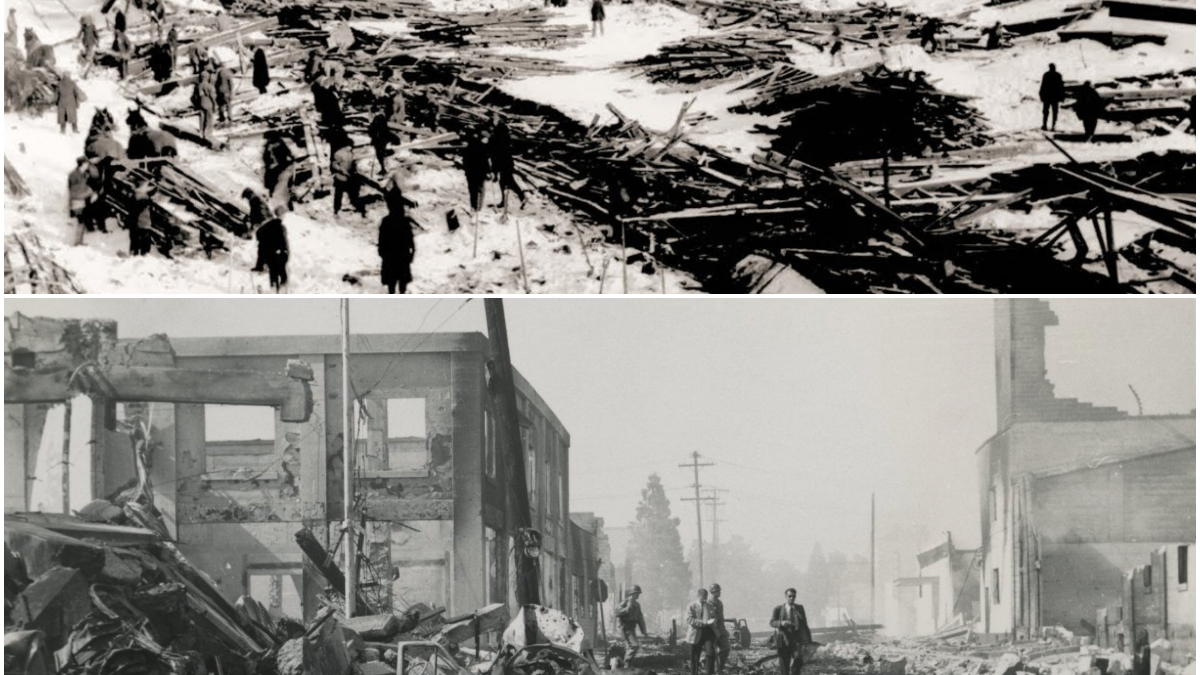
Warehouses that had stood for decades were flattened into piles of torn lumber and mangled iron.
Railway cars were overturned, their wheels still spinning slowly as if trying to make sense of what had happened.
Fires erupted where sparks found fuel, spreading quickly among the broken structures.
Smoke rolled across the waterfront in thick waves, darkening the sky and casting long shadows across the twisted remains of the pier.
People tried to call out for help, but many could not hear their own voices.
Ears rang with a thin, piercing tone that drowned out all other sound.
Survivors staggered through the wreckage with hands pressed over their ears, their faces stre with dust and blood.
Some moved blindly, unable to see through the haze that surrounded them.
Others bent to help the injured, recognizing faces not by sight, but by clothing or the way someone moved.
The shockwave had left the city in a state of stunned silence, its people caught between disbelief and instinct.
Those who managed to find their footing looked toward the harbor for answers, but the water offered no comfort.
The Mont Blanc had vanished entirely, leaving behind only a boiling expanse of waves and debris.
Where the ship had drifted moments earlier, there was now a churn of smoke and rising steam.
Pieces of the frighter fell from the sky, hitting the ground with dull thuds that broke the eerie stillness.
Some fragments were small, no larger than stones.
Others were massive, jagged chunks of iron that embedded themselves deep into the earth.
The force of the explosion had destroyed nearly every vessel in the harbor.
Barges were ripped apart.
Schooners were overturned.
The shockwave carried sailors into the water where they fought to stay afloat among the debris.
The waves, stirred by the violence of the blast, slammed against the remains of the pier with erratic strength.
Survivors clung to the floating wreckage, their cries swallowed by the smoke.
In the distance, the remains of larger ships burned, casting flickering light across the chaotic surface of the harbor.
In areas farther from the waterfront, people described a sense of dislocation as they emerged from their homes.
Windows shattered inward, scattering glass across beds and floors.
Furniture lay overturned.
Doors had been torn open or blown off entirely.
Residents stepped into streets that seemed to tilt at strange angles, distorted by fallen beams and broken utility poles.
Telegraph wires sagged in tangled webs, trapping some in their homes or blocking access to the road.
The air pulsed with the deep, muffled roar of fires consuming structures across the city.
The shock wave had not only destroyed buildings, it had rearranged the landscape.
Streets were buried under fallen debris.
Bridges collapsed into the water.
Churches lost their steeples which lay in splintered pieces across the yards.
Entire blocks had shifted, their outlines obscured by dust and rubble.
Those who attempted to move through the city did so with caution, stepping over broken bricks, shattered beams, and the remnants of everyday life that now lay scattered across the ground.
People wandered in silence, their faces blank with shock.
Some carried injured children in their arms, unsure where to go for help.
Others attempted to lift sections of collapsed roofs or move fallen timbers in search of survivors.
The shock wave had turned Halifax into a maze of destruction where every movement required careful thought.
Fires flickered through the smoke, lighting the darkened city with an eerie glow that seemed to pulse with the rhythm of the burning buildings.
As the minutes passed, the full scope of the devastation began to settle in.
The shock wave had reached miles beyond the harbor, shattering windows as far as Dartmouth and sending tremors across Bedford Basin.
Railway lines were twisted beyond recognition.
Street cars were overturned, their passengers thrown violently inside.
Hospitals, stores, and schools were damaged or destroyed, leaving the wounded with nowhere to go.
The sounds of collapsing structures echoed through the haze as weakened buildings gave way to the fires spreading unchecked.
The shockwave had not just changed Halifax, it had broken it open, leaving its people stranded in a city that no longer resembled the one they had known moments before.
The pier was gone.
The harbor was a wound.
The neighborhoods were unmade, and as the dust slowly settled, those who survived understood that they were standing at the edge of an unimaginable tragedy.
Nothing around them looked familiar, and nothing would again.
A landscape of survivors searching for answers.
In the minutes after the explosion, those who’d survived found themselves trapped in a world stripped of order and meaning.
The pier, once a place of movement and purpose, had been transformed into a jagged field of broken timbers and twisted metal.
People who had been watching the burning ship only moments earlier now crawled among the wreckage, coughing through the dust and trying to understand how the familiar harbor had turned into something unrecognizable.
The instinct to help, born from shock rather than clarity, drew survivors toward cries echoing faintly through the haze.
Men staggered to their feet, their coats burned or torn away, their faces gray with soot.
Some clutched their sides where shards of wood or metal had pierced their clothing.
Others blinked through the stinging dust, struggling to open their eyes fully.
The explosion had left many temporarily blinded, their vision reduced to a shifting blur of shapes and shadows.
But even in that confusion, they heard voices calling for aid.
Children cried out from beneath collapsed structures.
Workers moaned as they tried to free themselves from under splintered beaMs. A few stood frozen, unable to move or speak.
Their minds still trapped in the moment the sky turned white.
The destruction around them was overwhelming.
Piles of lumber lay scattered across the ground, some pieces smoldering from the heat of the blast.
Sections of railway track had been thrown across the pier like pieces of bent wire.
The remains of carts and wagons were reduced to wheels and shattered planks.
Their contents spilled across the waterfront in chaotic heaps.
Clothing, tools, and personal items were strewn among the debris.
Mute reminders of the routine that had existed only moments before.
Despite the devastation, people began to move with purpose.
Survivors nearest the water pulled themselves toward firmer ground, using broken beams as makeshift crutches.
A few men waited into the harbor to rescue those thrown into the water by the blast.
They dragged injured sailors to the shore, their movements sluggish, but determined.
The water was cold, and many who had been tossed into it struggled to stay afloat, weighed down by heavy coats or stunned into immobility.
The rescuers acted without hesitation, driven by instinct rather than instruction.
Farther in land, residents rushed toward the waterfront, unaware of the full extent of the damage.
They arrived at the pier to find it shattered beyond recognition.
Some cried out for relatives who had been working along the docks.
Others knelt beside the injured, pressing cloth to wounds or holding trembling hands.
The air was thick with the smell of burning fuel and the sharp tang of chemicals lingering from the Mont Blanc’s cargo.
Smoke drifted through the wreckage in dark waves carrying embers that floated like sparks from a dying fire.
Across the city, people emerged from collapsed homes and broken storefronts with similar confusion.
They moved toward the sound of the harbor, drawn by the rising column of smoke and the desperate shouts of survivors.
As they approached, they found themselves entering a scene of devastation unlike anything they had imagined.
The waterfront had become a patchwork of ruined structures, fires flickering among the debris, and survivors wandering in dazed clusters.
The pier was no longer a place of commerce.
It had become a gathering point for the wounded, the lost, and the stunned.
In the absence of clear authority, ordinary people took charge.
Railway workers, soldiers on leave, fishermen, and civilians formed impromptu rescue teaMs. They moved methodically through the wreckage, lifting heavy beams, clearing pathways, and calling out to those trapped beneath collapsed roofs.
Some dragged the injured to safer ground.
Others used whatever tools they could find to pry apart layers of fallen debris.
The work was exhausting, but it gave survivors something to cling to in a moment when everything else felt impossible to understand.
The cries of the injured created a chilling chorus that echoed across the waterfront.
Children called for parents.
Workers shouted for assistance.
In some cases, the voices fell silent as survivors succumbed to their injuries before help could reach them.
Those searching for loved ones combed the rubble with frantic determination, sometimes uncovering faces they recognized, sometimes finding only remnants of buildings or shattered belongings.
The pier became a place of heartbreaking discovery, each rescue effort revealing new layers of loss.
As the smoke thickened, visibility worsened.
The fires that burned among the debris cast an eerie orange glow across the broken landscape.
The winter sun, already low in the sky, struggled to penetrate the cloud of dust and rising heat.
Shadows moved strangely through the haze, distorted by flickering flames.
Survivors coughed violently as the air grew heavier, forcing many to tear cloth from their clothing to cover their mouths and noses.
The cold wind off the harbor carried both relief and danger, pushing smoke away from some areas while feeding the flames in others.
In the quiet moments between calls for help, survivors began to grasp the enormity of what had happened.
People recognized friends and neighbors among the injured.
Some knelt beside the bodies of those who had been killed instantly, their grief swallowed by the scale of destruction.
Others looked out across the harbor, trying to reconcile the peaceful view they remembered with the chaos now unfolding before them.
The water seemed calm compared to the turmoil on shore, a cruel reminder of how quickly the morning had changed.
The shock that had frozen many survivors began to give way to a grim resolve.
Those who could stand did so, even if their legs trembled beneath them.
They pushed deeper into the wreckage, moving with a slow but steady determination.
The pier had been reduced to ruins, but its people were not undone.
They searched, lifted, carried, and called out.
Each act a testament to the instinct to help despite overwhelming fear.
The waterfront, though broken, had become a place where strangers supported one another, united by the shared need to survive.
In those first minutes after the disaster, the pier was no longer a site of work, trade, or routine.
It had become the heart of Halifax’s tragedy, a landscape of survivors seeking answers in a world transformed beyond recognition.
The city fought to save itself in the hours after.
As the first hour passed after the explosion, Halifax found itself struggling to respond to a catastrophe so vast that no one could initially grasp its boundaries.
The city’s systems were shattered.
Telegraph lines lay in tangled heaps across the streets.
Train tracks buckled like soft wire.
Fire engines were trapped behind debris.
Their horses panicked and trembling.
The very tools the city relied on for emergencies had been crippled in the same moment its people needed the most.
Yet the instinct to save one another emerged immediately, rising through the smoke like a second heartbeat.
Survivors streamed from the devastated waterfront toward higher ground, carrying the injured any way they could.
Some used doors as makeshift stretches.
Others supported neighbors with arms over their shoulders, guiding them across unstable streets and past burning buildings.
Many walked in silence, unable to speak, their faces blank with shock.
The explosion had left a trail of wounded stretching from the peers to the residential blocks.
Each step marked by the sound of broken glass crunching beneath boots.
People gathered in parks, schoolyards, and church lawns, forming impromptu triage stations where the injured were laid out in rows.
Doctors and nurses worked with frantic urgency.
Hospitals were overwhelmed within minutes, their hallways filled with people suffering from burns, lacerations, and injuries caused by flying debris.
Medical staff improvised with what little supplies remained intact.
They tore curtains into bandages and used kitchen tables as operating surfaces.
Volunteers ran messages through the debris to summon help.
The tasks were endless, but the rhythm of action helped steady the hands of those fighting to save lives.
In a city where so much had been destroyed, each successful rescue felt like a small reclamation of hope.
Fires continued to burn across the waterfront and beyond, turning entire blocks into fields of ash.
The blast had ignited fuel stores, shattered stove pipes and toppled lanterns inside homes.
Flames traveled quickly through wooden structures weakened by the shock wave.
Firefighters pushed through rubble to reach the sources of smoke.
Their movement slowed by the constant threat of collapsing walls.
They managed to gain control only through sheer persistence, working in exhausted shifts as the hours passed.
Smoke rose above Halifax in a towering column, visible for miles.
As afternoon approached, the first reports began to reveal the scale of the disaster.
Ships approaching the harbor signaled that much of the Richmond district had disappeared.
Entire families were missing.
Streets that once bustled with workers were reduced to ruins.
The city’s northern edge had become a wasteland of splintered homes, overturned vehicles, and silent foundations where neighborhoods had stood.
The enormity of the loss settled slowly, like dust drifting down from the damaged buildings.
Despite the devastation, Halifax did not fall into despair.
The instincts of its people, sharpened by hardship and necessity, carried them through those first terrible hours.
They worked, lifted, carried, and searched.
They gathered the wounded and comforted the grieving.
The city fought to save itself, not with resources or preparation, but with the resilience of ordinary people who refused to abandon one another.
The memory of the white sky never left them.
In the days that followed the explosion, Halifax struggled to understand the enormity of what it endured.
The city had been torn open in seconds, and the loss was almost beyond comprehension.
Entire streets had been erased.
Families had vanished.
Neighborhoods that once echoed with the sounds of morning routines now lay silent beneath collapsed roofs and broken foundations.
Snow began to fall across the ruins, softening the jagged edges, but doing nothing to conceal the devastation.
Survivors moved through the debris with a solemn steadiness, carrying the weight of both shock and exhaustion.
The sky above them looked gray and distant, as if it too had retreated from what had occurred.
Those who had witnessed the explosion from the pier carried their memories with a clarity that time could not dull.
Many spoke of the flash, describing it as something no human eyes were meant to see.
They remembered the moment the world turned colorless.
The brief and blinding stillness that came before the shockwave hurled them into darkness.
Some recalled the sound that followed, a thunderous roar that seemed to vibrate through their bones.
Others remembered nothing beyond waking amid dust and silence, their ears ringing and their minds struggling to understand how morning had transformed into ruin.
The pier itself became a symbol of the catastrophe.
Friends and relatives returned to the waterfront searching for answers.
Standing where their loved ones had worked that morning, they saw only broken beams and scorched earth.
The outlines of the pier barely visible beneath the debris.
Ships arrived carrying aid and rescuers, but even those familiar with disaster struggled with the scale of destruction.
Halifax had become a city marked by loss, its landscape reshaped by a single moment of unimaginable force.
In the weeks that followed, the city rebuilt with quiet determination.
Volunteers from surrounding towns arrived with supplies.
Carpenters and laborers cleared rubble from the streets.
Churches offered shelter and schools reopened in makeshift spaces.
The people of Halifax supported one another with a humility born from shared suffering.
They grieved together, rebuilt together, and honored the memories of those lost with a sense of unity that outlasted the immediate tragedy.
Yet, even as structures rose again and daily life slowly returned, the memory of the explosion lingered in every corner of the city.
Survivors spoke of looking up at the sky differently after that morning.
Some said they never again felt comfort in the brightness of winter sunlight.
Others described moments when the scent of smoke or the echo of a distant bang transported them back to the pier, back to the instant when the harbor became a blinding white fire.
For many, the memory was less a story than a wound that pulsed quietly beneath daily routines.
The disaster became a defining part of Halifax’s identity, a reminder of both fragility and resilience.
For those who had stood on the pier, the memory was more personal, etched into their lives with the same clarity as the flash that had changed everything.
They carried it forward, a private reminder of the morning when the sky turned white and the world they knew disappeared.
Nothing could erase it.
Nothing ever did.








