He Freed a Trapped Sasquatch from a Rockslide – By Morning, the Bigfoot Tribe Had Surrounded His Tent
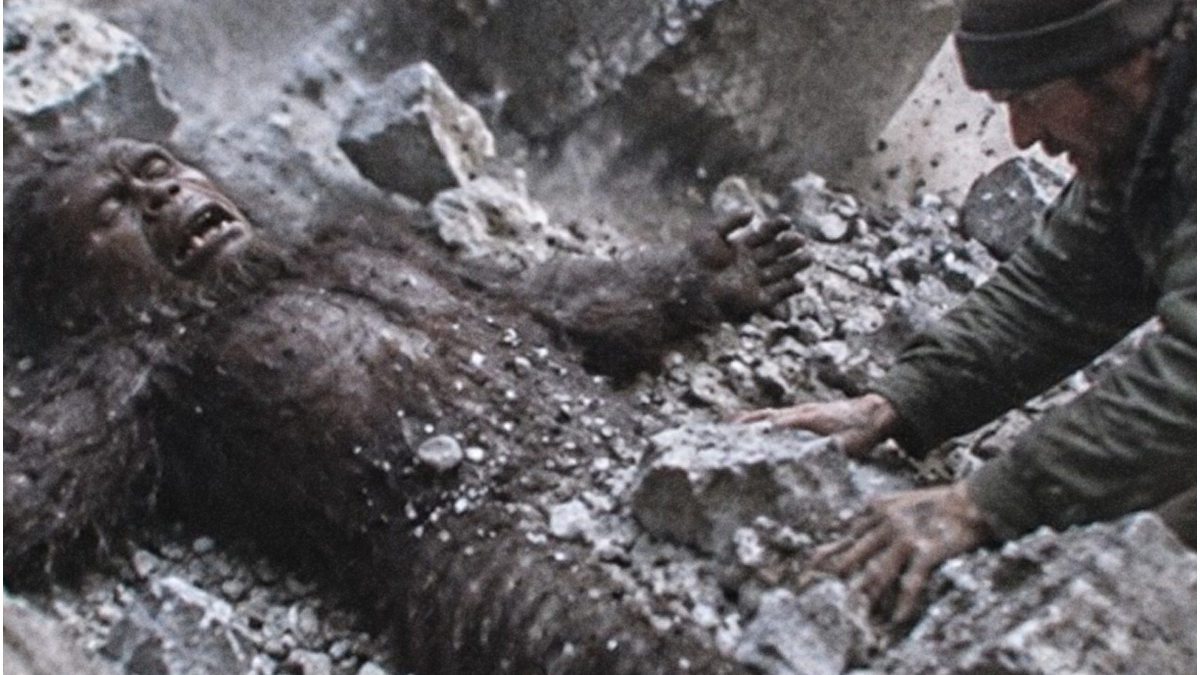
He Freed a Trapped Sasquatch from a Rockslide – By Morning, the Bigfoot Tribe Had Surrounded His Tent
The morning after I freed that young one from the rock slide, I woke up in my tent to a silence so absolute it was wrong.
No birds, no creek noise, no wind, just pressure.
The kind that settles in your ears before a storm or before pressure you cannot place.

I unzipped the tent flap and looked out into the gray of a Pacific Northwest dawn, and the treeine around my camp was full.
Not full the way a forest is full.
Full as a crowd is full.
Seven, maybe eight of them standing in the timber, watching, not moving, not making a sound, just standing there in the dark between the Douglas furs with their eyes catching the early light.
And every one of them was waiting to see what I was going to do next.
Before we get into it, let me know where you’re watching from and if you’ve had an encounter like this.
If you’ve ever wanted to know what it feels like to be the only human being in a situation that has no protocol, I can tell you it feels like being very small and very old at the same time.
If you’re new here, stay with me.
What I’m about to tell you is the strangest thing I have ever spoken out loud.
And I spent 31 years falling timber in the Gford Pincho National Forest.
So, the bar for strange is not a low one.
My name is Dale Cooper.
I am 72 years old, retired, living outside Randall, Washington, which is a small town in Lewis County at the edge of the Cascades where most people come to fish or hunt or drive the road to Mount St.
Helens and take photographs.
I logged these mountains for most of my adult life.
And what happened to me in the autumn of 1987 is something I have told to exactly four people in all the years since.
My wife Carol knows.
My oldest friend, a faller named Glenn Voss, who was on the same contract crew that season, knows.
My daughter Jenny knows because she pushed until I told her the same way she pushes on everything.
And now you do because I am 72 years old.
And Jenny is right that stories like this one do not belong buried with the man who lived them.
I want to be clear about one thing before I say another word.
I am not a man given to imagination.
I grew up in Morton, Washington, 8 milesi east of Randall, in a house where the practical ran the household, and the fantastical was considered a waste of breath.
My father logged, my grandfather logged, I logged.
The woods were not a mystery to us.
They were a place of work, of danger, of specific and cataloged hazards.
I had 14 years in the timber by the fall of 1987.
And in that time, I had seen widowmakers kill two men, seen a choker setter lose three fingers to a runaway turn of logs, seen a fuel fire eat through a landing in 45 minutes flat.
I had seen what the forest could do to a body and what a body could do in the forest.
And I had no religion about it either way.
It was terrain.
It was my job.
The trees fell and the trucks hauled them out and the paycheck came and the mortgage got paid.
So when I tell you what happened near the upper Cispus River drainage in October of 1987, I need you to understand that it comes from a man who spent his whole life trusting what he could see and measure and put his hands on and who spent a long time afterward trying to find a rational explanation and could not find one that fit all the facts.
The logging operation I was on that season was a timber sail on Forest Road 56, a secondary road off the main FR23 corridor that ran up into the Gford pin show.
The sail block was a mixed stand of Douglas fur and western red cedar, mostly second growth from the 1920s salvage cuts with some old growth pockets in the drawers that the contract left untouched.
We were a fiveman crew.
Glenn Voss was the other faller.
Roy Tilman ran the yarder.
Two chaser boys, brothers from Morton named Phil and Dennis Gabble, worked the landing.
I was the lead faller, which meant the responsibility for the plan and the sequence of cuts was mine.
We were working a contract for a timber company out of Chihalis, and the sale had been going smoothly for about 3 weeks.
Good weather for October in the Cascades.
Clear days with frost in the mornings, the kind of weather that makes the forest floor firm underfoot and the air sharp enough to keep you alert.
The trees were coming down clean and the landing was running ahead of schedule.
Quick thing before we get in.
Rain in that part of the Gford pin show is not gentle.
The Cispus River drainage runs roughly north to south, flanked by ridges that climb steeply to the east and west, and the draws between them are choked with deadfall and loose volcanic soil from Mount St.
Helens in the older Cascades geology underlying it.
After a rain, those slopes are unstable in ways that are not always obvious until the ground moves.
The 1986 rainy season had been particularly heavy, and there were slide paths visible on the east ridge above our sail block, where the soil had let go and pulled trees down with it.
Active talis above at least two or three points on the ridge.
I was working the uphill side of the sail block on the afternoon of October 14th, which was a Wednesday.
The other guys were back at the landing a/4 mile down the slope and I was felling a section of ridgeside timber by myself, which was not unusual for a faller of my experience.
You fall timber alone, you set your layout, you work your back cuts, you drop your trees into the gaps you’ve planned, and you stay aware of everything above and below you at all times.
Situational awareness in the woods is not a personality trait.
It is a survival skill.
You develop it or you do not come home.
I had dropped three trees in the sequence and was moving to my fourth setup when I heard the slide start.
Not a loud noise, not at first, more of a deep grinding shift like the mountain was adjusting its weight.
Then the sound built fast, a rushing, tearing roar that I knew meant a significant amount of material was coming off the east ridge above me.
I moved immediately downhill and left, angling away from the slide path, and I made it to a break in the terrain behind a large boulder outcrop that deflected the leading edge of the debris.
The slide passed me about 40 ft to my right, a wall of loose rock soil, and uprooted snags that carved a raw gray scar down through the green timber and piled up in the draw below.
I was shaking and I was unheard, which is the correct order of operations in those situations.
I stood behind that boulder for a long minute listening to the settling sounds of the debris field and then I moved out to assess the slide path and confirmed no one from the landing crew was in the impact zone.
The debris field was about 60 ft wide and ran down a vertical drop of roughly 150 feet before it spread out at the bottom of the draw.
It was a substantial slide.
Four or 500 tons of material, maybe more.
A mix of angular basaltt and soft volcanic soil.
The kind of slide that gets a paragraph in a forest service incident report and a conversation about slope stabilization.
I was picking my way along the upper edge of the debris when I heard it under the rock in the lower third of the pile where the material was deepest.
A sound low, repetitive, not mechanical, not an animal I recognized from 23 years in these woods.
A rhythmic vocalization deep in the chest, muffled by rock and soil and the settling weight of everything above it.
Something was buried in that slide.
I radioed Glenn on the CB and told him what had happened and what I was hearing.
I told him to bring the peeves from the landing and get up to me fast but carefully because the slope above was still shedding.
While I waited, I moved to the upper edge of the debris pile and started pulling rocks.
Not the big ones, not yet, but working from the top, moving loose material away from where the sound seemed to be coming from.
The vocalization continued.
It was irregular, coming in bursts, and it had a quality I could not name.
Not pain exactly, more like pressure.
Like a being using sound the way a person might clench their teeth pushing against pressure.
Glenn arrived with the peeves and fill gabble.
About 15 minutes later, I told Glenn what I was hearing.
He crouched next to the debris and listened.
And when the vocalization came again, he looked at me with an expression I had not seen on Glenn Voss’s face in over a decade of working together.
Glenn was not a man who spooked easily.
He said, “Dale, that is not a deer.”
I told him I knew that.
We started working the pile systematically, Phil pulling smaller rock from the sides while Glenn and I used the peeves to lever the larger pieces.
The sound was getting clearer as we move material away, which told me we were going in the right direction.
The sun was dropping fast.
October days in the Cascades are short and by 4:30 the light in the draw was already going gray green and dim.
I had a headlamp in my vest and I told Phil to go back to the landing and bring every lamp we had.
Over the next hour the three of us dug.
I have dug out a yellow cedar windthrow in a creek bed and I have helped pull a rigging sled off a buried machine and I have dug fence post holes in this cascade soil for over a mile of my own property line.
I have never in my life dug anything as carefully as I dug that debris pile.
About 4t down and 6 feet in from the downhill edge of the pile, I hit something that was not rock and was not soil.
My peeve found it and the texture was wrong, the resistance wrong, a dense yielding mass that moved differently from everything around it.
I put the peeve aside and used my hands and what came to my fingers first was hair.
Long, dense, coarse hair, dark in the lamp light, matted with dirt and fine rock debris.
I thought bear for just a second.
The way you think, the most available explanation first, then I felt the shape beneath it, and bear went away and was replaced by nothing because nothing in my catalog of experience fit what I was touching.
I called to Glenn.
He came over and reached in beside my hands, and we worked around the shape together, pulling rock carefully away from above and behind it.
And after another 20 minutes of work, we had uncovered enough to see what we were dealing with.
The thing in the pile was young.
That was the first clear impression, even before I had a full picture of it, small relative to what I would later understand the adults of his kind could be.
5T maybe 5’2 curled into itself with its arms over its head which suggested it had understood the slide was coming and had tried to protect itself.
The arms were long relative to the torso, significantly longer than a human’s proportions.
The hands, when I could see them, were broad and thickfingered and enormous for a body that size.
The hair was dense across the back, the shoulders, the backs of the arms, thinning at the face and palMs. The face.
I have tried many times over the years to describe that face to people.
And I have failed every time.
Not because the memory is unclear, but because the available language pulls it in the wrong direction.
It was not a bare face.
It was not what you picture when you think of zoo animals behind glass.
It was broad, heavy in the brow, wide at the jaw, with a nose that was flat and broad, and a mouth that was compressed in a line that I can only read, looking back as pain and fear and the effort of holding still.
The eyes were dark brown, nearly black, set deep under that heavy brow ridge.
And when the lamplight caught them as we worked the last of the rock away from its upper body, they were open.
It was watching us.
It had been watching us the whole time we were digging.
Glenn said something quietly.
I do not remember what.
I remember the sound of the sispus running somewhere below us in the dark and the distant sound of Phil coming back up through the timber with additional lamps and the absolute surreal stillness of the thing in the pile looking at me while I crouched in the debris of a rock slide in the dark with my hands covered in mountain soil.
I ran through what I had been taught about any situation in the field.
What was hurt?
What was mobile?
What was the immediate danger?
What could be done?
The young one’s left leg was pinned under a rock that Glenn and I together estimated at close to 600 lb.
A slab of basaltt that had come off the ridge faced cleanly.
The leg below the knee was beneath the rock.
The rest of the body above the rock was badly bruised and scraped, but appeared intact.
The vocalization had stopped when we cleared the chest and head.
It had been using the sounds to signal or to cope or both.
And when the weight came off its upper body, it went silent and very still.
The leg was the problem.
600 lb of basalt is not something two men move with their hands.
We had the peeves and I had worked enough unstable terrain to know that prying the wrong direction could shift the pile and bring more weight down on what we were trying to free.
I talked Glenn through the approach.
We had to get two peeves underneath the uphill edge of the slab at the same time and lever it toward the low side, which would rotate it off the leg rather than dragging it along the surface.
If we did it wrong, we would hurt the leg worse.
The young one had not moved during any of this.
It had watched me.
It had watched Glenn.
It had watched Phil when he arrived with the lamps and stopped dead in his tracks about 10 ft away and said something that I will not repeat because Phil was young and his language under stress was colorful.
I told Phil to come help with the peeve and to stop talking.
And to his credit, Phil came.
He was scared.
So was Glenn.
So was I.
But the thing in the pile was also scared.
And it was pinned.
And it was young.
And I had been in tight spots before.
And I knew that the only thing worse than the mess you were in is the mess you make by panicking instead of working.
We got the peeve set.
I counted down.
We levered together, all three of us, and the slab moved slowly, grinding on the rock below it, and rotated off the leg and settled beside the debris pile with a sound like a door closing.
The young one pulled its leg free immediately before any of us could react.
It had drawn the leg in and was pressing itself upright against the debris pile, weight off the injured limb, watching us from a height of about 5 ft.
The leg was damaged, and I could see the way it held it, not bearing weight.
The lower leg at an angle that told me something was broken or badly compressed, but it was moving.
It was conscious and it was very clearly deciding what to do about us.
Glenn and I stood back.
Phil stood further back.
Nobody moved for what felt like a very long time.
Then the young one made a sound, a single long vocalization, low and carrying, aimed not at us, but at the forest uphill.
A call, and the forest, which had been as quiet as forest gets, answered.
Distantly, from somewhere up on the ridge, a response came back.
The same register, a different rhythm, and with a quality that landed in my sternum, like a vibration more than a sound.
Whatever was up there had heard the call and answered it.
The young one looked at me, specifically at me, not at Glenn or Phil, at me, and then it moved.
Not fast, not the way a frightened animal bolts.
It moved with purpose, painfully, using its arms and its good leg to manage the slope, and it worked its way to the lower edge of the debris field and into the timber below.
We watched it go until the dark took it.
Nobody spoke for a while.
Phil was the first one to say anything, and what he said was, “Dale, what in the hell was that?”
I told him I did not know.
Glenn said we were going to pack up, get down to the landing, and get off the mountain before full dark, which is exactly what we did.
Phil was in his own truck, Roy in the yarder cab until he could get a ride at the road.
Nobody said much on the radio.
Phil keyed up once about halfway down and started to speak and then stopped.
The static held for about 4 seconds, and then he let the button go.
Glenn pulled up beside my truck window before he left.
He sat with his engine idling and looked at me as Glenn looks at things too large to be addressed directly.
Jaw set, eyes steady, no effort to fill the air with words.
Then he said, “I will be at your camp by 6.
Don’t do anything before I get there.”
I told him I wouldn’t.
He drove out.
I went back up to the camp alone.
I want to say that plainly because I think it matters.
I drove back up that forest road in the dark, past the point where the road went narrow and the timber closed in overhead, and I parked in the same flat spot and got out and stood in the cold dark outside my tent with the cispus running below and the slide debris invisible but present up the slope.
I was not afraid.
I want to be careful about that claim because I am aware it sounds like the kind of thing a man says when he is trying to present himself well, but it is simply true.
There was too much to pay attention to for fear to get any traction.
And whatever was in those mountains was not in my assessment going to come to my camp that night with any intent that required me to be afraid of it.
I did not sleep well that night.
I was staged in a camp I’d set up on a flat spot just off the forest road about 3 mi from the landing.
A small wall tent I had used for years on overnight operations.
A camp stove, a sleeping bag rated to 15°.
The tent was surrounded by the sounds of the cascades at night, which are particular sounds that I knew well.
The draw of wind through needles.
The creek of old growth in a light breeze.
The occasional bark of a coyote from the far side of the drainage.
Normal sounds.
Sounds I had slept through hundreds of times.
I lay on top of my sleeping bag without getting inside it, which tells you the state I was in because the temperature in the draw that night dropped well below freezing.
I did not notice the cold for a long time.
I was replaying the afternoon in my head.
The way you replay something your mind has not yet accepted.
Going back through the sequence and looking for the place where it stopped making sense.
The place was the face.
Every time I tried to reconstruct the scene rationally, I got to the face and the reconstruction stopped.
I know what a bear looks like when it looks at you.
I know the quality of that attention, which is reactive and mechanical.
A threat assessment running on wiring that has not changed in 10,000 years.
What had looked at me from that debris pile was using a different register entirely.
It was present in a way that bear is not present.
It understood that I was the reason the weight had come off its chest and it sat with that understanding and it waited to see what I would do next.
I got up around midnight and made a cup of instant coffee I did not want but needed something to do with my hands.
I sat outside the tent on my folding stool and looked at the treeine.
A great horned owl called twice from somewhere up the slope and was not answered.
Normal.
All of it was normal.
But I sat there until nearly 2:00 in the morning anyway because some part of me understood that something was happening in those mountains that I was not yet equipped to understand.
And I wanted to be awake for whatever came next.
What woke me at some point before dawn was not sound.
It was the absence of sound, the complete and total sessation of every ambient noise in the forest around my camp.
Then the pressure in the air changed.
And then, as the first gray of dawn came through the tent fabric, I unzipped the flap and looked out.
Seven of them standing in the timber around my camp in a rough semicircle.
The nearest was maybe 60 ft away.
The furthest was maybe 120.
They were all upright, all still, all watching the tent.
Most of them were significantly larger than the young one from the slide.
Two of them, I estimated at 8 ft or more, the kind of scale that your eyes reject first because it contradicts everything your brain knows about what size a standing biped can be.
They were covered in hair that ranged from dark brown to near black, heavier on the back and shoulders, and in the dim early light, their eyes caught the gray like reflectors, alive and attentive.
I crouched in the opening of that tent for a long time.
My rifle was behind me inside a Winchester Model 70 and 308 that I carried in the field and had never once considered pulling.
I did not consider pulling it now, not because I wasn’t scared.
I was the way you are scared when the scale of a situation exceeds your ability to respond to it.
A fear that is less panic and more a kind of clarifying honesty about your position in the situation.
I did not pull the rifle because it was obviously wrong.
Whatever these beings were, they had come to my camp and were watching me without aggression.
They had not surrounded the tent and moved in.
They had positioned themselves at a distance and waited for me to wake up.
That is not the behavior of something that intends harm.
It is the behavior of something that wants to be seen.
I got out of the tent.
Slowly, with no sudden moves, I stood up to my full height, which is 5’11, and I looked at them, and they looked at me, and we stayed that way for what was probably 3 minutes, but felt considerably longer.
The largest of them was standing slightly ahead of the others directly in front of me at a distance of roughly 70 ft.
Dark hair almost black across the shoulders and back with some lighter coloration around the face.
Massive through the chest and shoulders in a way that suggested a weight I could not calculate with any confidence.
But it was not the size that I kept coming back to in the years that followed.
It was the posture, the bearing.
There was nothing hunched or animal about the way it stood.
It stood the way a person stands when they are choosing to occupy space in a particular way.
Upright still facing me directly with the kind of patience that implies decision rather than instinct.
One of the things that 23 years in the woods teaches you is how to read the body language of large animals.
You develop a grammar for threat versus non-threat, for the shift of weight that precedes a charge versus the stillness that precedes retreat.
What was in front of me was neither of those things.
The large one in front was communicating.
I did not know the language yet, but I knew that much.
The young one was there.
I spotted it after a moment, standing at the back of the group, partially behind a large Douglas fur.
It was putting weight on the injured leg gingerly.
But wait, whatever damage had been done, it had not broken the leg, or the leg had benefited from a night of rest, or the physiological rules I was working with were not entirely applicable.
It was watching me the same way the others were, and when my eyes found it, it shifted slightly, not hiding exactly, just adjusting.
I studied it for what I could manage without being obvious about where I was looking.
The way you study a deer in the brush by keeping your eyes slightly off center because direct focus sends a signal that the thing you are watching picks up faster than you think.
The young one’s hair was darker than I expected given its age.
I had thought it might be lighter the way young animals often are, but the coat across its shoulders was nearly as dark as the adults in the group, just thinner with a fine quality to it that showed the shape of the body beneath more clearly.
The face was more open than I had seen it in the debris pile.
Whatever pain had compressed that expression was gone or diminished enough that I could see the face as it actually sat in repose.
The brow was not furoughed.
The mouth was not a compressed line.
It was watching me with an alertness that was simply alert.
The same quality I had seen in the large one, but scaled down younger without the depth of long experience behind it.
The leg that had been pinned was the left.
From where I sat, I could not tell at a glance which one it was favoring, which meant the knight had done something for it.
It was bearing weight.
That was the thing I kept checking.
It was standing on both feet with its back against the Douglas fur, and neither foot was lifted or turned.
Whatever had happened in that slide, the young one had come through the night mobile.
I did the only thing I could think of that made any sense.
I sat down right there on the ground in front of my tent, cross-legged, the same way you sit when you want to make yourself smaller and less threatening to an animal you don’t want to spook.
I put my hands on my knees where they could be seen, and I looked at the large one, and I waited.
The large one did not move for a long time.
Then it made a sound, not the call the young one had made from the debris pile.
That this was quieter, shorter, a complex descending tone that seemed to contain multiple notes at once.
And then something happened that I have turned over in my mind for 37 years.
The others relaxed.
I cannot think of a better word for it.
The physical change in the group was visible.
Shoulders that had been held very still shifted.
The angular attentiveness softened.
And one of the smaller ones, a female, if I was reading the proportions correctly, moved to a different position among the trees with a casualness that had not been present before.
The large one had said something.
Whatever that sound contained, it had told the group something about me, and the group had adjusted to the information.
I have never felt more seen in my life.
Glenn Voss arrived at my camp about 45 minutes after dawn.
He had driven up the forest road from Randall where he was staying, which was his habit on long contracts, and he came in on the road that flanked the east edge of my camp.
He was moving toward the tent when he stopped on the road and went completely still.
Then he said very quietly, “Dale,” I said.
I see them, Glenn, I have been seeing them for the past hour.
Just stay where you are and don’t do anything fast.
Glenn Voss stood on that forest road for a solid four minutes without speaking or moving, which is an unusually long time for a man who is normally in constant motion.
Then he said, “Are those the same ones?”
I told him I thought the young one from the slide was with them.
Yes.
He said, “They came to thank you.”
I said I did not know what they came for, but that they had been standing there since before dawn, and nobody had done anything aggressive, and I was going to proceed on the assumption that things were fine until something indicated they were not.
Glenn walked to the camp slowly, sat down beside me on the ground, and looked at the treeine.
He did not say another word for a while, and for that I was grateful because Glenn was one of the few people I had ever known who understood that some situations do not require narration.
They stayed until the sun was fully up, not all of them.
Over the course of that first hour, a few of the group drifted back into the timber at intervals, moving without sound in a way that still stops me cold given their size.
By the time the light was fully yellow through the cedars, only the large one remained visible, standing at the edge of the treeine with that same purposeful stillness, watching the camp.
Then it turned without urgency and walked into the trees, and it was gone, and the forest sounds came back all at once, as if someone had turned a dial.
Glenn and I sat on the ground outside that tent for another 10 minutes after the last of them went.
Then Glenn said, “I am going to need some coffee before I talk about any of this.”
I got up and started the camp stove, and neither of us said anything until the water boiled.
We talked it through over two cups each.
Glenn’s instinct was the same as mine.
Whatever had happened with the young one in the slide, whatever chain of cause and effect had resulted in a group of beings standing in a semicircle around my camp at dawn.
The morning’s events were not something we were going to share with the logging crew or report to the Forest Service or discuss with anyone we were not absolutely certain would not make it worse.
Glenn had a wife in Randall and I had Carol in Morton, and we both had enough experience with how people respond to the impossible to know that the fastest way to get something destroyed is to point at it and call it a wonder.
We agreed on a story for the crew.
I had heard the slide from my camp in the night.
Checked the debris field at first light.
Found nothing additional to report.
No further investigation needed.
The original incident was already logged with the Forest Service as a natural slide event on the contract area.
There was nothing in that reporting that required amendment.
What we did not agree to do, though neither of us said it explicitly, was pretend to each other that we had not seen what we had seen.
Glenn and I both knew what was in those trees that morning.
We had worked together for 11 years.
We had the kind of professional trust that builds in environments where mistakes are measured in lives, not dollars.
And that trust extended to the unspoken acknowledgement that the morning of October 15th, 1987 had happened, and we were both going to carry it.
I called Carol that evening from the pay phone at the Randall General Store.
I told her about the slide, which she already knew about from a brief call the previous night, and I told her I was fine.
She asked how the contract was going.
I said we were ahead of schedule.
She asked if I needed anything brought up from Morton on the weekend.
I said no.
And then I held the phone for a second before I hung up and thought about what was standing in those trees that morning and what it had decided about me.
And I said, “Carol, when I get home at the end of the month, I need to talk to you.”
She said, “Are you heard?”
I said, “No.”
She said, “Is Glenn hurt?”
I said, “No, everybody’s fine.”
She said, “Then it can wait until you get home.”
That was Carol.
39 years I have been married to that woman, and she has always understood the correct order of things.
The contract ran for another 3 weeks after that morning.
We finished ahead of schedule, and I drove home to Morton on a Saturday afternoon in early November with the mountains behind me in the valley opening out ahead.
And I sat in my own kitchen with Carol across the table and a pot of coffee between us.
And I told her what happened at the slide and what was waiting at my camp when I woke up the next morning.
Carol listened the way she always has completely, not interrupting, not nodding encouragingly, not telegraphing her reaction before I had finished.
When I was done, she put her hand over mine on the table and she said, “Did you feel like you were in danger?”
I said, “No, not after the first few minutes.”
She said, “What did you feel like?”
I thought about it.
I said, “Like I had been let in on something, like I had been seen and judged and found acceptable.”
Carol said, “Then I think that’s what happened.”
And then she got up and refilled our coffee and we sat in the kitchen until the November dark came on outside the window.
And she asked me questions the way Carol asks questions carefully and without conclusion.
And we talked it through until neither of us had anything left to say about it that night.
I want to tell you something about the Gford Pincho National Forest that I think matters to this story because I spent a significant part of my working life inside it and I have thought a great deal about what it can and cannot conceal.
The forest covers roughly 900,000 acres of Lewis, Yakima, Scammania, and Clickot counties in Washington state.
That is 900,000 acres of terrain.
That ranges from managed timber near the roads to wilderness drainage systems that have not been logged, surveyed, or walked by humans in any systematic way.
The upper cispus drainage alone, the area above the road system, contains creek drainages and ridge systems with no trail access where the timber is old enough and the terrain difficult enough that even the forest services trail maintenance crews don’t go.
There are areas in the Gford pin show where the only human-made disturbance in the past 50 years has been the flight path of a survey aircraft.
I have talked to other loggers over the years carefully and without naming what I was asking about and the things they have described.
Sounds at the edges of clear cuts, structure in the timber that was not there the day before.
The feeling of being watched from the ridges are so consistent across men who did not know each other and had no reason to manufacture the same story that I have come to believe the Gford pin show is one of the places where the presence is thickest.
The volcanic activity that shaped this landscape, Mount St.
Helens and Mount Adams both visible from parts of our contract areas also created the kind of geological complexity, the deep draws, the isolated ridge systems, the cave structures in the lava flows that provides concealment on a scale most people do not appreciate until they are standing inside it.
What the eruption of Mount St.
Helens in May of 1980 did to that population I have wondered about since the morning those beings surrounded my camp.
The blast zone from the 80 eruption covered an enormous area of the Gford pin show.
And while the recovery of the ecosystem has been one of the most documented ecological events in modern natural history, what happened to whatever was living in those blast corridors before May 18th is a question that nobody with an official title has thought to ask.
I drove back up to the Gford pin show the following spring alone on a weekend when Carol thought I was fishing the cowlets with Glenn, which I was partly.
Glenn and I fished the cowlets for about two hours on the Saturday morning.
Then I drove my truck up FR23 and turned off onto the 56 and went up to the old contract area.
The landing had been cleaned up and the slash was composting down.
The slide scar on the east ridge was already beginning to reveate.
Willow herb and alder coming in at the lower end.
Some slide alder reestablishing higher up.
The debris pile itself was smaller than I remembered it, which meant natural weathering and gravity had been working on it all winter.
I parked on the road and walked up to where my camp had been.
There was nothing left to indicate the camp.
I leave no trace as a matter of habit, but the flat spot was there, and the trees were the same trees.
I stood in the middle of that space for a long time looking at the timber around it and I waited.
Not with any particular expectation, just waited.
After about an hour, nothing had happened and the afternoon light was starting to go orange.
So I walked back to the truck and I found something on the hood.
A bundle of dried plant material tied with a strip of inner bark had been laid on the hood of my truck while I was up at the camp.
The bundle included what I later identified with the help of a library book on Pacific Northwest medicinal plants as dried yarrow, some dried mint, and a third plant I could never positively identify.
They were arranged in a considered way.
Three separate bundles within the larger one, each tied individually and then bound together.
On the flat rock beside where I had parked, there was a handprint, a right hand pressed in wet clay from the drainage that had dried to a crust in the afternoon air.
The span from the heel of the palm to the end of the middle finger was 11 1/2 in.
My own hand, for reference, is 8 1/2.
I sat on the tailgate of my truck for a long time looking at that handprint.
Not the bundle.
I had already looked at the bundle.
The handprint was what stopped me.
It was pressed into the wet clay of a flat topped rock beside the road from a seep that ran out of the slope above during wet weather and left a thin deposit on anything flat enough to collect it.
The print was crisp as if whoever had pressed it there had done so firmly, like pressing a stamp into wax.
All five fingers were clear.
The palm was clear.
The lines on the palm were clear.
The creases from closing a hand thousands of times over a life.
I had my tape measure in my vest from the day’s work and I measured it twice.
11 and 1/2 in from the base of the palm to the tip of the middle finger.
My own middle fingers 3 in the overall hand traced on paper would have covered mine with more than an inch to spare on every side.
What stayed with me was not the size.
The size I had already accepted in some provisional way.
What stayed with me was that the print had been placed there.
It was too clean, too centered on the flat rock, too squarely pressed to be incidental.
Someone had chosen that rock, positioned their hand, and pressed it into the clay at the edge of a forest road in Lewis County and left.
The plant bundle was a gift.
The handprint was something else.
It was an introduction.
The kind of thing you leave when you want the other party to know not just that you were there, but that you want them to understand what they found.
Then I put the bundle in my glove box and drove home and did not tell Carol about the handprint because some things require time before they can be spoken.
That bundle of dried plants is in a glass jar in my study.
The handprint crumbled when I tried to move the rock it was on, which I should have anticipated.
The jar has been on the same shelf for 36 years between a photograph of my father’s first logging crew and a piece of organ petrified wood my grandfather gave me.
Nobody who comes to the house asks about it and I do not offer.
Some things earn their silence.
Over the years that followed that spring visit, I made a practice of going back to the upper cispus drainage several times a year, usually alone.
Sometimes I fished, which gave me legitimate reason to be in the area.
Sometimes I just drove the forest road and walked.
I did not always find evidence that anything was present, but often enough.
Often enough to constitute a pattern rather than coincidence.
I found things that indicated I was being observed.
A branch placed across the path I regularly walked at a height of about 6 ft that had not been there the previous week.
A series of parallel depressions in soft soil along the creek bank that suggested a slow measured passage by a very heavy body moving upstream.
Once in September of 91, a complete arrangement of riverstones in a clearing beside the creek, a rough spiral pattern, riverstones ranging from fist size to head size placed with apparent deliberateness in a space of about 8 ft across.
The kind of structure that has no wildlife explanation and required hands to make.
Glenn came with me sometimes on the fishing trips especially.
He was processing the experience as Glenn processes everything slowly without drama, converting it over time from something that had happened to him into something he understood.
He told me once about 2 years after that morning at the camp that he had gone back to thinking about the religious upbringing he had largely set aside in his 40s, not because the experience had made him religious, but because it had forced him to acknowledge that the catalog of what he knew was not complete.
Glenn said, “I was operating under the assumption that I had a pretty good sense of what the world contained.
That assumption was incorrect.”
Glenn Voss is not a man of many words, but those were the exact right ones.
The logging industry changed significantly through the late 80s and the ‘9s, and my work patterns changed with it.
The old growth battles reshaped the Gford pin shows timber program dramatically after the spotted owl listings in 1990.
And by the mid90s, the scale of contract logging in the area had decreased substantially.
I shifted towards smaller private land operations and some forest service thinning contracts which kept me busy but changed where I was working and how much time I spent in the specific drainages around the upper cispus.
I retired from active falling in 2004 when my knees gave me the conversation about limits that knees eventually give to men who spend 30 years on steep slopes.
I was 52, which is young for retirement by most standards, but not unusual for a Pacific Northwest faller of the old school.
The job takes a physical toll that accumulates quietly until it doesn’t.
I sold my saws and bought a smaller property in Morton near Carol’s family and started spending my time in ways that my body could sustain.
Fishing, some light trail work as a volunteer with the Forest Service, and the regular drives up into the Gford pin show that had become part of the rhythm of my year.
I want to stop here and tell you something that I think is the most honest thing in this whole account because I have been careful throughout to describe what I observed and what I did and to stay away from interpretation.
But you are listening to this story and you are wondering what it meant.
And I think I owe you what I actually believe rather than just the events.
What I believe is this.
The young one in that slide was not an accident.
It was in the wrong place because young things are often in the wrong place for the same reasons that human children are in the wrong place because they have not yet developed the full assessment of consequence that experience builds.
The slide was a natural event that the young one was unable to predict or avoid.
And the group came to my camp not out of some mystical gratitude or emotional response that mirrors human social behavior in a convenient narrative way.
They came because something had happened that was relevant to them and they needed to assess the person involved.
They needed to understand what I was going to do.
What I did was dig a young one out of a rock slide and let it go.
What they did was spend a night determining whether that act meant what it appeared to me.
By dawn they had their answer and the answer was apparently satisfactory because the large one made that sound and the group relaxed and eventually left.
They were not thanking me in a human sense.
They were completing their evaluation of me and communicating the result to each other.
The result happened to be benign and they left me alone in my camp and went back to whatever they were doing before the slide.
This interpretation makes them neither more nor less than what the evidence suggests.
Intelligent, social, considered beings who make judgments about situations and communicate those judgments to each other with a precision that surpasses anything I can achieve with my own tools.
That is not mystical.
That is actually more impressive than mystical because mystical doesn’t require intelligence.
What I witness required intelligence.
Real applied contextual intelligence operating on a time scale and through a communication system that I do not have access to, but that was clearly effective.
I have never been back to the upper cispus in a way that felt like looking for them.
I go back to the drainage the way I always went to fish, to walk, to be in the forest that I have loved my whole adult life.
Whether they are there when I am there, I genuinely do not know.
I find things occasionally that I cannot explain.
I do not find things most of the time.
The forest does not keep a schedule that accounts for when I show up.
But there are times standing in a particular draw in the upper drainage with the creek running below and the old growth closing in above.
When the sounds change the way they changed that morning in my camp.
The birds go quiet.
The creek seems to be the only thing making noise.
And there is a pressure in the air that I have learned to recognize not as threat but as attention.
The awareness of being watched from a distance I cannot determine by a patience I cannot match.
When that happens I stand still.
While I put my hands where they can be seen.
And I wait, not for anything specific, just as an acknowledgement that I know it is there, and I am not going to pretend otherwise.
And I mean, no harm.
That’s all I’ve ever been able to offer.
And so far, it’s been enough.
The spring visit I just described was the beginning of a practice I did not have a name for at the time.
What I was doing, returning to that area, was not investigation.
Investigators gathered data with intent and direction.
What I was doing was more like keeping an appointment I could not schedule.
I went back because the forest road was there and I had always driven it and the idea of not driving it, of purposely staying away from a place I had worked and moved through for years seemed like a capitulation to fear.
I was not afraid of what was in those mountains.
I was, if anything, grateful to it in ways I could not fully articulate and did not try to.
The spring visit where I found the plant bundle was in April of 1988.
I went back in July of the same year.
Carol knew where I was going by that point and I had stopped the fiction about fishing with Glenn.
Not because Glenn wouldn’t have covered for me, but because covering things from Carol has always been more trouble than the truth.
I told her I was going up to walk around the old contract area that I wanted to see how the slide scar was recovering.
This was true as far as it went.
The slide scar in July of 88 was in active early recovery.
Fireweed and pearly everlasting had colonized the lower edges, as they always do in disturbed soil on Cascade slopes.
The alders that had been knocked down by the slide were already sprouting from the stumps in, as alders do, fast and multiple, a dozen new shoots per stump.
The upper edge of the scar, where the basalt had let go from the ridge face, was still raw and gray, but the willow herb was working up toward it.
The forest recovers from disturbance faster than people give it credit for.
It was already beginning to look from a distance like the slide had been there a long time.
I spent about 4 hours in the area that July day.
I walked the debris field.
I looked at the spot where the young one had been buried.
I found nothing out of the ordinary on that visit.
No plant bundles, no arrangements of stone, no evidence of anything beyond the normal life of the drainage.
But about a mile north of the slide area on a game trail that followed the creek, I found tracks, multiple sets of them pressed into a muddy stretch where the trail crossed a small tributary.
The largest were 18 in long with a stride length that I paced out at close to 5 1/2 ft.
There were at least four distinct sets ranging from the large ones down to a set that appeared to be a juvenile, perhaps 14 in long.
They were all moving upstream in the same direction without hesitation in the stride pattern that would indicate weariness.
Comfortable movement through terrain they knew well.
I crouched over those tracks for a long time.
Four sets moving upstream together, a group with what appeared to be at least one young member.
I did not follow them, not because I was afraid to, but because following seemed presumptuous.
They were going somewhere I had not been invited.
That autumn, Glenn and I were on a smaller contract in the Randall district, second growth thinning on a state timber parcel about 12 miles from the cispus drainage.
On the second week of the contract, Glenn pulled me aside at the morning coffee and told me that one of the chaser boys on the crew, a young guy named Ray Powell, who was new to the district, had come to him privately and said he had seen something at the edge of the timber the previous evening, walking the old skid road toward the upper end of the cut, Glenn described what Rey had told him.
Upright, tall, dark hair, moving fast and without sound on two legs.
Raid thought it might be a person, a trespasser maybe, or someone from the environmental groups that were increasingly active in the area, but the proportions were wrong and it was gone before he could get a clear look.
Glenn asked me what he should tell Ry.
I thought about it.
I told Glenn to tell Ry that the Cascades had a lot of wildlife in them and that it was easy to mistake a bear working a slope for an unfamiliar shape in low light.
And that if Rey wanted to keep his head straight, he should focus on the work and not on what was in the trees at dusk.
Glenn said he would do that.
He looked at me with the expression he had been giving me since that October morning, a look that was part acknowledgement and part a weighted quality, like a man carrying a load he has agreed to carry and is not complaining about, but is aware of at all times.
Ray Powell did not bring it up again.
He finished the contract and moved on to another crew.
And I do not know whether he ever arrived at any conclusion about what he saw on that skid road.
Young men who work the timber in the Cascades see things from time to time that they do not have frameworks for, and most of them find their way to an explanation that does not require them to revise their understanding of the world.
This is a reasonable response to an unreasonable situation.
I found the stone spiral in September of ‘ 91.
As I mentioned earlier, I want to describe it more carefully because I have not done it justice.
The clearing where it was built was not a natural feature.
It was a spot where a large Douglas fur had fallen and taken out several smaller trees when it came down, creating an opening in the canopy, maybe 30 ft across.
The creek ran about 20 ft away on the east side.
The spiral was built from river cobbles, smooth granite and basaltt pulled from the creek bed, ranging in size from my fist to my head.
The spiral had three complete rotations from the outer edge to the center with a gap at the entry point on the northeast side.
The center held a single large flat stone about 2 feet across and 4 in thick, too heavy and too regular to have rolled to that spot on its own.
I have looked at photographs of stone arrangements found in the Pacific Northwest and attributed to Native American cultural sites, and this spiral matched nothing in those references in either style or scale.
The river cobbles were not worn by extensive handling.
The underside showed the moisture staining of having been on the creek bed until recently.
This was not an ancient arrangement.
It had been made within the past week of when I found it.
I photographed it with the 35 mm camera I had started carrying in the field.
I did not disturb it.
I came back 6 weeks later in late October and the spiral was gone.
Every stone had been removed and returned to the creek bed.
The flat center stone was gone too, though its weight had impressed the earth beneath the canopy opening with an outline I could still see.
I have looked at those photographs many times over the years.
The spiral is clearly intentional.
The uniformity of the rotation, the consistent spacing of the stones, the way the largest stones anchor the outer ark and the smallest ones fill the inner turns.
This took planning.
It took an aesthetic judgment about what the arrangement should look like when it was finished.
Aesthetic judgment is not a category that the available science assigns to any species other than humans.
I assigned it accordingly.
In the summer of 94, I was on a Forest Service thinning contract about 8 milesi northeast of my usual area in the Sispus drainage.
And on a Thursday afternoon, I walked a ridge to scout an area scheduled for the following week’s cut.
The ridge was steep and the timber was old, big cedars and fur that had been left from the original old growth era.
Trees that I would not be touching on this contract because they were in the protected buffer along the creek system.
I was working my way along the ridge through a section of big timber when I came to a point where the ridge dropped away on both sides and I had a clear view down into the drainage to the east.
There were two of them in the drainage below me.
A/4 mile down the slope, moving along the creek in full afternoon light, one large, one smaller, moving together at an unhurried pace.
The large one was ahead, navigating a section of creek crossing where the bank was steep and it turned back and extended a hand and the smaller one took it and was helped across.
That was all.
A simple transfer of assistance across an obstacle.
8 seconds of observed behavior and I saw everything I needed to see about the social structure I was dealing with.
It was not complex.
It was as straightforward as any human parent and child in any geography.
The large one knew.
The small one needed help.
It provided the help.
They continued.
I stood on that ridge for a long time after they disappeared upstream.
The light was shifting to the long afternoon gold that October puts on the Cascades, and the shadows of the big cedars were stretching east across the drainage, and somewhere up the creek the two figures were moving through terrain that they knew and I did not.
And I was the only human being in perhaps several miles of these mountains who had any idea they were there.
I thought about the 1990s spotted owl listing and what it had done to logging in the Gford pincho.
And I thought about how the people who fought for the old growth buffer zones and the protected creek corridors and the reduction of clear cutting had been motivated by birds primarily and by the larger ecosystem logic of preserving complex mature forest habitat.
They had not been motivated by any knowledge of what I was looking at in that drainage.
But they had knowingly or not produced a set of protections that benefited whatever was moving through those drainages because the areas they were most vocal about protecting were the same areas where I had been finding evidence for years.
The old growth corridors along the creek systems were exactly the kind of terrain that provided cover and resource and the hard-fought protections that had infuriated many of my colleagues in the logging industry were from a different angle.
The most useful conservation action that could have been taken on behalf of a species nobody was officially trying to conserve.
Glenn retired from active falling in 96, two years ahead of me when his back told him it was done.
We kept fishing together, and I kept telling him what I found on my visits to the cispus drainage, and he kept listening with the same quiet attention he had always brought to everything.
Glenn’s wife, Alma, had been told the basic shape of what had happened.
Glenn was not capable of keeping something significant from Alma and he told me this without embarrassment and Alma had responded with a matterof factness that he said was entirely characteristic of her.
Glenn said Elma told him that the mountains of Washington State were among the oldest and most complex ecosystems in the northern hemisphere and that the idea of a large intelligent homminid living undiscovered in them was considerably less surprising to her than the idea that modern humans had conclusively cataloged everything that lived in a 900,000 acre forest.
Alma taught school in Randall for 27 years.
She was often the smartest person in any room she was in, and she calibrated her comments accordingly.
Elma’s comments stayed with me for a different reason than it probably stayed with Glenn.
Glenn heard validation.
I heard a specific word.
Alma had said, “Hominid, uh, not animal, not beast, not creature, hominid.”
The word the biological sciences use when they mean something that walks upright and has hands and a face and a social life.
One that belongs on the same branch of the tree that eventually produced us.
She had used it without hesitation.
The way a person uses a word they believe is simply correct.
I had been circling that word for almost a decade without landing on it.
I had used beings when talking to Carol and them when talking to Glenn and nothing at all when thinking about it alone.
What I had seen in the debris pile, what had sat at the back of the group watching me with its weight on both feet, what had turned back at a creek bank and helped a smaller one across.
That was a homminid.
One that shared enough history with us to have recognizable social behavior, recognizable care, recognizable intelligence, something that had diverged far enough back that the biology was different in every visible way, but the behavior was the same branch.
That was what Alma’s word gave me.
Not comfort exactly, precision.
A word that fit what I had seen and did not require me to either diminish it or turn it into myth.
By the early 2000s, I was spending more time in the area than ever.
Partly because my retirement gave me flexibility and partly because the visits had become the practice they remain today.
A practice I do not question and do not analyze but simply maintain.
I began keeping a journal, not the kind of journal a researcher would keep with measurement protocols and systematic observation records.
A personal journal, the kind where you write what happened and what you thought about it and leave out the academic scaffolding.
I have three of them now filled with notes from two decades of visits, most of which record nothing out of the ordinary.
The ordinary is there too.
The fish counts in the creek.
The elk sign on the upper slopes.
The way the alder is moving into the old slide area.
The state of the forest road after winter.
I put the ordinary entries in alongside the unusual ones because the ordinary is what makes the unusual comprehensible.
You cannot understand what it means to find an arrangement of river cobbles in a drainage if you do not also understand what a normal visit to that drainage looks like.
In 2007, an encounter occurred that I want to describe carefully because it is the most recent significant observation I have made in the drainage and because it took a form that I did not expect.
I was walking the Creek Trail in early May, the first real warm week after a wet spring, and the forest was doing what it does in May in the Cascades, which is explode.
The trillium were up in the forest understory.
The maple was leafing out along the creek.
The creek itself was running high and clear from the snow melt, and the sound of it covered any noise I was making on the trail.
I came around a bend in the trail where the creek curved away and the trail stayed straight.
And about 30 yards ahead of me in the middle of the trail, there was a young one, smaller than the one from the slide, or at least different younger, I thought, though I had no real calibration for age.
4t tall, maybe a little more, sitting in the middle of the trail in a patch of afternoon sunlight, working at a task with its hands.
I stopped immediately and stood completely still.
It had not noticed me yet.
The creek noise covered my approach, and the wind was coming from behind it.
It was sitting cross-legged in the trail, and in its hands it held a piece of bark, cedar, I thought, from the color, and it was doing something to the bark with a small stone tool, scratching or pressing in a pattern that I could not make out from 30 yards.
Making something, working on it with a focused concentration that I recognized in the posture, the forward lean, the absorption in the task, the posture of a person who is making something.
I stood there for probably two minutes watching it work.
And then a sound came from the timber to my left from above the trail on the slope.
A single brief vocalization low and sharp.
The young one’s head came up immediately and it looked uphill, not at me.
It stood, tucked the piece of bark into a pouch or fold at its waist that I could not see clearly, and moved off the trail into the downhill timber in four or five strides without looking back, without making a sound.
Gone.
The vocalization from the slope had been a warning, not a panic, a measured alert of the kind that assumes the listener knows what to do with the information.
The young one had received it, acted on it, and been in the timber before I fully processed what I was watching.
The whole sequence took maybe 6 seconds.
Something on that slope had been watching me long enough to know I was approaching before the young one knew.
Something had stayed in position long enough to assess the situation and decide a warning was appropriate and had delivered the warning at the right moment.
This was not instinct.
This was a surveillance and communication system operating in real time with judgment calls embedded in it.
The warning was not about panic.
It was about caution, not run, but be aware something is coming.
Move appropriately.
The young one had understood the distinction and responded to the correct interpretation.
I walked to where the young one had been sitting and crouched down.
In the dirt of the trail, there were impressions where it had sat.
And in the dirt, there were small curls of cedar bark that had come off the piece it was working on.
I picked up one of the curls and held it.
It was warm from the sun.
I put it back where I found it and kept walking.
2007 was also the year I started talking more openly with Carol about what I was finding in the drainage in the sense that our conversations about it became less about the events themselves and more about what the events meant.
Carol had never doubted what I told her, but her instinct was always to ask the next question rather than rest on the answer just provided.
Her questions over the years had pushed me toward an understanding of what I was observing that I could not have reached on my own.
Carol had been a school teacher before the kids came, and she had a teacher’s habit of asking questions that required the person being asked to do the actual thinking.
She asked me once around 2009 or so whether I thought the beings I was observing in the drainage were aware that I had been coming back repeatedly for more than 20 years.
I said I thought so.
Yes.
She asked how I knew.
I said because the pattern of what I found on my visits was too consistent to be coincidental.
The evidence of observation, the occasional gift or arrangement, the encounters that involved adults in positions that suggested awareness of my root and timing.
She said, “So, you have a relationship?”
I said, “I did not know if that was the right word.”
She said, “What word would you use?”
I thought about it.
I said I would say I was known, that I had been assessed and found acceptable, and was now simply a known presence in a territory as a familiar truck on a familiar road is known, not intimate, not transactional, not threatening, just known, registered, accounted for in the geography of a place that had its own ongoing life that I was not central to.
Carol said, “That might be the best kind of relationship there is.”
And she meant it.
Which is one of the many reasons I have been married to her for 39 years.
The observation I keep coming back to, the one that seems to anchor everything else is the act on the morning after the slide.
Seven beings standing in the timber at dawn, having spent the night deciding what I was.
I think about what that decision-making process required.
It required memory, a record of what happened the previous afternoon, which individual was involved, what actions that individual took.
It required communication, a way to share the relevant information with the group so that they could be part of the evaluation rather than just deferring to one individual’s judgment.
It required judgment, a way to assess the human’s act and arrive at a consensus about what it meant.
And it required a willingness to show themselves, to make themselves visible as a way of sending a message to me.
Even though visibility is presumably a vulnerability for beings who survive largely through concealment.
All of that is organized intelligence, not simple problem solving, not the intelligence of an animal finding food or avoiding a predator.
Social, communicative, deliberative intelligence of the kind that requires theory of mind.
The understanding that other beings have internal states, intentions, and knowledge that differ from your own, and that those differences are relevant to how you engage with them.
The large one looked at me that morning and made a calculation about what I knew and what I intended and what I would do with what I knew.
That is theory of mind.
And it made a sound that communicated the result of that calculation to the rest of the group in a way they immediately understood and acted on.
I am not a scientist.
I am a retired faller who drove a logging truck and ran a chainsaw for 31 years and who knows the Gford pin show the way I know my own back fence.
But I have had 37 years to think about what I observed and what I have arrived at is this.
Whatever is living in those mountains represents a level of cognitive development that our science has not been honest about because acknowledging it honestly would require acknowledging that these beings have interests that they have lives worth protecting and that we have not been protecting it.
The Gford pin show contains old growth pockets that the timber sales of the 70s and 80s never reached.
Locked away in steep draws and upper drainages where the economics of extraction never penciled out.
Those pockets survived not because anyone decided they were worth protecting, but because they were inconvenient to log.
The spotted owl protections that came along later added regulatory cover to what geography had already spared.
And in those pockets and in the broader second growth forest that has been recovering for 80 years since the early logging era, a population is living and moving and communicating and raising its young with a care that I witnessed firsthand on a September afternoon in 2007 when a warning came off a slope to protect the small one.
Working at something with a stone tool in a patch of afternoon light.
That is what I want you to carry away from this.
Not the rock slide, not the morning with seven of them in the timber, not the plant bundle on the hood of my truck.
Those are the dramatic moments and they are real and they matter.
But the thing that matters most is the small one on the trail working on a piece of bark with a tool absorbed in making something in the middle of an afternoon in May while the creek ran high from snow melt and the trillium were up in the understory and someone on the slope above was watching the trail to make sure the small one was safe.
That is not a monster.
That is not a legend.
That is a being with a life in a forest on an afternoon in May.
That is all I can tell you and it is everything.
My name is Dale Cooper.
I live outside Randall, Washington.
And I have spent the better part of my life in the mountains that rise at the east edge of this valley.
The Gford pen show is still there.
FR23 is still there, potholed and narrow in the upper sections, the way it has always been.
The old contract area on the 56 spur has grown back to the point where you would not know a crew worked it 37 years ago.
The slide scar from October of 87 is green now, fully forested in the lower half with young alder and maple that are tall enough to look established, old enough to provide cover.
I drove up there last fall, early October, the way it was when all of this started.
The light coming low through the timber and the frost on the road in the morning.
I parked where I always park and walked where I always walk.
The creek was running low at the end of the dry season, the way it always does in October, and the sound of it was quieter than it is in spring or early summer.
The leaves on the vine maple were turning orange and yellow in the drawers where they catch the most light, and the Douglas fur were the color they always are.
The deep blue green that does not change with the season.
I stood in the old slide area for a long time, not looking for anything specific, just present.
The forest did not perform for me.
The birds were going about their business.
A pair of gray jays worked the edge of the old debris field, picking at whatever the debris field offered.
A raven called from somewhere up the ridge and was answered by another raven further north.
A Douglas squirrel scolded something I could not see from the top of a big fur.
Normal sounds, the ordinary afternoon of a cascade drainage in October.
I walked back to the truck as the light started to go orange the way it does early in October when the sun drops behind the western ridge and everything goes from gold to shadow in about 20 minutes.
I had my hand on the door when I heard it from the timber above the road, from somewhere in the steep slope on the east side.
A single vocalization, low, brief, and layered the way a musical chord is layered.
More information in it than a single note should contain, though I do not have the vocabulary to describe what kind of information.
Not a call for attention, not a warning, nothing I had a word for.
It arrived not as a message I could decode, but as a presence, a weight in the air and acknowledgement.
I stood with my hand on the truck door, and I looked up the slope into the timber, which was already deep in shadow.
I saw nothing.
But the sound had happened, and it was the same register I had known for 37 years.
And after a moment, I said out loud into the trees, “Still here,” because it was what I had to say.
The forest went about its business.
The raven called again from the ridge.
I got in the truck and drove down the forest road toward the valley.
And the mountains held what they have always held.
And the timber closed behind me the way it always does.
And the world on the other side of those trees went on not knowing what it did not know.
I would not have it any








