Tearful Mother Bigfoot Leads Old Woman – You Won’t Believe What Happens Next
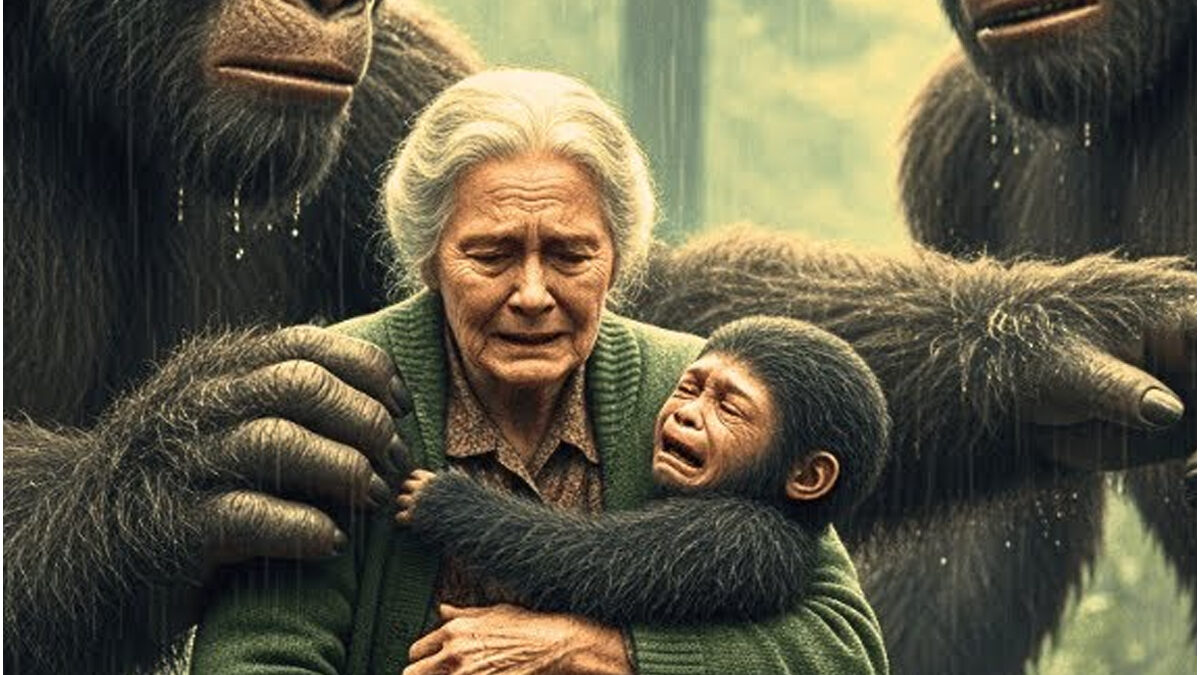
Tearful Mother Bigfoot Leads Old Woman – You Won’t Believe What Happens Next
What if I told you that a giant creature could quietly protect a human from hunters?
In the late 1980s, a 62-year-old widow named Maggie Callaway lived alone in the dense forests of Alageney, Pennsylvania.
But one autumn night, something knocked on her cabin door, and it wasn’t human.
The shocking truth.

Years earlier, Maggie had saved a dying baby creature caught in a rusted wire trap.
She didn’t know it then, but that baby was a young Bigfoot, and now its family had returned.
Not for revenge, but to repay her kindness.
This story comes directly from Maggie’s handwritten journals, discovered after she passed.
She had lived 27 years in the wild, far from civilization, but never alone.
Watch this to the end, and you’ll understand why Bigfoot has never attacked humans, and how one small act of compassion can echo through the most unexpected places, even the deep woods, even if you don’t believe in monsters.
This might change your mind.
That spring, Maggie slipped on a mossy slope.
She should have fallen, but a giant hand caught her.
When she turned, no one was there.
Just trembling leaves.
She knew then some creatures don’t forget, and neither should we.
Don’t scroll past this if you’ve ever felt left behind.
Because this story may prove that the most mythical thing of all is kindness.
Late autumn clung to the hills like a farewell.
The Alagany Mountains breathed in stillness, their ridgeel lines buried in gold and rust, the kind of colors that whispered something ancient before winter wiped the slate clean.
A cold hush held the forest, and though the sky burned a soft pewtor behind bare limbmed sycamores, the air was already shifting thinner, hungrier, the kind of cold that didn’t bite yet, but made promises.
Maggie Callaway stood beside a row of browning lavender.
Her hands deep in the soil even though the ground had begun to crust with froSt. 62 years old, back curved not from defeat but from doing what needed doing.
Her cabin hunched behind her, its logs old but upright, roof patched by her own hands with cedar shakes.
Smoke from the chimney rose soft and straight.
One of the goats bleeded, bored or hopeful.
She didn’t turn.
The earth in her palm was darker near the roots.
Good.
Still alive.
She wiped her hands on her skirt.
Dark wool patched at the knees.
Then brushed a stray curl of silver from her cheek.
Her boots made no sound on the wet leaves.
Years of walking soft.
The woods required it.
She didn’t want to startle anything that didn’t deserve to be startled.
Not anymore.
There had been enough death.
She moved quiet as a memory, following the narrow trail behind her garden, the one that curved toward the creek where elderberry grew.
She’d found deer sign there yesterday.
Not hoof prints, those were common, but broken branches high off the ground.
Too high.
She’d paused, fingers grazing the splintered wood.
The brake hadn’t been clean, like something strong but uncertain had reached out and snapped it just to see.
A test maybe, or a signal.
Either way, it didn’t feel like the wind.
Today, the same path offered something else.
A soft rustling pulled her toward a thicket of brambles.
The kind of sound that didn’t belong to wind or bird.
It had weight.
Maggie slowed, fingers tightening around the knife sheath at her hip.
The blade wasn’t for killing.
Not anymore.
It was for cutting snags, whittling tinder, and the quiet comfort of habit.
She knelt, eyes scanning the low brush.
There it was, a flash of tan, a leg trembling.
The deer was young, its eyes wide and wet, rib cage fluttering like a paper bag in a storm.
One hind leg twisted unnaturally, caught in a coil of rusted wire strung low between two saplings.
Poachers work.
Not legal, not right.
Maggie didn’t speak.
She didn’t need to.
Her breath slowed.
Her hands moved slow, measured.
She pulled a strip of cloth from her coat pocket, tore it lengthwise, folded it, and tossed it gently near the animals nose.
Her scent, her intention.
The deer flinched but didn’t bolt.
She crept closer, boots sinking into the wet leaves.
The wire was biting into flesh, blood seeping down the leg in tiny rivers.
She whispered a sound, not a word, just the memory of one.
A hush.
She took out her knife, clean and sharp, and slipped the blade between hide and steel.
One pull, then another.
The wire came loose with a jerk and a shudder, and the deer sprang back, leg buckling.
It staggered once, twice, then bounded forward in a crooked, desperate lurch until it vanished into the trees.
Only then did she exhale.
She stood slowly, knees aching from the cold.
Her hand brushed her chest as if to calm the tremble that still hadn’t left.
Her eyes followed the place where the deer had disappeared.
The woods had gone still again.
Too still.
Then something moved.
Not sound, not shadow.
A hand.
She saw it between the twisted branches of a sugar maple high above her head.
Not human.
Long fingers thicker than her wriSt. Pushing aside a veil of golden leaves.
Not breaking them.
Just gently shifting.
Watching.
Her breath caught.
Her spine stiffened.
It didn’t speak, didn’t growl or charge.
It simply stood there, hidden except for the shape, the mass that shifted slightly behind the trees.
A shoulder too broad for any bear.
A presence that made the air feel full, like standing next to a freight train, not moving, but full of momentum.
She couldn’t move.
The hand released the branch.
Leaves shivered back into place.
The space behind them fell quiet again.
But something lingered.
She felt it in her chest, in her knees, in the bottom of her boots.
That night, she didn’t light the lamp on the porch.
The fire inside her cabin crackled low.
She sipped goats milk tea from a tin cup, the steam fogging her glasses.
Her fingers stayed near the latch of the door.
Not because she meant to bolt it, but because she didn’t.
That was the strange part.
She left it unlocked.
The goats had long since gone quiet.
The woods should have, too.
But around midnight, something stepped onto the pine needles beyond the porch.
A footfall, heavy and deliberate.
Then another leaves shifted.
A breath long and low, not animal, but not quite human.
Ghosted across the threshold like wind through a hollow tree.
Maggie didn’t rise.
She stared into the fire as though it held more answers than fear.
The sound didn’t come closer.
It didn’t leave either.
It simply stayed as if waiting.
She set her cup down.
The old floor creaked beneath her as she moved toward the window.
She didn’t pull the curtain aside.
She didn’t want to see.
Not really.
She just wanted to listen to know.
The breathing continued slow, heavy, patient.
After a while, it was gone and yet not gone at all.
She dreamt that night of her husband, Leonard, as he had been the day before the mine collapse.
His cheeks covered in soot, eyes dancing as he described the fox that had followed him half a mile home.
“It weren’t scared,” he’d said, like it knew I wouldn’t hurt it, like it knew who I was.
In the dream, Leonard touched her cheek and said nothing.
Just stood there breathing.
When she woke, the fire had gone out, but the air in the cabin held warmth.
Not from the logs, from something else.
The next morning, Frost limmed the windows like delicate bones.
Maggie stepped outside, wrapped in her thickest cardigan, the hem brushing the tops of her muddy boots.
The ground crackled under her steps.
She walked the perimeter of her little clearing, checking for scat, tracks, broken fencing.
At the edge of the goat pen, near the wooden post where she’d once hung windchimes, she saw it.
Not a footprint, but the memory of one, pressed into the soft earth beside a tuft of fern.
Toes, arch, massive, as if something had stood there for a long time, undecided.
She didn’t speak.
She simply crouched beside the impression and laid her hand next to it.
Her fingers didn’t reach the outer edges.
The breeze shifted and all at once she knew this wasn’t finished.
This wasn’t chance.
Something had come to watch.
Something had waited and something would return.
The sun crested over the ridge.
Light filtered through the bare branches and thin gold lines, cutting the frost in silent slashes.
Birds didn’t sing.
Not yet.
But Maggie felt something stir beneath the quiet.
Something old.
Something watching.
And just past the edge of her vision, behind the curtain of thinning trees, something large moved like a shadow turning toward her, not away.
The morning came slow, as if unsure of itself.
A thick blanket of fog had settled over the ridge, so dense it pressed against the windows like a ghost holding its breath.
Maggie stood in the doorway, shawl clutched tight at her collarbone, boots already damp from the dew that clung to the grass like it didn’t want to let go.
The world looked bleached, colorless, as though the forest had been erased during the night, and only the shapes remembered where they belonged.
She could barely see the treeine now.
The red and gold of yesterday had vanished into miSt. The goats were quiet, no bleeding, no rustle of hooves.
Even the birds held their tongues.
It wasn’t just silence.
It was absence.
Maggie stepped down off the porch, the boards creaking behind her, then held still.
The only sound was the slow thud of her own heart.
Louder somehow in all this quiet.
Her breath fogged in front of her lips and disappeared just as quick.
She turned toward the trail leading past the orchard, the same trail where she’d freed the deer.
The memory of that wire still made her fingers twitch.
Phantom pain caught beneath her nails.
The way the animal had looked at her before it staggered off like it didn’t know whether to be afraid or grateful.
That look had followed her into sleep.
But it wasn’t the deer that haunted her dreaMs. It was the hand.
That massive hand parting the branches so gentle.
So wrong.
She didn’t know why her boots were moving.
She didn’t recall deciding to go.
But her body moved like it had remembered something her mind had forgotten.
Down the slope, past the blackberry bramble, through the ash trees now stripped bare.
The mist swirled as she walked, and every breath tasted like metal.
Then she saw it just past the second bend, where the trail met the edge of the clearing near the creek.
It stood.
She froze.
It was there, not 20 paces ahead, partially veiled by fog, but unmistakable.
No human could mistake the size, broad shouldered, towering, coated in thick, matted fur, the color of wet bark.
But it wasn’t just the shape or size that held her rooted.
It was the stillness.
It didn’t shift or fidget.
It didn’t blink if it had eyes she could see.
It stood like an old pine, grown there, patient and permanent.
She felt her hand drift toward her chest, gripping the folds of her coat like armor.
Then it moved, not toward her, away, one step back, slow and deliberate.
Another.
Its feet didn’t crash, didn’t crack the twigs.
It moved like it understood the forest better than she ever could.
Then it turned its head slightly, just enough for her to see one eye.
Just one dark, glossy, ancient, and full of something she hadn’t expected.
Grief.
It wasn’t the look of a predator or even a wild thing.
It was the look of someone who had seen too much.
And then, the strangest thing of all, it bowed.
Not low, not exaggerated, just a tilt forward like a nod she might have given a stranger passing her gate.
But there was weight in it.
Meaning not a gesture from instinct, but one from choice.
She forgot the cold, her breath caught in her throat.
Her fingers relaxed.
She thought of a patient once years ago, a man in his 50s who’d been in a motorcycle crash.
Broken ribs, a collapsed lung, and fear tangled in every muscle.
He hadn’t spoken for days.
But one night, she’d sat beside him during a power outage.
No machines humming, no nurses talking, just the rain in the dark.
And he’d reached out, just two fingers brushing hers like a child asking permission.
That moment, soft and unspoken, had stayed with her longer than the dozens of times she’d seen someone pass.
This felt like that.
This wasn’t a threat.
It was an invitation.
She didn’t know how she knew, but she knew.
The creature stepped backward, slow and sure, then turned.
It moved into the mist like it belonged there.
Maggie’s legs were trembling.
Her lungs forgot what to do.
Still, she followed.
Not quickly, she went back to the cabin firSt. She closed the door behind her with a soft click, crossed the room, opened the drawer beneath the stovetop, took the folding knife she’d carried since her days as a nurse, not the blade she’d used for field dressing goats or trimming bark.
This one was clean, sharp, and had her initials carved faintly into the handle.
Beside it, she grabbed the roll of linen strips and the small canvas pouch of herbs she kept for fever or bleeding.
She didn’t pack food.
She didn’t know why.
Her fingers found her coat collar again.
Then her boots found the dirt.
Back down the trail.
The creature hadn’t waited, but she could feel it.
She followed where the underbrush bent unnaturally.
Not crushed, just brushed aside.
Marks no deer would leave.
Twigs broken too high for any coyote.
She ducked through a gap in the furs and stepped down a muddy incline where the leaf litter had been disturbed.
And then she heard it.
Water, not a babbling stream.
This was heavier, a low, steady rush, like a spring that had opened somewhere new.
It pulled her deeper across slick roots and fallen branches until the mist began to lift just slightly, enough to see shapes again.
Stones, logs, the broken husk of a beaver dam.
The air smelled sharp, like pine sap and wet iron.
Then she saw it again.
It had stopped in a hollow near the edge of a low ravine.
Just standing, waiting, no words, no sound, but she felt it in her chest like a second heartbeat.
That thing you feel when you’re being asked for something without being told.
She didn’t speak.
She just nodded once, almost without realizing.
And it turned again, stepping deeper into the trees, careful now, like it didn’t want to startle whatever was ahead.
Maggie followed.
They crossed a narrow stream, water biting at her ankles through the seam in her left boot.
She stumbled once, grabbed a low branch for balance, and when she looked up again, it had stopped.
Its head turned, eyes watching, and for just a moment.
She swore it waited for her to catch up.
Not out of urgency, out of concern.
The mist was fading.
The forest was opening.
She didn’t know what she’d find, or why this thing, this being, this impossible presence had come for her.
But somehow, deep in that pocket of cold between her ribs, she felt like she had been chosen.
And when her boots hit the edge of the next clearing, when the trees widened into something vast and hushed and broken, she understood why.
But the full weight of that understanding hadn’t settled yet.
It was coming, just beyond the next breath, just behind the next tree.
The forest had changed.
Maggie felt it before she saw it, like the air had been stirred by something too heavy to see.
The fog was lifting in strands now, torn open by wind that smelled different, metallic, faintly sweet, like blood and moss, and something else she couldn’t name.
She followed without words, her boots dark with creek water, the cuff of her coat heavy from brushing against wet undergrowth.
The thing ahead of her moved without sound.
She never saw its face, just the slope of its back, the wide, steady shoulders, the flash of its long arm pushing aside branches too high for any man.
It never looked back.
But somehow she knew it was aware of every step she took.
The slope dipped again, steeper this time.
Her legs burned.
Her breath came in short clouds.
Then her foot hit something soft, and the scent hit harder than before.
Copper rot.
A silence that wasn’t just quiet, it was reverent.
She raised her eyes.
There, crumpled against the base of a gnarled oak, lay the body of a young one.
Smaller than the one who’d led her here, but still massive by human measure.
Maybe the size of a small bear, but leaner, limbs longer, fingers too human.
Its fur, dark reddish brown, was matted with mud and streaked through with something darker.
One leg was twisted beneath it, and its neck bent in a way that screamed finality.
Flies hummed low near its flank.
The leaves around it were spattered and turned.
Maggie stopped breathing.
Beside the body, half buried in leaves, a rusted coil of wire glinted in the weak light.
Not a trap meant for something this size, but enough to maim, to kill.
Someone had said it.
She knew that kind of wire.
She’d found one like it wrapped around a sapling once years ago, back when she still believed she could ignore the cruelty of strangers.
A quiet sound came from ahead.
Not a growl, not quite a cry.
She turned.
The creature had stopped at the edge of the clearing.
Its body shifted slightly to one side, almost as if bracing itself.
Maggie followed its gaze and saw the other one.
Under the rotted trunk of a fallen hickory, nearly hidden beneath leaves and ferns, a second form lay, smaller, still alive.
She didn’t know how she knew, but something in the air changed.
A flutter.
She moved without thinking, down on her knees, hands in the mud, pushing aside debris with trembling fingers.
The little one was curled on its side, chest barely rising.
Its fur was soaked, not just wet, soden, like it had lain in water or blood or both.
She touched the side of its face.
The skin beneath the fur was cold, but not stiff.
She pressed two fingers beneath its jaw, then over the rib cage, feeling for something.
Anything.
A beat, a breath, a flicker.
There it was, faint.
But there, Maggie looked up.
The mother, she knew now without doubt it was the mother.
Stood just feet away.
Her hands hung by her sides, but they were curled slightly inward, not fists, more like grief held in muscle.
Her chest moved in shallow heaves and her eyes, dark, massive, locked onto Maggie’s with something beyond understanding.
Not anger, not warning, plea.
No words passed between them.
There was no gesture, just presence, a silence that felt like surrender.
Maggie swallowed hard, then leaned over the child again.
She unbuttoned her coat with shaking fingers, pulled it from her shoulders, then reached under her sweater for the thick wool cardigan she wore beneath.
She pulled it over her head, folded it in half, and wrapped it around the creature’s cheSt. She’d done this before, not for something like this, but for a child, her child too many winters ago.
That night had ended in silence.
She wouldn’t let this one do the same.
She cradled the creature gently, lifting its damp body against her cheSt. It was heavier than it looked, limp, but still warm.
She could feel the shiver of breath against her collarbone.
One hand reached back into her bag for the linen cloths.
She tucked one beneath its neck, another around its legs, forming a cocoon.
The mother hadn’t moved.
Maggie looked back again.
Her knees were soaked.
Her heart was running too fast, but her hands were steady.
She shifted her weight and stood, arms full.
The child made no sound.
She turned slowly, expecting resistance, but the mother stepped aside.
Not away, just enough, like she was opening a path.
Maggie hesitated.
Then her boots turned toward the woods.
She didn’t speak, not to the mother, not to herself.
But her breath caught in her throat when she felt something massive move behind her.
The mother was following.
Not close, just enough.
She moved like a sentinel.
Not guarding Maggie, not guiding, just present.
Like she was making sure Maggie didn’t vanish, too.
The trail back was a blur.
Trees passed without shape.
Maggie’s arms achd.
Her steps slowed.
She stumbled once, nearly dropped to her knees, but caught herself.
She could feel the heat returning to the child’s skin.
Or maybe it was her own heat leeching away.
The cardigan was soaked now, clinging to both of them.
She shifted the bundle higher, felt a tremble in the little one’s limbs.
Not a seizure, a reflex, a whisper of life.
They crossed the creek again.
The water stung.
She slipped.
Caught herself on a branch, almost cried out.
Behind her, a low breath rustled through the trees, not threatening, just there.
The mother kept her distance, but she saw everything.
The air grew sharper as they neared the ridge.
Wind in the branches now.
Maggie’s cabin was still a ways off, but the sky had begun to change.
Orange behind the bare limbs.
Sunset was coming faSt. Then a sound stopped her cold.
Voices, male, laughter, bootsteps cracking through the woods from the south.
And then the unmistakable click of a rifle bolt.
She crouched fast, pressing the child against her cheSt. Her breath hitched.
She turned her head toward the sound.
Two, maybe three men close.
Too close.
Her eyes scanned the brush.
She saw it.
A shallow dip to her right.
A dry run-off bed lined with moss and wet leaves.
She dropped into it, chest scraping bark, feet sliding.
The child whimpered once, a tiny moan lost in her collar.
She hushed it, pressing her palm gently over its back.
The mother hadn’t followed.
Maggie turned her head slowly, peeking over the edge.
There at the treeine, the mother stood, still as stone.
The voices grew closer.
Laughter sharper now.
One of them shouted something crude.
Maggie’s heart pounded in her ears.
She curled tighter around the child.
Then an explosion of motion, not a gunshot.
Deer, a dozen or more crashing through the underbrush in a wide arc.
Snorting, bounding, hooves drumming the earth.
From the east, away from Maggie, right into the path of the hunters.
The men cursed, shouted.
One fired, another shouted again.
Then the sound began to fade.
Their footsteps turned, chasing the decoys.
Maggie didn’t move.
Not yet.
When the forest went quiet again, she peakedked up.
The mother was gone, but the underbrush to the left still swayed.
She had led them away.
Maggie’s breath shook in her throat.
She climbed from the gully, slower now, legs numb, chest tight.
The cabin wasn’t far.
A few more bends.
She gritted her teeth, shifted the bundle in her arms, and pushed on.
The child stirred again, just once, enough to keep her moving.
The sky was deepening now.
Gold bleeding into ruSt. Rust into blue.
By the time her boots hit the flattened grass near her goat pen, the sun had slipped beneath the trees.
She reached the porch and nearly collapsed.
Her knees gave, one hand catching the railing.
Then she turned, looked back.
At the edge of the woods, the mother stood once more, far enough not to be seen by anyone else.
Close enough for Maggie to see her eyes.
They didn’t plead this time.
They watched, measured, waiting.
And when Maggie stepped inside with the child, the mother didn’t follow.
She simply stayed like a stone that wasn’t ready to move yet.
And Maggie with her back to the door cradled the bundle close, heart racing, breath shallow, mind spinning with everything that had happened.
But knowing deep down it wasn’t over.
Not yet.
Not by a long shot.
The child barely stirred in her arMs. Its breath came in weak, damp puffs against her collar, shallow and uneven, and Maggie could feel the faint tremor in its limbs, even through the thick cardigan wrapped around them both.
The wool was soaked and heavy now, clinging to the baby’s matted fur and her chest alike.
But she didn’t shift it, didn’t stop, just clutched tighter, head bent forward to shield its face from the cold wind threading through the trees.
Every step sent a cold jolt up her calves, but she didn’t dare pause to reSt. Not here.
Not yet.
Not when the air around her had gone sharp again, tighter somehow, like the woods were holding their breath.
Behind her, the forest was still.
Maggie didn’t turn to look.
She didn’t need to.
She could feel the weight of that presence, large and steady, just a few strides behind.
The mother moved without sound, without rushing, but always there, just close enough to be known.
Not leading, not pushing, but watching her with a kind of sacred silence that made Maggie’s chest ache.
A strange kind of trust had built between them since she’d first cradled the child.
And now, with the weight of the dying creature in her arms, Maggie didn’t question why the mother hadn’t taken the baby back.
She just walked.
The brush grew thicker.
The closer they came to the ridge, the air had changed.
Cooler, yes, but more than that, there was a different kind of scent now.
Pine sap and smoke and something human.
It came in on the breeze in a broken wave, cigarette ash, boot leather, damp wool.
Then she heard it, voices low at firSt. Just a mutter carried through the birch trees, but her ears caught it like a dropped pin.
Two men, maybe three.
The cadence too careless to be loSt. Hikers, hunters.
She stopped in her tracks.
Her breath snagged in her throat.
The baby made a soft noise, and she hushed it automatically, rocking it close to her cheSt. The voices grew louder, clearer, punctuated by the clack of a metal latch and the unmistakable snap of a gun being cocked.
Maggie lowered herself quickly behind a fallen log, pressing the baby against her chest, letting her own body absorb the chill of the bark.
The mother hadn’t stopped.
Maggie looked up, heart pounding, but she was gone.
Gone from sight, at least, not gone, gone.
Maggie knew better than to believe that.
Then came the unmistakable crunch of boots over leaves.
Heavy, slow, pacing just above where the creek forked toward her property line.
The men weren’t looking for her.
Not yet.
They were just walking, hunting, maybe, but their path was curving too close to the cabin, too close to everything.
She bit her tongue and shifted her weight, cutting away from the trail she knew.
If they saw her, they’d ask questions.
If they saw what she carried, questions wouldn’t matter.
There’d be fear.
Maybe worse.
She ducked beneath a low branch and followed a narrow animal path that paralleled the creek bed.
Waterlogged leaves sucked at her boots.
Her knees achd from crouching, but she pushed on, teeth clenched, one hand bracing the baby’s head, the other gripping her coat tight where it wrapped around its back.
The sound of the men faded, then returned, then faded again.
She paused beneath a bent pine and listened.
A branch cracked.
Laughter followed.
Too close.
And then it happened.
A sudden thundering of hooves.
A rush of air like a gust through hollow logs.
From deeper in the woods to the weSt. A herd of deer exploded into the open, crashing through underbrush, breaking twigs, scattering leaves.
The noise was deafening.
The baby stirred in her arms, and she dropped to one knee, covering its ears with her palMs. Ahead of her, the forest lit up with movement.
Shadows racing through shafts of amber light.
The hunters cursed.
One of them yelled something she couldn’t make out, and then the crack of a rifle split the air.
Maggie flinched.
The baby let out a faint whimper.
Another shot rang out.
The noise rolled across the ridge like thunder.
Then the voices turned away, chasing the chaos.
Maggie stayed low, waiting for the woods to breathe again.
Her hands shook.
Her ears rang.
But something else rang louder.
It took her a second to understand what she was hearing.
Silence.
The deer hadn’t just run for no reason.
Someone had pushed them.
Someone had driven them between Maggie and the men on purpose.
Her eyes darted through the shadows ahead.
And there, just before the light dipped behind a pine, she saw a flash of fur, a massive arm pulling back into the brush.
A dark, deliberate shape disappearing into cover.
The mother.
Maggie blinked, lips parted.
She’d led them away.
The thought landed with weight.
Not just intelligence, not instinct, strategy.
That thing out there in the woods wasn’t wild in the way people assumed.
She was choosing, protecting, maneuvering for her and the baby.
Maggie rose to her feet slowly, knees stiff, back aching.
The cabin couldn’t be more than a/4 mile away now, but the terrain was steep.
The shadows had grown longer.
Twilight was beginning to creep across the treetops in long blue fingers.
She adjusted the baby again, shifting its weight against her shoulder, and started to climb.
The ridge was muddy, slick with fallen leaves and stones that rolled under foot.
Maggie gritted her teeth and drove her boot into the slope with each step, steadying herself against tree trunks as she went.
The baby was barely breathing now, but it was breathing.
Its fur was cold and damp, but its chest still moved.
She whispered nonsense as she walked.
Soft syllables, half prayer, half lullabi.
The way she used to sing to her son during storms when he was little and afraid of thunder.
She didn’t know if the baby could hear her or understand, but she kept talking.
When she reached the top of the hill, she paused.
The air was clearer up here, thinner.
Through the trees, her cabin was visible now, just a silhouette at first, then a shape with depth.
The porch railing, the smoke pipe, the back window where her reflection sometimes startled her when she passed at night.
She took one more breath, then stepped forward.
Behind her, the trees rustled.
She didn’t turn, but she knew the mother had stopped at the treeine.
The baby stirred again as they crossed into the clearing.
Maggie’s boots squatchched through wet moss and half frozen earth.
The light was almost gone now, sky turning the color of burnt ash.
When she reached the porch steps, her legs nearly buckled.
She caught the post with one hand and used it to haul herself up.
The door creaked open beneath her shoulder.
The cabin exhaled warmth and cedar smoke.
She stepped inside, turned, and looked back.
The mother hadn’t moved.
Still at the edge of the woods, half shadow, half real, watching, Maggie stared for a long beat.
Then the mother did something unexpected.
She took one step forward, then stopped, not to follow, not to ask, but as if to say, “I’ve done all I can.”
Maggie swallowed.
Her throat hurt.
She gave a small nod, one slow, tired nod, and the mother held her gaze for one more moment before stepping backward into the brush.
Swallowed whole by the trees.
Inside the fire had gone low, but not out, she knelt in front of it, setting the baby down gently on a folded wool blanket near the stone hearth.
The baby didn’t move.
She pulled another quilt from the rocking chair and wrapped it around its small body, then moved to stoke the fire.
The embers caught quick.
Flames rose again, casting light across the wood floor and up the log walls.
She placed a pot of water on the stove, not to boil, just warm.
Then she sat beside the child, knees drawn up, one hand resting over its small cheSt. The silence in the cabin was deep, but not empty.
The wind moved outside.
A creek came from the old rafters, and beneath her palm, faint as a memory.
The baby breathed.
The cabin wasn’t safety yet.
There was no guarantee the child would survive the night.
No promise the hunters wouldn’t circle back.
But in that moment, surrounded by the scent of wood smoke and fur and wet wool, with the weight of the child still warm beneath her hand, Maggie knew one thing for certain.
She hadn’t carried that child out of pity.
She’d carried it because something inside her had remembered what it meant to be chosen to protect.
And somewhere in the dark, something larger than her had trusted her to do it.
The night held its breath.
And for now, so did she.
The fire had gone down to a glow, its last tongues of flame curling weakly over the blackened logs like breath fading from the mouth of someone too tired to speak.
Maggie crouched near it, her knees on the rough wool rug.
The rest of the cabin dim except for that soft flicker.
She hadn’t lit the lamp.
The dark felt safer, quieter, more honest somehow.
Her hands worked fast but careful, movements honed by instinct and memory.
She dipped a cloth into the pot of warm water and rung it out, then gently wiped the baby’s limbs, avoiding the bruises and shallow cuts she’d noticed under the matted fur.
It didn’t flinch.
It barely moved.
Just that shallow rise and fall of breath.
Too slow, too light, like a candle caught between gusts.
She’d laid the baby on a folded blanket beside the hearth, a second one draped over its legs.
Around it, she’d placed three mason jars filled with warm water and wrapped in socks, one near the feet, one against the belly, and the third nestled just beneath its arms where the ribs met.
Not too hot.
She checked them by instinct, brushing her palm against each one and adjusting their angle like a mother might arrange pillows for a sleeping child who’d come down with a fever.
She spoke softly as she worked.
Not words really, just sounds, a humming from deep in her throat, one she hadn’t used in years.
Not since the night David died in that hospital bed, and she’d hummed herself quiet so the machines wouldn’t be the only thing filling the air.
She dipped her fingers into a shallow dish of goats milk she’d thinned with a little warm water and stirred in just a trace of honey.
Then she reached for the old linen dropper she’d kept since her nursing days, the one with the slightly bent spout, drew up just enough, sat back on her heels, leaned in.
She touched the baby’s chin with her thumb.
The skin was cold.
She tilted its head gently, angled the dropper near the corner of the mouth.
Let one drop fall.
No reaction.
Another still nothing.
Her throat tightened.
She exhaled slowly, then placed her palm over its small cheSt. Waited.
A flicker, a twitch in the cheek, then the faintest movement of the mouth.
Almost reflex.
She leaned closer, heart pounding now.
Another drop.
The lips moved just slightly.
She let another fall.
Then it happened.
Not a gasp, not a cry, just a breath.
A soft, fluttering inhale.
The baby’s tongue flicked once and then it sucked.
Weakly but real.
Maggie didn’t speak.
She didn’t move.
Only tears slid down her cheeks, slow and quiet, dripping onto the blanket below.
She kept feeding one drop at a time until the little chest began to rise more regularly.
Not strong, not safe, but steady.
She shifted closer and carefully gathered the baby back into her arms, quilt and all, pressing it close to her chest where the heat could pass between them.
She rocked just slightly, like muscle memory had taken over.
Outside, the wind moved across the roof like a whisper.
The trees creaked.
A branch ticked against the back window, slow and steady.
Then something shifted.
Not inside the cabin, out beyond it.
Maggie froze.
A sound moved across the front steps.
Wood flexed just once.
She didn’t startle.
She didn’t even turn.
She knew what it was.
She’d heard it before.
The breathing low, deep, controlled, like something massive was standing just past the threshold.
She didn’t reach for the lantern.
Didn’t make a sound, just held the baby tighter and watched the crack at the bottom of the door where the fire light met the dark.
A shadow passed.
Not fast, not lurking, just there.
She closed her eyes for a moment and let the heat of the fire lick against her skin.
Then came another sound, subtle, but different, not breathing this time, movement, outside the window.
She rose slowly, still holding the baby close, and stepped back from the fire light toward the wall.
She kept her body between the child and the window, tilting just enough to glance out the side without being seen.
What she saw made her breath catch.
Not one, three.
The mother stood closest, a few feet from the porch steps, upright and still.
Behind her, farther back, two larger shapes stood side by side, taller, broader, shoulders like stone.
Their fur caught the moonlight in dull flashes, brown, fading to charcoal at the edges.
They weren’t moving, not even swaying, just watching.
Her breath felt like it belonged to someone else.
She didn’t know if it was a family, a council, something more.
But the way they stood there together, not intruding, not pressing, just witnessing, sent a chill through her bones that wasn’t fear.
It was gravity.
She stepped back, shifted the child slightly.
Its face was pale under the fur, but less gray than before.
Still breathing, still with her, she looked toward the door, and for the first time since she’d brought the baby into her home, she whispered something out loud.
I understand.
She didn’t know if they heard, didn’t know if they needed to.
But after a long beat, one of the figures in back turned.
A shoulder moved.
Then the second followed.
Slowly, deliberately, the two larger beings stepped back into the dark, not vanishing, not hurrying, just fading into the edge of the foreSt. The way shadows returned to trees, the mother stayed.
She stepped forward once.
The old boards of the porch creaking slightly in response to the weight.
She didn’t come closer, just stood.
Maggie stepped toward the door.
Her hand brushed the knob.
Then she stopped through the glass pane in the upper half of the door.
Their eyes met and the world stopped with it.
Not a single breath passed between them, just knowing.
Then the mother lowered her head, not bowing, not pleading, acknowledging.
She stepped back again, slow and sure, until the night wrapped around her like fog, and then she was gone.
Maggie stood at the door for a long time after that.
She didn’t latch it.
She didn’t move the rocking chair in front of it like she used to when storms rolled in.
She just stood, then turned back to the fire and sat, baby still in her arMs. It made a small sound in its throat.
Half breath, half knead.
She adjusted the blanket, pulled it closer.
The fire cracked.
Outside, the wind moved through the trees again, this time softer.
Somewhere deep in the hills.
A distant owl called once, then fell quiet.
And inside that small cabin, under a roof that had survived three winters too many, Maggie Callaway held the weight of a world no one would believe.
And in that moment, for the first time in many, many years, she didn’t feel alone.
The fire had burned low, down to soft red embers that pulsed like a second heartbeat in the dark.
Maggie sat with her back against the log wall, knees drawn up.
The baby cradled between her arms in a nest of towels and thick quilt.
Its breathing had steadied, faint but rhythmic, a fragile thread holding it to the world.
She could feel the weight of the day slipping off her shoulders in waves, but her eyes stayed sharp.
She hadn’t slept.
Not really.
Every creek, every shift in the wind sent a ripple through her spine.
She was listening for something.
Not danger, exactly.
Not safety, either.
Something else, something just beyond the cabin walls.
Outside, the wind had picked up.
Not violent, but steady.
It moved through the trees like a presence, brushing against the porch, lifting the edge of the tarp she kept over the firewood pile.
The moon was high now, but veiled by a thin layer of cloud.
Light filtered through it like milk through gauze, turning the clearing a pale gray.
Inside, the glow from the hearth spilled across the floor in a faint shimmer, just enough to show the shapes of things.
Rocking chair, stove pipe, coat hook, everything quiet, everything watching.
Then the floorboards near the door groaned.
Not loud, just enough.
She froze.
The baby stirred.
She tightened her arMs. Another sound.
Not footsteps exactly, but weight.
Shifted carefully, deliberately.
She rose slowly.
The quilt still wrapped around the baby and crossed to the door.
She didn’t open it.
Just laid her hand flat against the wood.
The coolness of it pressed into her palm.
The stillness outside hummed through it.
Then came the breath.
That same low, slow exhale she’d heard two nights before.
Right on the other side.
She didn’t flinch.
She whispered just loud enough.
I hear you.
She didn’t expect an answer, but the breathing faded.
She stood there for a long moment, hands still on the door, before stepping back toward the hearth.
Her knees cracked when she crouched again.
She eased the baby back onto the quilt beside the fire, adjusted one of the warm jars she’d refreshed an hour earlier, and watched its chest rise and fall.
Then came a knock.
Three knocks, not sharp, not fists, open-handed.
One, then two, then three.
She didn’t move.
The baby’s eyes fluttered, not fully open, but not closed either.
She turned slowly toward the door again, heart racing now, her feet bare on the old floor.
She reached it, unlocked the latch, and opened the door just enough to see, and there she was, the mother, standing on the porch, closed this time, closer than she had ever dared come before.
Behind her, just beyond the edge of the clearing, two other figures stood tall in the dark.
Not the ones from before.
These were different.
One broader in the chest, posture stiffer.
The other smaller but tall still, maybe younger.
All of them still as statues, but it was the mother who held Maggie’s eyes.
She didn’t gesture, didn’t move forward.
She simply stood.
Maggie opened the door a little wider and stepped aside.
The gesture was small, quiet, not an invitation, an understanding.
The mother stepped closer to the threshold.
Her fur caught the fire light.
Her breath rose in miSt. Then she stopped just outside the frame.
She looked past Maggie toward the hearth, toward the baby.
Maggie stepped back slowly, giving her the space, the silence.
The baby whimpered.
The mother’s body tensed just for a moment.
Not fear, not threat, recognition.
Maggie knelt by the fire again.
The baby stirred, then let out a sound.
Small, raw, wet.
It tried to shift.
One arm moved from beneath the blanket.
The mother stepped forward into the cabin.
Not fully, just one foot over the threshold.
Maggie didn’t breathe.
The baby made the sound again, a soft croak, barely a breath.
And then behind the mother, there was a flicker of motion.
The others watching, not approaching, like a wall of forest had come to the cabin, but knew not to cross its line.
The mother lowered herself, slow and deliberate, and crouched by the hearth.
The floor creaked under her weight.
The air shifted with the size of her.
Maggie didn’t speak.
The baby opened its eyes.
Not fully, just enough to see light.
And then, as if drawn by scent or warmth or memory, it reached out, a tiny hand, fur matted, fingers curling.
The mother’s breath hitched.
She lifted her massive hand, the same one that had parted branches days ago, and laid it flat on the floor beside the child.
The baby touched it.
No sound, no sob, just contact.
And something passed between them that Maggie didn’t have words for.
Something older than language.
Something made of grief and bone and the long-held ache of survival.
The mother stayed like that for minutes, still silent, and when she rose, she didn’t look at Maggie again.
She turned, stepped out into the cold, and vanished.
But the others hadn’t moved.
They remained there at the edge of the treeine, watching.
The light from inside caught their eyes like mirrors.
Not hostile, not demanding, just there.
Maggie stepped back toward the door and closed it slowly.
She didn’t bolt it.
Instead, she returned to the baby and placed her hand over its chest again.
The heartbeat was faster now, the skin warmer.
She pressed her palm gently to its forehead and whispered something old.
A name she’d never used before, one she didn’t know she knew.
And outside, past the porch, past the field, past the cold trees, the sound of voices, human voices, rose again in the distance, too close, laughing, cursing, a flashlight beam sweeping across trunks, and something in Maggie locked into place.
She turned back to the door, grabbed the heavy iron poker from beside the hearth, and stepped into her boots.
The baby stirred and she whispered without looking back, “Stay with me.”
Then she opened the door again, walked out into the night, and stood on the porch, poker in hand, eyes searching the dark.
But she wasn’t alone.
To her right, in the shadows near the edge of the goat shed, a shape moved.
Not loud, not aggressive, just steady.
She didn’t turn.
She just nodded.
And the shape stepped forward until the edge of it became clear.
One of them had stayed.
Not the mother.
Another taller.
And for the first time, Maggie understood something that had only been a suspicion before.
They weren’t hiding.
They were watching the watchers.
And now they would not let her stand alone.
Not anymore.
The wind picked up colder now, curling around the porch, rattling the tin bucket by the steps.
And from beyond the trees, a dog barked closer than it should have been.
Somewhere behind it, a man shouted a name.
Another flashlight beam split the dark, but the cabin light stayed low, and inside the fire flared, casting a glow across the small body, curled in blankets, still breathing, still warm, still here.
And Maggie Callaway, 62 years old and alone for far too long, didn’t flinch.
Not because she was fearless, but because she finally knew.
Out here at the edge of what most people couldn’t name, she wasn’t the only one still listening.
The morning broke soft and colorless, like the sky itself was holding its breath.
Pale light filtered through the fog, brushing across the clearing like ash, and Maggie stood barefoot on the porch, the hem of her flannel night gown wet from the dew.
In her arms, the child stirred, a slow, uncertain stretch of limbs that hadn’t moved with strength in days.
Its breath had deepened sometime before dawn, no longer the shallow gasp of fading life, but something steadier, more willful.
She’d felt the shift long before the sun began to rise.
There had been something in the quiet, something that told her the child was ready.
She looked toward the trees.
The forest stood hushed and wideeyed as though it too was waiting.
She’d built a pouch from a towel and an old canvas sling, bundled it close against her chest, and buttoned her coat tight over them both.
The baby’s face peaked out beneath a knitted cap she’d used for goat kids in winter, the one with the ear holes cut uneven.
One of its hands poked through the wrap and curled around the front of her collar.
It had strength now.
Not much, but enough to hold on.
The walk to the ridge felt different this time.
There was no fear in her legs, no tremble in her step.
She knew the ground beneath her feet, even slick with froSt. Knew where the slope dipped and where the brambles thinned.
She didn’t rush.
The baby nestled against her chest made soft sounds, nothing close to words, but full of breath and presence.
She could feel the heat of it, warmer than yesterday, and she knew it was time.
She didn’t expect the mother to appear so soon.
But there she was, standing just beyond the path’s bend, half shrouded in the low fog, tall and still.
Her arms hung at her sides, fingers relaxed, not reaching, not demanding, waiting.
Maggie slowed, exhaled, and stepped forward until the space between them was no more than a few feet.
The child stirred.
The mother didn’t move.
Then, gently, Maggie crouched down.
She unwrapped the sling.
Careful and slow.
The child made a soft sound.
Not a fear, but something else.
Maggie kissed the crown of its head, then reached for the quilt she tucked beneath it, laid it over the soft moss near the edge of the clearing, and placed the baby down.
The forest leaned in.
Everything felt like it was listening.
The mother stepped forward.
She lowered herself, not fast, not slow, just deliberate, the way you move when every inch carries meaning.
She placed a hand on the earth, then another, and lowered her great form until she was eye to eye with the baby.
The child blinked, then, as if drawn by instinct or memory or both, it reached up.
A thick furred hand met the tiny one in midair, and the world seemed to stop moving.
Maggie didn’t speak.
She couldn’t.
She stood back slowly, giving them room.
The mother leaned in, pressed her forehead to the child’s.
A low hum filled the air, not a sound of warning, but one of recognition, it was deep and vibrating, like a lullabi born from the marrow of the earth.
The baby couped in response, eyes still half-litted, breathing steady, Maggie watched the mother cradle the baby against her chest, and something inside her chest broke open.
Not from pain, not from grief.
Something older, more rooted.
Something she hadn’t felt in years.
Completion.
But it didn’t last long.
Not far off, less than a 100 yards, maybe.
Came a sound that didn’t belong to the foreSt. The snap of a branch.
The crunch of boots on frostbitten leaves.
Voices.
Two men, maybe three, close.
And closing in.
She moved faSt. Her body reacted before her thoughts could catch up.
She turned east toward the old creek trail, reached into her coat and pulled out the brown wool scarf she always wore when mending the fence, the one that smelled of cedar and smoke.
Without a word, she tossed it into the brush beside the western trail, the direction the hunters would likely follow.
It landed with just enough weight to bend a branch.
She snapped a few twigs deliberately just off the edge of that same path, then turned and doubled back toward the eastern side.
Her boots bit into the mud.
The cold cut into her bones, but the trail wouldn’t lie.
The tracks she left now would tell a different story.
She glanced back only once.
The mother hadn’t moved.
She stood with the baby held close, watching Maggie with eyes that held no panic, only understanding.
And Maggie knew they’d wait.
They’d stay still until it was safe.
She pushed through the underbrush and ducked beneath the old leaning pine, the one shaped like a crooked finger pointing toward the hollow.
She crouched low.
The voices drew closer, louder.
One of them laughed, sharp, mean.
The other cursed at a thorn bush.
They were close.
So close Maggie could smell tobacco and stale beer in the wind.
But they didn’t follow the correct trail.
They followed the scarf.
Maggie stayed low, pressed to the ground behind a fallen log, heart pounding like it wanted to claw out of her ribs.
She heard them move past, arguing over something.
The dog barked once further off, then silence.
She waited five full minutes before moving again.
When she returned to the clearing, the mother and child were still there, but something had shifted.
The air was clearer now.
The fog had lifted just enough to let the sunlight through in broken bands, gold and warm.
The baby looked stronger in the light.
The fingers no longer curled tight, but moved, testing the space between them.
The mother didn’t look away when Maggie stepped into the clearing again.
She watched her.
Then slowly she stood tall and sure with the baby held close against her cheSt. Maggie approached carefully.
She knew what needed to happen, but it still pressed against her throat like a goodbye too big to say.
She stopped a few feet away.
The mother looked at her one last time, and this time she stepped closer.
Just a step, then another.
And when she reached Maggie’s side, she paused, lowered her head, and nudged Maggie’s shoulder gently with her brow.
Not hard, just enough.
Maggie lifted her hand, hesitated, and then pressed it lightly against the mother’s arm.
The fur was coarse, warm, alive.
Then the mother turned.
With the baby held tight, she walked back into the trees, not fast, not fearful, and Maggie stood there, watching her go until the branches swallowed them both.
She didn’t cry.
She didn’t speak.
She just stood still until the forest exhaled again and the sun warmed the crown of her silver hair.
Then from somewhere deep in the woods, a sound carried back to her.
A low, long hum, not a cry, not a call, something between them.
And in that sound, Maggie heard something that would stay with her until her last breath.
TruSt. And somewhere further away, behind the ridge and the weight of time, the hunters passed on.
None the wiser, none the closer, and the forest kept its secret just a little longer.
The snow was gone.
It had melted quietly without announcement, leaving the forest floor slick and rich and breathing again.
Maggie stood at the edge of her garden patch, boots sunk an inch deep in soft mud, one hand gripping the old trowel she’d used for years, the other clutching the basket on her hip.
The basket was half full of early spring leaves, dandelion, fiddlehead, nettle, and her joints achd in the familiar way they did every March.
The cold not quite gone, but no longer trying to kill.
The trees around her shimmered in that new green haze that only lasted a few weeks each year.
A tender flush along the branches that caught the morning light like hope taking shape.
Birds were back.
The air carried the faint trill of song birds she hadn’t heard since November, and something about it caught her in the throat.
A reminder she hadn’t asked for.
She bent low to gather a handful of lemon balm, fingers brushing the tender steMs. When she stood again, the ground gave slightly beneath her heel, soft and slick, and her body tipped faster than she could correct.
Her boot slipped, the basket dropped.
She stumbled backward, but she didn’t fall.
Something had caught her.
It wasn’t firm like bark or cold like rock.
It was warmer than the air, gentle.
The pressure came low between her shoulder blades, steadying, not grabbing, not pushing, just enough to stop the fall.
She gasped, turned fast, heart thutting.
There was nothing there.
Nothing but the trembling of new leaves, the moss damp from morning mist, the tall outline of her cabin in the distance.
No figure, no breath, not even a shadow.
But the air still held the shape of something as if it hadn’t yet decided to fully vanish.
She blinked, scanning the trees.
Her breath fogged once, then disappeared.
She knelt to gather her basket, and that’s when she saw them.
Two figures across the field near the old grove, where the creek ran narrow through a cluster of ash and cedar.
They moved not quickly, not slowly, just forward, one large, one smaller, both upright, both silent.
The larger one’s gate was unmistakable, wide, deliberate, shoulders rolling like thunder, held in quiet discipline.
The smaller one moved more lightly now, no longer leaning or unsteady.
Their shapes blended with the trunks behind them, earthy and enormous, but not monstrous.
The smaller one turned briefly.
Maggie couldn’t see a face, only the suggestion of an eye.
The way light bent against the edge of a cheek, but she felt it.
They didn’t wave, didn’t stop, didn’t look back.
They just moved through that open field like they’d never belonged to anything else, like they were walking home.
And she didn’t call out.
She didn’t follow.
She only stood still, her hand over her chest, feeling that warm spot between her shoulder blades where something had steadied her, as if she’d been given one last moment of balance before goodbye.
That night, after the sun dropped behind the ridge and the wind settled the trees into their slow night rhythm, Maggie sat by the stove with a cup of nettle tea, cooling between her palMs. She hadn’t lit the lamp.
The fire gave enough glow to see the steam curl upward, enough warmth to keep her bones from aching.
The window creaked as the wind pressed against it.
Outside, the forest whispered again.
No longer cold, no longer angry, just alive.
She didn’t expect it.
Not really.
But when the sound came, it didn’t surprise her either.
It rolled in from deep in the trees.
Not a howl, not a scream, a long, low rumble of sound, like the kind of grief that had learned how to sing.
It didn’t rise in pitch.
It didn’t fade.
It simply moved through the pines and over the cabin and down into the valley beyond, as if someone had carved a farewell from the marrow of the earth and let it travel without a name.
Her eyes closed.
Her breath caught, and when the sound faded, she didn’t feel emptiness.
She felt release.
She let the fire burn low.
Let the tea cool in her hands.
She didn’t move for a long time.
Just sat there wrapped in her old shawl, wrapped in memory, wrapped in the knowledge that the forest had held her, not just witnessed her, and that somewhere out there under branches older than her whole life, something wild and wounded had been given back what had almost loSt. She thought of the first time she’d seen it, just a hand pulling back the leaves.
And the last time, no hand, no gesture, just silence.
That was the way of some goodbyes.
Not loud, not final, just quiet enough to be sacred.
She rose sometime before midnight and stepped onto the porch barefoot, the wood cool against her souls.
The trees stood tall, their shadows stretching across the field in long, quiet lines.
She placed her hand on the railing and looked toward the creek where she’d last seen them.
Then she whispered, not to call them back, just to say thank you.
And as she turned to go back inside, the porch creaked behind her once gently.
She paused, smiled, and left the door unlatched.
Because some doors once opened, are meant to stay that way.
And deep in her heart, she knew saving a life, no matter what shape it wears, might be the only way we ever truly save a part of ourselves.
Sometimes the things that save us don’t speak our language.
They don’t come wrapped in answers or explanations or the shape we expect.
Sometimes they arrive in silence, in a gesture, a shadow, a hand that steadies you when no one else sees.
And in those moments, something ancient stirs.
Not in the world out there, but in us.
A memory of who we were before we forgot how to listen.
Before we unlearned how to care.
Because the truth is, the wilderness we fear out there often mirrors the one we carry inside.
And just as the forest holds the howl of a creature searching for home, so too do we carry longings, quiet, hungry things that ache to be seen, understood, held without judgment.
We walk this world armored in worry, busy trying to be strong, forgetting that strength isn’t always loud.
Sometimes it’s the courage to be kind to something misunderstood.
To kneel in the mud for a stranger, to offer peace before you ask for safety.
This wasn’t a story about monsters.
It never was.
It was about the echo between two hearts that never should have met, but did.
About the chance to rewrite a cycle of fear into something softer, something sacred.
It was about how compassion can reach across the lines we thought were permanent between species, between strangers, between the life we planned and the one that shows up instead.
And maybe that’s the message we’re meant to carry with us long after the fire dies and the forest goes quiet.
That every soul, no matter how different, is just looking for shelter.
That mercy, real mercy, isn’t a weakness, but the deepest kind of wisdom.
And that healing doesn’t always come from being saved, but from being seen, truly seen, by something that expects nothing in return.
If this story moved something in you, made you pause, reflect, or feel less alone in this big, messy world, then we’d love to hear from you.
Drop a comment, share your thoughts, tell us what stayed with you most, and if you haven’t already, go ahead and follow the channel.
We’re building a space for stories that matter.
Stories that remind us that even in the darkest woods, there’s still light, still warmth, still a chance to choose kindness.
Thank you for walking this journey with us.
We’ll see you in the next story.








