She Lived Forgotten In A Broken Cabin – Until A Wealthy Rancher Took Action
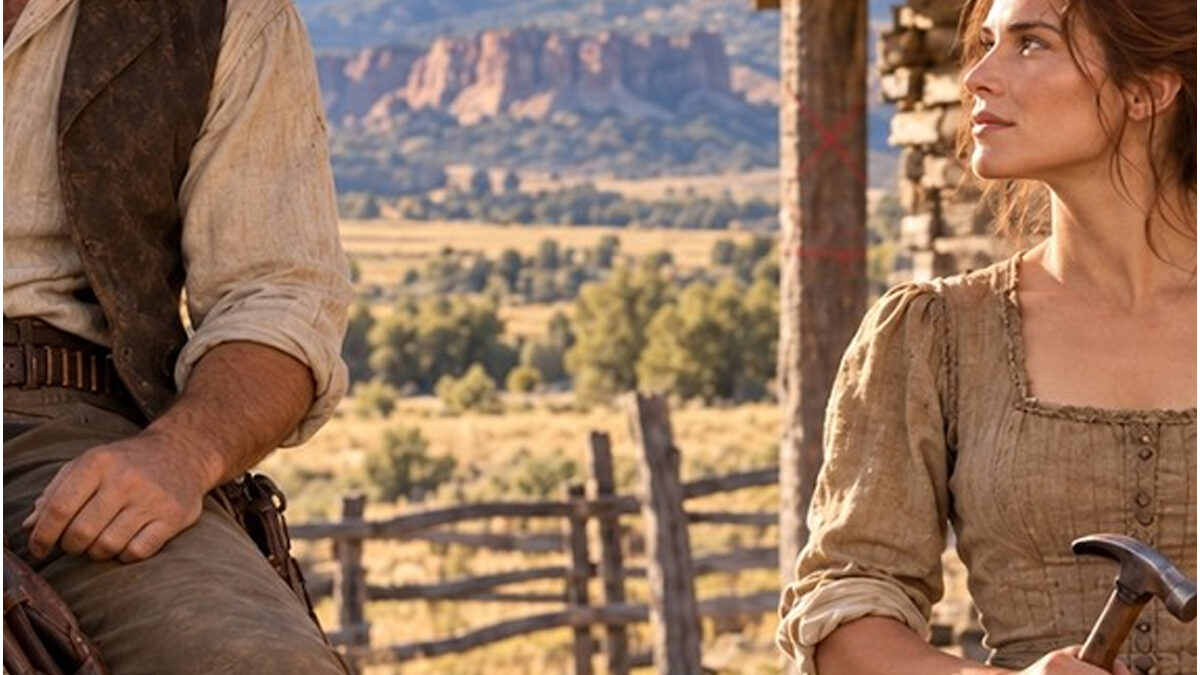
She Lived Forgotten In A Broken Cabin – Until A Wealthy Rancher Took Action
Caleb Voss had one hand on the weather split roof beam when a woman’s voice came from inside the broken cabin.
Pull that one first and half the south roof comes down with it.
He stopped.
Red carpenter’s chalk crossed the grey beam beneath his palm.

More red marks ran over the wall beside it.
Short lines, numbers, angles.
Small arrows disappearing beneath warped boards Caleb had planned to salvage before the cabin collapsed.
The woman stepped through the doorway carrying a hammer.
She was perhaps 32, sun-browned, dark-haired, and dressed in a plain work blouse with rolled sleeves.
Caleb looked from her to the beam.
This is my cabin.
I know.
And you’re living in it.
For now.
She pointed at the roof.
If you still want the lumber, take the corner brace first, then the cross piece, then that beam.
Caleb glanced upward.
He had repaired barns, corrals, sheds, and water structures across Red Basin for 20 years.
You sure?
No.
That answer made him look at her.
I measured it.
That’s better than being sure.
Caleb set down his pry bar and checked the wall from outside.
The corner brace had twisted.
The cross piece was carrying more weight than it should.
The beam beneath his hand had become part of the chain holding the southern half together.
If he had pulled it, she had been right.
The roof would have dropped.
What’s your name?
Mara Ellison.
Caleb Voss.
I know who you are.
Most people in Red Basin did.
Caleb owned nearly 6,000 acres of cattle ground and the irrigated bench that produced the best alfalfa for 50 miles.
How long have you been here?
11 weeks.
In a cabin with half a roof.
It had less roof when I found it.
Caleb looked past her.
Packing crates covered gaps in the walls.
A shelf had been rebuilt from fence scraps.
Oilcloth covered one window.
Everything looked temporary.
Nothing looked careless.
You work construction?
I worked for a millwright.
Irrigation works, flumes, grain equipment, whatever paid.
Worked.
The company failed.
Wages?
3 months unpaid.
And they left you here?
They left everyone somewhere.
Caleb nodded toward the cabin.
You can stay until we decide what happens to this place.
Mara’s grip shifted on the hammer.
I don’t take charity.
I didn’t offer any.
Caleb turned toward his horse.
Behind him, Mara said, “Your north stock tank is losing pressure.”
He stopped again.
How would you know that?
I hear the line hammer at night.
She pointed beyond the cabin toward the low ridge.
Water reaches this place before it drops to the north tank.
Every few nights, the pipe knocks twice after the flow changes.
Air is getting in somewhere or water is getting out.
The north tank had dropped three times that summer.
Caleb had replaced its cracked float valve himself.
The tank still dropped.
You think you know where?
I can narrow it.
Caleb looked at the chalk lines, the repaired wall, then toward the ridge where his water system crossed hard ground before reaching the north pasture.
What would that cost me?
3 days, $2 a day.
Meals while I’m working.
If I find nothing useful, you owe me nothing beyond the first day.
You negotiate like you expect me to argue.
Most men do.
I’m not most men.
We’ll see.
By noon, Mara rode beside Caleb in the supply wagon toward the upper line.
She carried a measuring stick, cord, a tin cup, and the same red chalk she had used on the cabin.
At the first tank, she measured the level.
At the second, she rested two fingers against the inlet while Caleb checked his watch.
At the third, she crouched beside a valve box and listened.
Caleb watched her work.
Then he checked every measurement himself.
Mara noticed.
She said nothing.
By late afternoon, she had marked three places on Caleb’s ranch map.
“Pressure drops here,” she said, tapping the second mark.
“Not enough to empty a tank faSt. Enough to make the system chase itself.”
“That section has never broken.”
“Then it’s due.”
Caleb ordered two hands to bring shovels.
The ground was hard enough that sparks jumped from one pick.
They dug until sunset.
Nothing.
One ranch hand looked toward Caleb.
Caleb looked toward Mara.
She studied the trench, then walked 12 paces uphill.
“Dig here.”
Caleb almost asked why.
Instead, he took the shovel himself.
Three feet down, wet soil appeared beneath ground that had been dry for weeks.
Another foot exposed split timber around the buried conduit.
Water whispered through the crack.
Nobody spoke.
Caleb climbed out.
Mara marked the broken section on the map.
“You found it.”
“I found one.”
He looked at her.
“One?”
“If this caused all your pressure loss, the lower tank should recover by morning.”
They repaired the conduit before dark.
Caleb stayed until the last brace was packed back into the trench.
Mara stood beside him, watching the water settle into a steady run, before she finally put away her chalk.
By sunrise, the tank had risen.
Caleb checked it himself.
Then he rode to the cabin.
Mara was already outside.
She saw his face and picked up the measuring stick without asking.
Together they returned to the line.
The north tank had gained water.
The west tank had lost more.
Mara measured both, walked 50 yards across the hard ground, and stopped where Caleb knew there was no valve, no joint, no recorded weak point.
She unspooled the red chalk line.
Then she snapped a mark across the dirt.
Long, straight, impossible to ignore.
Caleb stared at it.
Mara looked toward the buried root beneath their boots.
You don’t have a broken pipe, Mr. Voss.
She wound the chalk line back into her hand.
You may have a dying water system.
By 8:00 that morning, Mara had changed the three-day agreement.
Not with words.
She had spread Caleb’s water map across the tailgate of a wagon, weighted each corner with tools, and drawn six red marks from the spring canyon to the lower pastures.
Caleb stood across from her.
You think all six are bad?
I think all six need testing.
That wasn’t my question.
No.
Mara tapped the first mark.
If I guess before I measure, you’ll spend the day proving me wrong.
Caleb folded his arMs. You noticed that?
You checked yesterday’s measurements after I checked them.
Twice.
I noticed that, too.
Caleb almost smiled.
AlmoSt. Start wherever you want.
Mara looked up.
It was the first time he had given her that answer.
They began at the upper spring box.
Cold water pushed from the rock face into a timber-lined basin built before Caleb owned the ranch.
From there it entered a mixture of open flume, buried wooden conduit, and newer iron fittings added whenever money and time allowed.
Nothing about it had been designed as one system.
It had grown patch after patch, generation after generation.
Mara measured the spring flow while Caleb recorded the time.
“Plenty of water entering,” she said.
“So, we’re losing it below.”
“Maybe.”
Caleb looked at her.
“There’s that word again.”
It keeps men from falling in love with the first explanation.
They followed the flume downhill.
Near midday, Mara stopped beneath a raised section where the timber crossed a shallow wash.
She studied the braces, then the grade, then the water moving through the trough overhead.
“Your pitch is wrong here.”
“It’s been that way 15 years.”
“That doesn’t make it right.”
Caleb took the measuring stick from her.
“1 in over that span.”
“3/4.”
“1.”
Mara handed him the level.
“Prove it.”
Caleb climbed beneath the flume.
The shade there was narrow and smelled of damp wood and mineral water.
Mara crouched beside him while he set the level against the support.
He measured once, then shifted it, and measured again.
“3/4.”
He looked at the mark.
Mara said nothing.
Caleb handed the tool back.
“You could say it.”
“I could.”
“You’re enjoying this.”
“A little.”
He gave a low laugh.
It surprised both of them.
They reset the brace.
For the next 2 days, work moved faster.
Mara chose inspection points.
Caleb stopped asking for an explanation before everyone.
At the south pasture, she found a loosened joint hidden beneath cottonwood roots.
Near the horse lot, she discovered a warped gate that allowed water to bleed backward whenever pressure dropped.
Each repair improved the flow for a while.
By the fourth morning, the storage tanks were rising again.
Caleb found Mara beside the cookhouse sharpening a carpenter’s pencil.
You were hired for 3 days.
I noticed you’re still here.
You still have a water problem.
Caleb held out an envelope.
Her wages.
She counted the money without apology.
Good, Caleb thought.
He would have trusted her less if she had pretended not to care what her work was worth.
I want another week, he said.
Mara slipped the money into her pocket.
At the same rate?
$3 a day.
Her eyes narrowed.
Why more?
Because yesterday you saved me a crew and half a wagon of lumber.
That’s your reason?
That and I expect you to argue.
I was going to ask for three.
Then we save time.
She took the pencil and walked toward the wagon.
That afternoon, they ate beneath the flume because neither wanted to ride back to the ranch house.
Caleb passed her a canteen.
Mara drank and returned it.
No ceremony.
No awkward thanks.
A month earlier, Caleb would have found the silence uncomfortable.
Now it felt useful.
He looked at the red chalk case beside her boot.
Your father teach you that, too?
The chalk?
The measuring?
She rubbed dust from the case with her thumb.
He built mills.
Small ones, mostly.
Grain, lumber, irrigation pumps when people could afford them.
You worked with him?
From 12 onward.
Did he pay you?
Badly.
Caleb glanced at her.
She smiled.
He said family wages built character.
Did they?
No, they built resentment.
This time Caleb laughed before he could stop himself.
Mara looked toward the moving water.
My father was good with machines, less good with people.
Caleb understood enough not to ask more.
Instead, he handed her the last biscuit.
She broke it in half and handed part back.
Near sunset, the west tank reached its highest level in weeks.
Caleb stood beside it with Mara.
We may have it.
Maybe.
He frowned.
You ever say yes?
When yes is true.
By dawn, the west tank had fallen nearly 18 inches.
Caleb stared at the waterline.
Mara did not.
She was watching the inlet.
There was barely a trickle.
They rode uphill without breakfaSt. At the section they had repaired two days earlier, the ground was dry.
No leak.
At the next joint, dry again.
Mara dismounted.
We open it.
This section is sound.
You can’t see inside it.
It was replaced before I bought the east acreage.
How long ago?
22 years.
Mara looked at him.
Caleb took off his coat.
Fine.
They dug.
Two ranch hands joined them.
The sun climbed.
The first inspection cut revealed a conduit that looked good from above.
Caleb wiped dirt from the timber.
Solid.
Mara crouched beside the opening.
Cut underneath.
One man hesitated.
Caleb nodded.
They cleared more soil.
The lower half of the timber pipe had folded inward.
Not broken.
Collapsed.
Its inside passage was barely half the width it should have been.
Caleb stared at it.
Mara stood.
We need another cut.
How far?
200 yards.
The second opening was worse.
The timber had softened from within and compressed under decades of soil, water still passed through it.
Just not enough.
Caleb climbed from the trench slowly.
How much?
Mara looked downhill.
Hundreds of feet, probably.
We replace it.
With what?
Iron.
You don’t have enough.
Timber.
You don’t have time.
Caleb’s eyes hardened.
We repair what failed.
No.
Mara’s answer came quietly.
Caleb turned toward her.
No?
You’ve been fixing pieces of a system that’s finished.
This system watered this ranch before either of us was born.
And now it can’t.
The words stayed between them.
Caleb looked toward the distant alfalfa bench.
Green rows shimmered beneath the afternoon heat.
His best field.
His most reliable crop.
Mara took out her chalk line.
She walked the upper edge of the bench, stopping twice to sight the grade.
Then she continued downhill.
Caleb followed.
At the center of the field, she stopped.
You can bypass the buried conduit.
How?
Open gravity channel.
Across this?
Yes.
Caleb looked over hundreds of yards of alfalfa, nearly ready for cutting.
There has to be another route.
There might be.
Mara studied the ridge.
But this is the safest grade.
She pulled the red line tight between two stakes, then snapped it.
A clean mark crossed the soil between green rows.
Caleb stared at the line.
Saving the ranch’s water no longer meant repairing what had broken.
It meant cutting straight through the most valuable field he owned.
Caleb spent the next morning trying to prove Mara wrong.
He did not hide it.
They rode the upper bench together with two measuring rods, a level, cord, and every old ranch map he owned.
“There,” Caleb said, pointing toward a lower ridge.
“Run it around the field.”
Mara studied the slope.
“We lose too much fall.”
“Then deepen it.
That puts the headgate below solid ground.
Brace it.”
“With what?”
“Timber.”
Mara looked toward the ranch yard.
“You have enough heavy timber for either the channel crossings or that headgate, not both.”
Caleb said nothing.
They measured anyway.
By noon, the answer had not improved.
The longer route saved the alfalfa, but demanded nearly twice the digging.
One section crossed loose soil above the wash.
Another required a steeper drop than Mara was willing to truSt. Caleb stood beside the last stake.
“How bad?”
Mara rolled the cord around her hand.
“If we build this route fast, it may hold.”
“May?”
“For a season.
Maybe two.”
“And your route?”
She looked across the green bench.
“If the grade stays where I marked it, years.”
Caleb stared over the field.
He had bought the original 40 acres when there had been little there except hard earth and rabbit brush.
He had leveled it in sections, cut irrigation rows, improved the soil, lost the first crop to insects, lost half the second to an early froSt. By the fourth year, the field paid for itself.
Now Mara wanted him to dig through the center.
A rider approached from the lower pasture.
It was Tom Reed, Caleb’s foreman.
He pulled up hard.
“South storage tank is below half.”
Caleb turned.
“Since when?”
“This morning.”
Mara looked at Caleb.
Neither said what both understood.
Time had finished arguing for him.
Caleb rode to the tank himself.
He measured the level, then measured it again.
The second mark did not change the firSt. Tom waited beside him.
If it keeps dropping, we start moving cattle off the south range.
How many?
Caleb looked toward the herd beyond the fence.
Enough cattle to pay wages.
Enough cattle to cover winter feed.
Enough cattle that selling early would hurt for years.
Not yet.
Tom nodded.
Caleb rode back to the alfalfa bench.
Mara was waiting beside the red line.
She had not started anything that mattered.
She had given him the choice.
Caleb dismounted.
Cut it.
Mara watched him.
You’re certain?
No.
He looked across the crop, but I’m done asking certainty to do a job only judgment can do.
Mara held his gaze for 1 second longer.
Then she turned toward the waiting crew.
Start at the upper stake.
By afternoon, steel entered the field.
The first shovel broke an irrigation row Caleb had shaped with his own hands.
The second opened dark soil beneath the roots.
Then the men moved faster.
Green plants disappeared beneath boots and wagon wheels.
Fresh earth piled where the crop had stood.
Caleb worked with them.
He did not stand at the edge and supervise.
He swung a pick until his shirt darkened with sweat.
Mara moved along the cut checking depth and grade.
Every 50 ft, she snapped another red mark.
Late in the day, Caleb caught her watching him.
What?
You’re not complaining.
You expected me to.
Yes.
He leaned on the pick.
I’m trying something new.
What’s that?
Keeping my mouth shut when complaining won’t move water.
The corner of Mara’s mouth lifted.
Keep practicing.
They worked until the light began leaving the field.
At supper, Caleb barely spoke.
Mara sat across the bunkhouse table from him with dirt on one sleeve and a scrape across her glove.
Caleb pushed an envelope toward her.
She looked at it.
What’s this?
Another week.
I haven’t finished this one.
You’ve worked after dark three nights.
That was my choice.
So is paying you.
Mara pushed the envelope back.
I don’t charge extra because your ranch is in trouble.
Caleb pushed it toward her again.
I’m not paying for trouble.
Her eyes lifted.
I’m paying for work.
Mara studied him.
Then she took the envelope.
No argument.
Something between them settled.
Not softness.
Something stronger.
The next two days cost Caleb more of the field.
A wagon crushed one section near the channel crossing.
A spill of excavated soil buried another.
At the lower end, they discovered a layer of packed clay that slowed digging to half speed.
Still the grade held.
Mara checked it.
Caleb checked it once.
On the second morning, he reached for the level again.
Stopped.
Mara noticed.
You forgot something.
No.
You always check twice.
I checked.
Her expression changed slightly.
Caleb picked up the shovel.
That enough for you?
For today.
By evening, the channel reached the headgate site.
That should have been the easiest part.
It was not.
The heavy timber frame had been assembled in the ranch yard from the driest stock they could spare.
When the wagon delivered it, one upright had warped, only slightly.
Enough.
Caleb ran his hand along the timber.
We rebuilt it.
Mara crouched beside the frame.
With what?
I’ll pull beams from the north hay shed.
You need that roof before winter.
I need this gate now.
You need time more.
Caleb looked toward the storage tanks below.
Mara set her level across the warped upright.
Then another brace.
She measured the angle twice.
It can work.
Not square.
It doesn’t need to be square.
Caleb looked at her.
It needs to carry pressure evenly.
She took out the red chalk.
If we reset the frame 4° east and brace here and here, the load moves into the bank instead of fighting the warp.
Caleb crouched beside her.
He measured the upright.
Then the bank.
Mara waited.
Caleb reached to measure again.
His hand stopped.
For years, the second measurement had been the thing that kept mistakes away.
His father had guessed.
His brother had trusted a bad beam.
Caleb had built his whole life around never doing either.
But Mara had not guessed once.
Not at the north tank.
Not beneath the flume.
Not over the collapsed conduit.
Not across the field Caleb had destroyed because she had shown him exactly why it had to be done.
He lowered the measuring stick.
Then placed it in her hand.
Mara looked at him.
Caleb stood.
Set the head gate your way.
Around them, the crew fell quiet.
Mara closed her fingers around the tool.
You understand if I’m wrong.
I do.
The answer came before she finished.
Caleb looked down the unfinished channel toward the falling tanks.
Then back at her.
For once, Miss Ellison, I’m going to let the person who knows the job do it.
Mara rose slowly.
She took out the red chalk line.
And for the first time in years, the most important decision on Red Basin Ranch no longer belonged to Caleb Voss.
Mara set the first brace before sunrise.
Caleb said nothing about the angle.
He carried the warped headgate frame into the cut with Tom and two ranch hands, lowered it where Mara pointed, and held the weight while she checked the bank.
2 inches eaSt. They shifted it.
Stop.
Mara stretched the red chalk line across the upright and snapped a mark.
Caleb watched the red dust settle over the fresh timber.
For once, he did not reach for the level.
The remaining storage water had dropped again overnight.
If the new channel failed, there was no time left to rebuild it before cattle had to be moved.
Mara knelt beside the frame.
Brace against the bank here.
Caleb drove the timber into place.
Lower.
He adjusted it.
Again.
He struck once more.
The frame settled against the earth at the angle she had calculated.
By midmorning, they were ready.
The new channel stretched across the damaged alfalfa bench like an open scar.
Hundreds of plants had been cut away.
Soil covered sections Caleb had spent years improving.
At the upper end, the old conduit waited behind a temporary stop gate.
Mara walked the full length one last time.
She checked the first junction.
Then the second.
At the lower tank, Tom stood waiting.
Caleb remained beside Mara at the headgate.
You want to open it?
He asked.
She looked at him.
It’s your ranch.
You designed the route.
You paid for it.
Caleb rested one hand on the release bar.
We built it.
Mara studied him for a second.
Then she placed her hand beside his.
Slowly, together they lifted.
Water pushed beneath the gate.
At first, it barely covered the channel bottom.
A thin brown run slid through loose soil.
Caleb watched the first bend.
Nothing spilled.
The flow reached the warped frame.
The east brace took the pressure.
It held.
Mara moved downhill beside the water.
Caleb followed.
At the first junction, the stream spread wider and slowed.
Mara crouched.
Give it a moment.
Caleb looked toward the storage tank below.
The water moved again.
Faster now.
It rounded the second bend and entered the lower section.
Tom shouted from the tank.
Flow.
Nobody answered him.
They were all watching.
The channel filled deeper.
A steady current reached the tank inlet.
For several seconds, the level appeared unchanged.
Then water climbed over the old mineral stain.
Caleb removed his hat.
Mara sat back on her heels.
The ranch hands began talking at once behind them.
Caleb heard none of it clearly.
He looked at the cut field.
The ruined crop.
The new channel.
Then at Mara.
She was staring at the rising water as if she still expected the land to dispute her calculations.
It works.
Caleb said.
It’s working.
That sounded different.
It should keep working if the bank settles evenly.
Caleb laughed.
Mara finally looked at him.
This time she laughed, too.
The sound was brief.
It was enough.
Three days later, Caleb canceled the planned cattle sale.
The lower tanks held.
The south range reopened.
They saved what remained of the alfalfa crop.
Though nearly a third of the bench had been lost to excavation and wagon traffic.
Caleb entered the loss into his books himself.
He did not resent the number.
It was cheaper losing the ranch one careful failure at a time.
He found Mara at the line cabin that evening.
The repaired roof cast a clean shadow over the doorway.
She was replacing a warped sill board.
You’re working after supper again.
I live here.
That sounds like an excuse.
She set down the saw.
What do you need?
Caleb handed her a folded sheet.
She opened it.
It was not a gift.
It was an employment agreement.
Permanent oversight of Red Basin’s water works, flumes, tanks, headgates, structural repairs, and future irrigation construction.
The wage was written plainly.
So was her authority to stop unsafe work.
Mara read it twice.
This is a real position.
I know.
You’ve never had one.
No.
You made this up.
I needed it.
She looked toward him.
Caleb nodded toward the new channel visible beyond the ridge.
Apparently for years.
Mara folded the paper carefully.
And the cabin?
Still yours to use as long as you want it.
Part of the wages?
No.
Then what is it?
A building on my property I was about to tear apart before somebody stopped me.
Mara’s eyes narrowed.
No debt?
No debt.
No expectation that I move into the ranch house?
No.
A pause.
Good.
Caleb leaned against the porch poSt. That sounded almost disappointing.
It wasn’t.
Almost?
Mara looked down at the agreement.
Then back at him.
I’ll take the job.
Caleb nodded.
I hoped you would.
She held the paper against her side.
And if I decide later I want something different?
Then you decide.
That answer stayed between them.
Weeks passed.
The new channel settled cleanly.
Mara introduced inspection marks at every junction and a schedule Caleb pretended not to admire as much as he did.
He still checked important work.
Once.
Usually.
Some evenings he rode to the line cabin after the day’s work.
Sometimes Mara invited him inside.
Sometimes they sat on the porch.
Sometimes she was tired and told him so.
He went home.
That, more than anything, taught her she could say no without losing what had been offered.
One evening, Caleb found her replacing the porch boards.
“You’re doing that wrong,” he said.
Mara looked up slowly.
Caleb smiled.
“That was a joke.
Needs work.”
He picked up the other end of the beam.
“So does this.”
They fitted it together.
The cabin was no longer broken.
Mara had kept one old exterior board untouched.
Red measurements still crossed its weathered surface from the day Caleb first found her there.
He nodded toward it.
“You leaving that?”
“Yes.”
“Why?”
“It reminds me I knew what I was doing before anyone else noticed.”
Caleb absorbed that.
Then said, “I noticed eventually.
You nearly pulled the roof down firSt.”
“Details.”
Mara took out her father’s chalk line.
She hooked one end across the new porch beam.
Caleb held the other.
They stretched it tight.
Before she snapped it, Mara looked across at him.
“When this porch is finished, you know you don’t have to keep finding repairs here.”
“I know.
You can come without an excuse.”
Caleb’s hand stayed steady on the line.
“So can you.”
Mara’s expression softened.
Not because she owed him.
Not because she needed somewhere to go.
Because the choice was hers.
Together, they pulled the red line tight and snapped one clean mark across the fresh timber.
If Caleb and Mara’s hard-earned partnership stayed with you, subscribe and like for more Wild West stories built on choices that matter.








