Mail-Order Bride With Secret $23K Fortune Arrives at Burnt Homestead – Rebuilds With Scarred Cowboy
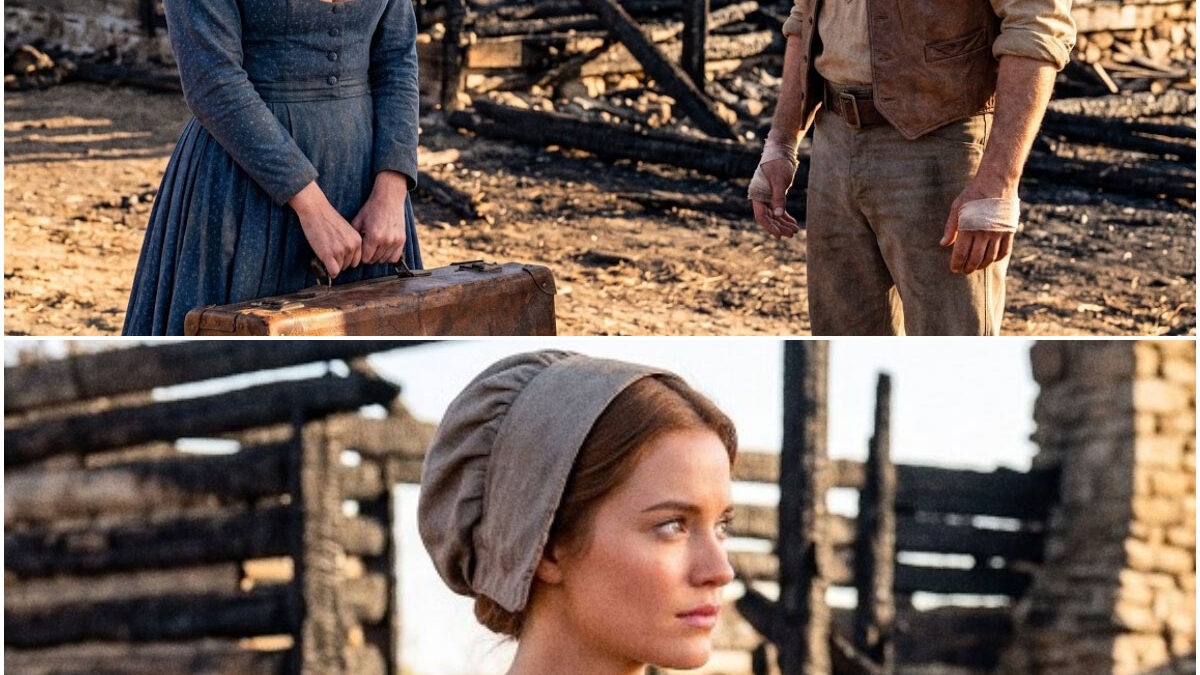
Mail-Order Bride With Secret $23K Fortune Arrives at Burnt Homestead – Rebuilds With Scarred Cowboy
Clara Marsh arrived in Texas with $23,000 hidden beneath the false bottom of her trunk.
It was enough money to buy a grand home in any eastern city.
Yet, when the stage coach left her beside the Brennan homestead, she found three burned walls, a dead garden, and a scarred cowboy sitting alone in the ashes.
Silus Brennan did not turn when she approached.

His broad shoulders were covered by a sweat- soaked shirt, and strips of dirty cloth wrapped both hands.
Behind him, black timbers pointed toward the sky.
The stone chimney was the only part of the cabin still standing straight.
“You should have stayed on that coach,” he said.
Clara placed her trunk in the duSt. I came to marry Silus Brennan.
He finally faced her.
The left side of his face was marked from his jaw to his temple.
Thick burn scars pulled one corner of his mouth and narrowed his left eye.
Clara had expected a lonely rancher.
She had not expected a man who looked as if fire had followed him all his life.
You found him, Silas said.
But the letter was written before this happened.
When 3 weeks ago, Clara looked at the ruin again.
What started it?
Lightning hit the roof.
His answer came too quickly.
She sensed there was more, but his cold stare warned her not to ask.
Silas picked up her trunk.
His wounded hands tightened around its leather handles and blood appeared through the cloth.
I’ll carry this back to the road.
Another coach comes Friday.
Clara caught the other handle.
Then you can leave it where it is.
I have no house.
You have a barn.
I have no money.
I can work.
His scarred cheek tightened.
You don’t understand.
I cannot take a wife into this.
Clara opened her trunk.
She removed a cast iron pot, seed packets, two tin plates, clean bandages, and a bottle of carbolic acid.
Beneath her folded winter clothes rested the papers that proved how wealthy she truly was.
She made certain Silas did not see them.
I crossed more than a thousand miles, she said.
I will not run because the roof is gone.
For the first time, something moved behind his hard expression.
It was not relief.
It looked more like fear.
The barn had survived the fire, but only barely.
Silas cleared a small tack room for her and hung canvas across its doorway.
Clara made a bed from hay and spread her mother’s wedding ring quilt over it.
As she arranged her belongings, Silas stood beyond the canvas.
“You should know how I got these scars,” he said.
Clara waited.
I was seven when our barn caught fire.
My little sister was trapped inside.
I went after her.
You saved her.
I carried her out.
His voice weakened.
She died from fever that winter.
Clara stepped through the canvas.
Silas was staring toward the ruined cabin.
What was her name?
Ruth.
It was the first thing he had given her that was not anger or rejection.
That evening, Clara cooked cornmeal and salt pork over an outdoor fire.
They ate beside the barn while coyotes cried beyond the cottonwoods.
Silas hardly touched his food.
“My father built that cabin,” he said.
“He died in it this spring.
Before he passed, he made me promise I would keep this land alive.”
Clara glanced at the black remains.
“Then we rebuild.”
Silus looked at his bandaged hands with what?
She almost told him.
$23,000.
Three buildings in Philadelphia.
Investments her father had left behind.
More wealth than Silas might earn in a lifetime.
But she remembered James Henderson, the man who had promised to marry her before she discovered he wanted only her inheritance.
She had come west because Silas’s letters never asked about money.
He had asked whether she could mend clothes, plant vegetables, endure dry summers, and stand beside a man when times turned cruel.
Clara feared the truth would change the way he looked at her.
We rebuild with what we have, she answered.
Before sunrise, axe blows woke her.
Silas was already cutting apart the burned roof beaMs. His bandages hung loose and fresh blood ran across the axe handle.
Clara carried water and clean cloth to him.
Sit down.
I have work.
You also have hands you’ll need tomorrow.
He resisted until she took the axe from him.
Then he sat on a charred beam and allowed her to clean his wounds.
The carbolic acid burned, his jaw locked, but he did not pull away.
When she finished, Clara dragged the first blackened board from the ruins.
Silas watched her struggle.
You’re a seamstress.
I still have arMs. For the next 4 hours, they worked side by side.
Clara’s palms blistered.
Ash covered her dress and darkened her face.
Silas said nothing, but he began choosing lighter boards for her to carry.
By noon, they uncovered the old stone foundation.
Silas knelt and tested the mortar.
It held.
Clara rested her aching hand beside his.
Then the fire did not take everything.
Wagon wheels sounded along the road.
Two neighboring families arrived with food, tools, and a load of fresh pine.
Silas rose at once.
I cannot pay for that lumber.
Mr. Hadley climbed from the first wagon.
Nobody asked for payment.
I don’t take charity.
Clara saw shame rising across Silas’s face.
Before he could send them away, she stepped forward.
Well repay it with labor during harveSt. Silas knows carpentry, and I can sew, cook, and preserve food.
Mr. Hadley studied her, then offered his hand.
That sounds like a fair trade.
They unloaded nearly 300 ft of pine.
Silas worked without speaking.
When the wagons left, he disappeared into the barn.
Clara touched one smooth board.
Lumber alone would not be enough.
They needed nails, glass, hinges, roofing, and tools.
Silas would never accept them if he knew she had paid.
The following morning, Clara walked three miles to Cooper’s merkantile.
Mrs. Hadley stood behind the counter when Clara placed a $20 gold coin before her.
The older woman stared at it.
That is more than a seamstress saves in a year.
Clara kept her voice low.
I need four windows, nails, and hinges.
Silas cannot know where the money came from.
Mrs. Hadley lifted the coin, then looked straight into Clara’s frightened eyes.
How much are you hiding from your husband?
Before Clara could answer, the storebell rang behind her.
Heavy boots crossed the wooden floor and Silas Brennan’s voice came from only a few feet away.
Clara, what are you doing here?
Mrs. Hadley covered the gold coin with her hand just before Silas reached the counter.
Clara’s heart struck hard against her ribs.
I asked what you’re doing here, Silas said.
Buying nails.
With what money?
Mrs. Hadley pushed a small sack across the counter.
With store credit.
Your wife brought eggs and she offered to sew curtains for me.
Silas looked from the sack to Clara.
He knew something was wrong, but Mrs. Hadley’s face gave him nothing.
Next time, tell me before walking three m alone, he said.
Clara nodded and followed him outside.
Behind them, the $20 coin disappeared into Mrs. Hadley’s ledger drawer.
During the next 3 weeks, the burned homestead slowly changed.
Silas taught Clara how to hold a draw knife and shape rough pine.
He stood behind her, placing his scarred hands over hers.
“Don’t fight the blade,” he said near her ear.
“Let the wood guide it.”
Clara pulled again.
A pale curl fell at her feet.
Silas smiled before quickly stepping away.
Every gentle moment seemed to frighten him more than the fire had.
Clara secretly paid for nails, hinges, roofing, and four glass windows.
Mrs. Hadley marked each delivery as store credit.
Silas accepted the supplies, but his questions grew sharper.
When the windows arrived, he read the bill twice.
“Paid in full,” he said.
“By who?”
“Mrs. Hadley trusts us.
She barely knows us.
She knows you.”
Silas stared at Clara, waiting for something more.
She turned toward the cabin before her face betrayed her.
The new walls rose around the old stone chimney.
Silas worked on the roof while Clara planted beans, corn, and squash.
At night, they ate beside the barn and spoke about the lives they had left behind.
One evening, Silas admitted he struggled to read.
Clara brought him an old newspaper and sat beside him beneath the lantern.
He stumbled through the first paragraph, his face growing red whenever a word stopped him.
“You think I’m foolish,” he said.
“I think you were never given enough time to learn.”
She guided his finger beneath each line.
He tried again until he reached the end without her help.
Silas closed the paper carefully.
“Nobody ever had patience with me.”
Clara looked at the scar that crossed his cheek.
“They should have.”
The next morning, Clara climbed onto the roof to help lay shingles.
Her boots slipped on loose duSt. She dropped the hammer and slid toward the edge.
Silas caught her around the waiSt. For one breathless moment, they were pressed together on the sloping roof.
His arm held her firmly while her fingers gripped his shirt.
Their faces were only inches apart.
“You hurt?”
He asked.
Clara shook her head.
His eyes moved to her mouth, but he released her and helped her reach the ladder.
I’ll finish this part.
Clara climbed down with her knees shaking for a reason that had nothing to do with the fall.
By early August, the cabin had a roof, windows, and a solid front door.
Silas built a pine table for the main room.
Beneath it, he carved two letters into the wood.
CB Clara traced them with her fingertips.
You already gave me your name,” she whispered.
“Only if you still want it,” she turned toward him.
Silas looked ready for rejection, as if the scars had taught him never to expect tenderness.
Clara placed her hand against the unburned side of his face.
“I came here for that name.
I’m not leaving without it.”
He pulled her into his arMs. The embrace was uncertain at first, then tighter.
Clara rested her cheek against his chest and listened to the steady beat beneath his shirt.
That Saturday, they attended a barn dance in town.
Clara wore her best blue calico dress.
Silas appeared in a clean white shirt with his dark hair combed back.
He stopped when he saw her.
“You look beautiful,” he said.
“You look handsome.”
His hand rose toward his scar, but Clara took it before he could cover his face.
They walked the three miles together.
Lanterns hung from the barn rafters.
Fiddle music filled the warm air while boots struck the wooden floor.
Town’s people watched the new couple enter, but Silas kept Clara’s hand in his.
During the dance, a wealthy rancher named Warren Cordell approached them.
He needed a skilled carpenter to build a new barn.
“What would you charge?”
Cordell asked.
Silas hesitated.
“$1 a day,” Clara answered.
You provide the materials.
Cordell raised an eyebrow.
That is a high wage.
It is fair pay for good work.
Cordell studied Silas, then offered his hand.
Start Monday.
Silas accepted.
On the moonlit walk home, his steps seemed lighter.
“You made that deal before I could speak,” he said.
“You would have asked for 75.”
“I might have.
You are worth a dollar.”
He laughed softly and swung their joined hands between them.
At the property line, they stopped and looked at the finished cabin.
Moonlight shone in its new windows.
It was small, but it stood strong against the Texas wind.
Silas touched Clara’s cheek.
I never thought I’d have this again.
She wanted to tell him everything.
Instead, the truth stuck inside her throat.
There’s something you should know about my money.
How much do you have?
More than you think.
Silus’s hand lowered.
How much, Clara?
She remembered her former fianceé, James Henderson.
He had promised love while secretly planning to use her inheritance to cover his gambling debts.
After him, Clara could no longer tell whether a man wanted her or what belonged to her.
“If I tell you, everything may change.”
“I’m not James Henderson.”
She looked up sharply.
How do you know that name?
You spoke it in your sleep.
Clara stepped back.
Silas waited, but she could not force out the number.
I came because your letter never asked whether my family had money.
She said you wanted a woman who could work beside you.
For once, I wanted someone to see me before seeing what I owned.
I see you.
You might not after tomorrow.
Silas drew her against him.
Then tell me tomorrow.
He kissed her beneath the cottonwoods.
It began gently, but months of loneliness lived inside it.
Clara held his shirt as his arms tightened around her.
For the first time since arriving, the burned land felt like home.
They spent that night inside the cabin beneath her mother’s quilt.
When Clara awoke the next morning, Silas was gone.
She found him in the barn beside her open trunk.
The brass lock had been broken.
Bank papers, property deeds, and investment records covered the dirt.
Silas held one statement in his trembling hand.
“$23,000,” he said.
Clara stopped in the doorway.
His face had lost all color.
“Three buildings in Philadelphia, railroad investments, bank accounts you never mentioned.
I was going to tell you today after letting me believe we had nothing, we built that cabin together.”
No.
He crushed the paper in his fiSt. I swung the hammer.
You secretly bought everything.
That does not make you less of a man.
His scar pulled tight as he looked toward the home he had rebuilt with bleeding hands.
To you, maybe.
Silas reached deeper into the trunk and found another set of papers.
They contained plans for a medical clinic and an unsigned bank order for $11,000.
His eyes rose slowly to hers.
What else have you been planning behind my back?
A medical clinic, Clara said.
I plan to give $11,000 to build it.
Silas stared at the papers as if they had struck him.
You plan to give away half your fortune without telling me.
People are dying because the nearest doctor is 2 days away.
That is not the point.
Then what is?
The point is that nothing between us has been honeSt. His voice rose inside the barn.
The cat fled through the open door.
Clara stepped toward him, but he backed away.
“You let me believe I was providing for my wife,” he said.
“Every morning I worked until my hands bled.
All that time you could have bought 10 houses.
The money bought wood.
You built the house with your money.
With our hands.”
Silas threw the clinic plans onto the dirt.
There is no hour in secrets.
He walked outside and grabbed his hat.
Clara followed him into the harsh morning light.
Where are you going?
Cordell’s ranch.
You do not start until Monday.
I start today if he will have me.
Silas, please listen.
He turned so quickly that she stopped.
Did you marry me because you wanted a husband or because I looked like another broken thing your money could repair?
The words cut deeper than she expected.
Clara’s face lost color.
That is not why I stayed.
Then why did you choose a man with nothing?
Because your letter was honeSt. Silas gave a bitter laugh.
Too bad your answer was not.
He crossed the field without looking back.
Clara watched until the cottonwoods swallowed him.
For 3 days, Silas did not return.
Clara milked the cow, gathered eggs, watered the garden, and slept alone in the house they had built together.
Every object held some part of him.
The shelves carried marks from his plane.
The table bore her initials.
Even the front door opened with the smooth care of his hands.
On the second afternoon, Mrs. Hadley arrived with a basket of bread and preserves.
One look at Clara’s face told her enough.
He found the papers.
Clara said.
Mrs. Hadley set down the basket.
Where is he?
Working at Cordell’s.
He will come back.
He thinks I used him.
Did you?
Clara looked toward the table.
No, but I decided what was best for him without allowing him to decide for himself.
Mrs. Hadley sat beside her.
You hid money because one man wanted it.
Silas rejected money because he feared needing it.
You both let old wounds speak louder than the truth.
What if he cannot forgive me?
Then make him understand what he is walking away from.
On the sixth evening, hoof beatats reached the cabin.
Silas rode in on one of Cordell’s mules.
Dust covered his clothes.
His face was burned by the sun and his shoulders hung from long days of labor.
He entered the cabin and placed an envelope on the table.
$18, he said.
6 days wages.
Clara did not touch it.
What is this?
The first payment.
I never asked you to repay me.
I am going to repay every cent at $1 a day.
That will take more than 60 years.
Then I had better keep working.
He turned toward the door.
Clara stepped in front of him.
No, you spoke before.
Now you will listen.
His jaw tightened, but he stayed.
Clara told him about James Henderson.
She told him about the engagement ring, the hidden gambling debts, and the banker’s daughter he had courted at the same time.
James had never wanted Clara.
He had wanted her buildings, her accounts, and the comfort her father’s work could buy him.
When I read your letter, you did not ask what I owned, she said.
You asked whether I could plant a garden and survive a Texas summer.
I came because I wanted one man to meet me before meeting my fortune.
Silas looked away.
I should have told you, she continued.
But every day we worked together, I feared the money would change us.
I wanted to know whether what grew between us was real.
You still made a fool of me.
I made a frightened choice.
That is not the same as wanting to shame you.
Silus moved to the window.
Outside, the last sunlight touched the cabin walls.
“Why the clinic?”
He asked.
Clara took the plans from her bag.
Sarah Cooper lost her son last year.
He cut his hand on a fence.
The wound turned bad and they could not reach a doctor in time.
Silus lowered his head.
I knew the boy.
He was eight.
I helped Tom bury him.
Clara laid the plans on the table.
Money sat in my father’s bank while that child died.
I cannot change what happened, but we might save the next one.
We?
Yes, we.
I do not know how to build a clinic.
You do?
Silus looked at the drawings, but he did not touch them.
I need time, he said.
He took the mule and returned to Cordell’s ranch.
The following morning, Clara walked into town alone.
She met Mayor Peterson, Preacher Michaels, and three councilmen inside the town hall.
She offered to buy the empty church lot, and pay for a clinic with two examination rooms, a surgery room, medicine storage, and living quarters for a doctor.
Her only demand was that the donor’s name remain private.
The men accepted.
Clara paid $50 for the land and sent a letter to a young doctor in Santa Fe.
Then she returned home and waited.
Six more days passed.
Late Saturday afternoon, Silas rode back.
He looked thinner and new blisters covered his palMs. He placed another $18 on the table.
Clara picked up the money and closed his fingers around it.
Come with me.
Where?
To see what your wages can build.
They walked into town as the sun began to set.
Clara stopped on the empty lot beside the church.
White stakes marked a building 30 ft long and 20 ft wide.
Silas studied the ground.
You bought this?
Yes.
Without me.
You were not there.
But I am asking you now.
She placed the clinic plans in his hands.
Your $18 can buy medicine.
She said your skill can turn this dirt into a place that saves lives.
I have money, Silas, but I cannot make it useful without people like you.
His hands shook around the papers.
I wanted to be enough for you, he said.
I wanted to give you something that came from me.
You gave me a home.
You gave me your name.
You made a table and carved mine beneath it because you wanted me to belong.
I still feel like I failed.
Clara stepped closer.
Then stop measuring yourself by what sits in my bank.
Measure yourself by what your hands leave standing after you are gone.
Silas looked across the empty lot.
In his mind, bare dirt became walls, windows, and a room where a frightened mother might find help before it was too late.
I cannot promise the shame will disappear, he said.
I am not asking for a promise.
I am asking for a partner.
Silas finally took her hand.
Tomorrow we put the money in both our names.
He said.
No more yours and mine.
Equal partners.
Equal.
He pressed his forehead against hers.
Clara closed her eyes as his scar touched her skin.
Then Silas looked back at the marked ground and tightened his hand around the plans.
We start building at sunrise.
At sunrise, Silas drove the first wooden stake into the clinic lot.
The mallet struck with a solid blow.
Clara held the measuring rope while he marked each corner with white lime.
Before they finished, wagons began arriving.
Mr. Hadley brought stone.
Tom Cooper brought tools and six ranch hands.
Women carried water, bread, beans, and apple pies.
Even children gathered loose rocks from the dirt.
Silas stood in the center of the lot with his father’s old carpentry square in one hand.
“Foundation trench goes here,” he called.
“3 ft deep.
Keep the corners true.
Nobody looked at his scars.
Nobody treated him like a ruined man.
They looked to him because he knew what to do.
Clara watched from across the lot.
When their eyes met, Silas gave her a small nod.
They were building together again.
That afternoon, they visited the bank.
Clara placed her account papers before the manager.
“We want everything moved into one account,” she said.
The manager adjusted his spectacles.
$23,000 in both our names.
Silas answered, “Equal ownership.”
The man looked at Silas’s dusty clothes and scarred face.
“Mr. Brennan, do you understand the amount involved?”
Silas placed his rough hand over Clara’s.
“I understand that it belongs to both of us.”
They signed every paper together.
When they stepped outside, Silas looked at their joined hands.
“Does it feel different?”
Clara asked.
Yes.
Better or worse, honeSt. Work on the clinic continued through September.
Silas directed the men while Clara mixed mortar and carried boards.
Her old calluses split open, staining her bandages red.
One evening, Silas found her still working after everyone else had gone.
Your hands are bleeding.
So did yours when we built the cabin.
He took the triel from her and carefully unwrapped the cloth around her palMs. I was too stubborn to stop.
So am I.
That is what worries me.
He cleaned her hands and tied fresh strips of muslin around them.
His scarred fingers moved gently.
“I said terrible things to you,” he whispered.
“You were hurt.
That does not make them right.”
Clara touched his face, then spend the rest of our years saying better things.
Silas kissed the center of her bandaged palm.
I can do that.
By the third week, the walls stood.
Silas built two examination tables from smooth pine.
Clara sewed white curtains for the windows.
Shelves filled with medicine bottles, bandages, carbolic acid, and clean instruments arrived from Fort Worth.
The bills carried both their names.
Each time Silas signed one, his hand became steadier.
Dr. Nathan Winters arrived from Santa Fe on a dusty stage coach.
He was 30, thin, and wore wireframed spectacles.
He walked through the clinic twice before speaking.
“I expected a shack,” he said.
“This is better than some hospitals back eaSt.”
“When can you begin?”
Clara asked.
Dr. Winters set his black medical bag on an examination table.
“The moment someone needs me.”
The dedication took place the following Saturday.
Nearly everyone in town gathered outside.
Preacher Michael stood on the new steps and offered a short prayer.
“These doors belong to every person who needs help,” he said.
“May no family here again face sickness alone.”
The crowd applauded.
Clara remained beside Silus near the back.
No one knew who had paid for the building.
They believed the money came from an unnamed donor in Philadelphia.
Clara preferred it that way.
As Dr. Winters opened the doors, a scream came from the road.
Sarah Cooper was running toward the clinic with her six-year-old daughter in her arMs. The child’s face was pale and a blood soaked cloth covered her left hand.
Fence wire cut her 3 days ago, Sarah cried.
This morning, she could not get out of bed.
Dr. Winters carried the girl inside.
Clara and Silas followed.
When the doctor removed the cloth, the cut was swollen and filled with infection.
A thin red line had already begun climbing the child’s arm.
Sarah saw it and broke down.
That same line appeared on my boy, she said.
He was dead by the next morning.
Dr. Winters worked quickly.
He cleaned the wound with carbolic water, removed the infected tissue, and wrapped the hand.
“She has a strong fever,” he said.
“She stays here tonight.”
Sarah sat beside the examination table and held her daughter’s uninjured hand.
Clara brought cold water and clean cloths while Silas kept the stove burning.
The hours moved slowly.
Near midnight, the child opened her eyes and asked for her mother.
The red line had stopped below her elbow.
Dr. Winters examined it under the lamp.
“She is fighting it,” he said.
“I believe she will live.”
Sarah covered her face and wept.
Outside the clinic, she caught Clara by both hands.
Whoever paid for this place saved my little girl.
Clara could not speak.
Silas stepped beside her.
His arm moved around her waiSt. Sarah looked between them.
Something in her face suggested she understood, but she did not ask.
On the walk home, moonlight covered the road.
Clara leaned against Silas as they passed the cottonwoods.
“You saw her,” Clara said.
“That child is alive because the clinic was ready.”
Silas looked down at his hands.
“That is what your money bought.”
“Our money?”
He nodded.
“Our money.”
The rebuilt cabin glowed ahead of them.
Smoke rose from the stone chimney that had survived the fire.
The garden was heavy with beans and squash, and the porch Silas had built waited beneath the stars.
They sat together on the wooden bench.
Silas removed an old silver pocket watch from his coat.
It had belonged to his father.
The hands had remained frozen at 3:47 since the moment Samuel Brennan died.
I stopped winding it after the funeral.
Silas said it felt wrong for time to keep moving when he could not.
He turned the small crown.
Once, twice.
Then the watch began to tick.
Silas held it to his ear.
His eyes closed as the tiny mechanism came alive in his palm.
What changed?
Clara asked.
I finally understood that keeping his land alive did not mean keeping everything the way he left it.
He placed the watch between them.
Clara rested her head against his shoulder.
After a moment, her hand moved toward her stomach.
Silas noticed.
“You think there might be a child?”
“It is too soon to know.”
He covered her hand with his.
“Are you afraid?”
“Yes, so am I.”
Clara looked toward the cabin they had raised from blackened wood and broken stone.
We will manage together, Silas said.
The word no longer sounded like a hope.
It sounded like a fact.
He kissed her beneath the Texas stars.
The watch ticked beside them while lamplight shone through the windows of their finished home.
Months earlier, Clara had arrived carrying a fortune she feared would ruin every chance of being loved.
Silas had waited among the ashes, certain his scars and failures had made him unworthy of a wife.
Now his arm held her close, while their home stood behind them, and the clinic’s white windows glowed in the distance.
The old watch continued moving forward, one steady second at a time.








