The 40-Ton Beast of Pure Destruction: The Deadliest Machine in the Forest
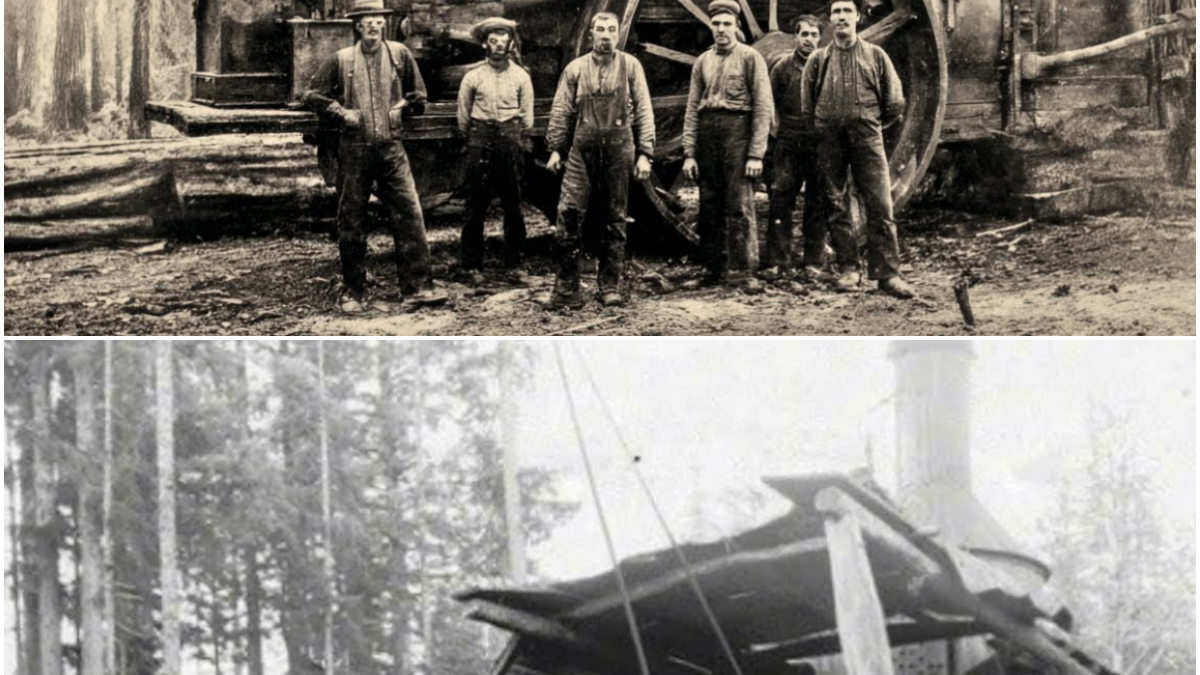
The 40-Ton Beast of Pure Destruction: The Deadliest Machine in the Forest
The steam donkey squatted in the clearing like an iron cathedral, 10 tons of boiler and drum anchored to old growth stumps with cables thick as a man’s thigh.
Its mainline stretched 800 ft into timber so dense you couldn’t see the choker setters working below.
When the drum spun, it could drag a 12t cedar log up a mountain.
When something failed, that same force turned rigging into shrapnel.
 ư
Between 1910 and 1940, logging killed more workers per capita than coal mining.
This wasn’t logging.
It was industrial violence with a whistle.
Was it the price of progress or just murder we agreed to call business?
If stories like this move you, please like, subscribe, and tell me in the comments which industrial disasters to explore next.
Your support makes these detailed historical investigations possible.
Thank you for watching with us.
Let’s dive right in.
The Pacific Northwest had a problem that couldn’t be solved with muscle alone.
Old growth Douglas fur and western red cedar, some over 300 ft tall and weighing 40 tons at the stump, grew on slopes so steep a horse couldn’t stand.
By the 1880s, hand logging, oxen teams, and skid roads had reached their limit.
The timber companies needed those trees.
The trees weren’t going to walk themselves out.
Enter the steam donkey.
A solution born from desperation and railroad engineering.
The first models appeared in Northern California logging camps around 1881, adapted from steamowered hoists used in mining and shipyards.
Within a decade, they’d spread north into Washington and Oregon, then into British Columbia.
What made them revolutionary wasn’t complexity.
It was brute force harnessed to distance.
A single machine, properly rigged, could pull logs uphill through terrain where nothing else could operate.
But revolution came with a cost written in blood.
Between 1919 and 1920 alone, Washington state recorded 127 fatal logging accidents.
The steam donkey didn’t cause all of them, but it fundamentally changed the math of danger.
Before, a man might be crushed by a rolling log or struck by a widow maker falling from above.
Horrible, yes, but the risks were visible, immediate, physical.
The steam donkey introduced invisible force, remote control, and catastrophic tension stored in steel cables stretched to its breaking point.
Could the timber have been harvested another way?
Possibly.
But economics doesn’t wait for safer methods when profitable ones already exist.
A steam donkey crew could move more wood in a week than Nox team could in a month.
Production rates soared.
So did the body count.
The industry called it progress.
Timber barons pointed to board feet delivered.
Jobs created, towns built on logging wages.
But progress for whom?
The companies got wealthy.
The forests got clear-cut.
And the men who actually stood in the rigging, who set the chokers and signaled the pools, they got what amounted to a coin flip every shift.
Go home tonight or go home in pieces.
To beat the forest, they built something that could also beat a man.
The question wasn’t whether the steam donkey would kill.
The question was how many and how long would it take before anyone cared enough to stop it.
The machine had no Mercy built into it because Mercy wasn’t part of the design brief.
A standard steam donkey back then weighed between 8 and 15 tons depending on the model.
The boiler alone, a horizontal cylinder of riveted steel, could run 75 to 150 horsepower.
Feed it cordwood or coal, keep the pressure up, and it would pull until something broke.
Usually cable, sometimes bone.
The core was simple, almost brutally so.
Steam from the boiler drove pistons connected to a vertical drum, sometimes two drums if the outfit could afford it.
The main line, the primary cable that did the actual pulling, wrapped around that drum under tension that could exceed £20,000.
When the engineer opened the throttle, the drum turned.
When it turned, whatever was attached to the other end moved, whether it wanted to or not.
Anchoring the machine required its own engineering.
Crews would chain or cable the donkey to massive stumps, sometimes multiple stumps if the ground was questionable.
Why did they need anchors strong enough to hold a locomotive?
Because when that drum spun up and the mainline went to, the physics didn’t care about intention.
Every action demanded an equal and opposite reaction.
If the anchors failed, the entire machine could lurch forward or flip or slide downhill into the very men it was supposed to be helping.
Rigging turned the simple into the complex.
The main line ran from the drum through a series of blocks, essentially industrial pulleys, redirecting the pull toward the logs.
A hallback line, if the setup was sophisticated enough, brought the rigging back after each turn.
Chokers, short cables with loops wrapped around individual logs.
Everything connected, everything under tension, everything waiting for the single weak point that would turn potential energy into violence.
In 1922, a Washington state survey found that cable and rigging failures accounted for nearly 40% of serious logging injuries.
The machine didn’t need to be complicated to be deadly.
It just needed to be strong, and it needed human beings standing too close to forces they couldn’t see and couldn’t stop.
Steam donkeys had no safety interlocks, no automatic shut offs, no fail safes.
If the engineer pulled the wrong lever, the machine obeyed instantly.
It wasn’t a tool.
It was a weapon on a timer and every logging crew knew it.
Understanding how the steam donkey killed requires understanding how it worked.
And the system was deceptively straightforward.
Steam from the boiler created pressure.
Pressure drove pistons.
Pistons turned the drum.
The drum pulled cable.
Cable dragged logs.
Every step in that chain depended on tension you couldn’t see until it was too late.
The mainline cable, typically 3/4 of an inch to an inch in diameter, ran from the drum out to the timber through a series of blocks mounted on stumps or trees.
At the far end, choker setters wrapped individual chokers around logs, connecting them to the main line.
When the engineer engaged the drum, the cable tightened, then pulled.
A good pull could move a 10-tonon log 500 ft in under 2 minutes.
What made that possible also made it lethal.
Steel cable under load doesn’t behave like rope.
It stretches, storing energy like a drawn bow string.
The heavier the load, the more energy stored.
If the cable snapped, all that energy released instantly.
The broken ends whipped back at speeds exceeding 100 mph.
Anything in the path, stumps, trees, human beings got destroyed.
But the cable was only one variable.
The logs themselves became part of the equation once they started moving.
A 12-oot section of old growth fur could weigh 6 tons.
Once in motion, it carried momentum that didn’t stop just because the drum stopped turning.
Logs rolled, slid, pivoted on stumps, changed direction midpull.
How could anyone predict the path of something that heavy on uneven ground?
They couldn’t.
They guessed.
In 1918, the US Department of Labor published a study noting that the inability to predict log movement during yarding operations was a leading cause of fatal crushing injuries.
The study recommended better training and increased spacing between workers.
It didn’t recommend stopping production.
Communication tied the system together or failed to.
The engineer sat at the donkey, usually with no clear view of the rigging or the men.
Whistle signals, one short blast for stop, two for go ahead, three for slack, carried across distances where voices couldn’t reach.
In rain, wind or dense timber, those signals got lost.
A choker setter who didn’t hear the warning whistle had no idea the pull was coming until the cable moved.
The system worked because it was simple.
It killed because simplicity left no room for error and error was inevitable.
A steam donkey crew wasn’t a team in any comforting sense of the word.
It was a collection of specialists scattered across terrain where seeing each other was optional and hearing each other was impossible.
Each man had a job.
Each job assumed the others wouldn’t make a mistake.
That assumption killed regularly.
The donkey engineer controlled everything from a position where he controlled nothing that mattered.
He sat at the machine, hand on the throttle, eyes on the drum.
His job was to respond to signals he often couldn’t see and manage forces he couldn’t directly observe.
In the early 1920s, experienced engineers earned around $5 to $6 per day, top wages, in the woods.
They earned it.
One wrong pull could kill three men a/4 mile away.
The rigging slinger coordinated the operation from somewhere in the middle distance, theoretically visible to both the engineer and the setting crew.
He read the terrain, planned the poles, and relayed signals.
When things went right, he was the spider at the center of the web.
When things went wrong, he was just another man hoping the cable didn’t find him.
Choker setters worked at the sharp end, wrapping cables around logs in timber so thick you could stand 10 ft from your partner and not see him.
The job paid $3.50 to450 per day in the Pacific Northwest around 1910.
For that wage, you worked under tons of suspended wood next to cable under tension that could cut you in half in conditions where the engineer couldn’t see you and you couldn’t see him.
How many men took that job because they wanted to versus because they needed to?
The hook tender managed the chokers and the setting crew, the last link in a communication chain that ran from hand signals to whistle codes to steam pressure.
When a choker setter was ready, he signaled the hook tender.
The hook tender signaled the rigging slinger.
The rigging slinger signaled the engineer.
The engineer pulled.
Four steps, four chances for miscommunication, and the entire sequence happened dozens of times per shift.
Washington state records from 1920 show that 23% of fatal logging accidents involved miscommunication or failure of signaling systeMs. The choreography worked until it didn’t, and when it didn’t, distance meant nobody could stop what was already in motion.
The cable sang before it killed.
Experienced loggers knew that sound.
A high-pitched hum that meant the wire was near its breaking point, stretched so tight the individual strands vibrated.
Smart men cleared out when they heard it.
Dead men were the ones who didn’t hear it in time, or who heard it and had nowhere to go.
Steel cable fails without warning.
One moment it’s holding, the next it’s shrapnel.
In March 1925, near Cathamett, Washington, a mainline snapped under the load during a routine pull.
The broken end whipped back through the rigging, severed a choker setter’s leg at the thigh, and embedded itself 3 in deep in a stump 40 ft away.
The man bled out before they could get him to the donkey.
Cable braking strength was rated in tons, but ratings assumed new cable, proper maintenance, and loads within specification.
How often did any of that actually happen?
Flying hardware turned bad into catastrophic blocks.
The heavy steel pulleys that redirected.
Cable weighed anywhere from 30 to 150 lb depending on size.
When a cable parted, those blocks didn’t just fall, they launched.
A block ripping loose from its mount became a cannonball with no predictable trajectory.
In 1923, British Columbia logging operations reported 11 deaths attributed directly to flying rigging components.
The provincial report noted that most victims never saw what hit them.
Chokers added another failure point.
These shorter cables wrapped around individual logs and connected to the main line took enormous lateral stress as logs shifted during the pull.
A worn choker could snap just as violently as the mainline, and choker setters worked inches away from them.
Forest Service safety bulletins repeatedly warned about inspecting chokers before each use.
The bulletins didn’t mention who was supposed to do that inspection or when or how logging crews were supposed to maintain production quotas while stopping to examine every piece of rigging.
Tension was invisible until it wasn’t.
You couldn’t see the stress in the cable.
Couldn’t measure how close it was to failure.
Couldn’t know if the block mount was about to tear loose.
By the time the cable started singing, you had seconds at most, and seconds in a forest full of stumps and slash and limited sight lines weren’t enough to matter.
A stationary log was wood, but a moving log was a freight train with no brakes and no tracks.
Once the drum engaged and the pull began, physics took over, and physics didn’t care about the men standing in its path.
Momentum killed differently than cable, slower sometimes, but just as certainly.
Runaway logs happened when gravity joined the equation.
A log being pulled uphill was under control, more or less, as long as the cable held and the pull stayed steady.
But logs being yarded across slopes or downgrades could break loose from their chokers, or the mainline could slack for a moment, and suddenly six tons of timber was rolling free.
In 1921, Oregon’s State Industrial Accident Commission recorded 34 deaths from logs in motion uncontrolled.
The report noted that most occurred on slopes exceeding 30° where momentum built faster than men could run.
Swing paths were worse because they were predictable and unavoidable at the same time.
When a log pivoted around a stump or boulder during a pull, it didn’t just change direction, it swung.
The rear end whipping around in an arc that could span 40 ft.
Choker setters learned to read the terrain to guess where the swing would go.
Guessing wrong meant getting crushed against a stump or caught between the log and something immovable.
How many men died because they guessed right nine times and wrong once?
Rebounds defied prediction entirely.
A log hitting a solid obstacle, a boulder, a standing tree, a stump could stop or it could bounce back.
Sometimes rolling, sometimes sliding, sometimes both.
The impact transferred energy in directions no one could calculate in advance.
A 1919 study by the Washington Department of Labor and Industries found that unpredictable log movement after impact with terrain features accounted for roughly 15% of serious logging injuries.
The engineer at the donkey couldn’t see any of this.
He felt resistance change through the drum.
Felt the load lighten or bind, but he had no idea if that meant the log was moving clean or if it had just killed someone.
The drum kept turning until someone signaled it to stop, and signals took time to travel back through the chain of command.
Time measured in seconds.
Distance measured in how far a rolling log could travel before anyone knew it was loose.
The whistle system was elegant in theory, fatal in practice.
One short blast meant stop, two meant go ahead, three meant slack the line, four meant tighten up.
Simple enough that a child could memorize it.
Complex enough that in wind, rain, and diesel smoke, men died because they heard two blasts instead of three.
Communication failed across distance.
First, a steam donkey operation could stretch a thousand ft from the machine to the farthest choker setter across terrain broken by stumps/ piles and standing timber.
The engineer sat at the controls, blind to everything beyond 50 ft.
The rigging slinger stood somewhere in the middle, relaying signals he could see to whistles the engineer could hear.
Chocassetters worked at the far end, listening for whistles that had to travel through forest dense enough to muffle a shout at 10 paces.
Hand signals worked only when someone could see them.
In dense timber, fog, or heavy rain, visibility dropped to nothing.
Men improvised, used agreed upon alternatives, shouted when they could.
But improvisation required that everyone understood the change.
And locking crews in the 1920s had turnover rates exceeding 100% annually.
New men learned on the job if they lived long enough.
The wrong pull killed because the machine was obedient.
In November 1924, near Long View, Washington, a donkey engineer received what he understood as a signal to take up slack.
He engaged the drum.
The mainline tightened with a choker setter still adjusting the rigging.
The cable caught the man across the chest, dragged him 15 ft, and pinned him against a stump.
He died before the crew could signal another stop.
The engineer heard two whistles.
The rigging slinger insisted he’d blown three.
Forest Service investigators couldn’t determine which man was right.
British Columbia’s workers compensation board reviewed 89 fatal logging accidents between 1917 and 1922.
27 involved signaling failures or miscommunication between crew members.
The board recommended standardizing whistle codes across all operations.
The recommendation had no enforcement mechanism and no penalty for non-compliance.
The machine never panicked, never misunderstood, never hesitated.
It did exactly what the engineer told it to do based on signals he thought he’d received correctly.
Every pull was a test of a communication system designed for perfect conditions that never existed.
How many men died in the gap between what was signaled and what was heard?
The danger didn’t decrease as crews gained experience.
It increased because experience bred familiarity and familiarity bred the kind of casual risk-taking that got men killed on ordinary Tuesday afternoons.
By the mid20s, steam donkey logging wasn’t experimental anymore.
It was standard and standard meant the bodies stopped making headlines.
Production pressure came from the top down and the bottom up simultaneously.
Timber companies paid by the thousand board feet delivered, not by the hour worked.
A crew that moved 50,000 board feet in a day earned more than a crew that moved 30,000.
The math was simple.
Move more wood, make more money.
The fact that moving faster meant taking shortcuts, skipping inspections, and working through conditions that should have stopped the job entirely.
That was just the cost of staying competitive.
Fatigue multiplied every other risk factor.
A steam donkey crew in the Pacific Northwest during the 20s typically worked 10 to 12-hour days, 6 days a week.
In 1923, a survey of Washington logging camps found the average work week exceeded 60 hours.
How sharp were your reflexes in hour 11?
How carefully did you check that choker after you’d set 40 that day already?
The pay system ensured nobody questioned the pace.
Choker setters earned peace rates in many operations.
Paid per log set rather than per hour worked.
Move faster, earn more.
The fact that moving faster meant less time to check rigging, less time to signal clearly, less time to get clear before the pool started, that wasn’t reflected in the wage calculation.
A man crushed by a runaway log earned the same rate as a man who made it home.
Worker turnover created a perpetual training crisis that nobody acknowledged.
Men quit, got injured, or died, and were replaced by others with less experience and no institutional memory of what had killed the last crew.
Approximately 40% of logging fatalities involved.
Workers with less than 6 months experience in their specific role.
The study noted this suggested inadequate training.
It didn’t suggest slowing production to provide better training.
The system normalized death because death was cheaper than changing the system.
Companies paid burial costs sometimes.
Families got nothing unless they sued.
And lawsuits required lawyers most logging families couldn’t afford.
So the bodies piled up, the timber moved, and everyone agreed not to call it what it was.
The industry called it progress when they introduced highle logging around 1910.
Instead of dragging logs along the ground, they’d lift one end into the air using a spar tree.
A topped standing tree rigged with blocks and guidelines.
The logs cleared obstacles, moved faster, caught less debris.
Production soared.
So did the forces involved, and forces that doubled didn’t make the work twice as dangerous.
They made it exponentially worse.
A spar tree setup required topping a standing tree at 100 to 200 ft, then rigging it with guidelines to keep it stable under load.
The high-rier who climbed the spar to set the blocks worked at heights, where a fall meant death.
Period.
Between 1920 and 1930, falling from spar trees accounted for roughly 12% of all logging fatalities in Washington and Oregon combined.
The men who did that work earned premium wages, 8 to 10 bucks a day.
Boy oh boy did they earn every cent.
Longer yarding distances meant more cable in the air under high tension.
Early steam donkeys pulled 5 to 800 ft.
Highled systems routinely pulled 12-,500 ft, some even farther.
The longer the distance, the more the cable stretched, the more energy it stored.
When a mile of cable snapped, the whip could travel the entire length before losing momentum.
Men working near the landing, supposedly in the safe zone, died from cable failures that originated a/4 mile away.
Bigger machines pulled harder.
By the late 20s, heavyduty yarders generated 2 to 300 horsepower, triple the capacity of the original Dolby donkeys.
They could move multiple logs in a single turn, pull up steeper grades, work faster.
But speed and power didn’t come with better brakes or finer control.
The engineer still operated the same basic throttle and drum system.
Now managing forces that could rip a stump out of the ground or flip a loaded log truck.
Visibility got worse, not better.
Highly logging created vertical lift, which meant logs swinging through the air in arcs nobody could fully predict.
A log 60 ft off the ground, rotating as it moved, could shift its center of gravity mid pull.
How was a choker setter supposed to anticipate that?
The industry didn’t answer that question.
It just kept pulling.
The machines are still out there, rusting into the soil they once tore apart.
Abandoned steam donkeys sit in clearings across the Pacific Northwest.
Boilers collapsed, drums seized, cables rotted into the ground.
Some are marked with historical plaques.
Most aren’t marked at all.
They’re just iron slowly becoming ore again.
Monuments to an industry that consumed men as efficiently as it consumed trees.
The rigging tells a more specific story.
In forests that have regrown over century old cuts, you can still find blocks hanging from cables embedded so deep in tree bark that the wood has grown around them.
Chokers lie buried under decades of duff and moss, their loops still intact, still waiting for logs that will never come.
These aren’t artifacts, they’re evidence.
Old logging grades cut into mountain sides remain visible from aerial surveys.
Geometric scars where nothing grows quite the same way.
The grades were cut by hand and animal, but they were designed for the donkey’s reach, engineered around its capabilities and limitations.
The landscape itself still bears the shape of the machine’s logic.
Stumps tell time differently in logged over forest.
A first growth stump cut in 1920 and standing 5 ft tall to clear the buttress swell can still be solid 100 years later.
Springboard notches cut so fallers could stand above the wide base remained sharpedged.
These stumps were the anchor points for steam donkeys drilled and chained to hold against pulling forces that could exceed 20 tons.
Some still have cable embedded in them, the steel fused to wood by rust and time.
Cemeteries hold the other half of the legacy.
In logging towns across Washington, Oregon, and British Columbia, you can map the industry’s timeline by counting graves.
A spike in 1918, another in 23 with clusters in the mid20s.
The markers are plain, often just name and date.
Cause of death went unrecorded or was recorded simply as logging, accident, a phrase that could mean anything from a widowmaker to a cable strike to being crushed under a runaway log.
The Pacific Northwest produces more timber now than it did in the steam donkey era with a fraction of the death rate.
Modern logging still kills, but it kills at rates that would have seemed miraculous in 1920.
What changed wasn’t the trees or the terrain.
What changed was the decision that bodies weren’t acceptable overhead.
Modern logging safety culture didn’t emerge from enlightenment.
It emerged from litigation, regulation, and the eventual realization that dead workers cost more than safe ones.
Once you factored in lawsuits, insurance, and the difficulty of recruiting men who’d watched their crew mates die, by the 30s, workers compensation laws in most timber states made injuries expensive enough that companies began investing in prevention, not out of compassion, out of accounting.
The technology changed because it had to.
Hydraulics replaced steam, giving operators finer control and faster response times.
Radio communication replaced whistle codes, eliminating the fatal gap between signal and action.
Modern yarders have automatic shut offs, load sensors, and sight lines designed around human limitations rather than machine convenience.
A cable failure today still releases catastrophic energy.
But modern rigging includes weaklink systems designed to fail in predictable ways.
Training became mandatory, not optional.
The 1970 Occupational Safety and Health Act established federal standards for logging operations, including required training periods, certification for equipment operators, and enforcable penalties for violations.
Logging remained dangerous, consistently ranking among the most hazardous occupations in America.
But the death rate dropped by more than 60% between 1970 and 2000.
Regulation worked eventually, partially.
But here’s what didn’t change.
The timber still has to come out.
The terrain is still steep.
The trees are still massive, though not as massive as they once were.
The economic pressure to produce more, faster, cheaper.
That pressure never went away.
It just encountered systems designed to resist it minimally, enough to keep men alive more often than not.
Was steam donkey logging progress?
By one measure, absolutely.
It moved timber that couldn’t have been moved otherwise.
Built an industry supplied lumber for a growing nation.
The houses, the ships, the infrastructure of early 20th century America.
Much of it came from forests cleared by steam donkeys and the men who worked them.
That’s real.
That happened.
That mattered.
Or was it just profit wearing the mask of progress?
A system that treated human life as expendable because expendable labor was cheaper than safe labor.
The men who died didn’t get a vote on which interpretation to believe.
Neither did their families.
The timber barons and shareholders voted with ledgers that counted board feet delivered and didn’t count the cost in blood.
Both things can be true.
Progress happened.
Murder happened.
Sometimes they were the same thing.








