Poor Ranch Girl Saved a Dying Cowboy Lost in the Blazing Desert – The Next Day, He Saved Her Ranch
Poor Ranch Girl Saved a Dying Cowboy Lost in the Blazing Desert – The Next Day, He Saved Her Ranch
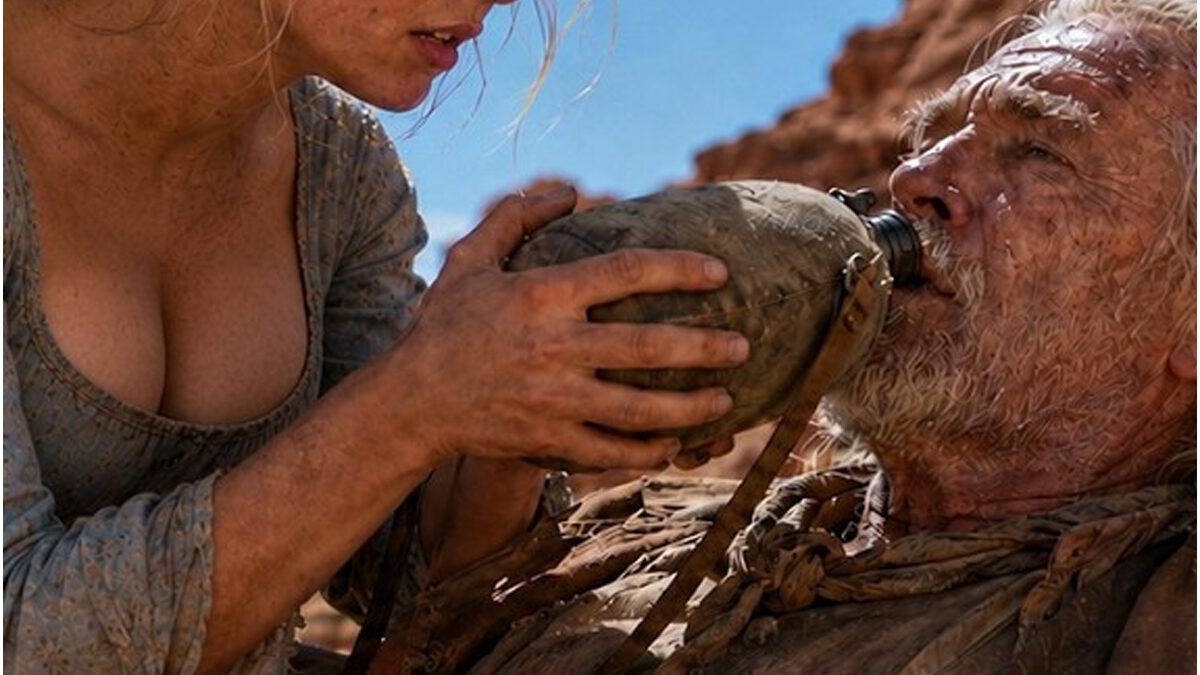
The vultures were already circling when 21-year-old Clara Miller found the old cowboy lying beneath the blazing Arizona sun.
His horse was dead.
His canteen was empty, and his cracked lips barely moved.
Clara had enough water for only one journey home.

If she gave it to him, she might not survive the desert herself.
If she rode away, he would be dead before sunset.
Clara dropped from her tired roan and hurried across the burning ground.
She searched the rocky ridge before touching the man.
Outlaws sometimes used wounded travelers as bait, but there was no movement among the red stones.
Only three black vultures watched from above, waiting for her to make the wrong choice.
“Mister, can you hear me?”
Clara asked as she knelt beside him.
The cowboy’s eyelids opened slightly.
He looked close to 70 with white hair, a weathered face, and a deep scar beneath his left ear.
His clothes were covered in pale dust, but his leather boots were well-made.
His weak hand moved toward her canteen.
“Water,” he whispered.
Clara raised his head and poured only a small amount between his lips.
He coughed, then tried to grab the canteen.
She pulled it back gently.
“Slowly.
Too much will make you sick.”
The old cowboy studied her through tired gray eyes.
“You should leave me, girl.
There may not be enough for both of us.”
Clara remembered the threat she had received that morning.
Amos Thorne, the richest cattleman in Red Creek, had ridden onto her ranch with two armed men.
He had given her until Friday noon to pay the $500 her father owed the bank.
If she failed, Thorne would take the land, remove her by force, and burn the cabin where she had been born.
It was Wednesday afternoon.
Clara had less than two days left.
She should have been searching for missing cattle.
She should have been repairing the south fence and finding something she could sell.
Every lost hour brought Amos Thorne closer to owning her home.
Yet her father had once told her that land could be regained while a life could not.
“What happened to your horse?”
She asked.
“Stepped into a hole before sunrise.”
The cowboy said.
“Broke his leg.
I put him down and started walking.”
“What is your name?”
“Henry Weston.”
“I’m Clara Miller.
Can you stand?”
Henry tried but his knees folded beneath him.
Clara caught his arm before his face struck the ground.
He was heavier than he looked and the heat had weakened her.
Still, she dragged him toward her horse one painful step at a time.
Getting him into the saddle took everything she had.
Clara pushed from below while Henry pulled against the saddle horn.
When he finally settled across the horse, she took the reins and began the long walk home.
She could not ride with him.
Her roan was already exhausted.
The ranch stood nearly eight miles away.
Heat rose through Clara’s boots as she walked.
Her throat became dry and the glare hurt her eyes.
Twice, Henry begged her to climb onto the horse but she refused.
By the time the cabin appeared beneath the distant cottonwood trees, Clara’s legs were shaking.
The sun was sinking when she helped Henry inside.
She placed him on her own bed and washed the dust from his burned face.
She gave him water a few mouthfuls at a time then warmed the last of her chicken broth.
That food had been meant to last her until Friday but Henry needed it more.
Night covered the ranch yet Henry’s condition grew worse.
His body shook beneath the wool blanket and his breathing became rough.
Clara sat beside him replacing the wet cloth on his forehead whenever it turned warm.
Her father’s Colt lay on the table within reach.
A lone woman could never be too careful, even with a dying man.
Near midnight, Henry’s fever finally broke.
He opened his eyes and saw Clara sitting in the rocking chair.
“You stayed,” he said.
“You were in no condition to be alone.”
Henry glanced around the small cabin.
He noticed the leaking roof, the empty food shelves, and the sheriff’s silver badge above the fireplace.
His eyes rested on the framed picture beside it.
Clara stood between her parents in the faded photograph.
“Thomas Miller,” Henry said quietly.
“Your father?”
Clara looked sharply at him.
“You knew him?”
“I knew his name.
Every honest cattleman in this territory did.
They said Sheriff Miller could stop a gunfight with one look.”
“He died last winter.”
Henry lowered his head.
“I’m sorry.”
Clara added another piece of wood to the stove.
It was the last dry log in the basket.
“My mother became sick before he died.
Father borrowed money for doctors and medicine, but none of it saved her her.
Now Amos Thorne owns the debt.”
Something changed in Henry’s face when he heard the name.
His weak eyes became cold and alert.
“Amos Thorne came here?”
“This morning.
He wants my ranch.”
“Why this ranch?”
“He says he needs the grazing land.”
Henry looked toward the dark window.
“Amos Thorne has more grass than he can use.
A man like him never risks blood over a few cattle.”
Clara turned toward him.
“Then what does he want?”
Henry did not answer at once.
He stared at the floor as if putting forgotten pieces together.
“Does your northern boundary reach Blackstone Canyon?”
He asked.
“Yes.
The creek runs through it.”
Henry leaned back against the pillow.
“That explains more than you know.
Clara moved closer, but he closed his eyes.
His strength was gone again.
“What does it explain?”
She pressed.
“Tomorrow.”
Henry whispered.
“Let an old fool sleep first.”
Clara remained in the chair until the lamp burned out.
She thought about Blackstone Canyon and wondered why a lost cowboy cared about its location.
She also wondered how he knew her father’s name.
Before she could find an answer, exhaustion pulled her into a restless sleep.
At dawn, Clara woke to an empty bed.
The blanket had been folded neatly.
Henry’s dusty coat was gone and no footprints remained near the porch because the morning wind had covered them.
On the table lay a silver dollar and a short note written in a firm hand.
Clara, you gave away what little you had to save a stranger.
Hold your ground today.
Some debts are not as powerful as the men holding them want you to believe.
Henry Weston.
Clara read the note twice.
She had never told him the payment was due the next day.
Yet the words felt like a warning.
She put the silver dollar into her pocket, saddled her horse, and rode toward Red Creek to beg the bank for more time.
She did not know Henry had reached town before sunrise.
She did not see him enter the telegraph office or hand the operator a gold coin.
She did not hear the message he sent east.
But when the operator read Henry Weston’s full name beneath that message, the color drained from his face.
Before Clara reached town, three urgent replies were already racing back across the wire.
Red Creek was awake when Clara rode into town.
Wagons rolled through the dusty street while shopkeepers raised their wooden signs.
She tied her horse outside the mercantile and bought the smallest sack of flour she could afford.
Mr. Higgins, the gray-bearded owner, placed it on the counter but did not take her coins.
“I saw Amos Thorne riding toward your place yesterday,” he said.
“Folks say he has been buying every unpaid debt in the valley.”
“He bought mine,” Clara replied.
Mr. Higgins pushed the coins back toward her.
“Your father protected this town for 15 years.
Keep your money.”
Clara left the coins anyway.
She would accept kindness, but she would not use her father’s name to take food without paying.
Outside, the brick bank stood at the far end of the street.
She walked toward it with Henry’s silver dollar inside her pocket.
The bank manager, Owen Pike, became nervous the moment she entered.
He was a thin man with pale skin and a stiff collar.
He invited Clara to sit, but he would not meet her eyes.
“I need 30 more days,” Clara said.
“My cattle will be ready for market soon.
I can pay the full debt after the fall drive.”
Owen removed his spectacles and rubbed his tired eyes.
“I cannot give you an extension.
Thorne purchased your note, and he has forbidden any delay.
The territorial farming law allows one extension during a dry season.
That law means nothing when Thorne controls most of the money in Red Creek.
If I oppose him, he will call in the bank’s debts and close this place before sunset.”
Clara leaned forward.
“Why is he so desperate for my ranch?”
Owen glanced toward the front door before lowering his voice.
“Because he is nearly ruined.”
Clara stared at him.
“Amos owned thousands of cattle, three ranches, and half the businesses in town.
Nothing about him appeared ruined.”
“His cattle operations are built on borrowed money,” Owen explained.
“Prices fell back east, and his lenders want payment.
The Western Pacific Railroad plans to build a new line through this valley.
If Thorne controls the route, he will earn enough to save everything.
“Blackstone Canyon,” Clara whispered.
Owen nodded.
“It is the only safe path through the mountains, and it crosses your land.
Thorn needs your deed before the railroad chooses a route farther north.
That is why he will not wait.”
Clara’s last hope disappeared.
Thorn did not merely want another pasture.
Without her ranch, his empire would fall.
He would never grant her more time because time was the one thing he did not possess.
“I’m sorry,” Owen said.
“If there were anything I could do, I would do it.”
Clara stood and walked outside.
For one weak moment, she rested her forehead against her horse’s saddle.
She could accept Thorn’s offer, take his $50, and leave Arizona.
She might find work in St.
Louis, or marry some quiet shopkeeper who knew nothing about cattle, drought, or men with guns.
Then she remembered her father’s final night.
He had taken her hand and told her that the ranch was more than wood and dirt.
Her parents had arrived when the valley held nothing but wolves and graves.
They had built a home there and given frightened families a safe place to settle.
Clara lifted her head.
She was not leaving.
“Well, look who came to beg.”
Three cowboys stood outside the saloon.
The tallest was Roy Danner, one of Thorn’s hired guns.
A pale scar crossed his chin, and his hand rested near his revolver as he stepped into Clara’s path.
“Mr. Thorn says you should be packed before tomorrow,” Roy said.
“It would be a shame if your cabin caught fire while you were still inside.”
The street became quiet.
Men watched from the boardwalk, but nobody came closer.
Clara did not touch her weapon.
“My father arrested you for horse theft in Dodge City.”
Roy’s cruel smile faded.
“He wrote that you tripped over your own spurs while trying to escape, Clara continued.
He also wrote that you cried when they locked the cell.
One of Roy’s companions laughed before quickly covering his mouth.
Roy stepped closer.
Your father is not here to protect you.
No, but his Winchester is on my saddle.
If you draw, I will reach it before your pistol clears its holster.
Roy looked into her steady blue eyes.
He knew Sheriff Miller’s reputation and he knew his daughter had learned from him.
After a long moment, Roy moved aside.
Tomorrow will be different, he muttered.
Clara mounted and rode out of town without looking back.
Her hands did not begin shaking until Red Creek disappeared behind her.
At the telegraph office, Henry Weston had watched everything through a narrow window.
His dusty coat was buttoned to hide a silk vest and the young operator stood behind him holding three newly arrived messages.
The first came from the governor.
The second came from a powerful bank in Chicago.
The third carried the official seal of the United States Marshal’s office in Phoenix.
The operator looked from the messages to the sunburned old cowboy.
Who are you?
Henry took a gold watch from beneath his shirt.
The back carried the mark of the Western Pacific Railroad.
I am the man who owns the railroad Amos Thorne plans to cheat.
Henry Weston was no helpless drifter.
He was the railroad’s chairman and one of the wealthiest men in the West.
He had traveled without guards because he wanted to inspect Blackstone Canyon in secret.
His accident had nearly killed him, but it had also shown him the truth about Clara and the man trying to destroy her.
Henry handed the operator another message.
Send this to Chicago.
Tell my attorneys to purchase every share of the Red Creek Bank before noon tomorrow.
And the marshal?
Tell him to bring 12 armed deputies.
Have him search Amos Thorne’s business records before riding to the Miller ranch.
While Henry quietly moved men and money across the territory, Clara returned home believing she was alone.
She opened her mother’s cedar chest and searched through old deeds, letters, and ledgers.
Nothing inside was worth $500.
Then she found one of her father’s range maps.
A red mark showed a hidden water seep inside Devil’s Box Canyon.
Beside it, her father had written about a herd of unbranded longhorns that often sheltered there.
Under open range law, those cattle belonged to anyone strong enough to capture them.
If Clara could drive the herd to the mining camp at Silver Reef, she might raise the money before noon.
It was a wild plan for one rider, but it was the only chance she had left.
Before sunrise on Friday, Clara strapped on her father’s revolver and rode into Devil’s Box Canyon.
She never saw the 10 armed men leaving Thorne’s ranch behind her.
Their saddlebags held rope, oil, and enough dynamite to make certain there would be no Miller ranch left for the railroad to buy.
Devil’s Box Canyon tried to kill Clara before Amos Thorne’s men could reach her home.
Loose stones rolled beneath Rusty’s hooves, thorn bushes tore at her sleeves, and steep red walls trapped the morning heat.
One wrong step could break the horse’s leg and leave Clara stranded just as Henry had been.
After nearly an hour, she heard cattle moving through the brush.
13 wild longhorns stood near a muddy water hole.
Their bodies were lean, their horns were wide, and the largest red steer watched Clara as if daring her to come closer.
Clara pulled her rope free and rode behind them.
She cracked it above their backs, driving them toward the narrow canyon mouth.
The cattle scattered at once.
Two ran into the brush, while the red steer turned and charged Rusty.
Clara pulled hard on the reins.
Rusty jumped aside as the horns passed close enough to tear her trousers.
She chased the steer, cut him off near the rocks, and forced him back toward the others.
Dust filled her lungs, sweat ran into her eyes, and her injured hands began to bleed through her gloves.
For four hard hours, she fought the herd.
Each time she gathered them, one animal broke away.
Twice, she nearly fell from the saddle.
Still, she refused to stop.
Shortly before 10:00, Clara drove 10 longhorns out of the canyon and onto the open plain.
10 cattle could bring more than $500 in Silver Reef.
Clara smiled for the first time that morning.
Then she heard a rider behind her.
She turned with her hand on her revolver.
An older cowboy sat on a brown horse near the canyon entrance.
His name was Jacob Cole, and he had worked as Thorne’s foreman for almost 20 years.
His hat was faded, his face was burned dark by the sun, and his tired eyes held no threat.
“You pulled those beasts out by yourself?”
Jacob asked.
“You are trespassing.”
Clara replied.
Jacob raised both hands.
“I did not come to fight.
You work for a man carrying oil and dynamite toward my house.”
The foreman’s expression changed.
“Then you already know.”
“I saw nothing.”
“I guessed from your face.”
Jacob looked toward the small herd.
“You have your father’s sharp eyes.
Thomas Miller once caught me stealing food when I was 17.
He could have sent me to prison, but he bought me a meal and found me honest work.
I have spent years wondering how to repay him.”
Clara pointed toward Red Creek.
“Help me drive these cattle to Silver Reef.
That will repay him.”
“You cannot make it.
I have to.
Silver Reef is 30 miles away.
Those longhorns are wild, and you need at least four riders to move them.
Noon will arrive before you cover half the distance.
Clara looked at the sun.
The truth struck harder than the desert heat.
Even after fighting all morning, she had not saved her ranch.
She had only found another hope she could not reach.
Jacob removed his hat.
Thorn is coming at 11:00.
He paid the county deputy to stay out of Red Creek.
If you refuse to sign the deed, his men will burn the barn and place dynamite beneath your cabin.
He means to frighten you into surrendering before the bank clock reaches noon.
The law gives me until noon.
Thorn stopped caring about the law years ago.
Clara looked at the longhorns.
$500 stood before her, but there was no way to turn them into money in time.
The red steer wandered toward the desert, and the others followed.
She slowly lowered her rope.
“Take this,” Jacob said, tossing her a full canteen.
“Your horse needs water.
Then ride north and keep going.
A ranch can be rebuilt.
A grave cannot.”
“If I run now, men like Thorn will keep doing this to every family in the valley.
You cannot face 10 gunmen alone.”
Clara poured water into her hat and held it beneath Rusty’s mouth.
“My father did.”
“Your father had a badge.”
Clara looked toward the distant ranch.
“So do I.”
She left the cattle and rode home as fast as Rusty could carry her.
When the cabin appeared, no smoke rose from it.
Thorn’s men had not arrived, but Clara found fresh hoof prints near the southern fence.
Someone had placed two barrels of oil behind the barn.
A wooden crate containing dynamite sat beneath the porch.
Clara carried the crate away from the cabin and buried it in an empty water trench.
She rolled the oil barrels into the open yard where no flame could spread.
Then she went inside.
She washed the dust from her face, braided her blonde hair, and put on her father’s worn leather vest.
The silver sheriff’s badge had remained above the fireplace since his death.
Clara pinned it over her heart.
At 11:15, riders appeared on the eastern ridge.
Amos Thorne led 10 armed men into the yard.
Roy Danner rode beside him, still carrying the scar Clara’s father remembered.
The others spread around the cabin, cutting off every path of escape.
Thorne stopped 20 ft from the porch.
He wore a clean black suit and sat on a powerful stallion.
Clara stood beneath the porch roof with her father’s Winchester resting across her arMs. “You have made a serious mistake,” Thorne said.
“Where is the dynamite?”
“Somewhere your careless men cannot kill me with it.”
Thorne’s eyes narrowed.
“The debt is due.
Sign the deed, and I may still give you enough money to leave Arizona.”
“It is not noon.”
Thorne pulled a gold watch from his pocket.
“My watch says it is.”
“The bank clock decides the deadline, not yours.”
Roy laughed, but the sound died when Clara raised the rifle slightly.
Thorne looked at the silver badge on her vest.
“Wearing your dead father’s star does not make you sheriff.”
“No.”
“But it reminds your men who taught me to shoot.”
Several riders shifted uneasily.
Sheriff Miller had killed two outlaws in this very yard years earlier.
Every older man in Red Creek knew the story.
Thorne held out the deed.
“This is your final chance.”
Clara did not move.
“Get off my land.”
His face turned red.
He dropped the deed into the dust and pointed at the barn.
“Burn it,” he ordered.
“If she raises that rifle, kill her.”
Roy dismounted and lifted one of the oil barrels Clara had moved.
Another man struck a match.
Clara raised the Winchester and aimed at his hand.
“The first man who lights a fire will not get a second match.”
She warned.
The gunmen froze.
None wanted to be the first man to test Sheriff Miller’s daughter.
“Cowards!”
Thorn shouted.
He drew his revolver and aimed at Clara himself.
“I will do it.”
Before he could pull the trigger, a deep whistle tore across the valley.
Rusty kicked against his stall door and every horse in the yard raised its head.
The ground began to tremble beneath the riders.
A huge cloud of black smoke climbed above the western ridge.
Through it came the grinding sound of heavy iron wheels followed by dozens of horses moving together.
Thorn lowered his pistol and stared toward the ridge.
The first rider appeared carrying an American flag.
Behind him rode a line of armed men in dark blue coats.
At their center was a federal marshal wearing a bright gold star.
Then a polished black carriage came over the hill.
Inside it sat Henry Weston.
Amos Thorn looked like a man watching his own funeral arrive.
The black carriage stopped beside the Miller fence.
18 armed men spread across the yard placing themselves between Clara and Thorn’s riders.
Their repeating rifles pointed toward the ground but every man looked ready to raise one.
The federal marshal rode forward.
He was broad shouldered with a gray beard and a gold star pinned to his coat.
“Tell your men to lower their weapons, Amos.”
Thorn tried to hide his fear.
“This is private property.”
“No.”
Clara said from the porch.
“It is my property.”
Henry Weston stepped down from the carriage.
He no longer looked like the dying cowboy Clara had carried through the desert.
His white hair was neatly combed and he wore a fine gray suit beneath a long black coat.
He still walked with a cane, but there was nothing weak about him now.
Clara slowly lowered her Winchester.
Mr. Weston?
Henry removed his hat.
Good morning, Clara.
I am sorry I took so long.
Thorne stared at Henry.
Who are you?
Henry Weston, chairman of the Western Pacific Railroad.
The name struck Thorne like a bullet.
His hand fell away from his revolver.
Every cattleman in Arizona knew Henry Weston controlled rail lines, banks, and freight contracts across the West.
Thorne forced a laugh.
Then you understand why I need this land.
Miss Miller owes me $500.
The payment is due.
And I have the legal right to take possession.
You had that right yesterday, Henry replied.
You do not have it today.
Henry’s attorney stepped from the carriage, carrying a leather case.
He removed several papers and handed one to the marshal.
Last night, the Western Pacific purchased the Red Creek Bank and every debt registered through it, Henry said.
That includes Clara Miller’s mortgage.
Thorne’s face lost its color.
You cannot do that.
I did it before sunrise.
Clara came down from the porch.
You bought the whole bank?
Henry looked at her.
It was the quickest way to stop a thief.
Thorne pointed at the armed men.
This is intimidation.
I will take this to court.
I was hoping you would mention the law, Henry replied.
The marshal opened another document.
Amos Thorne, a federal judge issued this warrant after Mr. Weston’s auditors examined the bank records.
You used false fees to increase ranchers’ debts.
You forged signatures, threatened borrowers, and moved stolen money across territorial lines.
Lies, Thorne shouted.
Owen Pike stepped from behind the carriage.
The bank manager looked frightened, but he stood straight.
I gave the marshal the real ledgers, Owen said.
Every payment, every false charge, and every property you stole is recorded.
Thorne turned toward his gunmen.
Shoot them.
I pay you to fight.
No one moved.
The federal men raised their rifles.
The sound of metal hammers being pulled back passed through the yard.
Roy Danner looked at Clara, then at the badge on her vest.
He slowly removed his gun belt and dropped it into the dust.
I will not die for a man who is planning to cheat us, too, Roy said.
One by one, the other hired men surrendered their weapons.
Jacob Cole rode into the yard behind them and stopped beside Clara.
I told the marshal where Thorne hid his private records, Jacob said.
Your father gave me a second chance once.
I figured it was time I did something worthy of it.
Thorne tried to turn his horse, but two deputies pulled him from the saddle.
He cursed and fought as they locked iron cuffs around his wrists.
This valley belongs to me, he screamed.
Clara looked at him without lowering her eyes.
It never did.
The deputies placed Thorne inside a prison wagon.
Without his expensive horse and armed men, he looked smaller than Clara remembered.
The wagon carried him toward Red Creek, while his fallen empire remained scattered across the dirt.
When the last rider disappeared, silence returned to the ranch.
Clara removed her father’s badge and held it in her palm.
Her hands finally began to shake.
Henry climbed the porch steps and gave her a sealed envelope.
Clara opened it.
Inside was the original deed to the Miller ranch.
A red stamp crossed the mortgage papers.
Paid in full.
Her eyes lifted toward Henry.
I cannot accept this.
You You my life.
I gave you water and a bed.
That does not equal $500.
No amount of money equals a life, Henry said.
But I am not giving you the ranch.
It already belongs to you.
I am only removing a weapon that should never have been placed against your throat.
Clara pressed the deed against her chest.
For the first time since her father’s death, she knew no one could force her from her home.
Henry pointed toward Blackstone Canyon.
The railroad still needs that route, but I will not buy your land.
I want to lease a narrow path through it.
You will keep full ownership, and the company will pay you every month.
How much?
Henry named a figure that made Clara stare at him.
That would rebuild the barn and buy 200 cattle.
It would also make you one of the strongest ranch owners in Red Creek.
Clara considered his offer.
The railroad cannot poison the creek.
The town’s ranchers must keep access to the western trail, and local men must receive the first chance at railroad jobs.
Henry smiled.
Your father taught you more than shooting.
Do we have an agreement?
He held out his hand.
We do, Miss Miller.
Six months later, the first train entered Red Creek through Blackstone Canyon.
Families gathered beside the new station as its whistle carried across the valley.
The mercantile had doubled in size.
The blacksmith employed four men, and ranchers who had lost land through Thorne’s false deeds received their property back.
The Miller ranch had new fences and a red painted barn.
A healthy herd grazed beside the creek, while Jacob managed the ranch hands for Clara.
She paid every worker fairly, and kept each promise she had made.
Roy Danner remained in town after the other gunmen left.
No rancher trusted him, so he survived by cleaning stalls at the livery stable.
One afternoon, Clara found him shoveling manure beneath the hot sun.
She handed him an envelope.
Roy opened it and found $20 with a letter of work from a cattle buyer in Silver Reef.
“Why would you help me?”
He asked.
“Because someone once helped a frightened horse thief in Dodge City.”
Clara replied.
“Do something better with the chance.”
That evening, Clara rode to the hill where her parents rested.
She placed her father’s badge against his wooden grave marker and told them the ranch was safe.
Far below, Henry stood beside the train depot and raised his hat toward her.
Clara returned the gesture as the setting sun turned the canyon walls bright gold.
One day earlier, she had crossed a blazing desert with almost nothing left and still chosen to save a stranger.
Now the old cowboy had kept his word.
Clara Miller was no longer fighting merely to survive.
At last, she was building the life her parents had begun.








