Old Woman Helped A Female Bigfoot, Weeks Later The Female Bigfoot Returned With A Shocking Surprise
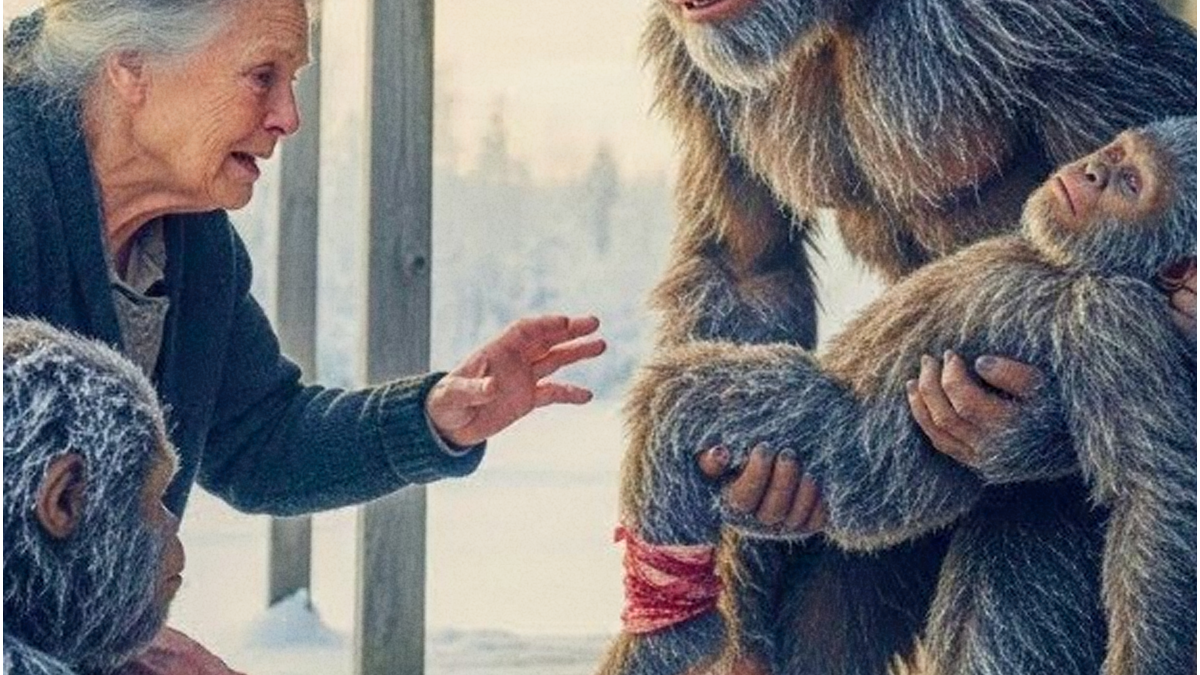
Old Woman Helped A Female Bigfoot, Weeks Later The Female Bigfoot Returned With A Shocking Surprise
Have you ever believed that a lonely widowed woman could become a second mother to a wounded Baby Bigfoot.
This isn’t a scene from a fantasy film.
It comes from a real journal found deep in the Missouri woods written by a woman who chose silence over society.

The truth is, not all encounters with mythical creatures end in fear or violence.
Sometimes they come to us not to haunt, but to ask for help.
And in return, they offer a kind of silent trust that modern humans have forgotten.
This story comes from the writings of Margaret Row, a 58-year-old recluse who lived alone on the edge of Mark Twain National Forest for over 15 years.
Her journals, later archived by the Missouri Wilderness Project, revealed a bond that defied science and perhaps even species.
In this video, you’ll see how she treated a broken-legged Bigfoot baby using only cloth, firewood, and instinct.
The unspoken trust between survivor and legend and a final message that might stay with you.
Love isn’t always about holding on.
Sometimes it’s about letting go so both can survive.
In the winter of 1989, an ice storm nearly killed Maggie until a female Bigfoot appeared from the trees and held up a collapsing roof beam to save her.
Days later, it returned, carrying an injured baby, quietly placing it on Maggie’s porch.
When spring came, the creature walked away, leaving behind a woven switchgrass ribbon as a wordless goodbye.
If you’ve ever felt alone in a world full of noise, don’t skip this story.
It might just remind you that trust still lives on the edge of the forest.
The air smelled like old pine needles and wood smoke.
The kind of smell that clung to denim and hair and stayed with you long after you came back inside.
Maggie Row sat on her front porch, a steaming chipped mug cradled between her palms, the ceramic radiating a fragile warmth that didn’t quite reach her fingers.
The old folding chair groaned beneath her weight, but it always had.
Its metal legs had sunk a little into the soft slope of Earth over the years, making it lean slightly to the left.
She liked it that way.
It felt like the world was tilting just enough to remind her she was still on it.
The sun hadn’t fully cleared the ridge yet, but the sky was already streaked in shades of amber and violet.
Somewhere down the hill, a sparrow flitted low across the tall grass, letting out a few dry notes.
The forest beyond lay still, washed in that quiet, waiting light before the day woke up properly.
A light breeze stirred the edge of the BM bim that had climbed up the side of the porch over the summer, its leaves already brittle, purple blooms curling inward with the season’s change.
From the stove pipe, thin smoke coiled lazily upward, touched by dawn.
Maggie shifted the mug to her left hand and with the right pulled the tattered spiralbound notebook onto her lap.
The cover had long since fallen off.
Most pages were yellowed at the edges, corners curled.
She flipped to the next blank spot where ink from the last entry had ghosted through faintly.
She paused, pen hovering, not because she didn’t know what to write, but because part of her wondered what was worth writing down anymore.
But then out of habit or hunger for stillness, she wrote, “October 12th, the bim bim is starting to give.
The porch held through last night’s wind.
I dreamed of salt again.”
She paused, tapped the pen once, twice.
“I still wait for his boots on the step.
30 years, and I still turn my head when the gravel shifts.”
She closed the notebook quietly, and brought the mug back to her lips, eyes trained on the edge of the forest like she always did.
It wasn’t fear.
Not quite.
More like a knowing.
The kind that grows in your bones after living alone for too long in a place that speaks only when it wants to be heard.
A branch snapped.
Faint but real.
Beyond the fence line.
Maggie froze.
Mug halfway to her mouth.
The sound came again, lower this time.
The crunch of something heavy moving slow.
Her eyes narrowed, squinting against the new light cresting through the trees.
At first, it looked like the shape of a tree had moved.
Something tall, unnaturally tall, shifted between two hickories and paused.
A silhouette too large to be a deer, too upright to be a bear.
The breath caught in her throat before her mind caught up.
Her body stayed still, but the mug in her hand began to tremble just slightly.
The figure stepped forward slowly, purposefully, not like a beast crashing through brush.
No, this one moved like it had learned to avoid being seen, but the morning light betrayed it.
Pale mist lifted off the earth, and in the veil of fog and sun, Maggie saw fur, matted, gray brown, patchy in places.
A hand, an actual hand, long-fingered, rough skinned, parted the bim bim at the edge of the clearing.
Then the creature paused.
She could see its face.
Not clearly, not yet, but just enough to make out the dark hollow where the eyes should be.
They weren’t gleaming.
They weren’t wild.
They were still watching, measuring.
Its breath came out in a visible huff, heavy and slow.
She could hear it from where she sat, just 10 ft from the porch steps.
A low, ragged exhale, like the drag of wind through an old chimney.
The sound didn’t belong to any animal she’d known, and she’d known plenty.
The figure didn’t advance.
It just stood there.
Maggie sat very still, not from terror, but from a deep ancient memory of waiting.
She hadn’t realized her hand was shaking until the mug tilted.
Coffee sloshed over the rim, a few drops hitting the porch boards with soft splats.
She didn’t flinch.
She just stared at the shape framed by the dying vines and felt her chest tighten.
Not with panic, but with something lonelier, deeper, because the way it stood there, the way it looked at her, reminded her of when she used to sit on this porch in the 70s, long after midnight, listening for a car door that never slammed, for a duffel bag that never thudded against the steps.
When news had come from the Navy missing off the coast of Okinawa, she hadn’t cried.
Not right away.
She just kept listening.
Night after night, hoping the woods might lie.
Now in the same stillness, she watched something return from the woods that shouldn’t have existed at all.
Then, just like that, it stepped back.
One long stride into the shadows.
Another gone.
The bim bim fluttered closed behind it as if nothing had been there.
Maggie lowered the mug, chest rising and falling with a quiet urgency.
She stood slowly, joints stiff, and walked to the edge of the porch.
Looked out into the trees, the morning now fully arrived, but the forest had gone quiet again.
The sparrows were silent.
Even the wind had calmed, as though holding its breath.
She waited a long while before going back inside.
The next morning, frost silvered the grass.
The porch boards creaked beneath her as she stepped out with her boots half-laced.
Same mug, same chair, but her eyes didn’t drift to the horizon like before.
They scanned the ground.
She walked past the porch and down the slight hill to where the edge of the clearing met the tree line.
The bim bim still hung limp over the brambles.
And just past it, where the dirt turned darker from dew, something caught her eye.
She crouched, pressed one knee into the damp ground.
There it was, a print.
No, two.
The first was wide, almost 20 in long, deep in the mud.
The toes spled, bare, humanlike, but massive.
She could see the pressure where the heel had sunk.
But next to it, almost touching, was a smaller one.
No more than half its size.
Then another, smaller still.
Three.
She blinked, unsure whether her eyes were betraying her.
But the prince were there, clear as day.
Not just one being, not a loner, a family.
She stood, backing away slowly, heart pounding, but strangely steady.
She didn’t speak, didn’t gasp, just looked back toward the porch where her coffee still steamed and the sparrow had returned to its branch.
Whatever she had seen yesterday, it hadn’t just been passing through.
It was watching, waiting, choosing whether to come closer, or perhaps deciding if she would.
The frost hadn’t lifted when Maggie stepped barefoot onto the porch that next morning, her boots dangling from one hand, the other carrying a shallow tin bowl covered in an old dish towel.
The boards were cold beneath her feet, but she didn’t flinch.
Her eyes scanned the treeine again, slower this time, not searching so much as acknowledging.
There was a new kind of quiet between them now, like the first breath after a long-h held silence, the space where decision hovered.
She walked down the slope, past the edge of the porch, where the grass gave way to moss and hardpacked dirt, and paused at the flat stone slab by the edge of the old hickory roots.
Years ago, that slab had marked the corner of the garden she used to keep, back when basil and tomatoes still seemed like they were for something.
Now it had a new purpose.
She placed the tin bowl in the center of the rock and peeled back the towel, revealing a neat pile of boiled corn and a few pans seared trout she’d caught from the current river the day before.
Not seasoned, not garnished, just food warm enough to let off a faint curl of steam.
She stood over it for a long moment, then stepped back.
Not all the way to the porch this time, just far enough to be out of reach, close enough to see.
She sat down on a turned over milk crate by the wood pile, and waited.
Her hand stayed in her lap.
She didn’t reach for the coffee.
A cardinal landed on the fence post, looked at her sideways, then flicked its tail, and darted off.
A squirrel skittered from the trellis to the gutter.
The rustle of leaves sharp and careless, then quiet again.
Not the kind that soothed.
The kind that made the world feel like it was listening.
Nothing came that day or the day after or the one after that.
What came instead were the ordinary forest folk, the raccoon with the crooked paw, the pair of gray foxes that never traveled far apart.
A hungry young black bear that pawed at the fish and huffed when it wasn’t fresh enough.
She didn’t interfere.
She didn’t speak.
She just kept placing the food, wrapping it carefully, and retreating to the crate.
By the fourth morning, the trout was gone.
The corn, too.
Nothing disturbed.
No paw prints in the dirt.
No rustled leaves.
Just the faint drag of something wide and heavy that had brushed past the edge of the bay bim in the early dark.
Maggie didn’t smile, but she didn’t feel quite as cold.
That night she left a lantern burning low on the porch, not as an invitation, as a sign, a small flicker of understanding.
On the fifth day, she rose before the frost and prepared the offering as usual, hands moving slower from sleep, but steady.
The trout still smelled of riverstones, the corn buttery with nothing added.
She placed it all on the same rock, and stepped back.
The wind had picked up, brushing dry leaves across the yard in slow, crackling waves.
The forest, darker than before, pressed inward with a kind of weight.
She sat again, watched the sun barely crest above the trees and waited.
Then she heard it, the softest shift.
Not the snap of twigs or the crash of underbrush, but something careful, calculated breath first.
That same low horse drag of breath that she’d heard from the porch.
Her gaze moved toward the treeine.
She didn’t reach for anything.
There it was again.
Between the trees, half shadowed, stood the same figure, taller than she remembered.
Or maybe the stillness just made it seem bigger.
It didn’t move toward the food right away.
It stood behind the hickory, half its face exposed in the slanting light.
The fur looked different up close, coarser, darker around the shoulders, stre with dirt and old leaves.
The hand, long and strong, rested lightly on the bark, and the eyes, still golden, still dark, still watching.
Maggie’s heart pounded in her chest, but she didn’t move.
Her hands stayed folded.
Her back stayed straight.
A squirrel darted across the yard, startled by nothing, and the figure flinched, not in fear, but in instinct.
Its eyes cut toward the motion, then back to her.
She exhaled slowly.
The creature stepped forward once, then twice, not toward her, toward the food.
It reached down, not with a lunge, but with purpose, and lifted the fish in one hand, the corn in the other.
Then it turned its head slightly, as if checking the perimeter.
Still no sound, still no growl or hiss or rush, just the breath.
And then just as slowly, it turned and walked back into the trees.
That night, she didn’t light the lantern.
She didn’t need to.
Something had shifted.
The silence wasn’t empty now.
It was agreed upon.
A kind of truce, unspoken, but binding.
She opened her notebook that night and wrote just a single line.
There are languages we were never taught, but we can still understand them.
The next day brought rain, not a storm, just a cold, steady mist that made the world feel smaller.
Maggie wore her old army green slicker and a knit cap and still set out the food.
This time she added a few pieces of apple.
She liked to think someone might like the sweetness.
She didn’t sit long, just enough to feel the damp settle in her knees.
Then she turned to go back inside, and that’s when it happened.
The door creaked as she opened it, and just before she stepped across the threshold, a sound caught her.
Soft but heavy, like a sack of potatoes dropped gently to the ground.
She turned.
It was still there, not gone yet.
The creature hadn’t retreated fully.
It stood at the edge of the trees, both hands at its side, its chest rising and falling in a slow rhythm.
Rain glistened off its shoulders.
The hair matted and clumped, dripping in places.
Its face was wet, but not just from the rain.
The skin around its eyes looked darker.
Tired.
She froze again, not out of fear, but something else.
And then it did something she hadn’t expected.
It tilted its head.
Not sharply, just enough.
As if asking.
She didn’t raise a hand.
She didn’t speak.
She simply nodded.
And it turned slow and sure, disappearing again into the woods without a sound.
That night her dreams were different.
Not the ocean, not the silence.
This time she dreamt of wet earth and golden eyes blinking slow beneath a canopy of cedar.
She didn’t tell anyone.
There was no one to tell.
But each day after that, she continued the ritual, the food, the stillness, the milk crate.
She learned not to expect the same timing.
Some days the offering was taken within minutes.
Other days it sat until sundown.
Sometimes she felt watched.
Sometimes she didn’t, but she never stopped.
One evening, as the sun dropped low behind the ridge, she stepped out to gather the tin bowl.
The food was gone.
But the towel was still there, folded neatly, not tossed, not dragged, folded.
She stood there for a long time, looking at that towel, then slowly reached down, picked it up, and held it to her chest.
No prints, no noise.
But the message was clear.
Not just presents, recognition.
It had taken weeks to get here.
But now, as the chill of late autumn settled deeper into the ground, Maggie began to understand that she was part of something.
Not equal, not invited, but tolerated, and that was more than enough.
That night, the wind picked up and whistled low through the eaves.
She pulled a second quilt over her shoulders and lit the lamp low.
Before bed, she wrote again, “Some thanks are quieter than others, but they are no less true.”
She paused, then added, “I will not speak first.”
And closed the notebook as the wind howled once more across the ridge like breath over hollow stone.
Outside, under the bim bim vines, something passed again, soft and slow, leaving only the faintest bend in the grass.
The wind came down off the Ozarks, sharp and fast, dragging a low sky with it.
By early morning, the branches had begun to wear a sheen of glass.
Maggie stood at the window, both hands curled around the frame, watching the woods bend beneath the growing weight.
It was the kind of cold that didn’t just bite.
It wrapped itself around your spine, slow and unforgiving and settled behind your ribs.
Her breath fogged the pain, blurring the outlines of the trees she knew by heart.
The same sycamore that leaned like a question mark.
The cedar with its arms folded close.
The bim bim was already gone, shriveled weeks ago, but the trellis still creaked as if remembering the weight of it.
She lit the stove early, fed it with three logs and a pine cone for good measure.
The cabin warmed slow, the scent of smoke mixing with the faint leftover smell of trout she’d fried the night before.
She moved quieter than usual, every step deliberate, as if the cold might hear her.
On the table, the notebook lay open where she’d left it.
A smear of ink ran down the page where her hand had caught a drop of tea.
She didn’t bother wiping it.
Her boots waited by the door, half-laced.
She looked at them, then at the stack of firewood by the barn.
The roof over the feeding stone had begun to sag days ago.
Just a slight dip at first.
She’d meant to reinforce it.
Then the forecast had turned, and now each icicle that formed along its edge felt like a countdown.
She poured a thermos of broth, tied her scarf twice around her neck, and stepped outside.
The world was silent, not the peaceful kind, the kind that holds its breath before something cracks.
Each blade of grass was trapped in a sheath of ice.
Her boots crunched with every step.
Above her, a crow called once, then went still.
The sky pressed low, the color of steel.
Her breath came out in clouds, vanishing faster than she could make them.
She crossed the yard slow, past the porch, down to the slope where the flat stone sat waiting beneath the buckled roof.
The makeshift frame, two cedar posts and a rusted tin sheet, shimmerred under the weight.
Ice pulled it into a crooked arch ready to fold.
She reached forward, tested the edge of the structure with her gloved hand.
A soft groan echoed above her.
She stepped back.
Then the wind shifted.
Not hard, just enough.
The sound was brief.
A wooden creek, a pop of metal, and then the fullthroated snap as the crossbeam gave way.
She didn’t have time to scream.
The beam hit her shoulder as it fell, then rolled.
One end of it thutdded into the frozen ground, and the other slammed across her lower arm, pinning it to the dirt with a dull, thick crack that sent pain shooting up her back.
She twisted, gritted her teeth, but the weight didn’t budge.
Not enough.
Her legs kicked.
Her free hand scrabbled against frozen mud and bark.
The thermos rolled into a ditch.
The sky above looked flatter now, like a ceiling pressing down.
The cold wasn’t biting anymore.
It had moved in.
She hissed, tried again, pulled hard, but the beam held.
The pain in her arm changed from hot to distant.
That wasn’t good.
Her breath grew faster, clouding the air above her like smoke signals no one would read.
She blinked toward the treeine.
Nothing moved.
She shouted once.
Not loud.
Her voice cracked halfway.
She wasn’t sure it carried.
Then that sound again.
Not the wind, not branches.
Breath.
Low, wet, alive.
She turned her head and there it was, a figure emerging from the white mist.
Silent, broadshouldered, steam rising off its back like it had walked straight through a river.
Ice clung to its fur in long strands, catching the pale light.
It moved without rush, but with force, its feet placing with intention, not sound.
The Bigfoot, the mother, stood at the edge of the stone slab.
Her chest rose slowly, then fell.
She looked down at Maggie.
Not wildeyed, not confused, just watching.
Maggie didn’t speak.
She couldn’t.
They stayed like that for seconds, maybe more.
Then the creature stepped closer.
One arm reached down, not to strike, not to shove, but to the side of the fallen beam.
She didn’t lift it outright.
She crouched beside it, dug one hand beneath, the other bracing against the frost crusted slab.
With a low growl, not hostile, but strained, she shifted her weight and leaned her shoulder into the wood.
The beam groaned again, the edge lifted just an inch.
Enough.
Maggie gasped, twisted her body, and yanked her arm out, sliding back against the slope.
The sudden release sent pain blooming white hot again, but it was pain she could move with.
She clutched her arm against her chest, breathing fast.
The beam dropped with a dull thud beside her.
And then for a moment, nothing.
She looked up.
The creature was still kneeling.
Their eyes met again.
Maggie’s were wet.
Maybe from the cold.
Maybe not.
She tried to speak.
Couldn’t.
The creature didn’t move.
Just stared.
One breath, then another.
Then she stood slow, towering above the woman in the snow, and turned away.
Walked back into the forest.
Disappeared.
The world stayed hushed.
The snow came down in fine shards.
Maggie lay there a while longer, heart pounding, arm burning, trying to remember how to get up.
When she did, she crawled halfway before she could stand, made it back to the cabin door on her knees.
She kicked it open, collapsed onto the floor.
The stove still burned.
Later, she’d bandage her arm, splint it best she could.
She wouldn’t go to town.
Not yet.
Not with what she knew now.
Night fell early that day.
Moonlight spilled across the ice in hard angles, turning the world to crystal and shadow.
She didn’t sleep.
Instead, she sat by the window, watching the treeine.
And out there, in the stillness under the cold stare of stars, the trees moved once, just once.
A shape too broad for any deer, too upright for any bear.
She didn’t look away, didn’t blink.
Her arm throbbed, wrapped in flannel and tape.
But her gaze stayed firm because something had shifted, something that didn’t just take, something that saved.
And in that silence, more powerful than any scream.
She understood she wasn’t alone.
Not really.
By morning, the ice began to melt, but the tracks in the snow remained.
Two sets, the large, unmistakable prince of a mother, and beside them, vanishing into the deeper brush.
Only one smaller set.
The third was gone, and the forest once again had decided who stayed and who left.
The thaw came slowly that year, creeping in under the eaves like a thought you didn’t want to finish.
January settled heavy on the hills, frost still clinging to the north sides of the trees, ice like white bruises in the gullies.
Maggie had begun sleeping in layers.
Not because the stove wasn’t doing its job, but because there was a kind of cold that slipped through the walls no matter how long the fire burned.
The kind that comes from something being just a little too quiet.
The kind that reminds you someone hasn’t come back.
Her arm had mostly healed, stiff but working.
She could chop small wood again, carry buckets without gritting her teeth.
But she hadn’t ventured far past the feeding stone.
Not since that night the ice gave way, and something enormous pulled her out from under death like it was moving furniture.
The tin roof over the stone still lay half collapsed, glinting dully under snow that didn’t melt even at midday.
She hadn’t fixed it.
She wasn’t sure she was supposed to.
Then came the day the air changed just slightly.
A shift in the wind from north to west.
The kind of wind that carried thaw and mud and the brittle edge of spring.
The sky was clear that morning, a thin gold pouring through the cedar.
Maggie sipped her coffee on the porch.
She hadn’t written in the notebook for days.
Words felt clumsy now, too small for what she’d seen.
So she sat listening to the trees, the floorboards warm under her slippers.
And then she saw her.
She didn’t come from the woods this time.
She came from the left side of the yard, past the collapsed garden bed, walking not like a shadow, but like someone who had decided.
The Bigfoot mother stepped slow through the melting snow, her massive frame slick with thawed ice, fur dark and matted, but glistening at the edges.
She didn’t stop at the feeding stone.
She didn’t hover near the trees.
She kept walking right up to the porch.
Maggie didn’t move.
The air felt thinner suddenly, like someone had sucked the oxygen from it and replaced it with memory.
The boards didn’t creek under the weight.
Not yet.
But the sound of her breath came first, raspy, fullbodied, like lungs too large for quiet.
Maggie set the mug down carefully on the railing.
Stood.
Her knees achd, her back stiff, but she didn’t flinch.
The creature stopped at the bottom step, and she wasn’t alone.
Behind her, just past the porch’s edge, came the two young ones.
The taller one had a steady gate, strong and quiet, fur darker than its mother’s.
The smaller one wasn’t walking.
It was being carried.
Draped in the crook of her massive arms, its legs dangled limp, one twisted unnaturally at the knee.
Blood had dried along its flank, and a matted wound at the thigh glistened dark in the cold morning light.
Maggie’s hand went to her chest.
The creature didn’t speak.
She only stared.
Those amber black eyes locked on hers.
And then, in a movement so human it made Maggie’s breath catch, she crouched and lowered the injured young one onto the grass.
Slow, careful, like setting down something sacred.
The child didn’t stir.
Its chest rose and fell shallowly.
One arm twitched.
The mother straightened again, looked at Maggie, then at the porch, then back at Maggie, and stayed.
No movement, no sound, just breath and weight and the space between them.
Maggie stepped down the stairs.
She didn’t rush.
She moved the way you do when someone hands you a newborn or an open letter from the past.
She knelt beside the child.
The smell of it was wild, musky, but not foul.
It smelled like wet bark and pine pitch and something raw underneath.
The wound at its leg had begun to fester.
Maggie could see where the bone pushed beneath the skin.
The angle wrong.
Like a tree snapped and splintered.
Her hands hovered.
She looked back at the mother.
Permission wasn’t asked, but it was given.
The creature didn’t blink.
She just watched.
Maggie lifted the child carefully, surprised by its heat.
It was lighter than she expected.
She wrapped it in the old wool blanket she’d left by the wood pile for the dogs that never came.
She turned, walked slowly back to the porch.
The boards groaned beneath her boots.
She looked back once.
The mother was still there, not breathing hard, not reaching forward, just standing.
Maggie pushed open the screen door, carried the child into the house.
She didn’t lay it on the couch.
That didn’t feel right.
She laid it on the folded quilt in the corner near the stove where the dog bed used to be.
She lit another lamp, took her last two clean towels from the cupboard.
She boiled water.
She broke the broom handle in half, shaved it smooth with her pocketk knife, and wrapped the splint in cotton strips torn from her old winter undershirt.
She soaked a cloth in warm chamomile water, and wiped the dried blood from the child’s side.
The skin beneath was dark gray and strangely soft, not human, but not animal.
The muscles twitched once under her fingers.
She worked carefully, remembering how she once bandaged her son’s knee after he jumped from the shed roof and hit the garden fence.
He was seven.
He bled and laughed at the same time.
This one didn’t laugh, didn’t cry, just breathed, shallow and sharp.
She wrapped the leg.
She secured the splint.
She draped a second blanket across its shoulders, watching the rise and fall of the chest slow to something steadier.
And when she finally looked up, the mother was standing at the door.
Not inside, not asking, just there, rain began to fall around dusk.
A slow soaking kind, the kind that lingered.
Maggie stepped out once, stood just under the edge of the porch roof, met the mother’s eyes again.
They hadn’t changed.
Not in all those weeks.
Still wide, still deep, still unreadable and knowing.
She said nothing.
But her shoulders fell just slightly like someone setting down a burden.
Then she turned, walked back to the treeine.
The older sibling followed, looking back once over its shoulder, eyes round, posture tight.
And then they were gone.
Maggie stood there until the sky turned purple.
She didn’t like the lantern.
She didn’t make tea.
She just sat on the edge of the porch, staring at the spot where the creature had stood, her knees cold through her jeans, her fingers twitching once like they wanted to hold something that had already left.
Inside, the child stirred.
She turned, moved fast now, knelt by its side, its eyes opened, slow, dark, unfocused.
It didn’t flinch.
It didn’t growl.
It just breathed.
She placed a hand lightly on its arm.
Not to soothe, to say, “I’m here.”
It blinked, closed its eyes again.
She stayed there all night.
Didn’t write, didn’t sleep, just watched the rise and fall of the child’s chest in the firelight, and thought of the night she held her son on the floor of the barn after the beam came loose from the storm, and he cried into her neck, not from pain, but from fear.
She had whispered the same thing then again and again.
I’ve got you.
I’ve got you.
And now in this tiny space with snow melting off the roof and a wild thing wrapped in her old blankets.
She whispered it again.
Just once low as if it were true.
And outside the woods stayed quiet, but not empty.
Not anymore.
The wind didn’t sleep that night.
It scraped across the roof like claws over sheet metal, pushing against the old barn door till its hinges moaned.
Inside the small shed behind Maggie’s house, where the feed crates used to be stacked, a second lamp flickered beside the makeshift pen.
The boy, because she’d started calling him that in her mind.
Not it, not the small one, but the boy, lay curled on his side under a double layer of quilt, his spinted leg propped on folded flannel.
His chest rose shallow but steady now, but the cold was unrelenting.
It pushed in through the chinks in the wall, under the floorboards, across the oil skin curtain Maggie had hung just that morning.
She hadn’t slept the night before, and she wasn’t going to sleep tonight.
Not with the wind crying like that.
Not with the weight of a creature breathing on her back porch.
She sat on an overturned crate, her hands rubbing a warm stone she’d pulled from the stove.
Every hour, she swapped it out.
Every hour, she changed the boy’s water, checked the leg, adjusted the quilts.
The silence between them was thick, not empty.
He hadn’t made a sound in almost two days.
No whimpers, no breathless cries, just that raspy inhale and the occasional twitch of fingers too long and too thin for a human child.
His hair had started to dry now, soft black and stre with mosscoled grime.
His face was still wild, still wrong, but there was something familiar in the way his brow furrowed when she touched the wound.
She didn’t speak aloud anymore.
She just worked, wiped, turned, waited.
A thud echoed from outside.
Maggie’s head snapped toward the door.
Not a branch, not wind.
She rose carefully, hand already wrapped around the iron poker by the stove.
Her boots crunched across the packed straw as she stepped to the door and unlatched the top half.
The wind caught it, flinging it open.
Snow flurries tumbled in like startled moths.
Then she saw it.
The bear, black, broad shouldered, snout wet with sleet.
Its eyes reflected the oil lamp in twin gold sparks.
It wasn’t charging.
Not yet, but it was too close.
20 ft from the shed.
Maybe less.
Its nose tilted.
It had caught the scent.
Not hers.
The other one.
Maggie stepped fully into the doorway, slamming the poker once against the door frame.
Go on, she hissed through clenched teeth.
Not tonight.
The bear didn’t move.
It huffed once, a slow steam rolling from its nostrils and took a step forward.
Then something moved from the dark beyond the pen.
From the trees, not a sound, just presence.
Massive upright, Maggie froze.
There she was, the mother.
She stepped into the firelight’s edge, arms low, shoulders squared.
No growl, no snarl, just stillness.
The bear stopped.
The air thickened like the temperature had dropped 10° in a blink.
The bear tilted its head, shifted weight, sniffed again, and then backed up.
One step, two, then turned and lumbered off into the woods.
Maggie stood in the doorway, breath caught somewhere behind her ribs.
The poker hung loose in her hand.
The creature didn’t come closer.
She just stood there between the shed and the woods.
Her figure a shadow stitched to the earth.
She didn’t nod, didn’t signal, but Maggie felt it.
Not gratitude, not expectation, just understanding.
She stepped back into the shed, shut the door, and bolted it.
The wind howled again, shaking the frame.
Inside, the boy stirred.
Maggie rushed back to him, dropping the poker by the stove.
His eyes were open now, not wide, just cracked enough to see.
He blinked once, she whispered.
“It’s all right.
You’re all right.”
The boy didn’t respond, but his hand shifted just an inch toward her knee.
She sat beside him on the straw, placed her hand near, not touching.
Close enough.
The hours blurred.
She didn’t sleep, not even in moments.
She refilled the stone, swapped towels, wiped sweat from his brow with the corner of her sleeve.
His fever had broken, but the cold didn’t forgive.
Around 3:00 a.m., a loud crack echoed through the forest like a gunshot.
Then silence.
Not even the wind.
Maggie sat up straight.
There it was again.
Metal.
A faint distant snap.
Too deliberate to be nature.
A trap.
She stood, heart pounding in her throat.
She looked toward the sleeping boy, then to the window.
The mother was gone now, or maybe watching from where no eyes could see.
She grabbed her flashlight, threw on her coat, and stepped out into the black, but the forest offered no answers, only shadows.
And in the distance, the echo of something cruel reset itself.
Cold, calculated, set by hands that didn’t know what lived in these woods now.
Maggie turned back toward the cabin.
She didn’t know it then, but something was about to change.
The fog clung low to the field, like breath held too long.
Maggie had woken before sunrise, the edge of a dream still clinging to her chest like frost on glass.
Something about a scream without sound.
Something about mud thick as blood.
When she opened the door, the world was gray.
The frost was gone, but the cold had stayed, settled into the roots, into the spaces between fence posts and the creaking porch boards.
She pulled on her boots, laced them without haste, and stepped into the silence.
The boy had slept through the night again, his fever broken, legs stiff, but healing.
She’d changed his bandage in the dark, watching his eyes flutter, but never open.
He gripped her hand once, not out of fear, just contact like a child, unsure if the dark had eaten everything else.
She walked past the edge of the woodshed, down the slope where the switchgrass grew in toughs, now wet with thaw, and paused near the clearing.
That’s when she saw it.
A smear of disturbance on the ground, fresh mud torn in two lines like something had thrashed, then gone still.
The earth had been scraped raw, and in the center of it all, a faint drag mark with deep punctures like two wide crude jaws had snapped shut and held.
She crouched.
The leaves were disturbed in a circular pattern.
Her stomach dropped cable.
She followed the faint trail up through the alder and cedar.
Her breath was tight now, not from the pace, but the knowing.
She’d seen this before.
Not often, but once was enough.
Poachers set them for cougar, for coyote, for anything that moved and didn’t scream loud enough.
She crested the hill and froze.
There, against a fallen pine, was the mother.
Collapsed.
Not gone, not yet.
Her side heaved shallow.
One leg twisted in the wrong direction.
A metal snare biting into the meat just above her knee.
The cable was threaded to a post, sunk deep into the earth, and bent at a cruel angle.
The blood wasn’t pouring.
It was slow, thick, like syrup mixed with mud.
Maggie’s knees hit the ground.
The creature didn’t react.
Eyes open, not blinking.
Her chest rose, then shuddered, then rose again.
Maggie crawled forward.
The cable was old, hand wrapped steel, the kind used by people who didn’t belong to the Forest Service.
Didn’t bother with tags or warnings.
Her hand shook as she reached into her coat.
The old hunting knife was still there.
She hadn’t sharpened it in months.
Its edge was rusted.
The handle cracked, but it would cut.
She looked into those eyes, black, flat, tired, but not afraid.
The creature didn’t struggle, didn’t pull.
She waited.
Maggie leaned in, one knee in blood soaked grass, and slid the blade under the wire.
The metal bit against the skin with a groan.
The creature winced.
A breath winded out from between its clenched teeth, but it didn’t move.
Maggie pressed harder.
The cable snapped loose with a metallic pop.
The mother didn’t bolt.
She didn’t rise.
She simply lay there breathing, eyes still locked on Maggie’s face.
And then something happened that Maggie didn’t understand until later.
The creature, this massive, wild, bleeding mother, lifted her left hand and slowly, deliberately placed it palm down into the wet earth.
Then she tilted her head just slightly toward the direction of the barn.
Not a gesture, not a threat, but a message, she was asking without words.
And Maggie, without thinking, nodded.
Then she sat down in the blood wet grass, knife still in her lap, and waited as the mother rolled to her side, groaning once, then pushed herself to standing.
Her leg buckled.
She steadied herself against the trunk.
Her breath came hard and fast, but she didn’t fall again.
She turned, stumbled once, and vanished into the fog.
Maggie sat there for a long time until the cold reached her bones, until the fog burned off and the sun found her shoulders, until the sounds of the forest returned.
And when she walked back down the slope, her knees mud stre, her hands stained with blood and rust.
The boy was awake.
He was sitting up just barely.
Blankets pulled around his shoulders, his hair matted, his eyes wide, and through the slats of the wooden pen.
He looked at her like he’d known all along that she’d come back.
That night, the wind was still, the trees didn’t creek, but headlights did.
She heard the crunch of tires on gravel before the knock.
Maggie stepped onto the porch, hand already brushing the poker.
But it wasn’t danger that waited.
It was old ranger Dorsy from the county line.
Hat in hand, boots caked in mud.
He asked if she’d heard anything about cougar sightings.
Said one of the ranchers lost a few sheep.
Found a calf torn open clean.
She said no, just birds and squirrels.
He nodded, looking past her shoulder into the yard.
Said they’d be setting a few traps in the back valley just for a week or two.
She tightened her grip on the railing.
Told him this wasn’t cougar country.
Not really.
He shrugged.
Said the prince looked big.
Said you can’t be too careful.
Said it might be something else.
But Maggie didn’t flinch.
She looked him in the eye.
Said she’d be walking her property more now.
Said if she saw anything dangerous, she’d let him know.
He nodded, tipped his head, left.
She watched the tail lights until they vanished behind the ridge.
Then she turned back to the pen, and the boy was waiting.
Not crying, not calling, just watching.
Like he understood exactly what it meant to stand between something you love and a world that doesn’t.
She didn’t sleep that night either.
But she didn’t feel alone.
The wind had changed again.
Not the biting kind from the north, not the dead stillness of winter either, but something lighter, breathing through the trees in bursts that smelled faintly of river mud and thawed pine needles.
The boy had stood up that morning.
Not for long and not without trembling, but he’d stood.
Maggie had watched from the doorway of the shed, a mug of barely warm coffee in her hand, heart climbing into her throat as he took that first unsteady half step toward the edge of the pen.
The quilt dragged behind him like a discarded cocoon, his spinted leg stiff, one arm out for balance, the other gripping the frame as though the earth might vanish beneath him if he let go.
He didn’t stumble, didn’t look at her, just stood there in the spring light, nostrils twitching, eyes pinned to the field beyond the fence like something inside him had heard a sound no one else could.
Maggie didn’t speak, didn’t move.
She just reached down slowly and unlatched the top half of the pengate.
It creaked, the metal moaning with rust.
She opened it halfway, then stepped back, her boots crunching softly in the gravel.
The boy stayed still, one foot in shadow, one in sun.
The kind of stillness you see in deer when they smell something just out of reach, the kind that isn’t fear, it’s memory.
He stepped forward once, then paused.
The wind came again, brushing his face, stirring the hair that had grown longer, matted in places, but softened now with time and care.
He tilted his head just slightly, took in the air, then took another step.
That’s all, just two steps, and then he turned, not fast, not frightened, just deliberate.
He walked back into the pen, dragged the quilt over his shoulders again, and curled back into the corner near the crate.
Maggie exhaled so slow it made her dizzy.
She closed the gate, not all the way.
Left it where it was, not locked, not open, just halfway.
That afternoon, she sat on the porch and stitched a new lining into the boy’s blanket.
Her fingers moved, slow, but sure.
She’d always hated sewing.
Her mother used to scold her for crooked heMs. But this wasn’t about neatness.
It was about warmth, about choosing to do something kind when the world had forgotten how.
The trees were greening at the edges now.
Buds tight-fisted on the branches.
Crows had returned to the upper pines.
Their cries echoed like questions no one wanted to answer.
She looked up at the ridge where the woods bent around the clearing.
She hadn’t seen the mother in days, but she knew she was there.
The firewood stack was lower than she liked, but she hadn’t gone into town.
She didn’t want questions, didn’t want to lie, didn’t want to tell halftruths about injured wildlife and rescue efforts.
She just wanted to be left alone with her coffee, her notebook, and the rhythm of healing that didn’t belong to her, but passed through her hands anyway.
Around dusk, the boy stirred again.
She was in the kitchen when she heard the soft thud of the gate.
By the time she got outside, he was standing halfway into the yard, not running, just standing, his arms loose at his sides, shoulders higher, head up.
She didn’t move from the step.
He looked at the trees again, and from the far side of the pasture, in the shadows where the grass had started to ripple with spring wind, came a figure, the mother.
She stood tall but not tense.
Her arm draped across the shoulders of the older sibling who towered now almost level with her chest.
Their shapes were solid in the twilight.
Not phantoms, not dreaMs. Real breathing, waiting.
The boy didn’t run to them.
He didn’t even step forward.
He stood still.
The gate was still open behind him.
Maggie didn’t touch it.
The mother raised her chin once, held it there.
The boy’s body shifted, not toward her, not away, somewhere in between, like his weight hadn’t decided yet where it belonged.
He looked over his shoulder, not at the pen, but at Maggie, then back at them.
The space between filled with wind and the rustle of switchgrass, tall now, brushing his knees.
Then something passed between them.
Not a nod, not a sound, just breath.
The boy turned again, walked back to the pen.
Not fast, not reluctant, just balanced.
Maggie watched as he stepped inside, turned once more toward the wind, and sat.
He didn’t close the gate.
Didn’t pull the blanket over him.
Just sat there, half in, half out.
The mother didn’t leave right away.
She stood still for a long time, her gaze not on the boy, but on Maggie.
A look that felt heavy, not hostile.
Measured, grateful in a way that didn’t need human words.
And then she turned, slipped into the shadows with the older sibling close behind.
The boy didn’t move, not even when darkness fell.
Maggie lit the porch lamp, poured herself the last of the coffee, and sat down.
She didn’t write that night.
Didn’t say anything at all.
She just watched him, breathing, choosing.
And somewhere in that silence, something settled.
Not closure, but understanding enough to last the night.
The sky had turned that strange color it only knows how to wear in early summer.
Pale gold, bruised by heat, tinged with smoke, as if something far off had already begun to burn before anyone struck a match.
The ground had dried quicker than usual.
Maggie felt it in the grass, in the crackle beneath her boots, in the way the morning breeze no longer cooled, only stirred up dust.
By midm morning, the wind shifted again, hot, sharp, and full of tension.
The kind of wind that made animals uneasy and birds too quiet.
The kind of wind that carried the smell of something you couldn’t see yet.
She stood on the back porch, hand braced on the wooden frame, watching the switchgrass sway.
The boy had taken two full steps out of the pen that morning, had even crouched to touch the earth, sniff it, let it run through his fingers.
But now he sat against the crate again, alert, eyes trained to the treeine like he knew something was coming.
The sun fell in long lines through the thinning canopy, turning the dust into glitter.
And then she saw it.
First smoke, thin, moving too fast to be a campfire.
Then flicker, not light, not yet, but movement.
Low to the south, where the edge of the backed pasture dipped toward the creek bed.
Something orange shimmerred through the haze like a reflection off broken glass.
She stepped off the porch, walked slowly, then faster, boots beating dried dirt until she reached the fence post and climbed up for a better look.
Flames, small ones, but enough.
And the wind was wrong, carrying it sideways toward her ridge, toward the barn, toward the boy.
She didn’t think.
She ran back to the house, ripped the shovel from the shed wall, grabbed the rusted hoe from behind the dog crate, her old army canteen.
Then she moved fast now.
She stomped the first flames before they reached the pine edge, dug a line with the shovel, hands raw from the splinters.
The fire wasn’t roaring.
It was crawling, licking through dry grass like it knew its time was short, but wanted to eat everything before it died.
Her back screamed.
Her thighs burned.
She stomped again, shouted once when an ember caught the hem of her pant leg and had to be slapped out with a gloved hand.
Her breathing turned shallow.
Smoke crawled into her throat.
Made her choke.
Then a crack behind her.
Not wood, not fire.
Movement heavy.
She turned.
They were there.
The mother and the sibling.
No hesitation, no warning.
The mother grabbed a fallen limb longer than Maggie’s whole body and began dragging it through the grass, beating the flames back.
The sibling moved beside her, stomping small flare-ups with bare, massive feet.
Maggie didn’t ask.
She dug harder, faster, cutting a line into the dry soil to stop the spread.
The fire curved, hesitated.
It wasn’t big enough to fight all three of them.
Together, they held it.
It hissed, died slow, smoldered, then faded.
Ash blew across Maggie’s arms like snow.
She fell to her knees, coughed.
The mother stood at the edge of the burn, shoulders rising and falling.
She didn’t look at Maggie.
Not yet.
She looked toward the barn, toward the pen, toward the boy, and he was there, standing, no longer behind the gate, not waiting for permission.
He walked across the field through the haze of smoke and cinders, barefoot, head high.
The mother didn’t go to him.
She stood still, waited.
He stopped 5 ft from her.
They stared at each other.
The wind died completely.
Maggie held her breath.
Then the boy took a single step forward.
She lowered her head, not in command, but in welcome.
He walked to her side, pressed his forehead into her chest, her arms wrapped around him.
She closed her eyes.
The siblings stood close, hand resting gently on the boy’s shoulder.
Then all three turned, and just like that, they began to walk.
Maggie didn’t move.
She watched them reach the tree line, watched the leaves shift around them like a curtain drawn shut.
The woods swallowed them whole.
Silence fell again, but it didn’t feel empty this time.
It felt earned.
When Maggie walked back toward the pen, something caught her eye.
A top the gate braided a loose strand of switchgrass tucked gently between the slats twisted in a simple knot.
She reached out, touched it, soft, dry, deliberate.
She didn’t take it down, just rested her fingers there for a moment, then turned and walked back to the house.
That evening, the wind picked up again, soft and cool.
The fire line had gone cold.
The pen sat open.
The lamp flickered in the window.
Maggie poured herself a fresh cup of coffee, sat on the porch.
The sun had dropped behind the ridge, casting long shadows across the yard.
She didn’t cry, she didn’t write, she just breathed.
And for the first time in years, it felt like there was room for that breath to go somewhere.
Not to disappear, but to land.
Sometimes the quietest stories are the ones that stay with us the longest.
They don’t arrive with answers or explanations.
They don’t fit into neat boxes or follow rules we’re used to.
They drift in slowly like fog along the treetops, like breath held in a moment of stillness, then linger, leaving something changed behind.
This was never a tale about monsters or myths.
It wasn’t about proving what’s real and what isn’t.
It was about the space between things, between fear and trust, between isolation and understanding, between what we expect from the world and what it quietly offers when we stop expecting anything at all.
Sometimes survival isn’t about strength.
It’s about softness.
The kind of softness that keeps a fire going through a bitter night.
The kind that doesn’t ask for anything back.
The kind that recognizes another being, not for what they are, but for what they carry.
And maybe love doesn’t always look like the stories tell us.
Maybe it’s quieter, wordless, felt more than seen.
Maybe it’s something you tend gently, like a wound that’s slow to close, something you protect, not because you’re told to, but because you know what it means to lose.
There’s a grace in letting go, in knowing when to open the gate just halfway.
In choosing not to possess what you love, but to stand guard over it while it finds its own way back to the wild.
At the end of the day, what matters most isn’t what we keep.
It’s what we’ve cared for while it was with us.
What we chose to believe in when no one else would.
What we offered quietly, consistently, without condition.
And that’s the heart of it, isn’t it?
That even in a world full of noise and fear and distance, something ancient and gentle still lingers in the trees, something that remembers kindness, something that knows the shape of a hand not raised in violence, something that answers silence with presence.
If this story touched something in you, some distant memory, some quiet ache, some hope you’d almost forgotten, please share your thoughts in the comments.
Let us know how it made you feel.
And if you’d like to be here for more stories like this told with reverence, mystery, and heart, don’t forget to subscribe to the channel and turn on notifications.
Thank you for being here, for listening, for still believing that compassion, no matter how quiet, always leaves a mark.
We’ll see you in the next story.








