Old Man Raised A Loyal Dog And A Bigfoot Child – But When They Grew Up, The World Was Left Speechless!
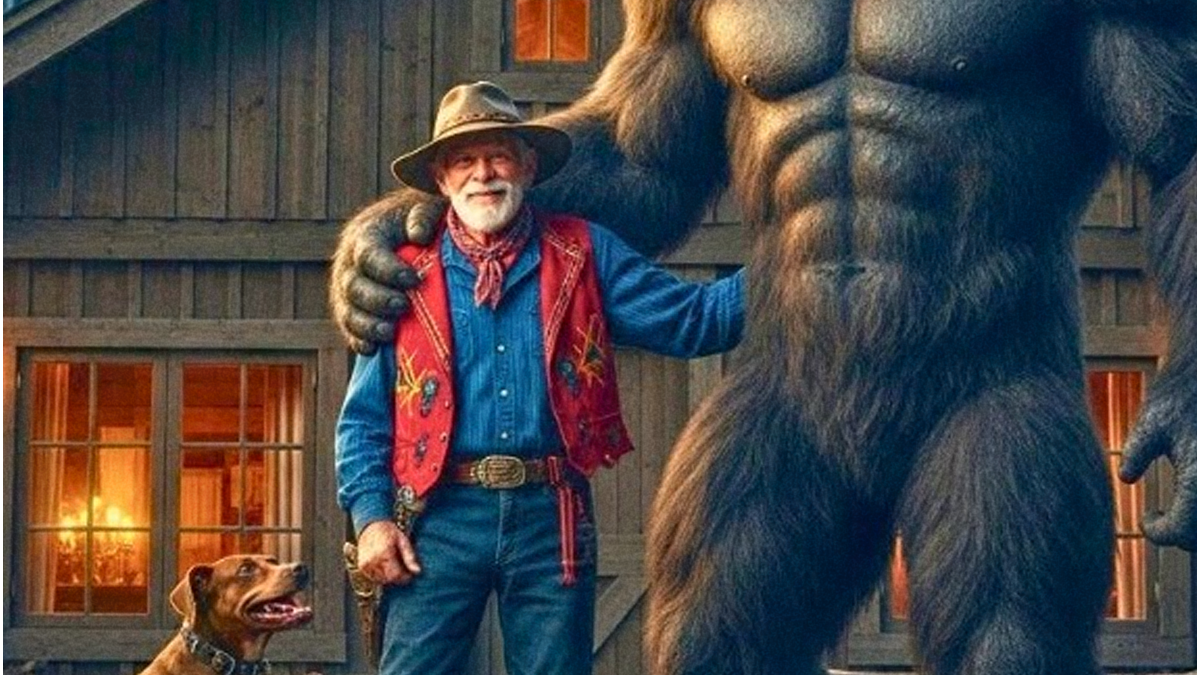
Old Man Raised A Loyal Dog And A Bigfoot Child – But When They Grew Up, The World Was Left Speechless!
What would you do if one day, lost in the snowy mountains, you came face to face with a creature of legend, a Bigfoot?
Would you run or would you try to save it?
In the late 1980s, a 68-year-old recluse in the Oregon wilderness did the unthinkable.
He brought a young Bigfoot into his wooden cabin and nursed it back to life.

Even more surprising, his loyal dog didn’t reject the creature.
It accepted it as part of the family.
This isn’t just a campfire tale.
It appears in accounts tied to Wallaw Forest and in the memories of those who once knew Harland Pike.
In the next few minutes, you’ll discover why a full-grown Bigfoot once left salmon on the porch.
Why a biologist chose silence instead of exposure and the final words of Harlon that moved everyone who heard them.
Hunters swore they saw a towering figure that night, forcing them to flee.
And Dr. Tams and Row herself confirmed Harlon once cared for a being unlike any other.
If you skip this story, Bigfoot will remain just a monster in folklore.
But stay and you’ll hear a tale of love, loss, and a bond that defies the boundaries of species.
The wind had no shape, but it filled the forest like a living thing.
Cold, relentless, whispering through the black pines like an old warning no one wanted to remember.
The Walawa Mountains weren’t kind in winter, and this one was worse than most.
For three days straight, the sky had buried the ridge lines in snow so thick the world outside the cabin vanished into whiteness.
And then just like that, it stopped.
The fourth morning broke in silence.
No birds, no wind, just that strange kind of quiet that made your chest ache before your feet even hit the floor.
Harland Pike sat up slowly, joints popping like old timbers settling in the night.
68 winters had worn grooves into his body, but this one, this one had something in its breath.
He stood by the frost rimmed window, mug in hand, watching the blue gray light stretch itself over the blanket of untouched snow.
Somewhere beneath that quiet, the forest was still breathing.
You could feel it.
He didn’t know why yet, just did.
Behind him, timber stirred.
The dog had been restless all night, low, whining in his throat, ears twitching at shadows.
Now he stood stiff, nose to the door, tail low, but not tucked.
That meant something.
Timber didn’t spook easy.
Harlon sipped once, then set the mug down without tasting it.
He cracked the door open.
The cold hit like a slap, sharp and absolute.
Timber rushed out ahead, nose to the ground, paws punching through the crusted snow.
The wind had smoothed everything overnight, erased all memory of paths or prints.
But not these, Harlon saw them just past the wood pile.
Tracks not old, fresh, deep, spaced wide apart.
Whatever made them was heavier than any bear that had passed through this range, and the shape, five toes, spled, almost human, but too big, too long.
He squatted beside one and laid his gloved hand inside the print.
Didn’t fit, not even close.
Timber let out a low wine and turned toward the east slope, where the forest dipped into a narrow cut of land that used to be a glacial runoff.
There was a creek down there, mostly frozen this time of year, with choked cherry scrub and old windfall trees tangled along the banks.
Harlon didn’t like the way the dog moved, nervous, ears back, every step hesitant like he was being pulled by something he didn’t trust.
Still, he followed.
The path wasn’t a path.
It was instinct.
Something deeper than memory, older than maps.
His boots crunched over the surface until the snow thinned near the creek bed.
That’s when he saw the tree, a massive ponderosa blown over long ago, roots still clawing at the air.
It had collapsed across the narrow gully like a bridge no one wanted to cross.
Timber stopped at the edge and barked once, sharp.
Then he backed up, whed again.
Harlon stepped forward and saw it.
At first he thought it was a bundle of old fur snagged in the brush.
Maybe a wolf cub that didn’t make it through the storm.
But then it moved barely.
A trembling twitch, slow and exhausted.
Something alive.
He moved closer, careful not to startle it.
It wasn’t a wolf.
It wasn’t anything he’d seen before.
Curled under the fallen tree, half buried in snow and branches, was a small figure.
Not small like a raccoon or a deer fawn.
Small like a child, but it wasn’t human.
Not exactly.
Its fur was matted with ice, dark brown, almost black.
One leg twisted under it, pinned by a thick limb.
The chest rose and fell in shallow, irregular gasps, and the eyes, when they opened, were wide, brown, and brimming with the kind of fear that didn’t come from instinct alone.
It came from memory.
It looked at him, not like an animal, not like prey, like someone who knew what it was to be left behind.
Harlon knelt down and pulled his gloves off.
His breath puffed out white, clouding his view, but he didn’t blink.
He reached for a thick branch and braced it under the treere’s weight, using his whole body to lever it up just enough.
The creature whimpered, but didn’t struggle, didn’t bite, just watched him.
The leg came free.
It cried out soft, breathy, like a sob.
But the sound was almost human in its pitch.
Its ache, he didn’t think.
He just scooped it up.
One arm under the shoulders, one under the knees.
It was lighter than it looked, but dense with cold, with silence, with the weight of something ancient.
Timber didn’t growl.
He circled once, sniffed the creature’s foot, then whed, and fell into step beside them.
Behind them, in the stillness of the trees, something exhaled.
A sound not quite wind, not quite animal.
It was deep, controlled, measured.
It didn’t come closer, but it was there, watching.
Harlon didn’t stop.
He didn’t need to turn around to know.
Something bigger was in the woods, and it had let him leave.
The hike back felt longer.
Snow kicked up around his boots, and the creature shivered against his chest.
It didn’t resist.
Its breath was weak but steady.
Timber stayed close, glancing back every few steps, his fur along the spine bristling, but not raised in panic, more like reverence.
They reached the cabin as the clouds returned, low and heavy, promising more snow.
Harland didn’t speak a word.
He laid the creature on a wool blanket near the stove, stoked the fire, boiled milk, added honey.
He poured it into a shallow dish and knelt, waiting.
The creature blinked slowly, eyes sunken and rimmed with ice.
Then it reached, shaky, uncertain, and dipped its fingers into the bowl.
It tasted again, swallowed, its eyes closed.
Timber lay down across the doorway.
Outside the trees shifted with the wind, but inside the cabin, it was still.
Harlon wrapped the creature in an old wool sweater, placed another log on the fire, and sat beside it.
He didn’t ask what it was.
He didn’t wonder if he’d gone crazy.
He just listened to the faint heartbeat under the fur.
It was there barely, but it was alive.
He placed his hand gently on its chest, not pressing, just resting there like he used to do when his daughter was sick and couldn’t sleep.
He hadn’t touched another living thing like this in years.
The memory came before he could stop it.
Her fevered body, the smoke, the way the world went quiet when the radio said there was nothing left to save.
His hand trembled.
He turned away from the fire and wiped his face with the back of his sleeve.
Behind the window pane, the world remained white, quiet.
But as he looked closer, he noticed something.
A flicker.
A breath on the glass.
Condensation, then gone.
No footsteps, no knock, just the knowing.
Whatever had let him walk away from that gully was still out there, still watching, not angry, not afraid, just waiting.
And in that moment, for the first time in a long time, Harland Pike realized he was no longer alone.
The cabin was warm, but the air inside it still carried the scent of pine smoke, wet wool, and something else.
Something wild and unfamiliar, like damp earth clinging to roots that had never seen sunlight.
The creature lay quiet, swaddled in layers of old blankets and Harland’s silence.
Outside, the clouds had thickened again, pressing low and colorless against the ridge.
Timber dozed near the door, one eye open.
The moment came when the stillness broke.
A rustle of breath, a shift of fur against coarse wool, and the sound, small but real, of a being trying to move in a world not made for it.
Harlon turned.
The creature tried to sit up, but pain made it twist and freeze.
Its leg, still swollen and bruised from where the tree had trapped it, shuddered under the effort.
Harlon stepped in before it could panic.
Palms open, slow, careful.
He didn’t speak, didn’t need to.
He knelt beside it, eyes low, movements precise like when a fire used to sneak under floorboards.
One wrong breath could make it all go wrong.
He touched the edge of the blanket and lifted it just enough to see the injury again.
It was ugly.
Skin, or what passed for skin, dark, stretched over muscle that twitched with every pulse.
He slid a pillow beneath its knee, eased the joint into a better angle.
It didn’t fight.
It just watched him with those wide brown eyes.
Eyes that held something older than panic.
He rose and moved to the old pantry, pulled down a walking stick he’d carved years ago, but never used.
The wood was solid, naughty, worn smooth, where his hands had tested it a hundred times, but never committed.
He cut the bottom end into a narrow wedge and stepped back outside.
Snow had drifted again, not deep, but soft, like sifted flower over hard ground.
The print was still there where it had stood.
He didn’t look toward the trees.
Not yet.
He knelt by the wood pile, snapped off a couple of dry branches, and wedged them between two stones.
He set the stick like a lever, drove it under the base of the firewood stack, and tested the force.
Solid.
That’s how you moved weight when there was no help.
He brought it back inside.
The creature flinched when he approached.
Not from fear, but recognition.
The stick, the same shape, the same motion like when he’d freed it.
He set it down gently by the fire.
Then he wrapped his hands around the worn grip and mimed the action again, slow and firm, the way you’d show a child how to hold a fishing rod.
The creature followed his movement.
Its hand rose, shook, but reached.
Long fingers longer than his, closed around the handle.
Not tight, but present.
It understood.
He stayed by its side, letting it move as much as it could.
Its weight shifted.
One leg stayed curled, but the other braced just enough.
Harlon steadied the creature’s shoulder, and together, inch by inch, they got it upright.
Its head barely reached his ribs.
Timber growled low, but it wasn’t warning.
It was nervousness.
The creature turned, faced the dog, and lowered its head.
Timber stopped.
One step forward, a sniff, then another.
The dog circled once, then pressed his snout to the creature’s knee.
Gently, the way he’d done to Haron after the stroke last year.
A moment passed.
Then Timber walked away, curled up, and slept.
Harlon lowered the creature back to the blanket.
This time, letting it keep the stick close, he poured water from the kettle into a chipped mug and held it out.
The creature stared at it, sniffed, then cupped its hands and drank the way something from the forest might drink from a stream.
Outside the clouds thickened, and then a shadow passed behind the far window.
No sound, no threat, just presence.
Haron didn’t move.
His breath slowed.
The creature stilled too, spine straight, eyes fixed on the window, though nothing was there now.
Only snow, only pine, only memory.
That presence, it hadn’t left.
It had just stepped aside.
He rose and moved to the door.
Opened it.
Didn’t speak.
Didn’t call out.
Just stood there, letting the cold wrap around his shoulders like an old question that didn’t want answering.
Snowflakes landed on the porch rail, melted, and vanished.
He stepped out, boots sinking an inch, and scanned the tree line.
No movement, no wind.
But there, barely visible, where the snow had broken cleanly in a straight line, were more prints, new ones, larger than before.
He crouched again, laid his hand next to one.
Same shape, same spread, but deeper.
It had come back, watched, then gone again.
He followed the edge of the prince for 10, maybe 15 ft.
Then they vanished, swallowed by the woods like they’d never been, as if the earth had decided to protect whatever made them.
He turned back toward the cabin.
Something had shifted.
The sky was darker now, and he could feel it.
Not in the air, but in his bones.
That quiet weight that said the forest wasn’t done yet.
Inside, the creature slept, curled near the fire, arms folded around the walking stick like a talisman.
Timber lifted his head when Harlon entered, but didn’t rise.
Harlon sat by the stove, didn’t speak, just listened to the log settle.
The creature stirred once, not in pain, in comfort.
Its breath no longer shallow, no longer afraid, only tired, only real.
And somewhere beyond the trees, deeper than snow and shadow, something bigger waited.
Not with hunger, not with rage, but with patience, with memory, like a father keeping watch, like a vow that hadn’t been broken yet.
And Harlon, for the first time in years, didn’t feel like the last man left in the walls.
Something else had noticed and chosen to let him live.
The fire cracked low, throwing light against the log walls in uneven bursts that made the shadows crawl like something waking up beneath the floorboards.
Outside, the storm had faded to stillness again.
A different kind of quiet, not peaceful, more like the hush between questions.
The kind where something waits to be named, but no one dares speak it aloud.
Inside the cabin, warmth held the corners gently.
The kind that seeps into bone and memory, whether invited or not.
Harlon moved slowly, careful not to make noise that would break the spell.
The creature, no not creature anymore, was curled near the stove, blanket half fallen from its shoulder, the stick from earlier resting just within reach.
He watched its chest rise and fall, measured, but steady.
That was new.
The shallow, ragged gasps from the night before had given way to something more like trust.
Not full, not open, but present.
Timber stayed near the threshold, eyes alert, but he hadn’t barked in hours.
Not even a growl, just a low huff now and then, the kind he used when a deer passed too close, or the air changed in ways only dogs could feel.
Harlon poured warm milk into the old ceramic bowl.
Not hot, just enough.
He set it down gently beside the figure, then stepped back, not saying a word.
The thing stirred.
No, the child.
He had to start calling it something in his mind or it’d stay a thing.
Its hand twitched once, then lifted, fingers dipping into the milk like it was learning water for the first time.
It drank slowly with care, but not like an animal.
There was something in the movement, some learned patience, like this wasn’t the first time it had to accept help it didn’t ask for.
When it finished, it looked at him, not directly.
Just enough, like it understood that the act meant something, even if the words didn’t follow.
Harlon nodded once, barely, then reached behind the stove where the wool blankets were kept.
He pulled out the thickest one and draped it over the creature’s back, tucking it just enough at the shoulder, like he used to do when his daughter would fall asleep on the couch too close to morning cartoons.
He didn’t speak.
Still couldn’t.
Not yet.
Timber shifted, his ears twitching, eyes locked on the door again.
Harlon followed his gaze.
Nothing.
No footsteps, but the cold had changed.
Not sharper, deeper, like the trees outside had leaned in a little closer.
He walked to the window, careful not to cast too wide a shadow, and peered through the frostlaced glass.
Just darkness, pines, the slope rising to the north where the snow never melted, even in April.
But something had passed there not long ago.
He couldn’t prove it.
Couldn’t even see it.
But he knew.
You don’t spend 30 years walking burn lines and cutting fire breaks without learning what it feels like when something watches with weight.
He pulled the curtain closed and stepped back.
Timber let out a breath.
The wind didn’t blow.
The roof didn’t cak.
The forest held its breath.
Back by the stove, the child shifted again, turning slightly toward the heat.
Its leg was still stiff, the bruise darkening down to black near the joint.
He’d have to check it again.
Maybe find some willow bark if the snow led up or cedar pitch.
He knew a few tricks.
Harlon settled in his chair, the one with a frayed arm where Timber had chewed it during a thunderstorm two years back.
He leaned forward, elbows on knees, and for a long while just sat there, eyes flicking between fire light and shadows.
Nothing in him wanted to sleep.
Eventually, he reached into the drawer near the hearth and pulled out the little tin, matches, sewing needles, a half spool of dark thread.
The coat he’d worn since the 70s had split down the shoulder last fall.
He’d meant to fix it.
Now seemed like a good time.
He pulled the jacket across his lap, thread looped between his fingers, and began the slow, steady work.
The child watched, quiet, not afraid, just curious.
It lifted one arm slightly, sniffed at the wool of its own covering, then caught sight of the needle flashing under the fire light.
Its eyes followed the ark of thread, its fingers twitching every time he pulled the loop tight.
He didn’t speak, but the rhythm was enough.
Something passed between them.
Time maybe, or just the understanding that a quiet task done in the company of someone else meant more than a warm bed or full stomach.
Timber rose, stretched, and ambled across the floor.
He circled once, then curled beside the child, pressing his side gently against its back.
The child flinched just a little, then leaned in, just enough, not to sleep, but to rest.
The coat was mended by the time the fire sank low.
Harlon stood, set it on the back of the chair to cool, then stoked the flames once more.
It was then, as he stepped back from the hearth, that he noticed the bowl, empty, clean, but beside it, nestled on the floor with quiet precision, was something else.
A small, jagged cedar sprig, fresh green.
Not from his pile, not from inside the cabin.
Something had left it.
Timber hadn’t moved.
The child hadn’t either, but the door had never opened.
The sprig lay there like a gift.
Not wrapped, not hidden, just offered.
Harlon stared at it for a long time.
Then he picked it up, held it, smelled the sap still clinging to its base.
It had been cut recently, not broken.
He looked back to the door, still closed, still latched, but now behind the glass of the side window.
The frost had shifted, a breath mark, large, slow, fading already.
He didn’t open the door, just stood there, one hand wrapped around the cedar, the other clenched at his side, steady.
The air behind him felt warmer than before.
He turned back, placed the sprig on the mantle above the stove.
It didn’t feel like a warning.
It felt like acknowledgement.
And from then on, something shifted.
The next morning, when the child stirred, it reached not for the bowl, but the coat.
Its fingers found the cuff, tugged at a thread, played softly.
Timber brought over a scrap of leather from the corner, and dropped it at its feet.
The child blinked, sniffed, then nawed once before spitting it back and huffing, a sound that sounded suspiciously like amusement.
Harlon let the moment pass.
Didn’t interrupt, just watched.
He boiled water for oats, crushed some dried berries, and added them.
Sweetened the batch with the last of the honey.
A quiet breakfast.
No clatter, no words, just spoons against wood and the soft shuffle of breath, learning how to be safe again.
By midm morning, the clouds thinned.
Light hit the front porch in thin bands.
When Harlon stepped outside just for firewood, he paused.
Something lay at the top step.
Not much, just a fish.
A small trout, fresh, still damp, no blood, clean.
He looked up.
Nothing moved.
But for the first time in days, he smiled.
A real one.
Not big, not wide, but true.
He bent down, picked up the fish, and whispered thank you to the woods.
Not loud, just enough so whoever had left it would know they’d been heard.
And inside the cabin, behind the closed door, the child watched, then reached for the needle, not to fear it, but to understand.
The snow softened in late January, the way old men rise slower from chairs, heavy, steady, unwilling, but not without grace.
The mountains breathed easier for a few days, sky widening into pale, dry blue.
The cold didn’t leave, but it retreated enough to let the creek move again, just beneath its crust of ice.
Harlon stood near the back shed, axe in hand, eyes on the treeine as if waiting for something he could never name out loud.
Behind him, the cabin crackled with quiet life.
He’d left the door a jar.
Timber moved in and out as he pleased, and Solace.
He called the child that now, at least in his thoughts, sat bundled in Harlland’s old denim coat, legs stretched toward the fire, one healing, the other stronger each day.
It had started standing on its own for longer than a few seconds, not walking yet, but watching timber closely, studying the world in small rehearsals.
And when it moved, it no longer flinched from Harland’s shadow.
That morning, Harlon caught it tracing the edge of the cedar sprig on the mantle with a fingertip, slow and deliberate, as if it were learning to read something no one had ever written down.
He said nothing, just went about his tasks like it was normal to live with something that looked like a lost chapter of the natural world.
Solace had learned to eat with hands that no longer shook, drank from bowls without spilling, slept with timber curled beside it like the two had known each other in some forgotten lifetime.
The dog never left its side for long now.
Even when Harlon whistled or opened the back hatch to split wood, Timber hesitated, glanced at the child before choosing to follow.
As if asking permission first.
The silence between them all had grown comfortable.
It wasn’t emptiness anymore.
It was space, like how mountain air holds between peaks.
Not because there’s nothing, but because something sacred needs the room.
Harlon still didn’t speak much, but Solace had begun to hum.
Not songs, not language.
Just low, soft noises that rose from its chest and caught in the logs of the cabin, making the walls feel warmer than they were.
The hums came most often at night when the wind returned and clawed at the eaves, and Timber growled softly in his sleep.
Those sounds would settle the dog, and Harland too, though he never admitted it.
They sat together by the fire most evenings now.
One man, one dog, and something that no map had ever accounted for.
It was during one of those dusks, while Harland mended an old boot and the stove hissed in rhythm with the outside frost that he noticed the movement.
Solace stood up on its own, leaned on the stick just enough to balance, then limped to the door.
Timber followed.
No bark, no growl, just a tail wag, slow and unsure.
Harlon waited.
Solace pressed its hand to the door frame, then looked back.
Not for help, but for permission, Harlon rose, opened the door.
The snow was packed firm now.
Safe enough to step on without sinking.
The wind had calmed.
The trees didn’t move.
Solace stepped outside for the first time since the creek.
The cold bit at its face, but it didn’t retreat.
Just blinked, then limped toward the side path.
Timber at its heel.
Harlon followed.
Half to protect, half to witness.
They moved slow.
The old fence line came into view.
Beyond it, the slope that dropped into the gully.
Harlon paused when he saw what was waiting.
A fish again, but this one was larger, fatter, freshly caught, still glistening with melt, laid at the same spot as the first one, on the old wooden step, just beneath the window where Solace slept.
No tracks, no sound, but a message clear as daylight.
He didn’t touch it right away, just looked into the trees, into that thick place beyond the birches, where the pines grew too close for even snow to settle.
He knew it was there.
Somewhere behind those trunks, behind the fog of breath that wasn’t his, watching, always watching, but not with hunger, with purpose.
That much he felt in his spine.
Solace turned and looked too, didn’t cry out, didn’t run, just nodded as if to say, “I know.”
And then the days began to fall into rhythm.
Solace stayed near the cabin, slept beside the stove, ate quietly, reached for things like a child might, always watching Timber first, always copying what the dog did.
One morning, Timber found a raccoon carcass near the creek.
Fresh kill, he sniffed, backed up, barked twice.
Solace moved close, crouched low, sniffed too, then mimicked the way Timber pawed the snow to mark territory.
Harlon saw it all from the porch, arms crossed, heart tight with something he couldn’t name.
Something like pride, something like dread.
The name had come to him 3 days before.
Solace.
Because that’s what this was.
Not salvation, not miracle, just the quiet comfort of something unexpected surviving alongside you.
Something not yours, but somehow entrusted to you.
A fragile piece held together by warm hands, shared breath, and the unspoken agreement that none of them would be the first to break it.
Then came the moment.
Quiet, simple, but heavy like snowfall before a thaw.
Solace brought something to the hearth.
Not a toy, not a bone, a stone, small, round, smooth like river polish.
Laid gently at Harlland’s feet.
Then another one the next day, then another.
Always placed before dawn, before anyone else stirred.
Harlon kept them.
Didn’t ask, didn’t stop.
It just stacked them quietly on the window sill like the beginning of something only Solace knew the shape of.
And still the forest gave more fish.
Once half a rabbit, bunts, nothing but a cedar bow, fresh resin, still sticky, tied with a strip of bark like ribbon.
Offerings or exchanges, or maybe just proof that Solace wasn’t alone in this world.
Not really.
That even as it leaned on Harland’s hand, sat beside Timber’s belly, learned how to hold a spoon, and warm its feet against the stove’s edge, it belonged to something older, something massive and silent, and never fully seen until that one morning.
Gray light.
Harlon chopping kindling behind the cabin.
A sound low, almost like breath, but heavier, more contained.
He turned and for a moment, barely a second, he saw it.
Just past the trees, a figure immense, broad-shouldered, covered in dark fur, standing still, not moving toward the cabin, not backing away, just watching.
And then, without sound, it turned, vanished between the pines.
Timber didn’t bark.
Solace inside didn’t stir.
And Harlon, heart pounding like old thunder behind cracked ribs, didn’t chase.
He just lowered his ax, leaned on the stump, and looked toward the forest as if it had finally spoken in a language he couldn’t repeat because he understood now.
The child wasn’t here by accident.
It had been given, not abandoned, and someone out there was still waiting, still watching, still choosing.
The quiet didn’t break.
It bent just enough for something else to pass through.
It was late afternoon when Timber lifted his head and gave a short low bark that didn’t belong to hunger or boredom.
Harlon stopped midstep by the shed, axe in one hand, and turned toward the sound.
The air was strange again, not cold, not warm, just still, like the forest had drawn a long breath and held it tight.
He waited.
Nothing moved.
Then timber growled.
Not at Solace, who sat crouched near the melted edge of the snowbank, trying to balance a smooth riverstone on top of another.
Not at the wind.
At something farther down the slope, something walking.
Footsteps.
Not heavy.
Not like before.
These had a rhythm.
Boots.
Harlon’s pulse jumped before his thoughts could catch up.
He moved quickly, not panicked, but sharp, like muscle memory from decades past.
He crossed the yard in three strides, whispered the dog’s name just once, then glanced at Solace, and motioned gently.
The child paused, confused, then caught the edge in his face.
It stood, limped without complaint, and followed him toward the shed.
Harlon opened the side door, let Solace in, shut it quiet.
Inside was the old wood bin, a stack of rusted nails, buckets, traps he hadn’t touched in years.
Enough shadows to hide a hundred secrets.
Stay here.
He didn’t say it.
Just laid a hand flat against Solace’s chest and looked at him.
The child nodded.
Timber stayed outside the door, his head turning toward the ridge again.
The steps came clearer now.
Two men, one heavier, the other younger, maybe.
They weren’t trying to be quiet, but they weren’t stomping either.
That was worse.
That meant they were curious, not afraid.
Haron crossed to the porch, leaned against the post, and waited.
They appeared like they’d grown from the woods themselves, dressed in heavy wool, orange trimmed coats meant for deer season, rifles slung too casual for comfort.
The older one had a beard like sawdust and a squint built from too many winters.
The younger’s coat was too clean.
Evening.
The older one said.
Didn’t know this cabin was still occupied.
It is.
Harlon said.
Name’s Clint.
This here’s Ronnie.
Ronnie nodded.
Didn’t smile.
We heard something last week.
Clint said, adjusting the strap on his rifle like he wanted to make sure Harlon saw it.
Howls, screams echoed clean off the valley.
Folks in Joseph been talking.
Cougars, Harlon said.
Clint didn’t blink.
That what you think?
Haron let the silence sit a little longer this time.
The wind picked up just enough to nudge the edge of the tin roof.
They tracking low this winter, Clint continued.
You ought to be careful.
I am.
The younger one, Ronnie, finally spoke.
You got dogs?
Harlon nodded toward Timber.
Just him.
Clint scratched his chin.
Thing is, he said, “We tracked Prince out past the timberline yesterday.
Something upright, big, not bare.
You should go home,” Harlon said before dark.
Ronnie didn’t like that, his shoulders stiffened, fingers twitching near the strap of his rifle.
But Clint gave a little shrug, like the cold was already biting his back.
“We’ll keep moving.
Let us know if you see anything strange.
Huh?
Harlon didn’t answer.
They turned without waiting for one.
He stood there long after they were gone, watching their backs vanish between the trees, the tips of their boots barely lifting from the frozen ground.
He didn’t breathe easy until the snow swallowed the sound of them.
Only then did he go to the shed.
Solace peaked from the shadows, eyes wide but calm.
Harlon opened the door wider, helped the child step out.
Timber nuzzled his leg, tail low.
That night, the air never warmed.
The wind clawed across the roof in gusts that made the walls cak like old bones settling into dirt.
Inside, they didn’t speak, but the silence had changed again, tightened, thickened.
The forest felt closer now, less like a neighbor and more like something leaning against the door, listening.
Harlon didn’t light the lantern, just fed the fire slow, kept the windows covered, his back to the wall.
Solace slept beside timber, curled small, but his fingers twitched like he was dreaming.
Or remembering, or both.
Harlon dozed in the chair.
One hand still wrapped around the handle of his old thermos like a weapon.
The night dragged.
Then something knocked.
Not the door, not the window.
The roof.
Once, then twice, then silence.
Timber was on his feet before Harland could move.
Low snarl in his chest.
Solace sat up, eyes wide, but not scared.
Focused.
Harlon grabbed the oil lamp, but didn’t light it.
He crossed the cabin barefoot, careful not to make the floorboards betray him.
He pressed a hand to the door, waited.
Nothing.
He opened it an inch.
The porch was empty, but in the yard, barely visible under the halflight of the moon, were prints, large, familiar, and next to them smaller ones.
Two sets.
He didn’t step outside.
Not yet.
But he knew now.
The watchers weren’t just watching.
They were circling.
He shut the door, slid the latch slow, then crossed to the window and parted the curtain just enough.
Something moved near the tree line.
A shape too tall, shoulders too broad.
Walking parallel to the cabin, not toward it, just close, like pacing, like measuring.
And then another shadow behind it.
Smaller, lower.
No rifles, no flashlights, no threat, just presence.
He watched until they vanished.
Until the cold filled the air again like a closing door.
He turned back.
Solace hadn’t moved, but his eyes followed Harlon’s.
They both understood now.
They weren’t alone.
Not in danger, but not unseen.
He stoked the fire once more, let it burn a little brighter, just in case the cold pressed too hard from outside.
Timber lay back down, this time by the door.
Solace rolled toward the wall and pulled the wool blanket tight around his shoulder.
Harlon sat back in the chair, staring at the shadows, and this time he didn’t sleep at all.
The cougar had been circling for days.
Harlon hadn’t seen it, just felt it.
The way the air held tighter near the treeine.
The sudden quiet of birds that had grown used to the cold.
The unnatural hush that followed Timber’s growl when the dog froze midstep.
Eyes locked into the trees like he just spotted something watching them from a world no human could truly see.
It was the kind of predator that didn’t need to announce itself.
It waited, measured, picked the moment when movement betrayed warmth.
When snow softened to give chase the edge.
And now that moment had come.
It started with timbers bark.
Short, deep, not panicked, but urgent.
Then the thud.
Harlon dropped the kettle before it hit a full boil.
He crossed the room in two steps, flung the door open.
The snow glared bright, blue with the cold, and across the yard, timber was already at the edge of the woods, fur bristling, tail stiff, a snarl building behind clenched teeth.
Something moved beyond him, fast, low, lean like hunger in motion.
The cougar, massive, and graybacked, leapt over the low brush in a silent arc and landed hard against the porch beam.
The entire frame rattled.
Solace screamed, sharp and strange, more like a wounded violin string than a child’s voice.
Harland turned fast.
The cat didn’t hesitate.
It lunged.
Timber launched forward at the same time, catching the cougar’s flank midair.
They crashed into the snow in a tangle of fur, claws, and snarling chaos.
Harlon grabbed the oil lamp by its base, not for light, but for weight, and swung it hard as the cougar twisted free from Timber’s jaws, and came for the open cabin door.
The sound of glass shattering wasn’t loud.
It was final.
Solace was behind the stove.
Crouched low, hands shaking, but eyes locked on the cat as it advanced.
Timber, bleeding at the shoulder, stumbled between them.
Harlon stepped into the doorway just as the cougar lowered its head.
His hand gripped the broken lamp base tighter, ready to swing, and then the trees behind the cabin exploded.
Not with fire, not with sound, with presence.
A blur of mass and movement surged forward from the woods.
The cougar froze.
Too late.
A single enormous arm coated in dark fur thick as a tree trunk swept out from behind the porch and struck the predator in midstep.
The blow wasn’t wild.
It was precise, calculated, like someone flipping a table.
The cougar hit the snow hard, body folding inward from the force, its cry sharp and short.
It tried to rise, hind legs slipping, but it didn’t get the chance.
The Bigfoot stood over it now, towering still, backlit by the glow of the open cabin and the fire inside.
Harlon saw the breath rise from its chest like steam off hot stone.
The creature didn’t roar.
It didn’t beat its chest or bear its teeth.
It simply stared down at the cougar with a presence so vast and final it made the snow feel shallow.
The cougar backed away, limping, broken, head lowered, and vanished into the trees.
The silence returned like it had never left.
For a moment, no one moved.
The Bigfoot turned, its face now visible in full glow of fire light.
Eyes not wild, not animal, something closer to memory.
Its gaze met Harlons’s, not quick, not confused, but locked like the weight of a thousand miles, lived in a single stare.
They stood there, two men who were not men, separated by species, but not by silence.
Then the Bigfoot turned again, shoulders rising with one long breath, and walked back into the trees.
No words, no ritual, just choice.
Solace stood slowly, not afraid, not trembling, just still.
He stepped forward out of the shadow of the stove, crossed the cabin floor barefoot, and paused at the door where Timber sat bleeding.
He crouched and rested one hand gently on the dog’s head.
Timber whimpered, then leaned into the touch.
Haron didn’t speak.
He didn’t know what language to use.
He knelt beside them both, reached for Timber’s neck, checking for deep gashes, blood warm against his fingers.
Nothing fatal.
Shallow but angry.
He nodded once, more to himself than anyone else, then stood, grabbed the old first aid box from the top shelf near the wood stove, and got to work.
Solace watched him clean the wound.
The smell of blood hung thick in the air.
Timber winced, but didn’t growl.
Not at the touch, not at the presence.
The child didn’t leave.
Just stayed close, shoulders straight, as if something had shifted inside him.
Like the scream he let out earlier had cracked open a new space that couldn’t be closed again.
That night, the wind didn’t knock.
The roof held still.
But the silence inside the cabin didn’t return to what it had been.
It had changed.
Groan, wait.
The kind of silence that fills you after a prayer when nothing is spoken.
But everything is heard.
Harlon couldn’t sleep.
He sat near the stove, nursing his shoulder, which had taken the edge of the doorframe in the commotion.
Solace had curled next to timber, their backs pressed together like the shape of safety, and the three smooth stones Solace had once lined up on the window sill had been quietly stacked into a small tower beside them.
He stared at that stack a long time, and he wondered, “Who taught that child how to do that?
The fish, the cedar, the knock, the stone.
They were never just survival.
They were vocabulary.
He poured a bit of whiskey into a mug, sat back, and watched the fire eat what was left of the last log.
In the embers, he thought he saw a shape.
A face maybe.
But he didn’t look away.
Didn’t blink.
The next morning, the snow had a strange stillness.
Not untouched, not blank, but marked like something had walked around the cabin in slow circles.
Not close enough to alarm, just close enough to remind.
And right there on the porch railing, laid flat and clean as if by design, was a single bear claw.
Old, worn, removed, not in panic, but ceremony.
It hadn’t come from the cougar.
This was something else.
Something left behind, like an emblem.
Harlon picked it up with gloved fingers, turned it over once, and felt the weight settle into his palm.
Not a warning, not a threat, a gift.
He looked out into the trees, where the snow had already begun to fall again in lazy flakes.
Solace stepped outside behind him, still barefoot, still quiet, and touched his elbow gently.
Together they stood in the snow and looked toward the forest, not to find something, but to be seen.
The news didn’t arrive by phone.
It never did.
Not this far up the walls.
It came in a breath, carried by the sound of boots crunching over snow that hadn’t been touched in 3 days.
The air outside had gone brittle again.
Hard light spilled through bare pine, but it brought no warmth.
Harlon was stacking kindling when he saw the figure near the ridge.
Alone, not moving like a hiker or a hunter, but walking with a purpose that didn’t belong to Winter.
Timber saw her next.
He didn’t bark, just stood and waited, tail stiff, chest low.
Harlon squinted into the sunbleleached slope and felt his gut tighten.
Dr. Tamson Row wasn’t the type to wander.
She was a field biologist with the Oregon Department of Fish and Wildlife, which meant she only ever came when something had crossed a line, either in nature or on paper.
She wore a red scarf looped twice under a heavy tan coat, her breath visible in little clouds, hair tucked up under a knit cap.
She wasn’t afraid of the cold, wasn’t afraid of much.
That’s what made her different from most of the folks who passed through this part of the world pretending they were still close to it.
He met her halfway down the slope.
Morning, she said.
I was hoping I’d find you here.
You always do.
There was a report, she said, wiping her glove across her cheek.
Cougar sign, south edge of the valley, big prince.
Sounded like a near miss.
It wasn’t a miss, Harlon said, her eyebrows pulled together.
Not in shock, but readiness.
Was anyone hurt?
No.
Timber took the worst of it.
It’s gone now.
She studied him the way she studied elk scat or broken game trails, reading what wasn’t said.
She didn’t push, just walked with him back toward the cabin.
Inside, the fire had been stoked high.
Solace was near the far wall, crouched low by the stone stack he’d made days ago.
He looked up as the door opened, face still, hands resting in his lap.
Timber limped over and sat beside him.
The moment stretched tight.
Tamson paused just inside the doorway.
She didn’t say anything at first.
Her eyes found the shape by the wall.
Her breath caught, but not from fear.
Solace stared at her, not blinking, not moving, just watching.
She moved slow, careful, like a vet approaching a wounded fawn.
She crouched low, rested one hand on her knee, the other at her side.
Solace didn’t retreat, didn’t growl, just leaned slightly toward Timber.
“You’ve been caring for him,” she said, more to Harland than the child.
“I didn’t have much of a choice.”
I don’t imagine you did.
She stood, walked toward the stove, held her hands out toward the flame.
I can’t report this.
You could.
I won’t.
Another pause.
Then she turned back to him.
You know what this is, don’t you?
Harlon didn’t answer.
But the look in his eyes was enough.
There’s no classification for it, she continued.
No language that fits.
We have reports, anecdotes, whispers, but this.
She looked towards Solace.
This is something else.
He nodded.
And I won’t ask you how long he’s been here or where he came from.
I think I already know.
I’ve seen the other one, Harlon said.
Big, quiet, watches, leaves things.
The protector.
She said it like it had a capital letter, not as a theory.
As a truth.
She stepped closer to the window, brushed aside the curtain, looked out across the snow.
I’ve been working on a proposal, she said softly.
Seasonal closures, habitat easement along the creek.
Officially, it’s about elk migration, salmon spawn.
We close the logging roads, restrict hunting, keep human footprint low, temporary protection, but flexible.
You’re not filing this because of elk.
No, she said, “I’m not.”
They stood there a long time, neither speaking.
Then Solace moved.
He stood, still limping, still thin, but stronger now.
He crossed the room in slow, steady steps, and stopped beside Harlon, looked up at Tamson.
She didn’t kneel this time.
Just let him look.
Let him decide.
He reached out and touched the edge of her coat, fingers brushing against the red scarf at her neck.
She didn’t flinch.
She smiled, a real one.
And in that moment, something passed between them.
Recognition, not science, not understanding, just something deeper.
That night, she stayed for dinner.
They ate quietly.
Canned beans, hard bread, reheated fish.
Solace sat between timber and the stove, watching the flicker of light move across the walls like a language only he could read.
Afterward, she helped wash dishes, then stood at the door, reluctant to leave.
If anyone else comes up this way, she said, “Hunters, surveyors, I won’t send them, but words out.”
I know he won’t always be small.
I know.
And when he goes, he’ll stay gone.
Haron didn’t answer that one.
She stepped outside, the night already clawing at the light.
I’ll file the easement next week.
It’ll pass.
Nobody looks too closely at these hills unless they’re looking for something.
They won’t find it.
No, she said, pulling on her gloves.
But if they do, maybe by then they won’t know what they’re seeing.
She paused, then looked back.
You know, Haron, she said, you’re not just keeping him safe.
He’s keeping you that way, too.
Then she walked off into the dark, her red scarf trailing like a flare.
Inside, Harlon sat back by the fire.
Solace lay beside timber, breathing even.
The stones on the window sill stood in a new shape now, a triangle, open at the top.
An invitation, or maybe a promise.
Either way, the wind that night didn’t knock.
But it didn’t leave either.
It simply settled against the cabin walls and waited.
And Harlon, for the first time in a long time, didn’t dread what morning would bring.
He just listened to the silence like it was something alive.
The years slipped through the trees like fog.
Slow, soft, leaving no trail behind.
What began with a storm and a broken leg beneath a fallen pine became a season, then a cycle, and finally a memory etched into the timber of the cabin and the ground beneath it.
The snow still came hard in February.
The spring melt still carved through the valley creek.
Elk returned to the lower slopes in pairs.
Trout flickered through shadowed shallows, but the pace of things inside the cabin had slowed, the way old clocks do when they’ve run too long without rewinding.
Harlon had gotten smaller.
Not by much, not in a way you’d see if you passed him once, but in the way time changes a man when no one’s keeping score.
His hands had stiffened.
His eyes didn’t catch distance the way they used to.
And timber.
Once a storm of muscle and bark, now slept through most days, curled in the same spot by the stove.
His graying muzzle rising and falling in long, even size.
Solace had grown.
He never stayed long anymore.
But he always returned, never through the front, never with sound.
Just a shape moving between trees, larger now, taller than Haron, shoulders brushed with moss, eyes darker than before, but still familiar.
He’d come close, sometimes just to the edge of the porch, where the boards creaked and held still under his weight.
He never entered, never crossed that invisible line between what had been once and what could never be again.
But he came always around dusk, never on the same day.
Sometimes weeks would pass, sometimes months.
Then one afternoon there’d be a shift in the wind, a pause in the bird song.
Timber’s ear would twitch, and Harlon would open the front door before the knock could come, just to sit and sip warm cider on the steps, and wait for the shape to pass by in the treeine.
Just enough to be seen.
Just enough to remember.
He didn’t wave.
Solace didn’t nod.
But they both knew.
The bond wasn’t broken.
It had just evolved.
The stone stack on the window sill had grown taller over the years.
Harlon never touched it.
He let Solace decide its shape.
Sometimes the tower leaned sharp like a spine.
Sometimes it curled inward like a question.
Sometimes he’d returned to find all the stones had been taken, and one small new one laid in their place.
No words, just change.
That winter, Timber stopped standing at all.
He didn’t whimper, didn’t struggle.
He just curled tighter beside the hearth and watched Harlon with the kind of gaze that says, “I’m done here, but I’m grateful.”
Harlon sat with him that night, his hand resting on the dog’s side, counting the slowing breaths one by one until there were no more to count.
He buried him just beyond the shed beneath the cedar tree that had never bloomed quite right, but still stood its ground every year.
The next morning, there were tracks in the snow beside the mound, large, quiet, familiar, and a single fish, fresh, unbitten, laid carefully at the base of the grave.
That was the last time Solace came close.
Years thinned the cabin.
The roof slouched under snow a little sooner each season.
The stove pipe rusted at the joints.
Harlland’s firewood stack never rose quite as high as it used to, but he kept going.
People from town came up once in a while.
Rangers mostly, young, polite.
They never asked much.
Maybe because they didn’t want to know, or maybe because they already did.
The easement held.
Hunting lines stopped short of the ridge.
Logging was cut to the south end of the valley.
No one asked why.
They just learned to respect it.
And if someone wandered too close, the birds would fall silent.
The wind would shift.
A tree might fall at the wrong moment, and folks would get the message.
The last spring came quiet.
No storm, no ice, just a slow melt and the drip of old snow slipping from the eaves.
Harland didn’t move as much anymore.
Some mornings he stayed in bed long past dawn.
Other days he’d sit on the porch with a blanket over his knees and a chipped mug of tea cooling in his palm.
Eyes watching the woods like an old man waiting on a friend who might not show.
Then one morning he didn’t rise.
The cabin stayed still.
No smoke from the chimney.
No boots in the snow.
Just a silence deeper than usual.
Solace didn’t knock.
But he came.
Walked from the ridge down through the pines, barefoot, silent, now tall enough to block the morning light.
He crossed the clearing, past the old wood pile, climbed the porch like it had never been forbidden.
He stood at the door for a long moment, then ducked and stepped inside.
He didn’t cry, didn’t make a sound, just knelt beside the bed, and rested his large furred hand over Harlland’s chest, then rose, took a cedar bow from the hearth, laid it across the window sill, and walked back into the trees, no one found Harland.
No one needed to.
But some evenings, when the wind shifted just right, and the snow hadn’t fallen yet, a faint trail of large prints would appear just outside the cabin steps, and the stone stack would change.
Even now, the cabin still stands, slouched, weathered, but intact.
The fishbones are gone.
The old blanket on the porch chair is stiff with sun.
But inside, in the corner by the stove, the shape of timber’s resting place is still clear in the dust.
No tourists hike that far.
No hunters set blind past the southern ridge.
Even the wildlife seems to move around it.
Not in fear, but in memory.
Because what happened up there wasn’t a legend.
It wasn’t a warning.
It was a story.
A quiet one passed not through books or songs, but through tracks, gifts, silence, and return.
A man who had lost everything found something he couldn’t name.
A child who shouldn’t have lived grew into something the world didn’t know how to hold.
And in the space between them, something sacred took root.
Not miracle, not myth, just a bond that asked for nothing, gave without measure, and understood that love isn’t spoken.
It’s left behind.
One fish, one stone, one cedar branch at a time.
Sometimes the truest things leave no proof at all.
Only a different way the heart carries its weight.
There are winters that teach us to be small and brave at the same time, to keep a light burning for whatever might be lost in trying to find its way home.
There are thresholds that widen when we choose mercy over fear.
And there are guardians we may never see clearly.
Yet we feel them in the hush between breaths.
In the way the woods lean close and listen back.
This was never a tale about conquering the unknown.
It was about meeting it with respect, about how attention can be a kind of shelter, how survival is quieter than we imagine.
Often a warm place by the fire, a steady hand, a promise kept without signatures.
We learn piece by piece that family is not only blood and belonging is not only a map.
Sometimes it is the patient work of showing up again and again with nothing to trade but our gentleness.
Grief does not vanish.
It changes shape.
It becomes a bridge between what we loved and what we must now protect.
We don’t outrun it.
We carry it differently.
Lighter when we share it, steadier when we let the living world help.
In that practice, there is a lesson.
Save what can be saved and let the wild lift the rest.
Mercy moves on quiet feet.
Gratitude, too.
Neither demands applause.
Both, remember, on the other side of fear is attention.
When we stop trying to name everything in our language, the world begins to answer in its own.
The sift of snow on a roof, the soft thrum of a creek waking under ice, a single measured breath in the trees.
If we listen long enough, that language teaches us how to stand guard without aggression, how to be strong without hardening, how to draw a boundary without breaking a bond.
It asks us to be careful with power, patient with mystery, and loyal to the small and the fragile.
In the end, the measure of a life is not the trophies on a wall, but the tenderness we leave behind.
Did we make a place at the fire?
Did we return what was given to us with interest and with care?
Did we widen the circle?
The work is simple and it is holy.
Bring what you can.
Take only what you must.
Protect what is small.
Keep faith with those who trust you and walk each other home when the light grows thin.
If this story found a quiet corner in you and warmed it even a little, thank you for giving it your time.
I’d love to hear what stayed with you, what line you’ll carry into tomorrow, what moment felt true, what question you’re still holding.
Share your thoughts in the comments and add your voice to the circle.
And if you’d like more midnight journeys like this, more soft-footed wonders, more hard one grace, please consider subscribing and following the channel.
It helps these small, tender stories reach the people who might need them most.
Until next time, be gentle with yourselves and with the world.
And may your own woods be








