Old Man Freed A Giant Bigfoot Chained To A Tree With A Note – What Happened Next Was Unbelievable
Old Man Freed A Giant Bigfoot Chained To A Tree With A Note – What Happened Next Was Unbelievable
Have you ever imagined that the thing the world calls a monster could be the only one to save you from hell.
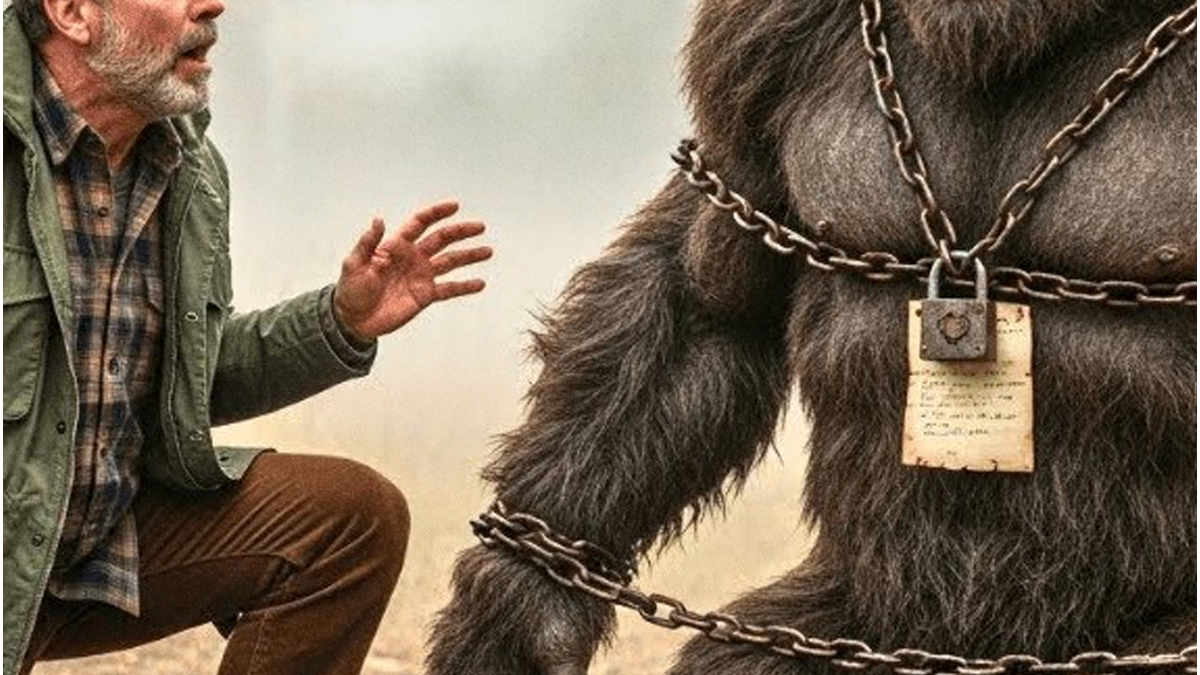
In the late 1980s, deep in the Red Valley of Wyoming, a war veteran haunted by PTSD finds a chained creature in the woods, massive, wounded, with amber eyes and a note that reads, “Too dangerous.
Forgive me.”
But instead of attacking, the creature gently places its hand on his shoulder.

They call it Bigfoot.
But the truth, it stayed by his side during panic attacks.
It sheltered a baby deer from the rain.
It sang at night, calming the nightmares of war.
It wasn’t a monster.
It was the heart of the forest.
This story comes from the real accounts of Calder Moore, a soldier who had lost everything until he found something even the battlefield couldn’t take.
Trust.
In the next 5 minutes, you’ll hear the story of Rook, the creature who saved a man’s soul, who vanished into the smoke of a wildfire and left behind a path of woven grass.
A sign he was never truly gone.
And when gunshots echoed through the trees, it wasn’t fear you heard.
It was sacrifice.
If you’ve ever felt alone in this world, don’t skip this story because maybe, just maybe, you’re still waiting for your own rook to find you.
By the way, where are you watching from?
Drop your city or country in the comments.
I’d love to say hi and see where this story has found a home tonight.
The woods pressed close that morning, the air thick with rot and ash, like the ground itself was holding its breath.
It was the kind of stillness Calder Moore had learned to read long ago, back when stillness meant snipers.
He stepped off his porch slowly, boots crunching through a brittle carpet of wet leaves, rifles slung loose over his shoulder, his breath fogging in the dawn air.
His right hand twitched near the trigger, not out of fear, but habit.
Red Valley and late fall didn’t make room for comfort.
The forest hadn’t changed in years.
Neither had he.
44.
Bones stiff in the cold, ears always listening for things no one else seemed to hear.
The war had ended on paper, but the sound of doors slamming still made his heart leap into his throat.
The stutter of lightning flickering through a storm cloud brought back the sick pink glow of parachute flares, and the silence that came just before an explosion.
That silence was here now, draped over the valley like a wet sheet.
His traps had been untouched for days, but this morning something had shifted.
The barbed wire along the northern edge was bent.
He followed the signs carefully, mind cataloging every break in the undergrowth, every bent weed.
A hoof print here, scuffed bark there, a deer maybe, or something worse.
It had rained the night before.
Now the world steamed in patches where the sun struggled through gray mist.
He reached the limestone stream just after sunup, where water chattered low against rock, half frozen in its banks.
The smell hit him first.
Animal, sweat, iron.
He slowed.
The pine boughs had been bent backward as if something massive had crashed through.
The trees were quiet.
The birds knew better.
Then he saw it.
At first, he thought it was a bear.
The size matched, but bears didn’t get chained to trees.
Not like this.
It was slumped against the wide cottonwood.
Thick iron links twisted around its upper torso, cutting deep where matted fur gave way to raw, purpleled skin.
Its head hung low, breaths shallow.
One massive hand, fingers like blackened tree roots, lay motionless against the dirt.
Its fur shimmerred dark and silver like scorched velvet, soaked in rain.
A crumpled scrap of paper lay by its foot, the ink bleeding out.
Too dangerous.
Can’t control.
Forgive me.
Calder’s breath caught.
The thing stirred, not to growl or lunge, but to breathe, shaky, weak, deliberate.
He stayed frozen.
The chain rattled softly.
For a long minute, he stared at it and it didn’t move again.
The only sound was water.
His knee found the mud as he knelt, cautious, like approaching a wounded soldier.
His brain screamed at him to back away.
His heart whispered otherwise.
A memory cut through.
Marcus in Beirut.
The blast, the screaming, the blood.
And that same helpless look before the light went out in his eyes.
Calder blinked away.
This wasn’t a man, but it wasn’t a monster either.
The chain was rusted.
It would take time.
He reached behind him, pulled the army knife from his belt sheath.
It still had the grit of sand on it from a place he no longer talked about.
He hesitated once, then he stepped forward, and slid the blade beneath the links.
The sound it made, metal against metal, wet skin giving way, made him wse, not from fear, from memory.
The blade bit hard.
His hand shook, but he didn’t stop.
Blood ran in thick globs, some his, most not.
The creature groaned once, low and guttural, not in threat, in pain.
Calder clenched his jaw, cut deeper, and with one final twist, the chain broke free and fell to the ground with a weighty clatter.
The creature collapsed.
Dust lifted around them.
The thing didn’t rise, didn’t roar, didn’t flee, just lay there, its back rising and falling in slow, labored waves.
Calder took a single step back.
Then it moved.
Not quick, not violent, just a hand, massive, leathery, scarred, reaching out and resting.
Not gripping, but resting on Calder’s shoulder.
He didn’t breathe.
The stream whispered behind him.
Mist curled through the trees like breath from a dying fire.
He looked down and for the first time saw its eyes, amber glowing faintly in the dim.
Not wild, not lost, just tired.
There were no words.
None were needed.
They stayed like that.
Human and beast, man and myth, stranger and stranger, knelt in the mud as the weak sun bled silver over the canopy, and the chain lay twisted and dying between them.
By the time Calder stood, his jeans soaked through and his muscles trembling.
He knew Red Valley would never be silent again.
He looked once more at the tree, the scarring deep in the bark, the clump of silver gray hair caught in the links and the paper halfmelted into the soil.
Forgive me.
The air shifted.
Something had been given.
Something taken.
Behind him, the creature stirred again.
It didn’t rise.
It didn’t run.
But it opened its eyes, and for one beat too long, it simply watched him.
Then slowly, carefully, it turned its head toward the sound of the stream and exhaled a long, rattled breath.
Calder looked back once before turning.
His boots scraped wet stone as he crossed the limeream.
He didn’t speak.
There was no plan, no reason.
But as he walked into the fog, back toward his old cabin of warped wood and rusted hinges, he knew something had changed in the marrow of that valley.
Something immense had been seen.
Something sacred had been unchained, and in the distance, beneath the bones of the trees and the pale breath of the fog, the forest listened.
The leaves no longer rustled alone.
The rain had started around dusk.
The kind that didn’t fall in drops, but seemed to hang in the air, soaked into your bones before you even noticed.
Calder Moore stood beneath the overhang of the old barn, arms crossed, watching the mist curl through the sycamores.
The roof groaned softly in the wind, loose slats breathing in and out like tired lungs.
Behind him, deep inside the stall, where hay hadn’t been fresh in years, the creature stirred.
Not loudly, not like something wild, just the quiet shifting of weight too heavy to belong to any man.
He’d managed to lead it here before the storm broke, dragging its feet, but still upright.
It hadn’t looked at him since the stream, but it had followed, half limping, half listening, as if some old trust had been dug up from the dirt.
Calder had stripped the inside stall, spread what dry hay he could find, set a dented water pail and an old wool blanket near the back corner.
Now the wool was soaked, the blanket untouched, but the thing was alive.
That was more than he expected.
He didn’t know why he stayed.
The rain offered no comfort.
The barn stank of age and mold, but something in him wouldn’t let go.
Not after the look in its eyes.
Not after that hand, the weight of it.
Not threatening, not begging, just being.
He leaned against the doorway now, silent, watching the forest blur into gray as the last light drained from the sky.
Behind him, a floorboard creaked.
He turned fast, heart thutting, hand brushing the old rifle leaning by the door.
But it wasn’t the creature.
It was smaller, cautious, coat speckled from the rain.
A fawn, shaking, eyes wide, ribs pushing through its wet skin.
The little thing stood at the edge of the open barn, half in shadow, half in light.
Then the wood snapped.
It wasn’t Calder.
He froze.
The noise had come from inside.
He raised the rifle halfway back toward the fawn.
And there, from behind the stall wall, the shape moved, massive, familiar now, and silent, the creature stepped slowly, carefully, not toward him, toward the deer.
Its body low, one arm out, not to strike, but to shield.
Calder stared.
The thing knelt.
The fawn didn’t run for a second too long.
The world felt as if it had stopped turning.
Rain thutdded against the roof, thunder far off.
But in that space between one heartbeat and the next, he saw something that didn’t belong to nightmares or folklore.
The creature, not crouched to kill, not bearing teeth, was hunching protectively over the shivering fawn, its broad back shielding the animal from the wind.
Its palm opened slightly, resting flat against the ground beside the deer like a barrier.
The fawn flinched once but didn’t bolt.
The wind picked up.
The lantern hanging by the door flickered hard.
Calder’s fingers loosened from the gun.
The rifle dropped an inch.
He stepped back into the barn and pulled the door shut behind him, slow and without sound.
The light inside was low now, just the sway of the lantern and the smell of hay and wet fur.
He didn’t say a word.
He couldn’t have, even if he tried.
The next morning, when the storm passed and the frost crept up the edges of the barn window, he found the fawn gone.
No blood, no prince, just a patch of dry straw in the shape of two curled bodies, one large, one small.
That was the day he stopped waiting for a reason.
By afternoon, he’d moved a few shelves into place, dug out a crate of dry oats, set an old tin bowl near the water bucket.
He didn’t name it.
Not yet.
But when he passed by the stall and the creature turned its head slightly toward him, eyes soft, unmoving, he didn’t look away.
That night, the oil in the lantern ran low.
Shadows flicked across the walls in long smears.
Calder sat in his armchair, radiostatic humming on the table beside him.
He sipped burnt coffee from an enamel mug.
Staring out the window at the barn where something ancient now slept.
He didn’t notice the headlights until they passed the trees.
A truck pulled up outside the gate.
He stood slowly, slid the bolt on the rifle, but didn’t raise it.
A woman stepped out, long coat, boots soaked, shoulders stiff against the cold.
She didn’t walk like a stranger.
She walked like someone with reason.
“Marakaton,” she said when he opened the door.
Her voice low, flat with road dust and concern.
Brought antibiotics for Jean’s dog.
You weren’t at the post.
Calder nodded once, stepping aside.
She didn’t enter.
You’ve got something out back, she said after a pause.
Tracks are too big for elk, too close for bear.
He didn’t answer.
She looked past him, rain dripping from the brim of her hat.
Her face was older than the last time he saw it.
Or maybe she just looked tired.
I know what you saw, she said.
Or what you think you saw.
He didn’t move.
I saw it too, she added.
Or one like it years ago, north of Cheyenne after the avalanche.
Still nothing.
If you’re keeping it here, you need to be careful.
There are folks who will shoot first and never look twice.
She waited, eyes locked on his.
It wasn’t a threat.
It wasn’t fear either.
It was something older, like she was waiting for him to lie.
He didn’t.
She exhaled.
You feeding it?
He nodded.
Does it eat some?
He said, first word spoken in two days.
She stepped closer, lowering her voice.
If someone finds out, you won’t be able to protect it.
He looked past her shoulder toward the barn swallowed in mist.
I know, he said.
She hesitated, then reached into her coat, pulled out a small paper sack, and handed it over.
For infection, she said, “If it’s got open wounds and this,” she reached back again.
“Tranquilizer, last resort.”
“He didn’t take it.”
“I’m not putting it down,” he said flat.
“It’s not for that,” she replied.
“It’s for getting it somewhere safe if you need to.”
They stood in silence for a while, the door creaking behind him, the air thick with what wasn’t said.
Then softly she added, “Why are you helping it?”
He looked at her, eyes darker than the storm behind her.
“Because no one helped me,” she didn’t answer.
She only nodded once and turned away.
As she reached her truck, he called out.
“It covered a deer last night.”
She paused, looked back.
“Good,” she said.
“Means remembers how to protect.”
Then she drove off.
The tires leaving muddy tracks in the gravel.
That night, as the wind picked up again and the fog returned, Calder stood at the edge of the barn and held the match to the note.
The one he found crumpled beneath the chain.
The ink had all but faded now, but the word still burned.
Forgive me.
He watched the paper curl into black along the edges, the flame catching fast.
He let it fall into the metal basin beside the door.
The flames lit the stall wall for a moment, danced against the creature’s sleeping form.
Its chest rose and fell, steady now.
The chain like coiled like a dead snake in the corner.
From the barn rafters, a single thread of hay dropped onto the flame and hissed away.
Inside, the creature opened its eyes once and blinked.
In the flicker of the dying fire, its amber eyes caught the light and held it, not with fear, with understanding.
A gust of wind knocked the door open slightly.
The ashes carried out into the dark.
And just before Calder latched it closed again, he saw it.
A shape, tall, broad, moving past the tree line, not the one in the barn, something else, watching, then gone.
He stood there for a long time, fingers on the doorframe, the fire light dimming behind him, the barn breathing slow and heavy.
In the dark, something deeper had begun to stir.
The snow had started falling in thin sideway streaks by the time Calder pulled the barn door closed for good that night.
The wind howled through the pines like something lost, and the sky above Red Valley had turned the color of faded steel.
It was early December, the kind of cold that sat behind your eyes and made your teeth hurt.
The kind that silenced even the birds.
Inside the cabin, the fire burned slow, steady, a single lamp casting soft light on worn wood and old walls that creaked like bones settling.
He stood there in the quiet, the handle of the coffee mug warm in his fingers, eyes fixed on the snow swirling outside.
Everything was different, yet nothing had a name.
Not yet.
He called it Rook.
He hadn’t said the name out loud, not even once.
But it had formed itself in his mind one night while watching the way the creature moved.
Deliberate, dark, silent, like a raven walking the line between thought and instinct.
Its fur, black with streaks of gray, caught the firelight like feathers in flight.
It didn’t ask for anything, didn’t growl, didn’t beg.
It simply observed as if every breath it took had a purpose.
Rook, it fit.
It wasn’t a name.
Not really.
It was an understanding.
In the stall, Rook no longer hid in the shadows.
It stood more now, even walked the perimeter of the barn like it was mapping the place, pressing its fingers gently into the soft wood, smelling the air near the window slats.
Calder would leave food in the same corner, slices of dried venison, leftover cornbread, apples going soft, and Rook always took what it needed, nothing more.
Sometimes Calder would pretend not to notice, give the creature space.
Other times he’d just sit on the porch at dusk, mug in hand, snow piling on the brim of his hat, watching the faint silhouette through the frosted barn window.
There were no words between them.
There didn’t need to be.
One night, Calder was late coming back.
A storm had pushed through quick and mean, and the trail up from the stream was iced over.
He lost his footing more than once, hands scraped raw from catching pine trunks.
By the time he made it back, boots frozen stiff.
The wind had already shoved its way beneath the cabin door.
He kicked the snow off and stumbled inside, chest heaving, but something in him had cracked open again.
Maybe it was the thunder, the flash of light too close to the porch.
Maybe it was the way the shadows danced across the kitchen floor.
Or maybe it was just the silence, the kind that didn’t soothe but scraped.
He dropped to the floor, back against the door, breathing sharp and shallow, eyes wide, but seeing nothing.
His fingers clawed at the air, his ribs locked up.
That old panic had found its way in again.
He hadn’t felt it in months, but now it crashed in like it never left.
Sweat ran cold down his temples.
His lips parted, but no sound came out.
Then something shifted outside.
He didn’t hear it at first.
Not really.
It was more like a presence, a current in the room that hadn’t been there before.
The wind didn’t stop.
The fire didn’t flicker.
But through the walls, something deeper moved.
A sound.
Low, round, carried on breath, not voice.
It wasn’t human.
It was an animal.
It was a tone, a single deep hum that rose slowly, then held, not loud, not sharp, but steady, like the thrum of a cello, like a cave remembering what it once held.
It didn’t demand attention.
It offered it.
Calder stayed frozen, heart pounding.
The sound didn’t rise.
It didn’t fall.
It simply existed.
One long steady note that seemed to hum inside the walls inside his chest, inside the ribs that refused to expand.
And then slowly, like ice melting in the gut of winter.
His breath found rhythm again.
In, out, in, out.
His eyes burned, not from fear, from something older.
He didn’t get up right away, didn’t speak, but he listened.
And as the hum faded, as gently as it had come, he felt a stillness settle that hadn’t touched him in years.
The next morning, Calder opened the barn door with the sun just brushing the treetops.
His breath smoked in the air.
The frost glittered across the wood like glass dust.
Inside the stall, Rook sat facing the back wall, hunched slightly, eyes closed.
Its breathing was slow, measured.
Calder didn’t say anything.
He just watched.
When he turned to leave, he saw it laid gently across the bottom threshold of the stall.
Not inside, not outside.
Was a single strand of braided grass.
It wasn’t tied into a ring.
It wasn’t shaped like anything.
Just a clean, straight line, as if drawn with thought, a marker, a boundary.
Not for trapping, not for warning, but for honoring.
He didn’t touch it.
Instead, he stepped around it carefully.
That night, snow fell heavy.
The barn creaked under the weight.
The world closed in, but inside the cabin, the air felt softer.
Calder lit a fire and tuned the old AM radio.
Most stations crackled dead.
He kept turning the dial.
Then he found one.
Barely a whisper, just the tail end of a song bleeding through static.
He turned the volume up.
Take it to the limit.
The old eagle’s tune faded and warbled through the dust of decades.
He sat back in his chair.
Rook watched from the shadows outside, face just beyond the windows edge.
The fire light caught in its fur, not in its eyes.
Those stayed steady, unblinking.
He didn’t wave.
He didn’t move, but the song played on.
And for a few minutes, Calder wasn’t alone.
He saw it then.
Not through the window, but in his mind.
The flash of his wife’s laugh.
The soft look his daughter gave when she asked for more marshmallows.
The way the living room used to sound when music filled it instead of silence.
They weren’t there, not really.
But in the fire light, reflected faint in the glass, he could almost believe.
Outside, Rook sat still, knees pulled up, arms resting across them, its gaze fixed on the flame.
Snow gathered slowly on its shoulders.
It didn’t move.
Then another sound far off from the ridge above the treeine.
Not a howl, not a growl, but something close to the sound Calder had heard that night.
Deeper, more layered, like voices overlapping in a long, low harmony, not loud, but purposeful.
Rook’s head tilted slightly.
It listened.
Calder rose and stepped to the door, hand resting against the old pine beam.
The sound came again.
This time there were two, a second tone rising just beneath the first.
Not quite matching, not quite echoing, but answering.
Rook stood slow, deliberate.
It didn’t look at Calder.
It looked to the trees.
That night, Calder didn’t sleep.
He sat by the window, watching the line of the forest, where shapes moved sometimes between the trunks.
Not fast, not careless, just present.
In the morning, the braided grass was gone, but the snow where it had laid remained untouched.
Rook didn’t eat that day.
It watched the trees waiting and called her for the first time in years, understood what it felt like to fear losing something you didn’t even know you’d come to trust.
Something you hadn’t expected to need.
Outside, the wind carried silence, but not emptiness.
Not anymore.
The dry wind swept across Red Valley like a breath too long held, drawing the scent of pine dust and cracked stone through the air.
It hadn’t rained in weeks.
The ground felt brittle underfoot.
The trees whispered like dry paper, and the sky had turned the color of old rust.
Calder stood outside the cabin with his sleeves rolled and his gaze fixed on the horizon.
Something in the light had changed.
The mornings no longer held due.
The birds had gone quiet.
Even the stream, always restless, now whispered like it didn’t want to be heard.
He could feel it in his ribs.
The way old men feel a storm before it breaks.
Rook hadn’t come to the edge of the barn in days.
Not since the last humming.
It stayed deeper in the shadows now, still alert, but listening.
Calder didn’t ask what for.
He just left water in the tin bucket, replaced the blankets as nights grew hotter, drier.
He watched the creature kneel sometimes, head tilted as if waiting for something more than wind.
The silence between them had grown heavier, not cold, but weighty, like both of them sensed a page turning before it did.
On the day the fire came, Calder was fixing the south fence, fingers wrapped in leather gloves, sweat pooling under his hat.
He didn’t see the smoke at first.
He smelled it, sharp, dry, like burning sage.
By the time he stood and turned, the ridge line to the west had already begun to glow.
Thin lines of orange flickered behind the trees.
Not steady, not loud, just breathing.
Then came the thunder.
Not from the clouds.
There were no clouds, just the sky, empty and red, and the sound of lightning finding bone dry pine.
He froze, not in fear, but something close, a flash, then two, far off, but too close for comfort.
He dropped the tools, boots skidding on dust, and ran for the cabin.
Inside, the air was thick, already warm.
He moved fast, packed water jugs, grabbed the rifle, slung the heavy pack over his shoulder.
His hands were shaking, but not from urgency.
From memory.
This wasn’t the first time he’d heard fire coming for him.
Beirut had sounded like this.
So had that night in the mountains when the sky had rained lead instead of rain.
The heat had a rhythm to it, the kind that brought him to his knees long before he could name it.
He reached for the front door and stopped.
The room tipped.
Sound vanished.
His chest locked.
He dropped the bag.
Hands to knees.
Mouth open.
No air.
His heart pounded too loud.
The light flickered.
Not from flame, from his memory.
Somewhere far off, someone had screamed.
He could taste blood in the back of his throat, but he hadn’t bit his tongue.
He fell, shoulder hitting the floor, vision narrowing to a thin line of ceiling beam.
The fire was coming.
He knew it.
But he couldn’t move.
Then the wood groaned.
Heavy, sharp, too big for any man.
The door burst open, not with violence, but purpose.
A shadow filled the frame.
Rook, covered in soot already.
Fur clumped with dust.
Eyes wild but focused.
It crossed the cabin in three strides, dropped to its knees beside him.
Calder’s lungs were locked.
His arms wouldn’t answer.
The creature reached for him, not with claws, with care.
It scooped him like a child.
One massive arm under his back, another beneath his legs.
It stood slow, adjusting for his weight.
Calder felt his own boots sway above the ground.
Rook turned.
The fire had crested the ridge now.
Smoke rolled in waves.
The trees hissed.
Without hesitation, Rook stepped out the door and into the red.
Calder blinked against the smoke, eyes watering.
Each breath burned.
But Rook moved with purpose, not running.
Moving fast, steady, holding him close.
The heat was alive.
Flames licked down the hills, low and crawling.
Not yet a wall, but hungry.
Ash fell like snow.
Ember flakes landed on Calder’s jacket, hissed on Rook’s shoulders.
The creature didn’t flinch.
They passed the edge of the pasture, the old wire fence still standing.
Rook didn’t stop.
It kicked through.
Smoke thickened.
The air roared, but still it carried him over the ridge, through the narrow cut in the rocks, past the half- buried pine stump where Calder once buried the old trappers journal.
Every step was fire and dust.
Calder’s vision blurred.
He wasn’t sure if it was the smoke or the tears.
Rook’s fur glowed orange now, backlit by flame.
Its breath rasped, but it didn’t slow.
Then they broke through the eastern meadow, green still, untouched.
Rook knelt slowly, lowered colder onto the soft grass near the stream bed.
Water still running low but cold.
The creature stepped back once, swayed, then dropped to one knee.
For the first time since the fire started, Calder inhaled fully.
His lungs screamed, but they worked.
He rolled onto his side, coughing hard, spitting into the grass.
When he looked up, the trees behind them glowed red like a second sunrise.
The wind had shifted.
The fire wouldn’t stop.
But for now, they were safe.
A sound rose nearby.
Boots, voices.
He turned.
People from town.
Mara was at the front, coat open, scarf torn, her face stre with smoke.
She stopped cold.
Her eyes locked on the massive figure kneeling just beyond the tree line.
Others emerged.
Three, five, a dozen maybe, all silent.
Rifles dropped slightly.
Rook rose to full height.
Its fur burned at the edges, blackened, stre with soot.
It turned slowly, facing the humans.
One boy, barely 15, stepped forward, eyes wide, voice cracking.
It saved him, he said.
No one answered.
No one moved.
Rook looked at Calder one last time, held the gaze, then turned and walked straight into the smoke.
The flames hadn’t reached the meadow yet, but the air already shimmerred with heat.
Rook disappeared into it like it had always belonged to fire.
No roar, no cry, just gone.
Calder tried to rise.
Mara caught his shoulder.
Don’t, she said, but he had to.
He stood slow, hands trembling, and looked where Rook had vanished.
Nothing now but smoke.
The boy still stood there, mouth open.
Others stepped closer.
Nobody spoke.
Calder lowered himself to the ground again.
Not from weakness, from reverence.
He pulled his coat tighter.
Looked at his arm.
A blackened patch had burned through the fabric.
Not big, not deep, but shaped.
The outline of a hand, massive, smeared in ash, burned into the jacket’s sleeve.
He didn’t cry.
Not then.
Not yet.
The fire burned west through the valley, taking with it dead wood, old cabins, hollow trees, but it didn’t touch the meadow.
Didn’t reach the stream.
The sky that night was red for hours.
The stars didn’t return till near morning.
And when they did, they blinked through a haze that still carried the scent of something ancient and alive.
Back in town, no one said much, but they all remembered, especially the boy, especially called her, especially the silence that came after.
Not empty, just waiting.
The first cool breath of autumn came early that year, sliding down from the big horns and crawling across Red Valley like a low sigh.
Calder Moore felt it under his collar as he hammered the last plank into place on the rebuilt barn wall.
The board smelled of new pine and old ash.
He had taken down what was left of the scorched timbers and rebuilt the stall by hand.
Each nail a promise, each swing of the hammer a heartbeat.
The grass around the cabin had begun to yellow.
The mornings carried mist the color of honey.
He could almost believe the fire had been a dream.
Almost.
The sign hung above the barn door now, carved into a slab of cedar he’d found washed up near the stream.
His hands had trembled, carving the words, but the blade had held steady.
He saved me.
Don’t hunt him.
The letters were simple, uneven, but they caught the morning light like quiet flames.
He didn’t know who would read it.
He didn’t know if it mattered.
But it was there, facing the world, an oath he couldn’t undo.
He still left water in the bucket each dawn.
He still set out food in the same place, but the barn remained empty.
Sometimes in the early hours, when the mist hung low, he thought he saw the shape of a shoulder, a dark flicker between the trees.
Then it was gone.
Only the braided grass Rook had once left remained on the threshold.
Faded now, fraying at the ends.
He didn’t move it.
He stepped over it each time like a ritual.
The valley had changed after the fire.
Word spread through town, though no one said it outright.
People came, men with cameras slung over their chests, boots too clean for the dirt roads.
They parked near the gate, peering through binoculars, whispering into handheld recorders.
Others came with rifles, not out of defense, but curiosity sharpened into something meaner.
Their trucks left tracks in the soft earth, cigarette butts in the ditch.
Calder knew what they wanted.
He also knew they wouldn’t find it easily.
Maraon visited less often now, but when she did, she stayed longer.
She would stand at the fence, coat button to the throat, her eyes scanning the treeine like she was looking for a ghost.
They’re saying it’s a bear, she told him once, voice low.
Or some hybrid.
People love a monster story.
He had only nodded.
She watched him for a while before adding, “If you’re not careful, you’ll be part of that story.”
He didn’t answer.
He just kept mending the fence, the cedar sign swinging gently in the breeze behind him.
At night, when the fog rose and the crickets fell silent, Calder would sit on the porch with his coffee gone cold, staring into the dark.
Sometimes he’d hear it, the low hum far off, softer now, like a memory of a sound instead of the sound itself.
It always came from a different direction, never closer than the ridge.
Once in a dream he followed it deep into the forest, past the place where the cottonwood had stood to a clearing he didn’t recognize.
When he woke the hum was still in his ears.
On the third night of October, just before dawn, he packed a small rucks sack, water, a coil of rope, the old army knife, a handful of dried apples, and left the cabin.
The mist was thick, golden at the edges, making the world look softer than it was.
He followed the old trail toward the stream.
Boots finding the same stones they had the night he’d cut Rook free.
The cottonwood still stood, scarred, but alive.
Bark split where the chain had bitten deep.
He knelt there, fingers tracing the groove like a name carved into a grave marker.
From his coat pocket, he pulled the section of chain he’d kept.
It was rusty now, stained from both of them.
He laid it gently on the roots, palms resting on his knees.
He didn’t say anything.
He just waited.
Then a hand, huge, rough familiar, settled on the earth beside his.
He didn’t look up right away.
He just stayed still.
The mist curling between his fingers, breath catching.
When he did look, Rook was there.
Not fully out of the trees, but close enough for the amber in its eyes to catch the weak light.
Its fur was darker now, patched with new growth where the burns had been.
Its chest rose slow, steady, the sound of its breath like wind through a cave.
It didn’t move closer.
It didn’t pull away.
Calder didn’t reach out.
He just nodded once, eyes on the chain.
The creature shifted, a slow, deliberate movement, then turned its gaze toward the ridge beyond the stream.
The hum came, then low and steady, but this time it felt like a warning, a tide pulling outward.
Calder realized what it was doing.
It had come back not to stay, but to lead, to draw the eyes, the guns, the cameras away from here, away from him.
He wanted to tell it to stop.
He wanted to tell it he was fine now, that he could handle himself.
But the words stayed trapped behind his teeth.
He knew it wouldn’t listen anyway.
It wasn’t his to command.
Rook lifted its hand once, fingers curling slightly, then dropped it back to the earth.
A farewell without saying.
Then it turned and stepped back into the mist, moving with a speed he hadn’t seen before, a grace that made the trees seem too small around it.
The sound of its footsteps faded into the low hum until there was only the stream again.
Calder stayed there for a long time, knees aching, hands cold against the roots.
When he finally stood, the chain was gone.
In its place, a single black feather lay across the bark, not from a bird, too large, too thick.
He picked it up and slid it into his coat pocket without thinking.
That evening, Mara drove up the dirt road.
She found him on the porch, hands empty, eyes on the treeine.
“You heard it again,” she said, not a question.
“He nodded.”
She tightened her scarf, looking past him toward the barn.
“They’re getting closer,” she said quietly.
“The ones looking for it.
I saw two trucks parked off County Road.
They’re baiting trails now.”
He didn’t move.
It’s leading them away, he said.
She frowned.
And you’re sure it’s not leading them back here?
He met her eyes and for the first time she saw fear there.
Not for himself, but for something else.
It wouldn’t, he said.
It’s not like that.
She didn’t answer.
She only set a small brown bottle on the porch rail.
For the cuts on your hands, she said, “And for whatever comes next.”
That night, as the sun went down behind the burned ridges and the mist rose again, Calder walked to the barn, the cedar sign swung gently, creaking in the wind.
He ran his palm over the carved words, feeling the grooves like scars.
Inside, the stall smelled of pine shavings and memory.
He knelt at the threshold where the braided grass had once lain.
For a moment, he thought he heard the hum again, softer than ever, fading like a heartbeat at the edge of sleep.
He stayed there until the stars came out, sharp and cold above the valley.
He stayed until the mist settled and the night pressed close.
The kind of clothes that makes you listen.
And somewhere out there, in the dark, he couldn’t see.
A shape moved through the trees, carrying the danger away from him, away from this place.
He could feel it in his chest, the weight of it, the pull of it.
He could feel the promise tightening like thread between two hands.
When he finally rose, his knees stiff, his palms dusty.
He knew nothing about Red Valley would ever be safe again.
But he also knew he wouldn’t run.
Not now.
Not after what he’d seen.
The wind shifted.
The cricket stopped.
For a heartbeat, he thought he saw two points of amber light far off in the trees, watching.
Then they blinked out, leaving only the dark.
He stayed at the doorway a long time, the cold creeping into his coat.
The feather in his pocket pressing against his heart, and listened to the silence grow heavy enough to hold.
The snow was falling in slow spirals, soft as breath, whispering over the rooftops of Red Valley like something trying not to wake the dead.
It was early December again.
Calder Moore moved through the trees with a lantern in one hand, the other clenched tight inside a wool glove.
His coat brushed low branches heavy with frost.
The trail to the old ridge had narrowed since last winter, overgrown, crusted in fresh powder, but he remembered each bend like muscle memory.
Every few steps, he paused to listen.
Not for a sound, but for the absence of one.
The kind of quiet that meant something was close.
Mara walked behind him, her boots crunching just slightly behind his.
She hadn’t spoken much since they left the road.
Her breath showed in bursts, quick and shallow.
She hadn’t expected him to ask her to come.
But when he showed up on her porch with that look, worn, raw, eyes gone distant, she knew it had started again.
Not the panic, the connection.
They reached the bend in the trail where the pines thinned out into open sky.
Ahead, the rise of the eastern slope cast everything below in silvery shadow.
Snow dusted the tops of the tall grass that hadn’t bent yet under winter’s weight.
And there, between two sycamores, barely visible in the silver blue light, he stood.
Rook, not hunched, not hidden, he stood tall and still, framed by the trees like a statue carved out of something older than the land.
His fur was stre with white now, not from age, but the storm.
Frost clung to the curve of his shoulder, the heavy muscles of his back, but his eyes they burned the same.
Amber, steady, knowing, Calder stopped.
Mara inhaled sharply, but she didn’t move.
Rook took one step forward.
In his hand, something shimmerred, a ribbon, tarnished, blackened at the edges, and clipped to it.
The metal Cder thought he’d lost in the fire.
He stared, didn’t move.
Rook stepped closer, silent.
Snow didn’t even crunch beneath him.
He reached out slowly and placed the metal into Calder’s palm, fingers brushing lightly against the weathered skin.
It was cold, heavier than Calder remembered.
The brass dulled by time, by smoke, but the engraving was still clear.
His name, his rank, a piece of metal he’d once buried at the bottom of a foot locker and tried to forget.
Rook didn’t pull back.
Instead, he lowered his forehead slightly, not in bowing, but recognition.
The gesture was simple, deep, like a stone dropped into still water.
Calder didn’t breathe.
He felt the shape of it press into his ribs.
Some unspoken current moving between them.
Then a sound shattered the stillness.
A crack.
Not from the woods, from the ridge behind them.
A rifle too close.
Calder turned fast.
Mara dropped to her knees.
Rook stumbled backward.
The snow bloomed red across his side.
Another shot tore through the trees, whistling past Calder’s head.
He lunged without thinking, grabbing Rook’s arm as the creature dropped to one knee.
Mara was already moving, dragging Calder’s pack from the snow, pulling the emergency wrap in the gauze, hands shaking, but quick.
Calder pressed his shoulder into Rook’s and hissed.
Don’t move.
But Rook didn’t try.
His breath was ragged.
He blinked slowly, not in fear, in pain, the kind that’s familiar.
Calder looked up toward the ridge, scanning through the trees.
Another shape, camouflage jacket, scope glinting.
He recognized the face, not a local, one of the strangers who’d come weeks ago, chasing stories, the kind that hunted for trophies with stories behind them.
He pulled Rook to the side, dragging him toward the treeine.
Mara pressed the gauze into the wound, crimson soaking through fast.
“Too much,” she whispered.
“Too much blood.”
Rook let out a sound, not a roar, a breath, low and deep.
His eyes never left Calder.
His hand twitched once, as if searching for something.
Then Calder saw it.
In the snow, under the edges of the brush, another strand of braided grass laid there long before they arrived.
A path, a direction, not escape, a message.
He grabbed Rook’s wrist, pressed it gently.
“You knew,” he said.
You knew you’d be followed.
The hum returned then, faint, carried on the breeze that moved between trees like a prayer.
Mara looked up, her breath caught.
The forest answered, not in sound, in presence.
Figures moved between trunks, huge, slow, three, one smaller, fur matted with snow.
One broader than Rook, eyes darker, deeper.
They didn’t speak.
They didn’t run.
They waited.
Rook struggled to rise.
Calder tried to hold him down.
You’re bleeding.
But Rook pushed gently against him, not in refusal.
In farewell, he stood slowly, legs trembling, his hand pressed into the wound.
Blood ran down his forearm, thick and dark, steaming in the cold.
He turned toward the others.
Mara rose beside Calder.
Her hands were red, her eyes were wet.
They didn’t stop him.
Rook stepped into the line of trees.
The others moved to meet him.
They didn’t touch.
They walked beside him.
The smallest one stopped near the braided grass, looked at Calder, then looked down, laid its hand on the ground beside the trail, then followed.
No one spoke.
The shooter on the ridge was gone now.
No more shots, just wind.
Calder dropped to the snow, the metal still clutched in his hand, the blood still on his jacket.
Mara stood above him, silent.
The forest was still.
Then the wind shifted again, high above in the canopy.
A low sound began to move, soft humming, full of weight and distance.
Not sadness, not anger, a mourning, a prayer, the kind only trees remember.
Calder looked down at the snow.
Near the edge of the trail, beneath the blood streaked brush, another braid of grass rested, pointed toward the ridge.
A direction, a warning, a gift.
He picked it up gently, wrapping it around the ribbon of his metal.
The brass was warm now.
He didn’t know why.
The forest fell quiet again, not empty, just waiting.
And somewhere far off, a breath was held between the trees.
The mist rolled in thick before dawn, laying low over Red Valley like breath from a sleeping thing.
It moved in slow drifts, hugging the treetops and softening the edges of everything it touched.
Even the moon, still clinging pale in the sky, looked quieter than usual, like it knew not to intrude.
Calder Moore sat on the edge of his porch with a blanket over his shoulders, boots planted firm against the cold planks, and one hand wrapped tight around the thermos of coffee he hadn’t touched.
The steam had long since stopped rising.
He wasn’t waiting for daylight.
He was listening.
The hum had returned the night before.
Not faint this time, not distant.
It had risen like a tide behind the trees, layered and deep, as if the whole forest was breathing through its roots.
It had shaken the cabin windows, trembled beneath his ribs.
Mara had felt it, too.
She’d shown up without calling, eyes wide, lips pressed thin.
She didn’t need to ask.
She just nodded once when he opened the door.
And now they sat side by side in the morning chill, neither speaking, both watching the fog crawl up from the hollow.
The melody rose again just past 6.
Not a sound exactly, more like pressure, like being inside a great bell just before it rings.
The tone came from beyond the ridge line, carried on wind that didn’t stir the trees.
Low then higher, not single note, but harmony deep and long and woven with something more ancient than language.
Mara stiffened.
Calder stood in the quiet that followed.
Something shifted in the mist beyond the barn.
Not a shape, a presence, then movement.
Steady, deliberate.
Calder moved first.
He stepped off the porch and crossed the yard, boots sinking into wet grass.
The barn door creaked open.
Rook stood inside, one shoulder bandaged, posture uneven, but breathing alive.
The wound still fresh but healing.
His eyes met Calder’s no surprise, just readiness.
Calder reached out slowly and took Rook’s arm, guiding him gently toward the cabin.
Mara stepped aside.
She didn’t speak either.
She looked at the frost clinging to Rook’s fur, the blood stained gauze beneath his ribs, and blinked something back she wouldn’t name.
They helped him onto the porch.
He settled against the beam, knees drawn slightly inward, arms across them, the way he always rested when watching the fire.
But this morning, his head lifted toward the trees.
The hum began again closer.
Mara’s breath caught.
Then from within the mist they came.
Shapes at first, tall, slowm moving, blurred through the gray, then clearer as they stepped into view.
Three figures, one larger than Rook, shoulders broad, fur streaked with white, another smaller, with a narrower chest and hands that moved with quickness and care.
The third young, maybe half rook’s height, steps uncertain, eyes wide.
They didn’t march, they didn’t speak.
They walked like music in rhythm.
Each movement held the weight of something sacred, something final.
Calder didn’t step back.
He stood still as the wind moved around them, tugging at his coat, brushing his cheeks like a farewell he hadn’t earned.
The smallest one was the first to break from the group.
It approached slowly, head tilted, watching Calder.
Then it looked to Rook and walked to his side.
The small hand, fingers long and leathery, rested on Calder’s knee for a moment, gentle, curious.
Calder didn’t flinch.
He met its gaze, nodded once.
Rook’s eyes were distant now, not fading, listening.
He straightened, pain blooming across his brow, but he didn’t wse.
He looked at the three, then up to the ridge.
The hum rose once more, deeper now, more voices, not human.
Mara turned slowly toward the timber line.
Across the ridge, hidden behind the last veil of fog, dozens of shapes stood, still, silent, as if the forest itself had stepped forward to bear witness.
Rook inhaled once, sharp and full.
Then he sang, not with voice, with resonance.
The tone that came from him shook the porch boards.
It hit Calder in the chest like the sound of a church bell struck from the inside.
It wasn’t pain.
It was surrender.
It was strength and grief and gratitude.
The others answered, “From every corner of the trees, from every ridge and hollow, the harmony returned, layered, deep, not chaotic coral.”
Mara began to cry.
Not because it hurt, because it healed something she hadn’t known was broken.
Rook stood.
Calder tried to help, but the creature refused.
One hand on the porch beam, one long breath, then he stepped down.
The smallest one walked beside him.
The others waited at the edge of the clearing.
Rook turned only once, eyes meeting Cers.
He didn’t blink.
He didn’t need to.
He placed one hand lightly over Calder’s chest just for a second.
Then he stepped into the mist.
The others followed.
The fog opened for them, folded around them like a mother’s arMs. No sound of footsteps, only the song, no trail left behind, only the feeling of something larger moving away.
They reached the treeine slowly and then they were gone.
No rustle, no cracking branch, just silence, but it wasn’t empty.
It vibrated like a string still humming long after the last note.
Calder didn’t move.
He didn’t wipe the tears from his cheeks.
He sat back on the porch step, feeling the weight of the hand still echoing through his coat.
Mara knelt beside him.
“I’ve never heard anything like that,” she whispered.
He didn’t answer.
The metal hung at his chest.
The braid of grass still tucked beneath the ribbon.
Wind moved through the yard, lifting dry leaves into a spiral, then dropping them again.
The sky was pale blue now, the mist breaking.
But the sound, faint, distant, eternal, remained somewhere in the marrow of the valley, not fading, just waiting to be remembered.
And at the edge of the forest, just for a moment, a flicker of amber blinked once behind the last line of trees, then vanished.
The grass had turned gold by the time Calder Moore finished setting the last stone along the creek bed.
Late summer leaned soft against the hills, the sky high and quiet.
Clouds drifting like old men with nowhere left to be.
Dragonflies buzzed low over the water, their wings catching sun in little flares.
It had been 3 years since the fire, two since the last voice hummed through the timberline, and one since he’d seen amber eyes watching from the pines.
The valley had changed, but not in ways you could photograph.
It breathed different now, calmer, like something ancient had unclenched its hand.
He stood slowly, knees cracking, and looked out over the field.
A cedar sign leaned slightly near the barn, weathered from snow and sun, but the words still held.
He was never a monster.
He was the forest’s heart.
Wind moved the tall grass in slow waves, brushing against the fence posts where red ribbons fluttered, not as warnings anymore, but as markers.
Soft flags saying this place belonged to something gentle now.
The Red Valley Sanctuary had no paved road, no power lines.
It didn’t need them.
There were five cabins now, all built by hand, staggered along the hillside like bird’s nests tucked between stone and pine.
Most days they were quiet.
Some held veterans who never said what they’d seen.
Others animals with scars no ranger could chart.
A mountain dog that never barked.
A buck with one eye.
A mustang that wouldn’t let anyone ride but the boy who sang to it at night.
They came broken.
They stayed.
Some healed.
Tobin Reyes arrived in August.
16, skinny as a branch, boots too big, no next of kin listed.
The first time Calder met him, he was asleep in the barn loft, curled into the hay like a thing trying to disappear.
Mara had driven him up from the Cheyenne station.
She didn’t say where she found him, only that he needed quiet.
Calder didn’t ask.
Tobin didn’t talk much.
He worked like he’d never learned how to stop.
Fixed hinges before anyone noticed they were broken.
Learned the creek’s rhythm and walked it barefoot.
He never asked why there were no cameras, no visitors, no press.
Maybe he already knew.
Or maybe he just didn’t care.
One evening, as the light burned low over the treetops, Tobin wandered toward the barn.
The sky was all lavender and gold, the kind of color that makes you stop midstep.
He paused at the sign, ran a hand over the carved words.
Calder stood nearby, hammer loose in one hand, nails in the other.
He waited.
Tobin turned.
What’s it mean?
Calder didn’t answer right away.
Just looked up at the ridge beyond the treeine.
A long breath then finally means the story they told us was wrong.
Tobin didn’t speak.
He just looked down at the words again then asked quietly.
Did you see him?
Calder nodded once.
Tobin didn’t press.
That night the cabin smelled of cedar smoke and river mud.
Calder wrote by lantern light.
The edge of a worn notebook brushing his wrist.
The words came slower these days, but they still came.
His handwriting, once sharp and angular, had softened.
He wrote like someone remembering, not recording.
He paused, stared at the open page, then wrote, “There are souls that never speak aloud.
They just keep us breathing when we forget how.”
He sat back.
The room was still.
Crickets in the walls wind in the grass.
And then, quietly, he turned out the light.
Somewhere beyond the clearing, something shifted.
Not loud, not sudden, but certain.
He stood, opened the cabin door slowly.
The air was warm.
Still, he stepped barefoot onto the porch, stared toward the dark.
Nothing moved, but something remained.
At the edge of the clearing, barely visible in moonlight.
Two faint glimmers blinked once.
Amber, soft, then gone.
He didn’t move, didn’t smile.
He didn’t have to.
At sunrise, Tobin found something on the front steps.
A single strand of braided grass, fresh, still green.
No one in the sanctuary claimed it.
No one needed to.
He picked it up gently, held it in his palm, then looked out across the morning.
The wind stirred.
The grass answered, and behind him, the cabin stood in stillness, alive, not just built.
Later that week, Tobin carved his own words onto a strip of wood, smaller than the sign near the barn and nailed it just outside the mess hall.
He didn’t ask for permission.
It read, “Quiet hands can still hold the world.”
The others didn’t ask what it meant.
They just nodded.
They knew.
That fall, more came.
A woman from Idaho who hadn’t spoken since her husband went missing in the sawtooths.
A boy from Kentucky with burns down his left arm who fed the rabbits like they were his brothers.
None of them knew the full story.
Not the names, not the fire, not the hymn that once rolled over timberline and shook the sky, but they knew the stillness.
They knew the space.
They knew how it felt to breathe again without asking for it.
Calder aged slow.
He still moved fence posts in the morning.
Still fixed the loose latch on cabin too, but he spoke less now.
The world inside him was full.
One evening, just before the cold returned, he sat on the porch as dusk laid down.
A cedar branch rested in his lap.
He’d found it along the creek earlier, shaped like nothing, carved by no one, but smooth, clean.
He turned it slowly in his hands, watched the light catch in its grain.
A crow passed overhead.
The dog barked once, then settled, and from somewhere deep in the woods, something hummed.
Not long, not loud, just enough.
He looked toward the trees.
The braid still sat on his window sill, untouched.
The metal hung from the hook inside the cabin.
Ribbon faded, brass dulled, but never dusty.
And in that moment, he felt it.
Not peace, not pride, but belonging.
He let the cedar fall gently into the grass, leaned back, closed his eyes.
The porch creaked once beneath him, then held.
The air shifted, warm, gentle, he whispered into the wind, not loud enough for anyone but the trees to hear.
I’m home now.
And somewhere between the branches, the leaves moved, not from wind, but memory.
Soft piano played from the cabin radio left on low.
Outside the sanctuary breathed.
Some stories are not told to entertain.
They’re not meant to thrill or frighten or spark debate.
Some stories are told because they hold something older than truth, something deeper than memory.
This was one of them.
A story about quiet grace in a world too loud.
About what it means to be seen and to see back.
About the invisible lines that connect a wounded soul to another, be it man, beast, or something that lives in the space between.
It’s a reminder that the wild is not always wild.
That silence does not mean absence and that sometimes the things we’ve been taught to fear are the very things that arrive to save us.
What do we carry forward from a tale like this?
Maybe it’s the understanding that healing doesn’t always look like fixing.
Sometimes it looks like coexisting.
Sometimes it looks like staying.
Sometimes it looks like letting go with your hands open.
That strength is not just in the roar or the fire light or the fight, but in stillness, in holding space for someone else to breathe, in choosing to protect even when the world calls you monster.
That mercy, when offered in the right moment, can echo through generations like a song passed through trees.
There are sacred things left in this world, not because we discovered them, but because we remembered how to listen.
And every once in a while when the wind shifts and the morning fog clings low to the ground, we might feel something watching.
Not to harm, not to haunt, but to remind us we’re not alone.
That someone somewhere remembers we were kind.
And maybe, just maybe, that’s enough.
Thank you for spending this quiet time with us beneath the trees, between the echoes, inside the hush of a valley that never quite forgets.
If this story touched your heart, we’d love to hear from you.
Leave us a comment.
Share your thoughts, your feelings, your own stories of connection and wonder.
And if you’d like to journey with us again through wild forests, distant memories, and the places where myth and humanity meet, don’t forget to follow, like, and subscribe.
Until next time, may your hands stay gentle, and may you always know the way back home.








