Old Man Didn’t Know It Was A Baby Bigfoot – Until Giants Surrounded His Cabin
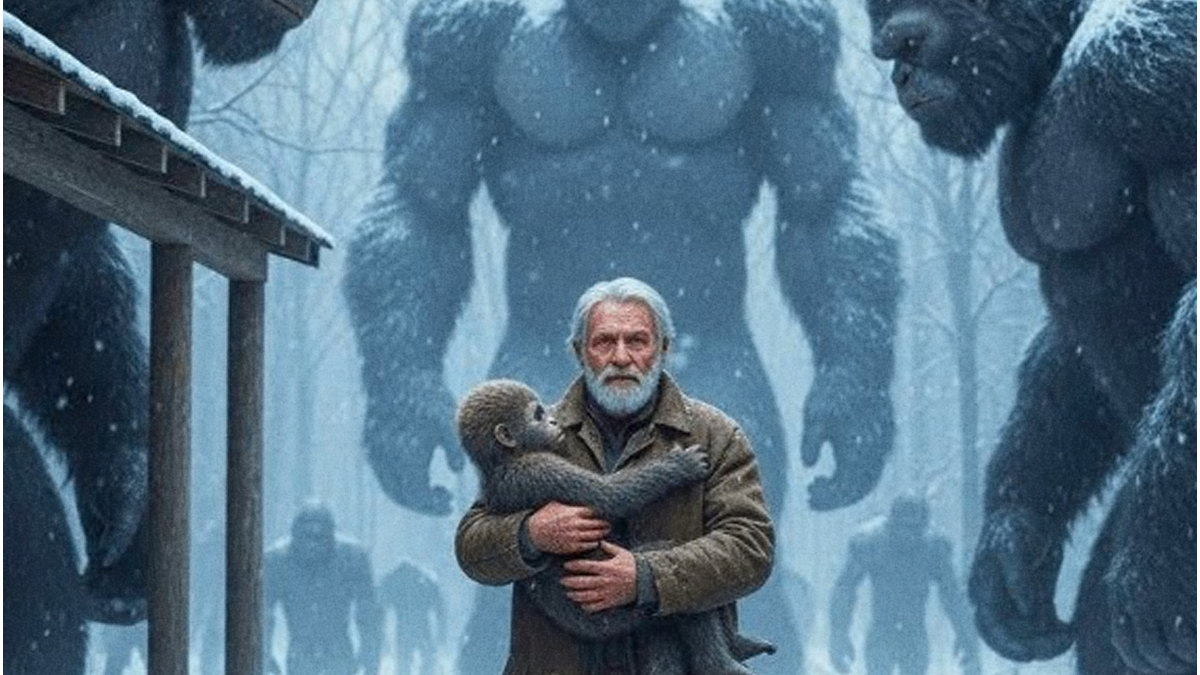
Old Man Didn’t Know It Was A Baby Bigfoot – Until Giants Surrounded His Cabin
What if the only thing that ever forgave you wasn’t human?
In Yok, one of the most remote mountain regions in America, an old widowed carpenter living alone began noticing strange signs around his cabin.
Fivefingered mudprints, food mysteriously moved, and trembling leaves arranged into perfect X’s at his doorstep.

The truth is, he wasn’t alone.
There was something else out there.
Something intelligent, something ancient.
Not monsters, not animals, but a presence we’ve never truly understood.
This story is based on personal journals and witness accounts from the only neighbor who said, “I’ve seen them, and they are nothing like you imagine.”
In this video, you’ll discover what these creatures really looked like.
Why they tied river pebbles with blades of grass as tokens of thanks, and how one lonely man found forgiveness, not from people, but from the forest itself.
Here’s what happened during the stormy night of 1996.
As lightning split the sky and the power went out, five towering figures emerged along the ridge.
But instead of violence, they bowed.
And the small creature, once hiding in fear, stepped forward to stand beside the man.
Two worlds met in silence, and something changed forever.
If you skip this video, you’ll never know.
We are not alone and not everything unknown is something to be feared.
Stay till the end.
The final gift will change how you see solitude forever.
The oil lamp gave off a soft amber flicker that didn’t reach far, just enough to paint the edges of the wooden walls in a warm sheen.
The rest of the cabin stayed in shadow, corners swallowed by dusk.
Silence pressed between the beams like time itself had stopped breathing.
Orson Hale sat still in that half-llight rough hands wrapped around the curve of the old glass chimney, as if afraid letting go would break more than just glass.
64 winters behind him, and only this one lamp still burned from the past.
Evelyn’s lamp.
She’d always kept it full, always made sure the wick was trimmed just so.
She said, “A steady flame meant you were still home, still reachable.”
Orson hadn’t touched that wick in years, not out of forgetfulness, but reverence.
It burned now, not for light, but for memory.
Beyond the windows, the pines stood still in their black suits.
Branches heavy with spring rain not yet fallen.
The wind was nothing more than a whisper, not even enough to rustle the bent tin nailed to the roof.
And yet the air inside the cabin seemed to carry pressure like something just past the edge of hearing.
Huck the old hound felt it first.
He lifted his head from the braided rug, ears perked, not a sound from his throat.
Just listening, waiting, Orson’s eyes followed the dogs, landing on the wooden hatch near the stove where the chicken feed was stored.
The lid had been propped open an inch, the chain latch swinging slightly as if something had disturbed it.
Not knocked, not jostled, but opened.
Too gentle for wind, too neat for raccoons.
He stood, joints aching with the familiar protests of a body lived in too long.
The air shifted when he stepped closer, faint scent of wet earth and something musky, unfamiliar.
The bin was half full, just like yesterday, but the sack’s top was peeled back, smooth and deliberate, not torn.
He crouched, scanned the floor.
A smudge just past the door frame.
Mud, thin, stringy, dark with pine debris pressed in five uneven lines like fingers.
Long ones.
No shoe tread, not paw, just hand smudged and uncertain like something not used to walking this way.
Huck didn’t growl.
He didn’t bark.
He simply moved toward the door and sat, posture stiff, eyes locked, waiting, tense, but not afraid.
Orson leaned over him and opened the door slowly.
Nothing but the quiet hush of twilight air met him.
But then he saw it.
Right on the threshold, just beside the welcome mat Evelyn had woven decades ago, lay two trembling leaves, quaking aspen, pale gold, too early for fall.
They were laid in an X, perfectly aligned, not blown, not scattered, placed.
His spine pulled tight as wire.
A flicker of breath caught behind his ribs.
No sound, no movement, just that X, just that strange stillness.
He shut the door, softer than usual, as if afraid to wake something.
Huck followed him back to the lamp where he stood again, not speaking, not blinking.
The dog laid down again, but kept his head high.
The rain hadn’t come, but the clouds began to roll like muscle under skin.
Far up the ridge, just past where the trees thinned into shale and fox dens, a sound rippled across the mountain.
Low, deep, a single pulse like boulder on boulder, tumbling once, then gone.
Not echo, not storm.
Orson’s fingers closed around the lamp tighter.
He remembered that other night, 13 years back, when a real storm had rolled in.
How the power lines hissed and spat before everything died.
How Evelyn’s voice called from the barn.
And how slow his boots were on the wet floor.
Just slow enough.
One second too late to stop the beam that fell.
Just one.
He’d been slow once.
He wouldn’t be again.
The lamp flared slightly as he adjusted the wick with a matchick.
The flame steadied.
No one spoke.
No sound returned.
But in the stillness, something shifted.
It wasn’t fear.
It wasn’t hope either.
It was something older, like recognition.
He left the lamp burning when he went to bed that night.
Not for light, not for warmth, for witness.
Something out there had come close enough to touch the edge of him and left something behind.
Not claw, not howl, a symbol, an intention.
That night, sleep didn’t come easy.
He lay on the old mattress, staring at the ceiling where the knot in the pine paneling looked like a closed eye.
The wind stayed still, but that rhythm, that memory of a single stone roll sound on the mountain, repeated in his chest like a second heartbeat, not constant, just there, Huck curled close to the door, not at the foot of the bed like he used to, as if he knew the line between inside and outside was thinner now.
At some point before dawn, the lamp sputtered and died.
The oil gone.
Orson didn’t get up to refill it.
He let the dark come.
Let it settle into the corners.
Let it hum around him like the silence after a name has been called, but no one answers because someone had knocked.
Not with fists or voices, but with quiet fingers in the mud.
And he’d heard it.
This time he’d heard it.
The mornings in Yak never came in a rush.
They spilled in slowly like mist over riverstone, light filtering through tall pine until the cabin exhaled.
Orson Hale moved without hurry.
He folded his bedding with quiet hands, stirred the embers from the night before, poured water into the battered kettle that hissed like it remembered things, too.
Huck circled the door once, then plopped down on the mat, sighing through his nose like he’d already had enough of the day.
By the time the kettle began to hum, Orson had shouldered his old canvas pack and stepped into the yard.
The woods behind the house still carried the scent of damp bark and the metallic bite of soil warming after rain.
He didn’t like to cut trees unless he had to.
He gathered deadfall, dry limbs broken in storms, soft pine already losing bark.
The axe hung on his hip, but it rarely got used.
That morning, he walked deeper than usual, past the split rail fence, through the fern line, up toward where the creek bent around a knuckle of stone.
His eyes were sharp, still, not fast, but clear.
He noticed when a bird didn’t call, when squirrels stayed still, when the wind shifted direction without brushing his shirt, and just past the log pile, the one with moss on its north face and fungus rings on the stump.
Something made him stop.
It was the shape first.
Not a stump, not a boulder, not a bear, something smaller, hunched, shivering.
It had thick fur, matted and dark, clinging to small shoulders that trembled with each breath.
The arms were too long for its size.
The left foot curled awkwardly like it couldn’t take weight.
The head didn’t lift.
Orson didn’t speak.
He didn’t move toward it either.
He just looked.
Huck, still behind him, let out a low growl.
Not loud, not menacing, just a warning.
Then silence again.
The thing didn’t flinch.
Didn’t bolt.
It just breathed shallow and fast.
Orson took a step back, then another.
Then he set the canvas pack down gently.
He opened the top, pulled out the flannel blanket he kept for sitting, and placed it near the log.
Not too close, just in reach.
Then he took out the tin cup, filled it from his canteen, and set it beside the blanket.
No words, no gesture.
He turned and walked away.
Boots quiet on the moss trail.
Huck beside him but glancing back often uneasy.
When they reached the edge of the yard, Orson didn’t look over his shoulder.
He just kept moving.
His hands stayed at his sides.
The door clicked shut behind him with a softness that had weight to it.
That night, after supper, he stepped out with a flashlight, but didn’t turn it on.
Moonlight was enough.
He walked back to the log pile alone slowly.
Huck stayed at the porch, refusing to follow.
The blanket was gone, not dragged, lifted.
The cup sat in the same place, but empty now.
No leaves, no dirt inside, just dry.
Sat back carefully, almost politely, like someone had learned the shape of a gesture and tried to repeat it.
Orson knelt down, touched the ring of ground where the blanket had been.
Still warm, he didn’t take anything back with him.
The next day, he left a bowl instead.
Heavy stone wear chipped at the rim, but clean.
He filled it with the broth from last night’s stew, thick with potato and soft carrot.
No meat.
He wasn’t sure why.
He placed it where the cup had been, then turned and walked away.
That evening, the bowl was empty.
Rinsed in creek water or maybe licked clean but not overturned.
It sat upside down, mouth against the stump, intentional, final.
Hu sniffed at it but didn’t bark.
He laid down in the doorway that night, facing out, watching.
The night was still, almost too still.
Orson didn’t sleep.
The cabin walls creaked with a drop in temperature.
The wind brushed the eaves like an animal circling, but never entering.
At some point, he rose, pulled on his coat, and stepped onto the porch.
The moon was lower now, yellow and quiet.
The dog sat up as he stepped past.
Out by the treeine behind the log pile, something moved.
Not fast, not afraid, just there.
Two eyes like polished coal blinked once in the dark.
Orson didn’t raise his hand, didn’t wave.
He just stood there.
The figure didn’t step forward, but didn’t shrink away either.
Then it shifted, straightened.
The arms hung low, long enough to touch the tops of its knees.
The head tilted, curious, and for the first time, Orson saw the shape not as a shadow, but as someone, not something, a child, not human, but child, no more than 3 ft tall, fur thick and tangled, but face expressive, eyes wide and wet, mouth small, silent.
He felt a pull in his chest, old and hollow, like the ache behind a healed rib.
He didn’t speak.
He only nodded once slow.
The figure blinked again, then crouched back behind the log, gone, but not in fear, not running.
The next morning, Orson carved a small spoon from pine.
He didn’t know if it would be used, but he placed it in the bowl when he set it out.
He also left a name, one word spoken aloud to no one.
Hero.
He said it softly, not with authority, but offering.
A name meant something.
It meant presence, meant belonging.
It didn’t matter if the creature answered to it.
It just mattered that it had been spoken.
That night, the bowl came back empty again, but the spoon was still there.
Clean, set across the rim, like a gesture of understanding, like an answer.
Huck no longer growled.
He didn’t wag either.
He just lay across the doorway as before, ears twitching, eyes following movement but not chasing.
And sometime after midnight, a sound came from the ridge.
Low, deep, one rolling note like before, but closer this time, more inside the canyon walls.
Orson opened his eyes from where he lay.
The fire had burned down to coals.
He didn’t move, but he could feel it.
Not fear, not welcome either.
A kind of tension, not threat, a boundary being watched.
Iro stirred beneath the cabin.
He’d curled under the old leanto stacked with firewood.
A space just deep enough for a small body to hide from storm or sight.
The sound made him flinch.
Orson sat up, listened.
No second note came, only the first, still ringing in the hollow places of the trees.
Huck lifted his head, but didn’t bark.
There was something unspoken in the air, something alive and waiting.
The mornings had taken on a new rhythm, though Orson wouldn’t have said it aloud.
He moved slower now, not out of age, but out of attention.
Each step out the door felt like part of something unspoken, like crossing into a quiet pact he hadn’t signed, but honored all the same.
The weathered porch boards no longer groaned beneath his boots.
He stepped lightly, as if trying not to disturb what had settled here with him.
Iro was still a presence more felt than seen.
He stayed tucked behind the firewood leaned to most days, wrapped in shadows, fur patched with mud, twigs caught in the mess.
But he watched.
Orson could feel it.
The way the air shifted when he stepped too close, the way the silence stretched then eased when he turned away.
There were rules.
Nothing written, nothing said, but rules all the same.
Space mattered.
Eyes mattered more.
And contact was not on the table.
Not yet.
The boy, because that’s what he was now in Orson’s mind.
Not a thing, not a beast, just a boy.
Limped badly.
The left ankle had a bulge that hadn’t gone down.
Some mornings, Orson found fur wrap tracks near the creek, always uneven.
So one day he sat at his workbench long after breakfast.
Tools spread like a memory.
He hadn’t whittleled anything since Evelyn passed, not even a spoon, but the grain of the pine called him back, and the motion returned without asking.
It wasn’t fancy, just two flat slats curved slightly and bound by soft bark ties.
He sanded the inside smooth with a scrap of shirt sleeve.
Then he left it on the edge of the steps beside the broth bowl and walked away.
The next morning it was gone.
And for the first time he saw the shape behind the wood pile, not just watching, but moving slower, steadier.
The limp was still there, but something had changed.
The body held less tension, less readiness to flee.
It sat more upright now, more deliberate.
Each meal became a silent exchange.
Orson cut apples into quarters, careful not to let the blade scrape the board.
He used the same bowl, never rinsed with soap, just creek water and cloth.
He placed it under the same birch stump and backed away.
The same 10 steps every time.
Iro waited until the door clicked shut before emerging slow and low.
But he came every time.
One afternoon, just before dusk, Orson stepped onto the porch with a mug of coffee and paused.
Huck was lying across the doorway again, head on his paws, facing the trees.
Past the edge of the wood line, something shifted.
A bird launched too suddenly.
A squirrel darted across the fence rail, and just beyond the coupe, the chicken wire shimmerred ever so slightly, a glint catching low in the slanted sun.
Orson frowned.
He walked over, boots scuffing against the dry grass, and knelt at the far corner where the ground sagged.
The fence post, one he’d driven into the soil 2 years ago, now stood straighter, firmer, reinforced with a crisscross of thin branches packed tight with pine bark, woven with care.
He hadn’t done that.
Neither had the wind.
He turned slowly, looking back toward the house.
Iro wasn’t in sight, but the message was clear.
They someone had helped, had fixed, not broken.
He didn’t touch it.
Just stood, arms at his sides, heart caught somewhere between pride and ache.
He hadn’t asked for this gesture, but it was real.
And more importantly, it was offered.
That night, when he opened the door to let the air in, something caught his eye on the porch step.
Two aspen leaves, golden green, folded together at the stem, forming an X, neater than before, deliberate, not placed in the middle of the threshold this time.
Off to the right, beside the railing, a signal.
Orson stared at it for a long moment.
Then he sat down on the top step, mug still warm in his hand.
Huck laid beside him, silent.
He didn’t move the leaves, didn’t pick them up.
They weren’t his to interpret directly.
Not yet.
But he understood what they meant.
Or at least enough to stop pretending this was coincidence.
This wasn’t just a lost child.
This wasn’t a fluke.
There were others.
They were watching.
Not from malice, but with boundary.
And now they were saying, “We let him come to you.
But don’t come looking for us.”
A language written without ink.
A border drawn in breath.
Huck lifted his head and growled once.
Low, but not at the woods, at the sky.
A single raven flew overhead, letting out a raw croak as it circled once, then glided toward the ridge.
Orson followed its path until it disappeared behind the trees.
He sat there a while longer.
The lamp inside flickered in the window.
No sound, no wind, but the shape of something had changed.
He could feel it.
The next morning, he found his saw move 2 in on the workbench, just enough to be noticed.
Nothing stolen, nothing disturbed, just seen.
That evening when he placed the apple slices on the plate, he added something else.
A single stone, smooth, round, creekwashed, with a dent like a thumbrint.
He didn’t know why he chose it.
Just did set it beside the food, then stepped back.
The stone was gone the next morning, but the apple cores were stacked in a neat triangle, rind side out.
Balanced carefully.
An answer, maybe even a thank you.
Huck began sleeping on the inside mat again, but he never took his eyes off the porch.
Orson started leaving the lamp lit a little longer each night, even after the fire was out.
The flicker was no longer just for memory.
It was a signal, a marker, a heartbeat in the dark.
The air had grown warmer.
The frogs at the creek returned.
Fireflies blinked low between the trees.
Summer came quiet in Yak, not with parties or parades, but with the smell of sap and the sound of distant owl wings.
Iro appeared more often now.
Sometimes in the morning, crouched near the edge of the chicken run, watching the birds pecket feed.
Sometimes just after twilight, halfway between the coupe and the log pile, silhouetted in blue dusk, his head tilted as if listening for something no one else could hear.
Orson didn’t speak to him, but sometimes he nodded, and Iro more and more nodded back.
The silent rhythm was building into something that wasn’t yet trust, but wasn’t fear either.
A bridge halfb built from each side.
He didn’t tell anyone.
There was no one to tell.
And even if there was, he wouldn’t have.
Not because they wouldn’t believe him, but because it wasn’t theirs to believe.
It was his to keep.
And the leaves kept coming.
Always in an X.
Always off center.
Always precise.
One morning he opened the door and found two instead of one.
Side by side, one smaller, one larger.
Both pressed flat to the wood with a pebble on the top.
It wasn’t a warning.
It was a reminder.
This child wasn’t alone.
He never had been.
Orson stepped back, left the door open a little longer that morning.
Let the air move through the cabin.
Let the scent of pine and smoke fill the space Evelyn once called home.
He looked toward the woods, toward the ridge beyond the trees, and didn’t feel alone either.
But somewhere inside him, he knew this was still a narrow line.
This was still a temporary grace.
And somewhere far behind the trees, something was still watching.
Something that hadn’t yet decided what came next.
The morning began the way most late summer mornings did in Yok with the slow unwinding of mist across the field and a damp cool that clung to the porch railings.
The sunlight was lazy, soft, and slanted, catching on every cobweb and nail head like it had nowhere to be.
Orson sat with a cup of wheat coffee the way he always did.
But there was a stillness to his breath, a pause between sips that hadn’t been there before.
Not since the spoon was returned clean, not since the chicken wire had been mended by hands that didn’t belong to him.
It wasn’t that he felt watched.
He felt accompanied, like something old and shy had taken up space just beyond the woodline and decided it might stay.
The leaves kept appearing.
Each X sharper than the last.
And now they weren’t always on the porch, sometimes by the coupe.
Once by the axe handle resting near the chopping block, but always intentional, always just far enough to be seen, never touched.
That day, Orson didn’t head for firewood.
He grabbed a sack of oats instead, the kind Evelyn used to sprinkle for the chickades in spring.
He walked slow around the edge of the cabin, past the dog’s dish, past the leanto where Iro had once hidden, and stood near the outer porch post, the one with a deep knot like a closed eye.
He crouched low and spread the oats gently on the flat railing, scattering them like a question.
The birds didn’t come, not right away, but the breeze picked up like a breath held too long.
And one by one they arrived.
Not songbirds, ground feeders, finches, towes.
One bold nuthatch that stared him down before hopping closer.
They didn’t sing.
They just ate fast and silent like they too were being watched.
When he stepped back inside, he found Huck sitting near the door with something between his paws.
A stone, small, round, pale, with a thin green stem tied once, simple and loose, like a child’s first attempt at a knot.
Orson didn’t move for a long while.
He sat down on the floor next to Huck, hands slack against his knees, and looked at the stone like it was a message.
It wasn’t decoration.
It wasn’t art.
It was a return, a gesture back.
He didn’t place it on the shelf or pocketed like a keepsake.
He set it on the porch railing beside the coffee cup, out in the open, in the sun like it belonged there.
That night, after supper, Huck did something he hadn’t done in years.
He trotted off the porch with purpose, not to chase or bark, just to carry something in his mouth.
Orson followed at a distance at the edge of the cabinard in the half shadow between the woods and the path.
Huck dropped the object, one of Orson’s old boots.
Cracked leather, split soul, longforgotten under the cot.
He nudged it gently with his nose, then laid down beside it, and stared into the trees.
Orson didn’t say a word.
Didn’t need to.
Something had shifted.
This wasn’t about curiosity anymore.
This was ritual exchange.
The air felt heavy with meaning, like every movement was being witnessed and measured.
When Orson turned to go back inside, he didn’t hear a sound, but he felt one.
The kind of awareness that hums against the bones, like standing beneath a power line that isn’t buzzing, but still carries something deep and electric.
Later that night, he sat on the steps as the lamp flickered behind him.
The wind had died down.
Crickets murmured low, almost respectful.
A moth circled the flame and disappeared into the dark.
Huck lay curled at the bottom of the steps, ears twitching but quiet.
And then, without warning, it happened.
From the edge of the woods, just where the treeine thickened into shadow, a figure moved, tall, still massive, but not charging, not hiding.
It stood just long enough for Orson to see it was an eye row.
Not even close.
This one was broad through the shoulders, covered in deep black fur, stre with old dust and burrs, arms longer than any man’s, hands near the knees.
The chest rose and fell slowly, not strained.
It didn’t breathe like prey.
It breathed like forest.
Orson didn’t stand.
He didn’t reach for anything.
He simply held his breath, heart climbing in his chest, unsure what he’d done to earn this moment.
The figure didn’t move forward.
It lifted one hand, not high, just a few inches off its side, then lowered it, then vanished.
One step, maybe two, gone.
The air didn’t move again for several minutes.
Orson exhaled only when Huck sat up, turned his head, and leaned lightly into his leg.
No growl, no bark, just pressure, presence.
That night, Orson didn’t sleep.
He sat at the kitchen table with a lamp turned down low, hands wrapped around a mug gone cold.
He kept thinking of Evelyn.
The way she used to talk to the trees like they were old friends.
The way she’d pause before stepping into the garden, hand on the post, whisper something no one ever heard.
She used to say, “If you listen right, the wild has manners.”
He thought she’d been poetic.
Now he wasn’t so sure.
By morning, the mist came in heavier.
Orson stepped outside and found the birds already waiting.
Three of them, perched near the railing where the oats had been.
And beside the old boot, now dry with morning dew, sat another stone, smaller than the first, tied tighter, the knot neater, more practiced, and on the far end of the porch on the exact board Iro had once left the apples, set a single bright red berry, fresh, no claw marks, no tooth dents, no dirt, just placed, deliberate.
Orson didn’t touch any of it.
He just stood in the doorway, one hand on the frame, and said, barely above the wind, “I see you.”
Nothing answered, but deep in the trees, something shifted, a silence that had shape.
He didn’t know how long this would last.
This fragile balance, this dance of offerings and unspoken terMs. But that afternoon, as the sky turned golden, he found himself doing something he hadn’t done in over a decade.
He pulled the old oil lamp from the corner of the shelf, cleaned the soot from the glass, filled it fresh, and placed it on the porch.
Not for light, for invitation, not to speak, but to say without words.
The door is enclosed.
And just as he stepped back inside, the sound came.
Not one note.
Too low, deep, two rolls like thunder with breath behind them.
Spaced apart just enough to be message.
Not echo.
Not warning, not threat, but something ancient and spoken.
He froze in the kitchen doorway, huck beside him once more, and let the sound settle into the wood, into the floorboards, into the part of his chest that hadn’t stopped aching since the night Evelyn died.
It wasn’t fear that came.
It was memory.
But not the kind that haunted, the kind that stirred.
That meant the story was still being written.
That somewhere in the dark, someone had decided he was worth returning to.
The sky broke open without warning.
Not like spring rain that tiptoed in.
Not like autumn drizzle.
This came fast, sharp, the kind of mountains storm that tears through treetops like it’s hunting something.
Wind slashed sideways through the yard, peeling bark from branches, slamming the shutters hard enough to shake the lamp glass inside.
The temperature dropped 10° in half an hour.
The dog didn’t bark.
He just stood at the door like he knew.
Huck always knew before it came.
Orson lit the lamp with a hand that didn’t shake.
Not this time.
He trimmed the wick, closed the latch, and set it near the window like a beacon.
The light flickered against the storm dark cabin, throwing warped shadows across the kitchen wall.
The air smelled like wet cedar and thunder, like memory crawling through the floorboards.
He didn’t say her name, but she was here, Evelyn.
That same kind of storm had taken her years ago now.
And this one wore its shape, same rhythm, same pressure, like the world winding up again to teach him the same cruel lesson.
But he wasn’t the same man.
He wouldn’t move too slow again.
Wouldn’t be caught waiting for this guy to give him permission.
He checked the hinges on the back door tight.
He checked the seller latch secured.
Then he went to the front and opened it wide.
Rain slapped sideways onto the porch, bouncing off the boards in sharp, cold bursts.
Lightning snapped somewhere behind the ridge, followed by thunder that cracked straight through the valley like a bone splitting.
But Orson didn’t step back.
He lifted the lamp, held it high in the doorway.
Huck sat beside him, not looking at the rain, but looking past it, ears high, body stiff, eyes locked on something only he could see.
And Orson felt it, too.
Not just the storm, but presence, a hum in the air, deeper than wind, older than fear.
He took one step forward, then froze.
Up on the ridge, where the treeine bent and the shale opened into a bald slope of rock, something moved between flashes.
Not one, not two, five.
Five towering shapes cut through the night like living shadows, only visible when the lightning cracked.
They didn’t charge.
They didn’t hide.
They stood still, tall, surrounding.
Their eyes, if they had them open, didn’t shine.
They absorbed.
They held.
Orson kept the lamp steady.
Rain hit the glass, hissed, sizzled, slid down.
The porch creaked beneath him.
Not from movement, just pressure.
And something in him buckled.
Not from terror, from memory.
The image came back uninvited.
Evelyn that night calling out from the barn.
The wind stealing her voice.
The flashlight that wouldn’t spark.
His boots soaked and slow, his hands fumbling with the beam that should have held.
One second too late.
He gritted his teeth.
Not this time.
He stepped fully onto the porch, raised the lamp again, and spoke.
The words sharp, simple, soaked in the storm.
It’s safe.
He’s not harmed.
His voice didn’t echo.
It landed.
Heavy.
Huck didn’t move.
Didn’t flinch.
Beside him, under the table, just inside the cabin door, Iro stirred.
Not just stirred, trembled.
His breath came in small hitches, shoulders tight, eyes wide.
Orson didn’t turn to look, but he felt the shift.
The storm had reached the boy, too.
Not the rain, not the thunder, the presence.
They weren’t here for Orson.
They were here for him.
Orson lowered the lamp slightly, held it closer to chest level, then stepped sideways, making space on the porch.
The moment held like the pause before a bridge gives out, and then a sound from the ridge, low, long, not one note, but a full-bodied, chestde roll like granite cracking under pressure.
The voice of something old and wounded and still standing.
The largest of the five shapes shifted forward.
Just enough to break the symmetry.
Then it bowed.
Not a deep bend.
Just enough.
A nod.
Acknowledgement.
Recognition.
Orson’s hand clenched tighter around the lamp handle.
He didn’t bow back, but he didn’t move either.
He let the moment settle.
Let the gesture land.
And that’s when moved.
Slow, careful.
Still trembling.
He crept out from under the table.
One hand to the floor, the other pressed against the side of the door frame.
His chest rose and fell too fast, eyes locked on the rain.
Then on Orson, then beyond he stepped forward, not toward the woods, but beside the man, into the light of the oil lamp, onto the porch.
He stood small, hunched, soaked.
One foot turned wrong, fur matted at the chest, breath shaky, but he stood beside Orson, between the house and the forest, between worlds.
Huck looked up at him, blinked once, then turned back to the ridge.
The wind didn’t howl, then it stilled, held its breath.
Lightning flashed again, and in that split second, Orson saw all five clear, eyes, shoulders, breathing.
One massive figure at the center, two to the left, two to the right.
One of them leaned slightly, favoring a side, maybe injured, maybe older, but all still, all watching, all witnessing.
He couldn’t read their faces, but he could feel the decision hanging in the air.
Then the sound again.
That same deep tone, but softer this time.
Not rolled, not thundered, just there.
And they turned one by one.
Not fleeing, not retreating, just turning into the storm, into the trees.
The sound of footsteps so heavy it wasn’t sound.
It was vibration.
Into the ridge, into the forest.
Gone.
Orson exhaled.
He hadn’t realized he’d been holding it.
The rain kept falling.
The lightning flashed, but the hill was empty.
Iro still stood beside him, still trembling, but still standing, and Orson didn’t speak.
He just reached out, slow, deliberate, and set the lamp on the railing, then crouched, not toward Eero, just enough to meet his height, to be beside him.
The boy looked up at him once, then passed him, then back at the trees.
And for the first time, he didn’t flinch.
Didn’t shrink.
He stayed soaked, silent, but there.
And Orson, for the first time in years, felt something inside him, steady, not warmed, not healed, but steady.
The porch light flickered behind them.
Huck shook out the rain, and stepped back inside.
Orson stood, stretched one hand to the edge of the door, and left it open.
The wind carried the sound of the storm away behind them, and the night, though it still roared in the trees, felt changed.
No longer circling, no longer testing, it had seen what it came for, and turned away.
The storm didn’t end all at once.
It tapered, like breath being held a little longer than it should, then let go in pieces.
The rain softened to mist.
The thunder curled back into silence.
What remained was the hush of soaked trees and sagging branches.
The kind of stillness that came only after something ancient had passed through and chosen not to stay.
Orson stood in the open doorway with the lamp still burning.
The oil was low, but he didn’t refill it.
The flame danced in soft amber arcs, casting uneven light across the porch where the board still glistened.
Iro sat on the threshold, soaked to the skin, small body shivering in rhythm with the last drops falling from the eaves.
Huck pressed close to him, quiet, alert.
They had not spoken, not with voice, not with movement.
They had waited.
Somewhere deep in the trees, a pine snapped.
Not sharp, just tired, like something large had leaned against it on its way through.
The sound didn’t stir Iro.
He was no longer frozen, just still.
His breath had settled.
The first light broke just past 5.
Not yellow, not warm, blue, that thin, cold kind of dawn that looked like it had been rung through fog and memory.
The hills were coated in steam, the trees in silver light.
The porch sagged with the weight of wet wood, but the cabin stood firm.
Orson set the lamp aside, stepped out onto the porch, not to lead, to witness.
Iro followed, not fast, not hiding, just moved.
When his barefoot hit the edge of the step, he paused, then turned his face to the trees.
The line between house and forest didn’t exist anymore, and through that gray wall of morning mist, they came slow at first.
Massive shapes where the woods began.
More than before.
Less shadow now, more detail.
The first one stepped forward, broad across the chest, thick furred, still damp from the storm.
He moved like gravity meant something different to him.
Heavier, older, deliberate.
The others didn’t follow yet.
They stayed back, waiting, watching.
Not a sound, not a cry, just silence wrapped in trees.
Iro stepped forward.
The air changed when he did.
Not with fear, with something closer to ceremony.
He let out a low sound, not quite a hum, not quite a whimper.
Buried somewhere deep in his throat, and took another step off the porch.
Orson didn’t follow.
Huck didn’t either.
They both remained in place, as still as fence posts, as still as graves.
Iro walked on shaky legs, feet squishing through mud, shoulders trembling with each breath.
And when he reached the tall figure at the edge of the clearing, he stopped.
The shape before him didn’t move right away.
Then one giant arm reached forward slow like the pull of a tide and wrapped around the boy’s back, pulled him close, held him, and Iro collapsed into it.
Not limp, not unconscious, just folded like that shape had always been home.
No words, no noise, just breath, just contact.
Orson felt something inside him shift.
Not break, shift.
Like a fault line, adjusting after too long locked in place, like something he’d been holding together by habit had suddenly been let go.
And it didn’t fall apart.
The figure turned, Iro still in its arms, and stepped back toward the others.
As they moved, Orson caught the light off something along the taller one’s ribs.
A long, deep scar, thin, but unmistakable, shaped like the edge of metal, curved and healed badly.
A wound not from beast, from man.
He watched the light glint across it.
And the hand, that same massive hand, gently pressed the child closer as if to say, “I carry this, too.”
The other figures stepped aside as they passed.
One smaller than the rest followed them in.
She walked with a shape to her that Orson recognized before he could name it.
Her arms were longer, her frame leaner, and her steps were unmistakably maternal.
She moved straight for Orson’s porch.
Didn’t rush, didn’t pause.
When she reached the base of the steps, she didn’t climb them.
She stopped at the first one and bowed slow.
One hand pressed to her chest.
Not the heart, but the center, then extended outward.
She looked up once, met his eyes.
Orson didn’t know how long they held that gaze, but something passed between them.
It wasn’t thank you.
It wasn’t goodbye.
It was older than both.
She turned, joined the others.
Mist curled around their legs as they moved.
And just like that, they were gone.
No crashing, no call, no sound.
The trees accepted them the way the earth accepts river water, as if they had never truly left.
Orson stood alone on the porch, the lamp now cold.
The wind picked up slightly.
Huck pressed his head against Orson’s knee, and there on the top railing, not placed before, was a small round stone.
Still wet, tied with a new knot, neater, stronger.
It hadn’t been there when they came.
It had been left after.
A gift, a seal, not a promise of return, but a recognition that what had happened here had mattered.
That mercy had been witnessed and would not be forgotten.
Orson touched the stone with the tips of his fingers, but didn’t take it.
He left it where it was.
The wind sighed through the pines.
A raven called once from the ridge, and the sky, now fully dawned, broke soft across the cabin roof like a benediction whispered only once, never repeated.
Inside the coffee had gone cold, but he let it sit.
There was no rush anymore, no fear, only the sound of the creek returning slow and steady after the storm.
And somewhere far in the woods, too faint to call thunder, too deep to be wind, a low rhythm moved.
Not one, not two, just presence, still out there, still listening, still remembering.
The days turned soft after they left.
No more storms, no more sounds from the ridge.
The forest breathed like it had loosened its belt, like something long held in tension had been released back into soil and fog.
The grass grew heavy with late summer dew, and the mornings felt wider.
No urgency, no edge, just air, open and unhurried.
Orson moved slower, but not out of age.
He walked with a kind of stillness now, like a man who had already survived the thing he feared most, and found that it did not devour him.
Huck had taken back his place by the fireplace, but only when the door was open.
He would glance out every so often as if checking for something just beyond the tree line, but he didn’t press his ears flat anymore.
He didn’t growl.
The old dog had become a sentinel, not a soldier.
Orson began placing things at the edge of the woods without thinking too hard about it.
He left a split apple on a stump one morning.
A folded bandana, once Evelyn’s, laid carefully on the fence rail another.
Sometimes they disappeared, sometimes they didn’t.
He never checked too quickly.
He let time do the asking.
Once a whole week passed with no answer.
The apple browned.
The bandanna stayed folded.
He left a few dried berries by the cedar where he used to split firewood.
They remained untouched.
But the following morning, just as the light touched the side of the cabin, he noticed it.
A single quaking aspen leaf placed carefully at the base of the porch stairs folded at the stem.
Xshaped.
They were still out there, still watching, still near.
But the visits had changed.
This was not a relationship of proximity now.
This was rhythm.
Orson built a small shelf just under the eve where the lamp used to hang.
Took him the better part of two afternoons.
He cut the cedar planks himself, hands slower than they once were, but steadier.
He sanded them down till they caught the sun just right, then fixed the lamp to a metal hook.
Anchored deep.
Not for light, not for him, but as a way to say this stays open.
The house, the threshold, the heart.
Some nights he lit it.
Most nights he didn’t.
It wasn’t a ritual anymore.
It was a posture.
One evening, just after supper, he stepped out with his hands in his pockets.
The air was warm, buzzing with late Augustn gnats, the kind that hovered in shafts of sun like dust caught between pages.
Huck stretched on the porch.
Orson sat down beside him.
No book, no task, just silence, and that’s when it came.
Not a sound, not a form, but a feeling that something had passed through.
He looked up slow and scanned the edge of the tree line.
No movement, but something had shifted in the air.
He didn’t stand.
Didn’t go looking.
He just waited.
Minutes passed.
Then he saw it.
At the base of the cedar fence, where the light hit just right, another leaf.
X again.
But this one had a small pine cone beside it.
Hole.
Uncracked.
A gift or a question.
He didn’t move to pick it up.
He let it rest.
Like all things now, no need to chase.
If it was meant for him, it would stay.
The next morning, it was gone.
And in its place, three strands of dry grass, woven, loose, unfinished.
Orson stared at them longer than he meant to.
Then he smiled.
Didn’t know why.
Didn’t need to.
That night, he left a slice of peach out on the step, wrapped in linen, soft.
He watched the lamp glow against the porch railing and felt Evelyn more than ever.
Not in memory, not in mourning, just there.
In the way the wind curled up the hill, in the sound of Huck’s breath against the wood, in the shape of the shadows cast by that same old flame she’d trimmed and cleaned all those years.
He sat back, let his spine rest against the wall, and let his throat open for the first time in weeks.
The tears came slow, not from grief, from peace.
A different kind.
A kind that didn’t ache, a kind that made room.
He wept until the porch grew dark, and the fireflies rose up from the grass like the ground had begun remembering light again.
He didn’t wipe his face, didn’t hide it, just breathed.
One long inhale, then another, and felt the air return with no weight on its back.
For the first time in a long, long time.
By morning he found the linen folded, set neatly on the top stair, and beside it a stone, smaller than the others, but tied with the same thin stem, tighter now, better crafted, as if a hand was learning.
He left it where it was, he added nothing more.
Some weeks nothing came.
No leaf, no sign.
And then one morning in early September, when the mist clung low to the field, and the bird stayed quiet longer than usual, he found it again at the base of the old oak stump, an X of leaves with a pebble in the center.
Orson stood over it, one hand braced on his hip, the other shading his eyes from the rising sun, and he said out loud to no one.
I know.
Not as an answer, as an agreement, a way to say, “I’m still here, too.”
Later that week, he carved a new handle for the front door.
The old one had splintered.
He chose cedar again, shaped it slow, rubbed oil into the grain till it sang under his fingers, then fixed it to the wood with two brass screws.
One night, long after even the crickets had gone quiet, he stepped out to feel the air.
He didn’t bring the lamp.
He didn’t call out.
He just stood.
The sky above was deep, black, endless, the stars distant, but alive.
And from far, far off, not near the ridge, not even near the creek, came the faintest sound, a low single roll, not thunder, not warning, just acknowledgement, no louder than a whisper from the earth’s throat.
He smiled in the dark, didn’t answer, didn’t need to.
That had never been the point.
He turned back inside, closed the door gently, and left the latch undone.
The lamp didn’t need lighting that night, and neither did he.
The first frost came without warning.
It didn’t fall hard.
It crept in overnight, dusting the roof shingles, turning the edge of every pine needle stiff and white.
When Orson stepped out that morning, the porch boards felt different beneath his boots, dry, but crisp.
The breath in his chest left a trail behind him.
He stood there a moment, not moving, not shivering, just breathing out into the silence.
It was October, though he didn’t mark the days anymore.
The trees told him everything he needed.
The tamarax had begun to pale at the edges.
The creek behind the cabin made a thinner sound, and the squirrels, God, the squirrels were louder now, bolder, stuffing their cheeks like winter had already knocked.
Orson didn’t close the door as early as he used to.
Sometimes he didn’t close it at all.
Some nights he lit the lamp, sometimes not.
The choice wasn’t about routine anymore.
It was about listening to the wind, to the trees, to himself.
And lately, everything inside him said to keep the flame burning, even just a little longer.
That evening, he sat on the porch with the lamp between his boots and huck curled up against his thigh.
No sound beyond the soft shifting of light.
The kind that made shadows grow without ever moving.
The kind that let silence speak its own language.
He didn’t think of Evelyn much these days.
Not with sadness.
Her name didn’t sting anymore.
It settled like the last ash in a fire that won’t reignite, but still keeps the room warm if you sit close enough.
He watched the ridge in the distance.
Didn’t expect anything, but he watched.
Not waiting, just ready.
Somewhere in the dark, an owl called once.
A low, slow syllable dragged out across the pines.
Then nothing.
Huck’s ears twitched, but he didn’t move.
Orson reached down and scratched behind them.
Slow.
The fur was thinning now, but warm.
He spoke only once that night, voice barely louder than a breath.
Still here.
To no one, to everyone.
The morning after, the sky cracked open in color.
Pink, orange, deep blue, still clinging to the top edge like it didn’t want to leave.
The fog lifted early.
Orson poured his coffee, stepped outside, and stopped before the second sip.
There it was.
The stone, small, tied with fresh grass, still damp, still warm, sat not on the porch this time, but on the handrail, the exact spot where he always laid his palm when he stepped outside.
It hadn’t been there last night.
He didn’t touch it, didn’t lift it, just stood beside it, coffee cooling fast in his hand, and nodded once.
Whatever it meant, gratitude, memory, hello, it was enough.
By midm morning he was chopping wood again.
Not because he needed it yet, but because it felt good.
The swing of the axe, the scent of pine split clean, the weight in his shoulders reminding him he still had work to do.
That was the rhythm of this life now.
Not surviving, not watching the clock, just doing the next thing right.
Every week or so, he still left things at the edge of the woods.
Never much.
An apple slice, a woven thread.
Once a single feather from a grouse he’d found limp on the trail, neck broken clean by something that hadn’t left teeth.
Some days they vanished, some days they didn’t.
But every time he left something, he meant it.
And every time he found something returned, he didn’t speak.
He only acknowledged.
The neighbors came by once that month.
A young couple newer to Yak driving up in a dusty red pickup with a dog that wouldn’t stop barking at the trees.
They asked about bears asked if Orson had ever seen one real close.
He told them no.
Told them he kept to himself.
They asked if he believed in all that wild man nonsense folks whispered about up near the Canadian border.
He looked them in the eye and said, “Calm as ever.
They’re not monsters.
They’re just not ours.”
The woman blinked like she didn’t quite hear it right.
The man laughed.
That’s a good one, sir.
They left an hour later with a jar of choked cherry jam and a wave that didn’t reach their eyes.
Orson didn’t mind.
Some truths aren’t meant for everyone’s ears.
Later that afternoon, he stood at the porch rail with Huck at his side and placed one hand on the spot where the last stone had been.
It was gone.
He smiled just barely.
Didn’t feel loss.
Felt continuity.
The wind picked up right before dusk.
Not hard, just enough to shake the last of the dry leaves loose from the birch trees behind the shed.
The air smelled like earth and ash and something older than memory.
He didn’t turn on the light inside.
He let the lamp on the porch burn instead, and he said, “Quiet, letting the dark come to him.
There was no sound, no shape in the woods.
But still, he knew something had returned.
Not with footsteps.
Not with fire, just presents.
That kind you didn’t see.
That kind that lived in the shift of air beside your face.
That made dogs lift their heads without barking.
That made a man sit a little straighter without knowing why.
He didn’t speak, didn’t move, and slowly beside him.
Huck sighed deep, then lay back down.
The flame on the porch flickered once in the wind, then steadied.
No need to do more than that.
It was enough.
Later, when the stars stretched across the sky like a language long forgotten, Orson leaned forward, elbows on his knees, and stared out into the black beyond the fence.
He didn’t expect to see them again.
That wasn’t the point.
This wasn’t about visitation.
This was about a bond.
And that bond didn’t need sight.
It only needed memory.
He closed his eyes once, let the night fill in the rest, and just before sleep took him, somewhere out in the valley, so faint he could have mistaken it for wind, came one low, rolling rhythm.
Not two, just one, and it was more than enough.
Of all the stories tucked away in the quiet corners of this world, the ones that don’t make the news, that don’t get passed around over coffee or carved into roadside markers.
Some live not in what was seen, but in what was felt.
In the hush between thunderclaps, in a stone left on a railing, in the slow flicker of a lamp lit for no one and everyone.
These are the stories that ask nothing from us but presence.
The ones that remind us that not all answers come with proof.
Some only come with time and with listening.
At the edge of what we call wilderness, there are truths older than words.
Not louder, just more patient.
They don’t demand belief.
They wait for kindness, for silence, for someone to look past fear and say, “I see you.”
Not to own, not to explain, but to acknowledge.
That act alone, done with humility, becomes its own kind of bridge.
One that doesn’t need to be crossed every day to remain standing.
And maybe that’s what this story has really been about.
Not monsters or myths or the strange shape of what lives beyond the treeine, but about the quiet power of choosing not to close the door.
About what it means to leave a light on.
Not because someone will come, but because they once did.
About how forgiveness doesn’t always need an apology.
And healing doesn’t always come with a sound.
Sometimes it arrives with nothing but the soft weight of a leaf folded into an X, a small gift, a shared breath, a promise kept without being spoken.
In a world that moves so fast that demands evidence and noise and certainty, it’s easy to forget that the most meaningful connections are often the ones we never fully understand.
The ones that ask us not to know, but to stay.
To stay open, to stay human, to stay kind.
So if this story stirred something in you, if it made you remember someone or forgive something or simply pause for a moment and wonder, then maybe that’s enough.
Maybe that’s the whole point.
And maybe, just maybe, the next time you feel the wind shift or notice a small stone set just so, you’ll know it isn’t random.
It’s memory.
It’s presence.
It’s a return that doesn’t need to be seen to be real.
Thank you for sitting with us in the quiet.
If this story meant something to you, let us know in the comments.
We read every one of them.
And your voice matters more than you know.
And if you’d like to hear more stories like this, the kind that whisper rather than shout, feel free to follow or subscribe to the channel.
We’re here.
The lamp’s still lit.
And there’s always room on the porch for one more.








