NASA’s $100 BILLION Plan To Absorb Sun Energy
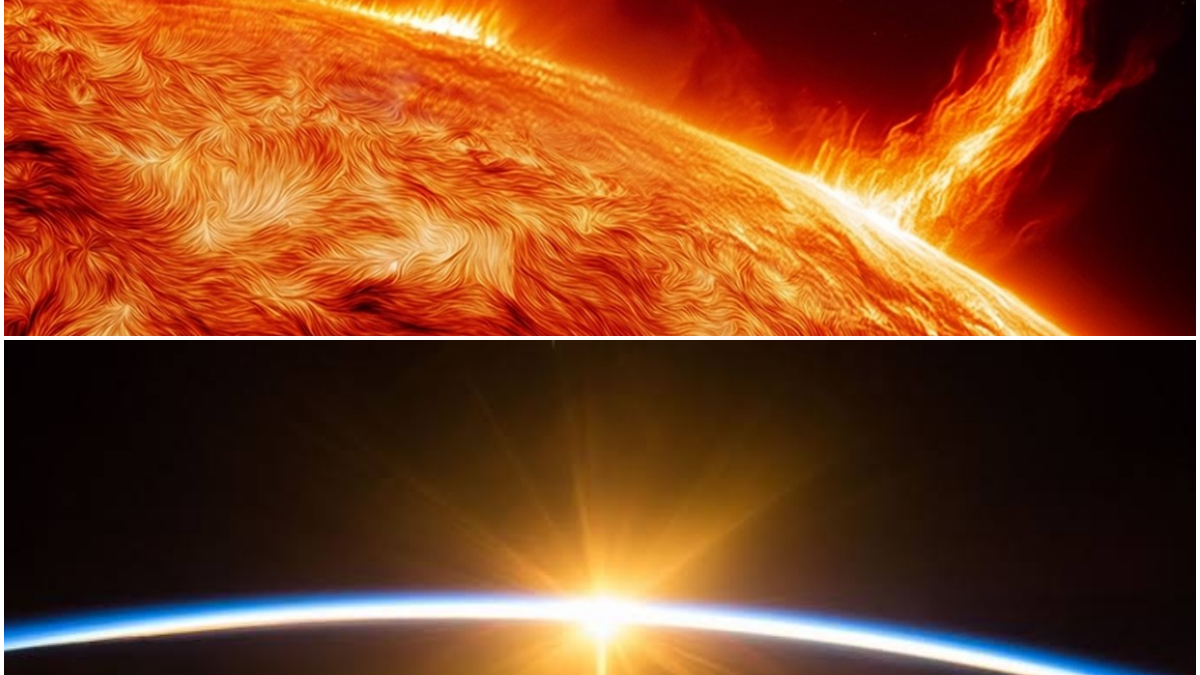
NASA’s $100 BILLION Plan To Absorb Sun Energy
A satellite the size of a football field is unfolding in geostationary orbit roughly 36,000 km above the equator.
It is pointing an invisible column of concentrated microwave energy straight down at a desert receiver the size of a small city.
And the number attached to this project is not 100 million or a 100red billion in some vague long-term sense.
It is $100 billion for a single operational system.
Wherever you are watching from right now, I want you to sit with that for a second because the story you have been told is that this is humanity’s next great clean energy breakthrough.
The story hidden inside the engineering documents is different.
It says we are attempting this because we have quietly run out of easier options on the ground.
And the physics involved is far far less forgiving than the press releases actually suggest.
That is the version I want to walk you through.
Because if you look at NASA’s 2024 reassessment of space-based solar power and you read it beside the DOE cost modeling and the European Space Ay’s parallel Solaris program, a pattern emerges that does not match the public tone.
The public tone is optimistic.
The internal numbers are not.
They describe launch cadences no nation has ever sustained.
Structures larger than anything humans have ever assembled in orbit and beam densities that only stay safe if every subsystem behaves perfectly forever.
Three tension signals stack immediately.
First, the sheer power involved.
A beam meant to deliver gigawatt through the atmosphere, aimed with a precision measured in fractions of a degree across tens of thousands of kilome.
Second, the launch problem.
To build even one of these satellites, you need to lift thousands of tons to orbit using vehicles whose full reusability at the required cadence has not yet been demonstrated.
Third, the assembly problem.
No country, no agency, no private company has ever built a structure at this scale in space.
Here is the thesis stated early so you can watch it get proven.
The rest of the way.
The $100 billion price tag is not the price of a breakthrough.
It is the price of an admission.
The reason this project is being funded now is not because it finally became easy.
It is because the alternatives are hitting limits nobody in an official role wants to name out loud.
The scale of energy humans now consume has outgrown the surface we live on.
Before we get to why the physics is worse than advertised, you need to understand what NASA is actually proposing.
Because the official version leaves out the part that matters most.
No night, no weather, no seasons.
The satellite catches solar energy at intensities significantly higher than anything a panel on Earth ever sees because none of that sunlight has been filtered through atmosphere first.
Then it converts that energy into microwaves, beams it down to a receiver on the ground, and the receiver turns it back into electricity that flows into the grid.
Clean, continuous, enormous, eight times more efficient than ground solar, or so the summary slides suggest.
And the beam itself, the part most people worry about, is described in the same slides as safe as sunlight at the receiver.
Wherever you are watching from right now, I want you to think for a second about how much energy your city burned today, just today.
Hold that number in your head because if the public pitch were fully accurate, this would be one of the easiest decisions in the history of energy policy.
And it is not.
The first crack shows up in the safety language.
The beam is safe as sunlight, yes, but only inside the rectenna footprint where the energy has been deliberately spread across kilometers of receiver so that the intensity at any single point stays low.
Step outside that footprint under normal operation and the numbers still hold.
Step outside that footprint during a pointing anomaly and the numbers depend on how quickly the system corrects itself.
That is not the same statement.
The second crack shows up in the efficiency claim.
Eight times more efficient than ground solar sounds decisive, but it is a per panel comparison.
It quietly emits the mass you had to lift to orbit to put that panel there.
Once you fold in the launch energy, the manufacturing energy, and the assembly energy, the multiplier shrinks fast.
It stays positive, but it stops looking like a miracle.
It starts looking like a bet on future launch prices.
And the third crack is the one nobody puts on a slide.
The public version treats the system as a completed product.
The engineering version treats it as a decadesl long construction project in the harshest environment humans have ever tried to work in.
Clean in the press release means clean if everything goes perfectly at every stage forever.
To see why that is a problem, we have to look at the machine itself.
The physics of moving sunlight to earth is not exotic.
That is the first thing worth saying clearly.
We are not waiting on a scientific breakthrough.
We are waiting on scale.
Here is how it actually works.
In geostationary orbit, roughly 36,000 km up, you deploy a photovalttaic array, not a small one, a structure measured in kilome on a side made of thin film solar cells or lightweight rigid panels.
That array catches sunlight continuously at intensities close to the raw solar constant of about 1360 watts per square meter unfiltered by any atmosphere.
Ground panels only ever see a fraction of that after the air is done with it.
The captured electricity is then rooted to a conversion layer.
In most current designs, that layer turns the direct current into microwaves at either roughly 2.45 45 GHz or 5.8 GHz.
Those specific frequencies are not accidents.
They pass through the atmosphere with very little absorption even through clouds and rain.
That is part of why the concept is attractive.
You are not fighting weather at the transmission stage the way you are at the capture stage.
The microwaves are then focused into a beam and aimed at a fixed point on Earth.
That point is not a small target.
It is a rectenna.
A rectifying antenna array.
A field 5 to 10 km wide tiled with billions of small receiving elements.
Each element catches its slice of the incoming microwave energy and converts it back to direct current.
The rectenna is not a solar panel.
It is an entire industrial installation permanently dedicated to catching an invisible column of concentrated energy pouring down from space.
Let that sit for a second.
A field the size of a small city fenced off permanently allocated pointed at a satellite so far away that the satellite appears fixed in the sky 24 hours a day forever.
The physics of every individual step is well understood.
Photovoltaic conversion, microwave transmission, atmospheric transparency, rectenna reconversion.
Every piece has been demonstrated in some form on the ground or in low power orbital tests.
That is exactly why the project is being taken seriously.
But here is the part that should bother you.
The beam I just described only stays safe because it is spread across kilometers of receiver.
That spreading requires phase locked control of the transmitting array across tens of thousands of kilome.
A pointing error measured in fractions of a degree changes the intensity distribution at the ground.
The physics that makes the system work is the same physics that makes a small error into a large problem.
And that is before we talk about how big this thing actually has to be.
Groundbased solar has a quiet advantage that almost nobody talks about.
If a panel fails, you replace the panel.
If an inverter dies, you swap it out.
If lightning takes out a string, the rest of the farm keeps generating.
A ground solar plant is a large collection of small, independently replaceable pieces.
Its failure modes are boring.
Space-based solar is the opposite.
Almost every subsystem carries a failure mode that ground solar simply does not have.
Start with the beam.
Continuous pointing accuracy across 36,000 km is not a passive state.
It is an active control problem running 24 hours a day with no allowed pause.
The transmitting array must maintain phase coherence across kilometers of structure.
Loss of active correction does not mean the beam politely shuts off.
It means the beam drifts or defocuses or reshapes depending on which subsystem failed and how fast the safety interlocks trip.
Every serious design assumes those interlocks work.
That assumption is doing a lot of quiet work.
Now look at the structure itself.
A kilometer scale truss in orbit is not a static object.
It flexes under thermal cycling as it moves through Earth’s shadow and back into full sun, expanding and contracting with every orbital period.
It gets hit by micrometeoroids small enough that individual strikes are absorbed by design but cumulative over decades.
It must maintain attitude and altitude against solar radiation pressure and gravitational pertubations which means it needs propellant which means it needs resupply or it slowly drifts out of station.
Then look at the ground.
The rectenna requires an exclusion zone, not because the beam is dangerous under normal operation, but because you cannot run air traffic through the column, and you cannot let people wander into it during an anomaly.
That exclusion zone is permanent.
It affects airspace corridors, wildlife movement, and land use across a footprint larger than most airports.
And then the redundancy problem.
You cannot patch a satellite the size of Manhattan the way you patch a solar farm.
If a critical subsystem fails, the repair mission is not a truck rolling up a service road.
It is a launch, a rendevous in geostationary orbit and a repair operation in an environment where humans have never worked at length.
Here is the historical comparison worth sitting with.
The International Space Station took 13 years to assemble across 42 missions, and it masses roughly 420 tons.
A single space-based solar power satellite requires somewhere between 2,000 and 10,000 tons.
5 to 20 ISS masses, one satellite.
Ambitious is the wrong word for that.
Unforgiving is closer.
But the fragility is not the real problem.
The real problem is what happens when you try to scale it.
Here is the intuition trap.
When most people hear about a hundred billion dollar satellite that could power a million homes, they mentally scale it.
10 satellites, 10 million homes.
100 satellites, 100 million homes.
Linear, manageable, just multiplication.
That intuition is wrong and the way it is wrong matters.
Start with the numbers.
A single operational space-based solar power satellite in the current NASA and DOE reference designs is sized to deliver roughly 2 GW of continuous electricity to the grid.
2 GW is enough to power somewhere in the neighborhood of 1 1/2 million American homes.
That sounds enormous.
In isolation, it is now scale it.
Global electricity demand averages roughly 3 ter 3,000 gaw.
If you wanted space-based solar to fully replace that demand, you would need approximately 1,500 of these satellites in orbit.
Not one, 1,500.
And even that assumes every satellite runs at full capacity forever with no downtime.
Pull the ambition back to something modest.
5% of global electricity from space-based solar.
That is roughly 75 satellites.
Each one requiring dozens of heavy lift launches.
Each one requiring years of orbital assembly.
Each one representing more mass in a single structure than every space station humanity has ever built combined.
Now translate that into cadence, not into cost, into cadence.
Because cost can be argued about, but cadence is physics.
To build 75 satellites within a plausible 30-year window, you need to be launching structural mass to geostationary transfer orbit.
Not once a month, not once a week, but on a schedule that looks more like a working seapport than a launch program.
Every heavy lift vehicle in every spaceport running as close to continuously as maintenance allows for decades.
Here is a comparison that puts the human scale of it in focus.
In the entire history of space flight from Gagarin in 1961 to today, the total number of humans launched to orbit is approximately 700.
700 people across more than six decades of space flight.
This program at even modest ambition requires launching mass equivalent to an international space station every few months for 30 years.
That is not a bigger version of what we currently do.
That is a categorically different industrial activity.
And this is where the linear intuition breaks.
Doubling the number of satellites does not double the difficulty.
It multiplies the launch cadence, the assembly workforce, the tracking load, the propellant supply chain, the ground station network, the maintenance schedule, and the regulatory footprint.
Every doubling stresses systems that were already stressed at the first satellite.
And launching the hardware is the easy part.
The hard part is what it does to the people who have to build it.
There is a quiet decision hidden inside every serious space-based solar power design.
And almost nobody talks about it out loud.
That decision is this.
Either humans assemble these satellites in orbit or robots do.
And neither option is currently within reach.
Start with the human option because it is the one most people imagine by default.
Humans have worked in space before.
The International Space Station has hosted continuous crews since 2000 and astronauts routinely conduct spacew walks lasting 6 to 8 hours to install hardware and repair equipment.
That experience is real and it is valuable.
But it is also almost entirely happening in low Earth orbit, roughly 400 km up, still comfortably inside the protective envelope of Earth’s magnetic field.
Geostationary orbit is a different world.
At 36,000 km, you are outside most of the magneettosphere’s protection.
The radiation environment is roughly 10 times more intense than what ISS crews experience.
And during a solar particle event, it can spike far higher than that.
Current occupational radiation limits for astronauts set by NASA and other agencies were not written for people who spend months in that environment.
They were written for people who spend days there and come home.
Now imagine what the assembly of one satellite actually requires.
Not one spacew walk, not a hundred, thousands.
Sustained construction work in pressurized suits across an orbital environment where every hour outside counts against a lifetime dose limit.
The workers who build this either do not exist yet in the sense that we have not decided to expose them to what the job requires or they come home changed by it.
Not injured in a headline sense, changed in a cellular sense.
So look at the robotic option.
In principle, robots do not care about radiation.
In principle, in practice, autonomous assembly of kilometer scale structures is a capability that has not been demonstrated.
Not in orbit, not in a simulated environment at full scale.
The tasks required, aligning trusses, connecting electrical bus systems, deploying thin film arrays without tearing them, verifying joints are difficult even for teleyoperated systems working with a signal delay measured in fractions of a second.
Fully autonomous operation across years of construction is an active research area, not a solved problem.
And even if you build the robots, you still need to launch them, service them, repair them, and eventually replace them.
The robotic path does not eliminate the launch cadence.
It just moves the burden.
Either way, the body’s problem does not disappear.
It just changes shape.
And even if we solve the bodies, we still have not solved the ground.
The satellite gets the headlines.
The rectenna gets the invoice.
Every serious space-based solar power design pairs its orbital collector with a ground receiver.
And the ground receiver is not a modest installation.
It is a permanent industrial site 5 to 10 km across, tiled with billions of small antenna elements connected to a grid interconnect that can handle continuous gigawatt scale delivery.
You do not tuck that into a suburb.
You do not slot it beside an existing solar farm.
You build it from scratch in a place that meets a very specific list of requirements.
The site needs clear skies most of the year because while microwaves pass through weather well, the receiver still needs to be visible to the satellite at a stable geometry.
It needs low seismic activity because the antenna array must maintain physical alignment across kilome.
It needs low air traffic because the exclusion zone around the beam column is not optional.
It needs to be far enough from population centers to satisfy public safety review, but close enough to grid infrastructure that the electricity has somewhere to go.
And it needs land that is available, permittable, and politically defensible for the 50-year operating life of the system.
Those places exist.
There are not many of them and they are not free.
Now widen the frame.
Grid integration at gigawatt scale is its own problem.
A 2 gawatt continuous input into a regional grid is comparable to a large nuclear plant.
It requires high voltage transmission buildout substation capacity and system level balancing to handle the steady load.
That infrastructure is expensive, slow to permit, and slower to build.
It is also not counted inside the hundred billion figure most people have heard.
Add the exclusion zone.
The airspace above and around the rectenna is restricted permanently.
Wildlife corridors are affected.
Local ecosystems around a site tiled with billions of antenna elements are not fully understood at the scale required.
Environmental review for a single site can take years.
Multiply that by 75 sites or 1,500 and you are looking at a permitting problem that dwarfs the engineering one.
Cost on the ground side alone rivals a midsized nuclear plant per satellite.
Before you count launch, before you count the orbital hardware, before you count maintenance, the hundred billion dollars is the price of the satellite.
The system fully accounted is a multiple of that.
Two times, three times depending on which model you trust and which assumptions you accept.
So why is the number in the press release so much smaller than the number in the engineering studies?
The answer to that question is the next layer.
Nobody involved in space-based solar power is lying.
I want to say that clearly because the rest of this chapter is going to sound harder than it is meant to.
The engineers are not fabricating data.
The agencies are not hiding a scandal.
The scientists working on this are in most cases among the most careful and most competent people in their fields.
What is happening is subtler than dishonesty.
It is a slow structural softening that occurs when a project needs public support to survive.
And public support does not survive nuance.
Look at how the numbers are framed.
Launch costs in most current SBSP economic models assume Starship class reusability at cadances and reliability levels that have not yet been demonstrated in sustained operation.
The vehicles exist, the cadence does not, at least not yet.
When the projection assumes a mature launch industry that is still in its early operational years, the resulting cost per kilogram looks reasonable.
When you replace that assumption with what has actually been achieved, the cost multiplies.
Neither number is fake, but only one of them is on the summary slide.
Look at how the assembly is described.
Public materials often refer to autonomous or semi-autonomous robotic construction as an available capability.
In the technical literature, the same capability is described as underactive research and development.
Both statements are true.
The gap between them is where the schedule risk lives.
Look at the safety language.
Safe as sunlight at the receiver under normal operating conditions is a technically accurate statement.
It quietly does not include a failure mode analysis.
It does not describe what happens during a pointing anomaly or a phase lock failure or a communication loss between the satellite and the ground control system.
Those scenarios exist in the engineering documents.
They rarely appear in the press release.
And look at how the cost is quoted.
A hundred billion dollars per satellite is a real number, but it is the number for one satellite.
It is not the number for delivered terowatt.
The distance between a demonstration project and civilization scale energy replacement is not linear.
And the funding language blurs the two on purpose because the political case for a demonstration project is easier to make than the political case for a decadesl long industrial commitment.
None of this is corruption.
It is a normal institutional pattern.
Agencies need funding.
Funding needs public support.
And public support needs a story that fits in a headline.
The physics does not fit in a headline.
But if you pull back far enough, you see why this project exists at all.
And it is not the reason they tell you.
Here is the question that unlocks the rest of this story.
If space-based solar power is this hard, why is it being funded seriously right now in 2024 and 2025 by agencies that have avoided it for decades?
The answer is not that the technology got easier.
The physics has not changed.
The launch costs have improved, but not enough to close the gap on their own.
The engineering challenges are the same ones the concept has carried since Peter Glazer first proposed it in 1968.
What changed is the alternatives.
Look at groundbased solar.
It is cheap.
It is scaling fast.
And it is genuinely one of the great energy stories of the last two decades.
But at civilizational scale, it hits limits.
The land footprint required to power a modern industrial society entirely on ground solar is enormous.
The storage problem, batteries or otherwise, to move solar energy from daylight into the evening peak is expensive at grid scale and constrained by material supply chains.
Lithium, cobalt, rare earths.
All of these have finite extraction pathways.
Ground solar keeps growing, but its ceiling is real.
Look at nuclear.
The physics works.
The safety record of modern designs is strong, and the energy density is unmatched among lowcarbon sources.
But nuclear faces political headwinds that have not softened.
Regulatory timelines measured in decades and construction costs that have proven stubbornly resistant to reduction.
Small modular reactors may change that, they may not.
Either way, the buildout rate required to displace fossil fuel electricity is not close to happening.
Look at fusion.
The scientific milestones are real and the private investment is unprecedented.
But gridscale commercial fusion remains unproven.
It may arrive in the 2030s.
It may arrive in the 2050s.
The energy planners of today cannot bet the grid on that timeline.
Look at continued fossil use.
That path is already priced into the climate models.
The costs are not hypothetical.
They are wildfires, coastal loss, agricultural disruption, and heat mortality, distributed unevenly across the century.
That is the baseline the other options are being compared against.
Now, put space-based solar back on that list.
It is expensive, technically brutal, and logistically enormous.
It is also one of the few remaining options that offers continuous weatherindependent land efficient lowcarbon power at civilizational scale.
It is not on the table because it is easy.
It is on the table because every other path is constrained.
The hundred billion satellite is not a symptom of ambition.
It is a symptom of a much larger constraint.
Which brings us back to the beginning and to the part of this story that changes how you read the headline.
Go back to the opening image.
A satellite the size of a football field unfolding in geostationary orbit pointing an invisible column of concentrated microwave energy down at a desert receiver the size of a small city.
Hundred billion dollar.
One system.
When you first saw that image, it probably looked like a symbol of progress, something humanity had finally figured out.
A breakthrough unfolding on schedule.
Now look at it again.
The physics of moving sunlight to Earth works.
That is genuinely true and it is genuinely important.
Every subsystem taken alone has been demonstrated in some form.
That is not a small achievement.
It is the reason the concept is being taken seriously now.
But working and scaling are not the same word and the gap between them is where this entire story lives.
The satellite requires a launch cadence humans have never sustained.
The assembly requires either bodies in orbit under radiation conditions we do not have permissions or protocols for or robotic capabilities we have not yet built.
The ground receiver requires permanent industrial installations the size of small cities in places that meet a narrow list of geographic and political requirements.
The full system cost honestly accounted is a multiple of the number in the headline and the institutional framing softens all of that not out of dishonesty but because public support does not survive nuance.
None of that is why the project exists.
The project exists because every other path to civilizational scale lowcarbon energy is constrained.
Ground solar hits limits.
Nuclear moves too slowly.
Fusion remains unproven.
Fossil continuation carries costs already visible in the climate record.
Space-based solar power is on the table because the alternatives are worse and the people making energy policy know it.
The hundred billion is not the price of a breakthrough.
It is the down payment on an admission.
The admission that human energy demand has grown to a scale where every remaining path requires civilizational level commitment.
There are no easy options left.
There may never have been.
I want to be honest about the hope though because it is real and it is earned.
The engineers working on this are among the most competent people in the field.
Demonstration missions planned for the late 2020s and early 2030s will resolve real uncertainties.
Launch economics are still improving.
The technology is worth pursuing precisely because the constraint is real and because at some point the harder path becomes the only path.
That satellite unfolding in geostationary orbit is not a symbol of what humanity can now do.
It is a measure of how far we have had to reach.








