My Rescue Bobcat Sings With My Cat Every Night – What Happens at the Piano Is Magical!
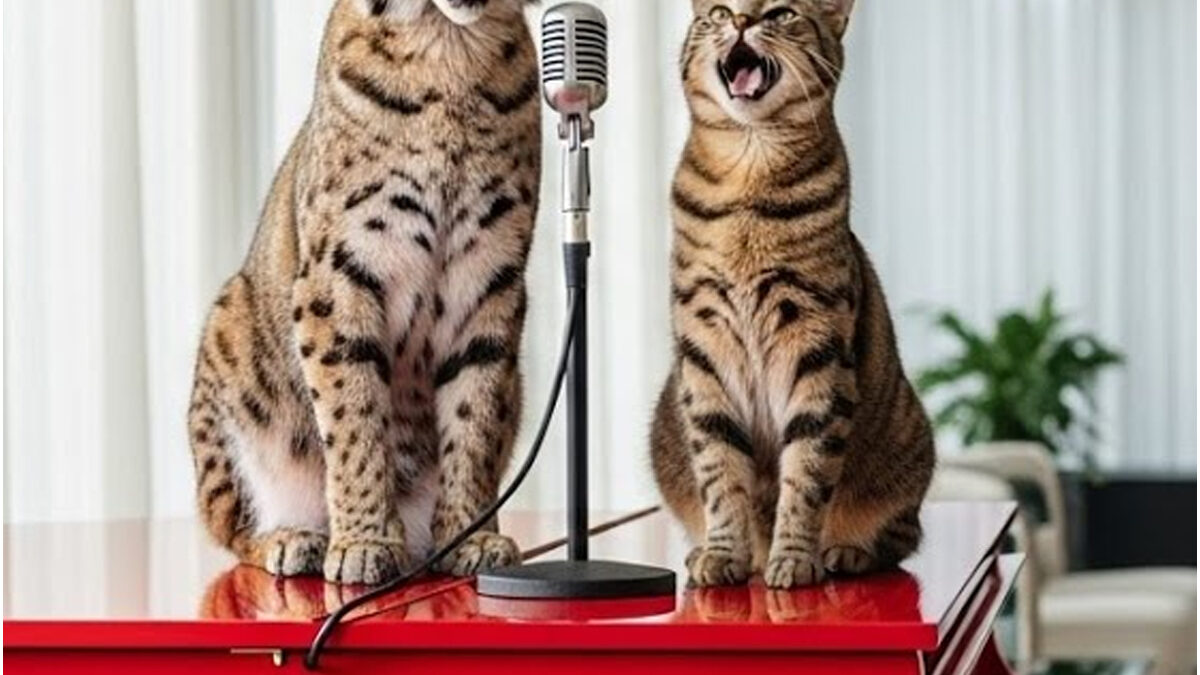
My Rescue Bobcat Sings With My Cat Every Night – What Happens at the Piano Is Magical!
The skinny bobcat stared intently as if understanding every key.
In a quiet cabin buried deep in the snowy woods of Flagstaff, an aging widowerower rescued a young bobcat he thought had simply wandered onto his porch.
But night after night she returned, not for food, but for the piano.
And then one evening she began to sing alongside him and his house cat.

What followed was nothing short of magical.
The first snow always came quietly in the mountains outside Flagstaff, drifting down from the dark sky like a soft reminder that another year had slipped paSt. Caleb Hayes felt the familiar ache in his chest as he watched the flakes settle against the window pane.
He had lived long enough to know that winter had a way of bringing memories back with sharper edges, and tonight was no exception.
The cabin was still, warmed only by the low crackle of the wood stove and the soft rhythmic purr of Milo, his cream colored cat curled beside the old upright piano.
At 68, Caleb had grown used to silence, too used to it, in fact.
After his wife Margaret passed 3 years earlier, sound had become something he rationed carefully, like someone might ration wood on a long, cold night.
But there was one sound he could never let go of.
The piano.
Margaret had played violin.
Caleb piano.
Together they had filled concert halls and small classrooms with music that felt larger than anything he could sort into words.
And now he played alone, more out of devotion than habit, as if trying to convince himself that she might hear him somewhere.
His fingers rested on the keys, lingering on the first quiet chords of Winter Echoes, a piece he and Margaret had written together during their early years of marriage.
The melody rose gently, carrying the weight of decades, of performances, of laughter, of arguments, of reconciliation, of love that had lasted through every season life had handed them.
Tonight, the notes seemed to move slower than usual, stretching through the room like a fragile thread pulling him backward in time.
Caleb exhaled, eyes half closed, letting the music guide his thoughts.
Milo shifted slightly, pressing closer to his leg, as if sensing the heaviness lingering in his rib cage.
The cat had been Margaret’s idea, a gift she brought home two months before she passed, insisting the little creature would keep him company.
He hadn’t believed her then.
He believed her now.
In many ways, Milo was the last living piece of her still left in the world.
As the melody drifted, something outside caught the corner of Caleb’s attention.
He paused, his hands hovering above the keys.
At first, he thought it was simply the reflection of the porch light bouncing off the snow.
But then, Milo lifted his head sharply, ears pricking forward, body suddenly alert.
Caleb turned fully toward the sliding glass door.
Two golden eyes glowed in the darkness beyond the porch.
For a long moment, he didn’t move.
The creature stood absolutely still, framed by falling snow that swirled around it in slow, deliberate spirals.
The eyes were wide, too wide to belong to a deer, too low to belong to a coyote, too intense, too focused to be anything but a predator.
Yet there was no aggression in them, no tension, only an unnerving, steady attention that made the air inside the cabin feel suddenly too small.
Caleb’s breath hitched.
He wasn’t a stranger to wildlife.
Living on the edge of the Cookanino National Forest meant seeing all sorts of animals, but this was different.
This wasn’t the fleeting glimpse of a fox darting into brush, nor the bold curiosity of a raccoon poking around for scraps.
This was engagement.
As if the animal wasn’t simply passing by, but listening, watching, Milo slid off the piano bench and padded toward the door, tail low, but not bristled in fear.
He stopped a few feet away, letting out a small, questioning chirp.
An unusual sound he made only when something puzzled him.
The two glowing eyes blinked slowly in return.
Against all logic, Caleb felt a shiver run through him.
Not of fear, but something he hadn’t felt in a long time.
Recognition, connection, a strange, fragile moment suspended in the snowy quiet.
He stood slowly, careful not to startle the visitor, though he doubted any sudden movement would break the moment.
He approached the door with cautious steps, placing one hand lightly against the cold glass.
Outside, the creature stepped a fraction closer, and the porch light revealed just enough for Caleb to understand what he was seeing.
A bobcat, young, thin, alone.
Snow clung to her whiskers, her coat weighed down by dampness, her posture weary, but not hostile.
She looked exhausted, loSt. And yet her eyes, those bright amber eyes, were fixed on him, unwavering.
The music still lingered in the air, fading slowly like the last breath of a memory.
“Were you listening?”
Caleb whispered, unsure why he even asked.
“The bobcat didn’t flinch, didn’t retreat, didn’t even blink.
She simply stood there as if his voice was part of the melody she had come to hear.
Something inside him shifted.
A faint, nearly forgotten feeling.
Something opposite of loneliness.
Its first quiet crack.
Its first interruption.
Milo brushed against his leg, looking up at him with wide, expectant eyes, as if asking whether their visitor would be joining them inside the story that was just beginning.
Outside, the bobcat took a single tentative step closer to the door.
She would return.
He didn’t know how he knew that, but he did.
And for the first time in a very long time, he found himself looking forward to tomorrow.
The next morning, Caleb lingered by the window longer than usual, watching the soft light filter through the tall pines that bordered his cabin.
The snow had settled thick and undisturbed across the yard.
Its surface smooth except for one set of prints, small, round, and unmistakably feline leading toward the foreSt. He traced them with his eyes, following the path until it vanished into the trees, a quiet reminder that last night had not been a dream.
Milo patted around his ankles, letting out a gentle meow as he brushed against Caleb’s leg.
The cat seemed more alert than usual, as if attuned to the possibility that their nocturnal visitor might return at any moment.
Caleb scratched Milo’s head absently, unable to shake the faint, almost eager anticipation stirring within him.
He tried to go about his day as usual.
He practiced scales, answered a few emails from former colleagues, and attempted to tidy up the cabin.
But every time the wind brushed against the house or snow slipped from a branch outside, he glanced toward the sliding door.
Evening arrived earlier than he expected, ushered in by the deepening gray sky of a winter storm moving in.
As the first flakes began to fall again, he lit the small brass lamp and sat before the piano.
Milo hopped onto the bench beside him, as if taking his usual place in their unspoken routine.
Caleb warmed up with a few soft chords, letting the notes stretch slowly through the cabin like opening breaths.
Before long, as if answering a signal he hadn’t meant to send, movement flickered at the edge of his vision.
He turned.
There she was, closer than ever.
The young bobcat stood not at the far edge of the porch, but just a few feet from the door, partially sheltered beneath the overhang.
Her amber eyes caught the glow of the lamp, reflecting it back with an intensity that made Caleb’s breath pause for a moment.
Snowflakes clung to her coat like tiny crystals, and her sides rose and fell with shallow breaths that hinted at fatigue.
She looked thinner, a little too thin.
The realization tugged at Caleb’s cheSt. Still, her posture was not fearful.
She held herself with a strange mix of caution and trust, like an animal torn between instinct and something unfamiliar drawing it closer.
Milo reacted firSt. He stood up on the bench, tail high but relaxed, and let out a soft, short, gentle, unmistakably welcoming.
The bobcat’s ears perked at the sound.
A moment later, she responded with a quiet chirp.
Caleb blinked.
He’d seen wild animals interact in the foreSt. But this this small exchange between a house cat and a young bobcat felt impossibly delicate, like watching two worlds attempt a tentative handshake.
“You two are going to give me gray hair,” he whispered to Milo.
Though he already had more than his share, he shifted slightly on the bench and began to play again, choosing a piece Margaret had loved, a slow, wandering melody that always reminded him of early autumn mornings.
As the notes drifted into the night, the bobcat inched closer, not boldly, never boldly, but with the kind of cautious grace only wild animals possessed.
Caleb’s hands moved across the keys with practiced ease, but his eyes flicked up often, marveling at how the distance between them shortened with each passing phrase.
The bobcat eventually settled again on the porch, paws tucked neatly beneath her, her gaze fixed on his movements in quiet fascination.
Caleb slowed the music, softening his touch, almost testing her reaction.
She leaned forward slightly.
Her ears rotated like tiny satellite dishes, tracking every shift in tone.
She blinked slowly, a sign of trust in feline language, and lowered her head, though she did not close her eyes.
Something else happened then, something so subtle that Caleb almost missed it.
When he moved into a minor key, her breath hitched, her whiskers twitching faintly.
When he returned to a warmer cord, her posture loosened again, as though she physically felt the tension rise and fall through the music.
“You’re really listening,” he murmured.
When the piece reached its natural finish, she remained motionless.
The silence that followed was not empty, not like the hollow quiet that had filled the cabin since Margaret’s passing.
The silence hummed softly like a thread of connection stretching across the cold night.
Milo hopped down from the bench, walked to the sliding door, and sat directly before the bobcat.
He pressed his paw gently against the glass.
It was a small gesture, one Caleb had seen him make only with people he trusted.
The bobcat responded with a low, brief chirp.
Caleb felt the breath leave his lungs as though something inside him had cracked open, just a little wider.
There was nothing threatening in the sound, nothing hostile.
It was communication, genuine, earnest, and surprisingly tender.
He stood slowly, careful not to shatter the fragile balance.
He approached the sliding door, stopping a foot away.
The bobcat watched his every movement, her eyes alert, but not fearful.
“Easy, girl,” he whispered.
From this closer vantage, he could see how thin she truly was.
Her winter coat didn’t hide the sharpness of her ribs.
Her paws trembled faintly from exhaustion or cold.
He couldn’t tell which.
Instinctively, he felt a pang of worry, the kind he hadn’t felt in a long time, the kind that came from caring.
He didn’t open the door.
Not yet.
He knew better than to rush.
She wasn’t ready.
And maybe he wasn’t either.
But he did lower himself to one knee slowly, making his frame smaller and less imposing.
The bobcat didn’t retreat.
She simply looked back at him with those luminous eyes, head slightly tilted, as though weighing his presence, testing whether the space between them was safe.
You’re hungry, aren’t you?
He said softly.
She didn’t move, didn’t blink.
Caleb hesitated.
He knew the rules about feeding wildlife.
He’d lived in Flagstaff long enough to understand that helping wild animals too directly could cause more harm than good.
Yet something in her gaze, something quietly pleading made the rules feel less rigid, less absolute.
He didn’t act on the impulse.
Not yet.
He simply sat there on the cabin floor, looking at the young creature through a thin sheet of glass.
Milo perched proudly beside him.
The three of them lingered in that quiet moment for what felt like hours, though it couldn’t have been more than a few minutes.
Then, as if a decision had been made inside her, the bobcat slowly rose.
She took one last lingering look at Caleb, then at Milo before stepping backward into the falling snow.
She didn’t run.
She simply turned and slipped into the shadows, her form fading into the forest with the same silent grace as the night before.
Caleb exhaled only when she disappeared completely.
His hand trembled as he pushed himself back onto his feet.
Milo nudged his leg, tail brushing gently against him, and Caleb couldn’t help but smile.
“Well,” he whispered, voice thick with something he hadn’t felt since Margaret died.
“Hope.
Looks like she’s trusting us a little more each day.”
Outside, the snow continued to fall.
Inside, the warmth seemed to reach a little farther into the corners of the cabin.
And somewhere in the trees, a young bobcat paused, listening to the faint echo of a melody she couldn’t understand, but somehow needed.
Something had shifted.
Two worlds, once impossibly distant, had taken their first small steps toward meeting.
The next day passed slowly, wrapped in the quiet hush of steady snowfall.
The storm had deepened overnight, laying down a clean white blanket that softened even the sounds inside the cabin.
Caleb moved through his morning routine.
Coffee, a simple breakfast, the familiar scratch of Milo’s paws against the pantry door, but his thoughts kept drifting back to the young bobcat.
Every time he glanced toward the sliding door, he felt a small flutter of anticipation, something his heart hadn’t held in years.
By early afternoon, the clouds pressed low, turning the world an even quieter shade of gray.
Caleb tried to focus on practicing, running through warm-up scales and a few old atudes, but his hands fell into the keys with less certainty than usual.
Eventually, he gave up and made his way to the door, sweeping a hand over the frosted glass.
Fresh tracks dotted the edge of the porch.
Light, delicate impressions circling the area where the bobcat had sat the night before.
She had returned earlier, sometime before sunrise.
He hadn’t seen her then, but the marks were unmistakable.
She had been close, maybe even waiting.
Caleb’s chest tightened.
He pressed his fingers against the cool glass, feeling the strange pull again, an almost instinctive longing to bridge the distance between them.
He knew better than to act too quickly.
Wild animals operated on trust, built grain by grain, often scattered as soon as a human made the wrong move.
But he also knew she wouldn’t survive long in this storm without help.
She was still too thin, too fragile, and something in her eyes had told him she wasn’t merely wandering.
She was seeking.
Milo seemed to sense the heaviness of Caleb’s thoughts.
The cat circled his feet, then padded to the sliding door and sat, tail curled neatly around him as if expecting a visitor.
As dusk crept in, Caleb turned on the small brass lamp and sat at the piano.
The soft golden glow pulled across the keys, casting warm reflections into the glass.
He began playing a slow, contemplative piece.
Nothing planned, only gentle phrases that wo themselves naturally into the quiet.
Milo hopped beside him on the bench, settling into his usual place, as if he too played a role in this strange ritual.
It took only a few minutes for the familiar sensation to arrive.
That subtle change in the cabin’s air, a shift that felt almost like someone stepping into the room.
Caleb looked up.
She was already there.
The bobcat stood closer than ever, paws nearly touching the edge of the door frame.
Snow clung to her fur in tiny speckles glittering under the porch light.
Her eyes, wide and steady, reflected the glow of the lamp behind him.
Caleb swallowed, steadying his breath.
“Evening,” he murmured softly.
She blinked slowly at the sound of his voice, her tail giving a single, hesitant twitch.
Milo let out a gentle chirp, and the shaolton Bobcat answered with a faint sound of her own, a small, breathy chirup that made Caleb’s heart stutter.
He could see her ribs more clearly now.
A pang of worry shot through him.
She wasn’t just thin, she was hungry.
Truly hungry.
And winter in the high country wasn’t forgiving to young predators without a mother to teach them how to hunt effectively.
He glanced toward the kitchen, then back at the bobcat.
The rules flashed through his mind, the ones posted on every trail head.
Do not feed wildlife.
Do not interfere.
Wild animals must stay wild.
But her breaths were shallow, her movements tired.
She wasn’t just passing through a neighborhood looking for scraps.
She had come back again and again, and she wasn’t begging with teeth or claws.
She was sitting quietly, listening, kneading.
He stood slowly from the bench.
Milo watched him, but didn’t proteSt. Caleb’s steps were cautious as he walked toward the door, each movement deliberate, controlled.
He stopped a few feet away, meeting the bobcat’s gaze.
“You’re not just cold, are you?”
He whispered.
“She didn’t move, didn’t even flinch.
Her ears stayed forward, alert, curious.”
Caleb knelt down carefully, lowering himself to her eye level.
The bobcat’s gaze followed him, unblinking.
Then, surprising him, Milo stepped off the bench and approached the door, sitting directly before her.
He lifted one paw and pressed it gently against the glass, the same gesture he had made before.
This time, the bobcat leaned forward, her nose stopping just an inch from where Milo’s paw rested.
She let out the softest sound yet, a small, barely audible chirp that felt almost like a question.
Caleb exhaled shakily.
“All right,” he whispered.
“I hear you.”
He stood slowly and walked into the kitchen, his heart thudded with a mix of nerves and determination.
After a moment’s hesitation, he warmed a small bowl of water, nothing more, and set it onto a tray.
He cracked the sliding door open just an inch.
A gust of cold air rushed in, raising goosebumps across his arMs. Milo stayed by the opening, his presence calm and steady.
Caleb slid the water bowl just inside the threshold, no farther.
Then he stepped back, giving space.
For a moment, the bobcat froze.
Her muscles tightening with instinct, she sniffed the air cautiously, shifting her weight.
Caleb held perfectly still.
Milo sat motionless as a statue.
Then, with slow, deliberate movements, the bobcat stepped forward.
Her whiskers brushed the edge of the door frame.
Her nose dipped toward the bowl.
She paused there as if waiting for permission.
“It’s all right,” Caleb whispered.
She lowered her head and drank.
The sound of her lapping water, gentle, rhythmic, was the most fragile, extraordinary sound he had heard in years.
It wasn’t just survival.
It was truSt. Trust she had chosen to give in her own time, in her own way.
When she finished, she lifted her head and looked directly at him.
Her amber eyes shone not with the fear, but something quieter.
Weary gratitude perhaps or recognition.
“You’re a brave girl,” he murmured.
She chirped again, stronger this time.
Then she stepped back, slipping once more onto the porch, but she didn’t leave.
She simply sat there, close enough that her breath fogged the glass.
Milo returned to the piano bench, chirping as if inviting her back to their nightly routine.
Caleb sat again at the piano, hands trembling slightly.
He played a slow, soothing piece, letting it drift gently across the room and out into the night.
Halfway through, he glanced up.
She was watching, truly watching every motion of his fingers, and something in her posture had changed.
She was no longer merely a visitor drawn by curiosity or hunger.
She had claimed her place on the porch, as if it were her own quiet corner of the world, a place she knew she could return to, a place she felt safe.
When the final note faded, she remained.
She didn’t rise until he stood, and even then, she lingered, blinking slowly at him through the glass.
He placed his hand on the door, mirroring where her nose touched the cold surface.
Two thin layers of glass separated them.
Yet for the first time, it felt like almost nothing at all.
He whispered, “Lyra.”
The name slipped out effortlessly, unplanned, but right.
A name from a star constellation Margaret had once adored.
A name belonging to something wild, bright, and quietly beautiful.
The bobcat blinked once, as if accepting it.
Lyra.
When she finally turned and stepped back into the falling snow, Caleb didn’t feel the usual ache when something left.
He felt only the warm certainty that she would come again, and that next time the distance between their worlds would be even smaller.
The following day brought a rare break in the storm.
The sun rose pale and thin over Flagstaff, filtered through drifting clouds that had softened into a gentle gray.
Caleb stepped out briefly to shovel the walkway, leaving slow, careful footprints in the snow.
He searched the edge of the treeine, hoping for a sign of small round paw prints, but the forest remained still, silent, watching.
Milo sat perched on the windowsill, tail flicking as if keeping vigil.
Every so often, he made a soft chirp toward the glass.
The same sound he had used when greeting Lyra the night before.
Caleb couldn’t help but smile at the idea that Milo had appointed himself host, guardian, and translator between two worlds.
Inside the cabin carried the quiet anticipation of something unfinished.
Caleb moved through the day with an undercurrent of expectancy, a subtle awareness that evening would bring another visit.
And though he tried to distract himself with household chores and musical exercises, his thoughts kept circling back to Lyra.
He found himself wondering what her life had been like before she wandered onto his porch, whether she had siblings, whether her mother had taught her enough to survive the winter, whether she had ever been close to a human before.
As the light faded and the temperature dropped, he placed a bowl of warm water near the door once again.
Not an invitation, but an offering, something small and safe.
He reminded himself to stay cautious.
She was still wild, still navigating her own instincts, but he could at least give her comfort without crossing the fragile boundary they had just begun to build.
Milo sat near the door, tail wrapped neatly around him, like a sentinel awaiting a familiar gueSt. When the sky shifted from gray to deep winter blue, Caleb lit the lamp, took his place at the piano, and rested his fingers on the keys.
He hadn’t chosen a piece yet.
Instead, he let his hands wander through soft, wandering notes, an improvised prelude that settled into the cabin like a warm breath.
He was halfway through a rising phrase when he felt it again.
That delicate change in the air like a draft that carried intention instead of wind.
He looked up.
Lyra was already there, closer than ever.
She stood not on the outer edge of the porch, but directly at the crack in the sliding door.
Snow dusted her fur in tiny sparkles, and her amber eyes glowed with recognition.
Her chest rose and fell in steady, cautious breaths.
She lifted one front paw and pressed it lightly onto the wooden floor just inside the threshold, testing her boundary.
Caleb stilled his hands, but Milo acted firSt. He padded toward the door, stopping just a few feet from Lyra and let out a soft, his tail lifting in polite curiosity.
Lyra responded a soft, delicate chirp.
The same sound she had used before, but this time there was no hesitation in it, no fear, only an earnest attempt at greeting, an acknowledgement.
The space between them was no longer a chasm.
It had become a narrow bridge.
Caleb’s heart tightened in his chest, moved by the gentle bravery of the moment.
He slowly resumed playing, choosing a piece Margaret had composed years ago, a meditative lullabi written during a summer retreat in Sedona.
The melody drifted through the room like warm sunlight, calm and steady, wrapping around the three of them.
As the notes filled the cabin, Lyra stepped fully inside.
Not far, only a foot or so, but it was enough to make Caleb’s breath catch.
She moved with the deliberate grace of a creature torn between instinct and trust, her ears rotating gently with each shift in the music.
Her paws made no sound on the wooden floor.
She lowered herself onto her belly, positioning her body so she could watch both the piano and the open doorway at once, a wild animals version of compromise.
Caleb softened his touch on the keys, letting the melody flow in smaller, more intricate patterns.
Lyra’s eyes narrowed slightly, not in threat, but in focus.
She wasn’t just listening.
She was absorbing.
The rise and fall of the notes seemed to move through her like a language she half remembered.
Milo circled her carefully, nose lifted, tail swaying.
He stopped just beside her, then lay down facing the piano.
His posture relaxed, his body a silent message.
She belongs here.
She is safe.
The shift was so gentle that Caleb nearly overlooked it.
How Lyra’s breathing matched the rhythm of the lullabi.
How her muscles loosened with each descending phrase.
How she let her chin rest lightly on her paws, her eyes blinking slower and slower.
He transitioned into a different piece, one Margaret had used for her evening warm-ups, a soft, repetitive sequence that mimicked falling snow.
Lyra reacted instantly.
She lifted her head, tilted it slightly, and let out a low, drawn out hum, not a meow, not a growl, a sound somewhere between breath and melody, a tone that matched the pitch of Caleb’s left hand.
Caleb froze.
Lyra made the sound again, more deliberately this time.
It resonated beneath the piano line like a quiet harmony.
His eyes stung.
He blinked hard.
“You’re singing,” he whispered.
His voice cracked on the last word.
Milo chirped again as if confirming the impossible.
Caleb continued playing, hands trembling now, but moving without conscious thought.
Lyra followed the melody with small hums, her tones shifting as the music shifted, sometimes low and steady, sometimes airy and light.
There was no pattern to it, no trained technique.
It was instinct, emotion, response.
A wild animal responding to music.
Something inside Caleb cracked wide open.
Not in pain, but in awe.
It felt like watching Margaret play again.
The presence of harmony, the presence of a companion, a connection he had believed the world had taken from him forever.
He whispered, barely breathing.
Good girl.
It’s all right.
I hear you.
When the piece finally came to a gentle close, Lyra’s hum faded with it.
Her ears flattened briefly, a small sign of comfort, and she blinked slowly at him in a gesture that nearly undid him.
She trusted him.
Not completely, not yet, but meaningfully, quietly, tenderly, the kind of trust a wild creature offered only when she had decided on her own terMs. Caleb sat motionless for several moments, absorbing the weight of what had happened.
Milo pressed against his side, warm and steady, as if reminding him to breathe.
Lyra remained on the floor for a while longer, her gaze soft and half-litted.
Then, after a long moment of quiet companionship, she rose.
She looked toward the door, then back at Caleb, letting out a small chirp that sounded almost like gratitude.
Then she slipped out into the cold night, her tail brushing gently against the threshold as she left.
Caleb did not feel the familiar ache of loss.
He felt something else entirely, a growing bond, a shared melody, a quiet promise.
Lyra would return, and next time the music between them would carry them even further.
The next day felt different from the moment Caleb woke.
The light seemed a little warmer coming through the frosted windows.
The coffee tasted a little richer.
The cabin even sounded different.
Still quiet, but not the empty quiet that had shadowed the last three years.
This quiet felt full, expectant, like the air before an orchestra lifts its boughs.
Milo sensed it, too.
He stayed close to Caleb all morning, trailing him from the kitchen to the living room, occasionally pausing at the sliding door to peer outside.
Every time Milo chirped toward the glass, Caleb felt a small flutter in his chest, wondering if Lyra was somewhere nearby, listening, waiting for nightfall.
But the day remained uneventful.
No paw prints appeared on the porch.
No golden eyes flashed between the trees.
By late afternoon, a faint worry crept into Caleb’s thoughts.
Winter wasn’t kind to young predators.
Had she wandered too far?
Had she run into something stronger, bigger?
Had she grown afraid of him after stepping inside the cabin?
He shook the thoughts away.
Lyra wasn’t fragile.
She was thin, yes, tired, yes, but in her eyes, he had seen something resilient, something that reminded him of the part of himself that had kept playing music even after Margaret passed.
A part that refused to give up even when the world fell painfully silent.
Night came early.
Heavy clouds pulled darkness over the mountains like a thick blanket.
The wind softened and snow began to drift again, slower this time, almost gentle.
Caleb lit the brass lamp and let its warm glow spread across the room.
He sat before the piano, took a long breath, and placed his fingers on the keys.
He played Promise in the Snow, the piece Margaret had loved beyond all others, the piece they had performed together for the last time before illness took her from him.
The opening notes were soft, hesitant, like footsteps on fresh snow.
Milo curled beside him, leaning his warm body against Caleb’s hip.
The melody climbed in slow, aching phrases, each one carrying a bittersweet weight.
Caleb’s hands moved almost automatically, shaped by decades of playing, by memory, by grief, by love that still lived quietly beneath his ribs.
Then Milo stiffened, his ears perked, his tail lifted and trembled lightly at the tip.
Caleb didn’t stop playing.
He only turned his head slowly, cautiously toward the sliding door.
Lyra stood there, but this time she wasn’t on the porch.
She was inside, not just a few inches past the threshold like before.
She had entered fully, stepping onto the worn wooden floor of the cabin with the quiet certainty of someone finally returning home.
Her fur glowed softly in the lamplight, dusted with snowflakes that melted into tiny droplets along her whiskers.
She walked with purpose, not toward the door or the corners of the room, but toward the music, toward him.
Caleb’s heart hammered.
He didn’t stop playing.
He couldn’t.
Not when she had chosen this moment, this song, to come closer than ever.
Lyra approached until she was only a few feet from the piano.
She sat down, her posture straight, her eyes fixed not on Caleb, but on his hands, on the way they moved across the keys, shaping the melody that filled the room.
The piece swelled, rising toward its emotional center.
Caleb felt his throat tighten as memories of Margaret’s smile, her bow lifted under stage lights, her presence beside him, flickered through his mind.
He swallowed hard, fighting the familiar ache.
And that was when it happened.
As the melody climbed, Lyra lifted her head, her mouth opened, and she sang.
A long, low, rippling sound flowed from her.
A wild, haunting tone that matched the pitch of the piano with uncanny precision.
It wasn’t a roar or a growl.
It wasn’t a meow.
It was something in between, a melodic cry, resonant and raw, carrying emotion in a way no human words could.
Caleb’s fingers faltered for a fraction of a second, but only a fraction.
Something instinctive kept him going, guiding his hands through the swell of the piece.
Lyra’s voice wo through the melody in a way that felt impossible, natural, ancient.
Milo joined her.
The soft, high meows he made blended with Lyra’s deeper, more primal tones, forming a delicate harmony.
A trio, a man, a house cat, and a wild bobcat singing together in the glow of a brass lamp while snow fell outside in perfect silent flakes.
Caleb felt tears sting his eyes.
He blinked them away, but they spilled anyway, sliding hot down his cheeks as he played through the crescendo.
The room felt larger than it ever had, filled with presence, with warmth, with something almost sacred.
Lyra’s voice rose with the piano, her tone trembling with feeling.
At the peak of the melody, she let out a long, undulating call that vibrated through the cabin, through Caleb’s chest, through the very floorboards.
It was raw.
It was beautiful.
It was impossible.
Caleb choked on a sob, but his hands kept playing, guided by something outside himself.
Lyra’s eyes glowed, reflecting the shifting chords, and she poured her voice into the music as if she had been waiting for this exact moment all her life.
When the melody finally descended, softening into the piece’s quiet, fragile ending, Lyra lowered her head, her tone tapering into a gentle trill, almost like a sigh.
The last note faded.
Silence settled over the cabin.
Not empty, not cold, but warm and breathless, like the quiet that follows a miracle.
Lyra blinked at Caleb, her gaze calm, almost serene.
Milo looked up at him, too, as if asking whether he understood what had just happened.
Caleb pressed one trembling hand to his cheSt. I I can’t believe this,” he whispered.
His voice broke on the last word.
Lyra lowered herself fully onto the floor, curling her paws beneath her cheSt. Her ears flicked once, soft and relaxed.
She looked not like a wild soul animal lost in the winter wilderness, but like a creature who had found a place she recognized, a place she needed.
Caleb leaned forward on the bench.
Tears slipping quietly down his face.
He wasn’t crying from sadness.
Not entirely.
He cried because something inside him had cracked open in the most unexpected way.
Because a piece of his heart he thought had died with Margaret suddenly felt alive again.
Lyra watched him with quiet understanding, and Milo pressed closer, purring deeply as if anchoring the room’s emotion with his steady warmth.
Caleb wiped his cheeks, exhaled unsteadily, and whispered, “Thank you, both of you.”
Lyra blinked slowly, a feline gesture of trust, a gesture Margaret had once told him was the truest compliment a cat could offer, domestic or wild.
Outside, snow piled gently on the porch.
Inside the piano sat quiet, but the air still vibrated faintly with the memory of three voices that had for a brief moment become one.
It was the night Lyra truly sang and the night Caleb realized he was no longer alone.
The next morning, Caleb woke with a feeling he hadn’t known in years.
Something soft, steady, and strangely youthful.
Hope.
He lay still for a few moments, listening to the quiet hum of the cabin, replaying the memory of Lyra’s voice rising above the piano, Milo’s higher tones weaving through hers, and the powerful impossible harmony that had taken shape between them.
If he closed his eyes, he could still feel the vibrations in his chest, the warmth in the air, the sense of something unexplainably sacred hovering in that room.
Milo nudged him gently, purring with unusual insistence as if trying to wake him for another performance.
Caleb chuckled under his breath and scratched behind Milo’s ears.
“I know, buddy,” he murmured.
“I’m still trying to believe it, too.”
He rose slowly, joints stiff from sitting too long at the piano the night before.
He made coffee, fed Milo, and walked to the sliding door to peer outside.
Snow covered the yard again in fresh powder, but faint paw prints revealed that Lyra had lingered near the porch sometime after he had gone to bed.
The tracks circled toward the door, paused, then drifted back to the treeine.
She had checked on him.
That realization made Caleb’s breath catch for a moment.
Lyra wasn’t just returning for music anymore.
She was forming a bond with him, with the cabin, with Milo.
And somehow, in ways he couldn’t yet fully grasp, she was becoming part of his life.
He carried that warmth through the morning.
His first piano student of the week, an older woman named Ruth, who lived a few miles away, arrived for her lesson just before noon.
She shook snow off her boots in the entryway and sighed dramatically, as she always did.
I swear, Caleb, Flagstaff weather gets moodier every winter, she said, brushing flakes from her coat.
The mountains are trying to freeze us out.
Caleb smiled politely, but felt an unexpected tension rise inside him.
He suddenly wished she weren’t here.
Ruth had visited many times, but today her presence felt like an intrusion, a disruption of something delicate that needed quiet to thrive.
He pushed the thought aside.
Ruth meant well.
She was a good student and he enjoyed teaching her.
But as they sat at the piano and worked through her scales, he couldn’t stop glancing at the sliding door, half expecting Lyra to appear, half fearing she would.
Ruth noticed his distraction by the second half of the lesson.
“You keep looking outside,” she said, narrowing her eyes.
Expecting someone?
No, Caleb answered quickly.
Just checking the weather.
H, she replied, unconvinced.
Well, something’s catching your attention.
She said it with a light chuckle, but Caleb still felt uneasy.
Lyra had come inside last night.
She had stepped across the boundary between two worlds, and Caleb wasn’t ready to share that miracle with anyone.
Not yet.
He wasn’t sure anyone would believe him, and even if they did, he wasn’t sure they should know.
Lyra needed safety, not attention.
Ruth left shortly after.
Caleb watched her car trail down the snowy road until it disappeared around the bend.
For the rest of the afternoon, he stayed close to the piano, feeling the edge of something unsettled brewing quietly inside him.
It wasn’t until early evening that the first sign of trouble arrived.
He was pouring himself a cup of tea when a soft knock sounded at the door.
Milo darted to the mudroom, chirping curiously.
Caleb opened the front door to find his neighbor, Tom Reed, standing on the porch, cheeks bright red from the cold.
“Hey, Caleb,” Tom said, stamping snow off his boots.
“Sorry to bother you this late.”
No bother, Caleb replied, though he felt a flicker of concern.
Everything all right?
Tom hesitated before answering.
Well, listen.
Folks in town have been talking.
Something about a wild cat hanging around your property.
Large one, gold eyes.
Is that true?
Caleb forced his expression to remain neutral.
You know how winter is, he said calmly.
Animals come closer looking for shelter.
Happens every year.
Tom nodded.
But the worry in his eyes deepened.
Yeah, but this one’s different, he said.
Jim Harrove swears he saw a bobcat near your deck last night.
Said it was just sitting there staring inside like it belonged.
Caleb felt his chest tighten.
Well, I haven’t seen anything unusual.
He lied gently.
Tom exhaled, rubbing the back of his neck.
Look, I’m not trying to pry.
Just wanted to warn you.
People talk, and when people talk around here, sometimes they call the ranger station.
Just keep that in mind.
I will, Caleb said quietly.
Tom left with a friendly wave, but his warning sank deep.
As the sky faded into dusk, Caleb felt that delicate new joy inside him start to tremble like a candle in wind.
Lyra was in danger.
Not from him, not from winter, but from people who wouldn’t understand, from people who would see her as a threat before they saw anything else.
Milo brushed against his leg again.
Caleb picked him up, pressing his cheek gently against the cat’s head.
We have to be careful,” he whispered.
When the first notes of night settled over the cabin, Caleb moved the bowl of water away from the door, not because he didn’t want Lyra there, but because he needed to be discreet.
He dimmed the lamp slightly, creating a smaller circle of light.
He let the room grow quieter than usual, hoping to keep their small world hidden from curious eyes.
Then he sat at the piano and began to play.
This time the melody was softer, more subdued, the kind of music meant not for performance but for speaking directly to a single listener.
Minutes passed.
Then movement.
Lyra appeared at the glass, her body half shadowed but unmistakably present.
She stepped close, her ears twitching at the sound of the music.
Caleb’s breath loosened as relief washed over him.
“You came back,” he whispered.
Lyra chirped softly, but she didn’t step inside.
She stayed just at the threshold, posture slightly tense.
Her instincts warned her that something in the world had shifted.
Something was watching.
Something was closing in on the fragile bond they were building.
Caleb continued to play, letting the music reassure her.
Milo walked to the door, lifted his tail, and chirped gently at Lyra.
An invitation, a greeting, a familiar connection.
Lyra responded with a soft trill, but stayed outside, ears alert, and Caleb understood.
She felt the pressure too, the danger, the presence of curious eyes, the whispers moving through town.
The miracle of the previous night had drawn them close.
Tonight, the world outside was pushing them apart.
When the song ended, Lyra blinked slowly at him, a gesture he had come to understand as trust, and then slipped back into the darkness of the trees.
The cabin felt colder when she left.
Caleb sat in the dim light, hands resting motionless on the keys, heart heavy with the weight of the world intruding on something fragile and beautiful.
The pressure was growing.
The rumors were spreading.
And if they weren’t careful, the little miracle between him, Milo, and Lyra could be shattered before it had even begun.
For several nights after the rumors spread, Caleb tried to maintain the fragile routine he, Milo, and Lyra had built.
He dimmed the lights.
He played softer pieces.
He kept the bowl of water tucked just inside the threshold, discreet and small.
And every night, Lyra appeared, sometimes inside, sometimes just at the doorway, but always drawn to the music as if it were the only compass she trusted.
But even in those quiet evenings, something was shifting.
Lyra was cautious in a way she hadn’t been before.
Her ears flicked more often toward the woods instead of toward the piano.
She startled at distant car engines.
And even when she stepped inside the cabin for a few minutes, she never fully relaxed the way she had on the night she sang.
Caleb noticed.
Milo did too.
And deep down, Caleb feared he knew why.
Whispers, curious neighbors, people who didn’t understand the difference between wild and dangerous or wild and wondrous.
On the morning everything changed, the storm clouds hung low over Flagstaff, swollen with a cold, heavy gray that felt older than winter itself.
Caleb moved slowly around the cabin, fatigue pressing at him more than usual.
He had barely slept.
He kept thinking about Lyra wandering the forest alone, thin, young, vulnerable to fear or hunger or human misunderstanding.
He poured himself a mug of tea, but halfway through lifting it, a sharp pain shot across his cheSt. Not the kind of brief sting that comes from cold or age, but deep, gripping, spreading.
His hand trembled.
Milo meowed loudly, circling his feet.
Easy, easy, buddy,” Caleb whispered.
Though the words came out thin, he tried to steady himself on the counter.
Instead, the room tilted.
The mug slipped from his fingers and shattered on the floor.
Milo yowled, darting backward.
Caleb collapsed to his knees, breath shallow, heart pounding irregularly like a drum losing rhythm.
“Oh no,” he whispered, his voice cracking.
Not now.
Not.
The pain surged again.
He reached for the phone on the table, but his vision blurred.
His fingers missed the screen.
His body weakened, folding toward the wooden floor.
It was Milo who saved him.
The cat sprinted to the window, leapt onto the sill, and began pawing urgently at the blinds.
Then he raced to the door, and scratched at it frantically, crying out in repeated bursts.
His voice pierced the quiet morning.
Tom Reed, the neighbor who sometimes passed by during snowplowing rounds, heard the noise from the road.
When Milo didn’t stop, when the cries grew sharper, Tom rushed to the porch and peered through the window.
Minutes later, paramedics were lifting Caleb from the cabin floor, asking questions he could barely answer.
Sir, stay with us.
Can you hear me?
You’re going to be all right.
The last thing Caleb saw as they carried him out was Milo’s wide, terrified eyes watching him leave.
And the last thing he felt before losing consciousness was fear.
Not for himself, but for Lyra.
For the first time since she appeared in his life, he would not be there when she came.
The cabin stayed empty for the rest of the day.
Milo was left with a kind neighbor who promised to keep him safe.
But Milo refused food, sitting motionless by the window, tail wrapped tightly around him, eyes fixed on the porch.
And when night fell, when the quiet returned to the little cabin in the woods, the only creature who appeared was Lyra.
She stepped onto the porch slowly, ears alert, eyes scanning the window.
She chirped softly, the same greeting she always used for Caleb and Milo.
No answer.
She moved closer, pressed her nose to the crack in the door, waited.
Nothing.
Inside, the piano sat silent.
Lyra chirped again, louder this time.
Still nothing.
She paced along the porch boards, leaving long, anxious tracks in the snow.
Her tail twitched, her ears flattened.
She looked back toward the woods, then toward the cabin again, as if trying to understand a world suddenly missing something important.
Then she let out a sound Caleb had never heard from her before.
A long trembling call drifting into the cold night, full of confusion and fear.
She circled the cabin, searching every window, sniffing the air.
There was no scent of danger, only absence, only the missing warmth of the man and the cat she had come to truSt. And as fate would have it, Tom Reed, who had told half the town about the bobcat he’d seen, heard Lyra’s cry from the treeine.
He stepped onto his porch with a flashlight and caught sight of her silhouette near the cabin.
“Damn it, it is that bobcat,” he muttered.
He pulled out his phone.
I’m calling wildlife control.
That animal’s hanging around houses now.
Someone could get hurt.
Lyra heard his voice and bolted into the shadows, heart pounding, breath sharp.
But even as she fled, she glanced back toward Caleb’s cabin.
A soft, desperate chirp caught in her throat.
She didn’t understand where he had gone.
She didn’t know why the music had stopped.
She didn’t know why the door was closed or why Milo’s scent was faint and sad.
She only knew this.
The man she trusted was gone, and she had no way of knowing if he would ever return.
The winter night swallowed Lyra’s small, trembling cries as she retreated into the treeine.
The cabin behind her, normally a warm beacon of light and music, now sat dark and silent, a hollow shell offering no answers.
Snowflakes drifted past her whiskers as she paused one last time, ears tilted toward the cabin, waiting for a sound she knew would not come.
The music was gone.
The human scent was fading.
The warmth had vanished.
And for Lyra, who had already lost a mother and a family, this silence cut deeper than cold.
She wandered the forest for the rest of the night, pacing paths she’d memorized, circling back to the cabin again and again.
Her prince crisscrossed the snow like threads of desperation.
Each time she approached the porch, she chirped softly, hopeful at first, then confused, then frightened, nothing answered.
When dawn broke, pale and washed out, Lyra curled beneath a fallen log.
Her breath shaky from exhaustion, her ribs rose and fell too quickly, hunger nodded at her again, sharper now that she had tasted safety and companionship.
She slept fitfully, waking at every distant engine sound, every snap of a branch, every whisper of winter wind.
By the time the second night came, she could no longer ignore the need that had guided her every step for weeks.
She needed the music.
She needed the man with gentle hands.
She needed the small house cat who spoke to her like a sibling.
She needed the warmth of belonging she had never known before.
So she returned, but again the cabin was empty.
She approached the door, sniffing deeply.
The scent of Caleb still lingered, but underneath it another scent.
Worry, fear, urgency.
The scent humans carried during sickness or distress.
She rubbed her nose along the crack beneath the sliding door, letting out a soft, trembling hum that dissolved into silence.
Inside, the piano sat untouched.
The bowl of water had been moved aside.
No lamp glowed from the corner.
Lyra lowered herself onto the porch boards and pressed her head against the door, breathing slow, uneven breaths.
Nothing changed.
Not that night.
Not the one after that.
During those same nights, miles away in Flagstaff Medical Center, Caleb remained in a quiet hospital room, recovering from the heart attack that had blindsided him.
Machines beeped beside his bed, monitoring the steady climb of his progress, while nurses checked on him with the calm efficiency of people accustomed to emergencies.
He drifted in and out of sleep, his mind fogged by medication and the strange stillness of hospital nights.
But whenever he dreamed, he heard music.
Not the sterile hum of hospital equipment, but chords from his piano, followed by a deep, wild hum threading through the melody.
Lyra’s voice.
He woke each time with a jolt, the absence of that sound piercing him so sharply he had to close his eyes and breathe through it.
The doctor reassured him he was lucky, that getting help quickly had saved his life.
Caleb nodded along, but his thoughts were elsewhere, out there in the cold woods on the porch of his cabin, where a young bobcat waited without understanding what had happened to him.
Sir, you need rest,” the doctor said gently.
“Stress isn’t good for you right now.”
Caleb wanted to laugh.
He wanted to tell the doctor that the one thing keeping him awake was not stress, but longing.
A fierce, aching worry for a creature no one else would understand.
But he said nothing.
He simply lay still, counting the hours until morning.
Meanwhile, Milo stayed with Tom Reed’s wife, Denise, who adored cats, but couldn’t understand why Milo refused to sleep, refused to eat, refused to settle.
He sat by the window almost constantly, tail still, pupils wide, staring out toward the dark ridge where the cabin sat unseen behind trees.
Every hour or so, he’d chirp softly, calling for Lyra, calling for Caleb, calling for the small family he didn’t know he’d had until it was gone.
Denise worried over him, offering treats, toys, and blankets.
But Milo only grew more restless, more determined.
On the third morning, before sunrise, he clawed gently at the window pane, meowing loud enough to wake Denise from the next room.
He misses that old man,” she murmured, scooping him up.
“Poor thing doesn’t understand.”
She didn’t realize Mila wasn’t looking for Caleb alone.
He was looking for Lyra.
When Caleb was finally discharged 3 days later, he stepped out of the hospital feeling weaker than he’d expected.
His legs shook slightly and his breath came shallowly in the cold air, but there was no hesitation in his stride.
Tom drove him home.
The ride was quiet.
“You scared the hell out of us,” Tom said softly as they neared the cabin.
“Lucky Milo made that fuss, or we might not have found you in time.”
Caleb nodded, unable to form words.
His heart pounded, not from the walk, not from fear, but from something deeper.
“Would she be there?”
When the truck pulled into the driveway, Caleb’s breath caught.
The snow around the porch was covered, completely covered by small, lonely paw prints.
They circled the cabin.
They traced back and forth.
They were fresh and old and layered.
She had come looking for him.
Every night, his knees weakened.
Tears stung his eyes.
Tom said something.
He wasn’t sure what, but Caleb barely heard it.
He placed a hand on the porch rail, steadying himself, then climbed the steps with slow, careful breaths.
“Milo,” he called into the cabin as Tom opened the door.
A blur of cream colored fur streaked across the room.
Milo let out a frantic, high-pitched cry, bounding into Caleb’s arms with a force that nearly toppled him backward.
Oh, buddy,” Caleb whispered, clutching the cat close as Milo buried his face against his coat.
“I’m here.
I’m here.
I’m here.”
Milo purrred loudly, trembling with relief.
But Caleb’s eyes were already drifting toward the sliding door, toward the porch, toward the woods.
He stepped toward the glass, leaning lightly against the frame.
Lyra, he whispered, voice cracking.
I’m home.
The forest remained still for several long seconds.
Then a faint rustle, a pause.
Two golden eyes appeared between the trees.
Slowly, achingly slowly, Lyra stepped into the open.
Her posture was low, uncertain.
Her steps hesitated, but her gaze never left him.
Caleb’s breath collapsed into a soft, broken sound.
Milo chirped from his arms, tail lifting in recognition.
Lyra came closer and closer until she reached the steps of the porch where she stopped, trembling with a mixture of fear and hope.
Caleb lowered himself to one knee, bracing against the railing.
“I’m sorry,” he whispered.
“I didn’t leave you.
I was I was sick.
But I’m back.
I’m here.
Lyra chirped, a soft, shaky note.
Then she took one more step.
And finally, finally, she climbed onto the porch.
Milo wriggled free from Caleb’s arms, trotted forward, and touched his nose to the glass, chirping softly.
Lyra pressed her nose against the same spot.
It was the closest thing to an embrace a wild creature could give.
Caleb wiped his eyes.
The trio, the man, the house cat, and the bobcat were together again.
And for the first time since the music had stopped.
Caleb felt the world fall back into rhythm.
The family he never expected.
The family formed by loss, by instinct, by song had found its way back to one another.
Snow drifted quietly across the yard as Caleb stood at the sliding door, watching Lyra settle on the porch.
Her body trembled slightly, not from cold, but from the lingering uncertainty of the last few days.
She lowered herself onto the wooden boards, eyes never leaving him.
Milo pressed against Caleb’s leg, tail raised in a soft arc of recognition as he chirped toward her again.
Give me a moment,” Caleb whispered to Milo, his voice thick.
“I need to breathe this in.”
He opened the door just an inch, no more than before, but enough for warmth to slip out and reassure Lyra that the world she trusted hadn’t disappeared.
Lyra moved closer, nose pressing to the narrow gap.
She chirped softly, a tender sound that seemed to carry relief, confusion, and cautious joy all at once.
Caleb lowered himself to the floor, careful not to startle her.
You came back every night, didn’t you?”
He murmured.
“I saw your prince.
I felt you here.”
Lyra blinked slowly.
Milo approached the crack in the door and pressed his forehead against it.
Lyra leaned in gently, touching her forehead to the same spot, keeping them connected by the thin line of cold air.
It wasn’t quite a greeting between equals or strangers.
It was something between family members recognizing one another after a painful separation.
Caleb exhaled shakily.
He hadn’t realized how deeply he’d feared losing this unusual bond until this moment.
Seeing her alive, safe, trusting again, he reached for the piano bench, using it for support as he got to his feet.
His chest still achd faintly, but the doctor had said light activity was good.
Music, he thought, surely counted as more than activity.
It was a kind of medicine.
He sat down carefully, Milo hopping onto the bench beside him as if summoned by instinct.
Caleb rested his fingers on the keys, taking a long, steadying breath.
Lyra straightened, ears perked.
“You remember this,” he whispered.
Don’t you?
And he began to play.
Not the big emotional pieces, not the sweeping melodies.
Tonight, he played something quiet and intimate, a fragment of a song he and Margaret had written together decades ago, one that had never been finished.
The first notes were slow and questioning, like footsteps through untouched snow.
Lyra’s gaze softened.
She stepped into the doorway halfway between the forest and the cabin as though the music itself was guiding her toward warmth.
Milo sang first, his soft high meows blending with the melody.
Lyra hummed low in her throat, her voice trembling like a bow brushing its first note on a string.
She moved fully into the cabin, lying down near the piano, her head angled as though she were studying the structure of the music.
Caleb paused.
Lyra’s head lifted.
That’s where we always stopped, he whispered.
This part.
Margaret and I never finished.
He stared at the sheet of handwritten notes in front of him.
Margaret’s handwriting winding across staves in delicate loops.
For 30 years, the unfinished bars had remained untouched, a frozen piece of their past, too painful to complete alone.
LRA chirped, a short upward note that matched the unresolved cord hanging between Caleb’s fingers.
He stared at her.
“You think I should keep going?”
Lyra chirped again, louder this time, and then Milo added his own chirp, a higher, shorter melody, as if insisting on agreement.
Caleb felt a tremor in his hands, not from age or weakness, but from something that felt eerily like a nudge from beyond memory, from Margaret’s presence in the room, from music waiting to be born.
“All right,” he whispered.
“Let’s try.”
He pressed the keys again, tentatively at first, shaping the next phrase without overthinking it.
Lyra responded with a low hum, mirroring the key change.
Caleb shifted in response, his fingers drifting toward a minor variation he’d never considered before.
Milo sang with it, offering small, bright notes that guided the melody toward gentleness.
Caleb paused again.
Lyra lifted her head and let out a single insistent chirp as if pushing him forward.
He laughed softly, a sound he hadn’t made in weeks.
Bossy tonight, aren’t you?
He played the next line, “Stronger now, more certain.”
This time, Lyra hummed in harmony, her tone steady and resonant, filling the cabin with a warmth no fire could provide.
Milo added his voice, too, weaving between Caleb’s cords like a ribbon tied through fabric.
It was clumsy in places, imperfect in others, but it was alive, breathing, growing, and slowly the unfinished melody that had belonged to two people now belonged to three.
One human, one cat, one bobcat, woven together by something deeper than training, deeper than instinct.
It was creation.
It was healing.
It was family.
Caleb felt tears building behind his eyes, blurring the notes on the page.
“I miss her,” he whispered into the music.
“Every day.”
Lyra lowered her head, offering a soft, mournful hum, a sound that carried sympathy with startling clarity, as though she understood loss in her own wild way.
Milo pressed his head against Caleb’s arm.
The three of them remained like that for several minutes, surrounded by the sound of an unfinished melody finally filling its empty spaces.
Caleb slowly set his hands back on the keys.
“Let’s finish it,” he whispered.
And they did, phrase by phrase, note by note, voice by voice.
The melody grew, unfolded, expanded into something Margaret would have loved, something more emotional, more vulnerable, more whole because of the creatures helping him bring it to life.
By the time the final cord echoed into the rafters, Caleb’s tears were flowing freely.
Lyra blinked slowly at him in the dim light, her posture relaxed, calm, trusting.
Milo purrred loudly, vibrating against his arm.
Caleb wiped his cheeks and whispered, voice shaking but full.
“Thank you, both of you.
I couldn’t have done that alone.”
Lyra chirped softly as if accepting the gratitude.
The music faded into the warm air of the cabin, leaving behind a quiet that no longer felt empty.
A quiet filled with presence.
A quiet filled with the ending of a song and the beginning of something much larger.
Winter returned in full force over the next few days, coating the forest in thick white layers that softened every sound and slowed the world to a peaceful hush.
The storm rolled in gently, carrying with it the kind of snow that fell straight down in perfect silence, like a curtain lowering over the mountains.
Inside the cabin, warmth gathered in the corners once again.
The wood stove crackled softly.
Milo purrred in steady rhythms, and Lyra reclaimed her favored spot near the hearth, close enough to feel the heat, far enough to keep her instincts comfortable.
Caleb couldn’t help watching her as he moved around the cabin, watching how she settled into his home with a familiarity that grew each day, watching the way her ears followed every sound, every breath, every shift in his steps, watching the trust she offered, slow, cautious, and steady as falling snow.
It astonished him how quickly those evenings became a routine again.
A quiet ritual of companionship formed in the gap between two worlds.
Milo would curl on the bench beside him.
Lyra would lie across from the piano, head perched on her paws, and Caleb would play, sometimes new pieces, sometimes old, sometimes nothing more than wandering melodies that flowed from memory and emotion instead of sheet music.
But tonight, tonight was different.
This night marked a quiet milestone, exactly one year since Lyra first appeared in the snow outside his door.
The storm outside deepened as the evening grew darker.
Snow piled thick along the porch railing and drifted against the cabin windows in shimmering waves.
The air inside glowed with warm lamplight, casting soft gold across the piano, across the scarf of Margaret’s folded wool by the fireplace, across the two animals who had become unexpected anchors in Caleb’s life.
He walked to the bookshelf and removed three photographs.
One of Margaret, violin under her chin, smiling beneath stage lights.
One of Milo curled in a sunbeam, tiny paws tucked beneath him, and one, a grainy but beautiful picture a visiting student had snapped, of Lyra perched on her makeshift stool beside the piano, her mouth open mid hum, eyes bright with instinct and something akin to joy.
He set all three carefully on the piano.
Three souls, three voices, three pieces of a family no one would have believed possible.
Milo jumped onto the bench and settled on Caleb’s right, brushing his cheek against Caleb’s arm.
Lyra rose from the hearth, stretched in a long feline ark, then walked gracefully across the cabin floor.
She hopped onto her small wooden stool beside the piano, the one Caleb had built for her months ago.
She sniffed the top once, circled, and lay down in her familiar position, posture attentive, tail curled neatly around her side.
Caleb sat in the center, hands resting on the keys.
“All right, my friends,” he whispered.
“Let’s play our song.”
He began with the opening notes of Winter Echoes, final version, the piece he, Margaret, Milo, and Lyra had each in their own way, completed together.
The first chords rose from the piano softly, like breath warming the cold air.
Milo joined almost immediately, letting out a series of high, delicate meows that threaded themselves around the melody.
Lyra watched Caleb’s hands move, her ears twitching in perfect rhythm, her amber eyes reflecting the lamp’s glow like small sparks.
As the melody swelled, she lifted her head.
When Caleb reached the first emotional rise, the part that once belonged to Margaret’s violin, Lyra opened her mouth and released a long, haunting hum.
It vibrated under the melody like a rich earthly tone, instinctive and raw.
Her voice didn’t mimic a violin, but it carried the same weight, the same ache and beauty and yearning.
Caleb’s breath hitched.
He played through the tremble in his cheSt. The harmony grew more powerful, carried by Lyra’s deep resonance and Milo’s bright soft voice, creating a three-way chord that filled the cabin wall to- wall.
Caleb’s fingers moved with more emotion than precision, guided by memory, instinct, and the presence of the two creatures who had breathed new life into his music.
Outside the window, snow fell in thick glowing sheets, swirling in the golden spill of lamplight like a slowmoving ballet.
Each flake drifted toward the porch, collecting in gentle piles against the railing, as though the world itself had paused to listen.
As Caleb entered the final movement, the section he and Margaret had never completed until Lyra and Milo helped guide him.
The music shifted into a longing, openhearted passage.
The notes felt like a doorway, like a prayer, like a message carried on breath.
Lyra’s voice followed it upward.
She stood now, tail lifting high, her hum turning into a sustained wavering cry that echoed the melody with stunning clarity.
It wasn’t a wild sound.
It wasn’t threatening.
It was full of emotion, something that felt older, deeper than instinct, shaped by connection rather than fear.
Milo pressed his paw against Caleb’s arm, steadying him as he held the final cord.
The sound lingered in the rafters, vibrating faintly as Lyra’s voice tapered into a soft, trembling finish.
Silence settled over the cabin, a warm, luminous silence.
Caleb closed his eyes, tears slipping quietly down his cheeks.
He didn’t wipe them away.
He let them fall, mingling with gratitude, grief, healing, and awe.
The room felt full of music, of presence, of memory, of family.
He turned slightly, looking from Milo to Lyra.
Both watched him.
Both had given him more than he ever imagined winter could bring.
“Thank you,” he whispered, his voice rough.
Forgiving me this, for giving me another chance to feel alive.
Lyra blinked slowly, a feline gesture of affection and truSt. Milo purred, nudging Caleb’s hand until he smiled.
Outside, the snow kept falling, painting the mountain night in soft white strokes.
Inside the warmth of the fire reflected off the piano, off the photographs, off the three souls gathered close around the fading echo of a song finally completed.
Caleb rested his hand lightly on Lyra’s head.
She closed her eyes and leaned into the touch.
In that moment, he felt it.
Not in the notes, not in the memory of Margaret’s violin, but in Lyra’s quiet presence beside him.
Music had saved him.
Love had found him.
And the family he never expected had formed in the quiet between their shared voices.
Winter pressed softly against the cabin walls, but inside the three of them remained wrapped in warmth, harmony, and the fragile, miraculous truth of a bond that no one would have believed.
Yet he knew was real.
A man, a house cat, and a wild bobcat.
Three voices, one song, and on that night their music rose into the falling snow, carrying with it everything they had survived and everything they had become.
If this story touched your heart even a little, I’d love to hear from you.
Just drop a simple zero or one in the comments.
It’s enough to let me know you were here listening with us.
Your voice helps keep these stories alive.
And if you’d like to join us for the next chapter of Miracles, Music, and Unexpected Bonds in the Wild, make sure to subscribe.
There are so many beautiful stories ahead and I’d be honored to share every one of them with








