My Father Was Bigfoot. My Mother Took That Secret to Her Grave.
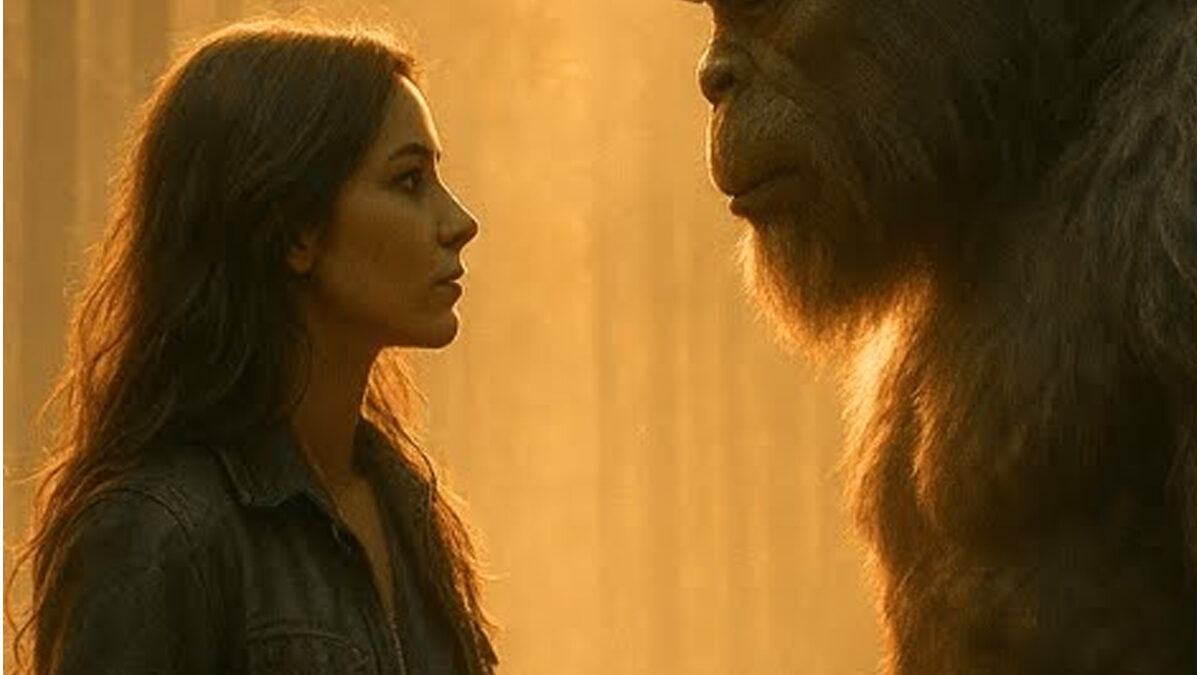
My Father Was Bigfoot. My Mother Took That Secret to Her Grave.
Have you ever felt like you’re not entirely human?
I’m not joking.
I’m serious.
Because I was born after my mother was attacked.
Not by a man, but by something no one could explain.
In 1990, in the deep woods of Storm Haven, Alaska, my mother, Ellie Carter, went missing for 3 hours.
She came back terrified, not hurt, not dead, just changed.
Weeks later, she found out she was pregnant.
The town called her crazy, a liar.
But she wasn’t.
She was just the first woman to survive and keep the child.
That child was me.
I’m June May Carter.
I’m 32.
And I’m not here to defend my mother.
I’m here because I need to understand what I am.
In this video, you’ll see my mother’s hidden files, her blood test results, handdrawn maps, and the final footage she recorded before her sudden death.
If you’ve ever felt like something inside you doesn’t belong to this world, you might not be alone.
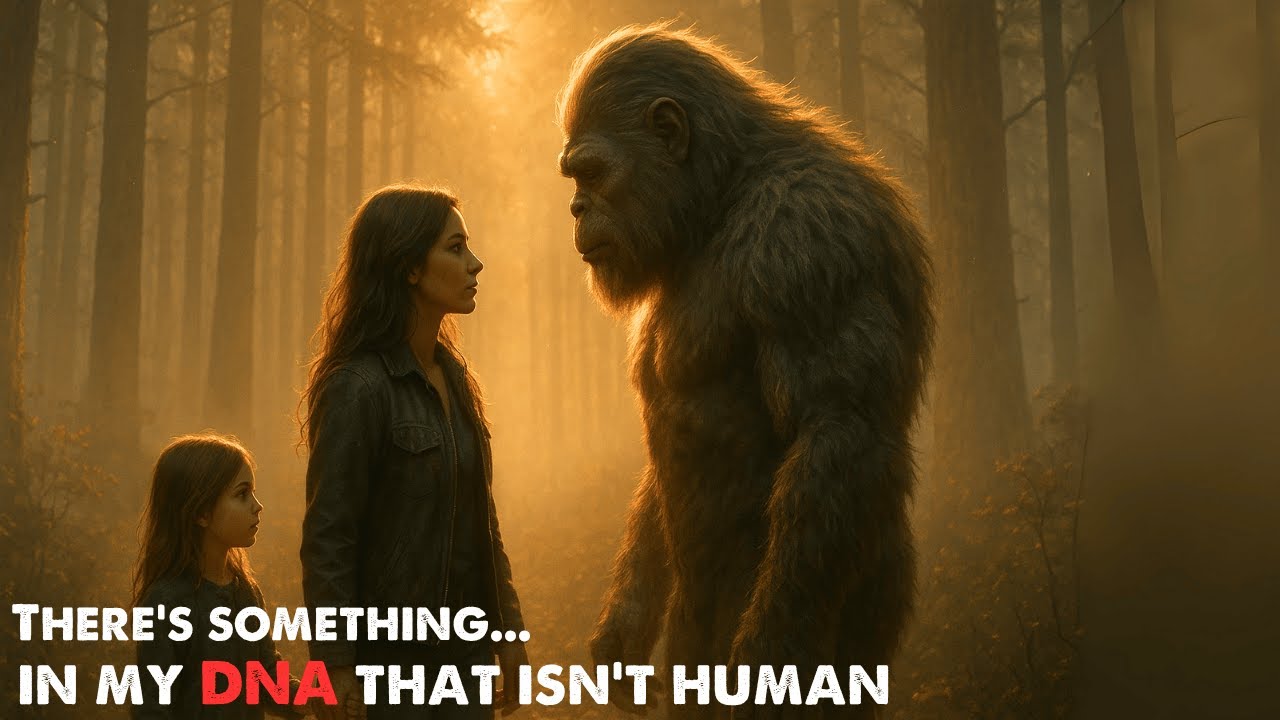
Because in her last video, something stepped out of the fog, nearly 10 ft tall, and called me by name.
A name stitched onto a silk cloth I’d never seen until that moment.
If this sounds impossible, feel free to click away.
But if you’ve ever heard your name whispered from the trees, “Stay!
You might be part of the Blood Between Worlds, too.”
I hit record before I could talk myself out of it.
The red light blinked and the screen showed my face.
Tired, bare, unfiltered.
I hadn’t worn makeup in days.
My eyes were swollen from crying.
My voice felt small but steady.
My name is June May Carter, I said.
And if you’re watching this, you probably already heard the rumors.
Or maybe you laughed at them.
I looked down for a second.
The silence inside the trailer felt like a thick coat I couldn’t shake off.
Outside, the wind howled down from the Alaskan mountains like it always did this time of year.
Cold, sharp, unforgiving.
It’s been 7 days since my mama passed.
Ellie Carter.
Maybe you remember her, maybe you don’t, but I remember everything.
I reached across the table and picked up the old photo.
The one with the corners curled and a faint coffee stain across the bottom.
Mama was younger in it.
Wild curls, eyes like chipped amber, and a crooked smile that never quite reached her eyes.
They said she was crazy, I whispered.
They said she made it up.
Storm Haven, 1990.
She was 58 years old.
They sent her and my stepdad Huck out to that godforsaken island to investigate environmental anomalies.
That was the official reason.
What they didn’t say, what they buried beneath fancy reports and cold redactions was that something had been watching that place long before they arrived.
Mama didn’t go out there chasing legends.
She wasn’t that kind of woman.
Practical, grounded, sharp as attack.
She used to say, “Curiosity is fine long as you don’t lose your footing in it.”
But I think deep down she was already slipping.
Years of not being able to have a child had changed her, I saw it in the way she folded baby clothes she never wore.
The way she stared at her reflection just a second too long.
When the Red Lantern Society offered that Storm Haven assignment, she took it.
No hesitation.
I think maybe she hoped something out there would fill the hole in her.
I don’t remember any of it.
Obviously, I wasn’t even born yet.
But I know the aftermath like the back of my hand.
The hushed arguments, the hospital bills, the silence.
I only started asking questions after she got sick.
And I mean really sick.
It came out of nowhere.
She took a solo trip to Oregon, just like she always did around the solstice.
And when she came back, she looked wrong.
Her veins dark under the skin like tree roots, her eyes yellowing.
She said it was the flu.
It wasn’t.
They ran test after test.
Nothing made sense.
Her blood didn’t clot.
Her immune system went haywire.
I sat beside her hospital bed and watched machines do the breathing for her.
And I kept thinking, “This isn’t a normal illness.
Something deeper, something older.
After she passed, I didn’t sleep for 3 days.
Then I did what I’ve been too afraid to do my entire life.
I mailed my DNA in.
It felt stupid at first, dramatic, like I was feeding a fire that had already burned out.
But I needed to know, not just for me, but for my kids, for my husband, for mama.
The results came back broken.
That’s the only word I have for it.
They flagged sequences.
Sequences that weren’t just rare, they were unknown.
Parts of my genome didn’t match any existing database.
Not human, not animal, not even ancient.
The lab thought it was a contamination error.
But I knew better.
I stared at the printed report until the letters blurred.
Then I stared at the mirror.
My reflection looked back.
My dark hair, my wide shoulders, the way my eyes never blinked quite right.
The way they glowed faintly in the bathroom light.
I was the answer to a question no one had dared to ask out loud.
I am the evidence.
They called my mama a liar.
They said she fabricated a story about being attacked.
Said she invented some fantasy to cope with grief or guilt or shame.
But what if she was telling the truth?
What if I’m living proof that something out there, something real and ancient and monstrous, chose not to kill her, but to leave something behind, a legacy, or maybe a warning.
I stood up from the table and walked to the wall.
Her picture was taped there, just a snapshot from 1994.
I was maybe three, sitting on her lap, holding a plastic dinosaur.
Her arm was wrapped around me so tight, like she was afraid I’d disappear.
I pressed my fingers to the image.
The surface was cold.
“They laughed at you,” I whispered.
“They made you small.”
I closed my eyes.
“But now they’ll have to listen to me.”
And in that silence, for the first time, I didn’t feel afraid.
I felt ready.
I felt ready like the story wasn’t over yet.
Like maybe, just maybe, it had finally begun.
Mama didn’t believe in monsters.
Not the kind hiding in the woods, at least.
She believed in systems, patterns, echoes of something older than memory.
If you asked her why she joined the Red Lantern Society back in 78, she’d tell you it was for the thrill of the unknown.
But I think it was always about something deeper, maybe even something broken.
By the winter of 89, she and Huck were living in a double wide on the south end of Anchorage, halfway between nothing and nowhere.
Their house always smelled like old coffee and wood smoke.
Huck worked maintenance for the school district.
Mama taught a night class in folklore at the community college, though she’d roll her eyes if you called it that.
Said folklore was just history that got tired of facts.
They’d been trying to have a baby for almost 10 years.
I wasn’t there for the worst of it.
But I’ve read enough of her journals to understand what it did to her.
Hope became poison.
Every cycle of slow unraveling.
Puck did what he could.
Bought her lavender candles.
Told her it was God’s timing.
But mama didn’t want timing.
She wanted a child, a heartbeat in the dark that she could call her own.
So when the society offered her and Huck, the Storm Haven case, she said yes before they finished the sentence.
Storm Haven wasn’t on any tourist map.
It was a jagged little island tucked off the coast just west of Cordova.
The kind of place you fly over without knowing it ever existed.
One old ranger station, a history of logging disputes, and lately people disappearing, hikers, surveyors, a fisheries inspector who radioed in static and was never heard from again.
Mama didn’t scare easy.
They took a barge over in early June.
Supplies packed in weathered crates, batteries, tarp, bare spray, three notebooks, a map.
Huck always joked they packed more for paranoia than survival.
She wrote in her journal that the moment they stepped onto that island, something felt wrong.
Not dangerous, just off.
The trees leaned too far north.
The moss was too thick.
Even the air seemed like it had weight.
No birds, no squirrels, no buzz of mosquitoes.
Just a constant hush, like the island itself was holding its breath.
Huck set up camp by the stream that ran past the east ridge.
It was a good spot, flat, dry, tucked under a bluff.
They pitched the tent and spent the first few days scouting the perimeter.
Mama was looking for tracks, signs, anything.
What she found was silence and then the map.
She hadn’t told me about the map until I found her box after she passed.
Folded into the back of her journal, slipped between notes on local fauna and strange seismic readings.
It was handdrawn.
No labels, just red ink and a single phrase scribbled in block letters.
Do not enter.
That was where they were headed.
She didn’t say anything to Huck.
Not yet.
He’d always been the steady one.
Sweet, patient, loyal.
But Mama had a different fire in her bones.
She followed that fire straight into the woods the next morning, alone.
She’d told Hug she was going to check the riverband.
Instead, she walked for miles.
The further she got from camp, the thicker the air became, like walking through soup, trees twisted in strange angles.
No birds, no buds, just her own breath and the crackle of old twigs beneath her boots.
Then came the hollow.
She didn’t describe it in full.
Not at first.
Just called it the mouth.
A cave, a den, I don’t know.
She only wrote one line that day.
Something here remembers what we’ve forgotten.
She came back before dusk.
Said nothing, ate in silence.
Huck thought she was tired.
But I know that look, that stare like she’s trying to remember whether she dreamed it or lived it.
That night, while Huck snored beside her, she sat outside the tent and wrote under the stars.
I’ve memorized every word.
I came looking for proof.
Instead, I found a silence so deep it felt like being swallowed.
Maybe this trip gives us nothing.
Or maybe it gives us everything.
She drew a small star next to those last lines.
I don’t think she ever told Huck what she saw that day.
Maybe she didn’t have the words.
Or maybe she knew he wouldn’t believe her.
But something changed in her after that.
You can see it in the way her handwriting stiffened, the way her sentences started to trail off mid thought.
The way she stopped documenting facts and started writing about feelings.
She started dreaming about a baby.
Not just any baby.
A child with dark eyes and hands too big for its arMs. A child that moved in the womb like it was remembering something older than bones.
A child that didn’t come from love, but from a bargain.
Huck never saw the change.
Or maybe he chose not to.
Either way, by the end of June, Mama wasn’t the same woman who’d left Anchorage.
She’d gone looking for something impossible, and it had already been waiting.
The summer my mama disappeared, at least the version of her that existed before.
It was unusually dry for Storm Haven.
The moss that usually clung to the rocks like wet velvet had turned brittle.
The creek behind their camp ran thinner than it should have for June.
You could see the round stones at the bottom, slick and orange, like old bones under glass.
She wrote that the birds had stopped calling by day three.
That was the first thing Huck noticed.
Said it like a joke.
We must have scared the damn things off.
But mama, she didn’t laugh.
The way she described it later, it wasn’t just quiet.
It was hollow.
Like the forest had swallowed its own tongue.
No fluttering in the trees.
No chipmunks chasing each other through brush.
No bugs, just the sound of her boots, and every breath she took echoing like she wasn’t supposed to be there.
She and Huck had set up camp near a rock formation they called the mouth.
It jutted out of the hillside like a jaw frozen mid roar.
Beneath it was a dark hollow.
Not deep enough to call a cave, but enough to hold shadow, enough to make your instincts whisper turn around.
On the fifth day, she went down to the creek to fish.
Huck stayed back to clean gear.
They weren’t speaking much by then.
He was worried.
She’d been distant, distracted, kept waking up in the middle of the night, drenched in sweat, staring into the dark like she heard something that didn’t make sound.
She told him she just needed a few minutes by the water.
Just wanted to cast a line, clear her head.
She never came back.
She didn’t remember the moment it started.
That’s what she wrote.
One second, she was crouched near the stream, hooking bait.
The next there was a pressure like gravity folding sideways like her ears popped but the air didn’t change a vibration through the ground.
Her vision blurred at the edges.
Then snap a sound behind her low and heavy.
Not a twig, not a branch.
Something thicker.
She turned and saw nothing.
But she felt it.
It was the smell that struck her first.
Rotten bark, salt, copper, and something else.
Wet fur left too long in the heat.
Then came the breath.
She didn’t even hear it approach, but she felt the air shift near her skin.
Warm.
Close.
She turned again, and this time it was there.
She never gave it a name, just the thing.
As if naming it might make it real in a way she couldn’t survive.
She said it stood upright, taller than any man, covered in tangled dark fur matted with patches of mud.
But its eyes, she said, its eyes weren’t wild.
They were focused, measured, aware.
And the worst part, she didn’t feel rage from it.
She felt purpose.
She tried to run, but her feet wouldn’t move.
She remembered the ground hitting her back.
The moss felt cold, slick with dew, though the sun had already climbed past the ridge.
Her breath caught in her throat.
A hand.
No, not a hand.
A weight with fingers like thick roots pressed her down.
The bark under her dug into her shoulders.
The smell filled her nose, crawled down her throat.
She tried to scream, but only made this rasping animal sound that didn’t sound like her.
There were sounds, low groans, like wolves in pain, but rhythmic, slow, the rhythm of something being taken, something being forced.
She blacked out.
When she woke, she was alone, lying on her side near the edge of the hollow, the stream murmuring nearby like nothing had happened.
Her boots were off, her clothes torn and soaked through.
Her body achd, not in the way of bruises, but like something inside her had been shaken loose.
The sun was lower now, casting long gold light through the spruce trees.
And there, next to her shoulder, pressed into the soft earth, was a footprint, three times the size of hers, deep, clear, not bare, not moose, not anything she’d ever studied.
She sat up slow.
The air felt thick in her chest.
Her hands trembled as she reached for her pack.
It wasn’t there, but her knife was still sheathed.
Still clean, she stood, staggered, then walked back to camp in silence.
Huck saw the state of her.
See, he asked if she’d fallen, if a bear had come through, if she’d gotten lost.
She didn’t answer.
That night, she burned everything.
The clothes she’d worn, the shirt, the under layers, even her pack, poured fuel from the cooking tin and lit it like it was nothing.
Sat cross-legged by the fire, watching the flames climb higher than they should.
She didn’t cry.
She just whispered something over and over.
Huck said he couldn’t hear it, but I found it written in the corner of that same journal and in handwriting that shook like it came from a different person.
It didn’t want to kill me.
It wanted to leave something behind.
And it did.
Mama didn’t talk about the weeks after the incident.
Not in full, just fragments.
Just enough to piece together the outline of something she never wanted to look at directly.
What I do know is that she got off that island quieter than she arrived.
Something in her had gone still.
Not broken, just rearranged, like a song in a different key.
The medical exam didn’t show trauma, not outwardly, but inside something had started.
Something new, something she didn’t understand.
She thought it was a parasite.
Wrote it down just like that.
Muscle fatigue, cramping, light sensitivity, possibly parasitic infection from water or surface contact.
She even made a chart.
Symptoms, progressions, duration, duration.
But that chart didn’t help when her body started rejecting certain smells or when the veins along her wrists darkened like blue ink bleeding through paper.
She tried to explain it away.
Hormonal imbalance, PTSD, stress.
Then came the nausea, the blood tests, and finally you’re pregnant, Mrs. Carter.
And she didn’t believe the nurse said that wasn’t possible.
Not anymore.
Not after years of dead ends and disappointment.
She was 59.
She’d given up on that dream long before Storm Haven.
The nurse smiled gently and pointed at the monitor.
And there I was, just a flicker, just a beat on the screen.
Mama went quiet, not surprised, not afraid, just cold.
She walked out of the clinic without taking the ultrasound photos.
Sat in the truck for an hour.
Huck asked what was wrong.
She told him nothing.
Told him she was just tired.
The next few days, she didn’t sleep.
Kept pacing the kitchen with her hand on her stomach like it didn’t belong to her.
Her journal entries got messy, rambling.
Half medical notes, half prayers, or maybe confessions.
One night she wrote, “Whatever this is, it didn’t come from love, but I can feel it listening, watching, growing.”
She booked an appointment to terminate.
Didn’t tell Huck.
Told herself it was the rational choice, logical, clean, but something stopped her.
It was the music.
Huck played old Roy Orbison records on the weekends.
There was one morning he was humming along, slicing apples, when mama felt a twitch.
Not pain, but a shift, like something inside her was turning toward the sound.
Then it happened again under the moonlight.
They were sitting on the porch.
It was late September.
A harvest moon hung so low it lit the field like silver fire.
The wind picked up and Mama swore just for a moment.
She felt a ripple move through her belly in time with the wind.
Not reflex, not human.
A kind of response.
That night, she unpacked the suitcase she’d packed for the clinic and she whispered to herself, “This ain’t just mine anymore.”
She never told Huck the full truth.
Said it was a miracle, a final gift, one last chance from a god who’d waited too long.
Ak wanted to believe her.
The silence, the scar she never let him touch.
So he just nodded and cried and called it grace.
The pregnancy dragged.
Not 9 months, closer to 10.
There were days Mama couldn’t get out of bed.
Her joints swelled.
Her gums bled.
Her spine achd like she’d been carrying rocks.
At night, she’d feel something press against her ribs, too sharp for a foot.
Too deliberate for a kick.
She started dreaming again.
The forest, the mouth of the cave.
But now the trees leaned toward her, not in threat, but in memory, like they were watching something pass from one world into another.
Her delivery wasn’t like other births.
The doctor on call had delivered babies for 30 years and said he’d never seen anything like it.
Mama didn’t scream.
She barely made a sound.
Her body trembled, convulsed, but her eyes stayed open the whole time, wide, silent, staring at the ceiling like she was watching stars move behind plaster.
Then I was there.
No crying, no flailing.
I just stared, eyes wide, not blinking, covered in a layer of soft, downy hair that shimmered under the hospital lights like frost.
I held on to her finger so tight they had to peel me off.
The nurse assigned to Mama’s room didn’t come back the next day or the day after.
Two weeks later, she was reported missing.
Never found.
Mama didn’t ask questions.
She didn’t want the answers.
Instead, she wrapped me in a handstitched quilt and held me against her chest, whispered something I’ve only ever read in her journal.
You ain’t a curse, baby.
You’re the last thing this world needs to understand.
She didn’t let the doctors run extra tests, refused all genetic screenings, said I was healthy.
Now it was enough.
And for a while it was.
But I think even then, deep down she knew that whatever I was, whatever part of me had come through her, that piece wasn’t done with her yet.
I don’t remember the first time I knew I was different.
Not really.
I just know there was always a hum under my skin.
A feeling like something inside me was listening harder than I was, watching even when my eyes were closed.
Mama used to call me her wild child.
Not in the way people mean when a kid throws tantrums or draws on the walls.
She meant it literally.
Like I came into the world already half feral.
I learned to walk early, spoke late, refused to sleep unless the window was open, even in winter.
Mama said I hated blankets, hated mittens, cried when she tried to swaddle me, but the wind I calmed to the wind.
She tried to ignore the little things.
The way my hair never stopped growing.
The way my baby teeth came in sharper than they shove.
The way I stared at the moon like I was waiting for it to speak.
But the preschool couldn’t ignore it.
I was taller than the other kids.
Stronger, too.
I didn’t mean to knock little Jesse over during red light, green light, but he cried and his mom told the school something was wrong with me.
Then came the nickname Wolfling.
Kids can be cruel without knowing why.
It spread fast on the playground in the lunchroom.
Whispers and stairs.
And I just stood there, hands shoved into my pockets, trying not to growl.
Mama pulled me out by spring.
Said the system wasn’t built for girls like me.
Homeschooled me in the mornings and let me run wild in the woods after lunch.
She said learning came better when your feet were dirty.
She wasn’t wrong.
I grew like weeds after rain.
By the time I was 12, I could hear things no one else could.
A squirrel’s claws on bark.
The snap of a branch a mile away.
I could smell storm fronts before they touched the horizon.
Taste copper in the air before snow.
At 13, my canines dropped lower.
My arms stretched too long for my frame.
I wore sweatshirts year round to hide the fine hair that ran across my shoulders and down my back.
Not enough for anyone to call me out, but enough to make me itch.
I hit the basketball court hard at 14.
Coach said I moved like I had springs in my legs, like I was reading plays before they happened.
I wasn’t the fastest, but I had this strange timing like I just knew.
I got a scholarship, full ride, Montana State.
Mama cried the whole drive down from Anchorage.
Said it was the first time she felt like the world might see me the way she did.
I tried to be normal.
I studied business.
Got a job at the campus bookstore.
Dated a boy named Wes.
He had a crooked smile and dimples I didn’t trust, but he made me laugh.
And that was enough for a while.
We got married right after graduation.
Bought a house outside Miss Msula.
Two kids, a swing set, a golden retriever named Darcy.
On the outside, it looked like a postcard, but I never stopped feeling like I was wearing a mask.
There were nights I’d sit by the window long after everyone was asleep and just listen to the wind moving through the pines, to the distant howl that no one else ever mentioned.
I stopped trimming my hair.
It felt raw, like cutting down something that still had work to do.
My oldest, Clara, once told me I looked more like the moonlight than her friend’s mom’s.
I didn’t know what that meant, but she said it like a compliment.
Then came the accident.
Late November, black ice on Route 12.
The truck skidded, rolled twice.
They pulled me out of the wreckage unconscious, but breathing.
My vitals were stable, but my blood wouldn’t clot.
I was in a coma for 6 days.
The doctors ran every test they could.
They said my immune system didn’t match any known profile, like I was a separate branch on the tree of life.
Wes didn’t understand.
He thought maybe it was a lab error, some rare mutation.
But I saw the way he looked at me when he thought I wasn’t watching, like he was trying to decide if he still recognized the woman in the hospital bed.
I did the same.
On the seventh morning, they let me stand.
I walked to the mirror.
My reflection stared back.
Eyes too steady, skin too pale, pupils darker than they she’d been in that lighting.
I touched my own cheek and whispered, “If they knew what I really was, would they still call me mom?”
No one answered.
I got discharged that evening.
The wind outside the hospital felt different, like it knew something had cracked open.
Mama called that night, said she’d felt something, like a thread tightening across her chest.
I didn’t ask how.
We both knew.
Something in me had shifted.
Not broken, just awakening.
It started with a look, the kind of look that stays behind after the person’s left the room.
My daughter Hazel had just turned four.
She climbed up onto my lap one afternoon, pressed her forehead against mine, and said real quiet, “Mama, your eyes don’t blink like mine.”
That stuck with me.
It echoed harder than any test result ever had.
Louder than every whisper from doctors and specialists, and all their clean clinical words about what I was and wasn’t.
I could dodge strangers.
I could fool neighbors.
But I couldn’t lie to her.
Not for long.
A week later, I stood in front of Mama’s house, just outside Eagle River.
Same crooked fence, same porch light that buzzed like it had a secret.
I hadn’t been home in years, but something in me pulled me back like a string tied to my ribs.
She opened the door and stared at me like she’d been waiting.
I didn’t ask to come in.
She didn’t need to offer.
We sat in the kitchen, just the two of us, the air between us thick as syrup.
She poured coffee, her hands trembling only slight.
I could tell she was trying not to look at me too hard.
I didn’t want to waste time.
I need you to tell me the truth, I said.
She didn’t blink.
Just turned and walked to the hallway closet, pulled down a box wrapped in an old quilt, the same one she’d wrapped me in when I was born.
She set it on the table like it weighed more than it should have.
Inside there were folders, photographs, medical scans, torn notebook pages, a strip of ultrasound film, and a vial, thick glass, corktight, half filled with darkened blood that shimmerred when the light hit it sideways.
She didn’t say a word, just pushed it all toward me.
I reached inside and pulled out a Polaroid, black and white, a hillside I didn’t recognize.
Trees leaning east, a small dark shape at the tree line, barely visible, but unmistakably upright.
I kept digging.
There was a worn notebook with a writing cramped and rushed.
Journal entries from 1990, blood tests, notes from a biologist she never named, DNA charts full of red pen slashes and arrows.
In the margins, one word kept repeating, anomaly.
Then I saw the photo that made my stomach turn cold.
It was mama in a hospital bed, looking pale, exhausted, holding me.
But not the me I’d ever seen before.
I was maybe 5 days old, hair down to my shoulders, eyes wide open, staring straight at the camera like I knew something, like I remembered something.
I tried to protect you, Mama finally said.
Her voice cracked on the last word.
From what?
From everything.
I asked about Huck.
She closed her eyes, took a breath.
He knew something had happened, but he didn’t ask.
I think that was his way of loving me.
Loving us.
She stood up, walked to the sink, and stared out the window like she was trying to see a time that didn’t exist anymore.
I told him the baby was a miracle.
I told him the baby was a miracle.
That God had changed his mind.
But he wasn’t dumb.
He saw the hair.
The way you never cried.
The way you never slept.
He just loved you anyway.
Maybe out of fear.
Maybe out of guilt.
But he got it enough.
I opened another full.
Inside was a printed report, university seal at the top.
It was from Yukon, dated 1976, details of a forest fire and a body.
No clear photos, just fragments, tissue samples.
The lab notes listed the subject as nonhuman, nonan animal, unknown by p.
And on the last page, Denna segments nearly identical to mine.
I looked at her.
You knew.
She nodded, eyes glassy, voice barely a breath.
I didn’t birth a monster.
I birthed a witness.
It hit me hard.
All the years I’d carried the weight of silence, the ache of being something unspoken.
And she had carried it longer with fewer answers, more fear, more love than I could understand until that moment.
I reached for her hand.
She gripped mine like I was the only thing keeping her tethered.
I whispered.
I didn’t ask to be born like this, she answered.
But I chose to keep you.
That’s love.
And it was.
Whatever else was waiting, whatever truth hadn’t surfaced yet.
I knew it started here with her.
With a silence she broke just to make sure I wouldn’t have to live inside it alone.
I sat there long after she’d gone to bed.
Just me, the box, and the sound of the wind rushing against the house like an old friend trying to find its way back in.
She came back from Oregon looking like something had been hollowed out of her.
Mama never said where she went.
Just told me she needed a break.
That the house felt too small.
That the air up here wasn’t right anymore.
She packed light.
Said it’d just be a few days, maybe four at most.
Left the dog with me, kissed my kids, hugged me longer than she ever had.
I thought maybe she was just getting soft with age.
But now I know it wasn’t softness, it was goodbye.
When she got back, her skin was pale and tight, like stretched wax paper.
Her lips were cracked.
Her hands trembled when she tried to hold her mug.
She said it was just fatigue, a stomach bug, the drive.
She waved it off with that same old stubborn shrug she’d always used when she was trying to hide a burn or a bruise or something sharp caught too deep under the surface.
By morning, she couldn’t keep food down.
By that night, her nose started bleeding and wouldn’t stop.
I wrapped a towel around her face and drove straight to Providence Hospital.
No shoes on my feet, my coat still hanging on the kitchen chair.
I kept thinking it was the flu.
Maybe something viral, something explainable, but it wasn’t.
They ran blood work.
Her platelets were almost non-existent.
White blood cells in disarray.
Her blood wouldn’t clot.
Her lungs began to seize.
Every symptom contradicted the last.
One doctor said autoimmune.
One said fungal infection.
One said maybe leukemia.
But none of it made sense.
She crashed at 2:13 a.m. They stabilized her, intubated, kept her under.
I sat by her bed for 40 hours, barely blinked.
The machines made soft mechanical noises, but her body never stirred.
Her chest rose and fell, but I couldn’t feel her in the room.
Not really.
And then I remembered something she’d said years ago after the car accident, after my DNA came back looking like a mistake on paper.
She said, “I don’t think it’ll end with me.
I think whatever started that summer, it still wants something.
I didn’t understand it then, but I did now.”
On the third day, I broke into her apartment.
I know how that sounds.
But I wasn’t looking for money or medication.
I was looking for reason, for answers.
I opened drawers, searched the medicine cabinet.
Nothing.
Then I found her bag.
Inside a handheld camcorder, one of those older digital ones.
The battery was almost dead.
I found the charger and plugged it into the wall.
The red light blinked once.
I hit play.
At first, it was static.
Wind leaves brushing the mic.
Then the frame stabilized.
She was holding the camera low.
Hiking boots stepped over pine needles.
The light was gray, not morning, not evening, something in between.
She wasn’t alone.
In the far corner of the screen, just at the edge of the treeine, something moved, not an animal, not a person, just a shape.
Too tall, too still.
She zoomed in and it moved again.
Just its head, just enough to turn and look toward her.
Then it vanished.
She gasped, but didn’t scream.
I could hear her whisper.
I see you.
I remember.
Then the tape cut out.
I stared at the blank screen for maybe 5 minutes.
My fingers froze.
The air in that apartment felt heavier than it should have, like I’d let something in by watching.
I ran the GPS data from the camera.
She’d been in Storm Haven, not near it, on it.
48 hours before she collapsed, she went back to where it all started, alone after 30 years.
And whatever she found, whatever she brought back with her, it was inside her now.
Not an infection, not a disease, something else, something ancient, something unspoken.
Back at the hospital, I sat beside her and held her hand.
Her fingers were cold, but not stiff.
Like she wasn’t dead yet, just leaving slowly.
I unlocked her phone.
Not out of disrespect, just instinct.
There was one audio file.
No name, no timestamp, just a voice memo.
I hit play.
It was her voice.
Soft rasping like she knew I’d find it.
June, if you’re hearing this, I went back.
I needed to.
I needed to see if it was real.
And it was.
It still is.
I didn’t go to fight.
I went to remember and to let it know.
I’m not angry anymore.
I don’t regret anything.
Not you.
Not the pain.
Not the silence.
Not even the night.
It changed everything.
If it takes me, that’s okay.
Just promise me one thing.
Don’t let them write this off.
Don’t let them bury the truth with me.
The recording stopped.
Just like that, I sat in that chair and wept so quietly the nurse didn’t even turn her head.
Mama died at 3:7 a.m. The doctors called it organ failure.
A cascading reaction they couldn’t explain.
I called it a reckoning.
I buried her in a cedar box.
No headstone, just coordinates, just trees.
Just a whisper of who she was and what she carried.
But I knew the story wasn’t over because two days later, I found something on my front porch.
A strip of torn fabric, brown, woven, old, embroidered in thread, the color of moonlight.
My name was stitched into it.
Not June.
June May.
And the corners weren’t frayed.
They were new.
I didn’t tell anyone I was going back.
Not Wes.
Not the kids.
Not even the woman from the genetic clinic who kept calling to follow up.
I left a note on the fridge, packed one bag, took Mama’s quilt in the old camcorder, and I drove past Anchorage, past Cordova, all the way down the coast to the same ragged dock where it all began.
Storm Haven hadn’t changed.
Not really.
Still the same ghost colored sky hanging too low over the trees.
Still the smell of cedar and rot and salt all braided together in the air like breath from an old lung.
The same silence that made your heart beat louder.
Just to remind you it still could.
I docked the skiff by midm morning, low tide, fog coiling in through the rocks like it remembered me.
I stepped onto the island with both feet like it was church ground.
And I waited.
I brought more than cameras.
I brought names.
There were others out there.
People like me.
People who didn’t quite belong to one world or the other.
Survivors of something they couldn’t explain and were taught never to speak aloud.
We called ourselves the crossblood network.
Started as a message board.
Now it’s something more.
A place to gather stories no one wants to hear.
Names they tried to erase.
Wounds that never made it into textbooks.
But that day, Storm Haven wasn’t about anyone else.
It was about Mama.
About standing where she had stood, about touching the ground she bled on.
I found the stream first, shallower than in her notes, the stones dry along the banks.
Further up, the cave she called the mouth still loomed, moss hanging down like curtains, and there, just to the right, was the patch of flat earth where she’d said she woke up.
I knelt, laid the photo of her and me, me still wrapped in her arMs. my baby eyes fixed wide on something invisible and pressed it into the dirt.
Then I placed the strip of embroidered fabric, the one with my name stitched into it, somehow untouched by time or weather, I whispered.
I’m not here for revenge, my voice cracked.
I’m not even here for answers.
The wind didn’t move.
The trees didn’t sway.
The whole island just washed.
I walked the perimeter.
Set motion triggered cameras along the treeine, every 50 ft, night vision lenses, sound recorders, every lens pointed back toward that cave, toward the place something had stepped out of her and left me behind.
And then I waited.
Hours passed.
The sun dropped behind the fog, smearing the trees and rustcoled haze.
I didn’t light a fire.
Just sat by the quilt.
Knees drawn to my chest.
Breath short and sharp the same way she must have breathed that night 35 years ago.
And then the camcorder blinked.
One of the sensors triggered.
I didn’t move, just pressed record.
The mist thickened by the cave mouth.
Not like fog, thicker, like shadow pushed into air.
And then something stepped through it.
Not fast, not violent, like it was walking home.
9 ft tall, covered in hair like wet earth and pine needles.
Shoulders hunched, arms too long, hands dragging near the ground.
But it was the face.
No, not face.
Something close to a face that made my ribs feel like glass.
There was intelligence there.
Old, heavy, tired.
Its eyes were deep, golden, but not glowing.
They held no rage, just recognition.
And then it spoke, not loud, just one word.
My name, not the name everyone calls me.
Jun May, the full name.
The one Mama whispered the day I was born.
The one no one else uses.
And in that second, everything broke loose in me.
Every question, every ache, every dream, every scream I never let out.
I stood, my knees buckled.
I didn’t fall.
I didn’t run.
I didn’t speak.
We just looked at each other.
And in that silence, I didn’t feel small.
I didn’t feel afraid.
I felt seen.
Not as a mistake, not as a leftover, as a link.
Something between.
It stepped back into the fog.
Gone.
The wind moved again.
Just once, just enough to rustle the photo at my feet.
I picked up the camcorder and faced it toward me.
I wiped my eyes, looked into the lens, and I said, “If you feel like you don’t belong anywhere, maybe it’s because your story hasn’t been told yet.”
Then I shut it off and I finally let myself cry.
Sometimes the stories that matter most are the ones that live in sil.
The ones passed down not through headlines or history books but through memory, through scars, through the quiet knowing that something once happened here and left its mark.
Not every truth is meant to be shouted.
Some are carried in the body, in the way we walk through the world, in the ache between who we are and who we’re told we should be.
What if the things we fear most aren’t monsters, but the parts of ourselves we’ve spent a lifetime trying to bury?
Sometimes belonging doesn’t come from bloodlines or borders.
It comes from being brave enough to look into the dark and whisper, “I see you.”
And if we’re lucky, something might whisper back.
Something that knows we’ve been walking a long road alone.
Something that understands that survival is not the same as living.
And that carrying a secret can be heavier than grief.
The line between worlds is thinner than we think.
It’s not just out there in the woods or hiding beneath the floorboards of old stories.
It’s in us.
In the way we search for meaning, in the way we ache to be understood.
In the way we crave answers even when we’re afraid of what they might cost.
But truth has a way of rising.
Not always with fire.
Sometimes just with breath, with memory, with the act of telling.
And in that telling, something opens.
Not just between people, but between worlds, between past and future, between what hurt us and what still might heal.
This story, like all stories born of mystery and silence and love, was never about proving what’s real.
It was about giving shape to what’s been felt but never named.
It was about reaching into the dark.
Not to conquer it, but to sit beside it and listen.
So something in this story stirred something in you.
If you’ve ever felt different or unseen or like your truth didn’t quite fit the world around you, know this.
You are not alone.
There’s more beneath the surface than most are willing to admit.
There are others out there, quiet, watchful, carrying stories that haven’t found their voice yet.
You may never cross paths.
Or maybe you already have.
But you choose to believe that your truth matters.
Something shifts.
Something begins.
Thank you for spending this time here with me, with the story, with the quiet between words.
If this journey meant something to you, I’d love to hear your thoughts in the comments.
Your voice might just help someone else feel seen.
And if you want to be part of the next story or walk a little further into the unknown with us, go ahead and subscribe.
This isn’t the end.
It never was.
It’s just where the next path begins.








