My Ex-Wife’s Best Friend Showed Up After Her Engagement Fell Apart… She Said, “There’s Only One P…”

My Ex-Wife’s Best Friend Showed Up After Her Engagement Fell Apart… She Said, “There’s Only One P…”
I was fitting a new mainspring into a pocket watch the size of a walnut when I heard gravel shifting under tires at the end of the lane.
My name is Oliver Strand.
I am 41 years old.
I repair and restore antique time pieces out of a converted garden shed behind the house I bought in Naramada, British Columbia after my marriage ended 3 years ago.
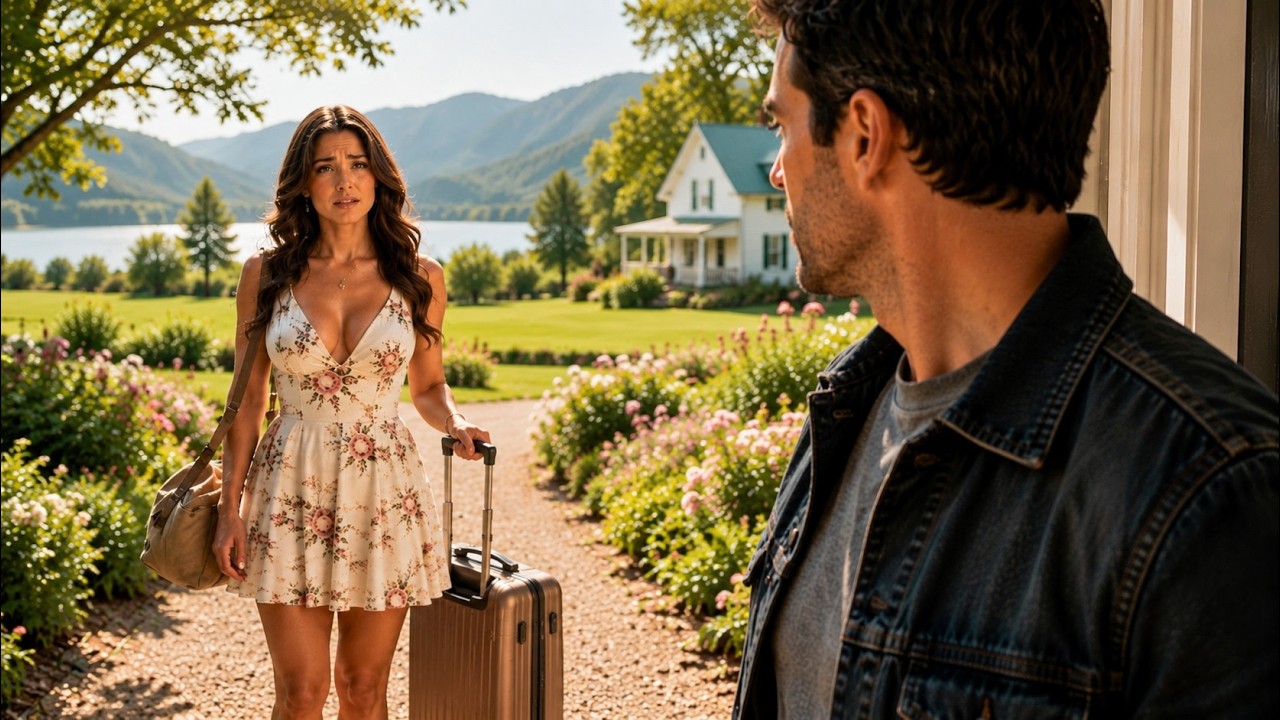
The house is white with a green metal roof, a covered porch that faces Okonogan Lake, and a strip of orchard along the south fence, six apple trees, and two old pear trees that the previous owner planted before I was born.
I bought it because it had no memories attached to it because it was exactly the kind of place Sylvia would never have chosen.
Sylvia and I were together for 9 years, married for six.
She wanted Toronto, the gallery openings, the dinners that started at 9:00, the life that looked good from the outside and felt like theater from the inside.
I wanted the lake.
I wanted mornings that didn’t require a plan.
We tried to meet in the middle for years until the middle caved in.
The divorce was quiet, almost too quiet.
She signed in March.
By June, I was west of the Rockies.
I’m not going to tell you I was over it, but I will tell you that over and done with are not the same thing.
And that distinction kept me honest through the first year.
The gravel shifted again.
I sat down the watch.
Standing at the top of the lane, halfway between the road and my porch, was Miriam.
I hadn’t seen her in 2 and 1/2 years.
She was thinner, carrying a canvas duffel bag over one shoulder and a small tote in her other hand.
And there was something in how she stood, not lost exactly, but like a person who had arrived somewhere.
They weren’t sure they still had permission to be.
She said, “Oliver, I didn’t know where else to go.”
Miriam had been Sylvia’s closest friend since university.
She was the one who gave the toast at our wedding.
She was the one Sylvia called first about everything.
After the divorce, the friendship logistics shifted, the way they always do, and I assumed she’d stayed on Sylvia’s side of the line.
I didn’t blame anyone for it.
That’s how it works.
I hadn’t known she was in town.
I hadn’t known she was coming.
I opened the porch gate and said, “Come in.
Miriam sat at my kitchen table while I put the kettle on.
She held a mug in both hands, the way people do when they need something warm to hold on to.
She didn’t say anything right away, and I didn’t press her.
The lake was going silver through the window.
The orchard was full of starings.
I asked her eventually, “Does Sylvia know you’re here?”
She shook her head.
“What about Rory?”
Rory was the man she’d been engaged to.
I’d met him twice.
Once at a mutual friend’s dinner in Vancouver, once briefly at a birthday party the summer before everything came apart.
She said, “Rory is why I’m here.”
She didn’t say anything else for a while, and I didn’t need her to.
I know the shape of a sentence isn’t finished yet.
I made tea.
I put out the last of a package of digestives I’d been rationing and sat across from her.
It came out in pieces over the next half hour.
The engagement had ended 6 weeks ago.
Rory had been going through her things.
Not maliciously, she said.
He’d been looking for her passport before a trip, and he’d found a letter in the back of her desk drawer.
A letter she’d written and never sent.
She didn’t have to tell me who it was addressed to.
I could see it in the way she looked at the table while she talked.
I asked her where she’d been for 6 weeks.
My parents’ place in Abbottzford and then a friend’s couch in Colona.
She looked up.
I’m not here to make things complicated, Oliver.
I just needed somewhere that felt like solid ground for a little while.
I know that’s a lot to ask.
I told her the room at the end of the hall had a good mattress and a window that looked into the orchard.
I told her she could stay until she figured out what came next.
She exhaled.
It was the kind of exhale that’s been building for weeks.
That night, after she’d gone to bed, I sat in the workshop for a long time.
I had a mantel clock half assembled on the bench, a French piece from the 1890s with a crack in the enamel face that I’d been filling with patient coats of lacquer.
I didn’t do any work on it.
I just sat there with the smell of cleaning solvent and machine oil around me and tried to be honest with myself about why I’d said yes so quickly.
The first few days were careful, polite.
She read on the porch in the afternoons.
She borrowed my old copy of a Michael Ani novel she’d never gotten around to and left it face down on the arm of the chair like she’d always done with books she meant to come back to.
I noticed that it’s a small thing.
It means you’re planning to return.
She helped without being asked.
She learned somehow without my saying anything that I took my coffee with oat milk in the morning and black in the afternoon.
She stopped asking after the first day.
She just made it the right way.
On the third day, she came into the workshop to call me for lunch.
She stood in the doorway looking at the clock parts laid out on the workbench, all the gears and wheels and jeweled bearings arranged in order on a cloth.
She said, “I always thought you needed something like this.”
I asked her what she meant.
She said, “Something to take apart and put back together.
Something where the problem has a solution if you’re patient enough.”
I didn’t say anything.
I followed her inside and we ate soup from a can because I hadn’t gone shopping and neither of us mentioned what she just said.
There was a moment on the fifth evening that I’m going to tell you about plainly.
We were cleaning up after dinner.
She was at the sink.
I was putting away dishes.
She reached past me to hang a dish towel on the hook above the stove and for about 2 seconds we were standing close enough that I could smell the lavender hand soap she used.
She stepped back.
I stepped sideways.
We both looked at different parts of the kitchen.
She said, “Sorry.”
I said, “Don’t be.”
And we went on drying dishes like neither of us had noticed anything.
But I had I think she had too.
And that night, I lay awake for a long time thinking about what it means when someone apologizes for standing too close to you and you tell them not to be sorry.
The second week, a storm came in off the lake.
BC Falls can do that.
Clear and golden for days and then the sky just lowers itself and stays.
We lost power for a few hours on the Tuesday.
I lit candles on the coffee table.
Miriam pulled a blanket around her shoulders and we sat on opposite ends of the couch with the sound of rain hard against the windows and the porch roof.
She talked more that night than she had since she arrived.
She told me she’d been teaching high school English in Suriri for 8 years.
She told me she’d wanted to take a sbatical and write something.
She didn’t say what, but that Rory had always thought it was impractical, that it could wait.
She said that was the thing about the letter.
After he read it, she realized she hadn’t really been living her own life for a long time.
She’d been living a life that was almost right.
Almost right is its own kind of loneliness, I said.
She looked at me.
The candle between us moved a little.
I know you know that, she said.
I did know it.
That was the problem.
I want to be honest here about what I was telling myself during those two weeks.
I was telling myself she needed a friend and I was being a friend.
I was telling myself that she was Sylvia’s person, even if the friendship had faded, and that there was a category of things you simply don’t cross into.
I was telling myself I’d been alone for 3 years and was probably reading too much into small gestures, the way people do when they’ve been quiet for too long.
I was wrong on all counts, but I held on to those explanations the way you hold onto a piece of wood when the current picks up.
One morning toward the end of the second week, I came up the porch steps after checking on the orchard and found Miriam standing in front of the shelf in the hallway holding something small in her hands.
I stopped in the doorway.
It was a small watercolor, 3 in x 4, more than a study mounted in a piece of driftwood frame I’d made years ago.
I painted it the summer before Sylvia and I were married.
We’d gone to a dinner party at a cabin near Whistler, and Miriam had been there.
I always had a small brush kit with me back then.
Late in the evening, when most people had drifted inside, Miriam was sitting on the dock with her feet over the water.
I’d painted her hands, just her hands in her lap, the way they looked when she was listening to something she found worth hearing.
I’d given the painting to no one.
I’d kept it for no reason I ever let myself examine too closely.
She didn’t hear me come in.
She was looking at it the way you look at something you’ve seen before, somewhere you can’t quite place.
She set it back on the shelf very carefully and went to the kitchen without turning around.
I stood in the hall for a long moment.
Then I followed her in and poured myself a coffee and we talked about the weather and the state of the orchard and whether the pear trees would hold another season.
She asked to stay a third week.
I said yes.
That night, I heard her phone ring twice in the spare room.
She didn’t answer it.
In the morning, there were messages on her screen that she turned face down on the table when I came in.
I didn’t ask.
She mentioned once over breakfast that Sylvia had been trying to reach her.
“I’ll deal with it,” she said.
I said, “Okay.”
She looked at me for a second as if she wanted me to say something else.
I didn’t.
I went to the workshop and spent the morning not thinking about Sylvia.
On a Saturday near the end of the third week, a silver Audi came up the lane and stopped under the Gary Oaks.
I recognized it immediately.
Sylvia stepped out with the particular kind of ease she’d always had.
Like arriving places was something that happened to her, not something she did.
She was wearing sunglasses, even though the sky was flat gray cloud.
And she had the look on her face I recognized from a dozen old arguments.
The one that meant she’d already decided how this was going to end.
She walked across the yard and smiled at me.
“Oliver,” she said, “you’ve done something with the place.”
The sentence had a barb in it that I chose not to pull at.
I held the gate open and asked if she wanted coffee.
She came inside and moved through the kitchen and living room, the way people move through a house they’re appraising.
Her eyes found the shelf in the hallway.
She looked at the watercolor for exactly 1 second longer than she needed to.
She looked at the mug on the counter, the one with the chip in the rim, the one Miriam had been using every morning, and then she looked at me.
Miriam came downstairs and stopped at the bottom of the steps.
Miriam, Sylvia said.
Her voice was warm in a way that had always made me careful.
I have been calling you for 2 weeks.
Miriam said, I know.
Sylvia sat down at the table.
She looked at us both.
Then she opened her bag and set her phone on the table between us.
Screen up.
It was a screenshot of a text conversation.
Miriam’s name at the top.
The timestamp showing late at night months ago.
Sylvia pushed the phone toward me slowly.
I didn’t want to read it.
I looked at Miriam.
Miriam looked at the window.
I read it.
The message was long.
The kind of thing that gets written late when the guard is finally down.
Most of it was about the engagement, about Rory, about feeling like she was building a life around someone who didn’t know the version of her that mattered moSt. And then near the end, one paragraph I read twice.
I’ve been carrying something for a long time.
Sill.
You know what it is.
I’ve never said it out loud and I’m not going to now.
I’m telling you because I trust you and because I need to say it somewhere real.
It doesn’t change anything.
It’s just true.
Sylvia crossed her arMs. I’ve known since before your wedding, Oliver.
She told me the night of my bachelorette.
She cried in the bathroom of a restaurant in Gas Town and made me swear I’d never say anything.
And I kept that promise for 9 years.
But she’s living in my ex-husband’s house and I think we’re past keeping secrets now.
I set the phone down on the table.
I looked at Miriam.
She was standing very still.
Her hands were at her sides.
She wasn’t crying.
She wasn’t asking me to understand.
She said, “I’m sorry you found out this way.”
Then she turned and started up the stairs.
I said her name.
She stopped.
She turned.
We looked at each other across the length of the room.
Sylvia said, “Oliver, let her go.
She does this.
She gets attached to things and she doesn’t know when to.”
I said, “Sylvia, quietly, this is my house.”
She blinked.
In 9 years of marriage, I had never interrupted her that way.
Not with that word, that tone.
I walked to the foot of the stairs.
I didn’t block Miriam.
I just stood there at the bottom step and she stopped on the fourth one.
Sylvia tried again.
She said something about what their mutual friends would think about what it looked like that the two of us had been out here for 3 weeks without telling anyone about the optics.
I turned around.
I spoke as clearly as I’ve ever spoken to her.
I said, “You drove 4 hours from Vancouver on a Saturday because you needed to be the one who decided how this story ends.
That’s not love for your friend.
You know the difference.”
Her face changed.
Then it didn’t.
She crossed the room and picked up the watercolor from the shelf.
“Charmming,” she said, turning it in her hands.
“You kept this little sketch.”
I walked over.
I took it from her gently.
“That’s not mine to keep or not keep,” I said.
I walked back to the stairs and held it up.
Miriam came down two steps and took it from me.
She held it the way you hold something that’s been yours longer than you’d admitted.
Sylvia picked up her bag at the door.
She said, “You’re both being naive.”
The Audi pulled out.
The Gary Oaks didn’t move.
The orchard went very quiet.
I filled the kettle and stood over it while the water came up to temperature.
I made two cups of tea with loose leaves the way I always did, the slow way.
With the strainer she’d once called old-fashioned.
I set one in front of Miriam.
I sat across from her.
I said, “Tonight you sleep in your room.
Tomorrow we talk.”
She nodded once.
That night I heard her moving around at the end of the hall, not pacing, just the small sounds of a person who can’t get settled.
I lay on my back in the dark and thought about what it meant that she had carried something that heavy for 9 years without once asking me to take any of the weight.
I was up before first light.
When I came downstairs, she was already on the porch.
Coffee held in both hands a cardigan pulled close, watching the fog sit low on the lake.
I pulled the second chair up and we sat without talking until the mountains on the west side found their color again.
She spoke firSt. I didn’t come here because I had nowhere to go, she said.
I have parents.
I have friends.
I have a job and a lease that doesn’t end until January.
I waited.
I came because after Rory called it off, I spent a month in Abbottzford and I finally understood something.
I wasn’t devastated about losing him.
I was devastated about the years, about pretending that what I felt for him was the full version of what I was capable of feeling.
I couldn’t keep doing that.
She looked at the lake.
I know how it looks.
I know what Sylvia thinks.
I know it’s not fair to arrive at your door with all of this, but I’ve been keeping it somewhere quiet for a very long time and it got too heavy to carry alone.
I said, Miriam, I didn’t know.
I want to be clear about that.
If I had known back when I was still married, back when everything was still intact, I honestly don’t know if I’d have been decent enough to leave it alone, I’d like to believe I would have been.
But I’m not going to sit here and promise you something about my past self that I can’t verify.
She nodded slowly.
“I know,” she said.
“That’s one of the reasons I never said it.”
I looked at the watercolor, which she’d brought out with her, and sat on the arm of her chair, face up.
“I can’t let you stay here on the terms that brought you,” I said.
“You deserve better than being kept because Sylvia forced the conversation open, and I can’t tell you what I feel for you in the same week all of this happened.”
That wouldn’t be honest to either of us.
What I can tell you is that I’m not unaffected, but I don’t want the first real thing between us to be a reaction to a bad afternoon.
She watched me.
She didn’t interrupt.
Go back to Siri, I said.
Finish the semester.
Teach your students here.
If in 3 months you still feel like this is where you want to be.
Not because the other options looked worse, but because this is the actual choice, you come back.
I’m only asking that it be a choice, not a refuge.
She cried.
Then it was the first time since she’d arrived.
Not much.
A few quiet tears she didn’t try to hide or wipe away, she nodded.
She asked, “Are you afraid I won’t come back?”
“Yes,” I said.
“But I’m more afraid of you coming back because staying felt easier than leaving.”
She packed slowly that afternoon.
She left the watercol on the window ledge in her room.
I noticed when I carried her bag downstairs.
“You’re leaving it?”
I said.
I’ve been looking at it in my memory for years.
She said, “It’s your turn.”
I drove her to the via rail station in Colona.
October light flat and gold the whole way along the Okonagan.
The orchards were picked over.
The vineyards had gone to rust and copper.
She had her hands folded in her lap and we didn’t talk much until the bridge came into view.
Near the edge of the city, she reached over and rested two fingers on the back of my hand where it lay on the wheel.
She didn’t look at me.
I didn’t look at her.
She kept them there for about a kilometer and then she folded her hand back into her lap like something had been said without words.
On the platform, she turned before she stepped up.
She said, “Ol, I don’t need a promise.
I just need the door to stay open.”
I said, “It’ll stay open.”
The train left.
I stood on the platform long after the last boarding call, long after the station had emptied out, smelling diesel and damp concrete and the particular cold of a railway platform in October.
I let everything get very quiet before I walked back to the car.
The drive home took 40 minutes and felt like 4 hours.
The first month was work.
I finished the French clock.
I took on a long case restoration for a client in Pentictton and drove there twice in November along the Orchard Highway.
The lake going from green to gray on my left.
I sent Miriam a small package, a single gear I’d machined from brass stock, polished to a mirror finish packed in a square of velvet inside a cedar box I built in an evening.
No note, she would know what it was.
3 weeks later, a card arrived in the mailbox, an autumn field on the front.
On the back, in her handwriting, my students asked why I was smiling at a box.
I told them I’d received something that took a long time to make.
They accepted this.
She didn’t sign it.
She didn’t need to.
Sylvia called me in November.
She was pleasant in the way she always was after doing something she knew was questionable.
She told me she was seeing someone new, that she hoped I was well.
She didn’t mention Miriam.
I told her I was glad she was well.
When I hung up, I waited for something, some residual ache, some complicated feeling, and found only the sound of the refrigerator and the workshop clock ticking through the wall, and a clarity that had been building in me for months without my permission.
I understood then that I had stopped being a man who had survived a marriage.
I had become a man who finally knew what he wanted.
Those are not the same thing.
In December, Rory sent a message through a mutual contact.
He was gracious about it.
He used the word closure twice.
I read it once and didn’t reply.
Silence is its own answer sometimes, and it was the cleanest one I had.
The third month, I took a commission in Suriri, a grandfather clock that had belonged to one family for four generations and needed its movement fully rebuilt.
I took the job.
I didn’t tell Miriam.
I drove into the city on a Wednesday and checked into a hotel near the Fraser.
I spent two days with the clock in the spare room, photographing each component before I touched anything.
On the second evening, I walked to the neighborhood where I knew she taught.
The lights were still on in the English department wing.
Through the window, I could see her at the whiteboard erasing something and writing something else.
The slow, patient motion of someone who hasn’t run out of things to say.
I did not go in.
I did not call her name.
I went back to the hotel and sat on the edge of the bed with my coat still on and thought about the difference between waiting for someone and choosing someone.
In the morning, I drove home in the dark.
10 days before the 3 months were up, I heard gravel shifting under tires at the end of the lane.
I was in the workshop.
The same sound as the first time.
Slow, careful.
I came out wiping my hands on a rag.
Miriam stood at the top of the lane, a small weekend bag over one shoulder.
The same canvas one from September.
The lake was bright behind the orchard.
The two pear trees still held a few leaves.
She said, “I came because I wanted to come.”
I put the rag down.
I walked down the porch steps.
I put my arms around her and she pressed her face against my shoulder and let out a breath that felt like it had been held since September, or maybe longer, maybe for years.
And I held her there beside the orchard until both of us stopped shaking.
And we were just two people standing still in a yard that had finally stopped feeling too large for one.
The following spring, Miriam had boxes of books on every flat surface and a desk she’d chosen from a Chillowak estate sale set up in the room with a south window where the afternoon light was beSt. She was teaching three days a week at a school in Summerland, 15 minutes down the lake road, and using the other two for the novel she’d been putting off for 10 years.
I built her a proper writing table with a lip along the edge to keep her coffee from sliding because the secondhand desk was uneven and she’d already lost one mug to it.
The watercolor was back on the shelf in the hallway.
Beside it now was a second study I’d painted.
Her hands again subject, but this time from life.
She’d fallen asleep reading on the porch one afternoon with her hands in her lap.
And I’d painted them quietly from the doorway.
Same hands, better painter.
She cried a little when she saw it and then laughed at herself for crying and then took my hand and held it against her cheek for a long minute that I will remember for the rest of my life.
2 years after she came back on a Tuesday morning in Marcher, she set a cup of ginger tea on my side of the table instead of soft coffee.
I looked up from the watch movement I was cleaning.
She was standing across the kitchen with her hands wrapped around her own mug, not saying anything.
I set down the cleaning cloth.
I stood up slowly.
I walked around the table and put my hand very gently on her waist and she covered it with hers.
And we stayed like that in the kitchen with the lake going silver through the window and the orchard just beginning to bud.
She said, “I was going to wait until tonight to tell you.”
I said, “I know.”
She said, “How did you know?”
I said, “You made ginger tea.”
She laughed.
Then she pressed her forehead against mine and neither of us said anything else for a long time.
Four years later, our son was two and a half and already had her way of going very still when something caught his intereSt. He had my hands.
I noticed it every time he picked something up.
The particular spread of thumb and forefinger, the careful grip.
He’d found the watercolor on the hallway shelf and asked about it a number of times.
We’d stopped counting.
We told him I’d painted it when his mother was young.
He accepted this.
He had good instincts about when a story was still being told.
On an evening in late September, I sat on the porch with Miriam’s head against my shoulder, watching the last light cross the lake.
The orchard was full.
The years had settled around us the way Goodwood Tus without drama quietly into exactly the shape they were always meant to take.
I thought about the morning she’d stood at the top of my lane with a canvas bag and said she didn’t know where else to go.
I’d believed it was desperation.
I understood now it was the most honest thing she knew how to say.
That there was one place she had always meant to arrive.
And she had finally stopped giving herself reasons not to.
I used to think that love was something that came from outside the life you already knew.
That it had to be new, unencumbered, free of everything that came before it.
I was wrong.
Sometimes the person who knows you best was standing at the edge of someone else’s story for years, holding something carefully, waiting for the moment when the truth was finally worth the cost of saying it.
Miriam taught me that carrying something in silence for a long time isn’t weakness.
It’s a kind of faithfulness that most people aren’t capable of.
The watch on my workbench keeps time the same way it always has, slowly, precisely, without hurry.
That’s the thing about time that most people misunderstand.
It doesn’t wait, but it does, given enough patience, bring you around to where you were always meant to be.
If someone has carried something quietly for years without ever once asking you to carry any of it with them, do you think that makes them foolish?
Or do you think it makes them the bravest kind of person there is?
And have you ever stood at the end of someone’s lane, bag in hand, saying something that was true in more ways than you were ready to explain?
If Oliver and Miriam’s story stayed with you tonight, please tap the like button.
It tells me this kind of slow, quiet story deserves to keep being told.
Subscribe so you’re here for the next one and leave a comment.
Do you think Oliver was right to ask Miriam for 3 months or did he take a risk he almost didn’t survive?
I’d love to hear what you think.
Thank you for staying all the way to the end.








