She Whispered, I Have No Family Left And I Said, Funny, My Children Need A Mother
She Whispered, I Have No Family Left And I Said, Funny, My Children Need A Mother
Today’s story takes us back to the American frontier where one small decision changes several lives forever.
It’s a story about loneliness, second chances, and the kind of family that isn’t born but found.
I won’t spoil anything but I have a feeling this one will stay with you long after it’s over.
Before before we begin, I have one small favor to ask.
Over the past few weeks this channel has lost a lot of momentum because I haven’t been as consistent as I should have been.

That’s on me.
Almost 90% of the people watching these videos aren’t subscribed yet.
If you’re one of them, I’d truly appreciate it if you’d subscribe.
It doesn’t cost anything but it helps YouTube recommend these stories to more people who still love classic Western storytelling.
And if this story makes you laugh, makes you smile, or even brings a tear to your eye, then you’ll know someone else deserves the chance to experience that feeling too.
Now, let’s head back to the frontier.
The rain came down sideways over Bitter Creek, Montana territory and Nell Hastings scrubbed a boarding house bedsheet against a washboard until her knuckles split open pink.
She did not stop.
She had learned in two winters of widowhood that stopping cost more than the pain of continuing.
“That’s the last load, Mrs. Hastings.”
The boarding house owner’s wife stood in the doorway, dry, arms crossed.
“Mr. Vane says the shed’s rent is due Friday.
Says it’s going up.
Says a woman living alone out back of a boarding house draws talk anyway.”
Nell wrung the sheet with both hands, twisting until water ran brown into the mud.
“I paid October’s rent in full.
He’s raising November’s.”
“Then he can raise it into the sky, Mrs. Coulter.
I haven’t got wings to reach it.”
She hung the sheet on the line where the wind snapped it like a shot.
Her cough came up from somewhere low in her chest, the kind that had been living there since the fever swept through two Octobers back and left her a widow at 26.
That evening Silas Vane himself came to the shed door, a lantern held high enough to keep his boots dry and his conscience clean.
Behind him stood the sheriff’s deputy, young, unwilling to meet her eyes.
“You’ll want to gather what’s yours, Mrs. Hastings.”
Vane said.
“The shed’s needed for storage.”
“This is storage.
It’s storing me.”
She stood in the doorway with her husband’s cedar trunk behind her, the one thing she had carried west from Ohio and refused to sell even in the worst of the winter.
“I am not leaving without what’s mine.”
“Nobody’s asking you to leave what’s yours.”
Vane’s smile did not reach anything above his mouth.
“Just the shed.”
The door shut on her.
Rain found the gap beneath it and crept in cold across her boots.
And Nell Hastings sat down on the trunk in the dark and did not cry because she had used up her crying two years before and found nothing came of it.
By late October of 1886, everyone in Bitter Creek knew the shape of Nell’s story, or thought they did.
Her husband, Thomas Hastings, had brought her out from Ohio with a land claim and a wagon full of hope, and both had died with him.
The claim disputed by a cousin back east, the hope buried alongside him in the Bitter Creek churchyard.
Before that, her mother and father had gone within a week of each other to cholera, and her only brother had been crushed under a coal seam in Pennsylvania before she was 20.
She had said it once, flatly, to the preacher’s wife, who repeated it to half the town, “I have no family left.
Not one name I could write a letter to.”
The town did not warm to her for it.
A widow with no people to answer to was a widow no one felt obliged to help.
Mrs. Coulter gave her laundry work and no charity.
The general store extended no credit.
Twice a week Nell walked past the bank where Silas Vane kept, in a locked drawer, a note he claimed her late husband had signed for feed and milled lumber.
A debt she had never once been shown in her husband’s own hand, only in Vane’s with a total that grew every season like a weed nobody would pull.
It was the preacher’s wife of all people who mentioned the rancher.
Caleb Whit- fields out at Widow’s Peak with two children and no wife to raise them, she said, not unkindly, over a basket of mending.
Man’s ranch is falling in on itself for want of a woman’s hands.
Might be work in it if you don’t mind the ride.
Nell folded a shirt with more care than it needed.
I don’t mind work.
I mind talk.
There’ll be talk regardless.
Might as well eat while they talk about you.
Caleb Whitfield came into town two days later for flour and nails, his wagon splashing through the same mud that had swallowed Nell’s shed rent, and found her standing under the boarding house eve with her cedar trunk roped shut beside her and nowhere in particular to stand.
You got somewhere to be before dark, ma’am?
His voice carried the flatness of a man not given to wasting words on people he didn’t know.
I’ve somewhere to be.
I haven’t got a way to get there.
He looked at her exactly as long as was polite and not 1 second more, then at the trunk, then at the sky filling up with more rain.
I’m headed past the church road.
Wagon’s got room.
I can manage.
She said it out of habit more than truth, and both of them seemed to know it.
In the back of the wagon sat two children bundled against the cold, a boy of 10 with his sister’s mittened hand gripped tight in his own, and a girl of eight who did not speak, only hummed low and tuneless, a scrap of a lullaby that caught in Nell’s chest like a fishhook.
That’s Thomas and Sarah, Caleb said, watching the Sarah doesn’t talk much.
Before we get back to today’s story, I wanted to take just a couple of minutes to share another way.
Some of you have asked if you can support this channel.
A lot of you have told me that you enjoy these stories, but can’t always join Patreon or send a donation.
So, I started looking for other options that don’t require buying anything.
One of those options is called Faucet Matrix.
Faucet Matrix is a network of cryptocurrency faucet websites where you can choose from different crypto faucets in one place.
Today, I’ll use FreeTron as an example.
FreeTron is one of the faucet websites in the Faucet Matrix network.
According to the site, registered users can claim free TRX at regular intervals, and it also offers optional games, surveys, referral rewards, and weekly contests.
Here’s what a live claim looks like.
I’ll complete the CAPTCHA, press the claim button, and once it’s processed, the reward is added directly to the account balance.
If you’re interested in trying FreeTron, you’ll find my referral link in the description below.
Using it is another way to support Ben’s Frontier Chronicles while using the service normally.
And now, let’s get back to today’s frontier story.
hasn’t since her mother passed.
I’m sorry for it.
Everybody is.
He said it without bitterness, only fact, the way a man reports weather.
She rode as far as the church road and no farther, climbing down before he’d fully reined the horses.
“Mr. Whitfield, if there’s work at your place, I’ll come by daylight and I’ll leave by daylight, and I won’t set foot under a man’s roof without a ring and a preacher standing between us.
Whatever else I am, I’ve nothing left to lose but my name, and I mean to keep it clean.”
Caleb touched his hat brim.
“Never asked you to lose it.”
She watched the wagon go, Sarah’s humming trailing back to her on the wind, and found she’d already decided to come.
She came the following Monday and the Monday after that, mending shirts and boiling sheets and teaching Sarah to braid ribbon into her hair while Caleb’s widowed aunt, Ida, sat in the corner with her knitting and her sharp old eyes chaperoning without ever once being asked to.
Nell was paid in coin when there was coin and in firewood when there was not.
And either way she rode home before dusk with her reputation, such as it was, still intact.
The shared meal came on a Thursday near the end of November.
Beans and cornbread and a rasher of salt pork divided so carefully that Thomas counted the pieces twice to be sure his sister had gotten a larger share.
Sarah hummed her lullaby over the plate and Nell, without thinking, hummed the second half of it back to her.
A tune her own mother had sung in an Ohio kitchen a lifetime ago.
Sarah’s spoon stopped halfway to her mouth.
She looked up at Nell with something in her face that had not been there before.
“You know that song?”
Caleb asked.
“I thought I’d forgotten it.”
Nell’s throat had gone tight.
“My mother used to sing it over the washing.”
Caleb was quiet a moment, turning his coffee cup slow between his hands.
“Mary sang it to Sarah every night since she was born.
Died bringing our third child into the world two winters back.
Neither one of them made it past the night.”
He said it plainly, the way a man sets down a heavy thing he has carried a long way and does not intend to pick back up in front of company.
“That’s the whole of it.
I don’t talk on it much.”
“You don’t have to talk on it at all.
Seemed only fair since you told me yours.”
Nell had not told him hers, not directly, but she understood he meant the shape of it, the trunk, the town’s cold shoulder, the emptiness where a family should have stood behind her.
She said nothing, only refilled his cup, and something in the kitchen settled that had not been settled before.
It was not an easy peace.
Thomas, proud past his 10 years and carrying the whole ranch on shoulders too small for it, packed a bundle one night and made it nearly to the county road before Caleb caught him by lantern light, muttering that he meant to find mine work in Helena so his father wouldn’t need to pay a washerwoman’s wages.
Caleb didn’t strike him, only sat down in the frozen grass beside him and said, “Wages are mine to spend as I see fit, and I see fit to spend them keeping this family fed.
That’s not yours to carry.”
“Son!”
Thomas cried the way boys cry when they’ve been carrying too much for too long, all at once and ashamed of it, and let his father walk him home.
Then came the talk in town, Mrs. Coulter with relish that Nell Hastings spent her days alone out at a widower’s ranch, and what decent woman needed that much daylight in another man’s house.
Nell lost two laundry customers over it inside a week.
And then, worse, a letter arrived from a cousin of her late husband’s, a man she’d never met, laying claim to what remained of the land grant and the contents of the cedar trunk.
Besides, as though grief were a debt collectible by strangers.
Through all of it, the small moments held.
One evening Sarah, tired and half asleep against Nell’s shoulder while Nell brushed out her hair, murmured, “Ma and stopped herself hard, biting down on the word like it might get her in trouble.
Nell did not correct her.
She only kept brushing, slow and even, until the girl’s breathing went soft and even with it, and neither of them spoke of it again, though neither forgot it either.
Silas Vane heard the same talk everyone else heard, and where the town saw scandal, he saw leverage.
He held the note on Nell’s dead husband’s debt, and it turned out, Nell learned this from the land office clerk, a quiet man named Foss, who disliked Vane more than he feared him, that Vane also held the mortgage paper on Caleb Whitfield’s drought-thin ranch, three seasons behind on payment and one bad winter from foreclosure.
Vane rode out to Widow’s Peak himself, uninvited, and stood in Caleb’s yard with his hat still on.
Word is you’ve got a woman of ill repute keeping house for you, Whitfield.
Bank doesn’t look kindly on that kind of arrangement, not from a man who owes it money.
I’d think on who you let raise your children if I were you.
Man in your position can’t afford loose talk or loose payments.
She keeps house honest, in daylight, with my aunt sitting right there.
Caleb said, and my payments have been on time.
Payments can always be called early.
Vane smiled his mouthless smile.
As for the Hastings woman, she owes the bank a debt her husband signed, and I mean to collect it, one way or another.
He collected it 2 days later, publicly at the boarding house, with the deputy standing by looking sick about it.
Had Nell’s cedar trunk loaded onto a bank wagon in front of half the town, papers in hand, declaring the debt unpaid and her possessions forfeit against it.
Nell stood in the street and watched the last thing she owned roll away behind a stranger’s horses, and for the first time since the fever took her husband, she let herself think that perhaps she really did have nothing and no one left to hold on to.
That night she wrote Caleb a short note saying she would not be back, that her trouble was becoming his trouble, and she would not let his children lose their home for her sake, and she meant to be on the morning stage east before he could read it.
She never made the stage.
A blizzard came down off the mountains ahead of schedule, and somewhere in the white of it, Sarah Whitfield, who had watched Nell’s wagon disappear down the road that afternoon and understood, in the wordless way children understand loss, exactly what it meant, slipped out past her Aunt Ida’s watch and ran after it into the storm.
Caleb found the empty bed before full dark.
He did not shout, did not waste breath on it.
He saddled his horse in the time it took Thomas to fetch the lantern and rode into a storm that had once before taken everything he loved and left him standing in a kitchen with a dead wife and a silent daughter and no way to undo any of it.
He had told himself after Mary died that he would not risk that kind of loss again, would keep his heart fenced in as carefully as his herd.
He thought of that fence now and rode through it out into the snow calling Sarah’s name until his voice went to nothing.
He found her a half mile down the frozen road curled against a fence post with her coat too thin and her lips gone the color of ash and he wrapped her inside his own coat and rode for home with her small weight held against his chest like something he could not survive losing twice.
Nell was there when he arrived.
She had turned back herself at the first snowflake, some old instinct pulling her toward the ranch instead of away from it.
And together they packed the girl in blankets and hot stones until color came back into her face and her breathing steadied into sleep.
It was Foss, the land office clerk, who found the flaw in Vane’s paper.
Going through the county’s mortgage filings on an unrelated matter, he noticed the date on Thomas Hastings supposed loan signature, a date some 6 weeks after the man had died of typhoid according to the church burial register Foss happened to have beside him.
He went very still over the ledger, read the line twice, and looked up at nothing in particular for a long moment before he did anything at all.
The matter was settled at a town meeting held in the church hall the following week with half of Bitter Creek crowded in against the cold and Silas Vane standing at the front with the forged note in his own hand, unable to explain a dead man’s signature dated weeks past his burial.
His voice rose in the telling, threats first, then bluster, then a naked contempt for the room that told the town in the space of one bad minute exactly what he had always thought of them.
Every soul in that hall watched the truth turn over in front of them, and something in the town’s face changed for good.
The debt was struck from the county record.
Nell’s trunk came home on the same wagon that had taken it.
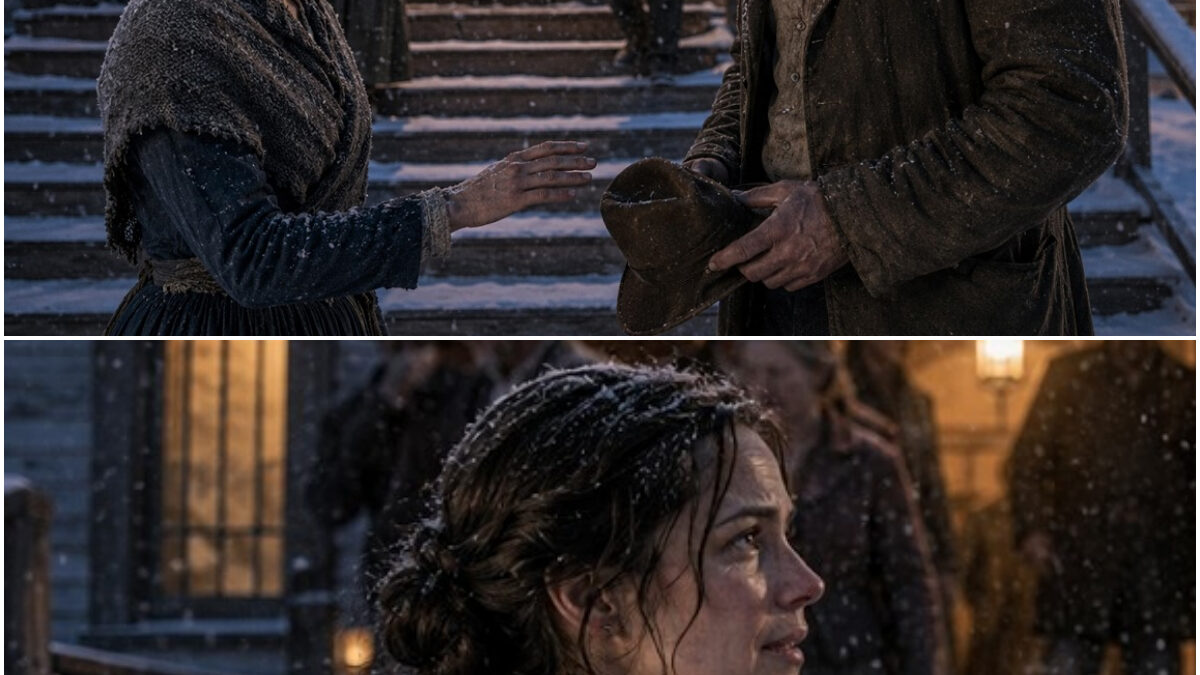
Caleb found her afterward on the church steps, snow still melting off both their coats.
“You’ve got your trunk back,” he said.
“Your name back, too, near as anybody in this town can give it.
I’ve got very little else.”
She looked at her own hands, chapped and empty.
“I have no family left, Mr. Whitfield.
Not one name I could write a letter to, not one soul obliged to claim me.
I don’t know what I’m meant to do with that.”
Caleb turned his hat over once in his hands, the closest thing to nervousness she had ever seen in him.
“Funny,” he said, “my children need a mother.”
She looked up at him.
“Not a hired woman who leaves by dark,” he said.
“A mother, a wife, if you’ll have the offer.
With a preacher standing right there to make it proper.
Same as you told me the first night I met you.
I’ve got a ring my mother left me, and two children who already call you something they’re not supposed to say out loud yet, and a house that’s been half empty two winters too long.”
Nell did not cry and did not shout and did not say a great deal at all.
She only went very quiet and reached for his hand, and that quiet said more than any speech either of them could have made.
When Caleb spoke of Mary that evening, telling Nell for the first time the color of his first wife’s eyes and the sound of her laugh, his voice held steady all the way through it, the way a man’s voice holds when a wound has finally begun closing over instead of tearing open again.
They were married in the spring in the same church hall where Vane’s fraud had come undone, with the whole town in attendance, and Mrs. Coulter herself bringing a cake she’d baked without being asked.
The Whitfield ranch hosted a barn dance not 2 weeks later, the first real celebration Bitter Creek had seen in a hard year, and Nell stood in the doorway of a house that was at last entirely her own, watching neighbors who had once denied her credit now line up to shake her husband’s hand.
It was Thomas who noticed first out by the fence that Sarah was laughing, really laughing, the high unguarded sound of a child who had set down a weight she’d been carrying so long she’d forgotten what walking felt like without it.
And it was Nell who heard it 3 days after the wedding, brushing out the girls’ hair by lamplight the way she had that first winter evening.
“Mama,” Sarah said, plain and clear and entire, no catching, no swallowing it back.
“Will you sing the washing song?”
Nell’s hands went still in the girls’ hair only a moment before she began to hum, low and even, the same tune two mothers had carried across two different griefs to meet in one kitchen.
Outside, the last of the snow was going soft and gray in the yard, and Caleb stood on the porch step with Thomas beside him, both of them quiet, watching the lamplight move behind the window glass, and neither one of them said a single word, because there was nothing left that needed saying out loud.
Thank you for spending this time with me.
I hope this story stayed with you.
If it did, I’d love to hear what part touched you the moSt. Leave me a comment below.
I read far more of them than you might think, and many of your comments inspire future stories.
If you haven’t subscribed yet, I’d be honored if today was the day you joined us here on Ben’s Frontier Chronicles.
Every new subscriber helps these stories reach another person who still enjoys thoughtful, character-driven Western tales.








