What China Found On the Moon’s Dark Side (They Cut The Feed)
What China Found On the Moon’s Dark Side (They Cut The Feed)
There is something buried beneath the moon that should not be there.
It lies beneath the largest impact crater in the solar system, a mass so dense that it’s deforming the lunar surface by more than half a mile.
We know it’s there because the moon’s gravity gives it away.
And in 2019, China landed directly above it.

What China uncovered doesn’t align with existing models of the moon’s interior.
So, in this video, we’re looking at what China actually found on the dark side of the moon.
The other face of the moon, the one we can’t see from Earth, is called the far side.
Some people call it the dark side, but that’s a bit misleading.
The term doesn’t refer to darkness in the sense of light.
It refers to mystery.
Because we can’t see it, we can’t communicate with it.
Radio signals travel in straight lines.
When you send a signal from Earth to a spacecraft on the far side of the moon, that signal is blocked by 2,000 km of solid rock.
There’s no way around it.
The moon itself acts as a barrier.
This is why no spacecraft had ever landed on the far side until 2019.
It’s not that we lacked the technology to get there.
It’s that we lacked the ability to control a spacecraft once it arrived.
The solution is a relay satellite.
In 2018, China launched Queqiao, which means Magpie Bridge.
The name comes from a Chinese folk tale about two lovers separated by the Milky Way.
Once a year, magpies form a bridge with their wings, allowing the lovers to reunite.
Queqiao was designed to do something similar for spacecraft and Earth.
The satellite doesn’t orbit the moon.
Instead, it sits at a special point in space called the Earth-Moon L2 Lagrange point.
This is a location about 65,000 km beyond the moon, where the gravitational forces of Earth and the moon balance out.
A satellite placed there can see both Earth and the far side of the moon at the same time.
The idea isn’t new.
It was first proposed in 1966 by Robert Farquhar for the Apollo program, but no relay satellite was ever launched for Apollo.
The far side remained unexplored.
China was the first to make it work.
On May 20th, 2018, Queqiao launched from the Xichang Satellite Launch Center.
It took 24 days to reach L2 using a gravity assist at the moon to save fuel.
On June 14th, it entered its final orbit and became the first lunar relay satellite ever placed at that location.
Everything was ready.
7 months later, Chang’e 4 began its descent.
The landing site was the Von Kármán crater, located inside the much larger South Pole-Aitken Basin.
The South Pole-Aitken Basin is not just large, it’s the largest confirmed impact structure in the solar system.
It’s roughly 2,500 km in diameter.
That’s about the distance from Texas to Washington, D.C.
The crater is so big that you can’t see all of it at once, even from orbit.
It formed approximately 4 billion years ago when a massive object, possibly the size of a small planet, collided with the moon.
The impact was so violent that it may have excavated material from depths as great as 200 km below the surface.
Scientists believe the collision might have exposed the moon’s mantle, the layer between the crust and the core.
If true, this would make the basin one of the best natural laboratories for studying the moon’s interior composition.
But there’s something else down there.
In 2019, researchers at Baylor University analyzed data from NASA’s Gravity Recovery and Interior Laboratory mission, known as GRAIL.
The mission used two spacecraft orbiting the moon to measure subtle changes in its gravitational field.
When they combined that data with topography measurements from the Lunar Reconnaissance Orbiter, they found something unexpected.
Deep beneath the floor of the South Pole-Aitken Basin, there is a massive concentration of material.
The anomaly is so dense that it’s weighing the basin floor down by more than half a mile.
Peter James, the lead author of the study, described it this way.
Imagine taking a pile of metal five times larger than the Big Island of Hawaii and burying it underground.
That’s roughly how much unexpected mass they detected.
There are two possible explanations.
One is that the metal core of the asteroid that created the basin is still embedded in the moon’s mantle.
Computer simulations suggest that under the right conditions, an iron-nickel core could be dispersed into the upper mantle during an impact and remain suspended there for billions of years.
The other possibility is that the mass represents a concentration of dense oxides that formed during the final stages of the moon’s magma ocean solidification.
Either way, it’s strange.
And it’s exactly where China decided to land.
Chang’e 4 entered lunar orbit on December 12th, 2018.
For 3 weeks, it circled the moon, refining its trajectory, and preparing for the final approach.
The landing was scheduled for early January, but the exact timing was kept secret.
Prior to confirmation, many details of the mission had not been disclosed.
On January 3rd, 2019, at approximately 2:30 in the morning GMT, Chang’e 4 began its descent.
Starting from an altitude of 15 km, the spacecraft used a rocket booster to decelerate.
This is normal for lunar landings.
There’s no atmosphere on the moon, so parachutes don’t work.
You have to burn fuel to slow down.
At 100 m above the surface, the probe briefly hovered.
Using a high-tech camera and laser measurements, it scanned the terrain below, identifying obstacles, and measuring slopes.
The surface of the moon is not smooth.
It’s covered with rocks, boulders, and impact craters of all sizes.
Landing in the wrong spot could mean disaster.
Chang’e 4 selected a relatively flat area and resumed its descent.
It touched down softly in the Von Kármán crater at 2:26 GMT.
The first close-up images of the far side began transmitting through Queqiao shortly after.
NASA Administrator Jim Bridenstine called it an impressive accomplishment.
Martin Wieser, a scientist at the Swedish Institute of Space Physics, said it was uncharted territory and that made it very exciting.
But the landing was only the beginning.
After the solar panels and antennas were deployed, mission control in Beijing prepared to release the rover.
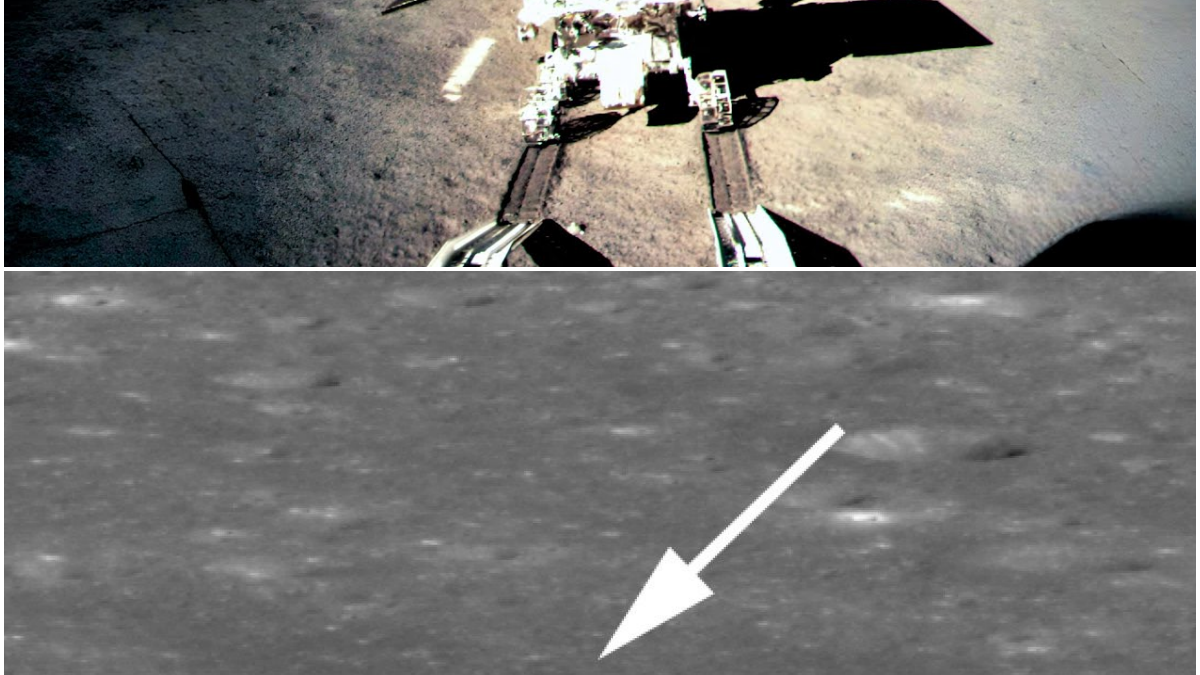
The rover’s name is Yutu-2, which means Jade Rabbit in Mandarin.
It’s the second rover China has sent to the moon.
The first, Yutu, landed on the near side in 2013.
Yutu-2 is small.
It weighs about 140 kg and stands roughly 1 m tall.
It moves slowly, traveling at a maximum speed of 200 m per hour, but it’s equipped with sophisticated instruments.
A panoramic camera, a ground-penetrating radar, a visible and near-infrared spectrometer, and an advanced small analyzer for neutral atoMs. Its mission is simple.
Drive around, take pictures, analyze the soil and rocks, send everything back to Earth, and then it found something unexpected.
In the early 2022, scientists analyzing images from Yutu-2 noticed something unusual on the surface.
Two translucent glass spheres sitting on the dusty lunar regolith.
They were small, between 15 and 25 mm in diameter, roughly the size of marbles, but they were different from anything that had been found on the moon before.
Glass has been spotted on the moon in the past.
The Apollo astronauts brought back samples of it.
NASA’s Apollo 16 mission found glass chunks near an impact crater on the near side, some as large as 40 mm in diameter, but those samples were opaque, dark, solid.
The spheres found by Yutu-2 were translucent.
You could almost see through them.
They glistened against the dry, gray landscape like small pearls.
Zhiyong Xiao, a planetary geologist at Sun Yat-sen University and one of the lead scientists on the Chang’e 4 mission, said the globules simply blew their minds.
They were so unique on the moon.
Glass forms minerals are rapidly superheated.
On the moon, this typically happens during a high-speed impact.
When a meteorite strikes the surface, it vaporizes rock.
The molten material is thrown into the air, and as it cools in the vacuum of space, it solidifies into glass.
Scientists call these microtektites.
They’ve been found on Earth around impact sites.
Upon being struck by a meteorite, chunks of planetary crust are thrown up into the air.
The molten silicate minerals contained within combine to form tiny glass beads that are sprinkled over the surrounding landscape.
The microtektites discovered by Yutu-2 are larger than those typically found on Earth, but they’re smaller than the glass chunks found by Apollo 16.
And they’re transparent.
The researchers believe the spheres were made from anorthosite, a feldspar-rich igneous rock that melted and reformed in the immediate aftermath of a meteor collision.
Anorthosite is common on the moon’s surface, especially in the highlands.
But, what’s interesting is what this discovery suggests about the moon’s composition.
Xiao described the spheres as the first discovery of macro-sized translucent glass globules on the moon.
He said it confirms that lunar anorthosites are excellent raw materials to manufacture glasses with good light-emitting quality.
That might not sound significant, but think about what it means for future exploration.
At the dawn of constructing human bases on the moon, lunar anorthosites are a promising and widespread resource.
If astronauts can produce glass locally, they won’t need to transport it from Earth.
Windows, lenses, solar panels, all of these could be manufactured on the moon using materials already there.
But, the glass spheres weren’t the only discovery.
Yutu-2 also detected something in the soil.
In 2021, Chinese researchers analyzing samples brought back by the Chang’e-5 mission made an announcement.
They had discovered natural few-layer graphene in lunar soil.
This was the first time graphene had been confirmed on the moon.
Graphene is a form of carbon made up of a single layer of atoms arranged in a honeycomb structure.
It was first isolated in 2004 by Andre Geim and Konstantin Novoselov, who later won the Nobel Prize in physics for the discovery.
Graphene is incredibly strong.
It conducts electricity better than copper.
It’s one of the thinnest materials known to exist, and now it’s been found on the moon.
The samples analyzed came from the Oceanus Procellarum region on the near side collected by Chang’e-5 in December 2020.
But, the discovery has implications for the entire moon, including the far side.
Researchers used a variety of to confirm the presence of graphene.
Scanning electron microscopy, Raman spectroscopy, high-resolution transmission electron microscopy.
They found graphene embedded as individual flakes ranging from two to seven layers thick.
In some cases, the graphene formed a shell structure enclosing a core of complex minerals.
This suggests a bottom-up synthesis process.
The graphene wasn’t created by exfoliation, where layers are separated from graphite.
Instead, it was formed through a high-temperature catalytic reaction.
The researchers proposed that the graphene may have been created during volcanic eruptions in the moon’s early history, or it could have formed through interactions with the solar wind, which carries high-energy particles that can stir up lunar soil and generate plasma discharge on the surface.
Iron-containing minerals, such as olivine and pyroxene, may have acted as catalysts, helping transform carbon atoms into graphene.
Meteorite impacts, which create high-temperature and high-pressure environments, could also have contributed.
What makes this discovery significant is what it tells us about the moon’s history.
For decades, scientists believed the moon was carbon-depleted.
Samples brought back by the Apollo missions showed that the moon had much less carbon than Earth.
This supported the giant impact hypothesis, the theory that the moon formed when a Mars-sized object called Theia collided with Earth about 4 and 1/2 billion years ago.
The intense heat from the collision would have vaporized volatile elements, including carbon, leaving behind a carbon-poor body.
But, the discovery of graphene, along with recent observations of carbon ion fluxes emanating from the moon, suggests there may be indigenous carbon present.
That challenges the existing consensus.
Wei Zong, a professor at Jilin University and one of the lead researchers, said the finding may reinvent the understanding of chemical components, geographic episodes, and the history of the moon.
It also opens up new possibilities for lunar exploration.
If graphene is abundant on the moon, it could be used to manufacture advanced materials for future bases, electronics, sensors, energy storage devices.
All of these could potentially be produced using lunar resources.
But, there’s more.
In 2024, another team of Chinese researchers announced they had discovered something even more unusual in samples from the far side.
Single-walled carbon nanotubes.
Carbon nanotubes are cylindrical structures made of rolled-up sheets of graphene.
They’re incredibly strong and lightweight.
They conduct electricity and heat extremely well.
Until recently, carbon nanotubes were thought to require artificial preparation.
They’ve been synthesized in laboratories for decades, but finding them in nature is extremely rare.
The discovery came from samples collected by the Chang’e-6 mission, which launched on May 3rd, 2024.
Chang’e-6 was China’s second sample return mission, following Chang’e-5.
But, this time the target was the far side.
Chang’e-6 landed in the Apollo Basin, a large crater within the South Pole-Aitken Basin, on June 1st, 2024.
It collected samples from the surface and returned them to Earth on June 25th.
The samples were analyzed using multiple spectroscopy and microscopy techniques.
The researchers identified single-walled carbon nanotubes formed through micrometeorite impacts and an iron-driven catalysis process.
The formation likely occurred under early volcanic activities and solar wind irradiation on the lunar surface.
This is significant for several reasons.
First, it demonstrates that carbon nanotubes can form naturally.
They’re not just laboratory creations.
They exist in nature, shaped by cosmic processes.
Second, it provides additional evidence of indigenous carbon on the moon.
The presence of both graphene and carbon nanotubes suggests that carbon is more abundant on the moon than previously thought.
And third, it challenges the idea that the moon is a dead, unchanging world.
The moon has a history.
Volcanic eruptions, solar wind interactions, meteorite impacts.
All of these processes have shaped its surface and created complex materials over billions of years.
But, perhaps the most intriguing discovery from the far side has nothing to do with carbon.
It has to do with the moon’s origin.
The moon is thought to have formed about 4 and 1/2 billion years ago when a Mars-sized object collided with the young Earth.
This object has been named Theia after the mythical Greek Titan, who was the mother of Selene, the goddess of the moon.
The collision was catastrophic.
Both Theia and the proto-Earth were turned into molten lava.
Most of Theia’s iron core sank into Earth’s core, but a significant portion of the mantle material from both bodies was ejected into orbit around Earth.
Over time, this debris coalesced and cooled to form the moon.
This is called the giant impact hypothesis, and it’s currently the favored explanation for the moon’s formation among astronomers.
Evidence for the hypothesis includes the fact that the moon’s orbit has a similar orientation to Earth’s rotation.
The stable isotope ratios of lunar and terrestrial rock are nearly identical, suggesting a common origin.
And the Earth-Moon system contains an unusually high amount of angular momentum compared to other terrestrial planets.
But, there are probleMs. One of the biggest is the moon’s composition.
If the moon formed primarily from Theia, as most models suggest, then it should have a different isotopic signature than Earth.
Theia would have formed in a different part of the solar system, where the building materials were slightly different.
But, the moon’s oxygen isotopes are essentially identical to Earth’s.
So are its titanium isotopes.
And its iron isotopes.
This doesn’t make sense, unless Theia and Earth formed in the same neighborhood.
In November 2025, a team of researchers led by Timo Hopp from the Max Planck Institute for Solar System Research published a study in the journal Science.
They examined the ratio of different iron isotopes in Earth and moon rocks with unprecedented precision.
They analyzed 15 terrestrial rocks and six lunar samples brought back by the Apollo missions.
The results confirmed what earlier studies had shown.
Earth and the moon are indistinguishable in their iron isotopic composition.
But, the team went further.
They used mass balance calculations to model different collision scenarios, testing various compositions and sizes for Theia and the proto-Earth.
Their conclusion was striking.
The most convincing scenario is that most of the building blocks of Earth and Theia originated in the inner solar system.
Earth and Theia were likely neighbors.
Theia probably formed closer to the sun than Earth, not in the outer solar system as some theories had suggested.
This has implications for understanding the early solar system.
It suggests that planetary collisions weren’t random events involving bodies from vastly different regions.
Instead, they were collisions between neighbors, objects that formed in similar environments from similar materials.
And it might explain why Earth and the moon are so similar.
But, it also raises new questions.
If Theia and Earth were neighbors, why did they collide?
What caused Theia to leave its stable orbit and crash into Earth?
One possibility is that Theia formed at a Lagrange point in Earth’s orbit, similar to where Queqiao sits today.
Lagrange points are stable, but only up to a certain mass.
Once Theia grew large enough, gravitational perturbations from other planetesimals could have destabilized its orbit, sending it on a collision course with Earth.
Another possibility is that a second collision occurred earlier, setting Theia spinning fast enough to alter its trajectory.
We may never know for certain, but what we do know is that the collision changed everything.
It gave Earth its moon.
It tilted Earth’s axis, creating seasons.
It sped up Earth’s rotation, shortening the length of a day, and it may have created the conditions necessary for life.
The South Pole-Aitken Basin is not just the largest impact structure on the moon.
It’s also one of the oldest.
Radiometric dating of lunar zircon suggests the basin formed approximately 4.338 billion years ago, during a period known as the Pre-Nectarian Epoch.
This was a time of heavy bombardment in the inner solar system.
Asteroids and comets left over from the formation of the planets were still crashing into everything in sight.
Earth was bombarded, too.
But unlike the moon, Earth has active geological processes, plate tectonics, erosion, volcanism.
These processes erase the evidence of ancient impacts.
The moon, on the other hand, is geologically quiet.
Its surface changes slowly.
Impact craters from billions of years ago are still visible.
This makes the moon a kind of archive, a record of what the early solar system was like.
Understanding the timing and intensity of the bombardment is important.
That was going on about the same time that life appeared on Earth.
Scientists are trying to work out the exact sequence.
Did the bombardment create the conditions for life?
Or did life emerge despite the bombardment?
The Earth has lost its record of that very early time, but the moon hasn’t.
Dating when the South Pole-Aitken Basin was created could help narrow down the window for the period of heavy bombardment.
And that could help us understand when and how life began.
This is why the basin is such a scientifically significant location, and it’s why China keeps going back.
On March 20th, 2024, China launched a new relay satellite called Queqiao 2.
The original Queqiao satellite had exceeded its designed lifespan.
Queqiao 2 was built to take over communications relay services for Chang’e 4, which is still operating on the far side, and to support future missions.
Compared to the first Queqiao satellite, Queqiao 2 has enhanced functionality, innovative features, and more intricate designs.
It also carries multiple instruments for scientific exploration.
The deployment of Queqiao 2 is a key step for China’s future lunar exploration missions, including Chang’e 7 and Chang’e 8.
Chang’e 7 is scheduled to launch around 2026.
Chang’e 8 will follow around 2028.
Together, they will form the basic model of a lunar research station to carry out lunar environment exploration.
But before that, there was Chang’e 6.
On May 3rd, 2024, Chang’e 6 launched from the Wenchang Space Launch Center.
Its mission was to collect samples from the far side and return them to Earth.
It was the first sample return mission from the far side of the moon.
On June 1st, 2024, at 22:23 UTC, Chang’e 6 touched down in the Apollo Basin, located within the South Pole-Aitken Basin.
The lander deployed a small rover called Jinchan to conduct infrared spectroscopy of the lunar surface and photograph the lander.
On June 3rd, at 23:38 UTC, the ascender launched back to lunar orbit, carrying samples collected by the lander.
It completed a robotic rendezvous and docking in lunar orbit, transferring the sample container to the returner.
On June 25th, 2024, the returner landed in Inner Mongolia, completing China’s far side sample return mission.
The samples are now being analyzed.
And what they contain could change everything.
Let’s step back and review what China has discovered on the far side of the moon.
Translucent glass spheres formed by ancient meteor impacts.
Evidence that lunar anorthosites can be used to manufacture high-quality glass.
Natural graphene embedded in the soil, the first confirmation that this wonder material exists on the moon.
Single-walled carbon nanotubes formed through micrometeorite impacts and iron-driven catalysis.
Evidence of complex chemical processes occurring on the lunar surface over billions of years.
And samples from the oldest, deepest impact basin in the solar system containing material that may have come from the moon’s mantle.
All of this information is helping scientists understand the moon’s formation, its geological history, and its potential as a resource for future exploration.
But there’s something else, something that hasn’t been fully explained.
In May 2019, scientists announced the discovery of a large mass of material deep within the South Pole-Aitken Basin, a concentration of density so extreme that it’s pulling the crater floor downward.
The leading theory is that it’s the metal core of the asteroid that created the basin, still embedded in the moon’s mantle after 4 billion years.
But that’s just a theory.
Another possibility is that the mass represents a concentration of dense oxides formed during the moon’s magma ocean solidification.
Or it could be something else entirely.
China has now landed in that basin three times.
Chang’e 4, Chang’e 6, and potentially Chang’e 7 inches in the near future.
They’ve collected samples.
They’ve analyzed the soil.
They’ve mapped the terrain.
And so far, they haven’t said what they think the anomaly is.
That doesn’t mean they’re hiding anything.
It means the data is still being analyzed.
Science takes time, but it does raise questions.
What if the anomaly isn’t just metal from an asteroid?
What if it’s something more complex?
What if the collision that created the South Pole-Aitken Basin exposed material from deep within the moon’s interior, material that tells a different story about how the moon formed?
What if the moon isn’t quite what we think it is?
There’s another puzzle about the moon that scientists have been trying to solve for decades.
The two sides of the moon look completely different.
The near side, the one we can see from Earth, is covered with dark maria.
These are vast plains of solidified lava that filled ancient impact basins billions of years ago.
The far side has very few maria.
Instead, it’s heavily cratered with thicker crust and a more rugged appearance.
Scientists have wondered about this asymmetry for years.
Why are the two sides so different?
One theory is that the South Pole-Aitken impact is responsible.
The collision would have added a tremendous amount of energy to the moon’s interior processes.
The flood of heat could have concentrated heat-generating and rare earth elements on the moon’s near side, producing a prolonged volcanic environment that created the vast plains of magma.
This would explain why the near side has so many maria, while the far side does not.
But there’s another theory.
In 2011, researchers suggested that a second, smaller moon may have formed alongside our moon during the giant impact.
This smaller moon, about 1,000 km in diameter, would have remained in orbit for tens of millions of years before slowly colliding with the far side.
The collision would have been at a low enough velocity that it didn’t form a crater.
Instead, the material from the smaller moon would have spread across the far side, adding a thick layer of crust.
This would explain why the far side’s crust is so much thicker than the near side’s.
However, mapping by the GRAIL mission has ruled out this scenario.
The data doesn’t support the existence of a second moon, so the mystery remains.
Why are the two sides of the moon so different?
What process created this asymmetry?
The answer may lie buried beneath the South Pole-Aitken Basin, and China may be the first to find it.
Here’s what we know about the moon’s composition.
The crust is made primarily of anorthosite, a light-colored rock rich in the mineral feldspar.
This rock formed when the moon’s surface was covered by a global magma ocean billions of years ago.
As the magma cooled, lighter minerals floated to the top and solidified into the crust.
Beneath the crust is the mantle, composed of denser rocks rich in iron, magnesium, and calcium.
These rocks are similar to Earth’s mantle, but not identical.
At the center is a small iron-nickel core.
The core is much smaller than Earth’s core, accounting for only about 1.6 to 1.8% of the moon’s total mass.
This is one of the reasons the moon is less dense than Earth.
But the South Pole-Aitken Basin might give us access to something we’ve never seen before, the mantle.
If the impact that created the basin excavated material from depths as great as 200 km, then rocks from the mantle should be exposed on the surface.
Analyzing those rocks could tell us what the moon’s interior is made of.
It could reveal whether the moon formed hot or cold.
It could show us whether the moon ever had a magnetic field, and if so, when it disappeared.
It could answer fundamental questions about the moon’s origin and evolution.
And that’s exactly what China is trying to do.
China’s lunar exploration program has drawn significant attention from the international scientific community.
NASA administrator Jim Bridenstine praised the Chang’e 4 landing as an impressive accomplishment.
The European Space Agency’s ExoMars probe, in orbit around Mars, photographed the interstellar object 3I Atlas as it passed by, demonstrating international co- operation in space observation.
But there’s also been tension.
In 2011, the US Congress passed a law that effectively bans NASA from working with China on space projects without explicit approval.
The law was intended to prevent technology transfer and protect national security, but it’s also slowed down scientific collaboration.
China has responded by working with other international partners.
The Chang’e 4 mission carried instruments from Germany, Sweden, and Saudi Arabia.
The Queqiao relay satellite includes a Dutch radio astronomy experiment.
And China has stated that it’s willing to share data from its lunar missions with other countries.
In fact, China has initiated an application process for researchers worldwide to study the lunar samples gathered by the Chang’e 5 mission.
They’ve also welcomed other countries to cooperate in China’s future lunar and planetary exploration projects.
This includes the use of the Queqiao relay satellite.
China has agreed to requests from NASA to use Chang’e 4 and Queqiao for future US moon missions.
The far side of the moon is becoming an international destination, and the discoveries being made there belong to all of humanity.
China’s lunar exploration program is accelerating.
Chang’e 7, scheduled for launch around 2026, will focus on exploring the lunar South Pole region.
This area is of particular interest because it may contain water ice in permanently shadowed craters.
Water is essential for future human exploration.
It can be used for drinking, growing food, and producing rocket fuel.
If water ice is abundant in the South Pole region, it could make long-term human habitation on the moon feasible.
Chang’e 8, scheduled for launch around 2028, will test technologies for in situ resource utilization.
This means using materials found on the moon to build structures, produce energy, and manufacture tools.
Together, Chang’e 7 and Chang’e 8 will form the basic model of a lunar research station.
China has also announced plans to establish a more permanent lunar base by 2029.
The exact details haven’t been released, but the goal is clear.
China wants a sustained human presence on the moon, and they’re not alone.
NASA’s Artemis program aims to return humans to the moon in the next few years, with a focus on the South Pole region.
The European Space Agency, Russia, Japan, and India are all planning lunar missions.
The moon is becoming the center of a new space race.
But this time, it’s not just about planting flags.
It’s about building infrastructure, establishing research stations, preparing for deeper exploration of the solar system, and it’s about answering fundamental questions.
Where did the moon come from?
How did it form?
What is it made of?
What secrets are buried beneath the South Pole-Aitken Basin?
What else is waiting to be discovered on the far side?
Let’s address the elephant in the room.
There are rumors that China cut the live feed during the Chang’e 4 landing, that they saw something unexpected and didn’t want the world to know.
There are rumors that the glass spheres are evidence of something artificial, that the carbon nanotubes couldn’t have formed naturally, that the anomaly beneath the South Pole-Aitken Basin is not what scientists claim.
These rumors are not supported by evidence.
The Chang’e 4 landing was not broadcast live in the traditional sense.
Many details of the mission, including the exact timing of the landing, were kept secret beforehand.
This is standard practice for Chinese space missions.
But the data from the mission has been shared with the international scientific community.
The images from Yutu 2 are publicly available.
The samples from Chang’e 5 and Chang’e 6 are being analyzed by researchers around the world.
There’s no evidence of a cover-up.
What China found on the far side of the moon is exactly what they’ve reported.
Glass spheres formed by meteor impacts, natural graphene and carbon nanotubes created through volcanic activity and solar wind interactions, ancient rocks from the oldest impact basin in the solar system.
These discoveries are significant.
They’re expanding our understanding of the moon’s composition, its history, and its potential as a resource for future exploration.
But they’re not mysterious in the sense of being unexplained.
They’re mysterious in the sense that every answer leads to more questions.
Why is the moon’s composition so similar to Earth’s?
What happened to Theia after the collision?
Why are the two sides of the moon so different?
What exactly is buried beneath the South Pole-Aitken Basin?
These are the questions that drive science forward, and these are the questions that will bring us back to the moon again and again.
The moon has been humanity’s companion for as long as we’ve existed.
It lights up our nights.
It pulls our tides.
It stabilizes our planet’s rotation, giving us seasons and a climate that allows life to thrive.
For most of human history, the moon was unreachable, a distant light in the sky, a subject of myths and legends.
Then we went there.
Between 1969 and 1972, 12 humans walked on the moon’s surface.
They collected rocks.
They took photographs.
They left footprints that will remain undisturbed for millions of years.
And then we left.
For more than four decades, no human has set foot on the moon.
But the moon hasn’t been forgotten.
Robotic missions have continued.
Orbiters have mapped every crater.
Landers have analyzed the soil.
Rovers have explored regions we’ve never seen before.
And slowly, piece by piece, we’re learning the moon’s secrets.
The discovery of water ice at the poles, the confirmation of indigenous carbon, the detection of a massive anomaly beneath the largest impact basin in the solar system.
Each discovery changes our understanding.
What we thought we knew about the moon is constantly being revised.
And that’s the beauty of science.
Science doesn’t claim to have all the answers.
It claims to have a method for finding them.
Sometimes the data confirms what we expected.
Sometimes it doesn’t.
Sometimes it reveals something completely unexpected.
And when that happens, we have to rethink everything.
That’s what’s happening now with the moon.
The discoveries from the far side are forcing us to reconsider the moon’s origin, its evolution, and its relationship to Earth.
They’re showing us that the moon is not a dead, unchanging world.
It’s a dynamic, complex with a history as rich and complicated as Earth’s.
And we’re only just beginning to understand it.
China is not done with the far side.
Chang’e 7 and Chang’e 8 are just the beginning.
Plans for a permanent lunar research station are already underway, and China is not alone.
The United States, Russia, India, all are planning missions to the moon in the coming years.
The far side, once the most inaccessible place in the solar system, is about to become one of the most visited.
And with each mission, we’ll learn more.
We’ll collect more samples.
We’ll analyze more rocks.
We’ll map the terrain in higher resolution.
We’ll drill deeper into the surface.
We’ll study the anomaly beneath the South Pole-Aitken Basin.
We’ll search for clues about the moon’s formation and the collision that created it.
We’ll look for water ice.
We’ll test new technologies.
We’ll prepare for the day when humans return to the moon to stay.
And maybe, just maybe, we’ll find something we didn’t expect.
Something that changes everything, because that’s what exploration is about, not finding what you’re looking for, but being ready for what you find.
So, what did China find on the dark side of the moon?
They found glass spheres formed by ancient meteor impacts, evidence that the moon’s surface is rich in materials that could be used to build future habitats.
They found natural graphene and carbon nanotubes, proof that complex chemical processes are still occurring on the lunar surface billions of years after its formation.
They found rocks from the oldest impact basin in the solar system, samples that may contain material from the moon’s mantle and reveal secrets about its origin.
And they found a mystery, a massive concentration of material buried deep beneath the surface, an anomaly so dense it’s dragging the crater floor downward, an anomaly that might be the metal core of an ancient asteroid or something else entirely.
We don’t know yet, but we will.
Because the far side of the moon is no longer hidden from us.
We’ve landed there.
We’ve explored it.
We’ve collected samples and brought them home, and we’re going back.
The feed didn’t cut.
The discoveries are real.
And the journey is just beginning.
For now, all we can do is watch the data come in, study the samples, build our models, test our theories, and wait for the next mission.
Because every time we think we understand the moon, it surprises us.
Every answer brings another question.
And that’s how science moves forward, one discovery at a time.
The moon is waiting, and so are we.








