Man Rescues A Bigfoot Baby – But What The Mother Bigfoot Does Next Will SHOCK You!
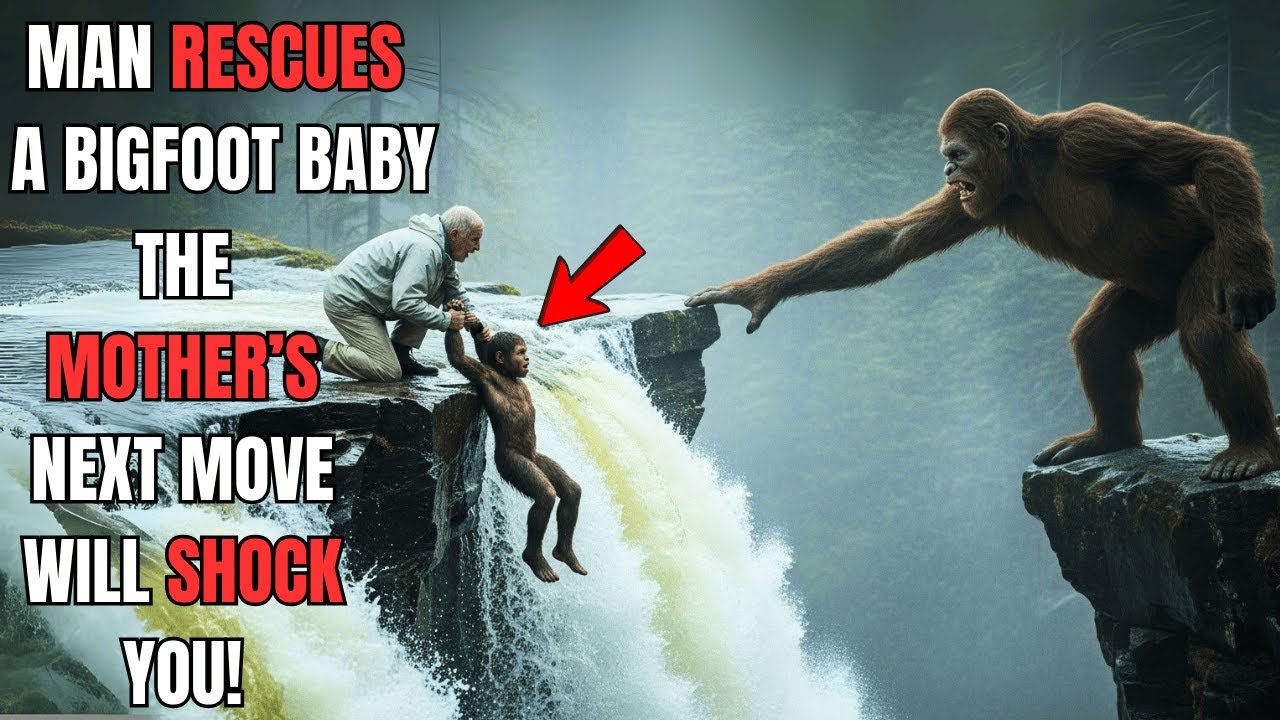
Man Rescues A Bigfoot Baby – But What The Mother Bigfoot Does Next Will SHOCK You!
Have you ever heard of a man who’s lived deep in the Montana woods for 47 years?
And every night he places a bowl of water at the edge of the forest for a creature the world believes doesn’t exist.
He’s not running from the world.
He’s remembering a winter morning when a dying young Bigfoot, barely breathing, was trapped beneath a frozen stream.
And how out of the trees, its elder, a towering matriarch, stepped forward, not to attack, but to help him save the young one.
No words, just a silent pact.
Handprints in ash, smoothed riverwood at his door, and thin lines of soot marking boundaries no man crosses.
I’ve spent months tracking whispers from the Frostline region, and I found it.
Smoothed driftwood markers that locals say only appear when a forest has accepted you.
In this story, you’ll witness a bond like no other, a man and a myth building trust through ritual.
You’ll see how kindness given without demand can echo back from the wild.
And you’ll follow the quiet return of his daughter, drawn back by the very silence she once fled.
A local reporter once wrote just one line.
The man who leaves water for the woods.
No headline.
No Bigfoot.
Just that.
Don’t scroll.
When this winter ends, their tracks will vanish.
And if you miss this, you may never understand why the forest chose Harland Pike.
At the edge of the world, where winter clung to the earth like breath on glass, a sound rose up through the gorge.
Low, drawn out and living.
Not wind, not water, something deeper.
Boon froze first.
His ears went stiff, head tilted, breath cut short mid pant.
Harlon Pike felt it before he understood it.
That pull in the ribs like someone whispering your name from behind a locked door.
The morning was all fog and melt.
Ribbons of mist curled around black furs and old stone.
The cascade of many voices thundered somewhere beyond, but it sounded far off, like a memory.
Harlon’s boots crunched over frostlaced moss, his gloved hand trailing along the rope coiled on his belt.
A piece from the old days, still smelling faintly of smoke and sap.
Boon started ahead, nose to the wind, weaving between ferns that clung to rock as the terrain sloped downward.
Harlon followed, eyes scanning for broken branches, old claw marks, scat, anything.
But it wasn’t sign they found.
It was the sound again.
Stronger this time, breath, but stretched long like a cello note drawn too slow.
It didn’t belong to anything he could name.
And yet it didn’t feel wrong.
He reached the bottom of the descent and saw it.
Near the base of the falls, a young creature lay half submerged.
Its leg pinned between two slick boulders.
Pale runoff from the thaw surged higher each minute, lapping over its chest.
Harlon didn’t breathe.
He didn’t blink.
Boon let out a low whimper.
It wasn’t a bear.
Wasn’t a child.
Its limbs were long, covered in damp, dark fur.
Its fingers, yes fingers, spled out from the rock, twitching faintly.
The head hung low, eyes shut tight, mouth slack with fatigue.
A curl of steam still rose from its back, alive, barely, and then he felt her.
To his left, high on the granite ledge, stood a massive figure, just still enough to blend with the treeine.
Her body was half turned, not squared off like a challenge.
Shoulders sloped, head tilted slightly, eyes locked on the same thing he saw.
She didn’t move, didn’t growl.
Harlland’s breath fogged the air.
His knees achd as he dropped the pack and fumbled for the rope.
He didn’t speak, didn’t look up again.
He planted the hook in the tree behind him, looped it tight, and clipped it to the harness just like he used to.
His fingers moved on memory.
The rope hissed through his gloves as he lowered himself toward the rocks, boots slipping once on the ice veined ledge.
The boulder was jammed in place, sharp at the edge.
When he tried to lift it, his foot lost purchase, and the full weight slammed down onto his shin.
Pain tore up his leg like fire.
He bit down on a curse.
Boon barked once, sharp and urgent.
Before Harlland could shift again, a shadow fell across the water.
She moved.
Matriarch North Wind, though he wouldn’t name her that until much later, descended the slope without a sound, her wide body angled, never fully facing him.
She reached the rock, planted a thick shoulder against it, and leaned in with a slow, muscular push.
The stone gave way with a crack.
Water surged in its place.
The child gasped.
She didn’t linger.
Just as quickly, she retreated back up the slope, back into the shroud of cedar and fog.
Harlon didn’t stop to watch her go.
He bent, gathered the cold, soden creature into his arms, its weight awkward, but not heavy.
It stirred weakly.
The face was more human than ape, though not either.
The eyes fluttered, but did not open.
Harlon laid it on a dry patch of moss, pulled a long strip from his flannel shirt, and tied a makeshift wrap around its foot.
The fur was coarse, wet.
The skin beneath was hot in some places, ice cold in others.
He pressed his fingers beneath the jaw, found a sluggish rhythm.
Boon stood close, blocking the wind with his body.
The old dog’s tail didn’t wag.
He was still as a statue, watching the trees.
And from the treeine came that breath again, long, deep, not labored this time, not urgent, just measured, as if saying, “You did it.”
And then it faded.
Harlon’s hands shook slightly as he adjusted the binding.
On his forearm, just visible through the pulled up sleeve, a white puckered scar gleamed in the mist.
The old burn from 78.
It ran from his elbow to his wrist like a riverbed long dried.
His hands trembled, but they held steady.
Still knew what to do.
The boy, no, not boy.
Frostling let out a soft weeze, eyes still shut, breath becoming steadier.
Harlon scooped him up again.
This time he didn’t feel heavy.
They climbed.
By the time they reached the cabin, the fog had thinned, but the quiet remained.
That hollow kind of quiet that only comes after the forest lets you go.
Harlon laid the creature down inside the storage shed, tucked dry rags around him, lit a lantern, and left the door slightly cracked for the air.
Boon sat by the porch steps, eyes on the woods, always the same spot, always listening.
Harlon leaned against the frame of the door.
His leg throbbed where the boulder caught it, but he didn’t sit.
Not yet.
His gaze moved to the rope still looped at his hip, stained now with river water and moss.
The harness buckle clicked as he undid it.
That breath, that low ribbon of sound, had been real, still echoed somewhere inside him.
He reached into his coat pocket and pulled out an old handkerchief, faded blue linen, fraying at the edges.
Not clean, not neat.
He wiped the dirt from his palms and paused, staring at the cloth a moment longer than needed.
Night fell slow inside the shed.
The creature’s breath stayed steady.
Outside the trees held their hush, and beneath the porch light in the muddy track that led from the edge of the woods.
Boon sniffed something invisible.
His ears tilted.
A small shape caught in the light.
Not a print, half of one, a wide toe curve.
No heel, just the front half pressed gently into the soft earth like someone had stopped just at the edge and then backed away.
Harlon knelt beside it, eyes narrowing.
No claw, no paw pad.
Five rounded ends, all uniform, but only the ball, only half a step, not an invitation, a boundary.
The dog didn’t bark.
The man didn’t speak.
And from the deep dark of the woods, nothing moved, but the faintest whiff of warm earth and riverstone curled in with the breeze.
The porch creaked behind them.
A silence settled over the clearing.
Heavy but not unkind, like someone waiting, not watching.
And Harlon, kneeling in the damp, found himself whispering words he hadn’t said in years.
Not to God, not to ghosts.
Just three words, soft as breath.
Still here, huh?
Boon’s tail gave one thump against the floorboards, and that was the only answer.
But it was enough.
The mist rolled thicker down from the falls, curling around the cabin like the hush of sleep.
Somewhere deep in the forest, beyond sight, beyond certainty, a breath like the turning of the earth itself, exhaled once more, and then was gone, but not forgotten, not by the man who’ held the rope, not by the one who’d pushed the stone, not by the forest itself, and certainly not by the young one lying warm now beneath a borrowed roof, saved by an old fireman and a mother who’d never spoken a word.
Because sometimes in places too wild for words, trust starts with a breath and ends with a hand not yet shaken, but no longer clenched.
By morning, the storm had cleared, but the air still held the taste of ash and thaw.
The forest was quiet in that uneasy way.
Like a crowd that had just watched something sacred happen and wasn’t sure if it should clap or bow its head.
Harlon woke before the sun, not from any noise, just something in the stillness.
Boon had slept at the foot of the shed all night, head tucked to flank, unmoving.
The dog didn’t stir when Harlon stepped out, just opened one eye, then let it fall closed again.
The sky was washed in pale amber, the kind of light that feels like it shouldn’t last.
Cold air slid down from the ridge, carrying the scent of wet bark and something else he couldn’t name on the door of the storage shed just above the latch.
He saw it.
A dark smudged print, open palm flat against the wood.
Not smeared, not clawed, not childlike.
Long fingers, widespread, each mark pressed with deliberate care, as if saying, “I see you.
I was here.
I’m not hiding.”
Harlon stared for a long time.
He didn’t touch it.
Inside the shed, the young one still breathed in slow, shallow waves.
The old wool blanket had dried at the edges.
His fur held the scent of pine smoke and damp stone.
Harlon turned back toward the porch.
Boon was up now, sniffing at the edge of the step.
Tail low.
That’s when Harlon saw the second sign.
On the bottom stair, where the wood met lay a piece of driftwood, smooth, pale, worn by water, not carved, not shaped, just placed.
Not across the step, not in front of the door, parallel to the edge, as if to say, “We’ll stand beside.”
Not before.
He didn’t move it.
Didn’t pick it up.
Just looked at Boon.
The dog sniffed at once, then turned away without a bark.
That told Haron more than anything.
By midm morning, the clouds had thinned.
Wind came in crisp from the west, carrying the smell of dry bark and distant fire pits from Red Lodge down the slope.
Harlon pulled the broom from beside the shed and began sweeping pine needles off the porch like it was any other day.
But it wasn’t.
Near the edge of the boards, right along the line where shadow met sun, he saw the third message.
A line of ash, not thick, not straight, a broken thread of soot, thin as a pencil mark running just a few inches from the porch’s edge.
It hadn’t been there last night, not when he came in, and it hadn’t been made by fire.
No scorch, no drag.
A trail drawn by hand or finger.
Boon sniffed along the line, then sat down right behind it.
Didn’t cross, didn’t bark, just waited.
Harlon crouched, brush in hand, and swept lightly at the far edge of the ash line.
Not hard enough to erase, just enough to see what might happen.
Nothing did, but Boon’s ears shifted, just slightly, and Harlon stood up, dusted his hands on his pants, and stepped back inside.
The message had been left, and so had the boundary.
By afternoon, the light had gone bright and flat.
Snowmelt ran in little creeks through the trees.
Harlon took his time patching the hole in the shed’s back wall, pretending not to glance every few minutes toward the forest, pretending not to notice the way Boon still sat right behind the ash line, guarding without guarding.
Inside, the frostling stirred once, turned in his sleep.
That evening, when the sky dipped orange and the trees caught fire in reflection, a new line of ash appeared.
This one was closer, still not touching the step, but not as far as before, and it bent just slightly, like an arc opening inward, not a circle, not a trap, more like a gate, half swung.
Harlon didn’t sweep it this time.
He stood there a long moment, broom hanging loose in his hand, watching the way the ash danced just slightly in the wind, never breaking.
Boon winded once, deep in his chest.
Then came the breath.
Low, far, same as the day before.
It carried through the trees like a sound meant for someone else, but finding you anyway.
Like hearing a voice say your name in a dream you weren’t supposed to remember, and then nothing.
No movement, no eyes in the trees, but the feeling stayed.
That night, when the moon rose behind a veil of thin cloud, Boon woke suddenly, not with a growl, just alert.
He looked toward the trees, ears forward, then back at Harlon.
The man opened the door.
Cool air rushed in, curling around his legs.
The ashline was still there.
And just beyond it, past the edge of the lantern glow, a shape moved, tall, broad, silent.
It did not step forward, did not test the line, just stood partially hidden by the trees.
A shadow among shadows.
Then it moved sideways, not back, not forward, just across.
Enough to show it had come.
Enough to say, “I understand.”
And then it was gone.
No crack of branches, no footprints.
But in the morning, the ash had shifted.
Not scattered, not blown.
Just a small, deliberate curl at the edge of the line closest to the door, as if someone had taken a single finger and drawn it inward.
Half an inch, maybe less, but enough.
Boon sniffed it once, then stepped back without prompting.
Harlon stood there in the doorway, the broom in one hand, the old blue handkerchief in the other, folded tight.
He didn’t say anything.
Didn’t need to.
The line wasn’t a threat.
It was a language, one he hadn’t heard before, but understood all the same.
And when he looked up toward the trees again, he didn’t see her.
Didn’t need to, because the line was still there.
The breath was still fresh in his memory.
And in the middle of the line, a small stone, smooth, watershaped, no bigger than a child’s palm, sat just off center.
He hadn’t put it there, but he didn’t move it.
He just stepped back, laid the broom by the wall, and left the door slightly open.
The wind moved through the trees with a low hush, like someone dragging a coat through snow.
And though night came heavy and Boon slept light, there were no more sounds, no more breath, just that line of ash and the memory of a hand flat against wood, a hand that had said everything without making a sound, and a silence that somehow felt like the start of a conversation.
By late afternoon, the light had changed.
Not just the color, though that too had gone grayer, deeper, but the weight of it.
It pressed differently through the branches now, angled low and thick, dusting everything in a sort of quiet warning.
The air was damp and cold, but not from snow.
It was that spring kind of cold, the kind that pulled up old smells from the ground, wet dirt, burnt pine, things that had no reason to come back, but did anyway.
Harlon noticed the smell first, then the wind shifted, and Boon stopped walking.
They had taken the south trail, the one behind the cabin that curved around a thicket of larch before dropping into the old ravine.
Harlon hadn’t meant to go far, just far enough to stretch the stiffness from his leg.
It still achd from where the stone had landed.
A low hum now, not sharp, but steady.
Familiar pain.
Nothing worth complaining about.
He carried no rifle, just his gloves, a small thermos of black coffee and the old leather gloves tucked half out his back pocket.
The ones with the seams blown at the knuckles.
The ones he never bothered to fix.
Boon paused near a moss slick stump and sniffed the air with a sudden sharpness.
Harlon stopped too.
He saw it then.
Not a shape, not a sound, just the faintest trace of something brushed into the bark.
Jar.
Dark flex scattered in a loose line along the trunks just above root height.
Old soot, cold, no pattern, no trail of flame, just the remains of something already done burning.
He remembered this place.
The scar from the lightning strike 3 years ago, maybe four.
A dry summer, August heat, the kind of thunder that doesn’t flash, just rolls deep under the skin.
The fire hadn’t lasted long, but it had cut clean in a way fire knows how.
Boon trotted ahead, stepping over the blackened soil like he remembered, too.
The path led to a small clearing now ringed in tall grass and new undergrowth, but the center still bore the wound.
Charred roots, a dip in the land where the blaze had smoldered.
No sign of flame now, no heat, but ash lived long.
Harlon stepped closer.
The ground crackled under his boots.
That’s when Boon pawed at something.
A shape half buried in the soot.
Haron crouched slowly, knees creaking.
He brushed the ash aside with the edge of his glove.
And there it was, another piece of driftwood.
This one thicker, longer, smoothed on all sides, but strangely proportioned, rounded at one end, squared at the other, with a shallow groove down its center.
He held it in his hand.
It fit too well.
Not just the weight, the way the edges sat against his palm, like it had been worn down by someone who had hands like his.
Same length, same curve in the thumb.
No carvings, no marks, but it didn’t need them.
His fingers wrapped around it without thinking, and it stayed there.
Boon circled back, tail down, not scared, but uncertain.
Harlon didn’t speak, just sat back on his heels, the black powder of the burnt earth coating the knees of his jeans, his fingertips.
He looked at the piece again, rubbed his thumb along the groove, not a handle, not a toy, something that waited for meaning.
He pocketed it.
Not because he wanted to, because it had already been his.
Behind him, a dry twig snapped.
Not loud, but enough.
He turned quickly.
Nothing, just the trees and dust rising again, disturbed.
Only it wasn’t dust.
It was soot.
And in it, near the edge of the clearing, a footprint, too wide, too long, pressed into the ash like it had been left just seconds before.
But no one there, no trail in or out, no breeze to explain it.
Harlon walked over slowly, heart doing that thing it hadn’t done in years, thumping not with fear, but with the ache of something being remembered by something else.
The print was fresh, but strange, only the ball of the foot.
No heel, no deep edge, just front pressure, like whoever left it had paused, then stepped back again.
Boon whed, not a fearful sound, more a question.
Haron crouched again, reached toward the soot.
His fingers came back black.
That smell, that deep charcoal sweetness, clung to the cuticles and slipped under his nails.
He stood up and saw the trees.
One in particular, the lightning struck pine still standing barely.
Black scar up the center.
Old resin wound crusted at the sides.
He hadn’t been here since the storm.
He hadn’t wanted to.
That was the fire that had burned through the canyon wall and nearly taken Caleb Voss with it.
The kid had been a hot shot back then.
Fast, arrogant, good lungs, but no caution.
Haron had pulled him back from a collapsed ridge with less than 30 seconds to spare.
They never talked about it again.
He took a step forward, closer to the tree, the bark crumbled beneath his fingertips.
Beneath it, deep in the crack of the wood, something caught the light.
He reached in carefully and pulled out a second object.
Another piece of wood, smaller, thinner, sanded, perfectly round on one side, concave on the other.
But when he brought it close, it aligned with the first.
Two parts of a grip, half and half.
Both shaped by water, by time, by someone or something that knew how to wait.
He didn’t pocket this one, just stood there holding both in his palm, testing the weight.
The pieces clicked against each other, not magnetically, but familiarly, like they knew the other was missing, like they belonged.
The ash moved again, breeze whispering through the grass.
From the ridge behind him came the sound of boots.
Real boots, crunching gravel, stepping too hard.
Then the voice, “Didn’t expect to find you out here.”
Harland turned.
Caleb Voss stood halfway down the slope, arms crossed, eyebrows high.
He was older now, but not that much wiser.
What brings you here?
Harlon asked flatly.
Caleb shrugged.
I saw smoke.
Thought maybe it was one of the old fires kicking back up.
Guess not.
Harlon didn’t answer.
Caleb’s eyes scanned the clearing.
Stopped on the soot.
The footprints then narrowed.
What’s that?
Don’t know, Haron said.
But he did, and so did Caleb.
He stepped forward anyway.
Too fast.
Boon barked once sharp.
Caleb stopped.
Something out here with you?
Haron didn’t look at him.
Just stared back down at the object in his hand.
It’s not with me, he said.
It’s around.
He didn’t explain.
Didn’t know him that.
But Caleb lingered.
Saw the driftwood pieces.
Saw the smudges on Harlland’s fingers the way he stood.
Saw the soot trail behind him.
And something shifted in the kid’s face.
Less cocky now, more curious, but not quite brave.
You think it’s what people say?”
Caleb asked quieter.
“I think,” Harlon replied.
“You should be careful how you talk about things you don’t understand.”
A long pause.
Caleb nodded once.
Not agreement, just acknowledgement.
Then stepped back the way he came.
No more questions.
Not today.
When he was gone, the clearing felt fuller somehow.
Not quieter.
Fuller.
The kind of fool that only comes when you know someone’s listening, even if they never speak.
Harlon turned back to the tree, slid the driftwood pieces into his coat pocket, not far from his chest, right where breath meets bone, and on the tip of his index finger, a line of black soot curled beneath the nail, thin as a promise.
The wind picked up again, low, soft, a breath not quite heard, but felt, and the clearing exhaled, not with fear, but with memory, and the weight of something beginning, something that had waited for the right hands, and had found them.
The storm had just passed midnight.
It didn’t start with thunder, no warning roll, no lightning flash, just a sharp, sudden drop in pressure, like the forest exhaled too fast and forgot how to breathe in again.
The wind followed, long and dry at first, then whipping wild from the north, pulling snow sideways against the cabin like fists of gravel.
Boon stood by the door before Harlon even woke.
His tail was stiff, eyes locked to the woods.
The kind of look that didn’t ask for permission.
It just meant something’s coming.
By the time Harlon pulled his coat on, the windows were already fogged with breath from the inside and crusted with snow from the outside.
He cracked the door.
Cold bit into his jaw.
Snow flew horizontal.
Couldn’t see more than 10 ft ahead.
But the air the air carried something under the wind.
Something slow, rhythmic.
Not a voice, not a growl.
A breath.
And beneath that breath, something else.
A shape in the storm just beyond the edge of the porch light.
Harlon narrowed his eyes, squinted hard.
The snow eased for a beat, and he saw it, faint, but there drawn into the powder in front of the steps, dark against white.
An arc, a bent line, ash?
No.
This time it was soot mixed with melted snow.
A symbol traced carefully, a shape like an anchor.
But the lower prong broken open, an invitation not to come in to allow approach.
Harlon didn’t move, just stared.
His fingers curled instinctively around the wooden door frame.
Boon didn’t bark, just paced behind him, then sat, body trembling, not with fear, but readiness.
Then the second shape appeared.
She emerged from the blur, not with footsteps, but like something peeled out from the storm itself.
The matriarch, massive, fur heavy with wet snow, chest rising fast.
Her arms were wrapped around something small, the frostling.
His eyes were half-litted, head slumped, breath labored.
Even at the distance, Harlon could hear the rasp.
Like gravel caught in lungs too young for pain like that, the matriarch didn’t step past the line.
She stood perfectly still, the child wrapped in her hold, breath fogging in long measured trails.
Harlon looked at the mark again, the anchor open at one side.
He understood.
He moved slowly, stepped out into the cold with the old broom in one hand, reached the edge of the mark, lowered the broom, and swept a single stroke through the base of the ark.
Half an inch, just enough.
His way of saying this way, but only so far.
The matriarch waited two seconds, then stepped forward.
Each foot falls slow.
She did not look at him, only at the shed.
The storage building stood to the left, squat and weatherworn, but warm.
Harlon had spent the afternoon stacking dry pine shavings inside and stoking the pot belly stove.
Not for this.
He didn’t know why, but something had made him do it.
Now he understood.
He opened the shed door and stepped aside.
The matriarch passed him, careful, enormous, and silent, the child still in her arMs. She crouched, set him down on the straw lined floor.
The frostling whimpered, coughed.
Harlon saw a spray of wet breath rise and vanish in the lamplight.
The matriarch didn’t enter.
She knelt just at the threshold, her back toward the wind, shielding the child from the worst of the cold.
Boon moved beside her, instinct drawing him to the opposite wall of the shed.
His body blocked the gap between door and frame, just wide enough for a draft to slide in.
Two guardians, one wild, one worn.
Neither said a thing.
Harlon knelt beside the child, slipped off his gloves.
His hands, calloused and red, touched the frostling’s chest.
Skin was cold but not rigid.
Still loose, still breathing, he pulled the old kettle from the stove.
Steam curled as he unccorked a bottle of strong smelling tincture, birch and juniper, a leftover remedy from back in the firehouse days.
Not made for this, but better than nothing.
He rubbed the mixture across the chest, slow circles.
The frostling shivered once, violently, then settled.
Matriarch remained still.
Harlon grabbed the thick wool blanket, his wife’s old one, the one with the faded green stitching, and wrapped it around the creature, tucking the corners like he’d done once for a coughing daughter too many years gone.
He sat back, placed a hand on the child’s forehead, warm now, not hot, and behind him.
The stove ticked gently, its iron belly glowing low red.
The wind moaned against the shed, but inside all stayed still.
Then came the sound, the breath, not from the matriarch.
From the frostling, weaker than before, but steady, shallow, but rhythmic.
It was the kind of breath that told you a body had stopped fighting to stay alive, and started trying to live.
Harlon exhaled.
Not relief, something older, deeper, a kind of peace.
He leaned back and pressed one hand against the shed door, not closing it, just touching the wood.
He didn’t look at the matriarch, but he could feel her breath behind him.
Not hot, not cold, just there, like a second wind humming between his shoulder blades.
And in that moment, in the sliver of silence between gusts, he whispered, not to her, not to the boy, not even to Boon, “Kuko!”
Now, it wasn’t a prayer.
It wasn’t a vow, just a line spoken into the hollow of the wind.
And something in the room heard it.
Maybe all of them.
The matriarch stood.
Her shadow shifted across the floorboards as she stepped back into the snow.
She didn’t look back.
Just disappeared into the swirl of white like she had come from it.
Boon stood, then sat back down, still watching the dark.
Haron checked the child once more, then closed the door gently.
Inside the steam from the kettle rose in thin, lazy ribbons.
The air smelled of pine, smoke, and something older than fire.
And the child kept breathing, steady, real, alive.
Outside, the wind began to die.
The pitch of the storm lowered.
The walls of the shed stopped creaking.
The kind of quiet that doesn’t mean danger’s gone, just that it’s moved a little farther out.
But farther is better than closer, and sometimes that’s all you get.
He sat on the floor, back to the wall.
One knee pulled up to rest his elbow.
Boon curled beside the stove.
No wine, no bark.
Harlland’s head tilted back, and for the first time in a long time, he let his eyes close.
Not because he was tired, because he was safe.
But in the distance, farther than the wind, softer than snow, came a different sound.
Boots, not his, not the matriarchs, not belonging to any creature that moved like silence.
Boots.
Too heavy, too far off to be sure, but close enough to hear.
Then quiet again.
Maybe just the wind trying to lie.
Maybe not.
And in the flicker of the stove light, the anchor drawn in soot outside the cabin door slowly softened under fresh snowfall.
Almost gone, but not yet.
It was still open.
The storm had left behind a kind of quiet that didn’t feel clean, not the soft hush of fresh snow.
Not the good kind that holds you still.
This was a quiet that felt like something had pressed its hand against the world and left an imprint.
You couldn’t see it, but you felt it.
In the way the wind moved different, in the way the trees leaned in a little farther than they should, Harlon woke stiff, still in his coat.
One boot on, one off.
He didn’t remember falling asleep.
Boon was gone from his usual spot by the stove.
The shed door stood cracked.
Cold air slid through the gap like a whisper.
The frostling still breathed, wrapped in the wool blanket, face turned slightly toward the wall.
His chest moved in slow rhythm.
The kettle on the stove had long since run dry.
Only the faintest curl of warmth clung to the iron belly of the stove, and even that was fading.
Harlon stood, every joint complaining.
He slipped his other boot on, opened the door fully.
Fresh snow soft and deep.
Trees standing solemn, every branch wearing white, but tracks already cut through it, dog prints moving fast, and something else.
A churn in the snow to the right of the shed, like something had collapsed.
Harlland’s eyes followed the path, squinting against the flat light of early sun.
That’s when he heard it.
A voice, not words, just the sound of someone in trouble.
Caught breath.
A call more instinct than language.
He moved fast.
Didn’t bother with the rope.
Didn’t take the thermos.
Just his gloves and the gut deep understanding that someone was in the kind of trouble you don’t wait on.
Boon appeared from behind the trees, barking sharp, circling something in the drift.
Then Harlon saw him.
Caleb, half buried, one leg wedged under the snow in a sinkhole where the edge of the root cellar collapsed.
Snow packed around his ribs, one arm free, reaching, “Help!”
Caleb coughed, voice thin.
“I can’t move!”
Harlon didn’t answer, didn’t waste breath.
He dropped to his knees and pulled off his gloves, reached for the old rope tied by the fence, tossed one end toward the boy.
“Grab it!”
Caleb struggled, his fingers closed around the frayed end, but the wind had picked up again, shoving snow sideways.
The rope swayed, threatened to drift out of reach.
Then the wind shifted, cut off.
Harlon felt it first, the sudden stillness like a pocket carved in air.
He turned only slightly, saw her, the matriarch.
She stood to the side, shoulders hunched against the wind, wide frame forming a natural wall.
Not too close.
Not overbearing.
Just enough.
She didn’t look at Harlon.
She didn’t have to.
The rope dropped true.
Caleb’s hand found the length.
Harlon pulled.
“Slow, steady.”
Caleb groaned, snow cracking under his ribs.
One leg dragged behind like dead weight.
But he came free.
Haron reached down, hooked an arm under his shoulder, and yanked the last bit himself.
They rolled back together, breathless.
Caleb stared past Harland’s shoulder, eyes wide.
She hadn’t moved, just stood there, chest rising slow, watching.
Caleb’s lips parted, but no sound came out.
He wasn’t afraid.
He was confused.
The kind of confusion that only happens when something you’ve always been told was dangerous just saved your life.
Harlon said nothing.
Boon sat down next to the matriarch, calm, no growl, no bark, only his tail wagging once.
Slow.
Harlon turned to Caleb.
You hurt?
Caleb nodded.
Ankle maybe sprained.
Haron pointed toward the porch.
Go sit by the stove.
Don’t cross the ash.
Caleb blinked.
Saw the line.
The faint soot from the night before still holding shape in the fresh snow.
He hesitated, then stepped wide around it.
Harlon stood and looked back.
The matriarch was already moving.
Not toward the shed, not toward the boy, just away.
Her job was done.
She didn’t wait for thanks.
Didn’t expect it.
Boon followed her for a few feet, then turned and trotted back to Harland’s side.
Inside the shed, the frostling stirred.
Harlon checked his breath, still steady.
The heat from the boy’s body had drawn fresh steam from the blanket.
That was good.
The boy was fighting.
Harlon closed the shed and walked back toward the house.
Caleb sat near the outdoor stove, holding a dented enamel mug between both hands.
His face was pale, but not from cold.
Shock of a different kind.
He looked up.
That thing, she didn’t.
She wasn’t going to hurt me.
No, Haron said.
Why?
Maybe because you were hurt.
Maybe because you didn’t run.
Caleb swallowed.
I thought they were dangerous.
You still think that?
Caleb didn’t answer.
Instead, he looked toward the treeine.
Harland watched him, then turned.
Near the edge of the porch, something new lay in the snow.
A second piece of driftwood, smaller than the last.
No markings, just sanded edges, placed carefully.
Not across the line, but just near it.
A sign, not a gift, a statement.
Harlon bent, picked it up, turned it in his hand.
It fit in his palm.
Not like the first.
But enough.
He looked back at Caleb.
The boy was staring at the object, then back at Harlon.
But this time he said nothing, just nodded once and Harlon nodded back.
No words needed.
That night after Caleb was gone, Haron stood on the porch.
The wind was light.
Boon Lake curled near the step.
Inside the shed, the frostling slept alive.
The driftwood sat on the rail.
Harlon’s hand rested beside it.
His fingers blackened faintly with soot from the line that still circled the porch, though thinner now, faded in some spots, but it hadn’t been broken.
Not once, not even when the boy was hurt.
And still help came.
He glanced at the treeine, saw nothing, but felt it.
A rhythm, a breath carried in wind not made of it, a pact, not spoken, but real.
And from somewhere past the dark, just beyond the reach of the lantern’s glow, a breath like an old riverbed rose again, slow and warm.
Then silence, but the kind that waits, not the kind that forgets.
The thaw came slow that spring, and with it the kind of mud that doesn’t just cling to your boots.
It steals something from you with every step.
But the cold lingered too, a stubborn edge hiding in the morning wind, whispering that winter wasn’t done with them yet.
The snow had melted in patches around the yard, revealing wet earth, broken pine cones, and prints too large to belong to any elk.
Boon sniffed at one near the shed.
Didn’t bark.
Just sat beside it like it was a familiar he didn’t quite understand, but had come to accept.
Inside the frostling was healing, breathing easier now.
No more rasp in the lungs.
Harlon had moved him to the cot in the main room covered in two layers of flannel and the old quilt with faded stars stitched across the middle.
The child barely stirred, but he was warm, alive, and breathing steady enough that Harlon could finally take a breath himself.
May Dillard arrived late that morning, the kind of arrival you don’t plan.
Just feel in your bones.
Her truck rattled up the ridge like it was fighting itself the whole way.
She stepped out in her usual wool coat, eyes squinting at the light, boots caked in roads salt.
The woman carried stories in her shoulders and questions in the corners of her mouth.
She didn’t ask to come in, just stood on the porch, and waited.
Haron opened the door, leaned against the frame.
They didn’t speak right away.
Then quietly she said, “I heard a few things.”
He nodded.
“Most people do.”
“You going to tell me what’s true?”
“No.”
She smiled, but it wasn’t happy.
More like something creaked inside her.
I’m not the type to sell a story, Harlon.
You know that.
I do.
Then tell it to me plain.
He didn’t move.
Didn’t blink.
All I’ll say is I put a bowl of water out, left it past the ash line.
Nothing else.
Boon stood beside him, ears soft, and she asked, “That’s all.”
May studied his face.
The man was worn thin from fire and time, but something in him had started stitching back together slowly, and she saw it.
“You trust it?”
She asked.
He didn’t answer, but the way he looked past her out toward the trees told her what she needed.
Later that afternoon, she returned to town.
Harlon didn’t follow, didn’t explain.
But that same night, as the wind picked up again, a small local paper found its way into circulation.
The High Plains Chronicle, not a big paper, barely read outside of Carbon County, but it had one of those quiet pieces that people linger over.
No headline in bold, just a column on page four with a grainy photo of an old cabin and a dog sitting alert on a snowy porch.
Below it, the caption read, “The man who left water for the woods.
No mention of creatures, no wild claims, just a quote.
Sometimes all you have to do is listen and leave things kinder than you found them.”
Renee saw it 2 days later.
She was in Billings laundromat off the interstate, waiting on a spin cycle and watching dust gather in the corners of the lenolium floor.
Someone had left the paper on the bench, folded open, a half- drunk cup of coffee resting on top.
She wasn’t going to read it, but the photo caught her.
It wasn’t her father’s face, but it was his porch.
And Boon, unmistakable.
She picked it up, read the line again.
Leave things kinder than you found them.
She stared at it long enough the dryer buzzed twice before she moved.
Then she grabbed her coat, walked three blocks, found a pay phone outside the old bowling alley that still had open till midnight stencled in faded red on the window.
The booth was cold, metal against her thighs as she said, the receiver sticky in her palm.
She dug into her pocket, found two quarters, slipped one in, listened to the dial tone, didn’t lift her hand.
She just sat there, thumb on the keypad, staring past her reflection into the glass, breathing.
The line went dead.
She didn’t put the second quarter in, didn’t call.
Instead, she reached into her bag, pulled out the old postcard she’d been carrying for months, the one with the drawing of a blackbird on the front, flying over water, flipped it over, wrote three words.
I’m still listening.
And her name not signed, just printed in her careful block handwriting like she used to write on school permission slips when no one else could.
She added no return address, just the name of the post office and the ridge.
He’d know.
She slid it into the mail slot before she could change her mind.
2 days later, Harlon found it in the box behind the shed, the one no carrier ever reached, but that somehow still collected what mattered.
The postcard was bent at the corners, the ink slightly smudged from snow, but the message was clear.
He read it once, then again, then slid it into the chest pocket of his flannel over his heart.
That evening, as the light drained from the woods, he sat on the porch with Boon and a cup of lukewarm coffee, the shed light was still on.
Inside, the frostling slept curled, one arm tucked beneath his chest, breath steady.
Outside, everything was still.
No wind, no breath, just the weight of something mending.
And then he saw it.
A new mark on the shed door.
Another open palm like the first, but smaller, higher.
A second voice.
Or maybe an echo.
He didn’t clean it off.
Didn’t touch it.
Just stood there for a while, hands in his pockets, hat pulled low.
Then gently, he took the empty bowl from the porch rail.
Cleaned it.
Refilled it.
Set it back down.
No food, no bait, just water as always.
And the line of ash, still faint, ran just past the bowl, still respected, still unbroken.
He didn’t know who would come next.
Didn’t need to.
Some things return when they’re ready.
That night, he took the postcard from his pocket and set it on the table beside the fire.
He didn’t stare at it.
Didn’t pick it up again, but his hand rested near it, close enough to feel the paper.
And when he stepped outside for one last look at the stars, the air felt warmer.
Not spring yet, but close.
And for the first time in years, when he closed the door behind him, he didn’t turn the lock.
Not because he forgot, because he didn’t feel the need.
The ground had finally thawed.
That thick, stubborn frost under the pine roots had given up its grip, and now the whole ridge smelled of wet bark and old iron.
Melt water pulled in shallow grooves down the logging roads, catching the low light in slow ripples.
Spring wasn’t a burst of color here.
It crept in with cold ankles and quiet bird song, asking permission.
Harlen moved slower these days.
Not from pain, but from knowing he didn’t need to rush anymore.
The day stretched longer, but they held more weight.
The kind that settles behind your ribs when something’s coming.
Something you don’t expect, but somehow knew you’d have to meet.
He’d started carrying the second piece of driftwood in his pocket, not because it did anything, but because the weight of it against his thigh reminded him the forest had memory, that something had watched him, measured him, and decided he was worth giving tools to.
It was mid-after afternoon when he walked to the edge of town.
The old cemetery lay behind the red pine slope, where the sun dipped earliest.
He carried no flowers, just a strip of dry grass and that small worn piece of driftwood.
May was already there.
She didn’t ask why.
Didn’t speak when he knelt by the headstone.
He placed the grass first, then gently laid the driftwood next to it.
Not as an offering, not a symbol, just a thanks, for time, for warmth, for things unspoken and forgiven.
In silence, May finally said, “You’re different.”
He stayed kneeling.
“The way you stand now,” she added.
He nodded.
“I don’t chase ghosts anymore,” he said.
“Not even the ones I used to beg to haunt me.”
They didn’t speak again.
When they left the cemetery, the wind was rising.
A dry kind of wind, not warm, not cold, just enough to carry stories without breaking them.
Back at the cabin, he found something folded and left just past the soot line.
A square of waxed cloth tied with twine.
He didn’t open it right away.
Boon sniffed it, then stepped back and sat.
That told him everything.
He unwrapped it carefully.
Inside was a pair of gloves, new but handmade, thick, stitched with something tougher than leather.
They looked exactly like his old ones, but not worn through.
The fingertips were rounded, reinforced, as if made for both fire and frost.
Between the gloves sat a hunting license, snapped clean in half.
No name, no tag number, just the seal split.
He looked up.
The treeine held nothing.
But he didn’t need to see Caleb to know.
The boy had returned, not to prove anything.
Not for answers, but for silence and maybe respect.
Harlon picked up the gloves, folded the wax cloth back over them, set the broken tag on the porch rail, didn’t say a word, just nodded once to the woods.
That night, May came by.
Brought with her something strange.
A photograph.
She held it in her palm like it might float away if she let go.
“This was in the back of my camera roll,” she said.
“I didn’t take it.
He looked grainy, dim, a piece of old lumber against the side of a shed.
Smudge of soot across the middle.
But on the far left corner, just above the window frame, there was a curve.
Not a face, not a full shape, just a breath, like something enormous had passed through the frame and left condensation behind.
Nothing clear, she said.
He smiled just barely.
It’s enough.
You sure?
Always been.
They didn’t speak about it again.
She left the photo on the table beside the lamp.
Didn’t ask for it back.
And Harlon didn’t move it for three days.
On the fourth night, something happened.
He heard Boon stir by the door.
Not bark, not a growl, just the soft lift of a head.
That one short exhale like a question.
Harlon stood, opened the door.
She stood there, not close, not looming, only her upper body visible, half shielded by trees and mist.
The matriarch.
This time she held nothing, just a quiet presence like breath rising from warm soil.
Then she stepped forward.
In her hands, a cane curved, worn smooth.
The grain still visible, polished by time, not carved, not decorated.
No symbols, no burn marks.
But the weight of it, Harlon knew.
She approached the line, the ash still faint, barely clinging to the windworn porch.
She stopped just before it.
Set the cane down, stepped back.
Boon stayed behind Haron, motionless, and Haron slowly stepped forward.
He picked it up.
The moment he wrapped his fingers around it, he knew it balanced perfectly.
The ark of the root matched his wrist.
The weight pulled gentle against his palm like it had always belonged there.
He didn’t look at her, not out of disrespect, but because it wasn’t needed anymore.
He turned, laid the cane across his chest, then walked to the edge of the ash line and swept one corner away.
Just a touch, a gesture, not of surrender, of gratitude, she watched, then turned, melted back into the trees, the way fog pulls upward after rain, and Boon sat.
Harlon stood with the cane upright.
Tip pressed gently to the earth.
His shape no longer hunched, not like a man bearing weight, but like one given balance again.
That night he leaned the cane against the kitchen table.
The postcard still rested by the lamp.
He didn’t pick it up.
Didn’t need to.
The air was shifting.
Somewhere in the far distance, the sound of a long-distance bus rolled through the timber road.
Too far to see, but not too far to feel.
He didn’t rise to meet it, but he reached for the cane, closed his hand around it, pressed it gently to his side, and in that silence, a warmth moved through his spine, not from the stove, not from memory, but from something in the grain of the wood.
The kind of warmth that only comes from something made not for the world, but for the person who’s still learning how to stand in it.
The bus hissed to a stop on the gravel turnoff just past mile marker 71.
No station, no bench, just a dent in the treeine and a wooden post sunble bleached to almost nothing.
Renee stepped off without a word.
The driver didn’t ask questions, just tipped his cap and pulled away slow.
The sound of the engine faded fast in the trees.
After that, just wind.
She stood there a moment, letting her eyes adjust to the light, then reached into her bag and pulled out the two things she’d carried since Billings, the clipped newspaper column, now folded soft at the creases, and the postcard reply he’d sent after all those years of silence.
She didn’t read them again, just held them in her hand as she started up the slope.
The path wasn’t marked, not really, just faint impressions where boots had passed before.
She remembered the ridge, though, the way it curved around the cedar grove, the way the light shifted green through the upper canopy and then vanished as the hill dipped.
Boon had once led her up this trail when she was 10, barking with every bounce, proud to show the world where his cabin was.
She followed the smell of wood smoke, the glint of metal flashing off the old wine chime above the porch.
Its sound was broken now.
Only two of the three pieces remained, and they rattled like bone instead of bell.
The cabin came into view slow, like something that had waited.
She stopped at the edge of the clearing.
The ash line was still there, barely, faded into the earth like a whisper.
A soft crescent now, wind worn, snow thinned, but not crossed.
Renee bent down, ran her thumb across it.
The soot clung faintly to her skin.
Then she stood, gripped the cane in her hand, his cane, the one he had sent with no words, and she did something she hadn’t practiced, hadn’t rehearsed, hadn’t read in any book.
She stepped to the edge, turned the cane forward, lowered it gently until the tip touched the threshold of the porch.
Then she took half a step back, and waited.
From the cabin, nothing moved.
Not yet.
Then, after a breath long enough to carry seasons, the door opened.
Harlon stood there, older than she remembered, but not smaller.
His face hadn’t changed much, just softened like weathered stone near water.
The corners of his eyes still held storm, but his hands didn’t shake.
He looked at the cane, then at her, didn’t speak.
She didn’t either, but the air said everything.
The door remained open.
She stepped forward, lifted the cane again.
This time she crossed just past the edge.
No rush, no collapse into arMs. She simply walked to the top step and sat.
He followed.
Boon padded out and laid his head across her boots just like when she was little.
Inside the window to the shed was cracked an inch.
Sunlight filtered through the pine boughs, touched the frostling’s fur.
He was standing now, not near the porch, but not far, next to the matriarch.
She stood quiet beneath the trees, not hidden, not in shadow, just watching.
Not to test boundaries, not to invade, but to see.
Renee glanced toward them.
Didn’t flinch.
The child stepped forward one pace, then stopped, just enough to show he was better.
Enough to say thank you without a sound, and then the matriarch turned slow, massive, breath steady, and vanished into the deeper grove.
The boy lingered a second longer, then followed.
The forest swallowed them both like mist.
Renee looked back at her father.
He was holding something.
A small, smooth piece of driftwood, curved and worn, stained with years.
She took hers from her coat pocket and set it beside his.
Two shapes, same weight, same curve.
His hand rested next to hers on the stair rail.
No contact, but close enough.
Inside the cabin smelled like old books and dry pine.
On the kitchen wall above the hooks for the coats hung a new thing, a little loop of metal rusty at the screw holding three small iteMs. A postcard, a folded news clipping, and a third thing, a small strip of cedar bark curled at the edge, still damp with resin.
She didn’t ask, didn’t need to.
On the table lay the old mug he used to drink from every morning.
Beside it, the new gloves, still clean, still unworn.
He reached into his shirt pocket and pulled out the second postcard.
Said it on the rail between them.
She read the words again, “Kongjangi.”
And below it, now in his handwriting, “Bakve.”
She smiled, but didn’t look at him.
He smiled, but didn’t need her to.
The cane rested between them.
Boon sighed and stretched, paws twitching.
Far beyond the cabin, the wind shifted west.
Blew gently across the clearing, and with it, one last ribbon of ash lifted from the porch rail and scattered into the spring air.
No one moved to stop it.
The line was no longer needed, not because the boundary was broken, because it had been understood by all of them.
The forest, the man, the child, and the daughter.
None of them said goodbye.
None of them said welcome back.
Some things are bigger than that.
Some things are breath, some things are weight, and some things, when understood, don’t ever need to be spoken.
They sat as the sun dipped behind the ridge.
Shadows long, airwarm, a stillness wrapped around them, not empty, but full.
The kind that says, “You’re home.”
Even if no one ever said so.
Somewhere deep in the quiet places where rivers remember their old names and trees lean a little closer when no one’s watching, there are stories not meant to be shouted, only passed along softly.
Stories that don’t come wrapped in answers, but in gestures, in breath, in stillness, in the silence between the wind and what listens to it.
Not all acts of kindness are loud.
Some look like waiting.
Some look like walking away.
Some are nothing more than standing at the edge of a line and choosing not to cross it.
And maybe that’s what it’s always been about.
Not conquering the wild, not taming it, but honoring it.
Meeting it where it stands with no weapon, no claim, just open hands and the hope that something ancient might look back and decide not to turn away.
We spend so much time searching for proof.
But sometimes the most powerful things are the ones that never try to prove themselves.
They just exist quietly, generously, unseen until they’re needed most.
And when they do show themselves, it’s never for attention.
It’s to return something.
A kindness, a silence, a breath.
There are no grand endings in stories like this.
No applause, no clear moral wrapped in a ribbon.
Just the gentle understanding that what was broken has begun to mend, and what was lost might find its way again.
Sometimes home isn’t a place on a map.
It’s the feeling that someone somewhere still remembers what you did when no one else was looking.
So, if you’re still out there listening, maybe take a moment, leave the gate unlatched, set a bowl of water outside, step back a half step, and see who returns the gesture.
And if nothing comes, know that something saw you anyway.
Thank you for walking this path with us tonight.
If the story moved you, if it reminded you of something you forgot you still carried, we invite you to share your thoughts in the comments.
Let us know what it stirred inside you.
Subscribe to join us for more stories that speak to the quiet part of the soul.
And if you’d like, leave behind just a symbol, a word, a silence, something that says you’re still listening to.
Until next time, keep the porch light on.








