Man Lets Freezing Bigfoot Mother And Two Baby Bigfoots Into His Home – Then The Unthinkable Happens
Man Lets Freezing Bigfoot Mother And Two Baby Bigfoots Into His Home – Then The Unthinkable Happens
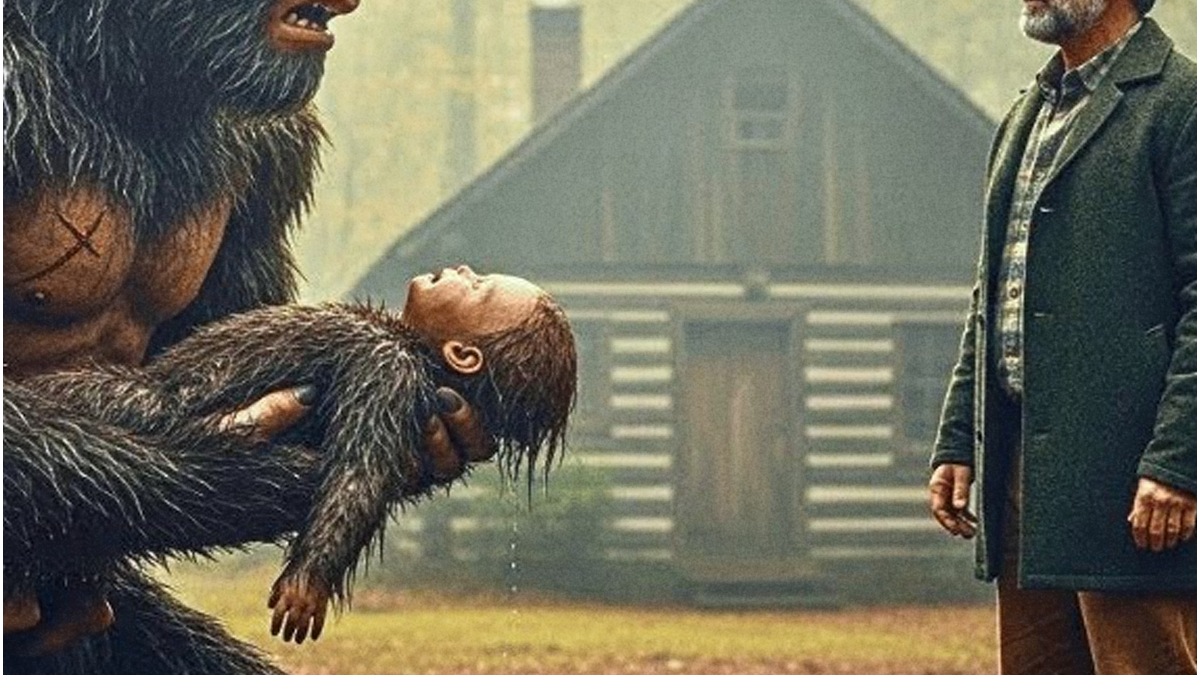
What would you do if a 2 m tall creature stood silently on your porch in the pouring rain, holding out a dying child.
This isn’t a myth.
It happened deep in Organ’s forests.
The truth, Bigfoot isn’t a monster.
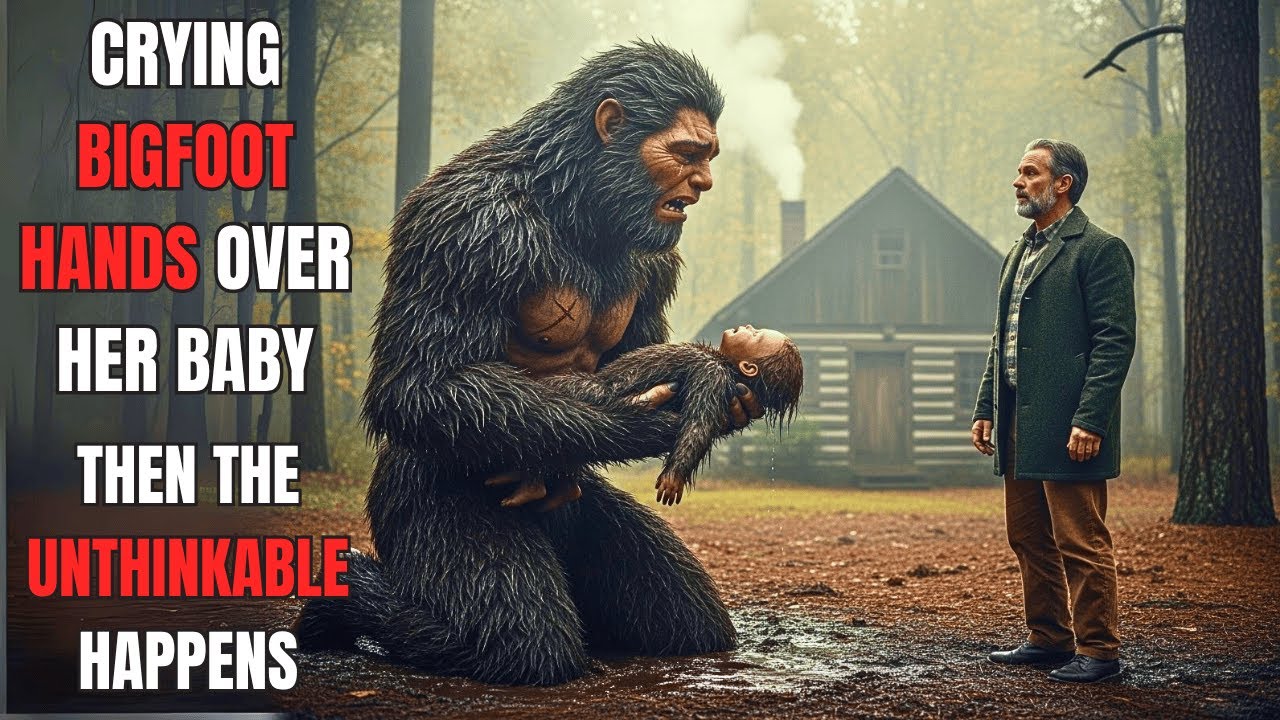
She’s a mother, desperate, grieving, and willing to trust a human with her child’s life and the man she found.
Dr. Corin Hail, a reclusive military vet and former wildlife doctor, still haunted by the loss of his wife and daughter.
In that moment, Corin didn’t see a beast.
He saw a father’s second chance.
What follows is not just a hidden story of survival.
It’s a tale of trust between species, silent gestures of gratitude, and small miracles in mosscovered woods.
A ruthless hunter gave up his traps after she saved his life.
A 12-year-old girl started sketching instead of screaming.
And every morning, a small woven bundle of grass was left at the doorstep.
Nature’s way of saying, “Thank you.
If you skip this story, you’ll miss the one thing most people never realize.
Sometimes the monsters we fear are just families trying to survive.
So stay with me just one minute and let the forest speak.
And before you go, tell me in the comments, where in the world are you watching from?
I’d love to know who’s walking this trail with me today.
It was the kind of morning where the lake held its breath.
Still Water Lake shimmerred flat as glass beneath a veil of pale mist, broken only by the slow sway of pine shadows, and the long sigh of wind through the prairie.
Corin hail stood on his porch, coffee cooling in his hand, boots planted on the warped cedar boards he hadn’t bothered to fix in years.
The air smelled of late summer and damp stone.
He hadn’t spoken to another human being in weeks, and the silence no longer felt hollow.
It felt earned.
Behind him, the old cabin creaked like an arthritic memory.
It was all he had left.
Since the accident, since his wife and little girl were taken from him on a stretch of road slick with rain and diesel, this corner of Paulina Prairie had become both exile and shelter.
The old military medical bag still hung on the wall, a relic of his past life as an army vet who once cared for working dogs.
Now he spent his days tracking elk paths, sketching owl flight, listening to the wind press secrets into the cedar walls.
He knew the forest by its breath.
That morning, just past dawn, he noticed them.
The mud along the edge of the lake told stories if you knew how to read them.
Coyote, rabbit, the heavy scatter of deer near the salt lick.
But this this was different.
Two sets of prints.
One large enough to swallow his boot hole, the other half its size, lighter, hesitant.
They walked in tandem for several yards, straight along the pebbled bank.
Then they stopped abruptly.
No turning, no retreat, just vanished.
He crouched beside them, palm hovering over the impressions.
The depth, the spacing, they weren’t bare.
They weren’t anything he’d ever seen.
He scanned the shoreline.
No dragging, no skid marks, like the earth itself had swallowed them whole.
A ripple of something old and cold moved through his spine.
Not fear, but memory.
The kind soldiers carry long after war.
He stood slowly.
The prince stared back.
By noon, the heat settled in.
It came low and thick, a hush pressing on the trees.
Even the birds quieted.
Corin sat near the window, his lunch untouched.
He hadn’t moved since returning from the lakeside.
Not really.
His hand drifted now and then to the dog tags in his pocket.
They weren’t his.
They were Ellie’s.
Her favorite bracelet, the one he’d given her when she turned eight.
Silver beads strung on waxed cord.
He carried it like a talisman.
Then it came.
A sound deep, vibrating, a hum, just one note, low and strange and full.
Not mechanical, not wind, not coyote or loon or any call he knew.
It filled the room without entering it, like the cabin heard it, too.
He froze, eyes on the treeine.
Silence, then again, for less than a breath.
That same note.
Not angry, not sad, just ancient.
He found himself standing, unsure when he’d gotten up.
The woods looked back at him.
He didn’t speak, didn’t call out.
He just stood and listened.
And then the note stopped.
The world for a moment felt offbalance.
Like a glass held midair, trembling.
The rest of the afternoon passed in half thoughts and second glances.
He tried to busy his hands, sorting through supplies, rotating jars in the root cellar, but the hum lingered, not in his ears, in his ribs.
By dusk, a storm of crows passed over the prairie, black flecks against the fading gold.
The sun stretched long over the ridgeeline, casting the world in that honeyed light that makes even the ordinary seem holy.
That’s when he saw her.
Not movement, stillness.
That kind of stillness that doesn’t belong to deer or elk or men.
She stood near the edge of the clearing, just beyond the wild thistle.
9 ft tall, maybe more, broad shouldered, cloaked in coarse auburn fur that caught the sunlight like bronze.
Her arms cradled something close to her chest, wrapped in moss or grass.
A bundle, a small shape clinging to her with breathy spasMs. One long arm curled protectively, the other gripping the bundle from beneath.
She didn’t advance.
Not yet.
Her head tilted slightly, watching him.
Her face, not human, not beast, was expressive in ways he hadn’t expected.
The ridge of her brow furrowed.
Her lips were slightly parted.
Her breath visible even in the warmth.
He could hear it.
Soft, labored.
Corin didn’t move.
He barely blinked.
Every nerve in his body lit up with quiet awe.
She stepped forward, not with threat, but with purpose.
Each step slow, weight conscious.
She approached the porch, never crossing the last few yards.
Then she knelt carefully, as if honoring something sacred.
She laid a small woven bundle of grass and reads beneath the first step.
It was simple yet intricately bound, almost ceremonial, and in that bundle a child, not human, not quite, fur covered, limbs trembling, a strange beauty in its fragility.
Its breaths came ragged, shallow.
The child, no taller than a toddler, was slick with fever sweat, chest rising in panicked flutters, eyes half-litted, weak, dying, the mother, if that was what she was, looked at Corin once more, her eyes glassy with moisture, and in them, something too human to ignore.
Not fear, not plea, sorrow, deep knowing sorrow.
The same kind he’d seen in the mirror the morning after the accident.
A kind of hurt that lives beneath language.
He stepped forward just one step.
She didn’t move, didn’t snarl, didn’t flinch.
She was rain soaked, sunlit, enormous, reverent.
He knelt slowly, heart thunderous in his chest.
The woven grass was warm.
The child’s tiny hand trembled, then went still.
He reached out, not with certainty, but with instinct.
His fingers brushed its fur, felt the heat of fever.
The child stirred.
A soft noise escaped its mouth.
Less a cry, more a whimper.
He looked up.
The mother hadn’t moved, but her eyes, her eyes had closed just for a second.
As if in trust, as if in prayer, Corin lifted the bundle.
The weight of it was strange, not heavy, not light, but significant, like carrying the last ember of something ancient and nearly lost.
He turned toward the cabin, toward the old door he hadn’t opened for anyone in years.
Behind him, the mother remained on her knees.
As he stepped inside, the sun dipped below the ridge, throwing gold fire across the lake.
A wind stirred the reads.
The door creaked shut.
Inside, he laid the creature, no, the child, on the old woven rug.
He didn’t even realize he was crying until a tear hit the floor.
Outside, through the window pane, the mother sat motionless in the fading light.
She didn’t come closer.
She didn’t call.
She simply waited.
Like the forest itself, Corin dropped to one knee beside the creature.
Its eyes fluttered.
He reached for his bag.
The hands that had once stitched flesh in battlefield tents now shook as they searched for sterile gauze and cool cloth.
The fever was real, the breath shallow, but it was alive.
He turned the oil lamp up a notch.
Its flicker cast long shadows across the walls, dancing against the glass jars and faded photos.
He didn’t dare speak.
He just worked.
Quiet, careful, deliberate, hands steadied by something larger than understanding.
The night rose slow and deep, the prairie fell into hush.
The child’s hand curled slightly toward him, barely brushing his wrist.
And in that moment, something broke open inside him.
Not with pain, but release.
For the first time in years, the cabin didn’t feel like a tomb.
It felt like shelter.
Outside the mother waited, and through the glass her eyes found his one more time.
They said everything words never could.
And in that silent exchange, there bloomed a fragile, wordless promise between worlds.
A vow not written, not spoken, but placed gently, like a child on a porch, like grass woven by hand, like breath shared between strangers.
A promise lit only by the flickering hum of a single oil lamp in the dark.
It rained that night, a steady curtain tapping on the roof like fingers too gentle to wake but too persistent to ignore.
The wind slid along the walls, curling through the chinks in the logs, whispering against the window panes.
Inside the cabin, the air held its breath thick with steam from a boiling pot.
The rust sweet scent of antiseptic and something older, softer, like pine warmed by fire.
Corin didn’t sleep.
He sat hunched near the cot, sleeves rolled, forearms tense, gaze fixed on the small form beneath a wool blanket, now damp with fever sweat.
Lark lay curled, chest rising in fragile stutters.
Fur matted and darker now where it clung to his skin.
His eyes didn’t open.
His limbs twitched every so often, the way a puppy might dream of running, but slower, weaker, like something flickering near the end of a wick.
Corin reached for the syringe, fingers practiced despite the years.
The vial of antibiotics was near empty.
The needle had dulled.
He’d sterilized everything he could.
The water boiled hard in the metal pot.
The bandages unrolled with careful hands, cut clean with the same knife he once used to gut fish.
It wasn’t enough, but it would have to be.
He pushed the needle in gently, just beneath the skin, watching for reaction.
Any reaction, a twitch, a flinch, a groan, nothing.
Only the faint warmth against his wrist, the weight of a life not quite gone.
He looked up once, just briefly.
She was still there.
Outside, beyond the glass, half shrouded by the slanting rain, Shaa stood motionless.
Her fur hung heavy, slick, and dark.
Her shoulders hunched slightly, but not from fear, from waiting.
She never moved, never knocked.
She simply stood, her eyes fixed on the cabin wall like she could see through it, like she didn’t need her eyes to know what was happening inside.
Every time Lark whimpered, a soft hum came from her chest, a low, steady note that carried through the night like a lullabi sung in a language older than words.
One note, always the same.
It didn’t waver.
It didn’t stop.
Not even when thunder rolled across the prairie or branches cracked under the weight of wind.
It was as if her voice was tethered to the boy’s breath, as if his pain passed through her like a current.
The lamp flickered low.
Corin adjusted the flame, casting the room an amber glow, shadows stretching like long fingers along the log walls.
He draped another towel across the boy’s brow, touched the side of his face.
The fur was burning, fever climbing like ivy, he whispered to himself.
Not in prayer, just habit.
The way soldiers sometimes talk to the dying to keep them tethered.
Come on, little man.
Not tonight.
He reached into the chest beneath the bed and pulled out an old wool blanket, blue and white, frayed at the corners.
The initials eh, stitched clumsily in the corner.
Ellie’s his daughters.
He’d kept it sealed in cedar for years, unable to touch it, unable to let it go.
He unfolded it now with hands that didn’t shake and wrapped it around the creature’s small form.
Not because it would help, but because it was the closest thing to love he had left in cloth.
The sound outside changed.
Rain softened.
The wind turned.
Corin looked again.
Shaa had not moved, but her hand was now lifted, palm flat against the cabin wall, a gesture without language, one that asked for nothing, but aloud everything.
He lowered himself beside the cod, watched the rise and fall of Lark’s ribs, counted each breath.
Long after midnight, the fever broke.
He felt it before he saw it.
Something in the air shifted.
Lark stirred, lips parting in a dry, shallow gasp.
His fingers curled weakly, brushing against the blanket.
Corin leaned in.
One eye fluttered open.
Amber, like sap in the sun, clouded with pain, but awake.
That was all that mattered.
The boy’s hand found his wrist clung weakly.
Corin’s breath caught.
Something behind his ribs gave way.
Something rusted shut for years.
He stayed like that, unmoving, letting the weight of the hand root him to the moment, letting it mean whatever it needed to mean.
Outside, Sha’s hum softened, then stopped, but she remained.
Dawn crept slowly over the lake.
The light was thin, silver gray, casting long bands across the floorboards.
The rain had stopped.
Mist curled along the grass, and still she stood.
Hours passed.
Corin brewed tea and burned his fingers on the old kettle.
He made broth and spilled half of it, trying to ladle it into the creature’s mouth.
It didn’t matter.
Lark took a few sips, then curled tighter into the warmth of the wool, eyes drifting closed, but not in sleep.
In healing, he left the door cracked.
Not wide, just enough.
Sha didn’t step closer.
She didn’t approach.
But when she looked at him through that sliver, her eyes no longer shimmerred with sorrow.
They carried something else now, something heavier than gratitude and deeper than trust.
The kind of knowing that only passes between those who have buried the same kind of love.
Corin didn’t speak.
He just nodded, and the corner of his mouth twitched.
Not quite a smile.
Not yet.
Just a signal.
I see you.
I know.
The lamp sputtered and hissed softly.
Flame trembling against the wick.
The smell of broth and wool filled the air, mingling with the faintest trace of cedar and damp fur.
He stood in silence, fingers resting on the window sill, watching her watch him.
Sha turned finally, slowly, her shoulders stiffened as she stepped back into the clearing.
Rainwater glistened on her back.
The trees welcomed her like she belonged to them.
But even as she disappeared beyond the ridge, her hum remained.
An echo in the floorboards, in the glass, in the bones of the house.
That night, Corin sat beside the cot with a notebook in his lap and the old radio crackling static in the corner.
He didn’t write much, just one line.
The forest speaks when we remember how to listen.
He tore the page out, folded it, and tucked it beneath the lamp.
Then he looked back to the child.
Not a child, not human, but still.
Something precious, something innocent.
The blanket rose and fell softly, steady now.
Corin leaned back in his chair, listening to the wind trace the eaves.
For the first time in years, he didn’t dread the night.
And when he closed his eyes, he didn’t dream of wreckage or flames or sirens in the rain.
He dreamed of a hum, one note, low and full, and a forest that sang back.
The cabin breathed with him.
And outside, just beyond the trees, the silence held, not empty, not waiting, but full, as if the land itself had taken a deep breath, and would hold it just a little longer before exhaling what came next.
The morning at Milstone drove up the narrow track toward Corinhal’s cabin.
The clouds hung low like old cotton caught in pine branches.
Her cruiser rattled over the ruts.
Windshield streaked from last night’s drizzle, the smell of cedar smoke still clinging faintly in the damp air.
She’d been sheriff of this part of Dashuites County for nearly 20 years and thought she’d seen most of what the woods could cough up.
Illegal traps, missing hikers, meth cookers hiding under camo tarps.
But the phone call she got from Doris at the general store had left her uneasy in a way she couldn’t name.
“Something’s out there, Ada.”
Doris had whispered over the line.
“They say it walks upright and leaves prints the size of dinner plates.
I saw myself down by Tallow Creek, fresh.”
Ada didn’t believe in fairy tales.
Not since her boy died and left her with nothing but night sweats and a shotgun in the closet.
But she believed in patterns.
And too many folks in the last week had started locking their chicken coops before sundown.
When the woods start whispering, you listen.
Even if you don’t want to.
She pulled up beside the cabin just as the mist began to burn off.
The porch looked the same as always.
Weathered boards, empty rocking chair, the faint scent of boiling something wafting out the cracked window.
She adjusted her belt, knocked once with the butt of her flashlight, then opened the screen door slow so it wouldn’t creek.
Corin answered without a word.
His face was lined deeper than she remembered, eyes sunk behind sleepless hollows.
He didn’t invite her in, but he didn’t close the door either.
Inside, the lamp was lit, though it was already past sunrise, casting everything in that same soft orange, she remembered from hospital rooms and late night vigils.
“Morning hail,” she said, voice dry.
“Heard anything strange lately?”
He looked at her without blinking.
Out here, strange is just a matter of timing.
She nodded once, stepped closer, boots leaving faint prints in the wet earth.
Her eyes caught movement beyond the glass.
Something flickered.
Not close, not clear, but not nothing either.
You know why I’m here, she said.
Corin didn’t answer.
He bent to pick up a metal pot, stirred something thick inside.
The smell hit her then.
Herbs, meat, something wild she couldn’t place.
There’s talk, she went on, voice quieter now, about shadows in the trees.
Big ones.
Some say twice the height of a man.
Corin set the pot back, wiped his hands on an old towel.
People talk more when the wind changes.
Somebody left a woven bundle outside Joe Lampard’s coupe last night.
Grass tight-knit looked like a charm.
Joe thought it was a warning.
I thought it looked like a gift.
Corin’s eyes flicked up at that.
Brief, sharp, but gone just as quick.
I have to ask, Corin, she said, not unkindly.
You got anything hurt in there?
Anything that shouldn’t be?
He didn’t lie.
He didn’t speak.
Just stepped aside slightly, enough for her to see the firewood basket beneath the window.
There, neatly placed on top, was a bundle of woven grass, tightly wound, green, still clinging to the stalks.
Not old, not dry.
Aa stared at it.
Something in her stomach turned slow.
She’d seen plenty of offerings in her time.
Ribbons on graves, coins at the foot of trees, trinkets kids left behind at accident sites.
This was different, intentional, but not human.
She took a long breath.
The wind shifted, and then it came.
A sound, faint, but unmistakable.
A hum low, one note, like a cello plucked somewhere beyond the trees.
It carried for only a few seconds, but it pulled at something behind her ribs.
She turned slowly toward the woods, hand resting instinctively near her holster, though her thumb didn’t twitch.
The clearing behind the cabin stretched wide, ringed in pines that hadn’t seen logging since before the war.
And in the shadows where the light didn’t quite reach, something moved.
A shape tall, broad, not rushing, not retreating, just watching.
Shoulders like split boulders.
Fur dark as wet earth.
She saw the glint of eyes.
That was enough.
But her hand never left her sidearm.
She didn’t lift the radio, didn’t call it in.
She simply stepped back from the door.
Shoes crunching softly on gravel.
Breath still caught halfway between exhale and faith.
Corin didn’t speak.
Neither did she.
Finally, Ada nodded toward the bundle.
“That from them?”
“From the forest,” Corin said quietly.
She looked at him long and hard.
“Not with suspicion.
But with the weight of someone used to measuring the space between duty and conscience.”
“I should report this,” she said.
“You will?”
He asked.
“I don’t know yet.”
They stood like that.
Two people older than their years, bound by losses they’d never shared, but could recognize like the scent of rain.
Ada turned then, slow and deliberate.
Her boots found the steps.
Before she reached the cruiser, she paused, bent down, touched the edge of the woven grass.
It was warm, as if it remembered the hands that made it.
She didn’t speak again, just climbed in, started the engine, and drove back down the road the way she came.
Not fast, not slow, but different.
She didn’t turn on the radio, didn’t call dispatch.
The silence inside her car hummed like something sacred.
That night, she sat alone at her desk, staring at the incident log.
The page was blank.
Her pen hovered once, then dropped.
She reached for the whiskey in the drawer instead.
She drank not because of fear, but because she finally understood something she hadn’t known she needed to.
Some things don’t need to be caged.
Some truths are gentler left unnamed out in the forest.
Something breathed with the rhythm of the rain, and behind her eyes, the sound of that hum still lingered.
One note, steady, true, like a mother watching from just beyond the trees, saying nothing but meaning everything.
There was a girl who never liked sidewalks.
Mina Joy preferred moss and roots underfoot, the whisper of trees instead of the clatter of bus doors.
At 12, she already knew more about the habits of raccoons than most grown men in Paulina Prairie.
She took the same shortcut to school every morning, not because it was faster, but because the woods felt kinder than town.
She liked the way the fog lifted off the forest floor, the way squirrels paused midbite to watch her pass, the way the creek always sang in the same key.
Her backpack bounced against her shoulders as she crossed the lower ridge that October morning, sunlight falling in bright angles through the thinning canopy.
She carried a sketchbook in her side pocket, a habit her teacher had encouraged, but her mother found odd.
“Draw me something real,” her mother had said once.
“But real was a word with too many edges.”
That morning, Mina paused near the clearing where the hail cabin sat tucked between thickets of huckleberry and young furs.
She didn’t mean to stop.
She told herself she was just tying her shoelace, but her eyes drifted toward the wood smoke spiraling from the chimney.
Something tugged at her.
She inched closer, feet soft on the undergrowth, breath shallow.
Through the narrow frame of the cabin’s side window, she saw something she would carry with her for the rest of her life.
Corin knelt beside a small figure wrapped in a worn blue blanket.
He moved with a steadiness of someone long familiar with grief.
Careful hands adjusting the cloth, checking the creature’s brow with a back of the hand touch that looked exactly like how her grandfather used to check hers.
But it wasn’t the man who held her attention.
It was what stood just beyond the doorway, towering, still, a shape too large, too silent, too utterly impossible.
The creature’s fur was a dark chestnut, slick with dew.
One long arm rested gently against the cabin support beam, massive hand open and relaxed.
The head tilted forward slightly, eyes locked on the bundle inside.
Not a beast, not a threat, just a mother watching.
Mina didn’t scream, didn’t move.
Something inside her froze, but not from fear.
It was reverence.
The way kids freeze when they see a deer up close for the first time.
When she finally remembered to breathe, she turned and ran, not in panic, but in purpose.
That night, in the corner of her bedroom, lit only by the glow of a desk lamp shaped like a bear.
She took out her sketchbook and drew until her fingers achd.
No words, just lines.
A man with tired eyes.
A creature with one hand on wood, a child nestled in between.
She didn’t show it to anyone.
The next afternoon, walking the same path home from school, she saw something that made her blood go cold.
Boon Keter, the trapper with the faded army cap and boots always two sizes too big, stood near the edge of the path, squatting low by the base of a tree.
He didn’t see her.
His hands were busy setting a steeljawed trap, the kind her father said was outlawed in half the country.
She crouched behind a cedar trunk, heart pounding.
He looked around once, then moved off into the brush.
She waited five full minutes before creeping forward.
The trap gleamed like a threat, the scent of blood bait already thick in the air.
She knew what this was for.
It wasn’t coyotes he was after.
That night, long after her parents had fallen asleep to the hum of late night radio and the rhythmic tick of the oven cooling, Mina pulled on her rubber boots and slipped out the back door.
The woods welcomed her like an old friend.
She followed the shortcut path, flashlight off, feet remembering where to step.
The trap still sat there, its teeth open like a sneer.
But she wasn’t alone.
Just ahead, the moon caught something pale.
A shimmer of hair, or maybe fur.
Then a hand, broad and sure, reached down and flipped the trap upside down into the dirt, not just disarmed, silenced.
The creature stood there for a second, framed in moonlight.
Then she, because somehow Mina knew it was a she, turned her head, looked back.
Their eyes met through darkness and fog.
Not a word passed, not a step taken.
But in that moment, something old and gentle bridged the gap between them.
A nod, a breath, a kind of agreement.
Mina walked home without touching the trap.
It didn’t seem necessary anymore.
The days that followed turned cooler.
Frost kissed the outer edges of the meadows.
The sun lingered lower on the horizon.
And each morning before school, Mina began leaving small things just inside the forest’s edge.
Half a biscuit, a dried apple slice, a button sewn with red thread.
Nothing loud, nothing flashy.
Gifts, she thought.
Not bribes.
A way of saying, “I saw you.
I didn’t run.
I remember.”
Then came the morning when one of the offerings disappeared.
She checked before school.
Just a few steps past the last fence post.
The biscuit was gone.
In its place, nestled in a neat circle of riverstones, was a tiny braid of bark and wild rye.
Mina knelt beside it.
Didn’t touch it, just stared.
Then she took out her pencil and drew it.
She didn’t need proof, but she wanted to remember the shape exactly.
Later that week, she was in her room after dinner, radio playing something old and scratchy in the background when her mother knocked and came in with laundry.
“You’ve been quiet lately,” she said.
Mina nodded, flipping her sketchbook closed.
Her mother didn’t push, just smiled.
“You always were the forest kind.”
That night, Mina dreamed of wide hands cupping water, of deep voices humming under earth, of a world just past the treeine that had always been there, waiting for someone to notice.
When she woke, she placed the tiny braid of bark in her drawer, right next to the drawing.
Not sacred, just true.
At school, she began to notice things differently.
How the boys laughed when the new teacher mentioned legends.
How grown-ups always needed noise to feel safe.
Mina didn’t mind the silence anymore.
She knew now that some things speak best when not interrupted.
One evening near dusk, she passed the hail cabin again.
She didn’t stop, not fully, but she slowed enough to glance through the same window.
The fire light inside glowed soft against the glass.
She could just make out the silhouette of Corin sitting in his usual chair.
A small shape curled against his side.
Outside, just past the porch, a large figure stood near the trees.
Not hiding, not watching, just there, present, like a mother waiting for bedtime to end.
Mina walked on, heartful and oddly calm.
She didn’t tell anyone.
Some truths were like roots, buried, necessary, and better left untouched.
But every night before bed, she opened the drawer, ran her fingers over the braid, and whispered thanks, not to a god, not to a myth, but to something real and quiet that had chosen just once to be seen.
And out in the forest, beyond the reach of porch lights and bedtime prayers, the air moved gently between the branches, as if someone large and kind had just passed by.
The wind carried a warning that morning, low and brittle, sweeping across the Paulina prairie like a breath held too long.
The tall grass bent in waves as if something unseen passed beneath it.
The frost hadn’t settled yet, but the smell of cold was in the air, sharp and mineral, clinging to the walls of Corin’s cabin like a second skin.
He felt it in his bones before he stepped outside.
A shift, not in weather, but in something older, something woven into the forest’s breath.
He pressed a palm to the door frame, watching the clouds smear low along the lake, and when he exhaled, the air came out white.
Inside, Lark stirred.
The boy had grown stronger in the past week, or at least steadier.
His fever had broken twice and returned once.
He drank more now, clung less.
But that morning, his breathing sounded tight again, shorter at the top.
A wetness in the chest that didn’t belong.
Corin leaned over the cot, hand resting gently against the thin rise of the boy’s ribs.
He didn’t need a stethoscope to feel it.
Infection settling back in.
The vial of penicellin was nearly empty, and what he had left wouldn’t last the night.
He stood slow, shoulders heavy with the choice already made.
The nearest active medical supply was nearly 8 mi west.
An abandoned wildlife research post tucked off Forest Service Road 242, left to rot years ago, but still holding a few things worth remembering.
Corin had stashed a small medical cache there two winters back.
He never meant to return, but now the boy’s life depended on it.
He packed quick, slid a thermos of broth into his satchel, bundled Lark in the blue blanket one last time.
Shaa had not come close in two days, but he felt her presence still like a shadow two steps behind the trees.
He whispered something to the boy that wasn’t quite goodbye, then stepped into the wind.
The door closed behind him with a sigh.
He took the long route, the one that kept low through brush and avoided open ridges.
The trail was slow, carved half by memory, half by instinct.
Every step sunk into frost hardened mud.
His boots slipped more than once, but he kept on, heart steady, even as the air grew colder.
Crows watched from bare branches.
A fox darted across the trail and vanished without sound.
The forest did not greet him today.
It simply let him pass.
He didn’t hear Boon until the man was already too close.
You out looking for ghosts, hail?
The voice came from behind a thicket of deadfall, coarse and familiar, the kind that smoked too much and prayed too little.
Corin turned slow, seeing the glint of a shotgun before he saw the man’s face.
Boon stepped forward, brow furrowed, jaw tight beneath 3 days stubble.
“Heard some things,” Boon said.
“Heard you’ve been feeding something out here.
Something you ain’t supposed to.”
Corin didn’t respond.
Boon took another step.
Boots crunching frost.
Saw tracks, big ones, too damn clean to be elk.
You helping it, that thing.
Corin’s eyes narrowed.
You shouldn’t be out here.
Boon laughed, the sound low and bitter.
Neither should that thing you’re keeping in your cabin.
The silence stretched between them, brittle as ice on a shallow pond.
Then a sound broke it.
Not words, not animal.
A low groan of wood above them.
The aspen trees, older than most men in town, had begun to shift in the wind.
A sudden gust rolled through the clearing.
And then, crack!
The trunk gave way with a scream of splintering wood, crashing down not 3 ft from Boon, but the limb kept falling, a heavy branch twisting as it dropped.
Boon shouted, stumbled, and in a blink, his leg was pinned beneath it.
The shotgun clattered to the ground.
He gasped, clawing at the bark, trying to pull free.
Corin rushed forward, kneeling beside him.
The branch had crushed Boon’s calf beneath its full weight.
The bone was likely cracked.
His face was pale now, mouth open in pain.
Corin looked at the tree, then back at Boon.
Don’t move.
I can’t feel my foot, Boon muttered.
From the edge of the trees, a sound rose, low and building.
Not the wind, not a growl, a hum, deep like earth singing.
And then she stepped out.
Sha moved with a speed that defied her size, closing the distance in three strides.
Her fur shimmerred with rain, her breath visible in the air.
She didn’t look at Corin.
Her eyes locked on the fallen tree.
Then the man beneath it.
Boon screamed, but she didn’t flinch.
She bent low, massive shoulders curling forward, hands bracing against the log, her fingers curled beneath the wood.
Corin stepped back.
She lifted.
The branch rose slow, deliberate, just enough for Corin to yank Boon free.
The man gasped, clutching his leg.
His boot was soaked in blood.
Shaa held the log suspended for another second before letting it fall gently to the side.
Then she turned her head.
Their eyes met.
Boon and Sha.
And for the first time in his life.
Boon did not reach for a weapon.
He stared, mouth open, heart thutting so loud it drowned out the wind.
Tears welled in his eyes.
His lips moved without sound.
Corin dropped beside him, tearing a strip from his sleeve to staunch the bleeding.
Boon didn’t resist.
He didn’t speak.
Not yet.
Shaa stepped back, her breath still heavy.
She looked once more toward the trail, toward the direction of the cabin.
Then she disappeared into the trees, the sound of her presence folding into the forest like smoke into wind.
Boon finally spoke, voice.
She helped me.
Corin tied off the bandage, tight, but not cruel.
Boon’s eyes were wide now, stunned and shimmering.
I’ve killed, he whispered.
Dozens trapped, skinned.
Never once did one look back.
Never once did one understand.
Corin didn’t answer.
Boon looked down at his own hands, then at the blood streaked snow.
She looked at me like I was the one being hunted.
Dusk settled slow.
The clouds dipped lower, brushing the treetops.
Corin helped Boon to his feet, slung the man’s arm across his shoulder.
They moved slow, boon limping, the forest silent around them.
The wind had died.
Only the memory of breath remained.
By the time they reached the cabin, the first stars had begun to appear, faint and cold above the lake.
Inside, Lark was asleep, his breathing still shallow, but steadier.
Boon didn’t speak as he lowered himself into the chair by the fire.
He stared into the flames like a man seeing something holy for the first time.
His hands trembled.
Corin poured two mugs of water.
They sat in silence.
The night no longer felt dangerous.
It felt awake.
Outside near the porch, the grass bent slightly in a shape that had not been there before.
The next morning would bring new choices, new confessions.
But for now, Boon sat with a bandaged leg in a memory he couldn’t explain, staring into the place where his fear used to live, now replaced by something he didn’t yet know how to name.
And somewhere deep in the trees, the wind carried a single hum, just one, long, steady, like forgiveness.
The snow had settled by morning.
A thin veil spread across the ground like a sigh.
It clung to the dead grass, nestled into the curves of pine branches, covered every trail and mistake with equal mercy.
Boon stood just outside the treeine, his breath coiling in front of him, fingers numb around the handle of the shovel he hadn’t used in years.
The forest was quiet.
Not the kind of quiet that waited, but the kind that forgave.
Last night still sat heavy in his chest.
The pain in his leg dull now beneath layers of gauze and disbelief.
But it wasn’t the injury that rattled him.
It was the way she looked at him.
That creature, that mother, no words, no roar, just eyes like mirrors, showing him parts of himself he never meant to keep.
He’d spent the night staring at the ceiling of Corin’s cabin, unable to sleep, unable to stop seeing that gaze.
And now, standing under the bare sky, he finally knew what had to be done.
He pulled the first trap from behind the cedar stump where he’d hidden it last spring.
Steel teeth, rusted but ready, jaws wide enough to break bone.
He stared at it a long while before unlatching the mechanism, letting it snap shut for the last time.
Then he buried it deep beneath the frozen earth, the metal biting into his gloves as he forced it down.
One by one he found the others, six in total, hidden in places only a man like him would think to look between tree roots behind logs under false moss.
He destroyed every last one.
He didn’t flinch when the metal sliced his thumb on the fifth.
Just let the blood drip into the snow like an offering or maybe a confession.
Later that night, long after Corin had lit the last oil lamp and Lark had fallen asleep near the stove, Boon took a small pouch from the shelf and poured a line of dried acorn husks along the edge of the cabin path.
Then he veered west toward the old hunter trail, careful to leave a trail, bootprints wide and clear, leading far from the hollow.
He wasn’t sure if it would work, but he hoped the scent would be strong enough to mislead any trackers.
Hunters always came in winter, always looking for meat or myth or proof.
And sometimes it didn’t matter which.
Back at the cabin, Corin sat beside the boy, hand resting lightly on his shoulder, fingers checking his temperature, not by number, but by knowing.
The boy no longer burned.
His breathing came smoother, slower, the way a stream softens once the ice loosens its grip.
Sha had not returned since the rescue, but her presence still lingered, threaded into the air like wood smoke.
There was no need for her to stay, not when the boy’s body had begun to heal, and the man beside him had already made a silent promise to see it through.
Corin rose to check the kettle when he saw it.
Just outside the window, two bundles lay gently on the steps.
Twin braids of fresh winter grass bound tight, still damp with snow.
He opened the door without hesitation.
The wind met him with a hush.
The air was full of a presence just mist, like a hand withdrawn a second too soon.
He knelt.
The grass bundles were perfect, symmetrical, bound with care.
They didn’t look like thank yous.
They looked like wings, two shapes lying side by side, angled just so, like a gesture of flight or forgiveness.
He carried them in with the reverence of a man who had forgotten what grace looked like, set them beside the cut.
Lark stirred once in his sleep, then curled tighter into the old wool blanket.
The lamplight flickered.
Outside the snow fell steady and soundless at the edge of the prairie where the forest met the road that led nowhere.
Adah Milstone stood in the cold, hammer in one hand, signpost in the other.
Her truck was parked behind her, engine idling low.
She hadn’t told anyone where she was going.
She hadn’t needed to.
The rumors had already begun to quiet, as if the town itself had agreed not to speak too loud.
But she knew winter brought strangers.
Men with binoculars and boots too clean, curious types, the kind who walked past fences and claimed not to see signs unless they were nailed into trees.
She pressed the post into the frozen ground, lifted the hammer, and struck three times.
The wood sank firm on it painted in red.
Danger, bear activity.
Do not enter.
She stared at it for a long while, then added one more word beneath the warning.
With the same brush, active, she drove back slow, headlights cutting through the dark like they were searching for something lost.
She didn’t glance at the mirror.
Mina wrote that night in her journal by flashlight, curled beneath a quilt her grandmother had stitched before she was born.
She didn’t write about Boon or Corin or the forest.
She wrote one sentence.
I think the woods forgave us.
Then she drew a pair of wings made of grass.
The next morning, Boon didn’t speak during breakfast.
He helped Corin chop wood, brought water in from the creek, cleaned out the ash pan.
Then, just before the sun began to rise through the mist, he stepped out onto the porch and knelt in the dirt beside the path.
His hands trembled slightly, not from pain, but something deeper.
He bowed his head low, the way some men do when they don’t know how to pray, but need to try anyway.
His voice came rough, nearly gone.
“If there’s a God in these woods,” he whispered.
“I saw you last night.”
The wind didn’t answer.
It didn’t need to.
The trees creaked slightly in the morning.
“Hush.”
“Far off?”
A raven called once, then fell silent.
Corin stood in the doorway, watching, arms crossed.
He didn’t speak either, but in his chest, something softened.
Something let go.
The past had not left them, but it had shifted its weight.
Later that day, he found Lark standing near the porch for the first time without help.
The boy’s back was to him, head tilted toward the trees.
He wasn’t looking for her.
He just seemed to be listening.
Corin joined him.
They stood in the cold, side by side, without words.
Until the boy reached down and gently placed his hand on the edge of one of the grass bundles now drying in the sun.
Not a gesture of ownership, but remembrance.
By sunset, the boy was asleep again, tucked deep beneath the quilt.
Boon had left two apples on the table.
Adah’s sign stood firm.
Mina’s drawing sat tucked between pages, safe beneath her pillow, and the forest held its breath again, not in fear, but in grace.
Somewhere beyond the lake, deep into the hills, a shape moved slow between the trees, not hiding, not staying, just moving forward.
The prints it left behind were already filling with snow, and inside the cabin the lamp flickered once, then steadied.
The cold didn’t bite that morning.
It lingered.
Soft gray light hung over the prairie like the inside of a breath, heavy with the weight of late winter.
The snow hadn’t melted, but it had begun to shift, sinking in on itself like a memory softening at the edges.
In the stillness, bootprints appeared along the edge of the old service trail.
Clean souls, new gear, synthetic fabric where wool should have been.
Voices didn’t belong here, but now they moved through the trees like they were searching for something owed to them.
And behind those voices came the quiet wor of lenses adjusting, shutters half-pressed, audio recorders tucked in weatherproof bags.
A university van from Corvales sat idling just off the forest road.
Mud caked high on the tires, windshields still warm from the drive-in.
The crew moved in pairs, half biology grad students, half documentary interns, none of them old enough to remember what it meant to just leave something alone.
Corin Hail stood at the edge of the frozen creek, eyes narrowed, one hand resting against the cedar trunk, worn smooth by time.
He’d seen the van hours ago from the ridge, glass catching the light in the way it never should have.
He wasn’t surprised.
This always happened when the snow began to retreat.
The woods held fewer secrets in spring.
He’d agreed to speak with them 3 days prior when the university liaison stopped by with a clipboard and a smile that didn’t touch his eyes.
Corin knew the type men who heard everything but listen to nothing.
They said they were there to monitor environmental anomalies.
They meant the tracks, the rumors, the way the local wildlife had rerouted itself around an unseen axis.
Something had stirred, and Corin had no doubt that some curious grad student had seen one of the woven grass bundles left near the ranger station last month and followed it back here, like pulling at a thread too old to unravel.
He walked back to the cabin with slow, measured steps.
Boon sat on the porch, sharpening a hatchet against an old wet stone.
His injured leg still stiff, but strong enough now for most things.
He looked up, one brow lifting.
They’re here, Corin said simply.
Boon spit to the side, blades still scraping.
Knew they would be inside.
Lark rested quietly near the stove, wrapped in a quilt Mina had dropped off the week before.
His eyes followed movement now, traced light.
He’d begun humming, too.
Soft little sounds under his breath that vibrated in one long note.
Not mimicry, something deeper, remembered.
When he looked out the window now, it wasn’t in fear.
It was in recognition.
Like he already knew which trees still carried her scent.
Ada arrived not long after, her cruiser pulling up behind the van with an engine that groaned like it hated the cold.
She stepped out slow, adjusting the brim of her hat as she walked up the path.
The head researcher met her halfway, extending a gloved hand.
We’ve spoken on the phone, Dr. Nevin.
We’re just trying to gather some baseline.
Ada raised a hand.
I’m issuing a soft closure on the back trail.
Slides on the east slope.
Could take weeks to clear.
Dr. Nevin blinked.
But we’ve already It’s a liability issue, she said flatly.
You need a permit to continue and a secondary field clearance from the county.
There was silence long enough for Snow to slide off the roof in a dull thump.
She didn’t budge.
Eventually, they backed off, muttering something about regrouping.
The van door slammed too hard.
One of the interns took a photo anyway.
Back inside, Corin poured coffee into a chipped mug and handed it to Ada.
She took it without a word, eyes watching the smoke curl above the rim.
“I lied,” she said quietly.
“There hasn’t been a slide.”
“I know.
They’ll be back.
I know that, too.”
She glanced toward the window.
Lark had moved closer to the glass.
He pressed a palm against it.
Not to wave, just to feel the cold on the other side.
That evening, Mina returned by herself.
Red scarf wrapped three times around her neck.
She left something small on the porch step.
A knitted scrap of wool, the same blue and white as the blanket Corin had used weeks ago.
She didn’t knock.
She didn’t stay.
She just placed it down, stepped back into the treeine, and vanished.
Corin found it just before nightfall.
Beside it, resting gently on the wood, was a stalk of dried rye woven so tightly it looked almost like bone.
Someone had returned it, someone with hands large and patient.
Boon stared at it a long time, then nodded once, like a man finally understanding the terms of a deal he never signed.
That night, just past midnight, the hum came again, longer this time, not loud, but clear.
Corin stepped outside with the lamp low and shielded.
Snow crunched faintly beneath his boots.
The trees ahead looked ordinary, silent, but he saw her.
Not clearly, just enough.
Shaa stood near the creek’s bend, half shadowed by branches.
She didn’t move toward him, didn’t lift her arm.
She simply pressed a wide hand to her chest.
Once, then turned her body toward the west, toward the mountains, toward somewhere he would never follow.
He didn’t speak.
The hum faded into silence.
She disappeared.
The next morning, Corin found the forest quieter than it had been in weeks.
The trails undisturbed.
The air settled, and in that quiet, the ache in his chest returned, not as grief, but as space.
Boon watched the sun rise from the porch without speaking.
The scarf Mina had left was now tied loosely around the banister, its colors softening in the morning light.
Inside the cabin, the boy stirred once, then slept deeper.
Ada, standing at the edge of the treeine, looked back at the road winding down toward the university van, its windshield now frosted with last night’s breath.
She didn’t regret the lie, not even a little.
Some truths didn’t belong on paper.
Some stories deserve to stay buried in bark and snow.
But she still felt it.
Something like guilt, something like peace.
And when the wind passed through the grass, it carried no song.
Only the sound of something having moved on, and something else choosing to stay.
The ice was almost gone.
Still Water Lake, once sealed beneath a sheet of winter glass, now stirred gently under a skin of mist.
It didn’t break in loud cracks or give way all at once.
It softened, shrunk back from the shore.
The edges rippled like breath after silence.
Dawn came slow through the pines that morning, light unfolding over the water in pale ribbons, gold where it touched the tips of the reeds, silver where it slid across wet stones.
The trees no longer looked like they were bracing for cold.
They just stood still as if listening for something only the forest could understand.
Corin walked the edge of the lake with his hands in his coat pockets, breath of faint trail behind him.
A year had passed since the night she placed her child on his porch.
A year since silence became language.
Since the boy, since Lark was carried inside on a bed of woven grass and hope.
The cabin had changed in that time, not in shape, but in weight.
The air inside it no longer pressed against his ribs.
It moved freely now, like it had forgiven him for all the things he could never fix.
He stepped carefully over a cluster of frostbitten cattails, boots sinking just enough to leave a print.
The surface of the lake was still too cold for a full thaw.
But here, near the shallows, the ice had cracked in long veins, stretching outward like the branches of a hand, reaching towards something just beyond its grasp.
He stopped at the same flat rock where Ellie used to sit, the one she once called her thinking stone.
She’d tie her shoelaces there before they hiked the ridge.
Little legs swinging above the moss, fingers picking at the bark to see what might be hiding underneath.
He didn’t sit now.
He just stood with the weight of her memory in his chest, watching as the fog lifted slightly from the lake.
Then he saw them across the water, not far, close enough that their shapes were clear, distant enough that they remained untouched by sound.
Two figures stood still against the backdrop of morning.
Shaa, upright, strong, darker now around the shoulders, as if time had made her coat deeper in color.
And beside her, Lark, not the child bundled in fever, but tall now, standing of his own.
The proportions had changed, limbs longer, back straighter.
But there was no mistaking him.
Corin knew the boy, no longer quite a boy, held something in his hands.
Long green, damp from the lake.
A braid of reeds nodded down the center.
Corin had shown him how to twist that shape one morning last spring when the snow had melted early and the creek ran high.
They sat on the porch with cedar bark and wild grass, weaving slow patterns, not for function, but for rhythm.
A game without rules.
And now from across the thawed water, Lark lifted the braid in both hands.
He didn’t wave.
He didn’t shout.
He threw.
The ark was wide and deliberate.
The braided reed spun once in the air before landing with a soft splash just shy of the rocks.
Corin took two steps forward, boots skimming the wet stones.
The braid floated toward him like it had been meant to return.
He knelt, reached into the cold, pulled it gently from the surface.
It was still warm in places.
The knots were tight.
Exact.
There was no mistaking the hands that made it.
He didn’t call out.
He didn’t have to.
Across the lake, Lark turned his face towards Shaa, and she in turn placed one hand on his back.
She said nothing, not aloud, but something passed between them in that stillness.
A breath, a nod, a choice.
She looked once more across the water, eyes locking on Cororins.
She didn’t smile, but her shoulders relaxed.
Then they turned slow and certain, stepping back toward the treeine.
Neither rushed, neither looked back.
The mist swallowed them gradually, their forms fading not into darkness, but into something softer, like smoke retreating into bark, or the hush that follows a hymn.
The sound came last, a hum, one note, long and low, held just long enough to settle beneath the ribs.
It carried across the lake, rippling the water’s surface, folding into the call of a lon somewhere behind the fog.
Corin didn’t know if it came from her or him or the trees themselves, but he felt it deep in that place where grief used to live.
Behind him, the wind moved through the grass with gentle insistence, not to warn, just to remind.
At the cabin’s edge, Mina stood beneath the porch’s overhang, scarf tucked against her chin, one hand resting on the banister.
She’d come early before sunrise with no plan except to wait.
Her journal lay open beside her, pen untouched.
She didn’t say a word as Corin stepped up from the lake and placed the dripping braid beside her.
She looked at it only once, then down at the ground, eyes brimming with something too old for her age.
Ada arrived a few minutes later.
Not in uniform, not in boots, just jeans and a thick sweater and eyes that knew how to see through trees.
She stood beside Mina without asking what they were watching.
The snow was gone from the path now, and the mud didn’t try to pull you down like it used to.
It just let you pass.
The three of them stayed like that for a while, long enough for the sky to bloom into something less gray.
A hawk passed overhead.
Somewhere in the distance, Boon’s axe struck wood in steady rhythm.
No one spoke.
Not because there was nothing to say, but because sometimes the right words stay behind your teeth, pressed there like seeds, waiting for spring.
Later, Corin would hang the braid inside the cabin above the window that faced the lake.
He wouldn’t tell anyone.
He wouldn’t need to.
It would dry there slowly in the months to come, stiffen under summer heat, catch the light just right at sundown, and when it eventually cracked and loosened, he would take it down gently, place it in the fire, and watch it vanish in orange breath.
But that morning, standing by the lake with mist curling around his boots, he didn’t think about later.
He just breathed.
And in that breath, he found something he hadn’t held in years.
Peace.
At the edge of the prairie, where the woods began to stretch tall again, a small indentation marked where a foot, broad, flat, impossibly human, had pressed into the soft earth.
It wasn’t deep.
It wasn’t fresh, but it was still there.
And beneath the thinning frost of late spring, the ground had begun to bloom.
Sometimes the most powerful connections are born not through language, but through silence.
Through a single glance held a little too long.
Through an open door in the dead of winter, through an act of kindness no one saw, but the heart remembers.
There are stories in this world that live quietly at the edges.
Tales passed down not in books but in the way someone pauses at the treeine or leaves a small gift where no one was watching.
These are the stories that don’t demand attention.
They ask only to be witnessed.
And maybe that’s the kind of truth we need more of now.
The kind that doesn’t need proving to be real.
The kind you feel in your chest, not because it’s loud, but because it hums at the same frequency as something you’ve longed for.
Something old.
Something honest.
What if the things we fear most are not monsters but mysteries we never took the time to understand?
What if what we call wild is simply what’s been waiting for us to remember how to be gentle?
And what if the most sacred things in this life aren’t captured in photographs or tucked away in glass cases, but carried instead in memory in compassion in the space we leave for others to belong.
There’s a quiet kind of heroism in tending to what the world forgets.
In offering help without asking why, in listening before speaking, and in trusting despite everything, that grace still exists in places untouched by progress or permission.
Sometimes the smallest acts echo the loudest.
A hand extended, a door left open, a promise kept even after the reason is gone.
We live in a world constantly chasing evidence.
But some truths are too sacred to be measured.
Some moments too tender to be explained.
And maybe the point was never to prove, but to protect.
Not to conquer the unknown, but to live beside it.
To learn quietly how to coexist with wonder.
Thank you for walking this path with us.
Through snow and silence, through memory and meaning.
If this story moved something in you, if it made you feel a little less alone or reminded you of something forgotten but still alive in your chest, we’d love to hear from you.
Leave a comment, share your thoughts, or tell us what part of the journey stayed with you most.
And if you’d like to keep exploring these quiet corners of the world with us, don’t forget to follow, like, or subscribe.
Sometimes all it takes to change everything is the courage to open the door and the humility to listen to what steps through.








