Man Helps A Dying Lion. You Won’t BELIEVE What Happened Next!
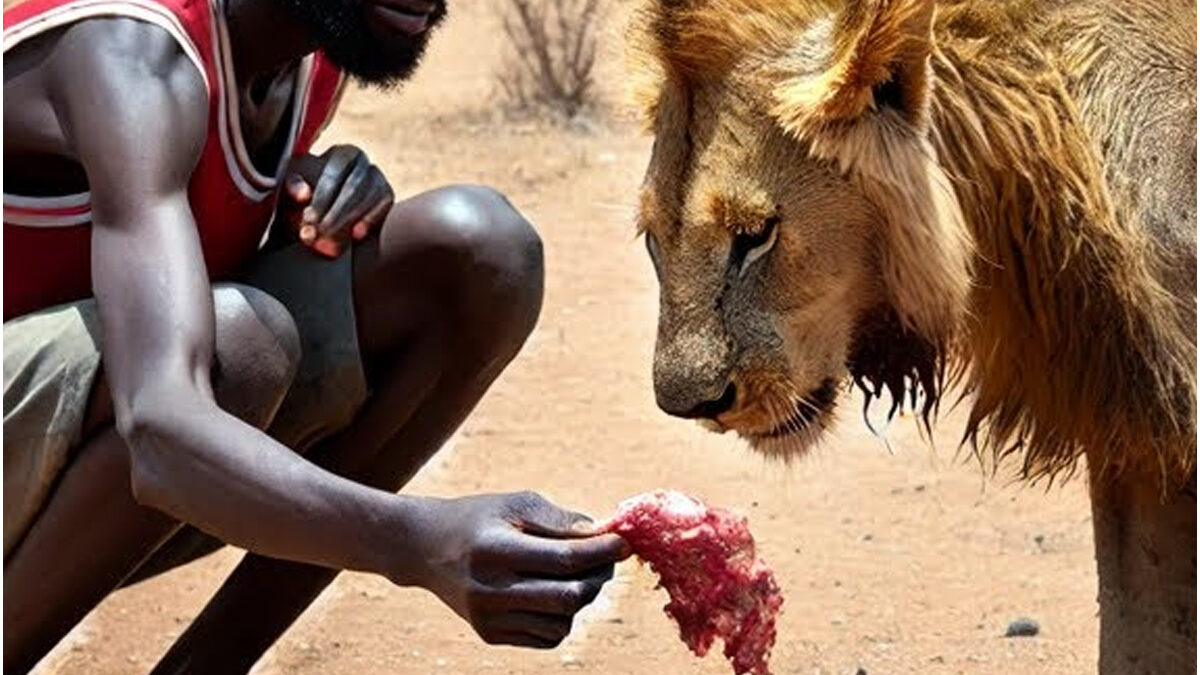
Man Helps A Dying Lion. You Won’t BELIEVE What Happened Next!
In April, people in a small village in Kenya learned about the strange events occurring near the Savannah.
The locals were shocked by what they saw.
They had never encountered a lion in such an unusual situation before.
But how did it get there?

Most of the time, lions are found in the grasslands and open plains far from this particular area.
Let’s find out what happened.
The lion must have become stranded after being carried away by a strong river current or wandering too far from its pride while searching for food.
At some point, the animal likely tried to return to familiar territory, but the vast landscape and obstacles made it impossible.
This young predator was about to embark on an adventure that would change its life forever.
After days or perhaps even weeks, the lion arrived in a strange place vastly different from its homeland.
The only thought in its mind was survival.
Upon reaching the outskirts of a small town, it stood near the riverbank, scanning the area.
It had traveled an astonishing 700 km from its home.
Desperate for food, the lion repeatedly tried to hunt but found nothing.
The land was unfamiliar, and its climate was different from what the lion was accustomed to.
Vegetation was sparse, and prey was scarce.
The lion hesitated to approach the settlement despite hearing the sounds of people from afar.
Its keen sense of hearing picked up the bustling activity of the village.
Typically, lions avoid human interaction, but this one was exhausted and famished.
Though approaching the town was a risky decision, hunger drove it forward.
Nearby, the lion noticed a large building and instinctively moved toward it.
Unbeknownst to the animal, this was the local ranger station.
Fatigued from its arduous journey, the lion collapsed near the entrance.
Its weary expression reflected helplessness and despair, almost as if it were crying out for assistance.
The local wildlife rangers soon noticed the unexpected visitor.
One of them quickly raised the alarm, and two additional rangers were dispatched to assess the situation.
The lion was an imposing sight.
Its golden fur was thick, and its sharp claws were clearly visible.
Understandably, the rangers hesitated to get too close.
With caution, the rangers approached to observe the animal more closely, ensuring they didn’t startle it.
When they finally recognized what they were dealing with, they were left in disbelief.
A large, formidable young male lion had mysteriously appeared near their town.
The rangers were stunned but also sympathetic to the creature’s condition.
A closer look revealed that the lion had sustained a severe injury to one of its front paws.
The wounded paw was tucked against its body as the lion lay motionless.
Realizing the lion was in distress, the rangers felt compelled to help.
Their first step was contacting the local Wildlife Conservation Authority.
The authorities were equally astonished by the case and acted swiftly to provide assistance.
Care was taken to treat the lion’s wound, and the animal was given time to rest.
Before long, the lion became well known throughout the village, earning the name Leo.
The residents took an active role in caring for Leo.
They provided food and fresh meat daily, though he only ate in small amounts.
The lion seemed to recognize the kindness of his caretakers, yet his gaze often wandered toward the horizon, longing for home.
As news of Leo’s presence spread, people from neighboring villages came to see him.
The rangers closely monitored the situation, ensuring that no one got too close to the wild animal.
Experts weighed in on the predicament, stating that Leo had no chance of surviving in this unfamiliar environment.
He needed to return to his natural habitat immediately.
But how could such a feat be accomplished given the vast distance?
The lion couldn’t possibly make his way back alone.
Even if he miraculously knew the route, he wouldn’t survive the journey.
The situation appeared hopeless.
Samuel Guardian, head of the wildlife conservation department, explained that such incidents had occurred before.
Strong river currents or wandering too far from their territory sometimes led lions into unknown areas.
Once stranded, these animals struggled to find food and often perished without intervention.
Leo faced the same fate.
The people, however, refused to let this happen.
They were determined to find a solution.
As Leo’s story gained attention, a plan was devised to ensure his safe return.
The office of Regional Governor Joseph Illich contacted Andy Chef, the Minister of Emergency Situations, requesting a helicopter for the mission.
Meanwhile, Ranger David and his team constructed a special transport cage designed to hold the lion securely.
The Kenyan Wildlife Service took on the operation, and 8 days after Leo’s arrival, an air mission was launched to return him home.
Such an undertaking had never been attempted before.
Using a helicopter to transport an animal of Leo’s size posed significant challenges.
Despite the risks, the rescuers remained committed to saving his life.
To ensure his safety, Leo was temporarily sedated.
Upon reaching the transport site, wildlife expert Alexander Shell confirmed that the lion had been well fed and was in stable condition.
Once sedated, Leo was carefully placed in the custom-made transport cage and loaded onto the helicopter.
The village gathered to witness the event, cheering as Leo was prepared for departure.
However, no one could have predicted what would happen next.
During the long flight, an unexpected event unsettled the team.
A sudden noise came from inside the cage.
Leo had woken up.
Instantly, tension filled the aircraft.
The rescuers were on high alert, fearing that any sudden movements might provoke the lion.
Their biggest concern was that Leo might attempt to escape or shake the helicopter mid-flight, which could lead to disastrous consequences for everyone on board.
Fortunately, Leo’s demeanor remained calm.
Though awake, he did not react aggressively or attempt to break free.
Instead, he observed his surroundings with an inquisitive gaze.
Government officials later reported that while the lion was clearly frightened, he maintained his composure throughout the journey.
It was a testament to Leo’s resilience and the careful planning of his rescuers.
After what felt like an eternity, the helicopter finally reached its destination, the region where Leo was meant to be released.
The crew landed, and with great anticipation they opened the cage.
At first, Leo hesitated, unsure of his surroundings.
Then, realizing he was home, he took off toward the savannah.
The moment was both triumphant and emotional.
The villagers, rescuers, and officials had worked tirelessly to give Leo a second chance at life.
Months later, something remarkable happened.
A severe drought had struck the village, leaving both people and wildlife struggling to find water and food.
One evening, a herd of desperate elephants driven mad by thirst stormed toward the village in search of sustenance.
In their frenzy, they began destroying crops, knocking down structures, and endangering the villagers’ lives.
As chaos unfolded, an unexpected figure emerged from the shadows.
Leo the Lion, now fully grown and powerful, charged fearlessly toward the elephants, roaring loudly.
He confronted the massive beasts, standing his ground against them.
His presence startled the elephants, causing them to hesitate.
With strategic movements and intimidating growls, Leo successfully diverted the herd away from the village, leading them toward a nearby watering hole.
The villagers watched in awe as their former guest became their savior.
After ensuring the safety of the people, Leo lingered near the outskirts of town.
He had not forgotten the kindness shown to him.
With one last glance at the villagers, he disappeared into the wilderness, leaving behind a legacy of gratitude and heroism.
Leo’s return was a powerful reminder that acts of compassion could forge bonds between humans and nature even in the wildest of places.








