Lonely Rancher Refused a Mail-Order Bride – Until He Saw Her Crying at the Train Station
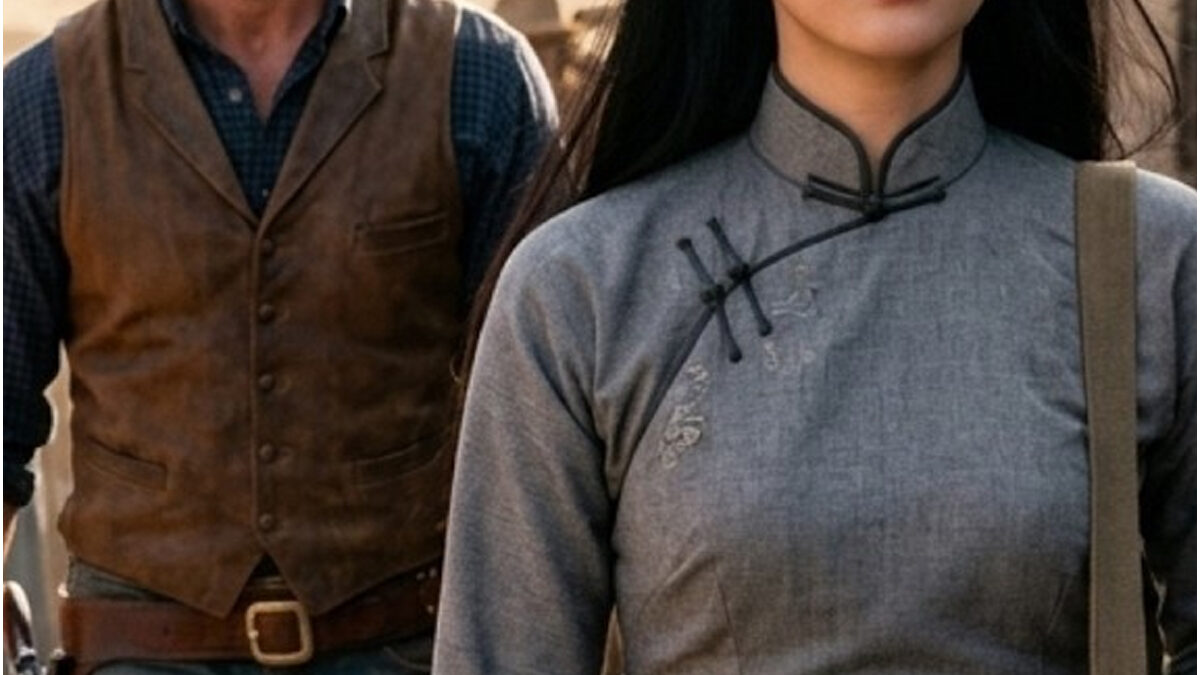
Lonely Rancher Refused a Mail-Order Bride – Until He Saw Her Crying at the Train Station
The train whistle cut through the July heat over Larkspur, Wyoming.
And Jonah Belle felt his stomach drop before the wheels had even finished grinding to a stop.
Because he was about to make the worst mistake of his life, and he knew it.
He had written the letter himself, though he could barely spell half the words in it.
And a woman named Yun Shu Tan had answered from a mission house in San Francisco with handwriting so careful it looked printed.

She had promised she could cook, sew, and keep accounts.
And she had asked for nothing in return but passage and a fair chance.
Jonah had read that letter 11 times before he worked up the nerve to send back his agreement.
And he had spent every night since wondering what kind of fool agreed to marry a stranger sight unseen.
But when the passengers began to spill out onto the platform, Jonah felt something in his chest go still and cold.
Because the young woman stepping down from the third car was not what he had pictured at all.
She wore a gray cheongsam, plain but well-made, with her dark hair pinned back from a face that was younger than her letters had led him to believe.
No older than 22 by his best guess.
Around her, the townsfolk of Larkspur had already begun to stop and stare.
The way people stared at anything unfamiliar in a town that saw little beyond cattle and duSt. Jonah’s first thought, God forgive him, was that he could not do this.
He had pictured a widow, someone plain and sturdy who understood the bargain the way he understood it.
A business arrangement between two people who needed the same thing.
He had not pictured a young woman standing alone on platform 3,000 miles from anything she knew, clutching a single carpet bag like it was the only solid thing left in the world.
He turned before she saw him.
He told himself it was practical that a woman that young needed a husband closer to her own years, that he was 38 and weathered and had no business standing beside something so obviously out of place in his hard, quiet life.
He walked back toward his wagon with his jaw set and his conscience arguing with every step, and he did not look back until he heard the sound that stopped him cold in the duSt. She was crying.
Not loud, not the kind of crying meant to be seen, but the kind that came out sideways, pressed down and swallowed.
The kind of crying a person did when they believed no one was watching and had nowhere left to put the feeling.
Jonah stood with one hand on the wagon wheel and listened to it.
And something in him that had been closed up tight for a long time came open despite every argument he had just made to himself.
He turned around.
She had not seen him leave and had not seen him return.
And by the time he crossed back across the platform, she had already wiped her face dry with the back of her wrist and straightened her shoulders like a woman preparing to face something alone because she had decided that was simply what the day required of her.
Jonah stopped a respectful distance away and took his hat off because his mother had raised him to do that much even when he did not know what else to do.
“Miss Tann?”
He said.
“I reckon you were expecting somebody to meet you.”
She looked at him for a long moment before she answered, and there was something steady in her eyes despite the redness left behind by the crying.
Something that told him she had already decided not to let this stranger see any more of her fear than he already had.
“I was told a man named Jonah Bell would be here,” she said, her voice careful, each word placed like she had practiced the English of it many times over.
“I began to think perhaps he his mind.”
“I didn’t change my mind.”
The lie sat heavy in his mouth even as he said it because for 3 long minutes he had changed his mind entirely and only her crying had turned him back around.
“Name’s Jonah.
I’m sorry I was late finding you.
Crowds thick today.”
She studied him the way a person studies a horse before deciding whether to trust it near their hand, careful and unhurried, and whatever she saw seemed to settle something in her because her shoulders eased a fraction.
“Yun Shu Tan,” she said.
“Thank you for coming.”
He picked up her carpet bag before she could protest, surprised at how light it was, as if she had crossed an entire ocean and half a continent with almost nothing to her name.
He did not ask why.
He had learned enough in his 38 years to know that some questions needed to wait for trust to be built firSt. And trust was not a thing that got built on a train platform in the first 5 minutes of two strangers’ lives colliding.
The ride out to his ranch took the better part of an hour, the wagon wheels grinding through dust that hung in the air behind them like smoke.
And for most of that hour neither of them spoke.
Jonah watched her out of the corner his eye, the way she held her spine straight despite the jolting of the wagon, the way her hands stayed folded in her lap even when the road turned rough.
She did not complain.
She did not ask when they would arrive or how much farther it was.
And something about her silence struck him as different from ordinary shyness.
It struck him as the silence of someone who had learned that silence was safer than speech.
“You’ll have your own room,” he said finally, because the quiet had started to feel like something that needed breaking.
I built it on when I built the house.
Figured a wife ought to have a place that’s hers until she says otherwise.”
Young Shu turned to look at him then, and something crossed her face that he could not name.
Surprise, maybe, or the particular kind of relief that comes when a fear does not come true.
“That is generous,” she said.
“It’s decent,” he said.
“Not the same thing, but I try for both when I can manage it.”
She almost smiled at that, the corner of her mouth lifting before she caught it and put it away again.
And Jonah found himself wanting, more than he expected to want anything from a stranger, to see the rest of that smile someday.
The ranch itself was modest by most standards, a clapboard house with a good roof and a corral that Jonah had built with his own hands over 11 long years.
300 head of cattle grazing land that stretched out toward hills the color of old copper in the summer heat.
When the wagon rolled to a stop in the yard, Young Shu climbed down before he could offer his hand, and she stood for a moment taking it all in, the house, the barn, the wide unbroken sky, with an expression Jonah could not read.
“It’s not much,” he said, feeling suddenly and uncharacteristically nervous about a thing he had never once been nervous about before this stranger arrived.
“It is more than I have had in a long while,” she said quietly.
And something in the way she said it told him there was a story behind those words that she was not yet ready to tell.
It did not take Jonah long to learn that Yun Xiu was not the fragile thing the town of Larkspur assumed her to be at first glance.
Within her first week at the ranch, she had reorganized his kitchen with a precision that made him wonder how he had survived a decade of cooking for himself.
And she kept accounts in a ledger with handwriting so neat it looked like it belonged in a bank rather than a rancher’s kitchen table.
She rose before he did most mornings, and by the time he came in from the barn, there was always something warm waiting, though she never made a show of it, never seemed to expect thanks for work she considered simply part of the arrangement they had made.
But the town of Larkspur was not as quick to accept her as Jonah had hoped it might be.
The trouble started at the general store less than 2 weeks after Yun Xiu arrived, when she went in alone to purchase flour and thread while Jonah was occupied at the livery.
The store’s owner, a heavy-set man named Otis Marsh, who had run the place for 20 years and considered himself something of an authority on who belonged in Larkspur and who did not, made her wait a full 10 minutes at the counter while he attended to customers who had arrived after her.
“We’ll get to you,” he said, not quite looking at her, “when we get to you.”
Yun Xiu did not argue.
She simply waited, her spine straight, her carpetbag of purchases growing in her arms as other customers were served ahead of her.
And when she finally reached the counter, Marsh counted her coins twice, slow and deliberate, as though he expected her to be cheating him somehow.
Word of the slight reached Jonah before the day was through, carried by a neighbor who had witnessed it and thought Jonah ought to know.
And something hardened in his chest that he had not felt in years.
Not since his own father had died and left him alone to run 300 acres with nothing but stubbornness to guide him.
He rode into town the next morning and walked into Marsh’s store with his hat still on his head, a deliberate discourtesy that Marsh clearly understood the moment Jonah crossed the threshold.
“Otis,” Jonah said.
“My wife tells me you made her wait yesterday while you served folks who came in behind her.”
Marsh’s face went a shade redder.
“Weren’t nothing personal, Jonah.
Just didn’t want trouble.”
“Trouble.”
Jonah let the words sit in the air a moment.
“She bought flour and thread, Otis.
That’s not trouble.
That’s commerce, same as anybody else brings you.”
“You know how folks talk,” Marsh said, lowering his voice like that made the words less ugly.
“Man like you bringing a woman like that all the way out here, people got questions.”
“Then people can bring their questions to me,” Jonah said, “instead of making my wife stand at your counter like she’s invisible.
I bought my tack and my seed from you for 11 years, Otis.
You want to keep that business, you treat her the same as you treat any woman who walks through that door.”
He did not raise his voice.
He He not need to.
Something in the flat certainty of it made Marsh’s jaw work silently for a moment before he finally nodded and Jonah left the store without buying anything, satisfied that the point had been made even if the man’s heart had not truly changed.
When he told Yun Shu what he had said, expecting perhaps gratitude, she instead studied him with an expression that was harder to place.
Something between surprise and a kind of careful reassessment.
“You did not have to do that,” she said.
“I have managed worse than a slow counter before.”
“I imagine you have,” Jonah said.
And something in his voice made it clear he understood there was history behind that sentence.
History she had not shared and that he was not going to demand from her.
“But you’re not managing it alone anymore.
That was the whole point of the arrangement, wasn’t it?”
She looked at him for a long moment and whatever she saw settled something further in her because that evening, for the first time since her arrival, she sat with him on the porch after supper instead of retreating to her room.
And they talked, haltingly at first and then with more ease, about small things.
The weather, the cattle, the particular way the light fell over the hills at dusk.
A storm rolled through the territory 2 weeks after the trouble at the general store.
The kind of summer storm that built fast over the hills and came down hard before a person had time to prepare.
And it caught Jonah out at the far pasture with half his herd still unsettled when the first crack of thunder split the sky.
He rode back toward the house at a dead run, knowing full well that spooked cattle in a lightning storm could scatter across a hundred acres of open range before morning.
And he found Yun-shiu already outside when he arrived, a lantern in one hand and a length of rope in the other, having heard the cattle’s distress from the house and decided against waiting for instruction.
“Get back inside.”
Jonah shouted over the wind, rain already coming down in sheets that stung where it struck bare skin.
“There are six head near the creek bank.”
Yun-shiu shouted back, already moving toward the corral gate.
“I saw them from the porch.
If the creek rises, they will be trapped.”
He did not have time to argue with her, and some part of him, even in the chaos of the moment, understood that arguing would have been wasted breath regardless.
They worked together in the driving rain, Jonah on horseback pushing the herd toward higher ground, while Yun-shiu worked the gate and the lantern, signaling him through the near darkness with a steadiness that surprised him, even as lightning cracked close enough to make the horses scream.
When the last of the six cattle near the creek bank finally scrambled up the bank to safety, the water already rising fast behind them, Jonah swung down from his horse and found Yun-shiu soaked through and shaking.
The weather from cold or from the fear she had not shown until the danger passed, he could not tell.
“You could have been swept into that creek.”
He said, his voice rougher than he intended, fear translating itself into something closer to anger.
“So could you.”
She said, matching his tone without backing down from it.
“I was not going to stand on a porch and watch six of your cattle drown when I had two working hands and a lantern.”
He looked at her for a long moment in the rain, something shifting in his chest that had nothing to do with the storm at all.
And without entirely deciding to do it, he reached out and pushed a strand of wet hair back from her face.
His hand lingering there longer than a practical gesture required.
Yun Shu did not pull away.
She stood very still, rain running down both their faces.
And for a moment, neither of them moved at all, caught in something neither of them was yet ready to name.
“We should get you dry,” Jonah finally said, his voice quieter now.
And Yun Shu nodded, though something had changed between them in that storm that no amount of dry clothes or warm fire could undo.
A recognition that had been building since the platform, and had finally found its footing in the mud and lightning of a summer storm neither of them had chosen, but both of them had faced together.
But the ease between them did not last long before a bigger trouble arrived.
And it arrived in the form of a man named Silas Weathers, who ran the bank in Larkspur, and held the paper on nearly every piece of land in the county, including a debt that Jonah’s late father had taken out years before to survive a drought that nearly ruined them.
Jonah had been paying that debt down steadily for years, but the payment was due at the end of summer.
And 3 days after the incident at the general store, Weathers rode out to the ranch himself, a rare occurrence that told Jonah immediately something had changed.
“I’ve come about the note,” Weathers said, not bothering to dismount, looking down at Jonah with the particular politeness of a man who knew he held every advantage in the conversation.
“I understand you’ve taken on a wife recently.
A foreign bride, they’re saying in town.”
“Her name is Yun Shu,” Jonah said, “and I don’t see what my marriage has to do with a bank note.”
“Perhaps nothing,” Weathers smiled, and the smile did not reach his eyes.
Perhaps everything.
The bank has certain expectations about the character of the men it lends to, Jonah.
Certain expectations about stability, about respectability.
I’d hate for anything to complicate what is otherwise been a very reliable account.
The threat was plain enough, despite the polite wrapping around it.
And Jonah felt the old, cold anger rise in him again.
The same anger he had carried into Marsha’s store, but with something sharper underneath it now.
Because Weathers held real power over the land Jonah’s father had bled for.
“The note’s due at the end of summer,” Jonah said, keeping his voice level.
“I’ll have the payment.
I always have.”
“See that you do.”
Weathers gathered his reins.
“And Jonah, a word of advice, man-to-man.
This is a hard territory for people who stand out.
Might be worth considering whether the arrangement you’ve made is worth the trouble it’s bringing you.”
He rode off before Jonah could answer, leaving the threat hanging in the summer air like dust that would not settle.
And when Jonah turned back toward the house, he found Yun Shu standing in the doorway, having heard enough of the conversation to understand exactly what had been said, even if she had not caught every word.
“He means to use me against you,” she said quietly, “to take the land.”
“He can try,” Jonah said, though something in his chest had gone tight with a fear he was not accustomed to feeling.
This was not fear for himself.
It was fear for her.
For what it would mean if the life he had promised to give her turned out to be built on ground that could be taken away.
That night, for the first time, Yunshiu told him the truth of why her bag had been so light on the day he met her at the station.
They sat together on the porch after the ranch had gone quiet, the cattle settled, and the sky gone the particular deep blue of a summer night in the territories.
And Yunshiu spoke slowly, choosing each word with the same care she brought to everything else she did.
“I did not come to America to find a husband,” she said.
“I came because my family in San Francisco could no longer feed everyone under one roof, and I was the eldest, and it was decided I would go where I could go.
The mission house found me a place on a ship, and later a place in a letter exchange for women seeking marriage in the territories.
I did not choose this the way you might imagine.
I chose it because the alternatives were worse.”
Jonah listened without interrupting, understanding that this was not a story that wanted questions, only patience.
“I was engaged once,” she continued, “before I left San Francisco, to a man my family approved of.
But when it became known that my family’s fortunes had failed, his family broke the engagement, and it was made very clear to me that I was no longer considered worth very much to anyone in that city.”
Her voice did not waver, but something in the stillness of her hands in her lap told Jonah how much the words cost her.
“That is why I was crying on the platform, not because I feared you, Jonah, because I had spent an entire journey convincing myself that no man would want a woman who came with nothing.
And when I saw the town staring, I believed for a moment that I’d been right and that you had already decided the same thing when you turned and walked away.
Jonah felt something in his chest crack open at that.
The shame of that first cowardly instinct on the platform landing on him fresh and heavy.
“I did turn away.”
He admitted.
“For about 3 minutes, I was as foolish as any man in that town.
I’m not proud of it.
But I came back, Yun Shu, and I meant every word I said to you that day and every word since.
You’re not a burden I’m managing.
You’re the best thing that’s walked onto this land since my mother passed.”
Yun Shu turned to look at him then, and in the low light of the porch, something passed between them that neither of them tried to name out loud, though both of them felt it settle into the space where fear had been sitting only moments before.
“Weathers will not stop.”
She said finally, practical even in the midst of something tender.
“Men like him rarely do.”
“No.”
Jonah agreed.
“But neither will I.”
The end of summer came faster than either of them wanted, the days shortening almost imperceptibly, the grass on the hills beginning to gold at the edges the way it did every year before the real heat broke.
Jonah worked the cattle harder than usual, selling off more head than he liked at market to scrape together the payment Weathers would demand.
And Yun Shu worked alongside him in ways the town had not expected, keeping his books tighter than they had ever been kept, finding waste in the household accounts that freed up coin for the note, even riding out with him some mornings to help move cattle when an extra set of capable hands made the difference between a good day and a bad one.
The town noticed.
Slowly, grudgingly, the people of Larkspur began to notice that the foreign bride they had stared out on the platform was, in fact, the reason the Bell Ranch was surviving a hard season better than most of its neighbors.
Even Otis Marsh, who had made her way to his counter, began greeting her by name when she came into the store, though he never quite met her eyes when he did it.
But Weathers was not a man who accepted a debt paid on time as the end of a matter, and 3 days before the payment was due, Johanna discovered why.
He rode into town to confirm the sum with the bank clerk, only to be told that the note had been called early, the full balance due within the week instead of at the agreed date, based on what the clerk described uncomfortably as an irregularity discovered in the original paperwork.
“There’s no irregularity,” Johanna said, his voice tight with a fury he was working hard to control.
“My father signed that note fair, and I’ve paid every installment on time for 6 years.”
“I only do what Mr. Weathers instructs,” the clerk said, unable to meet Johanna’s eyes.
And Johanna understood then that the trouble had never been about the paperwork at all.
It had been about Yun Shu, and about a man who did not like what he could not control.
Johanna rode straight to Weathers’ office, finding the banker seated behind his desk with the particular calm of a man who believed he had already won.
“You called the note early,” Johanna said, not bothering with a greeting.
“I did,” Weathers folded his hands.
“As is my right, given certain irregularities we discovered in your father’s original filing.
Nothing personal, Jonah.
Business is business.”
“This is about her,” Jonah said.
“You said as much yourself out at my ranch.
You don’t like that I married a woman you didn’t approve of.
And now you’re trying to take my land because of it.”
Weather smiled thin.
“I’d be careful with accusations like that.
A man in your position can’t afford to make enemies of the people who hold his paper.
And a man in your position can’t afford to have folks in this territory learn that the bank calls in honest debts early over a personal grudge,” Jonah said.
“Because I intend to make sure everyone from here to the county seat hears exactly why my note got called early.
Unless you find a reason to reconsider.”
For the first time, something like uncertainty crossed Weather’s face.
The confidence of a man unaccustomed to being challenged flickering just slightly.
“You’d need the full sum within the week, regardless of what you tell people,” he said.
“Talk doesn’t pay debts, Jonah.”
“No,” Jonah agreed.
“But I don’t need your patience.
I need 7 days, and I intend to have that sum whether you like it or not.”
He walked out without waiting for a response.
And that night, sitting again on the porch with Yun Shiu, he laid out the truth of what they faced.
A debt that needed paying within the week, and no clear way to raise the full sum from cattle sales alone in so short a time.
Yun Shiu was quiet for a long moment.
And then she rose without a word and went into the house, returning with a small wooden box that Jonah had never seen before.
Inside, wrapped carefully in cloth, was a collection of jewelry, delicate gold pieces and a single jade pendant that caught the lamp light when she lifted it free.
“This was my grandmother’s,” she said.
“It is the only thing I kept when I left San Francisco.
I was told it might be worth something if it ever came to that.”
“I won’t ask you to sell your grandmother’s jewelry to save my father’s land,” Jonah said.
Though the offer moved something in him he did not have words for.
“It is not only your father’s land anymore,” Yunshu said, meeting his eyes steadily.
“It is mine as well, if you will still have it be so.
I did not come here to watch it be taken from us over a man’s pride.
Let me do this, Jonah.
Let this be my choice, the way coming here was my choice, even when it did not feel like much of one at the time.”
They rode into town together 3 days later and sold the jewelry to a jeweler passing through on the rail line, the jade pendant fetching more than either of them expected, enough, combined with the cattle sales, to cover the full note with 2 days to spare.
When Jonah laid the full sum on Weathers’s desk, the banker’s composure cracked for just a moment before he recovered it, counting the coin with hands that were not quite steady.
“You’ll find,” Weathers said stiffly, “that this bank does not take kindly to threats.”
“I didn’t threaten you,” Jonah said.
“I told you the truth about what would happen if you kept pushing.
There’s a difference, and every honest man in this territory knows it.”
He took his receipt and folded it carefully into his breast pocket.
You keep your business fair from here forward, Weathers, and you and I won’t have any more trouble.
But you come after my family again, and I’ll make certain the whole county knows exactly what kind of man runs this bank.
He left the office with Yun Shu at his side, and outside on the street, in full view of anyone from Larkspur who cared to look, he took her hand in his, plain and unhidden, a gesture that would have been unthinkable to either of them on the day of her arrival.
Three months passed after that, and the change on the Bell Ranch was plain to anyone who cared to see it.
The herd had grown back stronger than before.
Careful management and Yun Shu’s sharp eye for the books turning a hard season into the most prosperous one the ranch had seen in years.
The house itself had changed, too.
Small additions that spoke of two people building a life together, rather than one person surviving alone.
A new stove Yun Shu had insisted on for the kitchen.
Curtains she had sewn herself from fabric bought without anyone at Marsh’s store making her wait for it.
Jonah had also begun, in small and deliberate ways, making certain the whole county understood exactly what kind of woman he had married.
He brought Yun Shu with him to the county seat when he delivered the season’s grain contracts, introducing her by name to the merchants and freight men who had never laid eyes on her before, watching with quiet satisfaction as her sharp questions about weight and pricing earned her a grudging respect from men who had expected to find nothing behind her quiet manner.
When a freighter from Cheyenne made an offhand remark about foreign wives being more decoration than help, Jonah did not raise his voice or his fists.
He simply said that his wife had saved the ranch from Silas Weathers and six head of cattle from a flash flood in the same summer and asked the man what exactly his own wife had saved lately.
The freighter had no answer and the story of it made its way back to Larkspur faster than Jonah could have managed on his own.
Jonah had also taken to fixing the fence line along the eastern boundary that his father had never quite gotten around to repairing.
A job that had sat unfinished for years because it required two sets of hands to do it right.
One to hold the post steady and one to drive it.
Yun Shu held the posts without being asked, standing steady against the resistance of the ground for hours at a stretch.
And the two of them worked in a companionable quiet that Jonah had not known he was capable of sharing with another person until she arrived in his life.
It was slow work, unglamorous work, the kind that never made for much of a story told around a fire.
But Jonah found he treasured those long afternoons more than almost anything else in the life they were building.
Because they asked nothing of either of them except steadiness and steadiness, he was beginning to understand, was the truest measure of what they had.
The town of Larkspur, for its part, had come around slowly, the way small towns do.
Not all at once and not completely, but enough.
Yun Shu had begun teaching reading and letters to a few of the ranch hands’ wives who had never learned.
A small kindness that had done more to soften the town’s opinion of her than any single act Jonah could have managed on her behalf.
Even Otis Marsh, in his own gruff way, had taken to setting aside good flour for her without being asked.
A small penance for a debt he never spoke of directly.
On a warm evening in early autumn, Jonah found Yun Shu on the porch where they had first spoken honestly to each other months before.
And he sat beside her the way he had grown accustomed to doing every evening since.
The two of them watching the light fade gold and then purple over the hills.
For a while, they simply sat in silence.
The kind of silence that no longer needed filling.
And then Yun Shu spoke.
“I think of that platform sometimes.”
She said quietly.
“The day you almost walked away.”
“I think of it, too.”
Jonah admitted.
“Every day, if I’m honeSt.”
“It reminds me how close I came to losing the best thing that ever happened to this land.
All because I was afraid of what I didn’t understand yet.”
“But you came back.”
Yun Shu said.
And there was no accusation in it.
Only the quiet certainty of someone who had long since made peace with the beginning because the middle and everything after had proven worth the fear that came before it.
“I came back.”
Jonah agreed.
And took her hand the way he had taken it outside the bank all those months before.
No longer a gesture that needed courage.
Simply a fact of the life they had built together out of hard seasons, honest work, and the kind of trust that did not arrive easily, but once earned, did not easily break.
And that brings us to the end of this one.
If you stayed with me all the way through, thank you.
Stories like this only get told because folks like you sit down and listen.
If you liked what you heard, go ahead and hit that like button.
And if you want more stories from the old frontier, subscribe so you don’t miss the next one.
Until then, take care of yourself and thanks again for being here.








