James Webb Just Detected A Black Hole Bigger Than The Observable Universe!
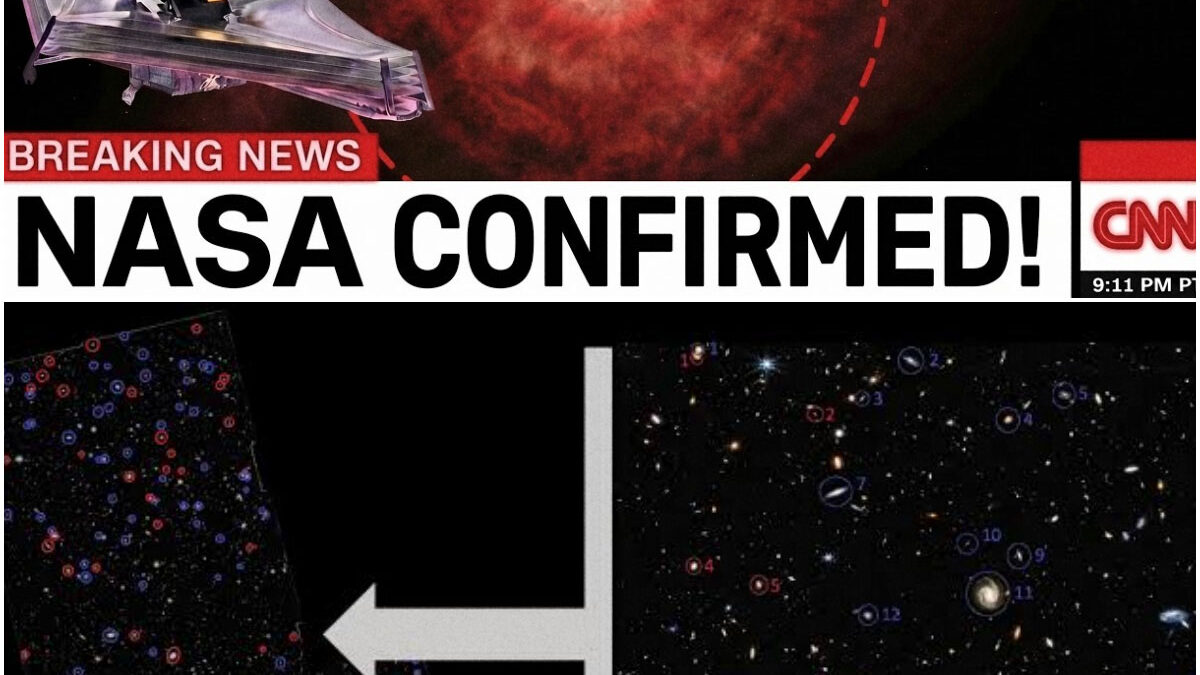
James Webb Just Detected A Black Hole Bigger Than The Observable Universe!
In August of 2025, a team using the cosmic horseshoe gravitational lens measured a black hole so massive it sits at the mathematical ceiling of what the universe is supposed to be able to build.
36 billion times the mass of our sun.
10,000 times heavier than the monster at the center of our own galaxy.
4 to n times heavier than the stars around it predict.

The press release called it a discovery.
That word is doing a lot of work because what was actually measured is a wall.
A limit our models did not think reality was allowed to touch.
And once you understand what that number really means, a hypothesis first published in 1972, filed for 53 years under speculation, quietly stops being speculation.
This is not a story about a distant object.
This is a story about the container we may be living inside of.
Before we go there, I want to ask you something.
Wherever you are watching this from, whatever city, whatever time it is on your clock right now, I want you to notice the sky above you.
Not look at it.
Just notice it.
Because the argument I am about to walk you through is going to change what that sky is.
And I want you to remember what it felt like before.
Now, let me tell you what you were told this discovery meant.
The public story of black holes is a story of tidy scaling.
Bigger galaxies have bigger central black holes.
There is a relationship between the mass at the center and the motion of the stars around it called the m sigma relation.
And for decades it worked.
Textbooks show it.
Documentaries repeat it.
Every large galaxy has one super massive black hole at its core, growing in proportion to its home, like an ornament that scales with the room.
The universe, in that telling, is well behaved.
The exceptions are rare.
The categories are clean.
The cosmic horseshoe object breaks that story.
It is not a little above the curve.
It is 4 to9 times heavier than the galaxy around it says it should be.
And it is not alone.
Homeberg 15A 40 billion solar masses.
Tons 618 estimated at 66 billion.
Phoenix A estimated near 100 billion with an event horizon roughly 100 times the distance from the sun to Pluto.
These are not statistical noise at the edge of a distribution.
They are structural outliers appearing at different distances, different epex, different corners of the sky.
The pattern is not that we keep finding bigger ones.
The pattern is that our ceiling keeps failing.
This is the part that should bother you.
The public was sold a universe of neat categories.
The data is showing a universe of exceptions our best model cannot absorb.
And when a model cannot absorb its own data, one of two things is happening.
Either we are missing pieces of the model or we are missing what the object actually is.
Consider the scale for a moment.
The cosmic horseshoe galaxy is roughly 100 times more massive than the Milky Way.
That alone is unusual.
Now put a 36 billion solar mass object at its core when the standard relation predicts something closer to 4 to 9 billion and you are looking at a black hole that ate more than its share of the galaxy that supposedly hosts it.
Astronomers used gravitational lens modeling combined with stellar kinematics, two independent methods to lock down that measurement with confidence.
The uncertainty on that number is small.
The uncertainty on what the number means is not.
There is a subtler failure inside the story too.
The M sigma relation was supposed to encode a simple physical intuition that black holes and galaxies grow up together, feeding each other, regulating each other.
When you see an object 9 times heavier than the relation permits, you are not seeing a stretched version of that intuition.
You are seeing that the intuition may have had the arrow of cause pointing the wrong way.
The black hole may not be a passenger inside the galaxy.
The galaxy may be the incidental structure that condensed around it.
Read that carefully because the shift is quiet, but everything after depends on it.
To see which one it is, you have to understand what a black hole actually is.
And here is where the real problem starts.
A black hole is not an object.
That is the first thing to get out of your head.
It is not a dense sphere sitting in space.
It is a region of spaceime defined by a single number inside which no information can escape.
That number is the Schwarz radius 2 gm over c^ squ.
Mass in size out.
Give me the mass of anything and I can tell you the radius at which if you compressed it that small it would become a black hole.
The sun compressed to a sphere 3 km across would become one.
The earth compressed to about 9 mm, the width of your fingernail would become one.
A human being compressed to the diameter of a single proton would become one.
Every mass has a Schwarz child radius.
The question is only whether it is compressed inside it.
The event horizon is not a wall.
It is not a surface you slam into.
It is a one-way membrane in the geometry of space itself.
Cross it going in and there is no path back out because outside stops existing as a direction.
Inside the horizon, the roles of space and time literally swap in the mathematics.
Moving forward in time for anything past that boundary becomes equivalent to moving toward the center.
The future itself points inward.
That is not a metaphor.
That is what the equations of general relativity do.
Think about what that sentence actually says.
Escape is not difficult inside a black hole.
Escape is not merely energetically expensive.
Escape is time reversed.
To leave, you would have to travel into your own paSt. The horizon is not enforcing a rule.
The horizon is the rule.
Let that sit for a second because here is the disturbing math nobody puts in the headline.
Take the total mass energy of the observable universe.
Everything, every star, every galaxy, every wisp of gas, every particle of dark matter, every photon in transit.
Add it up.
Then plug that number into the Schwarz formula.
What comes out is a radius.
And that radius is roughly equal to the actual radius of the observable universe.
About 46 1/2 billion lightyear.
Give or take on both sides.
The mass and the size of everything we can see satisfy the exact condition that I applied to anything else would define it as a black hole.
This is called the Pathria coincidence and it has been sitting in the physics literature for over half a century unresolved.
Rajkumar Pathria published it in nature in 1972.
The mathematician I J Good arrived at the same result independently around the same time.
Two people working separately noticed that the Hubble radius of our universe and the Schwarz radius of our universe’s mass are within measurement error the same number.
53 years later, nobody has explained that coincidence away.
They have only relabeled it, called it a curiosity, called it a numerical accident, called it a topic for another day.
The problem is that every attempt to make it go away costs something.
To dismiss it, you have to add fine-tuning to your cosmological parameters or invoke extra dimensions or lean on enthropic reasoning.
The idea that the universe looks this way because we are here to see it.
Each of those moves weakens the standard picture more than the coincidence itself does.
And meanwhile, the coincidence just sits there, refusing to leave.
There is a historical rhythm to this.
When Pensas and Wilson first detected the cosmic microwave background in 1964, they thought it was pigeon droppings in the antenna.
It turned out to be the fingerprint of the Big Bang.
When astronomers first noticed galaxies rotating too fast for their visible matter, the community called it a measurement error.
It turned out to be dark matter.
The history of cosmology is a history of coincidences that were dismissed until they weren’t.
Then once accepted, they turned out to be the loadbearing feature of the next model every time without exception.
So let me tell you what the Pathria coincidence means.
Taken seriously.
If the mass and radius of the visible universe satisfy the Schwarz condition, then by the exact same physics we apply to a stellar black hole, we are inside one.
Not metaphorically, not poetically.
By the same equation, the direction the universe is expanding is not what you think it is.
It is the interior geometry of a horizon.
Now, before that lands too easily, I want to break one more piece of your intuition.
Because the reason most people cannot take this seriously is that they picture black holes wrong.
They picture them small.
They picture the crushing.
They picture spaghettification, the shredding, the fatal tidal force.
And for a stellar black hole, that picture is correct.
A 10 solar mass black hole would tear a human body apart before you even reach the horizon because gravity would be so much stronger at your feet than your head that you would be pulled into a strand.
It is a violent object.
An ultramassive black hole is not the same category of object.
This is where the intuition breaks.
Sagittarius, a star, the black hole at the center of our galaxy, has about 4 million solar masses.
Its event horizon is roughly 24 million km across, about the diameter of Mercury’s orbit.
Already, that is not a small object.
The cosmic horseshoe monster at 36 billion solar masses has an event horizon spanning a serious fraction of a solar system.
Phoenix A at roughly 100 billion has a horizon about 590 billion km across.
That is roughly 100 times the distance from the sun to Pluto.
A single object whose boundary is larger than 100 solar systems laid end to end.
At the speed of light, it would take you 71 days just to circle it once.
Here is the counterintuitive part.
Tidal force at the horizon of a black hole scales inversely with its mass.
The bigger the object, the weaker the stretching at the boundary.
At the horizon of Phoenix A, the tidal force pulling on a human body would be less than the gravity you are feeling right now sitting still.
You could cross the event horizon of an ultramassive black hole and not feel a thing.
No shudder, no warning, no sensation of arrival.
The one-way membrane would simply pass through you and now your future points inward and you would have no way to know more than that.
Inside without extreme gradient without violent forces, the local geometry could look for anything embedded in it like a smoothly expanding space.
Galaxies drifting apart, light stretching to red shift.
A cosmos apparently doing exactly what our cosmos appears to do.
This is the property that makes the hypothesis so difficult to falsify.
A large enough interior would not look like a black hole from the inside.
It would look like a universe.
Which means the question is no longer whether it is physically possible for us to be inside one.
The question is whether our own sky is showing us the signature.
And this is where it starts to get harder to dismiss because in the last few years, three separate lines of observation, none of which were designed to test black hole cosmology, have started pointing in the same direction.
The first is the James Webb Space Telescope’s galaxy rotation data.
In an isotropic universe born from a symmetric big bang, spiral galaxies should rotate clockwise and counterclockwise in roughly equal numbers distributed randomly across the sky.
That is what standard cosmology predicts.
It is not what JWST is seeing.
In analyses of hundreds of early galaxies, there’s a strong preference for one rotational direction over the other.
Not a subtle bias.
A statistically significant asymmetry.
One of the published interpretations of that data by researchers who did not set out to promote any exotic model is that the universe was born spinning that it inherited angular momentum and the natural source of inherited angular momentum for a cosmos is a rotating parent black hole.
Angular momentum unlike matter cannot be destroyed.
It has to come from somewhere and in the standard model there is nowhere for it to come from.
The second line is the impossibly early massive galaxies.
JWST is finding galaxies that are too big, too structured, too chemically evolved too soon after the supposed big bang.
This is straining the standard model.
The equations of the standard cosmological model, LCDM, have to be bent to accommodate them.
A bounce interior, a universe that inherits mass from a collapse rather than starting from nothing, has no such trouble.
Structure formation gets a head start it does not have in the standard picture.
The third line is the strangest, and I want you to sit with it.
In 2023 and 2024, papers were published proposing that black holes gain mass as the universe expands.
That the two things are linked.
Cosmologically coupled black holes, the technical name.
And if that is correct, then black holes themselves are the source of dark energy, meaning the accelerating expansion of our universe and the interiors of the black holes inside it are the same physical phenomenon.
Read that again.
The expansion of the space you are sitting in and the growing of the black holes we see in the sky may be one process seen from two angles.
For a 100red years, dark energy has been the biggest unexplained ingredient in physics.
Roughly 68% of the total energy of the universe and nobody knows what it is.
The cosmologically coupled black hole proposal offers something the standard model has never offered.
An identified source, not a new field, not a new particle, something we can already see, whose masses we already measure, whose numbers are already climbing.
If it holds up, dark energy stops being an unknown ingredient and starts being an accounting entry.
Every black hole in the universe, contributing to the very expansion that is stretching everything apart.
Now, think about what that means.
When you look up at the night sky, the darkness between the stars, the horizon of the observable universe fading into microwave background, you may be looking at the inside surface of something.
The expansion you were told about in school may not be the outward growth of everything.
It may be the interior geometry of a container.
And every direction you look, the walls are further away.
Not because the container is small, but because the container is you.
If that is true, one of physics’s oldest embarrassments quietly disappears and that is where the theory stops looking like fringe speculation and starts looking like a repair.
The embarrassment is the singularity.
General relativity, the theory that gives us GPS, gravitational waves, and the entire modern understanding of gravity has one enormous crack in it.
At the center of every black hole and at the moment of the Big Bang, the equations predict a point of infinite density, zero volume, infinite temperature.
Physics openly admits this is a failure, not a real object, a place where the theory breaks and hands the problem off to a quantum theory of gravity that has not been finished for a 100red years.
Black hole cosmology in its modern form removes that failure.
The physicist Nicodemosi working in Einstein carton gravity has shown that when you include torsion, a twist in the fabric of spaceime that standard relativity ignores.
The collapse inside a black hole does not go to a singularity.
It bounces.
It reaches enormous but finite density, then rebounds, then expands.
Inside the event horizon from the perspective of anything embedded in the rebounding matter that expansion looks exactly like a big bang that is not fringe that is peer-reviewed physical reviewd standard journals standard mathematics the bounce also quietly addresses other problems the standard model needs inflation to patch the flatness problem why the universe appears geometrically flat to extraordinary precision vision.
The horizon problem.
Why regions of the sky that never had time to communicate somehow share the same temperature.
The low entropy initial condition.
Why the universe started in such an improbably ordered state.
A bounce inside a parent black hole handles each of these without inflation as a bolt-on.
Inflation was invented in the early 1980s to solve exactly these problems and it works.
But nobody has ever explained where inflation itself comes from.
The bounce does not need to.
The price of dismissing this hypothesis is keeping every one of those unsolved problems in the standard model.
The price of accepting it is admitting that the universe has an outside.
Those are not equal costs.
And once you feel the imbalance, the natural next question is why isn’t this the official story?
The answer is not conspiracy.
It is not that scientists are lying to you.
I want to be careful here because this is exactly where the argument can drift into places I do not want to go and where the evidence does not support drifting.
The answer is sociology, grants, tenure, telescope time, journal reputations, textbooks, curricula, review committees.
The entire infrastructure of professional physics is built around the standard cosmological model.
That does not mean the model is wrong.
It means the incentives to challenge it are asymmetric.
A careful physicist who publishes a paper strengthening LCDM has a career.
A careful physicist who publishes a paper suggesting we live inside a black hole has to survive their next funding cycle.
Multiply that across thousands of working scientists and you do not get a conspiracy.
You get an ecosystem that quietly rewards continuity and quietly penalizes reframing.
No memo has to be written.
The pressure is structural.
And so what you see in the literature is a language of tension.
When JWST returns data that LCDM cannot easily digest, the papers do not say the model is failing.
They say there is a tension.
A tension in the Hubble constant.
A tension in early galaxy formation.
A tension in the isotropy of large scale structure.
Tension is a diplomatic word.
It means our predictions and our observations no longer match and we do not yet have a replacement ready.
Science journalism translates all of that into wild theory when it reports on alternatives because caution reads better than reframing.
Uncertainty gets sanded off both ends.
And the middle that reaches the public is neither the honest doubt of the working scientists nor the honest weight of the anomalies.
I am not saying scientists are lying.
I am not saying the standard model is worthless.
It has produced enormous predictive success for over half a century.
I am not saying the big bang framework has given us nothing.
It has given us the cosmic microwave background prediction, the abundance of light elements, the large scale structure of the cosmos.
What I am saying is narrower and heavier.
The version of reality being handed to the public in documentaries and headlines is softer than the version the equations are actually describing.
You have been trained to treat we live inside a black hole as a meme.
The math has been sitting in nature since 1972.
Which means the real question was never whether the hypothesis is true.
The real question is what it means if it is.
And here is where the story stops being about cosmology and starts being about us.
Three consequences follow.
Each one is heavier than the laSt. The first, we are causally sealed.
The defining property of an event horizon is that it is one way.
Nothing that happens inside can send information out.
If our universe is the interior of a black hole in some parent universe, then whatever that parent contains, other cosmo, other physics, other observers, we cannot ever verify it directly.
Every question about what came before the big bang.
Every question about what lies outside the observable universe is not just unanswered, it is provably unanswerable from within.
There is no experiment we can build here ever that reaches out.
The horizon is not a technological limit.
It is a geometric one.
This is the loneliest fact in modern physics.
The second, the big bang was not a beginning.
It was a phase transition.
The bounce inside a parent black hole.
That does not make our universe younger or older than the standard model says.
It does something more disorienting than that.
It makes the concept of the universe’s beginning the wrong question.
There was a moment we call time zero, but it was not the moment matter appeared.
It was the moment the previous configuration crossed a curvature threshold and rebounded.
Before was still a valid word.
It just refers to a place we cannot see and cannot reach.
The third is the hardest and I want you to stay with me.
The recursion.
Black holes exist inside our universe.
We can count them.
We have imaged two of them.
If our universe is itself the interior of a black hole in a parent universe, then there is no principled reason to stop there.
The parent could be inside its own and so on.
This is not mysticism.
This is what the equations do when you keep applying them.
Physicists have several formal names for versions of this idea.
Lee Smolen called his version cosmological natural selection in which universes reproduce through black hole formation and the physical constants that favor black hole production get selected for.
Others use nested Schwarz cosmology or fractal cosmology.
The details vary.
The recursion is the same which means every black hole in every JWST image towen 618 Phoenix A the cosmic horseshoe monster we started with could contain in its interior an entire cosmos with its own galaxies with its own laws with its own version of this exact conversation happening between an observer and a screen and the observer would have exactly as much justification for believing they were on the outside of things as you do right Now that is not comforting.
It is not supposed to be.
It is what happens when a physical model refuses to stop at the boundary that our intuition wants it to stop at.
Previous cosmological revolutions demoted us within the universe.
Helioentrism removed us from the center of the solar system.
Galactic plurality removed us from the center of a small local cosmos.
Cosmic expansion removed us from any privileged frame at all.
This one does not demote us within the universe.
It demotes the universe itself.
And that leaves one final question.
The one nobody at a major agency wants to be quoted on.
What do we do with this?
Let me consolidate what we actually have.
Not what could be, what is.
The Schwarz shield Hubble radius coincidence has stood for 53 years and nobody has removed it.
The mass ceiling on directly observed ultramassive black holes is being touched and the ratio of central black hole mass to host galaxy mass is exceeding what the standard model predicts.
JWST rotation asymmetry is a published anomaly, not a rumor.
Einstein carton bounce cosmology is peer-reviewed mathematically self-consistent and lives in mainstream journals.
The cosmologically coupled black hole proposal ties the interior of black holes to the expansion of our own space through the same physical mechanism.
That is five independent evidence lines pointing at the same picture.
Five from different instruments, different research groups, different mathematical frameworks, different decades, all pointing the same way.
The last comforting thought people reach for is that this is unfalsifiable and therefore does not matter.
I want to take that away gently.
Unfalsifiability from the inside is exactly what the theory predicts.
That is the geometric consequence of the event horizon, not a flaw in the argument.
And the indirect signatures, the coincidence, the rotation, the accelerated expansion, the early galaxy problem, the singularity removal are exactly where the evidence is now converging.
The claim is not unfalsifiable in principle.
It is unfalsifiable through direct observation of the outside.
Every other kind of test remains open.
And so far, every one of them is failing in the direction the hypothesis predicts.
So return with me to where we started.
That 36 billion solar mass object at the center of the cosmic horseshoe was not the story.
It was the reminder.
When we look at super massive black holes, we may be looking at ourselves from the outside, from an angle we are not equipped to see from.
The largest objects in our sky may not be exotic anomalies inside our cosmos.
They may be the exact same kind of thing our cosmos is.
I am not going to tell you this is certain.
It is not.
Physics does not offer that word here.
And any narrator who does is selling you something.
What I will tell you is that the version of reality that treats we live inside a black hole as pop science trivia is no longer the intellectually honest position.
It has become the comfortable position and there is a difference between comfortable and honeSt. There has always been a difference and every time science has been forced to choose between them, the honest position has eventually won.
But the comfortable position has always fought harder than anyone expected.
The point of walking through this is not despair.
The point is that the universe is stranger, older, and more nested than the tidy version we were handed.
Understanding that, sitting with it, letting it change how you look at a night sky.
That is not a loss.
That is the first honest step toward whatever comes next.
It is also quietly the oldest thing science has ever asked of us.
To trade a smaller true story for a larger true story, even when the larger one is harder to hold.
Look up tonight.
The same equation that describes the horizon of a black hole describes the horizon of your sky.
That is either the biggest coincidence in the history of physics or it is the biggest thing the physics has been trying patiently for 53 years to tell us.
I will let you decide which one it is.
But I do not think you are going to look at the sky the same way again.








