What If We Aimed James Webb At Earth?
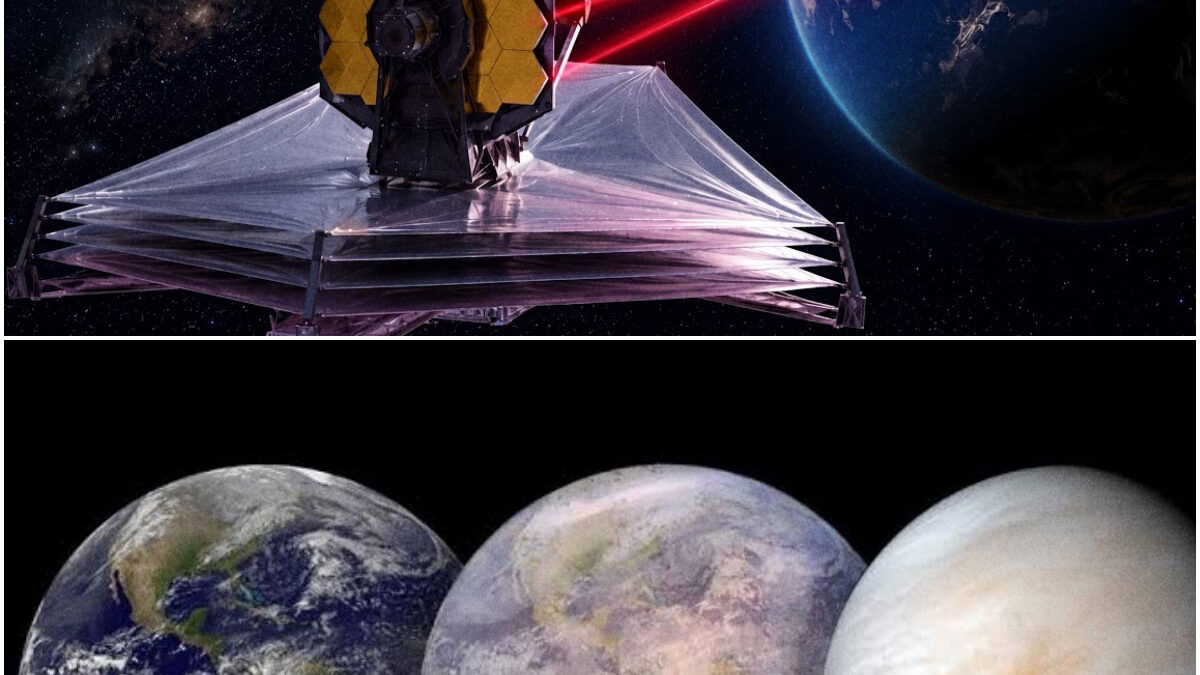
What If We Aimed James Webb At Earth?
The alarms would not be metaphorical.
If someone at the Space Telescope Science Institute in Baltimore typed the wrong command tonight and slewed the James Webb Space Telescope toward Earth, the fault protection system would fire within seconds, not minutes, seconds.
The onboard software is written to prevent exactly this maneuver because the engineers who built it knew what would happen if it ever executed.
The mirror would face a warm object for the first time in its operational life.
The detectors, chilled to 7 Kelvin above absolute zero, would begin to absorb radiation they were designed to hide from.
And somewhere in a control room, an engineer would watch a 20-year, 10 billion-dollar mission begin to die in real time.

Now, wherever you are watching this from, tell me honestly, when you first heard the question, what if we aimed James Webb at Earth, did you picture a photograph, a stunning image of our planet in a resolution no camera has ever achieved?
That is the wrong question.
That is the comfortable question.
The real question is why the most powerful telescope ever built cannot be pointed at the world that built it and what that inability tells us about ourselves.
Here is the thesis stated early because this niche does not hide its argument.
JWST was engineered as a time machine pointed away from Earth for reasons that are not curiosity.
They are physical, biological, and civilizational limits.
Turning it around would not give us a better view of our planet.
It would destroy the instrument, reveal how blind we still are to what is coming toward us, and expose the uncomfortable truth.
The most powerful telescope humanity has ever built cannot save us from what it was never designed to see.
Start with the physics that make the answer immediate.
JWST sits at Lagrange point two, roughly 1.5 million kilometers from Earth in the direction opposite the Sun.
From that position, the Sun, Earth, and Moon all cluster on the same side of the telescope, which is exactly the geometry the mission required.
The five-layer sunshield, unfolded to the size of a tennis court, blocks all three of those warm objects at once.
The cold side of the observatory sits around 50 Kelvin.
The hot side sits at around 358 Kelvin.
The temperature gradient across that shield is roughly 300°.
And it is maintained continuously, every second, for years.
Now, hear the design constraint that follows.
JWST cannot point within approximately 85° of the Sun without breaking the shield’s protective geometry.
And from L2, Earth sits inside that forbidden cone almost always.
The instrument was not merely optimized to avoid Earth.
It was structurally forbidden from seeing it.
This is not a limitation the public understands.
The public thinks of JWST as a camera in space.
It is not.
It is a cryogenically starved eye that survives only by avoiding warmth.
Earth is a warm object.
Earth radiates in the exact wavelengths JWST was built to hear whispers in.
Point the mirror at Earth, and the whispers become a scream.
The detectors saturate.
The mirror warMs. The margin collapses.
And here is the part that should bother you.
That collapse is permanent.
There is no reset, no servicing mission, no astronaut, no space shuttle, no repair.
JWST is six times farther from Earth than the moon.
If it breaks, it stays broken.
Forever.
So, the reason we cannot point JWST at Earth is not policy.
It is not caution.
It is not oversight.
It is that the telescope was built to survive by looking away from us.
And that fact is worse than a design flaw.
It is a confession about what humanity chose to see and what humanity chose not to.
Ask anyone at NASA the direct question and you will get a direct answer.
JWST is optimized for infrared observation of the early universe.
Earth observation is handled by other satellites.
Landsat images the surface.
Sentinel monitors climate.
MODIS tracks fires and vegetation.
GOES watches weather.
Each telescope has its job.
JWST does its job.
Earth-facing missions do theirs.
That answer is true.
It is also emotionally misleading.
And the difference between those two things is where this story lives.
Read the sentence carefully.
Each telescope has its job.
It sounds like specialization.
It sounds like a mature scientific ecosystem where every instrument occupies its rightful niche.
It is not.
It is a division of labor that conceals an asymmetry.
There is no instrument in existence, none, that combines JWST’s sensitivity with Earth-facing capability.
Landsat resolves 15 m.
Sentinel resolves 10 m.
These are useful numbers for agriculture and city planning.
They are useless for detecting the kinds of thermal, chemical, and atmospheric shifts JWST could theoretically measure if the physics allowed.
Think about what that means.
The most sensitive infrared instrument ever built points at galaxies 13 billion years old.
And the instruments that watch our own planet operate at sensitivities that would have embarrassed astronomers 30 years ago.
That is not specialization.
That is priority.
And here is where the polite answer starts to crack.
The reason no one has built a JWST-class Earth observation platform is not that the science community is uninterested.
It is that no funding coalition would survive the political consequences of building it.
An infrared telescope capable of resolving industrial thermal signatures, methane leaks, and heat island evolution at unprecedented sensitivity would generate data that governments do not want indexed.
It would answer questions we currently prefer to keep vague.
So, the public accepts the polite answer because the polite answer is comforting.
It sounds like a good decision made by smart people.
And it was a good decision.
JWST is doing extraordinary work.
But the shape of that decision, the fact that we chose to point our best eyes outward rather than inward, is not neutral.
It is a civilizational preference disguised as engineering logic.
Now, widen the frame.
When NASA says JWST cannot observe Earth, the technical claim is airtight.
But the philosophical claim underneath it is never voiced.
The philosophical claim is this.
We built the most sensitive infrared telescope in human history and chose to make it structurally incapable of seeing our own planet.
Not because we forgot to consider it, because considering it would have required conversations no one wanted to have.
The public version is JWST is for the early universe.
The uncomfortable version is JWST is a way of not looking at what is closer.
Both are true.
Only one is honest about what it means.
To understand why the polite answer breaks down completely, you have to understand what JWST actually does at the level of physics.
You have to understand why doing it at Earth would require breaking every rule the mission was built on.
And you have to understand that those rules are not arbitrary.
They are the reason the telescope exists at all.
This is the part where the science starts to matter, not as background, as evidence.
JWST works because it is cold.
That is the entire mission in one sentence.
Every design decision, every dollar of the 10 billion dollar budget, every year of the 20 year development timeline, all of it exists to keep one instrument colder than almost anything humans have ever tried to keep cold in space.
The MIRI instrument, the mid-infrared imager, operates at approximately 7 Kelvin.
That is 7° above absolute zero.
To put that in a frame you can feel, room temperature is around 300 Kelvin.
Liquid nitrogen boils at 77 Kelvin.
MIRI runs at a temperature 10 times colder than liquid nitrogen.
The rest of the observatory sits at around 50 Kelvin, maintained passively by geometry and the sunshield, not by active cooling.
Why does the cold matter?
Because infrared light is heat.
Every warm object radiates in the infrared.
If the telescope itself is warm, it drowns out the signal it is trying to detect.
Looking for a 13-billion-year-old galaxy with a warm telescope is like trying to hear a whisper inside a screaming crowd.
The telescope has to be silent in the wavelengths it wants to hear.
Silence in infrared means cold.
Now think about what that requires.
The sunshield unfolds to roughly 21 m long and 14 m wide.
Five layers of aluminized polymer, each thinner than a human hair.
Between the layers, vacuum.
Between the sun and the mirror, geometry.
Every second, that shield absorbs solar radiation on one side and radiates it into space on the other, maintaining a temperature difference of roughly 300° across a structure the size of a tennis court.
The sunshield is not equipment.
It is the only thing standing between a 10-billion-dollar instrument and thermal death.
Imagine holding an ice cube in one hand while a blowtorch burns 2 m away, and the ice cube has to stay frozen for 20 years.
That is the operational reality of JWSt. Every day, every hour, continuously.
And here is what the public framing misses.
JWST is not in space.
It is hiding.
It has spent every second of its operational life hiding from the sun, from Earth, from the moon, from every warm object in the inner solar system.
The sunshield is not a feature.
It is a survival mechanism.
The L2 orbit is not a location.
It is a hiding place chosen because it is the only stable point where sun, Earth, and moon cluster on the same side of the sky, allowing a single shield to block all three at once.
Read that back to yourself.
The most powerful telescope ever built has spent its entire operational life avoiding the planet that launched it.
Not incidentally, deliberately.
Structurally.
As a condition of existence.
And the moment you turn the mirror toward Earth, the hiding ends.
The shield still blocks the sun, but the mirror now faces a warm, bright, infrared-loud object at a distance where it cannot be ignored.
But that is not the worst part.
The worst part is what happens next.
Here is the fact that changes everything.
JWST’s optics cannot be recooled.
Not can, not may, cannot.
Once the mirror warms above its operational temperature, the observatory’s finite supply of coldness begins to bleed away.
And no engineer, no ground command, no future mission can put it back.
This is the point where state-of-the-art stops meaning strong and starts meaning fragile.
Understand what unreachability means at L2.
Hubble sits in low Earth orbit, roughly 540 km up.
Astronauts flew to it five times.
They replaced instruments, installed gyroscopes, corrected the mirror’s original spherical aberration with a set of custom optics.
Hubble is alive today because human beings could physically reach it and fix it.
JWST is 1.5 million km away.
That is roughly six times the distance to the moon.
No astronaut has ever traveled that far.
No spacecraft designed for human transport currently exists that could make the trip.
And even if one did, JWST was not built with a docking port, a refueling interface, or any hardware designed to be serviced.
The engineers who built it made that choice knowingly.
They assumed the telescope would never be touched again.
Now think about what that means for every observation JWST has ever made.
Every image of a distant galaxy, every spectrum of an exoplanet atmosphere, every measurement of early universe chemistry.
All of it is drawn from a finite budget of coldness the telescope will never recover.
The cryocooler that keeps MIRI at 7 Kelvin has a limited operational life.
The propellant that maintains L2 station keeping has a finite mass.
Every gram of it burned is a gram that cannot be replaced.
The public sees a triumphant instrument.
The engineers see a countdown.
And here is what makes a single glance at Earth catastrophic.
Point the mirror at a warm object and the thermal load rises faSt. The detectors that were designed to hide from radiation begin to absorb it.
The mirror’s beryllium segments, coated in gold, each aligned to a precision measured in nanometers, begin to expand.
Not visibly, not catastrophically, but enough.
Enough to break the optical alignment.
Enough to compromise the very thing that makes JWST JWSt. And that alignment cannot be recovered without either active cooling capacity the telescope does not have, or a human hand that will never arrive.
Read the implication.
A single mistaken command, a single software error, a single failure of the fault protection system, and the mission ends.
Not gradually, not with warning.
It ends because the telescope is a house of cards built out of cold.
And cold is the one thing space cannot provide on demand.
A single glance at Earth would not just fail as a photograph.
It would end the mission.
And ending the mission would end something bigger than a telescope.
Set aside the fragility for a moment.
Pretend, hypothetically, that JWST could survive pointing at Earth.
Pretend the sun shield geometry allowed it.
Pretend the detectors did not saturate.
Pretend the mirror stayed cold.
Now ask the question the public assumes has an obvious answer.
What would we actually see?
The answer will surprise you.
And it will surprise you because your intuition about telescopes is wrong.
Here is the intuition.
Bigger mirror equals better image.
JWST has a 6.5 meter mirror, more than two and a half times the diameter of Hubble.
Therefore, JWST pointed at Earth would produce an image two and a half times better than any Earth observation satellite.
That is the assumption.
It is completely wrong.
The math is unforgiving.
Angular resolution depends on wavelength and mirror size, but the actual size of features you can see also depends on distance.
JWST sits 1.5 million kilometers from Earth.
The International Space Station orbits at roughly 400 kilometers.
That is a distance ratio of 3,750 to 1.
JWST is 3,750 times farther from Earth than the ISS.
Now, translate that.
A commercial Earth observation satellite in low orbit can resolve objects smaller than a meter across.
JWST at L2, even with its enormous mirror, would resolve Earth features at a scale of roughly 100 meters at best, and that is being generous.
Because the telescope operates in infrared wavelengths, where resolution collapses faster than in visible light.
You would not see your house.
You would not see your car.
You would not see the streets of your city.
At the scale JWST could resolve, entire neighborhoods would be single pixels.
Continents would be blurred.
Storm systems that a weather satellite tracks in high definition would appear as smudges of thermal noise.
Hold your hand up in front of your face right now.
Extend your arm.
Look at your fingernail.
From L2, Earth would fill roughly the angular space of that fingernail held at arm’s length.
That is the entire planet.
Every ocean, every continent, every city, every human being compressed into a disc smaller than your thumb.
The most powerful telescope ever built, pointed at the most important planet in human history, would produce an image worse than the camera in your phone.
Not because the telescope is bad, because the telescope is in the wrong place for the wrong job.
This is what the phrase most powerful telescope ever built actually means in context.
Point it at a galaxy 13 billion light-years away, and it does what nothing else can.
Point it at Earth, and it becomes the most expensive blurred snapshot in history.
But here is what breaks the fantasy completely.
Even if the physics worked, there is a reason we do not need JWST to watch Earth, and that reason is the darkest part of this story.
JWST sees in infrared because infrared is the wavelength of heat.
Every warm object radiates in it.
Every fire, every engine, every body, every ocean, every forest, every city.
Infrared is not a mysterious alien signal.
It is the electromagnetic language of temperature, and Earth is loud in it.
Now think about what a JWST class infrared instrument, if it could survive pointing at us, would actually detect.
Not photographs, signatures.
Heat islands rising off cities in patterns that trace decades of unplanned expansion.
Methane plumes leaking from pipelines and landfills at concentrations that regulatory filings never disclose.
Industrial thermal signatures from facilities that operate below the resolution of public satellites.
Forest fire precursors, the slow warming of soil and vegetation that precedes ignition by hours or days.
All of it visible, all of it recorded, all of it at unprecedented sensitivity.
Your body radiates infrared right now.
As you sit there watching this, you are emitting roughly 100 watts of thermal energy into the room around you.
JWST could not, in practice, image a single human from L2.
The geometry does not allow it, and the physics does not permit it.
But the principle matters.
What an instrument like JWST detects, at its core, is not people.
It is the heat leaving people.
The same heat leaving forests, cities, factories, oceans.
Now, hear the reframe.
Everything you are worried about, quietly in the back of your mind when you read a news headline about climate, or industrial pollution, or ecological collapse, all of it lives in the infrared.
The wavelengths that JWST was built to hear whispers in are the same wavelengths that are quietly reshaping the human environment right now.
Invisible to your eye, but measurable to instruments that never point at us.
This is the point that should sit with you.
The reason we do not turn instruments this sensitive on ourselves is not technical.
It is not about optics, or thermal design, or orbital mechanics.
It is that the data would be politically radioactive.
A high-sensitivity infrared map of Earth, updated in real time, would produce evidence that would end political careers, force regulatory action decades ahead of the current timeline, and give environmental litigators a weapon that no corporate defense team could counter.
That is not conspiracy.
That is incentive structure.
No government, no coalition, no funding body volunteers to build the instrument that will produce inconvenient truth at industrial resolution.
So, we look outward.
We point our best eyes at the beginning of time.
And the wavelengths that could tell us the hardest facts about our own planet stay unmeasured at that sensitivity, deliberately.
Which leads to the question no space agency wants asked out loud.
What did we build instead and why?
JWST cost roughly 10 billion dollars.
That is not a headline number.
That is the cumulative total of NASA, the European Space Agency, and the Canadian Space Agency spending over two and a half decades.
The mission was proposed in 1996.
It launched in December 2021.
Between those two dates, the project survived cost overruns that would have killed almost any other program, congressional hearings that came within a single vote of cancellation, and delays that pushed the schedule out by more than a decade.
It survived because the astronomy community fought for it.
It survived because the successor to Hubble was a phrase that carried political weight.
It survived because looking outward is a story governments know how to fund.
Now consider what all of that money, all of that time, all of those thousands of engineers was spent to accomplish.
It was spent to look away from Earth.
Every design choice from the L2 orbit to the sunshield geometry to the wavelength range of the instruments was oriented toward the early universe.
There is no version of the JWST program that spent even 1% of its budget on Earth-facing capability.
Compare that to what does watch Earth.
Discover, the Deep Space Climate Observatory, sits at Lagrange point one on the sunward side of Earth.
It carries a 4-megapixel camera.
Its images are lovely.
They are also, in terms of scientific sensitivity, roughly a rounding error compared to what a JWST-class instrument could theoretically provide.
Discover was originally proposed in 1998 and sat in storage for over a decade before finally launching in 2015 on a budget so small it could have been rounded off inside JWST’s contingency reserve.
That asymmetry is not accidental.
That asymmetry is the shape of a civilization’s priorities carved into orbital hardware.
We built the most sensitive telescope in history to answer questions about the beginning of time.
We built a 4-megapixel webcam to watch our own planet from the same distance.
And the ratio of investment between those two things tells you exactly which questions we were willing to fund and which we were willing to leave under developed.
The infrastructure of astronomy is built to answer questions that are safe to ask.
How old is the universe?
How do galaxies form?
Do other planets have atmospheres that could host life?
All of these questions are important and none of them threaten anyone politically.
How fast is our planet actually changing in wavelengths regulators counting is a different kind of question.
And no funding body has ever prioritized answering it.
Which raises the harder question.
What exactly is being softened when the public asks about JWST and Earth.
Read a NASA press release about JWSt. Any of them.
Read the phrases the agency uses over and over.
The dawn of the universe.
Cosmic origins.
The formation of the first galaxies.
Exoplanet atmospheres and the search for habitable worlds.
These phrases are not accidents.
They are the result of decades of careful message discipline.
They are the language the agency has chosen to define what JWST is for.
Now, notice what is missing.
There is no mention of Earth.
There is no mention of climate.
There is no mention of any application closer than a few light-years away.
The framing is consistent, deliberate, and complete.
JWST is a telescope for looking at the beginning of time.
Everything else is outside its mission scope.
This is not a lie.
It is true.
JWST was designed for those purposes.
But the framing serves a second function that no press release ever states out loud.
It keeps the mission emotionally safe.
It ensures that when the public thinks about JWST, they think about beauty and wonder and the origins of the cosmos.
They do not think about what a comparable instrument pointed differently could tell us about ourselves.
Here is the fairness clause and it matters.
This is not to say NASA is lying.
It is not to say engineers are hiding anything.
It is not to say JWST should have been built differently.
The mission is doing exactly what it was designed to do and the science coming out of it is real, valuable, and worthy of every dollar spent.
The point is not that anyone is being dishoneSt. The point is that the framing of what JWST is for has been carefully managed to keep the mission emotionally safe, and that management is not neutral.
Optimized for the early universe is true.
It is also a way of not saying optimized to avoid uncomfortable applications.
Both statements describe the same telescope.
Only one of them is ever spoken aloud.
Read the pattern in the language.
When agencies want the public to engage with a mission, they use words like discovery, exploration, and origins.
When agencies want the public to disengage from a topic, they use technical specifications, orbital mechanics, and mission scope.
The public receives a version of space science in which the hardest questions are always somewhere else.
13 billion light years away, not one astronomical unit.
The formation of galaxies, not the transformation of our own planet.
And that distance, the distance between what we look at and what we live inside, is the real subject of this video.
Because that distance is not just physical.
It is chosen, and it is growing.
Widen the frame.
JWST’s inability to look at Earth is not an isolated engineering constraint.
It is a symbol of a larger blindness.
Humanity has built extraordinary instruments to see what is far away, and almost nothing to see what is close, near-term, and coming.
Consider the numbers.
JWST can detect the atmosphere of a planet 40 light years away.
40 light years is roughly 380 trillion kilometers.
The telescope can measure the chemical composition of an alien world at a distance the human mind cannot meaningfully picture.
Now compare that to what we know about our own solar system.
NASA and its partners have cataloged roughly 40% of near-Earth asteroids larger than 140 m across.
40% The other 60% are unknown, unmapped, and untracked.
Any one of them could be on a trajectory toward Earth right now, and we would not know until it was too close to deflect.
A 140 m asteroid, if it struck a populated area, would release energy comparable to a large nuclear weapon.
It would not end civilization.
It would end a city.
And we cannot reliably say where the majority of them are.
The Chelyabinsk meteor is the case study no one wants to talk about.
In February 2013, an object roughly 20 m across entered the atmosphere over Russia and exploded at an altitude of about 30 km.
It injured over a thousand people.
It shattered windows across six cities.
It was detected by no telescope, no early warning system, no space agency.
It arrived from the direction of the sun in a blind spot no ground-based instrument can see.
The first anyone knew of it was the flash in the sky.
20 m, one object, zero warning.
And that was the small version.
Now scale that forward.
Space weather threats, solar storms capable of collapsing power grids and destroying satellites, are typically detected with hours of warning at beSt. Coronal mass ejections travel from the Sun to Earth in 1 to 3 days.
The Carrington Event of 1859, if it happened today, would cause damage measured in trillions of dollars.
We have known about the Carrington risk for over a century and a half.
We have not built the infrastructure to detect its successor early enough to protect against it.
Read the pattern.
We can image the atmosphere of a planet 40 light-years away.
We cannot reliably catalog every 140 m asteroid inside our own solar system.
The asymmetry is not curiosity.
It is priority.
JWST is not the exception.
JWST is the pattern.
Our civilization looks outward because looking outward is safer than looking at what is aimed at us.
Which brings us to the verdict.
The question was never really about the telescope.
What if we aimed James Webb at Earth?
Sounds like a question about optics.
It is not.
It is a question about what we permit ourselves to see.
The physics gives a clean answer, and we have laid it out step by step.
The sunshield geometry forbids the maneuver.
The thermal design would collapse.
The detectors would saturate.
The mirror would warm.
The mission would end.
And even if all of that were somehow survivable, the resulting image would be worse than a phone camera.
Because 1.5 million kilometers is the wrong distance for the wrong instrument for the wrong job.
That is the clean answer.
It is technically complete.
It is also, by itself, insufficient.
The deeper answer is harder.
We do not need to aim JWST at Earth.
We need to build the instruments we have been avoiding.
We need Earth-facing infrared platforms at sensitivities comparable to what we point at distant galaxies.
We need near-Earth asteroid detection systems that cover the 60% of dangerous objects still unmapped.
We need space weather early warning at the scale the Carrington risk actually requires.
None of these instruments exist at the level the physics demands.
All of them could be built.
The reason they have not been built is not technical.
It is that looking outward is easier to fund than looking at ourselves.
Return to the opening.
The alarms at the beginning of this video were not hypothetical.
They were the alarms of a civilization that built a time machine to look at galaxies 13 billion years old and cannot reliably see a rock heading toward its own cities.
They were the alarms of an infrastructure that measures alien atmospheres to parts per million and measures its own methane leaks in press release approximations.
They were the alarms of a species that chose, deliberately, which questions it wanted answered and which it wanted left vague.
There is narrow hope and it should be stated.
The Vera Rubin Observatory is now online and beginning to close the asteroid detection gap.
NEO Surveyor, an infrared space telescope specifically designed to find near-Earth objects, is scheduled for launch later this decade.
The blindness is being addressed.
Slowly, unevenly, later than the physics preferred, but it is being addressed.
JWST looks away from Earth because that is what it was built to do.
The uncomfortable question is why we built it that way.
And whether we will build the instrument that finally looks back before something else does the looking for us.
The most powerful telescope ever built cannot see us.
That is not a limit of the telescope.
That is a choice about what we wanted to know.








