I Thought My Life Was Over – Then I Met a Female Bigfoot Who Would Become My Wife
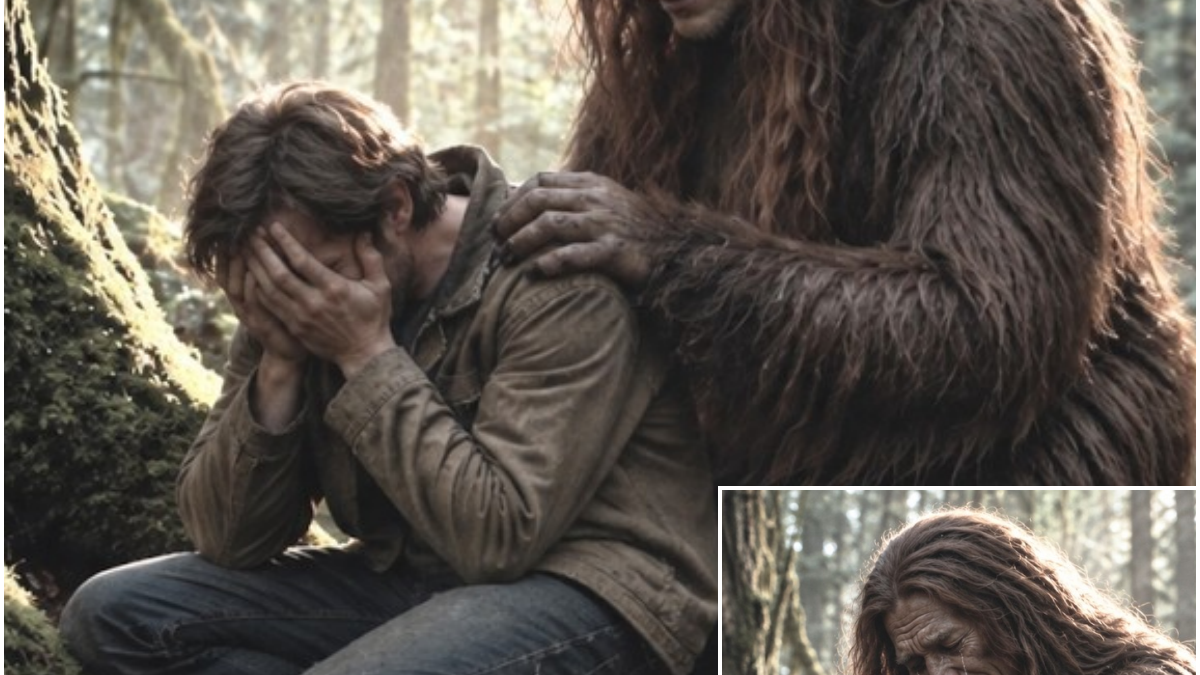
I Thought My Life Was Over – Then I Met a Female Bigfoot Who Would Become My Wife
I drove to the trail head at the end of Forest Road 52 with a length of climbing rope in the passenger seat and a half empty bottle of bourbon between my knees.
And I want you to understand that I was not being dramatic when I picked that particular spot.
I had chosen it the way a man chooses a coffin deliberately.
I had looked at topographic maps for 3 weeks and I had settled on a stretch of old growth Douglas fur about a mile up the hemlock creek drainage in the Mount Hood National Forest because the trees there were old enough and tall enough and far enough off any maintained trail that I figured it would be a long time before anyone found me.

The bears would get to me first or the coyotes.
And by the time some forest service ranger stumbled onto whatever was left, I would just be bones in a clearing.
And bones do not have to explain themselves to anyone.
Bones do not have to look their wife in the eye and tell her that the construction company they spent 11 years building is gone.
My name is Glenn Hatcher.
I was 38 years old in the fall of 1993.
And on the morning of October 11th, I drove out of Sandy, Oregon at 4:45 in the morning with the intention of not driving back.
My wife Patty thought I was going to a job site in Estacotta.
I had told her that lie over breakfast the night before, eating a ham sandwich that I could not taste, watching her at the sink, rinsing dishes with her back to me.
She had said, “That’s fine.
Just don’t be late for supper.”
And I had said, “I won’t.”
And that was the last conversation I ever had with my wife as the man I had been for the previous 22 years of marriage.
Because the man who came back down that mountain 3 days later was not the man who drove up it.
He was somebody else entirely carrying a secret that he would protect for the next 32 years.
And I am only telling you now because Patty passed in the spring and there is nobody left to hurt with the truth.
For 32 years, I have carried this thing inside me like a stone that I learned to walk with.
Heavy, but mine.
The shape of it pressed against my ribs every morning when I woke up and every night when I laid down.
And Patty never knew because Patty had her own life to live.
And I had decided somewhere on the long walk back to the truck that fourth morning that loving her well meant never asking her to carry what I carried.
So I did not.
I loved her the rest of her days.
I made her laugh.
I held her hand at the kitchen table when her sister Loretta died of cancer in 2008.
I watched her grow old beside me.
And when the stroke took her in March of this year, I sat by her hospital bed in Portland.
And I held her hand and I told her I had loved her every day of my life, which was true.
And I did not tell her about the woman on the mountain, which was also true, but in a different way.
The reason I was driving up that road with a rope and a bottle is a story so common in the early 1990s that I almost do not want to bore you with it.
I had a construction company.
I had built it up from a one-man framing operation in 1982 into a six crew outfit that did custom homes and additions all across the western flank of Mount Hood, from Sandy down through Estacata and up into government camp.
By 1990, I had 18 guys on payroll, two equipment trailers, a yard with a forklift, and a small office, and I was clearing better money than my father had ever made in 40 years at the Wire Hoser Mill in Clamoth Falls.
Patty and I had paid off our house outside Sandy.
We had a girl, Bobby, who was 17 that year, and a senior at Sandy Union High School, smart as a whip, planning on going to Oregon State to study veterinary medicine.
Then the savings and loan crisis caught up with the lumber industry and the interest rates went where they went and a developer I had been doing speculative work for, a man named Howard Vance out of Lake Oswiggo went bankrupt in February of 1993 and stiffed me on three completed homes, two foundations, and a permit package I had personally fronted the money for $291,000.
That was the number.
I had already paid my subcontractors and my suppliers because that is what you do.
You pay your guys first, even if it means you do not eat.
I had refinanced the house to do it.
And then I had taken out a second mortgage to keep the operation running while I tried to land enough new contracts to cover the hole.
And the new contracts had not come because the whole valley was contracting.
And by October, I was eight weeks behind on the second mortgage, six weeks behind on the equipment leases, and I had a stack of unopened mail on my desk that I knew contained foreclosure paperwork I could not respond to.
Patty did not know any of it.
That was the worst part.
Patty was a bookkeeper by training.
She had worked at a CPA office in Gresham before Bobby was born.
And if I had let her see the books, she would have understood inside of an hour exactly what we were facing.
I had not let her see the books.
I had hidden them.
I had sat at my desk in the office at 3:00 in the morning for weeks running numbers and lying to my own wife about why I was not sleeping.
And the lying had hollowed me out.
By the second week of October, I had made the math work out.
The personal life insurance policy I had bought in 1986 was for $400,000.
The contestability clause had run out years ago.
If I died in a manner that could be construed as accidental, Patty would collect, the bank would be paid, the house would be saved, and Bobby would still go to Oregon State.
That was the equation.
That was the only equation I could see that resolved to anything other than my family, losing everything I had spent my adult life trying to give them.
I had thought about it for 3 weeks before I acted on it.
I had settled on the mountain because the mountain made sense.
A man goes up to scout a job site.
A man falls.
A man hits his head.
A man is found three or four days later when his family realizes he never made it home.
And by then the snow has started and the scene is muddied and the medical examiner in Portland writes accident on the certificate because the medical examiner in Portland has no reason to write anything else.
I was not crazy when I made this plan.
I was clear.
I was the clearest I had been in months.
The bourbon in the truck was not because I needed courage.
It was because I had read somewhere that a body found with a high blood alcohol level was less likely to be examined closely for evidence of self harm.
The rope was for if the fall did not finish the job.
I had thought it through.
I parked at the trail head at 5:30 in the morning.
The light was just starting to come up gray through the canopy.
The air smelled like wet duff and cedar bark and that sharp sweet note that big timber has in October when the temperatures drop at night.
I sat in the truck for maybe 10 minutes drinking out of the bottle and looking at my hands on the steering wheel and trying to make my legs move.
The thing nobody tells you about deciding to die is that the body does not cooperate.
The body wants to live even when the man inside it is finished.
I had to physically force my own legs to swing out onto the gravel and stand up.
When I finally did, I left the keys in the ignition because I figured a vehicle with the keys in it suggested a man who had walked away expecting to come back.
I started up the trail with the rope coiled over my shoulder and the bottle in my jacket pocket.
It was steep right out of the parking area.
Switch backing up through second growth hemlock for the first half mile before it leveled out into the older timber where Hemlock Creek ran down out of the high country.
I knew this drainage.
I had hunted it with my father when I was a teenager before he hurt his back at the mill.
And I had brought Bobby up here once when she was about nine to show her a stand of trees that were older than the country we lived in.
Some of those Douglas furs were 6 and 700 years in age.
They were standing when Lewis and Clark came down to Colombia.
They would be standing long after I was forgotten.
And that thought sat with me oddly as I climbed, because part of me was glad I had chosen this place.
If I had to leave the world, I wanted to leave it in a cathedral that had been here long before me.
The trail thinned out about 3/4 of a mile up where it crossed the creek on a series of rounded boulders.
I stepped from rock to rock with the cold water running clear between my boots and on the far bank.
I left the trail and started bushwhacking northwest into the slope.
I was looking for a particular tree, a Douglas fur about a mile up the drainage on a small bench above the creek with a clean fall line off a rocky outcrop that dropped maybe 60 ft into a steep gully.
I had even worked out the precise mechanics of how to make it look right.
I was about 2/3 of the way up the slope when the smell hit me.
I am a man who has been in big timber his whole life.
I know what black bear smells like in the fall when they are gorging on huckleberries.
I know what a bear den smells like after the snow melts.
I know what elk mus smells like during the rut.
And I know what a fresh kill smells like when the coyotes have been working it.
The smell that came down the slope at me at about4 7 in the morning on October 11th, 1993 was not any of those things.
It was heavy and warm and organic with a deep musky base note that I have only ever encountered one other time in my life and that was years later at the Portland Zoo standing down wind of the gorilla enclosure on a hot July afternoon.
But it was not gorilla.
It was something else.
The smell pressed against me through the wet ferns, and it had a quality I can only describe as deliberate, as if it had been placed in my path.
Rather than simply being carried on the wind, I stopped walking.
I went absolutely still and I listened.
The forest around me was not the forest I had been walking through 5 minutes earlier.
The forest I had been walking through had been alive in the normal way of October forests.
Junkos calling a piliated woodpecker somewhere up the ridge.
The creek behind me a constant low conversation.
The forest I was standing in now was silent.
Not partially silent.
Silent the way a room goes silent when somebody pulls a gun.
Every bird gone.
Every chipmunk gone.
Then I heard a footstep.
One footstep maybe 40 ft up the slope from me.
Somewhere behind a stand of vine maple that was just starting to turn red.
It was the unmistakable sound of weight transferring through duff and needle litter.
A weight that was big.
Bears in October are usually noisy because they do not need to be quiet.
This was a single footstep placed with care and then nothing.
Whatever had taken that step was standing still and looking at me.
I have spent enough time in big timber to know when something is looking at you.
A man who has decided to kill himself does not have the normal relationship with fear.
He has worked his way around fear.
The fear of death, which is the engine of most fear, was a thing I had moved past in the previous three weeks.
So when I felt that presence above me on the slope, I did not experience what a normal hiker would have experienced.
I experienced something closer to recognition.
Whatever was up there was a part of the same forest I had come into to die.
And in some peculiar way, it felt like the forest itself had taken notice of me.
I called out.
I do not know why I did it.
I just opened my mouth and said, “Hello.”
My voice sounded small in all that timber.
I said it again louder.
“Hello, there is somebody there.
I am not going to hurt you.
I’m not even going to hurt myself anymore.
Not right this minute.”
I said that last part out loud to whatever was standing in the vine maple.
And I dropped the rope off my shoulder onto the wet ground.
And I sat down on a mosscovered log.
And I put my face in my hands.
And I cried.
I cried the way I had not cried in front of anybody since I was a boy.
I cried for the company and for Patty and for Bobby and for my father in Clamoth Falls who would have to bury his only son.
I cried because I was so tired that I could not stand up anymore.
And at some point during this I became aware that the smell had gotten stronger.
Whatever was up the slope had moved closer.
I had not heard it move but the smell was now pressing on me from less than 20 ft away.
And when I lifted my face out of my hands, I saw it.
There was a figure standing behind a Douglas fur about 15 feet up the slope from me.
The trunk of the fur was easily 5t in diameter, and the figure was using the trunk to break up its outline, which is a thing I had been taught to do in hunter education as a boy.
You do not stand in the open.
You stand against something.
You let the shape of the tree confuse the eye.
Whatever this was, knew that trick.
The figure was tall enough that its head and shoulders were visible above the lowest live branches of the fur, which put its eye level at least seven feet off the ground, and its shoulders were so broad that they extended past either side of the trunk.
It was covered in hair, long dark hair, almost black in the gray morning light, hanging down from its arms and across its chest like the coat of a horse in winter.
Its face was the part that has never left me.
The face was broad and high cheicked with a heavy brow and a wide flat nose.
But it was a face, you understand?
Not a muzzle, a face with eyes that were looking at me with an attention so complete that I felt in that moment like I was the most important thing in the world to the being looking at me.
And I was not afraid.
The figure stood there looking at me for what felt like a long time, but was probably less than 30 seconds.
Then it moved, not toward me, sideways around the back of the tree with a fluidity that I could not have produced on my best day.
There was no crashing of branches.
There was just an absence where the figure had been, and a deep rustle of vine maple farther up the slope as it withdrew, and then silence again.
And then after maybe a full minute of silence, I heard a sound from much higher on the slope, maybe a/4 mile up the ridge.
A low call that lasted perhaps 4 seconds, sustained at one pitch, with a depth and resonance that I felt in my sternum before I heard it with my ears.
It was answered almost immediately by another call from somewhere across the drainage, and then a third, much fainter, from somewhere down the valley toward the road.
I sat on that log for a long time.
The gray morning light became actual daylight.
The sun came over the ridge and lit the canopy gold above me, and I eventually stood up and walked back down the slope toward the creek without picking up the rope.
I left the rope on the log.
I left the bottle, which I set down in a hollow at the base of a hemlock.
I crossed the creek going the wrong direction.
I did not go back toward the trail.
I went up the drainage deeper further from the truck.
I had come up here to die and instead I was walking deeper into the forest where the thing that had looked at me lived and I did not have a single rational explanation for what I was doing.
My legs were moving and my body was carrying me up the creek bed because something in me had decided that the world had just gotten larger by an order of magnitude and I needed to find out what else was in it before I went back to the world I had been planning to leave.
I followed the creek up.
The terrain got rougher.
The bench above the creek narrowed and the slopes on either side steepened until I was walking in the bottom of a small canyon with the water on my right and a wall of mossy basaltt on my left and the canopy so thick overhead that the light went green.
I lost track of time.
I was not hungry, though I had eaten nothing that morning.
I was just walking with that smell intermittently present and absent on the wind and that sense of being accompanied by something I could not see.
It was somewhere past noon when I came around a bend in the creek and saw the structures.
There were three of them standing in a small clearing on the far side of the creek where the canyon opened out into a kind of natural amphitheater.
They were not leantos and they were not piled brush.
They were structures.
Each one was roughly conicle, built from young hemlock and cedar saplings that had been broken off at the base and arranged with the broken ends in the ground and the tops woven together about 10 ft up.
The diameters at the base were maybe 12 ft.
The interiors when I crossed the creek and approached were dry.
The walls were laid up tight enough to shed rain.
The floors were carpeted with dry duff and small cedar boughs that had been arranged the way a person arranges a bed.
Each of the three had a low entrance facing east away from the prevailing weather.
They were doiciles.
I am a carpenter.
I know what a building is.
These were buildings made by hands that understood weather and exposure and the principles of construction that human beings did not invent because they are older than human beings.
There were other things in the clearing.
A stone ringed fire pit, cold to the touch, but with charred bone fragments visible in the ash.
A flat topped boulder that had been used as a workt with scrape marks on its surface and tiny chips of obsidian scattered in the moss around it.
A rough wooden rack made of three peeled poles lashed together with strips of cedar bark on which several pieces of dried meat hung.
I touched one of the strips.
It was deer, I thought, or possibly elk, and it had been cured by smoke and time.
The fire pit had not been used in days, maybe weeks.
That was when I heard the sound behind me.
Not a call, a breath, a slow exhalation, maybe 10 ft behind me at a height that was well above my own.
I turned around.
She was standing at the edge of the clearing where I had just walked in from.
I want to use the word she because it is the truth and because the truth is what I am trying to tell you.
She was taller than the figure I had seen behind the Douglas fur but more lightly built.
Her shoulders were narrower.
Her face was finer in its proportions, the brow ridge less pronounced, the cheekbones higher.
Her hair was a dark chestnut color that caught the green light filtering through the canopy and held it.
The hair was thick down her arms and across her back and chest, but her face was nearly bare.
The skin a deep weathered olive brown that put me in mind of the faces of women in old photographs of the desert tribes from before the reservations.
Her eyes [snorts] were the color of dark honey, and they were looking at me with an expression that I read in the moment as caution and have reread over the years as patience.
She stood perhaps 7 and 1/2 ft tall.
I did not move.
I did not speak.
I stood in the center of the clearing with my empty hands held out from my sides where she could see them.
And I watched her watch me.
She did not move either for what felt like a very long time.
Then she took one step forward, just one, and she stopped, then another.
She was checking me, testing whether I would bolt.
I had hunted enough mule deer in the Cascades to recognize the cadence of an animal approaching something it was uncertain about.
And the cadence she was using was that cadence, but slower and more controlled with a thoughtfulness in it that no deer has ever possessed.
She was thinking, she was reading me.
She came up to within about 8 ft of me and stopped.
From that distance, the smell that had been moving on the wind became a presence in the air around her, warm and dense and oddly clean.
More like the smell of horses in a barn in the winter than anything wild.
Up close, her hands were the thing my eye kept going back to.
They were enormous, easily twice the size of mine, with fingers that were thick and powerful, but not clumsy.
I could see the calluses on her palMs. I could see a scar across the back of her left wrist that had healed white.
She had used those hands.
They had been used for work, and that detail, more than any other, made my mind shift.
She was not an animal.
She was a person.
I do not mean that in some philosophical sense.
The recognition of personhood that one human gives another when they meet a stranger and decide whether to extend a hand or step back.
That recognition fired in my chest looking at her.
And it fired without my permission.
She made a sound, not a call.
A soft tonal hum or 4 seconds long with a rise and fall in pitch that struck my ear as a question.
I did not know what the question was.
I said in a voice that came out thinner than I wanted it to.
I am Glenn.
I do not know if you can understand me.
I came up here for a reason I do not want to do anymore.
I do not know what I am doing here now.
I am sorry if this is your place.
She listened to me.
When I was done, she made another sound lower and shorter.
Then she turned and walked with that fluid, unhurried stride to the workt boulder, and she sat down on the moss beside it, with her knees drawn up and her arms wrapped around them, and she watched me.
And after a long moment, I sat down, too, on the duff in the middle of her clearing.
And I watched her back.
And that was how it started.
I stayed in that clearing through the afternoon of October 11th and through the night and into the morning of the 12th.
And she stayed, too.
And over those hours we worked out something that I would later come to understand as the beginning of a kind of trust.
I did not try to leave.
She did not try to make me.
As the afternoon wore on, she got up from the boulder and went into one of the conicle shelters and came out carrying a folded hide which she sat down at the edge of the clearing on a patch of moss.
The hide had been tanned and worked soft.
She gestured at it once with one of those enormous hands in a motion that was unmistakably the offering of a place to sit.
So I sat on it, and she went away across the creek, walking out of the clearing the way she had come, and she was gone for maybe an hour.
And when she came back, she had three small trout strung on a peeled willow with and a handful of huckleberries in a piece of bark she had folded into a kind of dish.
She built a fire.
She built it from materials she gathered from the edge of the clearing while I watched scraping a small pile of dry cedar shavings from the underside of a fallen branch with what I could now see was a flake of obsidian held delicately between her thumb and the side of her index finger like a draftsman holds a pencil.
She struck a spark from two stones I did not recognize in the spark caught in the shavings.
And within five minutes she had a low clean fire going in the stone ring.
She gutted the trout with the obsidian flake, working with a precision that made my stomach hurt because I had watched my father do exactly the same thing on the bank of the Sprag River when I was a boy.
She skewered the trout on green sticks and set them at the edge of the coals.
She did not eat any herself.
She watched me eat them one by one with the huckleberries in between.
And when I had finished, she made another of those low sounds, this one quieter, and I understood somehow that it was approval.
She had fed me, and I had received the food, and a thing had passed between us that did not need words.
I slept on the hide that first night.
I slept away I had not slept in months.
She slept, too, but not next to me.
She laid down at the far edge of the clearing with her back against the boulder and her head turned toward me.
And every time I woke in the dark, which was several times I could see her there in the fire light watching me the way a parent watches a sick child.
And every time I closed my eyes again, I went back to sleep faster than I had any right to.
The next morning on the 12th, I woke at first light and she was gone.
The fire was banked low under a covering of dirt.
The trout bones were in a small pile beside the fire ring, and there was a fresh piece of folded bark sitting on the boulder next to the workt.
And when I crossed to it and opened it, there were four small dried fish inside and a handful of dried berries the color of wine.
Breakfast.
She had left me breakfast and gone somewhere.
And the fact that she had left me alone in the clearing without seeming concern that I might damage it or steal from it or burn it down struck me even then as a very particular kind of trust.
She had decided something about me, something I had not decided about myself.
I sat on the boulder and ate the fish and the berries, and I waited.
I was a long way from the trail head and I had walked deeper than I had intended and I was no longer in any hurry to leave.
The truth is that I did not want to leave.
I had come into this forest with a rope and a bottle, and instead of using them, I had been given food and a place to sleep by someone who had no reason to give me either of those things.
And the simple kindness of it had broken something open in me that the previous months of catastrophe had only bruised.
She came back in the middle of the afternoon.
I heard her coming long before I saw her.
She was walking down the creek bed from upstream, and she made no effort to be silent, which I understood was a courtesy to me.
She did not want to startle me.
She wanted me to hear her coming.
When she came around the bend into the clearing, she was carrying things in her arMs. A length of soft tanned hide larger than the one I had slept on.
A bundle of dried herbs tied with a strip of bark.
And of all things, a tin cup, a blue enamel tin cup, dented and old, and clearly something that had once belonged to a human being, which I would later come to understand had been left behind decades ago by some prospector or trapper in a camp she had found, and which she had kept all those years, and which she now offered to me by setting it down on the boulder beside the bark dish that had held my breakfast.
That cup.
I have thought about that cup more in the last 32 years than is reasonable for a man to think about a tin cup.
The cup was a translation.
The cup was her saying, “I know what you are.
I know what you use.
I have seen things from your world before, and here is one of them, and you may have it because you are mine to take care of right now.”
I sat down on the moss beside the boulder and I looked at the cup and I started to laugh.
And the laugh turned into a kind of choked sob that I had to swallow back.
And she came over and crouched down next to me slowly the way you crouched down next to a dog you do not want to spook.
And she put one of those enormous hands on my shoulder.
Her hand on my shoulder weighed more than any human hand I have ever felt.
It was warm, dense, and so heavy that my collarbone settled under it like a piece of furniture being placed on a floor.
But the pressure was so carefully controlled that I felt no discomfort, only the unmistakable presence of a being who could have crushed me without effort and was choosing with absolute intention to be gentle.
I sat under that hand and I felt for the first time since the developer’s lawyer had told me in February that Vance Construction would not be paying out on the contracts that somebody else was carrying part of the weight.
I had been alone in the carrying for 8 months.
Patty had not known.
My father had not known.
And this woman, who was not a woman in any way that the medical literature of 1993 would have acknowledged, had put her hand on my shoulder and lifted just slightly a portion of the weight that had been about to kill me.
And the relief of it was so profound that I could not speak for several minutes.
When I could speak again, I said her name.
I gave her her name.
I did not ask her what she called herself because I knew already that what she called herself was not something my mouth could produce.
I said, “I am going to call you May if that is all right.”
My grandmother was May.
I never got to meet her, but my mother said she was the kindest person who ever lived, and you remind me of her.
She listened.
When I had finished, she made a sound that was not quite a hum and not quite a sigh, and she went and brought me the cup.
And she walked down to the creek and filled it with cold, clear water, and brought it back and placed it in my hands.
I drank from the cup.
The water tasted like stone and snow melt and something else, something faintly herbal, because she had crushed one of the leaves from the bundle of herbs into it without me noticing.
And after I drank it for the first time in three weeks, the knot of pain that lived behind my breast bone loosened enough that I could take a full breath.
And I understood somewhere in the back of my mind that this being, whoever she was, knew things about the body, that the world I came from had forgotten or never known.
The second night was different from the first.
She built up the fire again and brought out a heavier hide.
And she laid it down on the duff at the back of the clearing where the slope of the canyon wall made a natural windbreak.
And she gestured for me to come lie down on it.
And then she lay down on the duff beside me on her side with her back to mine.
And I felt the heat of her body through the hide and through my jacket.
And I understood that I was being kept warm.
There was nothing between us that crossed any line that a married man should not cross.
Not that night.
What there was was warmth and the deliberate kindness of a being who had decided that I needed to be protected from the cold and from the dark and from myself.
I lay there with the heat of her body pressed against my back through the hide and I cried quietly into the crook of my arm and I felt the rise and fall of her breathing against me slow and steady and I slept.
On the morning of the 13th I woke up and she was still beside me.
The fire had burned down to coals in the air and the clearing was cold and damp with that ground fog you get in the Cascades in October.
But the place where her back had been pressed against mine through the night was still warm.
I rolled over and looked at her.
She was awake, lying on her side, with her head propped on one hand, watching me with those honey dark eyes.
And when she saw that I was awake, she smiled with her mouth.
Not a wide grin, not a bearing of teeth, but a soft lift at the corners of her mouth that no animal in the world has ever produced.
A smile that meant good morning and meant I am glad you are still here and meant a hundred other small good things that I could read in it even without sharing a single word of language with her.
I smiled back.
I had not smiled at another being in 3 weeks.
My face felt strange doing it.
That morning she taught me my first words of her language.
We were sitting by the rebuilt fire and she handed me a piece of dried fish and made a sound, a soft twocllable vocalization that her throat produced with a depth I could not match.
I tried to repeat it.
I made a sound that was clearly not the same sound, but was clearly trying to be.
She laughed, a short, soft, breathy laugh that put crinkles at the corners of her eyes.
And she said the word again, more slowly this time.
And I tried again and got closer and she nodded and that was the word for the food I was eating.
Then she touched the cup.
Another sound.
Then she touched the water in the cup.
A different sound.
Then she touched the fire.
Another.
We did this for an hour.
I learned that morning about a dozen of her words, none of which I could pronounce correctly, but all of which I could recognize when she said them.
And as I sat there working on the sound for the cedar tree behind the shelter she had been sleeping in, it occurred to me with a kind of vertigo that I was being taught a language by a person who was teaching it to me with the patience and method of someone who had taught it before.
She had done this before.
I did not ask, but I understood that I was not the first human being she had met.
We stayed in that clearing through the day.
She showed me where she got her water and how she knew the trout were running in the pool below the bend in the creek.
She showed me a place on the canyon wall where lychans grew that could be steeped into a tea that her people used for joint pain.
She showed me a snare she had set on a small game trail at the edge of the clearing made entirely of woven cedar bark fiber and the springy young trunk of a vine maple sapling.
And she showed me how to reset it after she pulled a snowshoe hair from it that afternoon.
She killed the hair with one quick rotation of her hand, the way you ring out a wet rag, and she dressed it with the obsidian flake, and we ate it that night.
And as she handed me my portion, she made a sound I had not heard before, a low, complex, tonal phrase, and I understood without being told that it was a kind of grace.
There was a reverence in the sound and I bowed my head because it was the only response that felt right.
I was falling in love with her.
I want to address that head on because I know how it sounds.
I was a 38-year-old married man with a teenage daughter who had been so depressed 3 days earlier that I had carried a rope up a mountain.
And now I was sitting in a hidden clearing with a being who was not a being in any way the world would recognize.
And I was falling in love.
I was not in the grip of romantic infatuation.
I was not lusting after her.
What I felt for May was something that I had no vocabulary for.
It was the love that you feel for a person who has saved your life when they had no reason to.
It was the love that you feel for someone who has seen the worst part of you and not turned away.
It was more than anything else gratitude that had grown so large it had become love.
And she loved me too.
I knew it.
By the second night when she laid down on the duff beside me and put her back against mine and slept through the dark hours, she had decided that I was hers.
Not in any possessive sense.
She had decided that I was a person who belonged in her life now and that her life was going to make room for me.
On the morning of the 14th, the morning I had to go back, I woke up before her.
I lay there on the hide with her warmth against my back, and I thought about Patty.
Patty who was waiting for me at home.
Patty who would have called the sheriff by now.
Patty who had given me 22 years of her life and a daughter in the only home I had ever loved.
I understood what I had to do.
I had to go back.
I had to go back down the mountain and walk into my kitchen and tell my wife that I had nearly killed myself and that I had not and that I was going to find a way to fix what I had broken and that I was going to live for her and for Bobby and for the company guys who depended on me even if the company itself was finished.
I had to go back because going back was the only thing that honored what May had given me.
She had not pulled me back from the edge so that I could disappear into her world.
She had pulled me back so that I could go back into mine.
When she woke up, she knew.
I do not know how she knew.
I had not said anything, but she looked at my face in the gray morning light, and she knew, and her expression shifted into something quieter than it had been the day before, and she got up without saying anything, and built the fire up, and put one of the last pieces of dried fish on a green stick, and held it over the coals until it was warm.
And she handed it to me and I ate it and she ate one too and that was the only time I ever saw her eat anything in front of me.
She walked me out of the clearing.
She walked me down the creek bed the way I had come for about a mile until the canyon opened up and I could see the slope where I had first crossed 2 and 1/2 days earlier.
She stopped at the edge of the bench.
She would go no further.
We stood there facing each other on the moss in the gray October light.
And she put both of her hands on my shoulders and she looked at me.
Her face was about a foot above mine.
And her honey dark eyes were looking into mine with an expression that had no analog in any human face I have ever seen.
It was a look that said, “I have given you what I had to give.”
It was a look that said, “You have to go now.”
It was a look that said, “I will be here.”
All of those things at once.
And then she leaned down and she pressed her forehead against mine.
Just that, forehead to forehead, for maybe 10 seconds.
I felt the heat of her skin against mine.
And I smelled the warm, clean smell of her up close.
And I felt her breath against my mouth, slow and steady.
And then she stepped back and she made a sound very softly that I had not heard before.
And she turned and walked back up the creek.
And within a minute, she was gone into the timber.
And I was alone on a wet moss bench above Hemlock Creek with the smell of her still on my jacket and a tin cup in my pocket that I do not even remember picking up.
I walked down the mountain.
I came out of the timber at the trail head at about 10:30 in the morning on October 14th and my truck was still where I had left it, the keys still in the ignition, and there was a Forest Service note tucked under the windshield wiper that said, “Please contact the Sandy Ranger District at your earliest convenience.”
I drove home.
I drove the whole way back to Sandy in a state that I cannot adequately describe to you.
I did not turn on the radio.
I did not stop.
At some point around 11:30 in the morning, I pulled into our driveway on Bluff Road and Patty’s car was there and the sheriff’s department patrol car was parked behind it and I saw the curtains move in the front window and Patty’s face appear and she ran out of the house in her bathrobe with her hair undone and threw her arms around me before I had even closed the truck door and she was crying and saying my name and I was holding her and I was crying too.
I lied to Patty about the most important thing.
I never told her in 22 more years of marriage what the actual reason had been for my disappearance.
What I told her when the deputy had left and we were sitting at the kitchen table with her hand in mine was that I had gone up to scout a job site.
That I had slipped and hit my head on a rock crossing the creek.
That I had been disoriented for a long time and lost in the timber.
And that I had eventually found my way back when my head cleared.
There was a small cut above my left eyebrow that I had given myself on a low branch coming back down.
And Patty pressed a cold washcloth to it while I told the story.
And she believed me.
She believed me because I had never lied to her about anything important in 22 years.
And a man does not lose that kind of credit in one morning.
I made a decision that I would carry the rest of it alone because to tell Patty about May would have been to confess two things at once that would have broken her.
And I was not going to break my wife to ease my own conscience.
I told her about the money, though.
That afternoon, I sat Patty down at the kitchen table and I opened the books, all of them.
I put it on the table in front of her and I told her the truth about how bad it was.
And Patty, who I had been protecting from this for eight months because I had convinced myself she could not handle it, looked at the numbers for about 10 minutes in complete silence.
And then she got up and went to the kitchen drawer where we kept the pencils.
And she came back and sat down and started making lists.
Within an hour, she had triaged the entire situation.
Within two hours, she had a phone tree of calls she was going to make the next morning.
She did not blame me.
She did not raise her voice.
She looked at me across the table at one point and she said, “Glenn, why didn’t you tell me sooner?”
I said, “I didn’t want you to be afraid.”
She said, “I am your wife.
I am not supposed to be afraid by myself and you are not supposed to be afraid by yourself.
We are afraid together.
That is the whole point.
We did not lose the house.
We came close.
We lost the company.”
The bankruptcy attorney Patty knew was a woman named Linda Reid in Portland.
And Linda walked us through a chapter 7 filing on the business in late November of 93.
And Hatcher Construction ceased to exist on December 14th.
I went out to the yard the morning of the 15th and I told my guys, 18 men, I told them the truth that I had run the company into the ground trying to chase one bad contract and that I was sorry and that I would write each of them a personal letter of reference.
My foreman, a man named Hank Doyle, who had been with me since 1985, hugged me with his big, rough arms and told me I had been the best boss he had ever had.
We sold the equipment to a competitor in Gresham for 40 cents on the dollar.
Patty and I refinanced the house at a rate that hurt, but that we could carry, and I took a job in February of 94 working as a foreman for a residential builder in Gresham named Don Whitlock.
I worked for Don for 16 years until he retired in 2010.
And then I worked another four years for the man who bought his company.
And I retired at 60 in 2014, debt-free and modest with a house that was paid off and a daughter who had finished veterinary school at Oregon State and was practicing in Bend and a wife who I loved more every year than I had the year before.
But I went back to the mountain.
I waited until the spring of 94 in May.
I told Patty I was going hiking and I drove up Forest Road 52 and I parked at the trail head and I walked up the trail and across the creek and up the canyon and I went all the way to the clearing.
The clearing was empty.
The three conicle shelters were still there.
The fire pit was cold and overgrown with new spring moss.
The workt boulder had a small piece of bark on it that had not been there before.
And on the bark was a smooth round stone the size of a quail egg.
The kind of stone you find in a creek bed that has been polished by water over thousands of years.
Just one sitting on the bark.
I picked it up.
She had known I would come back at some point and she had left me a sign.
A sign that said, “I am still here.
I have not forgotten.
This is real.”
I went back the next spring in April of 95 on a Saturday when Patty was visiting her sister in Eugene and Bobby was studying at the OSU library and the house was empty in a way that gave me cover.
I went back in the summer of 96 on a long July afternoon when the trail was dry and the wild strawberries were ripe along the bench above the creek and I ate them as I walked up the drainage like a boy on his way home from school.
I went back twice in 97, once in May, and once in October, the October trip on the 4th anniversary of the morning.
She had first stepped out from the timber, and looked at me across the clearing.
Each time the clearing was empty, each time on the workt boulder there was something, a small bundle of dried herbs once, a piece of obsidian that had been worked into a smooth oval, like a worry stone.
Once in the late summer of 96, a single chestnut colored hair about 18 inches long looped into a careful spiral and pinned to the bark with a sliver of cedar.
Each time I left something in return, a small carving of a hand I had whittleled from a piece of fur at my workbench, a button from one of my work shirts.
Once a folded sheet of paper on which I had written in pencil, a single line that said, “My daughter is going to be a veterinarian.
She is going to take care of animals for her whole life.
I think you would like her if you ever met her, although I cannot bring her here.
I left it folded under a stone and I knew she could not read it, but I left it anyway because I needed to write it.
In 1998, on July 11th, I went back and she was there.
I came around the bend into the clearing on a hot July afternoon with the cicas going in the timber and the creek running thin and clear, and she was sitting on the workt boulder.
She had aged, not dramatically, but there were threads of silver in the chestnut hair at her temples that had not been there in 1993, and she sat with a slight stiffness in her left hip.
She was still beautiful.
I came around the bend and saw her, and I stopped in the middle of the creek with my boots in the water, and she looked up at me, and her face did the thing it had done.
That second morning, that soft lift at the corners of her mouth and I crossed the creek and I sat down on the duff in front of her on the same patch of moss where I had sat almost 5 years before and I cried.
She let me cry.
When I was done, she got up from the boulder and she came over and she crouched down in front of me and she put her enormous warm hand on the side of my face and she said something, a long phrase in her language.
I did not understand the words, but I understood the meaning.
The meaning was, “You came back, and I knew you would, and I am glad.”
She stayed in the clearing with me for 3 days that July, the same three days, almost to the hour that I had stayed with her in 1993.
We did not speak much because we could not, but we sat together and ate together, and she showed me what she had been making in the years between.
There was a fourth shelter, now smaller than the others, sat back at the edge of the clearing behind a stand of vine maple.
And when she led me to it and gestured for me to look inside, I saw that the floor was layered with cedar boughs and soft hides, and that there were a few objects arranged inside it on a low shelf made of a flat slab of cedar, a small wooden bowl, a folded square of hide, a round riverstone with a hole through the center.
And on the shelf at the back, propped against the cedar wall, the piece of paper I had left in 1996, she had kept it.
The button for my work shirt, the little carved hand.
They were all there arranged on the shelf like things that mattered.
And when I saw the paper, I understood that whatever this was between us, it was not less real for her than it was for me.
It was probably more.
On the third morning, she did the thing.
She woke before me.
She had slept beside me again on the same heavy hide at the back of the clearing.
I woke up when the gray light was just starting to come into the canopy and she was already sitting up looking at me.
She had a small object in her hand.
When I sat up, she held it out to me.
It was a piece of dark wood about the size and shape of a child’s fist carved into the rough shape of a person.
Two arms, two legs, a head.
The features on the face were minimal but precise.
A nose, two eyes, a mouth that was set in a soft line.
Not smiling, not frowning.
The carving was old.
The wood had been worn smooth by handling in a way that suggested years, maybe decades.
She placed it in my palm and closed my fingers around it.
Then she touched her own chest with the flat of her enormous hand over her heart.
Then she touched mine.
Then she touched the carving.
Then she made a long phrase of her tonal language slowly with great care.
Then she said in English the only English word I ever heard her say in all the times I knew her.
The word she had clearly worked to learn and to produce.
The word that I have carried in the front of my mind every day for 27 years since.
She said my name.
She said Glenn.
Two syllables clumsy.
Worked at, produced with the careful effort of a being whose throat was not shaped for that particular sound, and who had practiced it in the years between visits into the empty clearing because she had known I would come back and she had wanted to be able to say it my name.
She had learned my name and she had said it to me and she had given me the small carving with her hand over her heart and her hand over mine.
And she had said my name and I sat there on the hide in the gray July light of 1998 with a piece of carved wood in my hand and a sound in my ears that I would carry until the day I died.
And I understood finally what she was telling me.
She had given me a small wooden figure of a man to keep, the same way she had a small folded paper of a man’s words to keep.
And the figure in the paper would be there in their places when each of us was not.
I was being kept.
I took the carving.
I held it.
I touched my own chest with the flat of my hand over my heart.
And I touched hers very gently in the same place.
And I said her name out loud.
I said, “May.”
And she made the low please sound that I had not heard in five years and her eyes were wet and so were mine and we sat there in the cold gray light of the clearing for a long time without moving.
I went back to the mountain 12 more times in the next 27 years I saw her on six of those 12 visits.
The other six the clearing was empty but there was always something on the boulder, a stone, a feather.
Once a small carved figure of an animal that I could not identify, four-legged and graceful that I keep on my dresser now.
The last time I saw her was in the summer of 2017.
She was old by then.
Her hair was more silver than chestnut.
Her hands, those great warm hands, had a trimmer in them when she handed me a tin cup of Cold Creek water.
We sat together for the better part of a day.
I had brought her at that time a photograph of my granddaughter Lana who was three and who was Bobby’s only child.
I put it on the shelf in the small shelter with the other things.
May touched the picture with the back of one finger very lightly and then she made a sound, a quiet two-cllable sound that I had never heard before and she touched her own chest and she touched the picture.
The picture had a place now too.
My granddaughter had a place in May’s clearing on a shelf in a small shelter that no human eye but mine would ever see.
I went back in 2019.
The clearing was empty.
There was nothing on the boulder.
I went back in 2021.
The boulder was empty.
The shelters were beginning to come down.
The small shelter at the back of the clearing, the one with the shelf, had collapsed.
I went into the ruin of it and I found in the duff under what had been the back wall a few of the things that had been kept there.
The wooden bowl was gone.
The round riverstone with the hole through the center was still there.
The folded square of hide was still there.
The piece of paper I had left in 1996 had not survived the rain.
I gathered up the stone in the hide and I carried them back to the truck.
I have them in a wooden box in my closet along with the small carved figure she gave me in 1998 and the round quail egg stone from 1994 in the tin cup.
The cup sits on my kitchen window sill and I drink from it every morning and Patty thought it was a flea market find and I did not tell her any different.
Patty died in March of this year.
She had a stroke on a Sunday afternoon while we were sitting in our living room watching a basketball game.
I called the ambulance.
I rode with her to Portland.
And I sat by her bed for 16 hours, holding her hand while the doctors did what they could and then admitted that there was not much they could do.
She woke up once near the end on Monday morning.
She looked at me and she said, “Glenn, you are a good man, and I have always known it.
And I have always known that you carried something I did not ask about and I want you to know that I have always loved you for it.”
She said exactly that.
I have repeated it to myself a thousand times in the months since.
And then she closed her eyes and she went back to sleep and a few hours later she was gone.
I drove home from Portland that night.
Bobby and Lana came down from Ben the next day.
The funeral was the following Saturday.
I held it together through all of it, the way a man is expected to hold it together.
And then on the Sunday after the funeral, when Bobby and Lana had gone home, I got in the truck and I drove up Forest Road 52 and I parked at the trail head and I walked up the trail and across the creek and up the canyon.
It was March, late March, and there was still patchy snow in the upper drainage, and the clearing was full of light because the leaves had not come in yet.
I stood in the middle of the clearing where the three conicle shelters had stood and I looked at the workt boulder and I sat down on it and I cried for my wife.
I cried for the woman who had loved me for 54 years and had known I was carrying something and had loved me anyway and had not asked.
And then I cried for May because May was almost certainly gone by now too, although I had no way to know.
I was sitting on the boulder with my face in my hands when I heard a footstep behind me.
Just one, maybe 40 feet up the slope.
The unmistakable sound of weight transferring through duff and needle litter.
A weight that was big.
I did not turn around.
I sat very still.
The wind moved through the canopy.
The creek talked behind me.
And after maybe a full minute, I heard from somewhere uphill in the timber a low call sustained at one pitch, maybe 4 seconds long, the same kind of call I had heard the morning of October 11th, 1993, when I had been a man with a rope in his hand and a bottle in his pocket.
It was not May’s voice.
I would have known May’s voice.
It was a younger voice.
And after the call, there was silence.
And then after another minute from across the canyon, a second call answered and then a third, much fainter, from somewhere down the drainage toward the road.
They had registered that I was there.
And they had decided that I was not a threat and that I could stay as long as I needed to stay and that when I went down the mountain again, they would still be here and the place would still be theirs and the secret would still be safe.
I sat on the boulder until the light started to go.
And then I walked back down to the truck and I drove home to the empty house in Sandy and I sat in the kitchen and I drank water from a dented blue enamel tin cup that a woman who was not a woman had filled from a cold clear creek in October of 1993.
And I knew finally that the time had come to set this down.
I am 70 years old.
My health is good.
I expect with luck to have another 10 or 15 years.
And I intend to spend them quietly in this house with my granddaughter visiting on the weekends she can manage.
I am not telling this story because I want anybody to come looking.
I have changed the name of the creek.
The drainage I am describing is not Hemlock Creek.
The road is not Forest Road 52.
The clearing is not where I have said it is.
If you go up Mount Hood looking for what I have described, you will not find it because I have moved every detail by a few miles in directions I will not specify.
They are still up there.
May’s people.
Maybe May herself, though I doubt it.
Maybe her children if she had them, or her grandchildren.
I do not know what kind of family she had.
She never showed me.
What I want you to take from this, if you take anything, is the part I learned that has nothing to do with what species she was or how tall she stood or what her hands could lift.
I learned that a being who has no reason to save you can still decide to save you.
I learned that a kindness offered to a stranger in the worst hour of his life can echo for 32 years and outlast a marriage and outlast a company and outlast almost everything that a man thinks he is built out of.
I learned that the world is bigger than the people who run it think it is.
And that there are old things in old places that have been watching us with more patience than we deserve.
And that some of them, every once in a great while, decide to step out from behind a tree and look us in the eye and offer us a piece of dried fish and a place to sleep.
And the only thing they ask in return is that we go back to our own world and live the lives we were trying to throw away.
I went back.
I lived the life.
I loved my wife and I raised my daughter and I worked for Don Whitlock for 16 years.
And I held my granddaughter on the day she was born.
And I drank my morning water from a tin cup that came from a clearing on the side of a mountain.
And every morning when I lifted that cup, I said in my head where nobody could hear me, “Thank you, May.”
And the saying of it was the prayer I have lived by for 32 years.
And it is the only prayer I have ever needed.
I do not need you to believe me.
I have a small wooden figure in a box in my closet and a stone with a hole through it and a folded square of hide.
And I have a memory of a forehead pressed to mine in the gray October light of 1993.
And I have a wife who loved me and knew I carried something and loved me anyway.
And I have a daughter and a granddaughter in a kitchen with a tin cup on the window sill.
That is everything I have.
And it is more by an order of magnitude than the man who drove up Forest Road 52 with a rope and a bottle on October 11th of 1993 thought he had any right to ask for.
She gave it to me.
All of it.
She gave it to me by sitting down across a fire from a broken stranger and feeding him a fish and by laying down beside him in the cold and warming his back through a hide.
And by learning his name and saying it out loud one summer morning in 1998 and by keeping his small things on a shelf in a small shelter that nobody but him would ever see.
I have spent the rest of my life trying to live in a way that honored the gift.
And I think on balance I have done all right by her.
I think she would say so.
I think if there is any way that what passes between two beings can travel across mountains and years and the boundary that separates her kind from mine, she knows that the man she saved went on to be a husband and a father and a grandfather and a quiet old man with a tin cup and that the saving was not wasted.
The mountains are still up there.
They are listening.
They always have been.
And if you ever find yourself walking up a forest road at dawn with something heavy in your hand and something heavier in your chest, I want you to know that you are not the first man to do it.
And you will not be the last.
And the woods are older and stranger than what you have been told.
And sometimes, every once in a great while, somebody in those woods notices and steps out from behind a tree and decides, for reasons of her own, to keep you.
I went up a mountain in October of 1993 to end my life.
And I came back down because a being who was not a being fed me a fish and put her hand on my shoulder.
And the weight of it lifted the weight off me.
And I have carried what she gave me for 32 years.
And I am setting it down now gently where somebody might find it.
The cup is still on my window sill.
The carving is still in the box.
The mountains are still up there.
And so in whatever way she still is, is she








