I jokingly told my best friend, “You should just marry me”… She went silent, took my hand, and le…
I jokingly told my best friend, “You should just marry me”… She went silent, took my hand, and le…
She was sitting across from me at the kitchen table on a Sunday in October and I said it the way you say things when your guard is all the way down.
No preamble, no thought, just the words falling out.
You know what?
You should just marry me.

I was laughing when I said it.
Neva wasn’t.
She set her spoon down on the rim of her bowl very carefully, the way you set something down when your hands need to be still.
She looked at me and it wasn’t the look I expected, not the ha, very funny look we’d been trading back and forth for 8 years.
It was something quieter and older than that, something she’d been holding a long time.
Her chair scraped back.
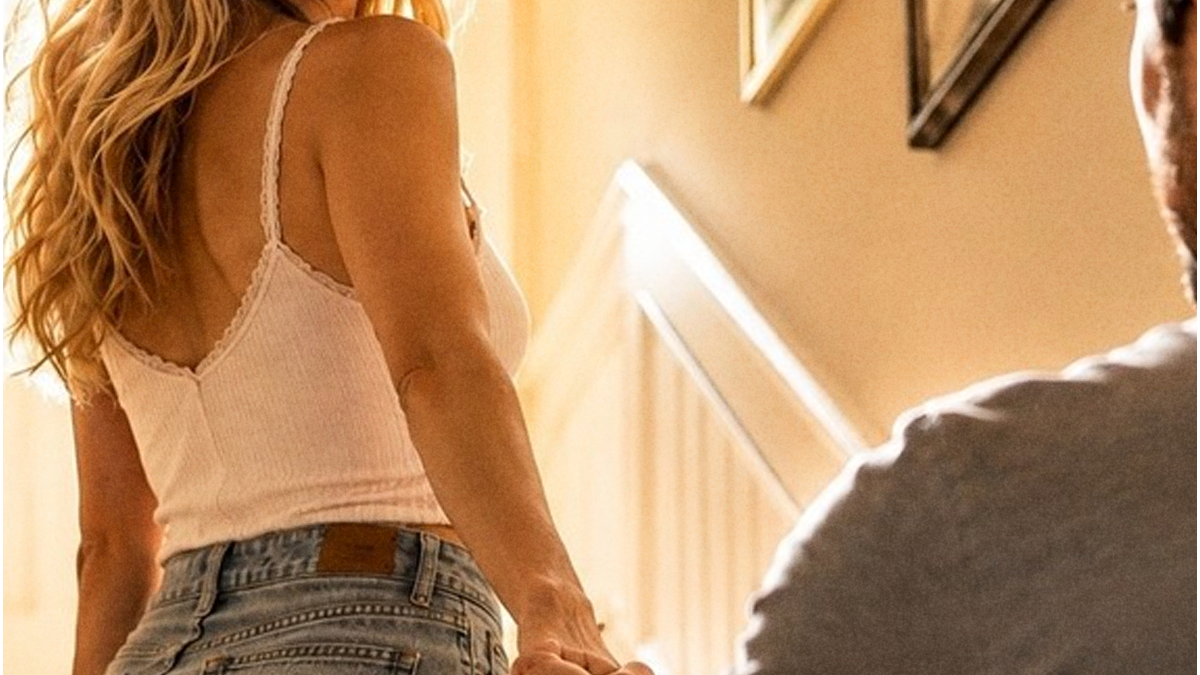
She stood up, walked around the table, took my hand without a word and led me to the staircase.
Her hand was warm and trembling and she started climbing.
By the fourth step, I understood that I hadn’t been joking.
To understand why Neva led me up those stairs that Sunday afternoon, you need to hear everything from the beginning.
My name is Corbin Shea.
I’m 37 years old and I restore wooden boats for a living.
Not fiberglass hulls or aluminum tenders, the old ones, the ones built from planks of white oak and Atlantic cedar in the Lunenburg tradition, the ones that smell like pitch and linseed oil and salt water even when they’ve been sitting in a barn for 40 years.
I work out of a yard on the Bedford Basin in Halifax, Nova Scotia with a crew of two in summer and just me and my tools in winter.
It’s physical work, patient work.
You strip the old paint back in layers and every layer tells you something about who owned that boat before and what they thought of her.
I like that.
I like the conversation a boat has with you when you’re willing to listen.
I live in a two-story hydrostone house in the north end of Halifax, the kind of house built after the explosion of 1917 to re-house the people who lost everything, built fast and plain, but built to last.
The walls are thick and the floors creak in exactly the places floors should creak and in late afternoon, the light comes in from the west through the wavy original glass and makes everything in the front room look like it’s underwater.
I bought it after my divorce from Gwen 3 years before all of this.
It needed work, and I wanted something to put my hands into that wasn’t my own grief.
Gwen and I were married for 5 years.
She’s a sharp woman, ambitious and organized in the way people are organized when the chaos of growing up made them decide that control was the only safe thing.
She wanted more than I knew how to give.
Not more love exactly, but more motion.
More dinners with people I barely knew.
More weekends in Toronto visiting colleagues.
More of a version of me that had somewhere to be beyond the boat yard and the back deck.
I didn’t hate her for wanting those things.
I just couldn’t be them.
By the time we signed the paperwork, I was mostly tired.
The ache came and went, but the exhaustion was permanent.
After the divorce, I built a life that asked nothing of me except the work.
I woke before 6:00, spent the day in the yard.
Evenings, I ran the waterfront path along the harbor with the container ships sitting out on the water and the lights of Dartmouth on the other side, and the cold smell of the Atlantic coming in off the street.
I told myself that kind of life was enough.
Looking back, I think I was just very good at calling an empty house a home.
Neva came into my life 8 years before that Sunday.
8 years before the soup and the sourdough, and the question I said like a joke because I was too slow to recognize the truth inside it.
We met on a job.
I was in Lunenburg about an hour down the South Shore doing a full restoration on a 1938 ketch called Eleanor Rose.
Neva was there on commission from a maritime museum documenting the hull lines from photographs and measurements before I started pulling planks.
She’s a naval architect, freelance.
The kind who takes the jobs nobody else wants because the working drawings don’t exist anymore, and you have to reconstruct them from what’s left.
She walked over to look at my scarf joints, the long diagonal cuts where I’d spliced new white oak into the keel, and I braced for the usual questions from someone who’d been to architecture school, but never held a drawknife.
Instead, she looked at it for a long time and said, “You followed the run of the grain even into the fillet.
That’s rare.”
That was it.
That was the first sentence of what became the longest conversation of my life.
Niva was the kind of person who took up exactly as much space as the situation required, and never 1 in more.
She remembered how I took my coffee without being told.
She knew I hated the way voicemail recordings repeat themselves, so she texted instead, usually in complete sentences, which in my experience is the mark of someone who thinks before they speak.
She called me once, though, the night I signed the divorce papers.
My phone rang at 11:30, and it was her, and she didn’t say a word about Gwen.
She said, “The fish and chips place on Quinpool is open till 1.
You coming?”
I went.
We sat in a yellow vinyl booth and ate out of paper cones, and she asked me exactly nothing about the marriage, which was the only thing I could have stood that night.
When we walked out into the November cold, she put her arm through mine, and we stood on the sidewalk watching the last of the bar traffic go by, and then she said, “You’re going to be fine, you know.”
Not a question, a statement, the kind you make when you’ve already done the math.
I called it friendship because that’s what I was capable of calling it then.
About 6 weeks before that Sunday lunch, Niva texted me.
She didn’t call, she texted, which is how I know she’d been choosing her words.
“Hey, bit of a situation.
Sublease on my place fell through.
Long story.
Is there any chance I could stay with you for a few weeks while I sort something out?”
I texted back in 30 seconds, of course.
She came the following weekend with one rolling suitcase, a flat case of drawing instruments, and two cardboard tubes of blueprints she had to carry horizontally in both arms coming through the front door.
I held the door.
She navigated through sideways.
“Thank you,” she said.
“I won’t be long.”
I carried the suitcase upstairs while she followed with the tubes.
On the third step, something tumbled out of the chest pocket of my work jacket, a small brass compass rose fitting I’d found wedged into the keelson of an old lobster boat I was stripping that week.
A decorative piece maybe from an old binnacle, no larger than a loonie.
It bounced twice and spun to a stop on the landing.
I was already at the top, the suitcase in my hand, thinking about nothing except setting it down.
Neva was on the second step.
She paused, bent down, picked up the little brass piece, turned it once in her palm, and slipped it into the front pocket of her cardigan without a word.
I want you to hold on to that detail.
It becomes the whole story.
The first week she was there, we moved around each other with the careful courtesy of people who know each other too well to be strangers, but who aren’t yet sure what the new geography between them looks like.
She kept the guest room door ajar, but her things organized and contained.
She asked before using the stove, even though I told her she didn’t have to.
There was a formality to it, like the first days working on a new boat, learning where the fragile wood is, learning where you can put your weight.
By the second week, something quieter had started.
Every morning when I came down to the kitchen before dawn to get my thermos, there was a mug of coffee already waiting on the counter, not left over from her own, made for me, black, still hot.
She woke up earlier than me to do it, though she didn’t have to be anywhere until 9:00.
She never mentioned it.
It was just there.
In return, though I didn’t think of it as a return at the time, I started buying the oat milk she used.
It sat in the fridge beside the regular 2% I’d always kept and neither of us said a word about it.
She worked at the kitchen table in the evenings, drawing at a drafting board she’d set up against the window, a clip-on lamp angled over the paper, her pencil moving in the precise language of someone who learned to draw the way other people learn to speak.
I worked in the back shed I used as a workshop, fitting the steamed ribs of a skiff onto a mold.
I left the door between the kitchen and the shed propped open with a chunk of deadwood and sometimes she would call through it.
White oak or hackmatack?
I’d say, “Oak.”
She’d say, “Right.”
Three words, but I looked forward to them more than most conversations I’d had all year.
I was out back one afternoon stripping caulking from a seam when I turned the corner and found Neva sitting on the back step in her socks, a mug in her hands, watching two chickadees work the bare branches of the backyard ash.
She didn’t hear me come around.
She just sat there, completely still, watching.
There was something in her face, a quietness that had nothing performed about it, that stopped me before I said anything.
I stood there for a moment and then I went back to the seam.
I told myself I hadn’t wanted to disturb the birds.
A few evenings later, Neva was washing up after dinner, her back to the room, and she said without turning around, “I like your staircase, all the different creaks.
You can tell exactly where someone is just by the sound.”
I said something like, “Yeah, it’s old.”
She turned her head partway.
“It’s honest,” she said, “kind of like you.”
I laughed, she didn’t.
She turned back to the dishes.
Then the ice storm came.
Mid-November in Halifax is when the storms start to mean it.
This one came overnight, freezing rain on top of snow on top of wind off the harbor, and by morning the power was out across the whole north end and the streets looked like they’d been poured in glass.
I was in the kitchen with a candle when I heard something that wasn’t a sound so much as a silence with the wrong shape to it.
I took the candle upstairs.
Neva was sitting on the hallway floor outside the guest room with her back against the wall, her knees drawn up, and a pillow held against her chest like a life preserver.
Her face was turned toward the frost-covered window at the end of the hall where the branches of the neighbor’s maple were cracking in the wind.
I sat down beside her without saying anything.
We stayed there for almost 2 hours.
Every time the wind loaded up and the ice on the power lines cracked and settled, I felt her shoulder go rigid for just a second against mine.
Not dramatic about it, just braced like someone who’s learned to absorb things quietly.
After a while, she said very quietly, “When I was little, my dad used to take us out to the shed when it stormed.
He’d have this old kerosene lamp.
We’d sit in there with it until the worst passed.
He never made a big deal out of it.
He just made sure we weren’t alone.”
I pressed my shoulder a little closer to hers.
When the power snapped back on and the hallway lights blazed, she stood, straightened herself, and said, “Thank you.”
I said, “I didn’t do anything.”
She gave me a look, the tiredness and the warmth together.
“Exactly,” she said, “that’s what I mean.”
3 days later, I was breaking down the recycling in the back porch when a piece of paper slid out of the pile.
I caught it before it hit the floor.
It was a letter from the property management company that owned Neva’s building.
A sublease renewal offer.
The same weekly rate extended for 12 months.
The box marked tenant declines to renew was checked.
Her signature was at the bottom.
I stood in the back porch a long time with that letter and the cold concrete smell around me and the ice still on the railing outside, and I couldn’t name what I was feeling.
I folded it, put it back, and went inside without saying anything.
She’d tell me when she was ready.
That’s what I told myself.
But after that day, I started seeing things I’d been too comfortable to look at before.
The way she glanced at me across the kitchen table, and then looked away a half second too late.
The way she straightened the collar of my jacket one morning before I headed out, not touching my neck, just the fabric, her fingers light and precise.
The way she made roasted squash soup every Thursday, the exact version my mother used to make, the one she’d watched me eat three bowls of exactly once, four years ago at somebody’s dinner party, and she had never once forgotten it.
Nobody else we knew even liked squash soup.
Then Gwen called.
I didn’t answer.
She left a voicemail, which she knew I hated.
I played it standing in the driveway.
Just heard you’ve got a house guest.
Interesting timing.
Always wondered what she was waiting for.
I deleted it, but the words sat in me like something I’d swallowed wrong.
A week later, Gwen’s silver Volvo was parked in front of my house when I pulled up.
Rental plates.
She’d moved to Ontario two years earlier and was in Halifax visiting her mother.
She was standing on my front step in a wool coat, looking like someone who had already decided how this conversation was going to end.
Inside, she set her bag on my kitchen table, the way she used to set her bag on every surface in our house, like she was marking territory by muscle memory.
She told me there was a document from the original property division she needed me to initial, something her lawyer had flagged.
She pulled it out with the same precision she did everything, but she wasn’t looking at the document.
She was looking at the kitchen, Neva’s drafting board by the window, two mugs in the dish rack, a cardboard tube of blueprints leaning against the wall.
She walked me out to the front step.
She kept her voice modulated, the way she used to when she wanted a fight without raising it where the neighbors might hear.
“She’s been in love with you for years,” she said.
Not a guess, a confirmation of something she’d filed away a long time ago.
“That sublease story is a fiction.
She engineered this whole thing to get herself into your house.
You know that, right?”
She tilted her head.
“Every dinner we ever had, every gathering, I used to watch her watch you from across the room.
I knew before you knew.
I just decided it wasn’t worth the energy.”
The screen door opened behind us.
Neva came out.
She didn’t approach Gwen or stand close to me or do anything that could be read as staking a claim.
She just stopped at the edge of the step, looked at Gwen once, and then looked at me with the same steadiness she’d had on the hallway floor in the dark.
“Gwen’s right,” she said.
“I turned down the renewal.
I chose to come here.”
Then she went back inside and the screen door closed and the street was just the street again.
A crow on the power line, a kid on a bike at the corner.
Gwen smiled.
The kind that’s really a weapon.
She left the document on my kitchen table like a calling card and drove away without looking back.
I stood on the front step alone for a long time.
The November air was cold and brine sharp and the harbor smell was in it and I waited for the anger Gwen had come here specifically to plant.
She’d laid it all out carefully.
The sublease as a scheme, the soup as calculation, the eight years of friendship as a long premeditated move.
She wanted me to look at Neva through a lens of suspicion and feel foolish for not having seen it sooner.
But I’m a boat builder.
I spend my days understanding why things hold together.
I know the difference between a piece of wood shaped to look like something and a piece of wood that’s simply being what it is.
And every instinct I had said that eight years of Neva being exactly Neva was not a performance.
The problem was I hadn’t yet said that out loud to the person who needed to hear it.
That night Neva didn’t come downstairs for supper.
I made chowder, basic, just potatoes and clam and thyme, and left a bowl outside her door.
When I came back an hour later, the bowl was empty and the door was still closed.
She’d eaten.
She was still here.
That night, that was enough.
The silence that followed was different from the quiet we’d built together over those weeks.
This was the absence of all of it, the shape left behind where something had been.
No coffee on the counter in the morning, the kitchen table with no blueprints, no pencils, no lamp angled over tracing paper.
The door between the kitchen and the shed stayed propped open out of habit, and nobody called through it.
The doorway just stood there like a sentence someone had started and never finished.
Five days of that, five evenings of a bowl left in the hall and returned empty by morning, five mornings of walking into the shed and finding the workbench bare.
Gwen sent one last message through her lawyer, a brief note about the signed paperwork.
I initialed the pages at the kitchen table, sealed them in the return envelope, and mailed them without reading the fine print.
On the sixth day, I came home from the yard in the late afternoon and found Neva’s suitcase at the bottom of the stairs.
My chest didn’t sink.
It seized up clean and cold and airless, the way it seizes when a plank you’re steaming splits unexpectedly and you know in that instant that hours of careful work are gone and you can’t get them back.
It was nothing like how I’d felt when Gwen left.
Gwen leaving had made me sad.
The sight of that suitcase made me afraid, and that distance between sadness and fear told me everything I hadn’t managed to tell myself in 8 years.
Neva was on the landing above folding a sweater, her back to me.
Neva.
She stopped folding, didn’t turn.
I found the letter in the recycling 3 weeks ago, the lease renewal.
Her hands went still.
I didn’t ask you about it because I was afraid of what it meant.
And I think I’ve been afraid of what a lot of things meant for a long time, and I used the quiet to call it contentment.
She turned around slowly and came down two steps and stopped, one hand on the railing, looking at me the way you look at something when you’re deciding whether you can afford to hope.
She said, “I’ve been in love with you since before you married Gwen.
I was at your wedding.
I wore a green dress and smiled for every photograph and drove home on the 102 and cried until I couldn’t read the road signs.”
Her voice was flat and steady, not performing anything.
“I waited 3 years after the divorce because I wasn’t going to be the person who swoops in when someone is raw.
I wasn’t going to give Gwen the satisfaction of being right.
The sublease was the only way I could get close to you without having to explain any of this out loud, the only door I could walk through without having to say why I was knocking.”
She held my gaze, and then Gwen kicked it open and turned it into something to be ashamed of, and I couldn’t stay here and have you look at me the way she wanted you to.
I said, “I don’t look at you like that.”
“Then how do you look at me?”
I took one step up, then another.
The staircase creaked beneath me in the same sequence it always did.
I reached for her hand.
It was warm and it trembled, exactly the way it had been a minute ago before all of this, and exactly the way it had been 8 years ago on a job site in Lunenburg when she said something that made me realize she actually saw the work.
“Like the person I want to make coffee for,” I said, “not for a few weeks, for good.”
Neva looked at me for a long moment, and then she took my hand the rest of the way and led me up the remaining steps.
At the top, she pushed the guest room door open.
On the nightstand beside the lamp was the small brass compass rose fitting, the one that had fallen from my jacket pocket the afternoon she moved in, the one I hadn’t noticed falling.
She’d kept it there on that night stand for 6 weeks.
Every morning when she woke, it was the first thing she saw catching the light.
Beside it was a drawing on tracing paper done in her clean architectural hand.
A workshop scaled to the footprint of my back shed, but expanded.
A timber framed addition along the north wall, a drafting station with a window facing the yard for natural light, a long workbench with storage underneath.
In the margin notes, two sets of tools listed side by side.
A door between the drawing office and the boat builder’s side propped open.
She had drawn our life together before I knew I wanted one.
“If you want me to go, I’ll go.”
She said quietly.
She was standing beside the night stand with the compass rose and the blueprint behind her like evidence in a case she’d never wanted to bring.
“But I’m done pretending any of this is anything other than what it is.”
I picked up the brass piece and held it.
It was small, just a found thing from the bilge of an old boat, the kind of detail you step over a hundred times before you think to look at it properly.
But she had bent down on the staircase and caught it before it could roll away.
And she’d kept it safe for 6 weeks without being asked.
And now it sat in my palm like the first sentence of something that had been trying to get said for a very long time.
“Stay.”
I said.
And that was the whole conversation.
Nothing changed overnight.
That’s not how real things work.
But things did change.
The coffee came back, black still warm, waiting on the counter every morning before I was out the door.
I started leaving a sprig of juniper from the hedge beside the gate on the kitchen table next to her mug each day.
Neither of us said a word about it.
It just happened every morning.
Coffee and juniper, a conversation conducted entirely in gestures.
The door between the kitchen and the shed stayed open.
By spring, Neva had taken on three restoration contracts in the north end.
Old hydrostone houses with wet basements and failing soffits and owners who wanted the original character preserved.
She brought me in as her carpenter.
We worked through the days together cutting and fitting and reading the damage of old buildings the way you read the damage of old boats, layer by layer, with patience and without assumptions.
We came home to the same kitchen table at night.
The people on the block started calling us the heritage couple.
Neva laughed when she heard it.
The kind of laugh that starts in the chest and doesn’t apologize for being real.
I didn’t correct anyone.
I didn’t go to a jeweler.
I took the brass compass rose to a silversmith on Gottingen Street and asked him to set it into a plain silver band, nothing elaborate, just a small fitted bezel and a clean shank.
Then one Sunday in May after lunch, fish tacos and iced tea on the back deck, nothing special.
I stood up from the table and Neva looked at me with the particular look she gave me when she knew something was coming before I’d said it.
I walked inside, she followed.
I stopped at the bottom of the staircase, the same place I’d said her name the afternoon her suitcase was sitting on the floor, the same place where the afternoon light came through the hall window and fell across the stairs in long warm stripes.
I held out the ring, the brass compass rose at its center catching the light from the window.
“Neva,” I said, “would you marry me?”
Not a joke this time, not even close.
She looked at the ring for a long moment, then she reached out and took my hand and led me up the staircase step by step, the wood doing its honest creaking work beneath us.
On the fourth step she stopped.
She turned to me.
Her eyes were full and her voice was clear.
“Yes,” she said.
Her answer was on the stairs, the same stairs where she’d told me she liked how honest they were.
The same stairs where a brass fitting had fallen and she had bent down and kept it.
The same stairs where everything had started and the same stairs were everything became real.
People ask me when I knew.
I never have a clean answer.
There was no single moment, no lightning.
It was just a lot of mornings walking down to the kitchen before dawn, and finding my coffee already made, and thinking, without quite knowing I was thinking it, that this is what I want my mornings to look like for every one of them that’s left.
Niva didn’t arrive in my life like a storm.
She arrived the way the tide comes into the harbor, steady, unhurried, and by the time you look up, the whole character of the place has changed, and you would never want it back the way it was.
The compass rose sits on her hand now, and when the light catches it in the workshop, it throws a small spinning glint across whatever surface she’s drawing on, a tiny navigation point in the middle of an ordinary afternoon.
I think love is sometimes like finding something on the floor of an old boat.
You could step over it.
Most people do, but if you slow down and pick it up and look at it, you understand that it’s been there a long time, that it belongs somewhere, and that someone had the patience to keep it safe without being asked.
If you’re lucky, if you’re paying attention, you realize it was never lost.
It was just waiting for you to notice it was there.
Is there a person in your life who has been showing up quietly for years without asking for credit, without making a production of it?
If this story found something in you, I’d like to hear about it.
Leave me a comment below.
I read every single one.








