I Fell for the Most Handsome Guy in College – Then I Learned His Looks Were Just the Beginning
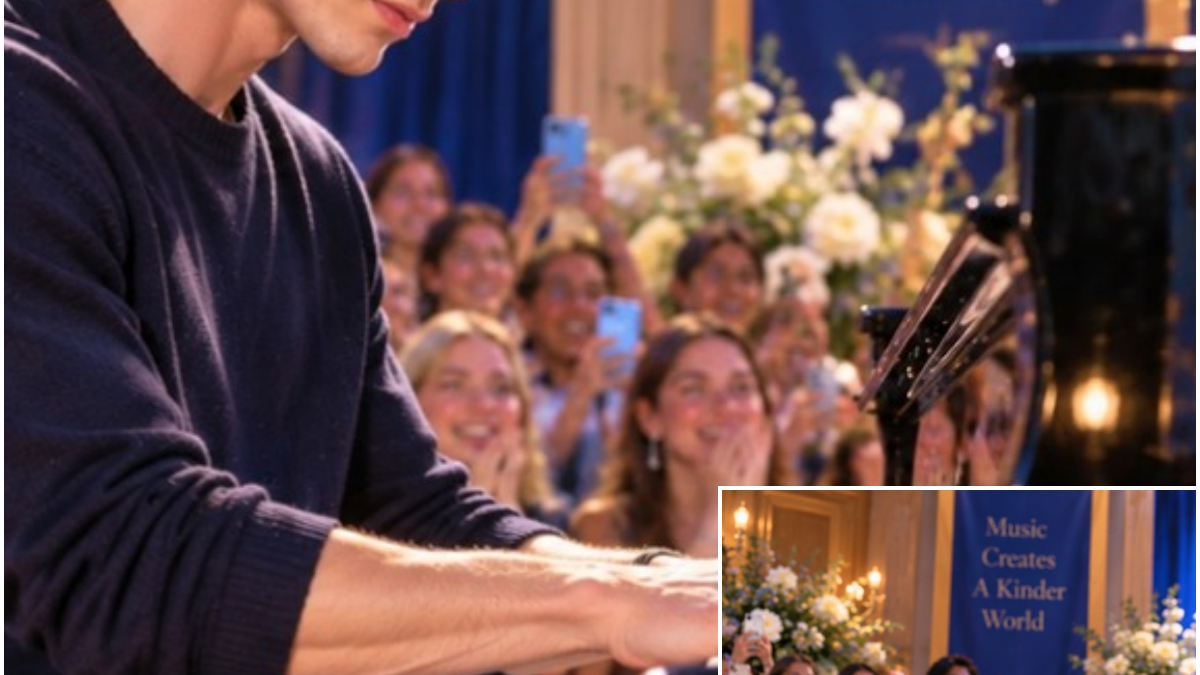
I Fell for the Most Handsome Guy in College – Then I Learned His Looks Were Just the Beginning
Everyone wanted Ethan Cole.
I thought I knew why.
I was wrong.
I used to think every girl on campus wanted him because of the way he looked.
Then I became his boyfriend and got close enough to realize his face was probably the least dangerous thing about him.
That realization hit me at 5:43 on a Friday evening.
While I was standing on a ladder in Westbridge University’s old ballroom with a roll of tape between my teeth, the literary and arts benefit opened in 2 hours.
One volunteer had vanished with food poisoning.
Three boxes of donated books were still downstairs, and the banner above me was beginning to peel off the wall.
So, naturally, Ethan walked in.
Conversations faltered.
Ethan had perfected the unfair combination of broad shoulders, athletic height, dark chocolate brown hair that refused to lie flat, and a face sharp enough to make strangers forget what they were doing.
His brown eyes swept across the room until they found me.
Beside the registration table, a girl holding tape stopped moving.
I climbed down.
Try being subtle.
Ethan took the box from my arms and kissed my temple.
I was subtle.
You caused a measurable drop in productivity.
I wore a jacket.
I laughed despite myself.
I had asked him to bring books, not rescue the event.
Still, 10 minutes later, I noticed him beside Maya, a freshman volunteer who had spent the afternoon terrified of greeting donors.
Ethan didn’t tell her to relax.
“Okay,” he said, leaning against the table instead of towering over her.
“Who was the nicest person you’ve met today?”
Maya blinked.
“Professor Ellis.”
“Good.
Who was the weirdest?”
Her mouth twitched.
“The man who asked whether poetry was taxdeductible.”
Ethan grinned.
“Perfect.
You’ve survived both ends of the spectrum.
Everyone else is easy.”
Maya laughed.
5 minutes later, she was greeting guests alone.
That should have been nothing except Ethan kept doing things like that.
When Mr. Alvarez from facilities entered carrying extension cords, Ethan immediately crossed over.
Louise, how’s your daughter’s ankle?
Mr. Alvarez stared at him.
Better.
She made varsity again.
I told you she would.
I’d introduce them once.
Once later, an elderly donor arrived early and looked irritated that nobody seemed ready for him.
Ethan remembered he’d funded West Brbridge’s athletic rehabilitation room and asked how the new equipment was working out.
Within seconds, the man’s expression softened and Ethan was walking him toward the student coordinator who knew the program.
I watched from across the ballroom.
People always looked at Ethan.
I was beginning to understand why they kept talking to him after they did.
Then Claire, our event coordinator, came running through the doors, white-faced and clutching her phone.
Noah.
Something in her voice killed my smile.
What happened?
Our pianist was in a car accident.
She’s okay, but she’s at the hospital.
She can’t perform.
My stomach dropped.
The benefit program had been built around her 20-minut set.
Clare pressed both hands to her forehead.
Doors opened in less than 2 hours.
Behind her stood the ballroom’s black grand piano, and Ethan was staring at it.
Not casually.
He had gone completely still.
I knew that look.
Ethan was calculating something.
I crossed the room.
Why are you looking at that piano like you know it?
His eyes shifted to mine.
For the first time all evening, the guy everyone else expected to have an answer looked almost caught.
Then Ethan glanced back at the keys because he said quietly, “I do.”
The strange part was that Ethan never seemed to notice the effect the way everyone else did.
He noticed people instead.
Before the first guest arrived, he had already learned which volunteer was fasting, which professor needed a chair near the aisle because of his knee, and which stack of programs had been printed with the wrong room number.
Beauty announced itself the second Ethan entered a room.
Attention like this required him to stay present after everyone else had started performing for him.
You know how to play?
Ethan gave me the particular look he used whenever he thought I had asked a question with an obvious answer.
I know where the keys are.
That is not an answer.
It technically is.
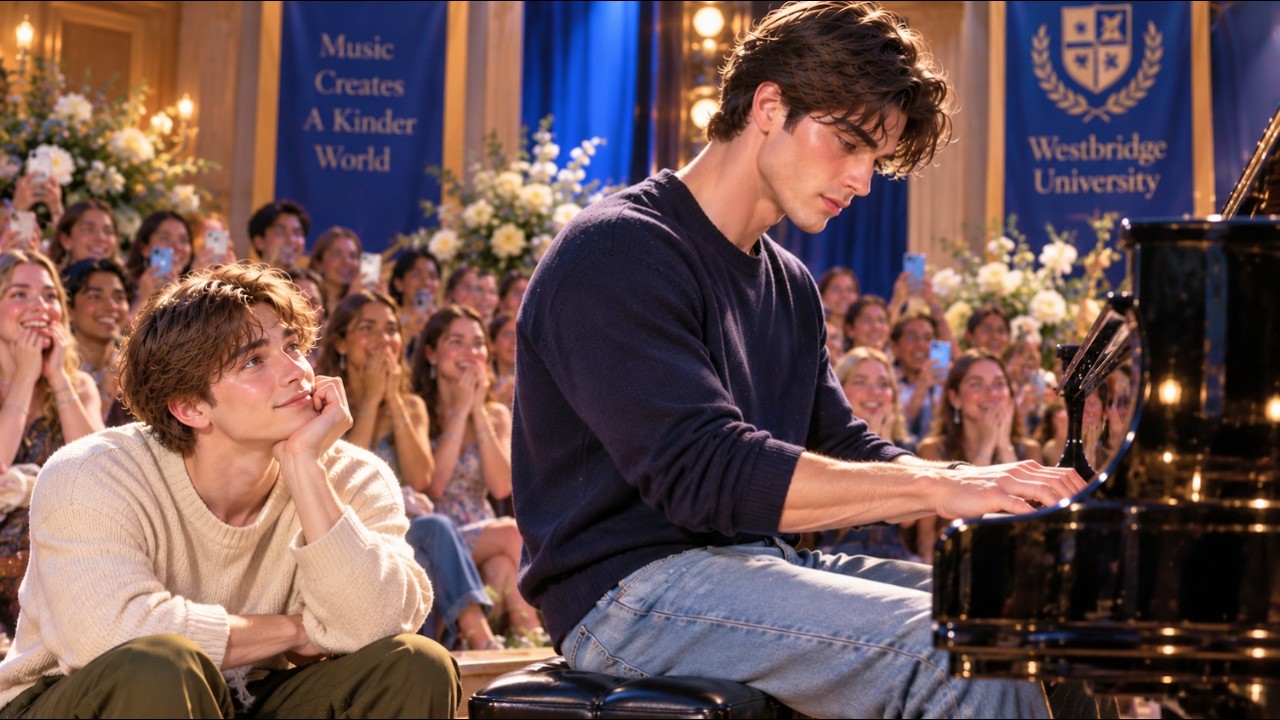
Before I could threaten him with one of the donated poetry anthologies, he crossed to the grand piano.
Ethan sat.
For one absurd second, the image itself distracted me.
His broad frame looked almost too large for the bench, sleeves pushed to his forearms, dark hair falling over his forehead as he lifted the cover.
Then he touched the keys.
Three quiet notes, a pause, and suddenly his hands moved.
The melody lasted maybe 20 seconds, but it was enough.
There was nothing hesitant about the way his fingers traveled across the keyboard.
He wasn’t searching for chords.
He knew where they were before he reached them, his left hand building something warm beneath a clean, fluid line from his right.
Then he stopped.
I stared.
Ethan glanced over his shoulder.
Don’t Don’t What?
Look at me like that.
My boyfriend just casually became a pianist in front of me.
I need processing time.
A laugh escaped him, but something guarded entered his expression.
I took lessons.
For how long?
He lowered the piano cover halfway.
10 years.
Ethan, what you cannot call 10 years lessons like you spent three Tuesdays learning happy birthday.
That got a real smile.
6 to 16, he admitted.
My mom loved piano.
She put me in lessons when I was little.
Competitions came later.
Competitions.
I waited for more.
Nothing came.
Why did you stop?
His fingers rested against the wooden edge.
Long story.
That answer mattered precisely because Ethan rarely used it with me anymore.
Before I could decide whether to push, Clare appeared.
Please tell me that was you playing.
Ethan stood immediately.
I can help reorganize the program.
That wasn’t what I asked.
I know.
There it was a boundary.
Clare looked disappointed but nodded.
And within minutes, Ethan had somehow become unofficial crisis management.
Mr. Whitmore, one of the major donors, arrived early and visibly annoyed.
Before Clare could intercept him, Ethan did.
He didn’t flatter him.
Instead, he asked whether the rehabilitation equipment Whitmore had funded last semester had finally arrived.
The man’s entire posture changed.
You remembered that the new resistance system?
Yeah.
Our trainers wouldn’t shut up about it.
30 seconds later, Ethan had him talking enthusiastically with our athletics outreach coordinator.
Watching Ethan was becoming unsettling in the best possible way.
He remembered what people cared about, not because he wanted something from them.
Because he’d actually listened.
I was still thinking about that when Clare’s phone rang again.
She answered.
Her face changed.
What?
Everyone nearest her went quiet.
She lowered the phone slowly.
That was Daniel’s roommate.
Daniel was our keynote student speaker.
He was riding with the pianist.
He’s at the hospital, too.
Minor injuries, but he’s not coming tonight.
I felt cold.
Clare stared at the printed schedule.
The piano performance and Daniel’s speech together accounted for almost 20 minutes.
There’s another problem, she whispered.
Whitmore’s matching pledge depends on tonight’s program meeting the presentation requirements.
My eyes found Ethan.
This time he wasn’t looking at the piano.
He was looking at the schedule.
Calculating again.
Clare swallowed.
If we can’t replace 20 minutes before those doors open, we may lose half the funding.
I should have known the piano meant more than a convenient solution.
Ethan had walked past it twice while helping Clare and had never touched it until the crisis made silence impossible.
Even then, the first thing he offered was not a performance.
It was a way to reorganize the program.
That detail lodged in my mind.
Ethan was comfortable being useful.
He was much less comfortable being watched while doing something he cared about.
The difference was small enough that nobody else in the ballroom seemed to see it.
I did.
And suddenly his refusal to answer Clare felt less like modesty and more like fear with excellent posture.
“Okay,” Ethan said, taking the ruined schedule from Clare.
“Nobody panic until we know what we’re actually missing.
We’re missing 20 minutes,” Clare said.
“We’re missing 20 minutes of programming.
That’s different.”
“That sentence changed the room.”
I watched shoulders lower.
People stopped staring at the doors like 300 guests were in approaching natural disaster.
Ethan pointed toward two volunteers.
Check whether the hospital needs anything from us.
Don’t call Daniel or Rebecca directly.
They have enough going on.
Then he looked at me.
Noah, those student submissions you edited.
Any of them work aloud.
I understood immediately.
Three, maybe four.
Find them.
There was no command in his tone, only trust.
I headed for my laptop.
For the next 30 minutes, the ballroom became controlled chaos.
I pulled essays from our literary program, pieces about belonging, education, and second chances, and started cutting them into possible readings without destroying the students voices.
Ethan handled everything else.
A freshman dropped a glass near registration.
The sound cracked through the room.
The poor guy froze, face turning red as everyone looked.
Ethan was beside him before anyone could make it worse.
Congratulations, he said, crouching to move the larger pieces away from passing shoes.
You just got the first disaster out of the way.
The freshman blinked.
Statistically, the rest of your night should improve.
He laughed.
So did two volunteers nearby.
And just like that, humiliation became a story he’d probably tell tomorrow.
10 minutes later, Ethan passed behind my chair and rested his palm briefly against my back.
No words.
He didn’t need them.
You okay?
I touched two fingers to his wrist before he moved away.
Keep going.
That was us now.
Noddramatic declarations.
Every time life became difficult.
Sometimes love was knowing what 1 second of contact meant.
By 6:30, however, I noticed something else.
Ethan, the catering count is wrong.
Ethan, where should we move the extra chairs?
Ethan, can you talk to Professor Lang?
Ethan, do you know what we’re doing about the missing performance?
Every question went to him, and Ethan answered everyone patiently, confidently, until I saw his jaw tighten.
People mistook his ability to calm them for an unlimited capacity to carry them.
I knew better.
When I finally finished restructuring the readings, I looked up.
Ethan was gone.
Where’d Ethan go?
I asked Maya.
She pointed toward the ballroom.
He said he needed 5 minutes.
I followed.
The main room was empty now.
Lights lowered while staff prepared the entrance hall.
Then I heard it.
Piano.
I stopped outside the doors.
The melody was different from what he’d played earlier.
More complicated, beautiful in a way that made me instinctively stay quiet.
Ethan sat alone beneath the stage lights.
His hands moved with practiced certainty.
Then a wrong note.
The music stopped.
He exhaled, started again.
The same passage approached.
His right hand hesitated.
Another wrong note.
Damn it.
I had almost never heard Ethan sound afraid of anything.
Through the narrow opening between the doors, I saw him stared down at his hands.
Then I saw something that changed the entire night.
His fingers were trembling.
The funding mattered beyond one elegant Friday night.
The benefit paid for student publication grants, emergency materials, and the small stipens that let students like Maya spend hours on arts projects without choosing between them and a work shift.
Clare had shown me the budget that morning.
Without the match, two spring programs would be cut first.
That was why nobody could simply apologize to the donors and cancel the missing segment.
It was also why Ethan’s instinct to absorb the problem frightened me.
He had a habit of treating every meaningful consequence as evidence that he should personally become stronger.
When was the last time you played in front of people?
Ethan’s hands stopped moving.
He didn’t turn around immediately.
I crossed the empty ballroom and sat beside him, leaving enough space that he wouldn’t mistake closeness for pressure.
Define people, he said.
People who weren’t your boyfriend accidentally discovering you have a secret relationship with a piano.
That earned the smallest smile.
16.
My teasing disappeared.
You haven’t performed since you were 16?
No.
7 years.
Suddenly, the trembling made sense.
I looked at the keys instead of at him.
What happened?
For several seconds, Ethan said nothing.
Then he pressed one key softly.
My mom loved piano.
She said I had too much energy as a kid and needed somewhere to put it.
I smiled.
That sounds believable.
She’d sit outside every lesson.
Competitions came later.
Another note.
I like them at first.
Then I started placing and people expected you to keep placing.
His mouth tightened.
There was always another judge.
Another score.
Another person asking what happened if I got second instead of first.
I knew that language not because of piano because expectations had followed Ethan into almost every room of his life.
What happened at 16?
He stared at his hands.
Regional final.
I knew the piece cold.
I played it hundreds of times.
His thumb moved unconsciously over the edge of a white key.
I got halfway through and forgot what came next.
You forgot a note?
Everything.
That word landed harder.
I sat there with an entire auditorium waiting.
Ethan swallowed.
Eventually, I stood up and walked off.
Did anyone do something to you afterward?
No.
He shook his head.
That’s almost what made it worse.
My teacher told me it happened.
Mom told me she was proud of me.
Nobody was cruel.
He finally looked at me.
I just realized I’d stopped playing because I loved it.
I was playing because I was terrified of failing at something people thought I was good at.
There was no dramatic villain in that story.
Just pressure accumulating until something beautiful became frightening.
And tonight, everyone had spent an hour saying the same thing.
Ethan will handle it.
I reached over and touched his knee.
Do you actually want to play tonight?
I want to help you.
That wasn’t what I asked.
His eyes lifted to mine.
For once, I didn’t let him escape behind confidence.
Ethan, he exhaled.
I don’t know.
That answer felt more honest than yes.
The ballroom door opened.
Clare hurried inside looking simultaneously relieved and terrified.
There you are.
Ethan stood.
Clare glanced at the piano then at him.
Whitmore heard.
You can play.
I felt Ethan go still beside me.
He told Mrs. Caldwell.
Clare continued.
She’s the donor underwriting the matching pledge.
My stomach tightened.
What did she say?
I asked.
Clare hesitated.
She wants Ethan to replace Rebecca.
Silence.
All 20 minutes.
Ethan asked.
Clare nodded.
She thinks having one of West Brbridge’s most recognizable students perform could actually strengthen the program.
There it was again.
Another room, another audience, another expectation wrapped inside a compliment.
Ethan looked at the piano, then at Clare, then at me, the confident expression everyone else knew had vanished.
For one brief second, only I saw the 16-year-old who had once sat before an auditorium and forgotten what came next.
And then Ethan said quietly, “Okay, I’ll do it.”
I remembered other moments differently now.
Ethan had once left a crowded student event because the microphone feedback made his shoulders lock, then joke that he hated bad sound systeMs. Another time, I had found an old recital program tucked inside a book at his apartment.
His name had been printed beneath a photograph of a much younger boy at a piano.
I had assumed it belonged to some forgotten childhood hobby.
Ethan had taken the program from me, smiled, and changed the subject so smoothly, I never questioned it.
The clues had been there.
I had simply been looking at the version of him that seemed impossible to rattle.
No.
Ethan had already turned toward the piano when I said it.
He looked back.
No, you said yes too fast.
Clare’s eyes moved between us.
I can give you two a minute.
The moment she left, Ethan exhaled.
Noah, we’re running out of time.
Exactly.
Which is why you volunteered before you had time to think.
I can play.
I know that stopped him.
I stepped closer.
I’m not questioning whether you’re good enough.
I’m questioning why you’re doing it.
His jaw tightened because this event matters to you.
And that is a terrible reason to scare yourself half to death.
His expression softened, which somehow annoyed me more.
I’ll be fine.
There it was.
The sentence people used when they wanted someone who loved them to stop asking questions.
Before I could answer, voices filled the lobby outside.
Guests were arriving.
Ethan looked toward the doors.
We don’t have time to argue.
He sat at the piano.
I hated that he was right about the time.
I hated more that he wasn’t necessarily right about anything else.
Claire gathered the nearest volunteers while Ethan chose a piece he remembered well.
I stood near the stage with my revised readings in my hands.
He began.
The opening was beautiful, not flashy, controlled.
His shoulders gradually loosened and for almost a minute I wondered if I’d been worrying about nothing.
Then the ballroom doors opened.
A wave of voices entered.
Dozens of guests.
Ethan looked up.
His hands stopped.
The silence was tiny.
Maybe 2 seconds, but I saw his face.
He wasn’t 23 anymore.
He was 16, staring into an auditorium and waiting for memory to return.
Ethan tried the next measure.
Nothing.
He pulled his hands away.
Okay, he said quietly.
That’s a problem.
I climbed onto the stage.
He gave me a humorless smile.
Feel free to say you told me so.
I’d rather solve it.
Clare joined us pale again.
Can you do the full set?
Ethan didn’t pretend.
No, I loved him a little harder for that answer.
Clare closed her eyes.
I looked at the schedule.
20 minutes.
Then at the pages in my hand, three student essays.
Then the piano.
Suddenly, the problem changed shape.
We’re solving the wrong problem.
They both looked at me.
We don’t need another pianist.
Clare frowned.
We need 20 minutes.
Exactly.
I spread the pages across the piano.
Three readings.
Short ones.
Ethan plays transitions underneath and between them.
Ethan studied the pages.
I continued.
The entire benefit is supposed to be about what this program gives students.
So, let them speak.
Clare’s expression shifted from panic to calculation.
That could work.
It could, Ethan said.
But those students haven’t rehearsed with me.
We rehearse now.
Clare looked toward the entrance.
One problem.
Mrs. Caldwell specifically asked for a polished musical replacement.
Of course, she had.
If she hates the change, I asked.
Clare lowered her voice.
She controls the matching pledge.
Ethan looked at the piano again.
I knew what he was thinking.
Take the risk himself.
Protect everyone else.
Before he could say it, I put my hand over his.
No, his dark eyes met mine.
This time, I said, we solve it together.
The story is only getting more exciting.
Please subscribe.
Your support motivates us.
Then Clare’s headset crackled.
5 minutes until Mrs. Caldwell arrives.
What scared me wasn’t that Ethan might embarrass himself.
I knew him well enough to know embarrassment would not destroy him.
What scared me was the reason behind his yes.
He had heard that the event mattered to me, seen 300 people approaching and translated both facts into a private obligation.
If I can carry this, nobody else has to.
That instinct was one of the things I loved about him.
It was also the part of him most likely to confuse love with self-reras.
I wasn’t going to reward that confusion just because it came wrapped in courage.
I can still do the full set, Ethan said at the second Clare left to meet Mrs. Caldwell.
I stared at him.
We just established that you can’t.
I froze once, twice, technically.
Thank you for the statistical support.
You’re welcome.
His mouth almost smiled, but his shoulders remained rigid.
Around us, volunteers dragged chairs into position while guests filled the lobby.
We had minutes, not hours.
Ethan lowered his voice.
Your version asks three students who’ve barely rehearsed to carry part of the program.
If something goes wrong, you’ll carry it instead.
If I have to.
There it was.
Not arrogance.
Responsibility pushed one step too far.
And what if you freeze again?
I’ll recover.
You don’t know that.
His eyes hardened.
And what if your version doesn’t work?
The question stung because it was fair.
So I gave him the only honest answer.
Then it doesn’t work.
Ethan blinked.
But at least we failed doing something we actually chose.
Something shifted in his face.
I touched the pages between us.
You told me you stopped loving competitions because every performance became about meeting expectations.
Don’t turn tonight into the same thing just because you’re trying to protect everyone.
For a moment, neither of us spoke.
Then Ethan looked toward the piano.
What are the readings?
I knew I’d won nothing.
We’d simply started listening.
I showed him.
Maya agreed to read a short piece about being the first person in her family to attend college.
Another student, Grace, had written about rebuilding her life after dropping out for 2 years.
The third, Lucas, had written about finding community after transferring.
“We don’t need 20 minutes of piano,” I said.
“We need one coherent 20-minute program.”
Ethan nodded slowly.
“Okay, we rehearsed and immediately failed.”
Ethan’s first transition was too long.
Maya entered late.
Lucas missed his queue.
I cut 40 seconds from Grace’s introduction while Ethan changed keys because the original transition fought the rhythm of her sentences.
Nobody magically became brilliant, but gradually it started working.
Then Maya rushed through a paragraph.
Sorry, she whispered again.
Ethan shook his head.
Don’t follow me.
She looked confused.
I’ll follow you.
They restarted.
Maya spoke.
Ethan waited.
Instead of forcing her words into his tempo, he changed his playing around her breathing, softening when she hesitated, leaving space when her voice tightened, returning only when she found the next sentence.
I forgot to mark my page.
That was what Ethan had been doing all evening.
Listening.
Not waiting for his turn to speak.
Actually listening.
He glanced at me.
What?
Nothing.
That face means something.
We have four minutes.
Coward.
I smiled.
Play.
The next run was better.
Not perfect.
Ethan missed one transition.
Lucas entered too early.
I caught a sentence that still needed cutting, but it was ours.
Clare appeared backstage.
2 minutes.
Then Grace stumbled toward us, breathing too fast.
I can’t.
I stood.
What happened?
I can’t go out there.
Her hands were shaking violently.
I thought I could, but I can’t.
Ethan stepped forward instinctively.
I can cover.
No, I said.
Everyone looked at me, especially Ethan, because this time I wasn’t going to let his first solution be carrying another person.
And judging by Grace’s terrified face, we had less than 2 minutes to find a different one.
We also made one rule before the final rehearsal.
Nobody would pretend a mistake had not happened.
If Maya lost her place, we waited.
If Lucas entered early, Ethan adapted.
If I cut a sentence badly, I fixed it instead of defending it.
And if Ethan froze, we did not turn his fear into a heroic test he had to pass alone.
Saying that rule out loud changed him.
His shoulders dropped for the first time all evening.
He stopped looking like the person responsible for guaranteeing the outcome and started looking like one member of a team trying to make something honest.
Grace, look at me.
Her eyes found mine wide and wet with panic.
I can’t go out there.
You don’t have to.
Ethan glanced at me, but he stayed quiet.
That mattered.
A few months ago, both of us might have mistaken helping someone for deciding what they needed before asking.
I held Grace’s pages between us.
Do you still want your story included?
She swallowed.
Yes.
Do you want someone else to read it?
A pause.
Then she nodded.
Okay.
I heard Claire’s voice through the headset.
90 seconds.
I looked down at Grace’s essay.
Then I understood exactly who that someone had to be.
I’ll read it.
Ethan’s head turned sharply.
You try not to sound so horrified.
You hate public speaking.
I hate mushrooms, too.
Different emergency.
Despite everything, Grace laughed.
Good.
Ethan stepped closer.
Noah, you don’t have to do this.
I met his eyes.
Neither do you.
That stopped him.
For a second, the noise backstage disappeared.
This wasn’t about proving courage.
It wasn’t about me rescuing Ethan or Ethan rescuing me.
We had both been given a choice, and we were choosing to stay.
Clare appeared at the curtain.
60 seconds.
I handed Maya and Lucas their final pages, then took graces.
Ethan moved toward the piano before stopping beside me.
His hand closed gently around my wrist.
Hey.
I looked up.
The confident expression was gone again.
If I lose the piece, there were probably a hundred things I could have said.
You’ll be fine.
You can do this.
I believe in you.
All of them sounded too much like expectations.
So, I said the one thing that wasn’t.
Look at me.
His eyebrows lifted.
That’s your solution.
If you lose where you are, look at me.
Ethan’s mouth curved.
That’s incredibly distracting.
You’ve survived worse.
He laughed under his breath.
Then he leaned forward until his forehead touched mine.
One second.
Warm skin.
Quiet breath.
The kind of intimacy nobody outside our relationship ever saw.
30 seconds.
Clare whispered.
Ethan pulled back.
Your hands are cold.
I’m about to read someone else’s emotional autobiography to 300 people.
Right.
Forgot you’re the brave one tonight.
I will abandon you on this stage.
There he is.
That stupid smile settled my nerves better than reassurance could have.
The ballroom lights dimmed.
Clare walked onto the stage.
Applause greeted her.
Through the curtain, I could see rows of faces.
Faculty, students, donors.
Mrs. Caldwell sat near the front beside Whitmore.
My stomach tightened.
Clare explained that an unexpected accident had changed the evening’s program, then introduced a presentation created from student voices and music.
No grand promises.
No mention of Ethan saving anything, just what we had built.
Please welcome Noah Bennett, Ethan Cole, Maya Reynolds, and Lucas Grant.
Applause rose.
Ethan squeezed my hand once, then we walked out.
The reaction to him was immediate.
Whispers, heads turning.
Of course, even now, Ethan Cole could enter a room and change its temperature without trying, but I wasn’t watching them.
I was watching him.
Ethan sat at the piano.
Maya took her place.
Lucas waited behind me.
I stepped toward the microphone with Grace’s pages.
The room became painfully quiet.
Ethan placed his hands over the keys.
Then, he looked into the audience.
I saw it happen.
His shoulders locked, his fingers stopped.
One second passed, then another, and no music came.
Later, Clare told us Mrs. Caldwell had noticed the same thing.
She had expected a replacement performance designed to protect the evening’s prestige.
Instead, she had watched students recover in public without pretending the accident had never disrupted them.
That, she said, was closer to the purpose of the benefit than the original program had been.
I like that explanation because it meant the pledge had not survived because Ethan Cole was handsome, famous, or secretly excellent at piano.
It survived because a room full of people had stopped trying to make one person save them and built something better together.
My name is Noah Bennett and the first story tonight belongs to someone who trusted me to tell it.
I started reading, not because Ethan needed saving, because that was my part.
My voice sounded too loud through the microphone, but I kept my eyes on Grace’s words instead of the audience.
Three sentences in, I heard a single chord, then another.
Ethan had started.
I didn’t look at him.
Not yet.
Grace’s essay was about leaving college after her mother got sick, working two jobs, then returning two years later, convinced everyone else had moved ahead without her.
Ethan played beneath the words quietly.
When I slowed, he slowed.
When Grace’s sentences became heavier, he left spaces between the notes.
He wasn’t performing over the story.
He was listening to it.
By the time I finished, my hands had stopped shaking.
Maya stepped forward.
Ethan transitioned into her piece.
She entered half a beat early.
His left hand adjusted instantly.
No panic, no correction anyone could notice, just adaptation.
Then came Lucas.
Halfway through his reading, he lost his place.
Silence opened.
I saw terror flash across his face.
“Take your time,” I said softly.
Lucas found the line.
Ethan waited.
The room waited with him.
That was when I understood something.
Confidence wasn’t making people believe nothing could go wrong.
Sometimes it was showing them that something could go wrong without becoming a disaster.
Then it was my turn again.
The final reading ended with a passage about returning to something you once thought you’d lost.
Ethan had chosen the music beneath it.
I recognized the melody, the piece from the empty ballroom, the one he’d failed to finish twice.
My eyes snapped toward him.
His hands moved steadily until they didn’t.
One measure, that was all.
But I knew this was the place.
The blank space he’d carried for seven years.
Ethan’s fingers hovered above the keys.
300 people were waiting.
He looked up, found me.
I didn’t nod.
Didn’t smile encouragingly.
Didn’t mouth.
You can do it.
I simply looked at him the way I did when we were eating breakfast, arguing over books, or walking home after class.
No audience, no expectation, just me.
Ethan breathed.
Then his fingers moved.
He didn’t finish the entire competition piece.
He didn’t need to.
He took the melody, changed it, and carried it gently beneath my final paragraph until the last sentence ended.
His final chord faded.
Silence.
For one terrifying heartbeat, nobody moved.
Then applause rose, not explosive, something better, warm, sustained, real.
Ethan looked at me from the piano.
His smile was small enough that I knew it belonged only to me.
Afterward, Clare found us backstage.
Mrs. Caldwell is keeping the matching pledge.
I exhaled so hard Ethan laughed.
She said the new format communicated the program’s purpose better than the original schedule.
So, we’re funded.
I asked minimum target.
Clare corrected.
We still have a semester of fundraising ahead.
Good.
Real life hadn’t magically solved itself.
Ethan slipped his fingers through mine.
Across the room, people were already congratulating him.
But for once, I wasn’t thinking about how easily everyone noticed Ethan Cole.
I was thinking about why after they noticed him, they trusted him.
And why tonight he’d finally trusted me enough not to carry everything alone.
Then Ethan leaned close.
There’s something else about the piano I haven’t told you.
I turned toward him.
What?
His expression changed.
Softer now, almost shy, and somehow that surprised me more than anything I’d seen all night.
My mother taught me that melody.
Ethan said it after the last guests had gone.
The ballroom looked different without them.
Half the chairs were stacked, abandoned programs covered the tables, and the grand piano no longer seemed like the center of anyone’s expectations.
I leaned against it.
The competition piece.
No, the part one changed at the end.
He sat on the bench again.
She used to play it when I couldn’t sleep.
I don’t even know what it was called.
His fingers found the opening notes.
This time, nobody was watching except me.
The melody was simpler than everything he’d played tonight.
Softer, too.
There was no technical brilliance demanding attention.
It just sounded like something remembered.
I sat beside him.
Across the ballroom, two volunteers passed the doorway.
One of them glanced at Ethan, whispered something to the other, and looked back.
I laughed.
Ethan stopped playing.
What?
Nothing.
That is never true when you say it.
I studied him.
For years, people had probably been doing exactly that, looking twice.
I understood it.
I was still extremely vulnerable to his face.
But tonight, I’d watched Maya stop shaking because Ethan gave her something manageable to hold on to.
I’d watched him remember what mattered to people who could offer him absolutely nothing.
I’d watched him fail at the piano, admit it, and return anyway.
And when the plan broke, he’d eventually let me stand beside him instead of stepping in front of me.
That mattered more than the music.
Play something you actually like.
I said I was something you don’t associate with judges.
He considered that then started again.
Six measures later.
Wrong note.
I winced dramatically.
That was terrible.
Ethan stared at me.
I was having an emotional moment.
You ruined it with the FP.
It wasn’t an F.
That explains why it sounded wrong.
He laughed, caught me around the waist, and pulled me against him.
You’re unbearable.
You’re dating me voluntarily.
Temporary lapse in judgment.
I kissed him before he could make it worse.
It wasn’t cinematic.
No applause followed, just Ethan’s hand warm against my side and the familiar way his thumb moved once beneath my shirt.
When we separated, he rested his forehead against mine.
Do you think I should start playing again?
I could hear the uncertainty underneath the question.
Old Noah might have rushed to answer.
Tonight had taught me better.
I think you don’t have to decide tonight.
His shoulders relaxed.
Good answer.
Literature major, explains the ego.
A voice interrupted us.
Clare stood in the doorway holding two trash bags.
The arts coordinator wants both of you on next semester’s interdisciplinary planning committee.
I blinked.
Ethan asked, “Doing what?”
She wasn’t specific.
Dangerous.
Clare smiled.
Think about it.
After she left, Ethan and I looked at each other.
Neither of us said yes.
Neither said no.
We had classes, work, plans, and apparently lives capable of surprising us.
Outside, campus had gone quiet.
Ethan reached for my hand as we crossed the courtyard.
He didn’t look first.
He just knew I’d be there.
I took it.
People had noticed Ethan long before I loved him.
They would keep noticing him.
But I was learning that being close to someone wasn’t about discovering one impressive thing after another.
It was learning where they were strong, where they weren’t, what they carried, and when to let them carry something beside you.
If you want to see where college life takes Ethan and Noah next, stay with us for their next chapter.”
Ethan squeezed my hand.
“What are you thinking about?”
I looked at him.
“You’re f.”
He groaned and laughing.
We kept walking.








