Her Helped a Baby Bigfoot at the Creek – Then Its Family Was Waiting
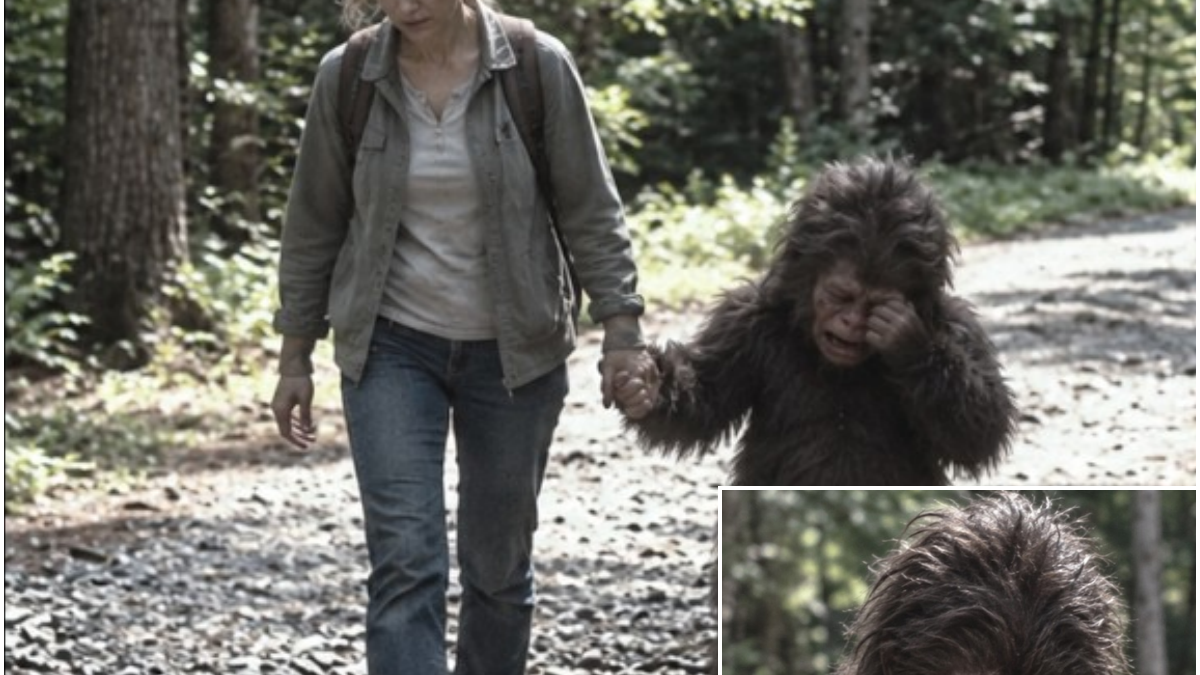
Her Helped a Baby Bigfoot at the Creek – Then Its Family Was Waiting
Bigfoot was the furthest thing from my mind that August afternoon in the western Maine Mountains.
I had crossed the brook and started up an old hall road when I heard water move behind me.
I turned nothing.
I kept walking.

It followed me a mile before I caught it.
When I finally stopped and looked back, it was standing in the middle of that grown over road about 40 ft behind me, no taller than a 5-year-old child, covered head to foot in pale tan hair, watching me with a face I have never once been able to describe to anybody.
It was a baby.
I knew that the second I saw it, the same as, you know, an infant of any kind.
Then the trees moved at the top of the clearing ahead of me and I looked up and three of them were standing along the tree line, full grown, not moving, waiting.
I was 33 years old, out of work, alone, 4 miles from my truck, standing directly between a baby and its family.
What happened in the next 10 minutes rearranged the whole rest of my life, and I have kept it to myself for 23 years.
My name is Sharon Mishad.
I am 56 years old.
And I have lived my whole life in Franklin County, Maine, in the Hill Country between the Sandy River and the High Peaks where the towns are small enough that the road sign and the census both round down.
Strong Phillips, Avon, Freeman Township.
If you have driven Route 4 north toward Rangely, you have passed my kitchen window without knowing it.
For 11 years, I stood at a machine in the Forester mill in Strong.
If you are old enough, you have had our product in your mouth.
Strong was the toothpick capital of the world once.
And I mean the world, not the county.
White birch went in one end of that building, and toothpicks went out the other by the truckload.
And for a hundred years and more, that was what my town did.
They shut it down in May of 2003, last mill of its kind in Maine.
The final toothpick came off the line, and men stood around in the parking lot afterward with their hands in their pockets, not knowing what to do with an afternoon.
I had a husband, Dale, driving a log truck for a contractor out of Kingfield, and a boy, Ryan, who was 12 and eating like a bear cub and a mortgage on a place my grandfather had put up in 1952.
I want to give you that last day because people say Miltown and picture something out of a movie and it was not that.
It was a Monday we had known since the winter.
The line ran a short shift and then ran out the last of the stock and it came down the belt and went into the boxes and somebody said, “Well, that is the last one.”
And it was not even true because two more came behind it and then it was true.
Nobody made a speech.
A woman I had worked beside 11 years put her hands flat on the machine and left them there about 10 seconds and then went and got her lunch pale.
The foreman shook every hand at the door and got most of the names right.
Somebody had brought a sheetcake.
There is always a sheetcake.
And then it was 2:00 in the afternoon on a Monday in May and 90 of us were standing in a parking lot in a town of,00 people with the whole rest of the day in front of us.
Somebody’s radio was on in a truck and the smell because a mill that has run white birch for a century smells sweet like the inside of a wooden spoon drawer.
And I stood there and understood I was smelling it for the last time.
I got in my car.
I drove home.
I sat down at my kitchen table at 2 in the afternoon and I did not know what a person was supposed to do next.
I want to be honest about what that spring did to me because it is the reason I was on that mountain in the first place.
And if I skip it, the rest will not make sense.
I was not sad.
I was worse than sad.
I was useless.
A person who has punched a clock since she was 22 does not know what to do with a Tuesday.
I put in applications at the hospital in Farmington and the school district and two stores and I waited and the waiting ate me.
I got short with Dale over nothing.
I sat in my own kitchen at 10:00 in the morning listening to the refrigerator run and feeling like a piece of furniture nobody had a use for.
So I started walking.
That is all it was at first.
Out the door after Ryan got on the bus up the road into the woods.
Back by supper.
It was the only hour of the day that did not feel like waiting, and I had grown up walking that country.
My father, Leon Pulan, was a woods boss for a small outfit out of Phillips.
And from the time I could keep up, he had me in the truck with him on Saturdays, and he taught me the things a woods boss teaches.
How to read a skid trail 30 years after the skidder is gone.
How to know a spruce from a fur in the dark by the feel of the needle.
How to keep your bearings when the sky is white and every ridge looks like the one behind it.
He taught me three things about the woods that I have never had cause to revise and I am going to give them to you because every part of this story runs back through them.
The first was that the woods are not a place you go into.
They are a place you are let into.
He never dressed that up as anything spiritual.
He meant it like a man means it when he says, “You come up a stranger’s drive at a pace that lets the dog see you.”
The second was that stillness is a tool and not a mood.
He could stand against a trunk 40 minutes without shifting his weight, and he taught it to me as a game when I was seven, and the game was that whoever moved first bought the other a soda at the store in Phillips.
I lost for 4 years.
Then I started winning and he stopped playing.
The third mattered on the 12th of August.
He told me that if a big thing ever comes at you in the woods, you do not run and you do not stand in its road.
You step aside and let it have the road.
He was talking about a cow moose in September, which is a real hazard in Franklin County and has put people in the hospital in my lifetime.
But a rule is a rule and it is stored in the body where you keep what you learned before you were nine and it does not ask which situation you are in before it fires.
By June I was going five and 6 mi a day.
By July, I was going up into country I had not been in since I was a girl.
And that was how I came to be on the old Senate Hall Road on the 12th of August, 2003 at about 2:00 in the afternoon with a canteen and a sandwich and nothing else on my mind but the pleasure of moving.
I need to describe this piece of ground for you because you will not find it and I want you to understand why.
North and west of the town line the land climbs into a jumble of low mountains.
Not the big peaks you see on the postcards, but hard country all the same.
Red spruce and balsom fur on the north slopes.
Sugar maple and yellow birch and beach in the coes.
Northern white cedar down in the wet ground where the springs come out.
Hobble bush so thick along the seeps that you go through it sideways or you go around.
Moose, black bear, snowshoe hair, barred owls trading calls at dusk.
Black flies from Mother’s Day to the 4th of July that will drive a strong man to his truck in tears.
Cut through the middle of it, running southeast off the height of land is a brook.
It has a name locally.
It has had that name since before my grandfather, and every logging outfit that ever worked that ground used it.
And it is not on the topographic map and it is not on the state stream layer.
And if you type it into a computer, you will get a family name out of a Rustuk County and a road in New Hampshire.
Small water in Maine gets named twice, once by the people who live on it, and once by whoever was doing the surveying, and the two names do not always meet.
I am going to call it the brook and let it go at that.
I have my reasons, and by the end of this, you will have them, too.
The whole of that drainage, some 4,000 acres of it, belongs to a water district.
Not the state, not a paper company, not the federal government.
A small quasi municipal water district formed by the legislature in the 1920s, as dozens of them were all over New England to protect the source that feeds one town’s drinking water.
The reservoir sits low in the drainage behind an earththen dam.
Everything above it is watershed land and has been closed to the public since before my mother was born.
No hunting, no fishing, no hiking, no camping.
Gated at the two places a vehicle could get in and posted every 200 ft along the boundary with metal signs that go a rusty orange after about 6 years and then somebody replaces them.
That is the whole of the reason 4,000 acres of main mountain has stayed as quiet as it has.
Not luck, not remoteness.
A piece of paper from the 1920s and a locked gate and a man to check it.
Now, before you ask, I was not inside the gate that day.
Not yet.
The Senate Hall Road runs up along the outside of the boundary for about 2 mi before it crosses over the height of land.
And it is on land that used to be a big family holding and is now owned by a timber investment outfit with an office in another state and a policy of leaving the gates open and not thinking about it much.
Legal walking, and I had walked it a dozen times that summer.
I had been up since 5 out of habit, and I had gotten a call the day before from a woman at the school district saying they were not hiring after all, and I had gone up the road that day with my jaw set and my head full of arithmetic that did not come out right no matter which end I worked it from.
I remember that clearly.
I remember I was not paying attention.
The road drops down to cross the brook at a ford about 3 mi in.
There is no bridge.
The abutments of one are still there.
Granite blocks and rusted pins from whenever the last outfit hauled across it.
But the deck is long gone, and you rock hop or you get your feet wet.
That day I got my feet wet because the water was low and warm, and I did not care.
I crossed.
I stopped in the middle of the ford and drank out of the canteen and looked upstream.
And I remember the light in there being that thick green underwater light you get in August in a cedar swamp.
And I remember thinking that it was the first minute all day I had not felt like crying.
And then I climbed out on the far bank and started up the grade.
And about a 100 yards later I heard the splash.
It was a small sound.
If you have spent time on brooks, you know what a beaver’s tail does and what a hooked trout does and what a raccoon does, working the shallows.
And this was none of them.
This was a single flat splash, like a foot put down in 8 in of water without much care.
I turned around and looked down at the ford, and the whole of that brook was empty and still, except for the ring of it going out from the middle and the water settling.
I stood there maybe a minute.
Then I decided it was a deer that had come down, seen me, and gone back.
And I turned around and kept walking because that is what a reasonable person does.
And I was in no mood that day to be anything but reasonable.
I want to be plain about the next part because it is the part I have gone over the most.
I walked for something like 25 minutes after that splash and in those 25 minutes I was followed and I did not know it not consciously but my body knew and I have thought about that for 23 years.
Three separate times I stopped for no reason I could have named.
I stopped once to retie a boot that did not need retying.
I stopped once and turned all the way around in the road and looked back down it and saw nothing and felt foolish and went on.
And I stopped once because the back of my neck went cold in the sun, a genuine physical cold, hair up on my arms in 80° August heat, and I stood there in the middle of that road with my heart going, and could not have told you why.
Every time I stopped, the woods behind me were dead quiet.
That is the piece I did not put together until later.
Not quiet like the woods are quiet.
Quiet like a room goes when somebody comes in the door behind you and everybody else has already seen them.
There was one other thing and it came in on the wind and I dismissed it and I have never been able to dismiss it since.
The wind that day was coming up the drainage behind me, southeast to northwest, and twice it brought me a smell, heavy and warm, somewhere between wet earth, turned over with a shovel and the inside of a barn where animals have wintered with a musk under it that was not a bear.
I know bear.
My father dressed bear and my mother rendered the fat.
And a bear in August in a berry patch has a sharp sour smell to it that you do not forget.
This was rounder than that, deeper.
It had a sweetness on the back end of it, like cut cedar left in a pile.
I remember thinking a bear had been through, and I remember getting my thumb through the loop on my belt where a knife would have been if I had brought one, which I had not, and I remember walking on because in Maine you smell a bear, and you keep going, and you make a little noise, and that is the end of it.
99 times in a 100.
The road climbs steady for the last half mile before it comes out into the clearing at the top.
The clearing is an old landing, a couple of acres where they piled and loaded wood back whenever, grown up now to raspberry and gray birch and pinch cherry with the timber standing close on every side.
It is the only open ground for miles, and it looks out southeast over the whole drainage.
And I had been eating my sandwich up there most of that summer.
I came up out of the trees into the open and I stopped to catch my wind and pull my shirt away from my back and I do not know what made me turn around.
I want to give you a better reason than the one I have and I do not have one.
I turned around and looked back down the road I had just come up and it was standing there.
I want to slow down here.
I have thought about how to tell this for a long time and I do not want to rush it.
The road behind me ran straight for about 150 ft before it bent.
And it was standing in the middle of it in full sun, maybe 40 ft from me, not in the brush, not half hidden, standing in the open in the middle of a road at 2:00 in the afternoon on a bright day.
It was small, that is what my mind said first, and it said it as a relief before it said it as a question.
3 and 1/2 ft, four at the outside, standing on two legs and standing easy on them, weight shifted onto one, arms hanging loose at the sides.
It was covered all over in hair the color of a thorn in June, a pale sandy tan, longer on the head and shoulders, and thinner over the belly, and through the thin place I could see the skin under it, dark and gray brown, like the bark on a beach.
The arms hung down past where a child’s arms would hang, and the hands on the end of them were wrong for the size of it.
Big hands, dark and bare skinned, fingers long, and it had one of them half curled, and was working the fingers a little, opening and closing, like a small child does with a hand it has just discovered.
The belly was round, the legs were short and heavy, and bowed a little at the knee.
The feet were flat and broad and turned in slightly, and they were planted in the dirt of that road, and I could see the toes spread in the dust.
And the face, I have described this face to exactly two people in 23 years, and neither time did I get it.
There was a brow over the eyes, but it was soft on that one, more a fullness than a shelf.
The nose was wide and flat, and the nostrils were open and working.
The mouth was small and pushed out a little, closed.
The eyes were dark all the way through and set close under the brow, and they were on me, not scanning me, not flicking off to the side and back like a deer’s do, on me, steady, with a plain and total curiosity that I have only ever seen in one other place in my life, which is on the face of a toddler in a grocery cart who has decided, “You are the most interesting thing in the store.”
It was a baby.
I did not reason my way there.
There was no chain of thought.
I looked at the round belly and the loose easy stance and the working fingers and that stare.
And my body handed me the word like it hands you a word in your own language.
And the word was baby.
And everything I did in the next 10 minutes came out of that word and not out of anything I decided.
Because here is what I did not feel.
I did not feel afraid.
Not then, not in that first stretch of it.
I felt what you feel when you turn a corner in a store and there is a small child alone in the aisle, which is not fear.
It is a kind of alarm that runs the other direction.
Where is the mother?
That was the whole of what was in my head.
Where is the mother?
I found out about 90 seconds later.
We stood there and looked at each other, the two of us, and I did not move, because I could not think of a single thing to do that was not worse than standing still.
It took a step toward me, one step, unhurried, and set the foot down flat, and stopped again.
It made a sound, small and high, and closed-mouthed, up and then down.
And if I heard that sound come out of a barn, I would have said calf.
And if I heard it come out of a stroller, I would have said baby, and that is as close as I can get.
And I heard the trees move behind me at the top of the clearing.
Not a branch, not a squirrel, a long low sweep of sound like a hand run down the length of a curtain, 40 or 50 ft of spruce boughs moving all at once as something came through them, and stopped at the edge of the open.
I turned my head slow.
I want you to understand that I turned my head about as slow as a head can be turned.
There were three of them standing along the tree line on the far side of that landing, maybe 200 ft from me, spaced out across a stretch of about 80 ft.
They were not hiding.
That is the thing.
The brush at the edge of that clearing was chest high raspberry, and the timber behind it was thick as a wall, and any one of them could have stood in that timber, and I would never have known it.
They had come out to the line where the shade ended, and stopped there with the sun on them, and their arms down, and they were looking at me.
I could not tell you now which one I looked at first.
I have tried.
The order is gone.
The one on the left was the biggest thing I have ever seen stand up on two legs.
I am 5’4 and I know what 6 ft looks like next to me and I know what a big man looks like and this was outside all of that.
The head came up above the standing brush and kept going.
The shoulders on it were so wide the head sat down between them and the chest under those shoulders came out like the front of a barrel.
The hair was dark, near black across the back and shoulders, and it had gone a dirty silver down the outsides of the arms and across the top of the head, and there was a bare patch of skin on the left shoulder, hairless and pale, that I would come to know very well.
It did not move at all, not one part of it.
It stood with the sun on it, and it watched me, and it might have been carved.
The one in the middle was smaller and leaner and stood forward of the other two by about a step, and it was not still.
It came up on the balls of its feet twice quick, and came back down, and its head went from me to the little one in the road, and back to me, and back again.
And I did not need one word of any language to read that.
I have had a child.
I know exactly what that motion is.
That was the mother.
And she was doing the arithmetic.
Every mother does, which is not what is that thing.
But how many feet is my baby from that thing?
And how many feet am I from my baby and she was farther away from it than I was?
That was the arithmetic.
She had it wrong and I had it right and both of us knew it.
The one on the right was the oldest.
I say that with more confidence than I can back up.
But I have never wavered on it.
It was heavy and low and gone gray nearly all over.
A pale ash gray the color of a weathered cedar shingle thin over the shoulders where the hair had worn or come out.
It stood square with both feet planted and its head caned a little to the side.
And where the other two were doing something with their attention, that one was simply looking.
The kind of looking that is not gathering any more information because it already has all it needs.
I want to be careful with the word I use.
Composed.
It was composed.
It had seen a person before.
I would bet my house on that.
Nobody moved.
The little one in the road behind me made its sound again.
The small up and down one, and I heard the raspberry cane’s rattle as the mother’s weight came forward and then held.
And that is when the fear arrived.
Late, all at once, and total.
I want to describe what it actually did to me because I have read what people write about this and it is never right.
My legs did not shake.
My hands were steady.
What happened was that everything went very loud and very slow at the same time.
I could hear my own pulse in my ears like somebody thumping a wall in the next room.
The sun on my arms felt like a hand pressing down.
And there was a voice in my head, calm as a dispatcher going through the list.
4 miles from the truck.
Nobody knows this road, no knife, no phone, and there was no signal up there anyway, and would not be for another decade, between a baby and its mother.
That is when I stopped being able to feel the bottoms of my feet.
And underneath all that noise, one thought came up clean and stayed.
And it is the only reason I am telling you this story instead of being a paragraph in an old newspaper.
The thought was this.
They have not come for me.
If they wanted me, the big one crosses that clearing in 6 seconds, and there is nothing on this earth I can do about it.
They are standing still.
They are standing still because I am standing between them and their child and they are waiting to see what I do.
So I made a decision and I made it in about 2 seconds and it was the single best decision I have ever made in my life.
I got out of the way, not backward.
Backward would have taken me farther up the road, deeper into the clearing, closer to the three of them and no farther from the little one.
And worse, it would have kept me in the line.
I went sideways.
I turned my body square to the road and I put my hands out to my sides, open, palms forward, the way you do when a strange dog comes off a porch at you.
And I said out loud in a voice I did not recognize, “Easy now.”
And then I took one step to my right, off the roaded into the tall grass on the shoulder.
Then another, then another, slow as a clock.
I did not run.
I did not turn my back.
I kept my hands out and I kept my eyes on the ground about 6 ft in front of me, not on any of them, and I moved out of the middle of that road one step at a time until I was 15 ft off it and standing in the raspberry with the canes hooked in my pant legs.
And then I stopped and I stood there and I made myself as still and as small and as boring as one human being can make herself.
The line was open.
That is what I had done.
Between the mother at the treeine and the baby in the road, there was now nothing but 90 yards of grass and dirt and August sunshine.
She was across it before I had finished breathing out.
I have never seen anything move like that.
I have watched a moose come out of a bog at a dead run, and I have seen a bear go up a beach tree, and this was a different order of thing.
She came out of that brush and across the open ground with almost no up and down to her at all.
Level, the shoulders swinging, and the length of the stride was the part my mind kept snagging on because it did not look fast.
It looked easy, and the ground came out from under her like a rug pulled.
9 seconds, 10 90 yards of raspberry and slash and old skid ruts.
She did not look at me once.
She went past my position at about 30 ft and I felt her go by.
I mean, I felt it in my chest like a loaded truck going by you on the shoulder of a road.
That smell came over me in a wave, the barn and the turned earth and the cut cedar, and it was so thick I could taste it in the back of my throat, and it stayed on my clothes until I washed them.
She went down the road to the little one, and she did not stop or slow.
She just bent and gathered it up with one arm under it and it went up against her chest and its hands came up and got a hold of the hair on her shoulders and she turned in the same motion and started back and on the way back she stopped.
She stopped in the middle of that road with the baby on her chest and she turned her head and she looked directly at me for the first time.
I will carry that look until they put me in the ground.
Her face was longer and narrower than the little ones, and the brow above the eyes was a hard shelf that put the eyes back in shadow, even with the sun straight overhead.
There was hair over most of it, thinning along the cheekbones down to bare skin, and the skin was dark.
The eyes in that shadow caught the light and gave a little of it back, the way a horse’s eyes do in a barn.
There was no anger in it.
I want to be very clear about that because when I have gotten close to telling this, that is where people go and they have it wrong.
There was no threat in it either.
What was in that look was assessment.
Cool, complete, and taking as long as it needed to take.
I have been looked at by a woman who was deciding about me in a mill office, across a hospital bed, in a school hallway.
I know the look.
This was that look.
And it was that look with a weight behind it that I had never had aimed at me before and have not had aimed at me since.
It lasted about 4 seconds.
Then she turned her head forward and carried her baby up the road and across the clearing and in among the other two, and the three of them went into the timber without a branch swinging, and the clearing was empty, and the whole thing was over.
The old gray one on the right went last.
And going in, it stopped at the edge of the shade, and it turned its head back over its shoulder and looked at me one more time.
And I would swear on anything you put in front of me that it held that look a beat longer than it needed to.
Then the woods closed up, and there was a chickity going somewhere off to the left, and a plane a long way overhead, and the sun was still where it had been.
I stood in that raspberry patch for 11 minutes.
I know it was 11 because I looked at my watch when they went in and I looked at it again when I could make my legs work.
Then I walked out and I want to tell you exactly how I walked out because it matters.
I did not run.
It never once entered my head to run.
I walked down that hall road at the pace of a woman going to the mailbox and I did not look behind me one time in 4 miles.
I would like to tell you that was courage.
It was arithmetic the same as theirs had been.
Whatever had just let me walk away had let me walk away on purpose and I was not going to be the one to change the terms of it by breaking into a run in front of them.
I got to my truck a little after 5.
I sat in it in the dooryard of that gate with my hands on the wheel and did not start it for some time.
Then I drove home and I went in the house and Dale was at the table with the paper and he looked up and said, “You all right?
You are white as a sheet.”
And I said the first outright lie I had told my husband in 14 years of marriage.
I said I had gotten too much sun.
I did go back.
I want to be honest about that because it is the thing that separates what happened to me from a story somebody made up which is that a madeup person would have stayed home.
I went back on the 15th of August 3 days later and I did not take one step past the ford.
I stood on the near bank with the water going over my boots and looked up that grade at the bend in the road and I could not make my legs do it.
Not fear exactly.
Something closer to manners.
It is the feeling you get when you have been let into a room you had no business in and you got out without breaking anything and now you are standing at the door thinking about going back in.
I went back the next week and got a quarter mile up.
The week after that I turned around at the last bend before the landing.
On the 4th of September, I went all the way up into the open and stood in that clearing in the middle of the afternoon with the raspberry ripe and the sun on the back of my neck, and there was nothing there.
No track.
That road is packed gravel and ledge and does not hold a print worth having, and the shoulder had gone to grass, and I got down on my hands and knees along it like a woman looking for a dropped earring, and found exactly nothing.
I sat on a slash pile for an hour.
Then I said out loud into a completely empty 2 acres.
I am not going to tell anybody.
I do not know why I said it and I do not know who I thought I was saying it to.
Then I walked out.
That was the last time I went up the Senate road for almost 2 years.
I did not tell him for 11 years.
I have gone back and forth on whether that was right and I am going to leave it there and let you decide.
What I will tell you is what the nottelling was made of because it was not shame and it was not fear of being laughed at.
In August of 2003, I was an unemployed 40-something woman in a small town where everybody knows everybody’s business, applying for jobs at a hospital and a school district.
You can finish that sentence yourself.
And the second thing was smaller and harder.
I did not have one shred of anything.
No photograph, no cast, no witness.
What I had was a story.
And I have lived in a small county my whole life.
And I know exactly what a story does.
It gets out of your hands in about 4 days.
And it never comes back.
And it comes to belong to the person telling it.
And the person telling it is never you.
But underneath both of those, there was a third thing that took me years to say plainly, even to myself.
She had looked at me and made a decision about me.
And whatever the terms of that decision were, I understood without being told that talking was on the wrong side of them.
So, I went quiet and I stayed quiet and I went back to waiting for a job.
That fall, I did what people around here do, which is patch it together, camp cleaning for a rental outfit out of Rangely, school lunches for a semester, a season at a hardware store in Phillips, and I kept walking, but I want to be honest about where.
I did not go up the Senate Road again that year, not once.
I told myself it was the deer season, and then I told myself it was the snow.
And by the time it was mud season, I had stopped telling myself anything.
What I did instead was read.
And here is where it gets a little bit strange because what I read was not what you would think.
I did not go looking for Bigfoot books.
I want to say that clearly.
There was a shelf of them at the library in Farmington, and I went and stood in front of it exactly one time in the winter of 2004 and pulled two of them out and put them back.
And I walked out and sat in my truck in the parking lot and could not have told you why I was upset.
It took me a long while to work out what it was.
I did not want anybody explaining it to me.
It had happened to me.
Somebody else’s theory laid over the top of it felt like a hand on my arm.
So instead, I read about the land, county histories, logging records, the old surveys.
I found out things about that drainage I had never known.
And I want to give you a few of them because they matter to the rest of this.
The first is that it has never been clear-cut, not in the whole recorded history of it.
It was cut over hard once in the 1890s for the Spruce, as everything in Maine was.
And then that outfit went under, and the family that held it after them ran a small operation that took a little at a time.
And then the water district was formed in 1926 and the cutting on the upper watershed stopped nearly altogether.
The lower end has been managed light.
The upper end, the cedar swamp and the two big north-facing coves under the height of land has not had a soar in it in a 100 years and before that not much of one.
That does not sound like much until you understand what it means in Maine.
There are pockets of that in this state, but they are pockets and they are small and they are almost never 4,000 acres in one connected piece with a gate on it and a legal reason nobody is allowed to go in.
The second thing I found was in the district’s own records, and it is the piece that turned me around.
The town office keeps the minutes in a green metal filing cabinet in a back room.
They go back to 1926, typed on onion skin until about 1970, photocopied after that, and printed after 1995 off a computer that no longer exists.
Nobody has ever put them on the internet, and nobody ever will.
There is no money in it and no reason for it.
And the same is true of about 400 small districts and boards in this state, which I have come to think of as one of the great quiet mercies of rural New England.
I asked to see them in March of 2004.
I told the clerk I was interested in the history of the dam, which was 2/3 true, and I sat in that back room for parts of 4 days, going through 80 years of a small board arguing about culverts.
And scattered through it six or eight times over 80 years was the same peculiar note.
1934, a discussion regarding the caretaker’s request that the upper gate remain locked in the month of May.
1951 voted that the caretaker’s root be as he has kept it.
1968 and this one I copied out longhand because I read it three times.
Discussion of the recommendation of the superintendent that no persons be permitted above the second brook crossing between the 1st of April and the 1st of June on account of conditions there.
It was voted to accept the recommendation.
Nothing said what the conditions were.
Nobody in 80 years of minutes ever wrote down what the conditions were.
I sat in that back room with my hand flat on that page and I understood two things at the same time.
The first was that somebody had known about this for a very long time.
The second was that the way they had protected it was by never once writing it down.
I put the folders back in the drawer and I thanked the clerk and I drove home and I did not go back.
I did not photocopy anything.
I have honored that decision ever since.
And I want you to notice that I am honoring it right now in that I have told you what the minutes say and I have not told you the name of the town.
Now the water district had one employee on that land.
One.
He had had the job since 1963 and his name was Virgil Cook.
Everybody in the north end of that town knew Virgil.
He was born in 1931.
He had been in Korea.
He had come home and gone to work for the district at 32 years old and he was still at it at 73.
His job on paper was to check the dam and the intake and the chlorine and run the gates and keep the road passable and walk the boundary and replace the posted signs.
His job in practice was to be the only person who ever set foot up there.
He was one of those old main men who has decided how many words a given day requires and will not be talked past that number.
He drove a green district pickup with the seat worn through and if you passed him on the Senate road he lifted two fingers off the wheel and that was the whole of it.
In the spring of 2005 Virgil Cook turned 74 and his knees quit on him and the district put a notice in the Franklin Journal for a watershed caretaker part-time 30 hours no benefits and I saw it on a Thursday and I read it about nine times.
I want to be careful here about what I thought I was doing because I have had 21 years to make it sound noble and I would rather tell you the truth.
I did not apply for that job to protect them.
That came later.
I applied for that job because I wanted to go back and I had spent 18 months being afraid to.
And here was a piece of paper that would put me up there legally alone on a schedule with a key and give me a reason to be there that I could say out loud to my husband.
I put the application in on a Friday.
The interview was in a room in the town office with three trustees at a folding table and it went about 11 minutes and two of the questions were about whether I could run a chainsaw and one was about whether I minded being alone.
Then the chairman said they would let me know.
And Virgil Cook, who had sat in the corner the whole time with his hat on his knee and had not said one word, stood up and walked me out to the parking lot.
He got about halfway to my truck and stopped and turned around.
He said, “You are Leon Puland’s girl.”
I said, “I was.”
He looked at me for a while.
Then he said, “If they give it to you, come see me and I will walk you the boundary.”
And then he said one more thing, and he said it in exactly the voice a man uses to tell you the trash pickup got moved to Wednesdays.
And then he turned around and walked off to his truck and left me standing in that parking lot with my keys in my hand.
He said, “Walk it the same days, same route, same days every week.
Do not vary it.
They do not care for surprises.
They gave me the job on the 16th of May, 2005, and I have held it for 21 years.
Virgil walked me the boundary over 3 days that first week, and I have thought about those three days more than I have thought about most years of my life.
He did not tell me anything.
I want that understood because it would be an easier story if he had, and it would not be true.
In 3 days of walking 12 mi of posted line with a 74 year old man on bad knees, he did not say one word to me about what lived up there.
What he did instead was show me the job.
And the job was the telling.
He showed me the route.
It ran counterclockwise up the east side from the gate along the reservoir over the shoulder along the top of the drainage below the height of land and back down the west side past the cedar swamp to the second crossing and out 11 and a half miles.
He walked it Tuesdays and Fridays for 42 years.
And he showed me where the route did not go.
And he showed me that without ever once framing it as a rule.
We came up on the cedar swamp on the second day.
It sits in the bottom of the western cove, 40 or 50 acres of northern white cedar in black muck with springs coming up through it.
And it is the darkest, closest, most difficult ground in that whole watershed.
The route on the map went straight through the middle of it.
Virgil turned left and went around it.
He went around it on a line that took an extra 40 minutes and put us up on the dry hardwood bench above it.
And when we came out the far side and got back on the mapped line, he said without me asking, “The muck will pull your boot off in there.”
That was it.
That was the whole explanation.
And I walked beside that old man the rest of that day, and I thought about the note in the minutes from 1968, and the words, “No persons above the second brook, crossing between the 1st of April and the 1st of June, on account of conditions there, and I understood that I was being handed something that had been handed to him, and that the handing was going to be done exactly this way and no other, and that if I asked him a direct question, I would get an answer about mud.”
So I did not ask him and I am glad of it and I think he knew I would not and I think that is why he walked me out to my truck in that parking lot.
There was one moment on the third day.
We had come down the west side and were nearly out and we stopped at the second crossing to let him rest his knees and he sat down on the abutment stone and got his wind and looked at the water and he said, “I never had one bad day up here in 42 years.”
I said that was a good run and he said it is a good outfit to work for.
Then he said they are good neighbors if you are one.
And he got up and we walked out and I never saw Virgil Cook in those woods again.
He moved down to Wales 2 years later to be near his daughter and he lived to be 91 and I sent a card every Christmas and he never wrote back but his daughter told me at the funeral in 2022 that he kept them in a drawer.
I want to tell you about the first four months on that job because nothing happened and that turned out to be the most important thing that could have happened.
I walked it Tuesdays and Fridays, same route, same direction, same hours, out at 7, back at the truck by two.
I went around the cedar swamp on Virgil’s Line.
I stayed out of the upper coes in the spring, which was easy that first year because I started in May, and the mud kept me low anyway.
And I saw nothing, not one thing in 4 months.
No track, no hair, no sound.
I will admit to you that I got low about it.
There was a stretch in August of that first year, right around the anniversary when I had it in my head that I had imagined the whole thing, and I walked 11 and 1/2 miles one Friday in a black mood, arguing with myself, and I came out at the truck and sat down on the tailgate and had a good hard cry over a thing I could not have explained to a soul.
The signs started in October.
The first one I found on the upper line where the route runs along an old stone wall from the 1840s.
There is a section of that wall that has come down over about 15 ft.
And on the 17th of October 2005, 11 of those stones were stacked, not piled, stacked.
Biggest on the bottom, four in the first course, three, then two, then one.
The whole thing about 30 in high and square as a chimney sitting on the wall line where the gap was.
I stood and looked at that for a long time.
Those were not small stones.
The bottom four were field stone the size of a dish pan, and I could not have lifted one of them off the ground without help.
And there is no reason on this earth for a person to be up there, and the gate had not been opened, and there were no boot tracks in the wet leaves, and there were no tracks of any other kind either, because it is all ledge and leaf litter along that wall.
I did not touch it.
I went on and finished my route.
The following Tuesday, there were three more courses on it.
That was the beginning of 8 years of the strangest working relationship I expect any human being has ever had.
And I want to walk you through how it actually went because it did not go the way you would think.
Nobody left anybody presents on a stump.
Nobody handfed anybody.
It was not that.
It was work.
That is the honest word for it.
Two crews on one piece of ground learning each other’s schedule.
Here is the shape it took.
In November of that first year, a big yellow birch came down across the upper road in a wind event right at the top where the grade is steep and it was too much for me.
26 in on the butt, hung up on the bank on the uphill side under tension.
And I am a woman who can run a saw, but I am not a woman who is going to cut a loaded 26-in birch alone 4 mi from the truck.
I limmed what I could reach, and I put a strip of orange flagging on it, and I wrote it up for the trustees to hire out in the spring.
10 days later, the top 40 ft of that tree was off the road.
Cut, no, moved.
The butt end was still where the stump was, still attached, and the top had been swung downhill and off the roaded, and the raspberry canes on that side were mashed flat in a fan shape.
I went and got my flagging back off it and I stood in the road and I said out loud to nobody, “Well, thank you.”
That is the first thing I ever said out loud up there and it went on to be most of what I ever said.
In the spring of 2006, I was 3 days digging out the spring box above the intake, which is a stone and concrete box from the 1920s that silts up every few years and has to be shoveled by hand because you cannot get a machine to it.
I got it done and I got the flat cap stone back on and I could not get the two big stones that hold the cap down back up on top of it.
I have never been strong in the shoulders.
I left them beside the box and figured I would bring a bar and a plank the next week.
They were on the cap when I came back Friday, set square, both of them 4 in in from the edges.
And I started that spring to do things back.
That is what I want you to hear.
It went both directions and the going both directions is the whole of what we had.
I did not walk the upper coes in May.
Not once in 21 years after that first year.
I put in a memo to the trustees about it and it is in the minutes and it says that upper cove inspections are scheduled for June on account of ground conditions which is what Virgil said and what the man before Virgil said and there is now a fourth generation of that same line of typing in a green filing cabinet in a town office in Franklin County and it will outlive me.
I quit running the saw between the 1st of April and the middle of June altogether anywhere above the reservoir.
And in December of 2007, I found the snares.
And I want to give you that one properly because it is the only time in 21 years I have been angry inside that fence.
It was the 11th, a Tuesday, about 10:00 in the morning, with a foot of dry snow down from the weekend and everything printing beautifully.
I was on the west boundary where the line comes down to the outlet and the ice makes a bridge across the dead water for about 3 weeks a year.
There were boot tracks coming in over that ice.
Two men, a pair of packs, and a pair of insulated rubbers in and out, 2 days old by the crust.
I followed them in and found the first snare 80 yard inside the posted line.
Homemade cable, seven strands, loop set at about 4 in in a hair run under a fur.
The run brushed in on both sides, so the hair had one road to take.
Well-made, whoever set it knew exactly what he was doing, which is the part that got me, because a man who knows that much has read the signs on the trees on his way past them.
I pulled it.
Then I walked that boundary the whole length of the west side in a foot of snow and pulled nine more.
Here is where the anger comes in and I want to be careful because I am aware of how this sounds coming from a woman who eats venison.
I have no argument with hair snaring.
My father snared hair.
Half this county eats hair in February and always has.
My argument was that those 10 snares sat inside a fence that says on a metal sign every 200 ft that this is the water 800 people drink.
And the men who set them had walked past those signs in the dark and decided the signs were not for them.
And there was the thing I could not put in the report.
That west boundary is a mile and a half from the cove.
10 snares is a set line, and a set line is a man coming back, and a man coming back walks farther in every time.
I wrote it up that afternoon.
Coordinates, photographs, account.
The district had the sheriff’s department, run the plate on the truck that sat at the culvert on the town road.
A deputy went and had a conversation, and I never found another snare inside that line.
I hung one of them on a nail in the shed at the intake.
It is there yet.
I think I kept it because it is the only thing I ever had to defend that ground against that I could hold in my hand.
And I learned the ground.
In 21 years, I have walked something on the order of 22,000 miles inside that fence.
I know where the first coltsoot comes up in April.
I know which culvert plugs in a hard rain and which spring runs in a drought.
I know a beach on the east bench with bare claw marks going up it in three sizes from three different decades.
And I know their ground inside my ground.
And I have never once walked into the middle of it.
And that is the only reason I still have it.
I did not see one of them again for 2 years and 8 months.
The first time was the 9th of June 2008 at about 8:00 in the morning on the high line under the height of land.
And it was the old gray one with the bear patch on the left shoulder.
I came around the turn where the line runs out onto a shelf of ledge and it was sitting down about 60 yard ahead of me at the far end of that shelf with its back to a boulder and its legs out in front of it in the sun doing nothing whatsoever.
I stopped.
It turned its head and then it did the thing that told me everything about the eight years that were coming, which is that it looked at me for about 2 seconds and then turned its head back and went on looking out over the drainage.
That is all.
It did not get up.
It did not go into the trees.
It looked at me like you look up when somebody you work with comes into the breakroom and then it went back to what it was doing, which was sitting in the sun on a warm rock on a June morning.
I stood there for maybe a minute.
Then I did the only thing I could think of that would not be a lie.
I turned around and walked back the way I had come and went around by the lower line and finished my route from the other end.
And it cost me an hour and a half.
I did that because it was sitting on my route and because I was not going to be the one who made it get up and that became the arrangement and it held for years.
If I came around a corner and one of them was there, I went around.
I never once walked past them.
Not one time in 21 years.
And in return, and I mean in return, the number of times I came around a corner and one of them was there went up and up because they stopped bothering to be gone.
By 2010, I was seeing one of them on average about every third week.
I want to give you one of those in full because the first one was all fear and arithmetic, and by then it had become a different thing entirely, and I would not want you to think it stayed the same.
The 18th of September, 2012, Friday.
Warm for the date, close to 70 by midm morning, and the yellow birch had just begun to turn on the upper slopes, so that the drainage looked like a green cloth with gold thrown across the top of it.
I was on the west side, coming down past the cedar swamp, on Virgil’s line, on the dry bench above the muck.
There is a spot on that bench where a shelf of ledge runs out and the hardwood opens up and you can see down into the top of the swamp like you can see down into a room from a landing.
I came around that ledge and she was 30 ft below me.
The lean one, the mother from the road, 9 years older than the last time I had been that close to her.
And I knew her the way you know a person you worked with once, by the build and the carriage, and by the set of the head on the shoulders.
She stood in about 8 in of black water at the edge of the swamp, with her back 3/4 to me, working a cedar.
She had hold of a strip of that long, stringy bark that peels off a northern white cedar in ribbons, and she was pulling it down the trunk in a slow, steady drawer, hand over hand, laying the strips over her other forearm, like my grandmother laid skes of yarn.
She had four or five already, and she was going for another.
I stood on that ledge with one boot half off the ground because that is where it was when I saw her.
And I put it down about as slow as a boot can be put down and I did not move again for 11 minutes.
Here is what I got and I have never gotten it again.
So I have kept every piece of it.
Her hands, the palms, and the insides of the fingers were bare dark skin, cracked and thick as the bottom of a foot.
The fingers long enough to go nearly around a 9-in trunk.
When she pulled, the muscle came up along the back of the forearm in ropes.
The hair, dark brown over the back and shoulders, with the sun sitting on it, gray coming in underneath where it lay open, and thinner and shorter along the low back and the outside of the thighs, so you could see the shape of her through it.
The smell coming up the bench on the warm air, the barn and the turned earth and under it that August afternoon in 2003, filed and waiting, and the sound low in the chest, no shape to it, no pitch that went anywhere.
It went on the whole time she worked and stopped when she stopped.
If you have ever stood in a kitchen with a woman doing a job she has done a thousand times and is not thinking about, you have heard that sound come out of a human being.
She was humming at her work.
She finished.
She turned with the strips over her arm and she came out of the water up onto the muck and she stopped and lifted her head and looked straight up the bench at the ledge where I was standing.
She had known I was there the entire time, and she had gone on peeling bark with her back to me for 11 minutes anyway, and then she looked up at me for about a second and a half, like you look at a clock, and walked off south into the cedar, and the swamp took her without a sound.
I sat down on that ledge and put my head back against the rock and laughed out loud, alone, 4 mi inside a locked gate.
at 42 years old.
I could not have told you why then.
I can now.
It was relief that had been 9 years arriving.
She had gotten to where she could put her back to me and go on with her afternoon.
I want to give you the details because the details are what I have instead of a photograph.
There were five of them in those years.
The big male with the near black back and the silver on the arMs. the lean female who was the mother in the road, the old gray one with the shoulder patch.
And I came to believe over time that this one was female and old and that the lean one was her daughter.
And I will tell you my reasoning in a minute.
A second adult male, younger, leaner than the big one who I only ever saw four times in 21 years and who I think ranged much wider and the little one from the road.
The little one grew.
That is the thing I got to watch and it is the closest thing to a gift I have ever been given.
In 2008, it was up past its mother’s hip and the pale tan had darkened at the shoulders.
In 2011, it was up to her chest, and I could not have called it a baby by any stretch.
In 2014, it was taller than she was, and the shoulders had come out, and the hair on it had gone a dark brown with a coppery cast in the low sun that I never saw on any of the others.
In 2019, I watched it lift the top out of a rotten yellow birch stump with one hand, a piece of punky wood, I would guess at 200 lb, and turn it over and set it down and go through the ants underneath it with two fingers, delicate as a woman, picking over blueberries.
There is a thing I have to put in here, and I have been going around it, so I will just put it in.
In the summer of 2009, Ryan was 18 and about to go off to school in Portland, and he asked to come up with me, not once, four or five times over that summer.
And the last time he asked properly, sitting at the table in the voice a young man uses when he has thought about how to ask, he said, “Mom, I have lived my whole life 8 mi from a place you go twice a week, and I have never seen it.”
And I said no.
I gave him the true reason and it was not the whole reason.
The true reason is that it is a closed watershed and I am the only person authorized past that gate and taking my son up there would have been grounds to fire me and would have been right to fire me over.
That is real.
Every word of it is real.
I have used it on trustees and on my husband’s brother and on a game warden and it has never failed me.
But he was 18 and he was mine and he could hear the part of a sentence that is not in it.
He looked at me for a second too long and then he said, “All right.”
And he took his plate to the sink.
I have got that back now.
He came up to the reservoir with his daughter this summer and stood on the dam with her and threw rocks in the water.
But he was 18 for exactly one summer and there was a thing he wanted from his mother that summer and she said no and would not say why.
That is the honest bill.
I have never thought the price was wrong and I have never stopped knowing that somebody besides me paid it.
I never named any of them.
I want to say why because people ask on the two occasions I have let anybody ask.
Naming is a kind of owning.
That is what it came down to for me.
The minute I put a name on that old gray one, some part of me was going to start thinking of her as mine and thinking of her as mine was going to lead somewhere I did not want to go.
She was not mine.
I was the one who was allowed to be there.
In my own head, I called them by what they were doing and that was enough.
The one on the ledge, the one who moved the birch.
The communication, and I use that word carefully, was almost entirely about position.
Here is what I mean.
There was a sound they made that I heard maybe 40 times in 21 years.
A low knock, single, like a hardwood stick brought down once on a hollow log.
Never a series, never a drumming, one knock.
And I worked out slowly over about four years that I never once heard that knock and then came around a corner onto one of them.
The knock came first and the corner was empty.
It was a courtesy.
It was somebody clearing their throat in a hallway so you do not walk into them.
And after I understood it, I started answering it.
And the way I answered it was that when I heard it, I stopped where I was for a slow count of 30 and then went on.
And after I started doing that, the knock started coming more often and the corners kept being empty and the whole thing got easier for both of us.
The other sound was the low one.
I only ever heard that at distance and mostly in October and mostly at the edge of dark.
And it is not a scream and it is not a howl.
And I am not going to pretend to write it down for you.
It starts under the range where you would say a voice starts.
It comes up.
It stays and it stops.
6 or 7 seconds and it moves through the ground and up through the soles of your boots and it does not sound like it is coming from a throat.
It sounds like it is coming from a room.
Twice I heard a second one answer it from over the height of land.
And both times I sat down on whatever was nearest and stayed sat down until it was done.
They never made a sound at me.
Not one time in 21 years.
No bluff, no rock thrown, no branch broken.
In 21 years, the closest thing to an aggressive act I ever received from any of them was being ignored, and I was grateful for every hour of it.
I told Dale in the fall of 2014, and I did not plan it, and it did not go the way I had rehearsed for 11 years.
We were in the truck coming back from Farmington on a Sunday and the radio was on low and he said out of nowhere, “You like that job?”
I said, “I did.”
He drove a while then he said, “You have liked that job for 9 years and you have never once told me one thing about it.
I know what a man’s face looks like when he is in a deer stand.
That is not the face you come home with.
You come home with a face like you have been at church.”
And I sat in the passenger seat of a Ford pickup on Route 4 with my hands in my lap, and I told him all of it, from the splash in the brook to the stones on the spring box, and it took the better part of an hour, and he did not interrupt me once, and he did not take his eyes off the road.
When I was done, he drove about two more miles.
Then he said, “That is why you would not let Ryan go up there with you.”
And I said, “Yes.”
And that was the first time I cried about any of it in front of another human being because he had gone straight past believing me or not believing me and landed on the one piece of it that had cost me the most, which was 9 years of telling my own son no.
Dale Mishold has never asked me for a picture.
He has never asked to come up.
He has asked me exactly one question about them in 12 years.
And he asked it about a month later at the kitchen table and it was this.
He said, “Are they all right up there?”
And I said, “I think so.
I think they are about the last ones who are.”
He said, “Then you keep doing what you are doing.
37 years married this coming June.
I am aware of how lucky that is.
Now I have to tell you about 2015 because that is the year it nearly all came apart and it did not come apart in the way you are expecting.
Nobody came looking for them.
That is the thing.
In 21 years not one Bigfoot hunter has ever set foot on that watershed because nobody on this earth has any reason to think there is anything up there.
The threat when it finally came came from a budget.
In the fall of 2014, the district’s engineer put a number in front of the trustees for replacing the intake structure and about 600 ft of transmission main.
It was a real number and it was a big one for a district that serves under 900 customers.
And at the January meeting in 2015, the chairman, a decent and careful man named Howard Seir, who had been on that board for two decades, and who I liked and still like, raised the obvious question, which was whether the district ought to sell a timber harvest off its own land to pay for it.
He was not wrong to ask.
A district that owns 4,000 acres of standing timber and cannot pay for its own intake is in a foolish position.
And there are districts all over New England that harvest watershed land carefully, and it does not hurt the water one bit if it is done right.
The proposal that came back in April was for 220 acres in the Western Cove.
Selection cut, not clear-cut.
A forers’s plan, a good one, professionally drawn.
Winter operation on frozen ground.
And the hall road would have to be rebuilt from the second crossing up and a landing put in on the dry bench and a temporary bridge set at the swamp outlet.
220 acres in the western cove.
The cedar swamp is in the western cove.
The upper cove is the western cove.
Every square foot of ground that Virgil Cook walked around for 42 years without telling anybody why was inside that harvest block.
I sat in the back of that meeting room in a folding chair and read the plan and I could not feel my hands.
I want to tell you exactly what I did next because it is the thing in my life I am proudest of and it was not brave and it was not dramatic and it took 14 months.
I did not tell them.
Obviously, I did not tell them.
If I had stood up in a public meeting of a water district in Franklin County, Maine, and said what was in that cove, one of two things happens.
Either they conclude I have had a hard time since the mill closed, and I am removed from a job that is the only thing keeping that land quiet.
Or, far worse, somebody believes me.
And if somebody believes me, 4,000 acres and one locked gate stopped being any kind of protection at all inside of a month.
So I fought it on the only ground where I could win, which was water.
And here is the thing that saved us.
I did not have to make anything up.
Every single word of what I put in front of that board over the next 14 months was true.
And it was true before I ever knew there was anything up there.
And it would have been true if the cove had been empty.
I got the district to pay $200 to send me to a source water protection workshop in Augusta.
I read every publication the state has on forestry and drinking water supplies.
I learned about turbidity and what a 100 ft buffer does and does not do and the real numbers on sediment off winter hall roads on steep ground.
And then I built the case and the case was this.
The western cove is the wetest ground in the watershed and it is the highest.
Everything in it goes to the intake and it does not go anywhere else.
The soils on that bench are a shallow tillover ledge and they move.
The cedar swamp is not an obstacle in the middle of the harvest block.
It is the filter and it is the reason that district has never once in 90 years had to build a treatment plant for anything but chlorine.
And that fact is in their own annual reports going back to the 1950s.
And I pulled every one of them.
I put together a document, 19 pages.
I did it at my kitchen table over that winter on a laptop my son set up for me and Ryan proof read it, which is a strange thing to think about now.
I did not argue against the harvest.
I want you to notice that because it is why it worked.
I argued for a different harvest.
I laid out a plan for 280 acres on the east bench and the lower south slope.
Better wood, easier ground, shorter hall, existing road, no new stream crossings, and a bigger number for the district at the end of it.
I gave every one of the five trustees a copy in their hand on the 9th of March, 2016, and I went home and was sick to my stomach for 11 days.
I want to tell you about the proofreading because it is the closest my son has ever come to knowing.
Ryan came up from Portland for a weekend that February and I had the pages spread over the kitchen table and I asked him to read them for spelling.
He was 24 and doing something with insurance I still cannot explain properly at church.
He read all 19 pages at that table with a pencil.
It took 2 hours.
Dale went to bed.
I sat across from him and pretended to do a puzzle.
When he finished, he squared the stack up and he did not hand it back right away.
He said, “Mom, this is really good.”
I said, “It was mostly other people’s numbers.”
He said, “No.”
He tapped the page.
He said, “You did the thing where you do not tell them they are wrong.
You gave them a better one.
Where did you learn to do that?”
And I said, “Out of my own mouth.”
Before I had any idea it was coming, I said from watching something up there that never once made me get out of its road.
He looked up and I watched my son decide in about 2 seconds not to ask because he had asked me about that mountain at 18 and got a door closed on him and children file everything.
He said, “Well, whoever it was, they taught you good.”
He handed the pages back.
He had found 11 spelling errors and one place where I had the acorage wrong by 10.
That night after he went up to bed, I sat at that table until nearly 1:00 in the morning with the pages in front of me.
And I want you to know what I was actually afraid of because it was not losing the vote.
It was that I would lose the vote and then have to decide whether to open my mouth.
I ran that to the end over and over that winter lying awake four to one against the harvest goes to bid machinery in that cove in December and me standing up in a room with five decent men who have known me my whole life saying the sentence I still do not know what I would have done I have made my peace with not knowing they voted on the 21st of April 4 to 1 for the east benchard seir moved it himself.
Afterward, he came over to where I was standing at the coffee pot and he said, “You saved us about $9,000 and probably a lawsuit.
Where in the world did you learn all that?”
And I said, “I walk it twice a week.”
The Eastbench Harvest went in the winter of 2017 and it went beautifully and I was up there for nearly all of it because the district put me on as the water quality monitor for the operation, which meant I was out there in January at first light in a coat that never got warm enough, checking crossings and taking turbidity samples off the intake twice a day.
Those February mornings were the best thing that ever happened on that job.
And I did not know it at the time.
There was a cutter and a forwarder and a crew of three and a landing on the dry knob.
And by 7 in the morning, that whole side of the mountain was engine noise and hydraulic wine and the crack of hardwood which carries in cold air for miles.
And every one of those mornings I came up that road expecting to find the family had cleared out of the drainage entirely.
They did not.
The 10th of February, I found the first set 400 yardds back in the standing timber above the landing on a low null with a clean sight line onto the operation.
Snow 8 in deep.
Three of them had stood there, not walked through, stood.
The snow was packed into three separate ovals, firmed and glazed over from how long they had been there, and there were no tracks going toward the operation, only in and back out the same line.
I found it again on the 14th, the 19th, and the 26th, four times that I know of, and a good deal more that I do not.
They stood back in the dark timber in the cold, and watched men take trees off a bench a half mile from where they lived, and then went home.
I have thought about that more than almost anything else in 21 years.
There is no version of it where they did not understand what a harvest is.
They have watched it in that country their whole lives and their people since before there were sores.
And every one of those mornings they made the call I would have made.
The noise was on the east bench and staying there and there was no cause to move a family over it.
They had read the operation.
They had worked out the boundary of it.
And then they had gone about their winter.
On the 8th of March, with the machines loaded out and the landing bare, and that whole side of the mountain quiet for the first time since December, I walked up to the null and stood in the ovals they had left, and looked down at what they had been looking at.
You could see the entire cut from there, every acre of it, and you could see past the shoulder to the west, the top of the cedar swamp in the cove, untouched, with the snow sitting on it.
The intake got replaced.
The district is in good shape, and I have watched that cut come back for 9 years now, and it is thick with young growth, and there are more hair in it than there ever were.
And I will tell you something, that I have turned over in my mind a great many times.
They used it.
All that winter the machinery worked the east bench, and I found their tracks in the snow, along the edge of the operation, on four separate occasions that February, well back in the timber, standing tracks, several of them together, in a spot with a clean view, down onto the landing.
They came and watched, and then they went home to the cove, which was still there.
I am going to tell you the last part now.
In the spring of 2023, I started finding less.
Not nothing, less.
The knock came maybe eight times that whole year, where it had been running 30 or 40.
I went the whole of one summer without seeing any of them, which had not happened since 2007.
I am not going to dress this up.
What I know is this.
In 2022, the state approved a wind project on a ridge system about 9 mi northwest of the height of land.
And the construction on the access roads ran through 2023.
And if you have never been near one of those builds, the blasting carries a very long way in that country.
I felt it in the ground at the reservoir 9 mi off.
I know that for a fact because I was standing on the dam when it went off and the water shivered.
What I think is that a family that had chosen 4,000 acres for the quiet of it made a decision about the quiet of it.
The old gray one with the shoulder patch I saw for the last time on the 11th of September 2023 on the same shelf of ledge where I had first seen her 15 years earlier in the sun with her legs out in front of her doing nothing at all.
She was very old by then.
The gray had gone nearly white through the crown and shoulders, and she had got heavier and lower, and she took a long time getting up off the ground.
She looked at me for about 2 seconds and then looked back out over the drainage, the same as she had done in 2008.
I did what I always did.
I turned around and went the other way.
I have thought a thousand times about whether I should have stayed.
I do not think I should have.
The reason I got 15 years of that old woman on that rock is that I never once made her get up and I was not going to start on the last day and I did not know it was the last day and it was better that I did not.
The 11th of October 2023 was the last of it.
I was on the high line at the very end of the route coming down off the shoulder with about 2 mi to go and the light going long and orange the way it does in October in Maine.
And every leaf in that drainage was turned, and I stopped where the line comes out on the open ledge, because I always stopped there.
And the low sound came from the northwest, from over the height of land, from a long way off.
It came up out of under where a voice starts.
It stayed.
It stopped.
And then a second one answered it from farther, still, higher and lighter, and going away.
And I stood on that ledge with my hand on a spruce and I listened to the two of them talking to each other from further off than I had ever heard either of them.
Then a third thing happened, and this is the one I have never gotten all the way through telling without stopping.
From the timber below me, close inside of a hundred yards, in the dark, under the spruce, where the line comes down off the ledge, there was one knock, single, hardwood on hollow wood.
The same knock I had been hearing for 18 years, which had never once meant anything, but I am here.
Go easy.
I will be gone by the time you come around.
I stood on that ledge in the last of that October light and I said out loud in a completely steady voice, which surprised me then and surprises me now.
I said, “All right, you go on.
I will look after it.”
There was no fourth thing.
There was a barred owl about 10 minutes later, and there was my truck at the bottom, and there was Dale at the table with the paper.
I have not heard the knock since.
That was 2 years and 10 months ago.
I still walk it Tuesdays and Fridays 11 12 mi counterclockwise around the swamp on Virgil’s line out of the coes in May.
I am 56 and my knees are starting to have opinions and the trustees have begun to say kind things about a younger person and a side by side and I have told them I will let them know.
The cove is still there.
That is the whole of what I have to show for 23 years.
And I have come to understand that it is a great deal.
220 acres of 100-year-old cedar and spruce that got cut in 2017 in every version of this story except the one that happened and it did not get cut.
And the reason it did not get cut is 19 pages about turbidity written at a kitchen table by a woman who used to make toothpicks.
If they ever come back, and I do not know that they will, it is there.
If their people come through from the northwest on their way somewhere, it is there.
If nobody ever uses it again for anything, it is still there.
And it is still filtering the water that comes out of my own kitchen tap.
And I drink it every single day of my life.
And I have never once gotten over that.
I do not know where they went.
North and west is all I can tell you.
And there is a great deal of north and west of that ridge and it runs a long way into country where the roads give out and past that it runs into Canada and past that it runs on.
People will want to know if I am sad.
I have been asked that once by my husband and I have asked it of myself in the truck at the bottom of that road more times than I would like to admit.
Here is the honest answer.
I was for about a year.
I would come around a corner on the high line and my chest would do a thing and then the corner would be empty and it was a different empty from all the corners before it because those had been a courtesy and this one was just a corner.
That was hard.
I will not tell you it was not.
But I have had 3 years to sit with it now.
And what I feel when I stand on that ledge in October is not loss.
Because look at what actually happened.
A woman lost her job in a mill in a town of,00 people and went walking because she could not stand her own kitchen.
And a family of something older than my whole species let her stand in their road for 10 minutes without laying a hand on her and then let her come back and then let her keep coming back for 18 years and moved a birch off her road and set two stones on her spring box and knocked once in the timber to save her the embarrassment of walking into them.
I did not save them.
I want to be extremely clear about that because it would be a nice ending and it is not the true one.
Nobody saves anybody in this story.
What happened is that for 21 years two parties who had every reason to be a problem for each other went to a good deal of trouble not to be and it worked and then one of them moved on the way people do and left the other one better than they found her.
That is not a small thing.
I have come to think it might be the largest thing there is.
I turn 57 in April.
Ryan is 35 and lives in Portland and has a daughter of his own now and she is four and she came up this summer and Dale took her down to the reservoir where the public is allowed and she threw rocks in the water for an hour and a half and told me it was the best day of her life.
I have not told her anything.
I do not know that I ever will.
That is not the kind of thing I have to pass on.
And I have made my peace with that because what I have to pass on is in a green filing cabinet in a town office four generations deep in the same flat typing.
And it says that upper cove inspections are scheduled for June on account of ground conditions.
Whoever gets this job after me will read that line and do what it says the way Virgil did and the man before Virgil and me.
And they will walk around the swamp because the muck will pull your boot off in there.
And if anything ever comes back through that cove in the spring, there will be nobody in it.
That is the whole arrangement.
It has held for a hundred years, and it did not need one word written down, and it did not need me to be believed.
On a good October afternoon, I get up to that ledge with the light going long, and I stand there with my hand on the same spruce, and I look northwest over the height of land at all that country going blue and folding away.
And I say the same thing every time.
And I say it out loud because there is nobody up there but me, and there is no reason on earth to whisper.
I say, “It is Tuesday.
Everything is where you left it.
I hope it is quiet where you are.
And then I walk down and go home and have supper with my husband.
Let’s That’s good.
What’s that?








