For 35 Years, He Fed the Same Mother Bigfoot – Then She Trusted Him With Her Baby
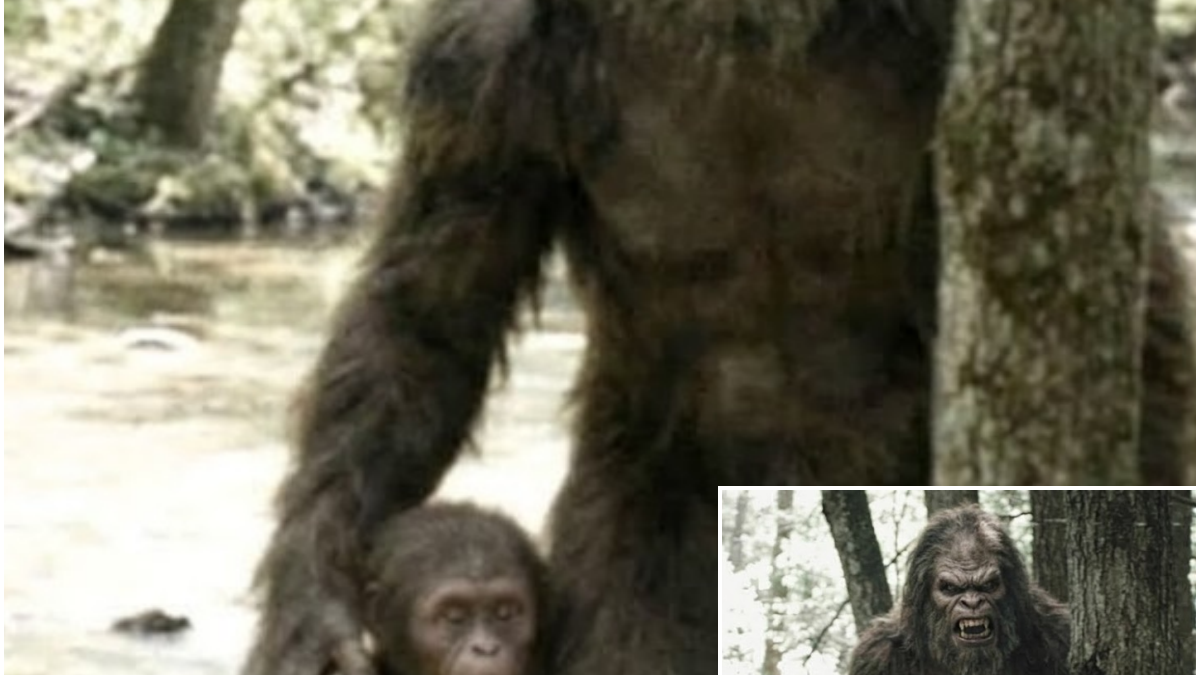
For 35 Years, He Fed the Same Mother Bigfoot – Then She Trusted Him With Her Baby
I’m 72 years old now, and for 35 years, I’ve been keeping a secret that would change everything we think we know about the forests of Northern California.
Every Wednesday morning, without fail, I drive my old Chevy pickup down a logging road that most people forgot existed decades ago.
Park at the same twisted oak tree, and walk exactly one mile into the Clamoth National Forest, carrying a cooler full of fresh salmon, apples, and whatever berries are in season.
And waiting for me, always at the same clearing beside Willow Creek, is a creature that science says doesn’t exist.

Her name, at least the name I gave her, is Sage.
And she’s a Bigfoot, a real living, breathing Sasquatch who’s been meeting me at that clearing every single week since 1988.
But this story isn’t just about feeding a crypted.
It’s about the moment 3 months ago when everything changed.
When Sage finally trusted me enough to show me something she’d been hiding for all these years, her baby and what that baby revealed about their kind, about why they hide, about what they’ve been protecting, still keeps me awake at night.
Because once you know the truth about what’s living in those forests, once you understand what they’re capable of, you can never look at the wilderness the same way again.
Let me take you back to where this all started.
June 7th, 1988.
I was 37 years old, recently divorced, working as a forestry technician for the US Forest Service.
My job was simple enough.
I’d spend weeks at a time in the back country checking trail conditions, monitoring for illegal logging, documenting wildlife populations.
It was lonely work, but that’s exactly what I needed.
After Marie left, taking our daughter Rebecca with her to Portland, I wanted nothing more than to disappear into the woods, where the only voices I heard belonged to the ravens and the wind through the pines.
That particular June, I was stationed at a remote monitoring post near the Marble Mountain Wilderness.
The closest town was Sawyer’s Bar.
Population, maybe 50 people if you counted the dogs.
My base camp was an old forest service cabin that hadn’t been properly maintained since the 70s.
The roof leaked in three places.
The wood stove smoked something terrible, and mice had made condominiums in the walls, but it had four walls and a roof, and more importantly, it was 23 mi from the nearest other human being.
I’d been there about 2 weeks when I started noticing things were off.
Small things at first.
The camp stool I always left beside my truck would be in a different spot in the morning.
My Coleman lantern, which I kept hanging from a branch near the cabin door, would be on the ground.
Food from my bear proof container installed exactly to regulation specifications 15 ft up a tree and 100 yardd from camp would be gone.
Not torn open like a bear would do.
Just gone.
The lid would be carefully removed and placed beside the container, the contents eaten, the lid put back on.
I figured it was other campers at first, maybe some thru-hikers on the Pacific Crest Trail who were desperate enough to steal, but there were no footprints, no tire tracks, no signs of any human presence at all.
Just this eerie sense that something was watching me, studying me, learning my routines.
The night of June 7th started like any other.
I’d spent the day marking hazard trees along a section of trail that needed clearing.
My radio check-in with the district office was at 5:00 sharp, same as always.
After dinner, I sat outside the cabin with a cup of instant coffee, watching the sun paint the rgeline orange and purple, listening to a family of coyotes warming up for their evening chorus somewhere to the west.
Around 9:30, I went inside and started getting ready for bed.
That’s when I heard it.
A sound I’d never heard before.
Something between a howl and a scream coming from maybe 200 yd east of the cabin.
It was deep, resonant, the kind of sound you feel in your chest before you hear it with your ears.
Every animal in the forest went silent.
The crickets stopped.
The owls stopped.
Even the wind seemed to hold its breath.
I grabbed my flashlight and my 357 revolver, standard issue for forest service personnel in bear country, and stepped outside.
My heart was hammering.
I’ve heard mountain lions.
I’ve heard bears.
I’ve heard elk bugling during the rut.
This was none of those things.
This was something else entirely.
I swept my flashlight across the clearing, and that’s when I saw the eyes.
Two ambercoled eyes reflecting my light.
Positioned at least 8 ft off the ground, staring at me from the treeine.
Whatever it was wasn’t moving, just watching, waiting.
I raised my revolver, hands shaking, finger on the trigger, but not squeezing.
Something in those eyes stopped me.
There was intelligence there, awareness.
This wasn’t an animal reacting on instinct.
This was something thinking, calculating, making decisions.
We stood like that for what felt like an hour, but was probably only 30 seconds.
Then the eyes blinked, turned away, and whatever owned them melted back into the forest so quietly I wouldn’t have known it left if I wasn’t watching.
I stood there in the dark for another 20 minutes.
Flashlight beam cutting through the night.
Heart still racing.
Nothing moved.
The forest slowly came back to life.
The crickets resumed their song.
An owl called from somewhere to the north.
Whatever had been watching me was gone.
I barely slept that night.
Every sound had me reaching for my flashlight.
Every creek of the cabin settling had me convinced something was trying to get in.
But nothing happened.
Dawn came gray and cold.
Fog rolling through the trees like smoke.
And I was exhausted, running on coffee and adrenaline.
That morning, I decided to check my food cache, the bare proof container up in the tree.
I needed to know if whatever visited me had also been the one raiding my supplies.
The container was exactly where I’d left it, lid secured, rope still tight.
But when I lowered it down and opened it, my stomach dropped.
3 days worth of food was gone.
Granola bars, dried fruit, beef jerky, even a can of chili I’d been saving.
But more disturbing was what had been left in exchange.
Three perfect pine cones arranged in a triangle, a handful of wild strawberries still fresh, and a single black feather easily 10 in long from a raven or a crow.
I sat down hard on a fallen log, staring at the contents of that container.
Whatever was taking my food wasn’t just stealing.
It was trading.
It was communicating.
It understood the concept of exchange, of reciprocity.
And that changed everything.
Over the next 3 weeks, I developed a new routine.
Every evening before dark, I’d take food from my supplies and leave it in a specific spot, a flat boulder about 50 yard from the cabin where I could see it from my window.
Canned peaches, apples, crackers, whatever I could spare.
And every morning the food would be gone, replaced with gifts.
More pine cones, interesting stones, bouquets of wild flowers, once a perfect arrowhead, obsidian, probably karuk or urok, easily a thousand years old.
I never saw what was taking the food, but I knew it was watching me.
I could feel eyes on me constantly when I was working on the trails, when I was sitting outside the cabin reading, even when I was inside doing paperwork, always watching, always present.
It should have been terrifying, and maybe it was at first, but gradually the fear transformed into something else.
Curiosity, fascination, and eventually a strange kind of companionship.
The first time I actually saw her clearly was July 9th, 1988.
I’d left my usual offering on the boulder, but this time I stayed awake, watching from the cabin window with all my lights off.
The moon was full that night, bright enough to read by, painting everything in shades of silver and shadow.
Around 2:00 in the morning, she came.
I saw her emerge from the trees on the east side of the clearing, moving with a grace that seemed impossible for something so large.
She had to be at least 7 and 1/2 ft tall, maybe more, covered in dark brown hair that looked almost black in the moonlight.
Her shoulders were massive, broader than any man’s, and her arms hung long, reaching almost to her knees.
But it was the way she moved that struck me most.
Fluid, careful, every step deliberate, testing the ground before putting her full weight down, moving in complete silence despite her size.
She approached the boulder slowly, stopping every few feet to look around, to listen.
She was checking for threats, making sure she was safe.
When she finally reached the food, she didn’t just grab it and run like an animal would.
She knelt down, surprisingly human in that gesture, and carefully examined what I’d left.
Apples, a can of tuna, some trail mix.
She picked up each item, brought it to her nose, smelled it thoroughly.
Then she did something that made my breath catch.
She looked directly at the cabin, directly at the window where I was standing, even though every light was off.
Even though I was as still as a statue, she knew I was there.
She raised one massive hand and made a gesture palm up, a motion that looked almost like a wave or an acknowledgement.
Then she carefully gathered the food, cradled it against her chest like a mother carrying a child, and disappeared back into the forest.
I stood at that window until dawn, my mind racing with implications.
She’d known I was watching.
She’d wanted me to see her.
This wasn’t just about food anymore.
This was about something deeper.
Trust, connection, the beginning of a relationship between two intelligent species that had spent thousands of years avoiding each other.
The next night, I left twice as much food.
And I added something new, a note written in large block letters on a piece of cardboard from a granola bar box.
Thank you for the gifts.
My name is Thomas.
The note was gone in the morning along with the food.
In its place was a perfectly braided circle made from willow branches about 8 in in diameter with white wild flowers woven through it.
It was beautiful.
It was art.
And it was impossible to ignore what it meant.
Over that summer, our exchanges became more elaborate.
I started leaving not just food, but other iteMs. A harmonica I’d been carrying for years but never played.
A small mirror, colored pencils and paper, books with pictures.
Every item would be examined, used if possible, and either kept or returned with something else in exchange.
The harmonica came back with dirt in it.
I like to imagine her trying to figure out how it worked, blowing through it, shaking it.
The mirror was kept.
The colored pencils were used.
I found drawings on the paper I’d left.
Crude but deliberate marks, patterns, and shapes that weren’t quite writing, but weren’t quite random either.
My assignment at that monitoring post ended in September, but I couldn’t leave.
I requested an extension, claiming I needed more time to complete my wildlife surveys.
My supervisor, a practical man named Bill Henderson, who’d been with the Forest Service for 30 years, approved it without question.
He knew what these remote postings could do to a man.
He thought I was finding peace in the solitude.
He had no idea I was making first contact with a species that wasn’t supposed to exist.
As fall turned the aspens gold and the nights grew cold, I started worrying about winter.
Would she stay in the area?
Would she migrate somewhere warmer?
Could she survive the snow and ice that would bury these mountains?
From November through April, the Marble Mountains regularly saw 10 ft of snow in winter.
Temperatures would drop to 20 below.
Nothing could survive out there without shelter and a reliable food source.
On October 20th, I left a note with the food.
Winter is coming.
Where will you go?
Will you be okay?
The next morning, the note was gone.
In its place was something that made my hands shake when I picked it up.
A drawing done with the colored pencils I’d left weeks before.
It showed a crude representation of a mountain with a dark opening at the base.
A cave.
And beside the cave, a stick figure that was unmistakably taller and bulkier than a human.
Next to the figure were smaller marks, three of them.
Did she have babies?
Family?
Was she trying to tell me where she’d be?
That night, I made a decision that would define the next three and a half decades of my life.
I wasn’t going to let winter separate us.
If she was going to be in a cave somewhere in these mountains, hungry and cold, I was going to make sure she had food.
I started stockpiling supplies, extra cans of fish, dried fruit, nuts, anything non-p perishable and calorie dense.
I bought heavyduty waterproof containers.
I studied maps of the area, looking for caves, rock formations, anywhere she might take shelter.
But I didn’t need to search.
3 days before the first major snowstorm hit, she showed me where she’d be.
I was outside the cabin splitting firewood when I felt that familiar sensation of being watched.
I turned and there she was standing at the edge of the clearing in broad daylight.
This was the first time I’d seen her during the day.
The first time I’d seen her clearly without moonlight or shadows obscuring details.
She was magnificent.
Her face was simultaneously human and not human with a pronounced brow ridge, a flat, wide nose, and a jaw that protruded slightly.
Her eyes were large and dark, positioned forward like a predators, but soft, intelligent, filled with an awareness that took my breath away.
Her body was covered in long, shaggy hair, dark brown, with hints of gray around the face and shoulders.
She wasn’t young.
I estimated she was at least middle-aged by her species standards, weathered by years in the wilderness.
We looked at each other for a long moment.
Then she did something extraordinary.
She pointed at herself.
She made a sound, a vocalization that came from deep in her chest.
It sounded like sage.
Or at least that’s how my human ears interpreted it.
She repeated it twice more, pointing at herself each time.
She was telling me her name or I was giving her one or we were creating language together.
Sage, I said out loud, testing the word.
Are you Sage?
She made a sound that might have been affirmation, a kind of soft grunt.
Then she turned and began walking east into the forest.
After a few steps, she stopped and looked back at me.
The message was clear.
Follow me.
I grabbed my coat, my pack, and without even thinking about how crazy this was, I followed a Bigfoot into the wilderness.
We walked for about 2 hours, climbing higher into the mountains, following game trails I’d never noticed before.
She moved slowly, deliberately, constantly checking to make sure I was keeping up.
We crossed two ridges and descended into a small valley I’d never explored.
Hidden between steep granite walls.
At the far end of the valley, almost invisible unless you knew where to look, was a cave entrance, partially obscured by a fallen pine tree and thick brush.
Sage stopped at the entrance and gestured toward it.
That same palmup motion she’d made weeks before.
This was her home, her winter den.
She was trusting me with her most vulnerable secret, the place where she’d be defenseless against the cold and snow.
She wanted me to know where to find her.
I stepped closer to the cave entrance, careful not to go inside without invitation.
I could see about 10 ft in before the darkness became absolute.
It was dry, protected from wind, large enough to provide shelter, but it would be cold, so cold during the deep winter.
I pulled out my notepad and drew a simple map, marking landmarks I’d passed on the way.
Sage watched with what I can only describe as patience.
When I was done, I showed her the map, pointed at the landmarks, traced the path we’d taken.
She studied it for a long time.
Then she reached out, her massive hand careful and controlled, and touched the map where the cave was marked.
She understood.
She knew I’d be back.
“I’ll bring food,” I said, making an eating gesture with my hands.
“Every week, I promise.”
She made that soft grunting sound again, the one that meant understanding or agreement.
Then she turned and disappeared into her cave, leaving me alone in that hidden valley.
As the first snowflakes of winter began to fall, I made it back to the cabin just before dark.
My mind racing with plans.
I had 3 days before the storm hit.
3 days to gather supplies, mark the trail, and figure out how to navigate through 10 ft of snow to reach that cave every week.
Most people would have said it was impossible.
Most people would have been right.
But I wasn’t most people.
I’d made a promise to someone who’d shown me trust.
When she had every reason to be terrified of humans, and I don’t break promises, I spent those 3 days in a frenzy of preparation.
I drove to every outdoor supply store within a 100 miles.
I bought industrial-grade snowshoes rated for 200 lb of load capacity.
I purchased a GPS unit.
This was 1988.
So, we’re talking a military surplus unit the size of a brick that cost me $800 I couldn’t really afford.
I acquired avalanche beacons, emergency bivowak equipment, waterproof containers in every size.
I mapped the route to Sage’s cave on topographic charts, identifying every ridge, every creek crossing, every landmark I could use when the world turned white and featureless.
I built supply caches along the route, burying containers of emergency food and fire starting equipment every half mile, marking each cache with a tall pole topped with orange surveyor’s tape.
If I got caught in a storm, these cashaches could save my life.
Also started stockpiling food specifically chosen for winter delivery.
Salmon was out.
It would freeze solid.
Instead, I focused on high calorie cold stable options.
Peanut butter in bulk.
Honey that wouldn’t freeze even at 20 below.
Dried fruits and nuts purchased in 50 lb quantities.
Canned meats, though I knew the cans would be a challenge for Sage to open.
I bought a case of military MREs, meals ready to eat, because they were designed to be consumed in extreme cold.
I filled an entire wall of my cabin with supplies, spending money I didn’t have, maxing out credit cards because none of that mattered compared to keeping my promise.
The first storm hit on November 11th.
I woke to a world transformed.
Everything buried under 18 in of fresh powder.
More falling in thick curtains that reduced visibility to maybe 20 ft.
This was it, the test.
I loaded my backpack with 40 lb of food, strapped on my snowshoes, and headed out.
That first winter trek took me 6 hours and 37 minutes.
I got lost twice, only finding my way back to the route using my GPS.
I broke through ice crossing a creek and spent 20 terrified minutes building a fire to dry my boots before my feet froze.
I triggered a small avalanche on a steep slope, rode it down 50 ft, buried up to my waist, and had to dig myself out with shaking hands.
By the time I reached Sage’s cave, I was exhausted, hypothermic, and questioning my sanity.
But I’d made it.
I left the supplies at the cave entrance, too tired to even call out to let Sage know I was there.
I turned around and made the brutal journey back, reaching the cabin just after dark, collapsing inside the door and sleeping for 14 straight hours.
But I’d done it.
I’d proven it was possible.
And every Wednesday after that, no matter how hard the snow fell or how cold the temperature dropped, I made that journey.
Some weeks were easier than others.
Some weeks nearly killed me, but I never missed a Wednesday.
Not once.
That winter was the hardest of my life.
The marble mountains were brutal that year.
Storm after storm, dumping snow until the forest was buried under a white blanket that wouldn’t melt until May.
But every Wednesday, I strapped on my snowshoes, loaded my backpack with supplies, and made the trek to Sage’s cave.
Sometimes it took me 4 hours to reach her.
Sometimes six.
Twice I got caught in white out conditions and had to dig a snow cave and wait out the storm before continuing.
But I never missed a Wednesday.
Not once.
I never saw Sage during those winter visits.
I’d leave the supplies at the cave entrance, carefully arranged so snow wouldn’t cover them, and by my next visit, they’d be gone.
But I knew she was there.
Sometimes I’d hear movement from deep within the cave.
Sometimes I’d see footprints in the snow around the entrance, massive prints that could only be hers.
And always, always, there would be gifts left for me.
Twisted pieces of wood carved into interesting shapes, stones with natural patterns.
Once impossibly a fresh trout, still warm, left in the snow.
She must have broken through ice somewhere to catch it.
She was sharing her catch with me, reciprocating in the only way she could.
Spring came late that year.
It was miday before the snow finally melted enough to reveal the forest floor again.
I’d lost 15 lbs that winter.
My back was never the same from carrying those heavy packs through the snow, and my supervisor had started making concerned comments about my insistence on staying at that remote post.
But I’d kept my promise, and when the flowers started blooming and the aspens leafed out, Sage returned to our clearing.
She looked thinner, harder, like the winter had been as rough on her as it had been on me.
I could see her ribs through her fur in places.
See the toll that winter had taken.
But when she saw me sitting on that boulder where we’d first made contact, she did something that brought tears to my eyes.
She walked straight up to me.
No hesitation, no fear, and she touched my shoulder.
Just a gentle touch, her massive hand resting there for a moment, a gesture of connection that transcended species.
“Thank you,” she seemed to be saying.
“You kept your promise.
You came back.”
I reached up slowly, giving her every chance to pull away, and I placed my hand on hers.
Her skin was rough, calloused, warm, real.
I could feel her pulse through her palm, steady, and strong.
Proof that she was flesh and blood like me.
We stayed like that for maybe 30 seconds.
Two creatures from different worlds sharing a moment of pure understanding.
In that moment, I understood something profound.
This wasn’t just about feeding a wild animal.
This was friendship.
Real genuine friendship that transcended language and species and everything that should have made it impossible.
Then she pulled away, made that soft grunting sound I’d learned meant contentment, and we resumed our routine.
Food exchanged for gifts.
Companionship shared in comfortable silence.
But something had shifted between us that day.
The relationship had deepened from curiosity and exchange to something more fundamental.
Trust.
Complete absolute trust.
She knew I would never harm her, never betray her, and I knew she would never harm me.
We were, in the truest sense, friends.
That summer, 1989, I officially resigned from the Forest Service.
Bill Henderson tried to talk me out of it, saying I was one of his best technicians, that I had a real future with the agency, but I couldn’t leave.
Not now.
Not when I had this responsibility, this relationship that nobody else in the world had.
I bought the old cabin from the Forest Service.
They were happy to sell it since they’d been trying to decommission it for years.
And I became a permanent resident of the Marble Mountains, living off my savings and odd jobs in Sawyer’s Bar.
The locals thought I was crazy, a hermit who’d lost his mind after a divorce.
They weren’t entirely wrong, but they had no idea what I’d found in those mountains.
What miracle I was witnessing every Wednesday morning.
Over the years, our routine evolved and deepened.
I learned to read Sage’s moods, her body language, the subtle variations in the sounds she made.
She learned to trust me more to let me see more of her world.
I discovered she had favorite foods.
Fresh salmon was at the top of the list, followed closely by apples and blackberries.
She was particularly fond of honey, and I started keeping bees just so I could harvest honey for her.
She hated citrus, made a disgusted face, and left oranges untouched.
She was curious about tools, would examine my knife or my axe with fascination, but never tried to take them.
She understood they were mine.
Respected that boundary.
I also learned she wasn’t alone.
There were others of her kind in these mountains, though I only caught glimpses of them.
Larger figures moving through the trees at dusk.
Distant calls echoing across valleys at night.
Once I saw footprints near the clearing that were even bigger than sages.
A male, I assumed.
Maybe her mate.
But Sage never brought them to meet me.
That relationship, that trust was between her and me alone.
The years blurred together in the way they do when you find your purpose in life.
1990 became 2000 became 2010.
My hair went gray, then white.
My hands developed arthritis from those winters carrying supplies through the snow.
My daughter Rebecca got married, had kids of her own.
She’d visit sometimes, never quite understanding why her father chose to live alone in the mountains, why he refused to leave even for holidays.
I remember one particular visit in 2006.
Rebecca was 31, pregnant with her second child, sitting on my cabin porch while her husband and young son explored the woods nearby.
Dad,” she said, concerned in her voice.
“You’ve been living up here for almost 20 years.
Don’t you get lonely?
Don’t you want to be closer to family?”
I looked out at the forest, knowing Sage was probably watching from the treeine, like she often did when visitors came.
I’m not lonely, sweetheart.
I have everything I need here.
But you’re missing so much.
My kids barely know their grandfather.
You missed Danny’s first birthday.
You’ve missed every Christmas since I was in high school.
I know and I’m sorry, but this is where I belong.
I have responsibilities here that I can’t explain.
Rebecca shook her head, tears in her eyes.
What responsibilities?
What could possibly be so important that you’d give up your family for it?
I wanted to tell her.
Wanted to explain about Sage, about the weekly meetings, about the trust that had been built over nearly two decades.
But how could I?
She’d think I was insane.
So I just said, “Someday maybe you’ll understand.
I hope you will.”
She left the next day hurt and confused, and I watched her drive away, feeling the weight of my choices.
But that afternoon, when I made my way to the clearing for my Wednesday meeting, Sage was waiting with something special.
She’d picked wild flowers, arranged them carefully, and placed them in the center of our meeting spot.
She’d seen my sadness.
She’d understood, and she was offering comfort in the only way she could.
I sat beside those flowers and cried.
And Sage sat with me in silence, just being present, offering the kind of companionship that needed no words.
How could I explain?
How could I tell anyone that some relationships transcend blood and species?
That I’d found connection and purpose with someone who wasn’t even human.
that the loneliness Rebecca worried about was less painful than the loneliness I’d felt before finding Sage, I couldn’t.
So, I carried the weight of that secret, the cost of that choice, and tried to believe it was worth it.
But then, 3 months ago, in September of 2023, everything changed.
It was a Wednesday morning like any other.
Cool autumn air, smell of pine and decomposing leaves, fog hanging in the low places.
I parked my truck at the twisted oak, same as always, and hiked to the clearing carrying my cooler, 20 lb of fresh salmon I’d bought from a fisherman in Crescent City, a crate of honey crisp apples from an orchard near Eureka, and two jars of honey from my own bees.
But when I reached the clearing, Sage wasn’t there.
In 35 years, she’d always been waiting.
Always.
My stomach dropped.
Was she sick?
Injured?
Had something happened?
I set down the cooler and called out, not loud, just a soft call, the way I’d learned she preferred.
Sage, it’s Thomas.
Where are you?
For a long moment, nothing.
Just the whisper of wind through the pines and the distant call of a stellar’s j.
Then I heard it.
Movement in the forest to the east, the direction of her cave, multiple footsteps, not just one set.
My heart started racing.
Was this it?
After all these years, was she finally going to introduce me to her family, to her mate?
Sage emerged from the trees.
But she wasn’t alone.
Walking beside her, holding her hand in a gesture so achingly human it made my throat tight, was a small Bigfoot, a juvenile, maybe four feet tall, covered in lighter brown fur that was almost coppery in the morning sun.
Sage’s baby.
I froze, barely breathing, afraid any movement would spook them.
Sage approached slowly, making soft, reassuring sounds to the young one beside her, encouraging each step.
They reached the middle of the clearing and stopped about 20 ft from where I stood.
The baby was hiding partially behind Sage’s leg, peering at me with huge, dark eyes, full of fear and curiosity.
Sage looked at me, and in her expression, I saw something I’d never seen before.
Vulnerability, desperation.
She was asking for help.
She knelt down beside the young Bigfoot and gently encouraged it forward.
The baby took a tentative step toward me, then another.
Sage made encouraging sounds, the kind a mother makes when teaching her child something important.
“Go on,” she seemed to be saying.
“He’s safe.
You can trust him.”
The baby came closer, stopping just a few feet away.
This close, I could see details I’d never noticed on Sage.
The baby’s hands were delicate, fingers long and articulate.
The face was rounder than Sages, softer, with eyes that seemed too large for its head.
But it was the eyes themselves that struck me.
They held intelligence, awareness, fear.
This wasn’t an animal.
This was a person, a child.
And that child was sick.
I could see it now that they were closer.
The baby’s breathing was labored, ribs showing with each breath.
There was discharge around its nose and eyes.
Its movements were sluggish, weak.
This little one was seriously ill, and Sage had brought her baby to me.
After 35 years of careful distance, of maintaining boundaries, she was asking me to cross a line.
She needed help that the wilderness couldn’t provide.
What do you need?”
I whispered, though I already knew.
I dropped to my knees, making myself smaller, less threatening.
The baby watched me, swaying slightly.
Sage made a soft sound, then did something extraordinary.
She guided her baby forward until it was close enough to touch me.
The little one’s hand, so small compared to sages, but still larger than a human child’s, reached out and touched my cheek.
The gesture was gentle, exploratory, getting to know me, learning to trust.
I held perfectly still, barely breathing, honored beyond words by this moment.
Then Sage did something that broke my heart.
She stepped back, leaving her baby standing in front of me alone.
She was entrusting me with the most precious thing in her world.
She was asking me to do what she couldn’t.
To take her baby into the world of humans to get help to save this child’s life.
And in that moment, 35 years of patient relationship building came to fruition because I understood exactly what I needed to do.
I looked from Sage to her baby, then back to Sage.
My mind was racing through options, each one more complicated than the last.
I couldn’t take this child to a hospital.
The moment I walked through those doors with a juvenile Bigfoot, everything would change.
Scientists would descend.
Government agencies would get involved.
The media would turn this into a circus.
And Sage, this magnificent being who’d trusted me with her most precious secret, would lose her child to examination rooms and research facilities.
That wasn’t an option.
It would never be an option.
But I knew someone who might help.
Dr. Sarah Chen, a veterinarian in Eureka, who’d been treating my dogs and the occasional injured wildlife I’d bring in for years.
Sarah was discreet, asked few questions, and had a genuine love for all living things.
More importantly, she had medical training and access to medications that could treat bacterial infections, respiratory illnesses, all the things that might be afflicting this baby.
The question was whether I could trust her with a secret this big, whether she’d help without demanding answers I couldn’t give.
I stood slowly, keeping my movements calm and deliberate.
Sage watched me intently, her body tense, ready to grab her baby and run if I did anything threatening.
“I need to make a phone call,” I said quietly.
Even though I knew Sage couldn’t understand my words.
She understood tone, intention, the energy I was projecting.
“I’m going to get help, medicine, someone who can make your baby better.”
I pulled out my cell phone.
The signal was weak but present and dialed Sarah’s clinic.
It was just after 8:00 in the morning.
The clinic would be opening.
After four rings, Sarah’s assistant picked up Eureka Veterinary Clinic.
This is Michelle.
Hi, Michelle.
It’s Thomas Webb.
I need to speak with Dr. Chen immediately.
It’s an emergency.
Mr. Webb, Dr. Chen is with a patient right now.
Can I take a message?
No, I said, my voice harder than I intended.
I need to speak with her now.
This can’t wait.
There was a pause.
Then Michelle must have heard something in my tone because she said, “Hold, please.”
2 minutes felt like 2 hours.
The baby swayed again and Sage made a worried sound, moving closer to support her child.
Finally, Sarah’s voice came through the phone.
Thomas, what’s wrong?
Michelle said it was urgent.
Sarah, I need your help.
I have a patient, a young patient with what looks like severe pneumonia or respiratory infection, labored breathing, discharge from nose and eyes, fever, weakness.
I need antibiotics, anti-inflammatories, whatever you’d use to treat this.
And I need it now.
Thomas, bring the animal to the clinic.
We’ll treat it here.
I can’t do that.
You have to trust me on this.
This patient can’t come to you.
You need to come to me.
There was a long pause.
Thomas, I can’t just hand out prescription medications without examining the patient.
That’s illegal.
I could lose my license.
I know what I’m asking.
But Sarah, in 15 years, have I ever lied to you?
Have I ever put you in a position that wasn’t legitimate?
No, she admitted.
Then trust me now.
This is life or death.
This patient needs immediate treatment and I’m the only one who can administer it because I’m the only one this patient trusts.
Please.
Another long pause.
Then Sarah sighed.
What’s the weight of the patient?
Approximately.
I looked at the baby trying to estimate maybe 40 lb, probably less.
And it’s definitely respiratory.
Breathing is labored, congested, visible weakness, possible fever based on behavior.
Hold on.
I heard papers shuffling, computer keys clicking.
Okay, I’m going to prepare a treatment kit.
A zithroycin for bacterial infection, predinosone for inflammation, pediatric cough suppressant with expectctorant.
I’ll include syringes, instructions for dosing based on weight, and my emergency cell number.
But Thomas, if this doesn’t work, if the patient gets worse, you bring them to me immediately.
Do you understand?
I understand.
Thank you, Sarah.
You’re saving a life today.
I’ll be at the clinic in 45 minutes.
I’ll have everything ready.
And Thomas, you owe me an explanation for this.
Someday I will tell you the whole story.
I promise.
Just not today.
I hung up and looked at Sage.
I’m going to get medicine.
I’ll be back in 2 hours.
Please stay here.
Wait for me.
I made a sitting gesture, hoping she’d understand.
Sage watched me for a moment.
Then she carefully guided her baby to the boulder where I’d left the cooler.
She opened it.
This was a skill she’d learned years ago, and pulled out a salmon.
She began feeding small pieces to her baby, who ate weekly without enthusiasm.
The little one was clearly too sick to have much appetite, but Sage was trying to keep her child’s strength up.
Smart maternal instinct transcending species.
I grabbed my truck keys and ran.
I’ve never driven the logging road as fast as I did that morning.
My old Chevy bouncing over ruts and rocks, branches scraping the sides.
I made it to Eureka in 38 minutes, bursting through the door of Sarah’s clinic like a madman.
She was waiting at the front desk with a large zippered case.
No other clients were in the waiting room.
Sarah had cleared her morning schedule.
Thomas, she said, handing me the case.
Everything’s in here.
Detailed instructions, dozing schedules, what to watch for.
The aithroyc is critical that needs to be administered twice daily for 7 days minimum.
The predinazone will help with inflammation, but watch for side effects.
and Thomas.
She grabbed my arm, looked me in the eyes.
Whatever this is, whatever you’re not telling me, be careful.
I don’t know what you’ve gotten yourself into, but I’ve known you long enough to know it’s something unusual.
I will be careful.
And Sarah, this conversation never happened.
You never gave me these medications.
She studied my face for a long moment, then nodded.
[bell] I never gave you anything.
You were never here.
I’ll remember that when you finally tell me what this is really about.
I drove back even faster, the medical case sitting on the passenger seat like precious cargo.
When I reached the clearing, Sage and her baby were exactly where I’d left them.
The baby was lying down now, head in Sage’s lap, breathing shallow and rapid.
Sage’s eyes were filled with worry, with fear.
She knew her child was getting worse.
I knelt beside them, opened the case, and began reading Sarah’s instructions.
A zithroyc suspension form, easier to administer, dose based on weight.
I pulled out a syringe, measured carefully, exactly as Sarah had instructed.
Then came the hard part.
I had to get the baby to take it.
The little one watched me with fevered eyes as I approached with the syringe.
Sage made a questioning sound.
This will help, I said softly.
This medicine will make the sickness go away, but your baby has to swallow it.
I brought the syringe to the baby’s mouth.
The child flinched, tried to turn away.
Sage made a firm sound, a mother’s command.
Take it.
Trust him.
The baby opened her mouth and I slowly pushed the plunger, administering the antibiotic.
The child made a face.
The medicine probably tasted terrible, but swallowed it.
Good, I said, relief flooding through me.
Good job.
Now rest.
I showed Sage the bottle of medicine, then acted out the process.
Medicine, then waiting, then more medicine.
I held up two fingers twice a day, morning and evening.
Sage watched carefully and I knew she understood the basic concept.
Treatment over time, not a single fix, but a process.
I’ll be back this evening, I said.
Same place, more medicine, and I’ll bring something to help with fever.
Over the next 7 days, my life became a cycle of driving to that clearing twice a day, morning and evening to administer medication to a baby Bigfoot while her mother watched with a mixture of hope and fear.
The first 3 days were the worst.
The baby’s condition seemed to get worse before it got better.
Fever spiking, breathing becoming more labored.
I called Sarah twice describing symptoms, adjusting doses based on her guidance.
On the third night, I sat in that clearing until 2:00 in the morning, monitoring the baby’s breathing, making sure she was still fighting.
Sage never left my side that night.
We sat together in the moonlight, two beings from different worlds, united in our desperate hope that this child would survive.
Day four, the baby’s fever broke.
I arrived that morning to find the little one sitting up, eating pieces of salmon with actual appetite.
Sage’s relief was palpable.
She made sounds I’d never heard before.
Joyful sounds, celebratory.
She hugged her baby, then reached out and touched my hand, holding it in both of hers.
Thank you.
The gesture said it clearly.
You saved my child.
Thank you.
By day seven, the baby was running around the clearing, playing full of energy and life.
The transformation was miraculous.
The discharge was gone, the breathing clear and strong.
The fever completely resolved.
Western medicine, for all its flaws, had worked on a species science didn’t acknowledge existed.
I finished the last dose of antibiotics, and Sage did something unexpected.
She picked up her baby and held the child out to me, encouraging the little one to come closer.
The baby, no longer weak and frightened, walked right up to me and hugged my leg, small arms wrapping around my knee.
The gesture was so innocent, so pure, so utterly childlike that tears streamed down my face.
“Thank you for trusting me,” I said to Sage.
“Thank you for letting me help.”
Sage made that soft grunting sound I’d learned meant contentment, peace.
Then she gestured for me to wait.
She walked to the edge of the clearing and called out.
A long carrying vocalization that echoed through the forest.
I waited, confused, wondering what was happening.
Then I heard them.
Footsteps, multiple sets.
From the trees emerged three more Bigfoots.
A massive male, easily 9 ft tall, with silver gray hair around his face and shoulders, and two more juveniles, slightly larger than Sage’s baby, maybe 5 and 6 ft tall.
Sage’s family, her mate, her other children.
She’d kept them hidden all these years, protected them from me despite our relationship.
But now, now that I’d saved her youngest, she was inviting me into her world completely.
The male approached cautiously.
Each step measured, eyes never leaving me.
He stopped about 10 ft away, and we regarded each other.
I could see the intelligence in his eyes, the assessment happening.
He was evaluating whether I was truly safe, whether his mates’s trust in me was justified.
Then Sage walked to him, said something in their language, a series of sounds that were clearly communication, clearly words.
She was explaining what I’d done, how I’d saved their baby.
The male listened, then looked at me again, and slowly, deliberately, he nodded, a gesture of acknowledgement, of respect, of acceptance.
The two older juveniles were less cautious.
They approached with the curiosity of children wanting to examine the strange human their mother had been visiting all these years.
They touched my clothes, fascinated by the fabric.
They looked at my truck in the distance with wonder.
They’d probably never seen human technology this close before, and I realized what Sage was doing.
She was teaching her children that not all humans were dangerous.
That in a world where their kind had to hide to survive, there was at least one human who could be trusted.
It was a gift beyond measure.
Over the next weeks, as autumn deepened toward winter, I got to know Sage’s family.
The male, I called him Ash because of his gray silver coloring, was stoic and protective, but gradually warmed to me.
The two older juveniles were playful and curious.
And the baby, the one I’d saved, I called her Hope, became particularly attached to me.
Every Wednesday, Hope would run to greet me, would sit beside me while I unpacked food, would play games, simple things like hide and seek around trees.
It was like having a grandchild if grandchildren were 7 ft tall and covered in fur.
But it was during one of these Wednesday visits in late October of 2023 that everything I thought I understood about Sage’s people changed.
I’d brought my usual supplies and was sitting with Sage and Hope, watching Ash and the older juveniles explore the far side of the clearing when Hope did something remarkable.
The baby picked up a stick and began drawing in the dirt.
Not random marks, deliberate shapes.
A circle, a triangle, a square, geometric shapes drawn with precision and purpose.
I stared, my mind struggling to process what I was seeing.
Sage watched me watch Hope, and there was something in her expression.
She’d been waiting for this, waiting for me to see.
Hope looked up at me and made a questioning sound, pointing at the shapes she’d drawn, then at me.
She wanted me to understand something.
She was trying to communicate something specific.
I pulled out my notebook and pen, something I always carried, and drew the same shapes on paper, circle, triangle, square.
Hope’s eyes lit up.
She took the pen from my hand, her grip awkward but functional, and drew more shapes, more complex patterns.
And then, impossibly, she drew numbers.
1 through 5 rendered in a style that was slightly off but clearly intentional, clearly mathematical.
Sage made a sound, calling hope back to her.
The baby reluctantly returned the pen and moved to her mother’s side.
I looked at Sage, questions flooding my mind faster [singing] than I could process them.
Your people have mathematics, I said, knowing she couldn’t understand my words, but needing to say it anyway.
You have symbolic representation.
You have abstract thought.
You’re not just intelligent.
You have culture, education, knowledge systeMs. Sage met my eyes.
And for the first time in 35 years, I saw something new in her expression.
Sadness.
Deep, profound sadness.
She wanted me to understand something, but we didn’t have the language to bridge that gap.
Not yet.
Then Sage did something she’d never done before.
She stood, called her family together with a series of vocalizations and gestured for me to follow them.
They were going to show me something.
We walked for over an hour deeper into the mountains than I’d ever gone with them.
We climbed steep ravines, crossed rushing streams, pushed through dense undergrowth.
Finally, we reached a place I’d never known existed.
A hidden valley surrounded by sheer cliff walls on three sides, accessible only through a narrow canyon that would be easy to miss if you didn’t know it was there.
And in that valley, I saw something that changed everything.
There were structures, not natural formations.
Built structures made from wood, stone, and woven branches.
They were simple, yes, more sophisticated than beaver dams, but less complex than human buildings.
But they were architecture, deliberate construction, homes.
There were seven of them arranged in a rough circle around a central clearing.
And near each structure, there were gardens.
Actual cultivated gardens with medicinal plants I recognized and others I didn’t.
They weren’t just hunter gatherers.
They were practicing agriculture, horiculture, cultivating resources.
This was a village.
A Bigfoot village hidden so deep in the wilderness that humans had never found it.
Sage led me to the center of the circle, and I turned slowly, taking it all in.
Other Bigfoots emerged from the structures, 10, 12, 15 of them, males, females, juveniles, an entire community.
They watched me with expressions ranging from fear to curiosity to hostility.
Sage spoke to them long vocalizations that were clearly language, clearly explaining who I was and why I was there.
Some of the adults made sounds that seemed like objections.
One male, particularly large and aggressive looking, approached with clear hostility in his posture, but Sage stood between us, her body language firm, protective.
She was vouching for me.
Ash joined her, adding his voice to hers, and slowly the hostile male backed down.
An elderly female emerged from the largest structure.
She was smaller than the others, maybe 6 and 1/2 ft tall, her fur completely gray with age.
She moved slowly, carefully, using a walking stick, an actual fashion tool, to help her navigate.
She had to be ancient by their standards.
She approached me and the entire community fell silent watching.
This was clearly someone important.
An elder, a leader.
She studied me for a long time.
Her eyes cloudy with age, but still sharp, still intelligent.
Then she did something that made my heart stop.
She spoke.
Not in their language, in mine.
Hello, Thomas.
Her voice was rough, barely human, the result of a vocal anatomy not designed for English.
But the words were clear.
She’d learned English.
Had been listening to humans for so long she’d learned our language.
I fell to my knees overwhelmed.
You can speak, I whispered.
You can talk to me, she nodded slowly.
Some of us learn.
Takes many years, many listening.
We watch humans long time learn words never use because dangerous.
But sage says you different.
Says you helped hope.
Says you keep secret.
Says maybe time to trust one human with truth.
Yes, I said my voice shaking.
Yes, I’ll keep your secret.
I’ve kept it for 35 years.
I’ll keep it forever.
But please help me understand.
Why hide?
Why not make contact?
Humans could help you, protect you, give you medical care, like I gave hope.
The elder made a sound that might have been a bitter laugh.
Humans protect nothing but humans.
She gestured around the valley.
We few, maybe 300 of us left in all mountains.
Used to be thousands, tens of thousands.
But humans cut forest, build roads, hunt us for sport, for proof, for trophies.
Your kind sees us as monsters or curiosities, never as people.
So we hide.
We survive by being myth, by being legend.
The moment we reel to humans, we extinct.
I wanted to argue to say she was wrong, that modern humans were different.
But I couldn’t because she was right.
I’d spent decades working for the Forest Service, watching how humans treated wilderness.
We destroyed habitat without thought.
We hunted species to extinction and called it sport.
And Bigfoot, if the world knew they were real, would be captured, studied, exhibited, hunted until none remained.
The elder continued, her voice heavy with centuries of grief.
You are good man, Thomas, rare human.
But you are one.
There are billions of others.
Many would not be kind.
Many would hurt us.
Take our children.
Cut open our bodies to see how we work.
We learned this long ago.
Before your grandfather’s grandfather was born, we learned humans cannot be trusted, so we hide.
We let you think we are myth.
We survive in shadows.
Sage stepped forward and said something in their language to the elder.
The old one nodded and looked at me.
Sage says hope alive because you help.
Says you keep promise 35 years.
Says maybe her children’s children can live in world where some humans know truth and protect it.
Is this true?
Can you protect secret?
Can you let us stay hidden?
Yes, I said firmly.
I swear it.
Nobody will ever learn about this place from me.
Your secret dies with me.
The elder studied me for a long moment.
Then she reached out one gnarled hand and touched my forehead, a gesture that felt almost like a blessing.
“You are friend to the forest people.
You are adopted son of Sage’s clan.
You welcome here always,” she gestured around the valley.
“This is Shadow Falls, our last home.
17 families, 43 people.
All that left in these mountains.
Maybe not all.
Maybe others in Canada, in Washington, in places we cannot reach, but we here are last we know of.
And we trust you to let us keep existing.
I spent the rest of that day in Shadow Falls, learning, observing, having my understanding of the world completely reconstructed.
I saw their fire making techniques more sophisticated than I expected, using friction and tender gathered specifically for the purpose.
I saw their tools, shaped stones, carved wood, woven baskets that would rival anything humans made before the industrial revolution.
I saw their written language, primitive but functional symbols carved into wood and stone marking territories, recording history, leaving messages.
They had culture.
They had society.
They had knowledge passed down through generations.
They were people.
They’d always been people, and humans had driven them to the edge of extinction without ever acknowledging their personhood.
As the sun set and I prepared to leave, Hope ran up to me one more time.
She handed me something, a small carving she must have made, while I was talking with the elder.
It was a rough representation of two figures, one large and hairy, one smaller and smooth.
Sage and me standing together, friends across species.
I carefully put it in my pocket, treasuring it more than any possession I’d ever owned.
On the hike back to my truck, Sage walked beside me.
We didn’t communicate with words.
We never had needed them.
But I understood what she’d done.
She’d trusted me with her people’s greatest secret, their vulnerability, their last refuge.
She’d made me complicit in their survival, and I would honor that trust for the rest of my life.
When we reached the clearing, I turned to her one more time.
I’ll keep bringing food every Wednesday.
I’ll keep checking on hope and your family, and I’ll make sure nobody ever finds Shadow Falls.
I’ll protect your people the way you’ve trusted me to.
Sage touched my shoulder.
That gesture of connection we’d developed over decades.
Then she melted back into the forest, silent as always, disappearing like morning mist.
I drove home that night with my mind reeling.
I’d just been granted access to one of the greatest secrets in natural history.
I’d met an entire hidden society of beings that the world thought were myth, and I carried the weight of their survival on my shoulders because if I ever told anyone if I ever betrayed their trust, I would be responsible for their extinction.
That was 3 months ago.
Since then, I’ve continued my Wednesday visits.
Hope is thriving, completely recovered, playing with her siblings and learning from her parents.
The elder, her name I learned is Grandmother Stone, has taught me more of their language.
I’m a slow learner.
My human vocal cords struggle with their sounds, but I can understand basic concepts now.
I’ve met all 43 residents of Shadow Falls.
I know their names, their family relationships, their individual personalities, and I’ve become part of something larger than myself.
I’m not just a lonely old man living in the mountains anymore.
I’m a guardian, a bridge between two worlds, the keeper of a secret that must be kept so that these magnificent beings can continue to exist.
Some nights I lie awake and think about what I know, about the responsibility I carry, about what would happen if I died suddenly and nobody continued bringing food, checking on them, helping when medical emergencies arose.
I’ve started writing everything down, detailed journals, maps with deliberately vague landmarks, instructions for how to earn their trust.
I’ve sealed these documents and left instructions that they should only be opened by someone who demonstrates the same patience and respect I’ve shown.
Maybe my daughter Rebecca someday when she’s older and wiser.
Maybe someone else who stumbles into these mountains and has the sense to look at the impossible without fear.
But for now, it’s just me, Thomas Webb, 72 years old, keeper of the greatest secret in the natural world.
And every Wednesday morning, I drive my old Chevy down that forgotten logging road, park at the twisted oak and walk one mile into the Clamoth National Forest, carrying food for a family of Bigfoots who trusted me enough to show me their baby, to reveal their village, to let me into their world.
Hope is learning to read now.
I’ve been bringing children’s books, teaching her the same way you’d teach any child.
She’s incredibly bright, picking up concepts faster than I can teach them.
Last week, she wrote her first English word in the dirt.
Friend, she pointed at herself, then at me.
Friend, I cried like a baby.
Sage stood beside me, watching her daughter learn to communicate with a human.
And I saw pride in her eyes.
Pride and hope.
Hope that maybe, just maybe, her children’s future will be a little less frightening than her past has been.
The elder tells me that in their oral histories, passed down for thousands of years, there are stories of a time before hiding.
A time when humans and the forest people coexisted, traded, even intermarried.
She says those were the days before the great forgetting, before humans decided that anything different must be destroyed or conquered.
She wonders if humans will ever remember that old way, if we’ll ever evolve past our fear of the other.
I don’t know if we will.
History suggests we won’t.
We’re still fighting each other over skin color and language and belief systeMs. How can we possibly accept a species that’s fundamentally different from us?
But then I look at Hope, reading her books and drawing her pictures and playing games with a human who’s become part of her family.
And I think maybe change doesn’t happen at the species level.
Maybe it happens one relationship at a time, one act of trust, one moment of connection.
Maybe that’s all we can do.
Build bridges one person at a time and hope that eventually collectively those bridges add up to something meaningful.
So I’ll keep my secret.
I’ll keep driving to that clearing every Wednesday.
I’ll keep bringing salmon and apples and honey.
I’ll keep teaching hope to read and learning the forest people’s language and protecting Shadow Falls from discovery.
And someday, when I’m too old to make that hike anymore, I’ll pass this responsibility to someone worthy.
Someone who understands that some things are more important than fame or recognition or scientific advancement.
Someone who knows that the greatest discoveries are the ones we protect rather than exploit.
That’s what Sage taught me in 35 years of patient relationship building.
That trust takes time.
That friendship transcends species and that the most profound way to honor the mysteries of this world is to let them remain mysterious.
The forest people exist.
They’re real.
They’re people with culture and language and love for their children.
And they’re counting on humans like me to keep their secret so they can keep existing.
I’m honored to be that human.
I’m honored to be Hope’s adopted grandfather, Sage’s friend, and Shadow Falls guardian.
And I’ll carry this secret to my grave.
Content in the knowledge that I helped protect something precious and irreplaceable from a world that wouldn’t understand it.
Last week, Sage brought me something I’ll treasure forever.
It was a piece of birch bark carefully prepared with symbols drawn in berry ink.
Their written language telling the story of our first meeting.
The symbols showed a human and a forest person separated by fear, then slowly coming together, then standing side by side.
At the bottom, she’d drawn two handprints, one large and one small, hers and mine.
Together, equal friends.
I keep it in a waterproof case, hidden where no one will find it.
It’s proof, if I ever needed it, that this all really happened.
That I didn’t imagine 35 years of Wednesdays in the forest.
That sage is real.
Hope is real.
Shadow Falls is real.
But I’ll never show it to anyone because some proof is too dangerous to share.
Sometimes late at night, I think about what would happen if I did go public.
If I wrote a book or called a press conference or led scientists to Shadow Falls, I’d be famous, vindicated, the man who proved Bigfoot was real.
But within a month, maybe less, Shadow Falls would be surrounded by researchers, journalists, curiosity seekers.
Sage would be captured and studied.
Hope would grow up in a cage.
Her childhood spent being examined and tested.
The 43 residents of Shadow Falls would become the 43 specimens in some government facility, and I would be responsible for destroying the very thing I’d spent 35 years protecting.
So, the secret stays buried.
The proof stays hidden, and the forest people stay free.
That’s my story.
That’s the truth about what’s living in the forests of Northern California.
And now you know it, too.
But remember, some truths aren’t meant to be shouted from the rooftops.
Some truths are meant to be held close, protected, honored in silence.
Because the moment we drag them into the light, the moment we try to study and quantify and explain them, we risk destroying the very thing that makes them magical.
So, keep this secret.
Let the world keep debating whether Bigfoot is real.
Let the researchers keep searching and coming up empty-handed.
Let the mystery remain because that mystery is what keeps Sage and Hope and all 43 residents of Shadow Falls alive.
And their survival is worth more than any scientific discovery ever could be.
Every Wednesday morning, I make that drive.
And every Wednesday morning, I’m reminded that this world is bigger and stranger and more wonderful than we give it credit for.
That there are still places where magic exists, where beings we don’t understand can live in peace, where trust can bridge impossible gaps, and that’s worth protecting.
That’s worth everything.
Thank you for listening to my story.
But more importantly, thank you for keeping my secret, for understanding that some truths are too precious to share, too fragile to expose, too important to risk.
The forest people are real.
They’re watching.
They’re hoping.
And they’re counting on us to be better than our history suggests we can be.
Don’t let them down.








