He Cuts Bigfoot Free from Barbed Wire – Bigfoot Reaction Is Absolutely Jaw Dropping
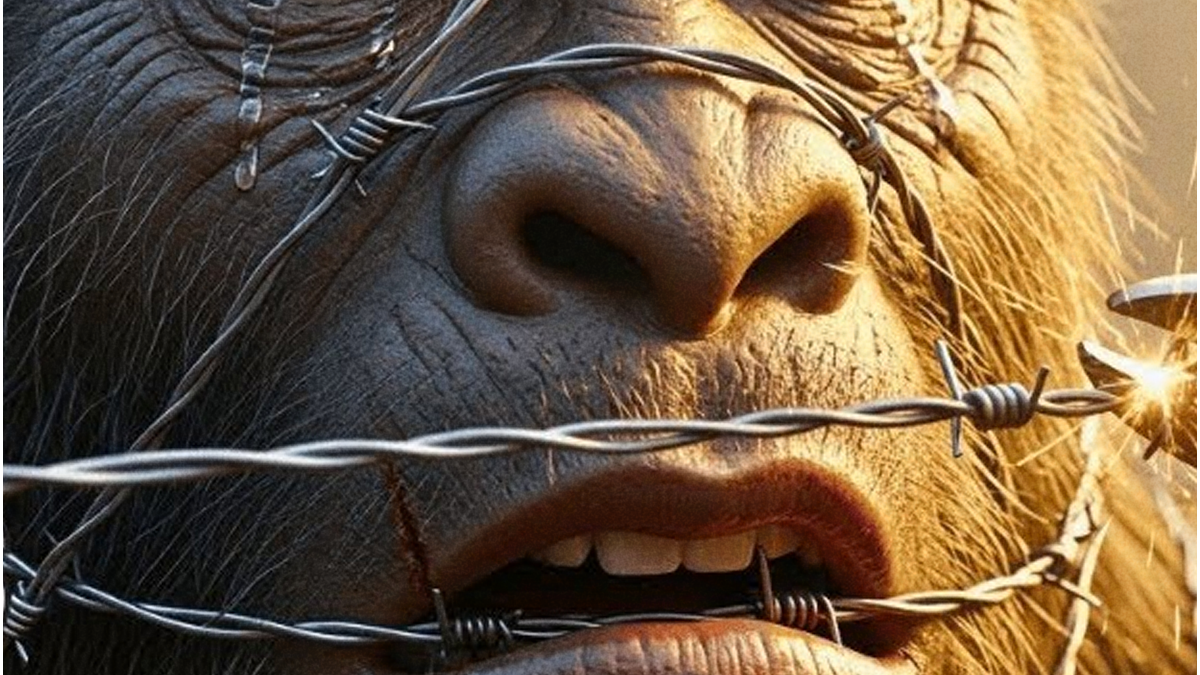
He Cuts Bigfoot Free from Barbed Wire – Bigfoot Reaction Is Absolutely Jaw Dropping
Hey.
Easy, big fella.
Let me see that wire.
Easy now, friend.

I’m not going to hurt you.
Just stay still.
Let me look at this wire.
Have you ever believed that a creature over 7 ft tall could gently stack firewood just to say thank you?
That something the world calls a monster might actually help a grieving man find peace?
In the spring of 1990, deep in the Blue Ridge Mountains, a reclusive woodworker named Jonah Reed heard a strange cry through the mist.
He followed it and found Bigfoot wounded, trapped, and looking him in the eye.
Not with rage, but something else.
Something almost human.
He cut the wire.
What followed was a silent bond.
Bigfoot began to return stacking wood neatly, offering quiet gratitude, and watching from the shadows.
As the seasons changed, so did Jonah.
And so did May, the widow who helped bandage the creature’s wounds.
In helping Bigfoot, they were helping themselves.
But in small towns, secrets don’t stay quiet.
And when fear came knocking with guns and accusations, it was that same monster who stepped forward to save a child in a dying deer.
No words, just action, just kindness.
This story comes from the pages of Jonah’s own journal.
And maybe, just maybe, it’s time we all read it.
Where are you watching from tonight?
How far can a story like this travel?
One born in snow, silence, and the soft thud of a thankful chuff.
From our little cabin in the woods to your screen, this is our quiet hello and warmest goodbye.
A spring fog had settled thick over the ridges of Blue Ridge.
The kind that felt like breathing through wet cloth.
It was early.
Too early for birds or trucks or the distant hum of saws from the mill.
Just fog and silence layered over the soaked earth like a wool blanket.
Jonah Reed’s old Chevy pickup groaned as it climbed the gravel incline behind the back pasture.
Tires pushing through soft ruts left by the rain overnight.
He cut the engine.
The sudden quiet was startling.
Only the tick of the cooling motor and the slow drip of rain from the truck’s metal roof.
He exhaled, watching his breath roll across the windshield, fading into the mist.
Then came another sound.
Not the wind, not a bird call.
Something low, strained.
A metal-on-flesh kind of sound.
Drawn out like it had nowhere left to go.
It came again.
And this time it was closer.
Wet, heavy, wounded.
Jonah’s hand hovered at the key, but didn’t turn it.
Something old in his body, the kind of instinct shaped by grief, not by fear, told him to wait, to listen.
He opened the door.
The cold hit first.
Then the smell.
Wet earth, iron, bark torn from trees.
He stepped out, boots sinking slightly in the mud.
The faint weight of dread pressing down on his spine.
He reached behind the seat and pulled out the old flashlight.
The one with the cracked yellow casing and faint flicker at the edge of the beam.
The noise came again.
But now layered with something else.
A breath.
There was an opening in the fence line up ahead where the storm had bent the wire down.
Jonah stepped over the twisted steel, careful not to snag his jeans.
The flashlight shook a little in his grip.
Not from fear, not entirely.
But from the cold and the memory of another morning like this one years ago when he’d walked into the woods and come out with fewer things than he’d gone in with.
He moved slow, the beam scanning between bare trees, slick grass, and overturned stones.
A broken trail of crushed weeds led toward the far side of the clearing.
That’s where he found it.
First, just the shape.
Too large to be a man, too upright to be a bear.
Covered in mud so thick it looked like another hill rising from the pasture until it shifted and the light caught the eyes.
Amber, wet with blood and reflection, staring back at him.
Not wild, not tame, just waiting.
A snarl of barbed wire wrapped around the creature’s shoulder, digging deep where muscle and fur met skin.
Its chest rose and fell in broken rhythm.
Each breath rattling like wind through metal sheeting.
Jonah didn’t move for a long time.
Not forward, not back.
The light in his hand dimmed, flickered, then steadied again.
He knelt slowly, hands visible.
The creature flinched at first, but didn’t lash out.
Just trembled.
Just breathed.
A pair of headlights swept across the distant ridge.
The town preacher’s truck doing its nightly loop.
Tail lights disappearing behind the curve.
Jonah lowered his head, keeping himself between the beam and the clearing until the red glow vanished.
He turned back toward the creature.
“It’s all right,” he whispered, barely moving his lips.
“I’m not going to hurt you.”
It didn’t answer.
But something in the way its shoulders dropped, in the way its jaw unclenched just slightly, Jonah felt it.
Not surrender.
Trust.
The fog thickened again, folding them into it like a closing hand.
And somewhere in the silence, a boundary crossed itself and disappeared.
Jonah came back the next morning.
The fog had lifted, but the sky still hung low, bruised and wet.
He parked at the same spot, though he hadn’t really planned to.
There were other things to do.
Jobs that paid.
Repairs to make.
But his hands had reached for the wire cutters anyway.
The old denim jacket and the tin of biscuits May had left by his door the night before.
The creature was still there, slumped lower now, as if the night had been heavier than it could carry.
The wire had cut deep.
Rusted barbs slick with blood and earth.
Jonah crouched close.
Not too close, but near enough to feel the heat coming off its body.
It smelled like damp moss, sweat, metal.
He studied the pattern of the tangles.
Each loop had tightened with movement, with struggle.
Each cut was a silent lesson in pain.
He worked slowly, one strand at a time.
The click of the cutters, the recoil in his palMs. With each snip, the creature winced, but only barely.
Its eyes would close when he moved in, like it was letting him take something out of it.
Letting him undo the thing that bound them both.
When the last strand fell, the creature collapsed forward into the mud.
Jonah startled, instinctively catching its shoulder with both hands.
It was warm.
So warm.
He pulled the denim jacket over its back, shielding the exposed skin from the breeze rising over the hill.
Above them, a crow called sharply and flew off, disappearing behind the tree line.
The sound lingered, too sharp to be ignored.
Jonah exhaled slowly.
“You’re meant it as a promise, but it felt like one.
For a week, there was nothing.
Just the usual.
The creak of the porch swing, the radio static from May’s vet station on the shortwave, the sigh of wind through uncut grass.
Then, one night, something struck the back door.
Not hard, not fast.
Just enough to wake the dogs and rattle the hinges.
Jonah grabbed the oil lamp, lit it with shaking fingers, and stepped out onto the porch.
It was lying just beyond the firewood stack.
Mud dried in cracked layers across its fur.
Blood caked in places where the wounds hadn’t yet healed.
It had come back.
He stood frozen at the threshold.
Every instinct telling him to turn, to bolt the door, to let the mountain take what belonged to it.
But then it groaned.
Not like a beast.
Like something hurting.
Like something that remembered him.
Jonah fetched the old blanket and the last of the corn cakes.
He didn’t speak.
He just placed them down, sat nearby, waited.
At dawn, he called May.
When she arrived, she didn’t scream.
She didn’t run.
She just stared.
Then said softly, “If it came back to you, it means it trusts you.”
They worked together.
May with her gauze and iodine.
Jonah with his arms bracing the creature’s weight.
When she stitched the largest wound, it groaned but didn’t flinch.
Its eyes met hers.
Tired, but steady.
It knew they were helping.
Later, long after the moon had crested the hills and dipped low again, Hattie Lou appeared at the porch with a brown bottle in hand.
She placed it on the steps without a word.
Just muttered, “Ain’t seen nothing.”
And walked back into the dark.
A pact spoken in mountain code.
Days passed.
The creature didn’t leave.
It didn’t hide.
It simply stayed.
Jonah built a lean-to off the side of the cabin.
A place that wasn’t a cage, but wasn’t exactly an invitation, either.
Some mornings the firewood would be rearranged.
Stacked in the precise pattern Jonah preferred.
Smallest to largest.
A detail no one else had ever noticed.
May saw it and smiled.
“It remembers.”
She said.
One dusk, as the sun melted into the pine line, the creature stood.
For the first time, full height.
Tall enough that its shadow stretched from the cabin wall to the edge of the field.
A deer wandered up to the fence, stood still, didn’t bolt.
Silence settled between them.
Not fear, not curiosity.
Something older.
Something like recognition.
That night, Jonah dreamed of his son.
The boy was reaching out, not to him, but to a figure in the rain.
Taller, broader, quieter.
He woke with tears on his cheeks, unsure if they came from grief or grace.
On the porch, the creature was curled under the tarp, breathing slow.
Still here.
Still real.
And in that moment, something inside Jonah began to loosen.
The part that had closed itself off.
The part that had once believed the world only took and never gave.
But now, in the quiet, something had been given back.
And the story, whatever it was, was only just beginning.
The morning was colder than expected.
Not the kind of cold that makes you shiver outright, but the kind that sinks under the skin and stays there, coiling around bone like an old regret.
Jonah Reed stood at the edge of the clearing with the same denim jacket he’d had since his 20s and a pair of bolt cutters hanging from one hand.
The fog had thinned, but hadn’t lifted.
Rolling low like breath over a shallow grave.
Dew clung to the grass.
And somewhere up the hill, a crow called once, then went silent.
The shape in the field hadn’t moved.
It lay half-curled near the remains of a collapsed fence post.
Its massive back barely rising.
The barbed wire had cinched tighter in the night.
You could see it now.
Not just wrapped, but buried in the muscle.
Red crust flaking where the rust had already found blood.
Jonah moved slow.
He didn’t say a word.
He knelt a few feet away.
His boots squelching in the saturated ground.
And let the cutters fall into the mud beside him with a muffled thud.
The creature didn’t flinch.
That, in itself, said something.
Maybe it was too weak.
Maybe it had given up.
Or maybe, and this hit Jonah hard enough to make him still.
Maybe it remembered.
Remembered the man who came with no fire, no threat, just a flashlight and a whisper in the dark.
Jonah reached forward, just enough to press two fingers against the tension of the wire.
The fur was thick, matted with dirt and blood.
Beneath it, the flesh pulsed faintly with warmth.
Still alive.
Still holding on.
He took a breath and slid the jaws of the bolt cutters over the first twisted strand.
The metal creaked like old bones.
His hands trembled.
Not from fear, but from the weight of the moment.
From the knowing that this wasn’t a bear, wasn’t a monster, wasn’t some campfire story meant to scare children.
This was real.
This was someone.
The wire snapped with a metallic pop.
The creature exhaled, low and shaky, like something had loosened in its chest.
Jonah moved to the next knot, then the next.
He had to get in closer now, crouching into the mud until his knees soaked through.
His face was inches from the wound.
The smell was sharp.
Earthy, metallic.
Wrong in a way that made the back of his throat tighten.
The third strand was lodged deep, embedded like a cruel stitch.
Jonah paused, steadied his hands, then pressed the cutters down.
A second later, the barbs gave way.
The creature groaned.
A sound that didn’t come from its mouth, but from somewhere deep in its lungs.
It made Jonah flinch.
He dropped the cutter for a moment and just stared.
Not at the wounds, but at the expression.
Barely a flicker of it in the set of the jaw, the narrowing of the eyes.
Pain, yes.
But not rage.
The last strand was the worst.
Wrapped around the upper arm, digging straight into the joint.
Jonah leaned over, pressed his palm flat against the creature’s side for balance.
Its breath hitched.
But it didn’t move.
He squeezed the handles.
The metal groaned.
The wire snapped.
Then it collapsed.
Not violently.
Not dramatically.
Just folded in on itself.
The weight of its own body too much now that the restraints were gone.
Jonah lunged to keep its head from hitting the ground.
And somehow, his arms ended up beneath it.
Holding it.
Not like prey.
Not like an animal.
But like a person.
The body was massive.
Too heavy to shift.
But he managed to slide the denim jacket over the creature’s back, pulling the sleeves forward like a blanket for a child.
It didn’t cover much.
Just a gesture.
Something about not leaving it bare under that sky.
He sat back, breathing hard.
Mud clung to his jeans.
His hands shook.
His chest tight from the effort and the weight of what he’d just done.
“You’re free.”
He whispered again.
Though it came out hoarse and uncertain.
The creature didn’t respond.
It just breathed, barely, and stayed.
The crow called again.
Jonah stood, wiping his hands on the side of his jeans.
And looked down at the massive figure lying in the grass.
He couldn’t carry it.
Not even drag it.
But he couldn’t leave it here, either.
Not like this.
He turned back toward the truck.
Walked slowly.
His boots felt like anchors.
The wind shifted behind him.
And he knew, without turning around, that this wasn’t the end of it.
That something had just begun.
He spent most of that day distracted.
Tried fixing the screen door.
Tried stacking the rest of the wood pile.
Even walked down to Hattie Lou’s for gas and left with a jar of pickled beans he didn’t need.
But his mind kept circling back, over and over, to the weight in the mud.
By late afternoon, he was back.
He brought a tarp and a coil of rope and a flask of water just in case.
When he reached the clearing, the creature was still there, lying just where he left it.
He crouched again, checked the breathing.
Faint, ragged.
But there.
Jonah pulled the tarp around the creature’s shoulders.
Then looped the rope through the grommets, fashioning a crude sling.
He wrapped the other end around his waist, braced himself, and leaned forward.
The first pull barely moved it.
The second shifted its shoulder.
The third brought its hand out from under the weight of its own chest.
Jonah paused then, looked down.
The hand had five fingers.
Human, almost.
Just larger.
Thicker.
The nails were cracked and blackened with dirt.
But there was something unmistakably familiar in the shape.
It twitched once, then stilled.
Jonah gritted his teeth and leaned into the harness again.
Inch by inch.
Foot by foot.
He dragged the tarp across the clearing, through the thorns, around the old stump, and up the slight incline toward the edge of the woods.
His breath came in hard bursts.
His legs burned.
But he didn’t stop.
Not until the shadows lengthened and the birds went quiet.
At the base of the slope, he eased the rope loose, stepped back, and dropped to his knees.
Both of them just lay there a while.
One barely conscious.
The other just barely holding it together.
“Didn’t think I’d be doing this today.”
Jonah muttered, half to himself.
Half to whatever gods might be listening.
The wind stirred the leaves.
He looked up, scanning the tree line.
Nothing moved.
No deer.
No birds.
No eyes watching from the dark.
But still, there was that feeling again.
Like the woods were holding their breath.
Not in fear.
Not in warning.
But in witness.
Jonah didn’t know what that meant.
Not yet.
But he felt it.
Felt it in the way the silence settled heavier than it should.
Felt it in the way the creature’s chest kept rising, barely, against the edge of the jacket.
Like it knew.
Like it understood.
And even if he didn’t, not fully, not yet, that would be enough for now.
He didn’t need answers.
He just needed to keep pulling.
Keep showing up.
One breath.
One inch.
One choice at a time.
And somewhere behind him, high up in the branches, a crow shifted its weight and let out a single hollow cry before taking flight toward the ridge.
Jonah was used to quiet nights.
The kind where the only sound was the ticking of the wood stove cooling off.
Or the sharp bark of a fox too close to the chicken coop.
But this night had a different stillness to it.
The kind that presses into your ears, makes you sit up straighter without knowing why.
He hadn’t planned on staying up late, just wanted to read a little, maybe have one more cup of that weak black coffee he kept reheating out of habit more than taste.
But the dogs started pacing before the knock came.
Not barking, not growling, just shifting their weight from one paw to the next.
Eyes fixed on the back door like they already knew what was on the other side.
The knock wasn’t loud.
It was more like a thump, something falling against the porch steps.
Jonah didn’t get up right away.
He just listened.
The wind had settled after a week of storms, and now the air was thick with that post-rain scent, wet bark and soil turned sweet.
He lit the lantern and opened the door with a slowness that came from living alone too long.
The first thing he saw was the smear, dark, wet, dragging across the wooden steps like someone had spilled ink in a hurry.
Then the shape, massive, slumped against the edge of the porch, half in shadow, half under the moonlight that filtered through the pines.
It was him, the same creature, the same body he had dragged up that hill not even 2 weeks ago.
Only now it was worse.
The mud had dried into a second skin, cracked along the joints, flaking off to reveal the rawness beneath.
Blood, too.
Not fresh, but not old, either.
Just enough to make Jonah step forward before he could stop himself.
The creature didn’t move, didn’t lift its head, but it was breathing, shallow, wet, like each inhale cost more than it could afford.
Jonah crouched, barely aware of the damp seeping through his jeans.
He reached out slowly, hand open, palm out like he might to a spooked horse.
No growl, no retreat, just the rise and fall of a chest too big for any normal thing.
He touched the shoulder, and it was hot, fever hot.
He pulled back quick, like the heat might bite, then stood and went inside.
A few minutes later, he returned with a folded blanket, a mason jar of water, and the last two slices of May’s cornbread.
He laid the blanket over its back, careful not to cover the face.
Left the water close by.
The cornbread, too, though he didn’t expect it to eat.
Then he sat on the top step, hands laced together, elbows on his knees, watching as the lantern flame flickered between them like a third presence.
Hours passed that way.
Nothing said, nothing moved.
By sunrise, he made the call.
May didn’t pick up right away.
When she finally answered, he didn’t try to explain much.
Just said, “It’s back.
Worse this time.”
She arrived an hour later.
No makeup, sweatshirt half-zipped, boots still wet from last week’s flood.
She stood over the creature for a long moment, hands in her pockets.
Then she nodded once, went back to her truck, and returned with the same oversized vet bag she’d brought the first time.
No questions, no panic, just that calm she carried like armor.
The kind of calm that came from stitching up cows with fence posts in them and pulling barbed wire from the mouths of panicked dogs.
“You hold the shoulders,” she said, already opening a pack of gauze.
“I’ll start here.”
Jonah knelt again, knees popping, one hand braced on the creature’s fur, the other gripping its arm just above the elbow.
It didn’t resist, didn’t flinch, just kept breathing in that ragged rasping way.
May worked quietly, threading the needle with steady fingers, her brow furrowed in that deep surgical way that didn’t welcome small talk.
The wounds were worse than they looked.
Deep lacerations, some from the wire, others newer.
Scrapes, bruises, maybe from falling, maybe from something else.
Jonah didn’t ask.
He could feel the heat coming off it, soaking through the denim of his sleeves, and wondered if it even had a word for pain, or for trust.
Halfway through the last stitch, it groaned.
May froze.
Jonah tensed, but the creature didn’t move.
Its eyes opened, just barely, and for a heartbeat, they locked onto May’s.
No fear, no confusion, just recognition, like it knew she was trying, like it saw her, really saw her.
May looked away first.
Finished the stitch, tied it off, then leaned back and wiped her hands on a towel.
“Well,” she said, almost too softly, “we’ll see how tonight goes.”
She didn’t say more, just packed up her bag and squeezed Jonah’s shoulder once as she passed.
That was enough.
It was nearly dark when Hattie Lou showed up.
Jonah didn’t hear her truck, didn’t hear her boots on the gravel, just the creak of the porch and the scrape of glass being set down.
A brown bottle, iodine with a torn label, sat on the top step beside him.
He turned, but she was already walking back toward the tree line.
Her coat flapping in the wind like a flag from some forgotten war.
“I ain’t seen nothing,” she called over her shoulder, then disappeared.
He sat there a while longer, the bottle still cold in his hand, listening to the soft rise and fall of the creature’s breathing beneath the blanket.
The dogs had stopped pacing.
Even the owls seemed quieter than usual.
Something had shifted, not just in the air, but in the way things moved around the cabin, in the weight of it all.
Jonah didn’t sleep that night.
He stayed on the porch, wrapped in his old coat, the same one from high school.
He dozed once or twice, but every time he opened his eyes, it was still there, breathing, not dead, not gone.
By morning, it hadn’t moved, but the water jar was empty, and the cornbread was gone.
Not crumbs, not scattered, just gone, eaten, and folded neatly at the foot of the blanket like someone returning borrowed clothes, was a single square of the tarp Jonah had used before.
Clean, folded tight, corners lined up.
He didn’t touch it, just sat down beside it, then stood and walked inside to make coffee.
Somewhere in the valley below, the town was waking up.
The gas station lights flickering on.
The first school bus rolling past the post office.
The world going back to its rhythm.
But up here on this ridge, something else was happening.
Something slower, quieter, a kind of understanding that didn’t need to be named.
And in the shadows just beyond the porch, something ancient lay breathing in sync with a man who had once sworn he’d never open his heart again.
But here they were, two beings wrapped in the same kind of silence.
Each nursing a wound the other couldn’t see.
Each staying anyway.
And outside, through the tall pines, the wind carried no warning, no omen, just a sound like breath moving softly through the needles, as if the forest itself had seen enough for now, and would wait.
There were mornings up in those hills when the wind barely stirred, when the whole world held its breath like it didn’t want to wake anything that hadn’t healed yet.
That was the kind of morning Jonah stepped into, coffee in hand, steam curling around the cracked rim of the mug, eyes still heavy, but gut already tight.
The old porch boards creaked under his step as he glanced toward the lean-to he’d rigged together from salvaged lumber and a bent tin roof.
It wasn’t much, just enough to keep off the wind and rain, to offer some kind of boundary without building a prison.
The creature was still there, breathing slow under the gray quilt Jonah had dragged out of the attic.
He hadn’t gone in close yet.
Let the space stay quiet.
Let time do what it needed.
But every morning, he left something, food, water, fresh cloth.
Sometimes he came back and found the offerings untouched.
Other times, the bread would be gone, the water jar empty and set neatly upside down.
No mess, no crumbs, just absence in the shape of trust.
That morning, though, something had changed.
The stack of firewood near the shed wasn’t how he’d left it.
The logs had been moved, lined up by size, edges squared, placed with a precision Jonah recognized instantly.
Long to short, thick to thin, the way his father had taught him to sort timber, how to read wood by its weight and grain.
Jonah crouched beside it, ran his fingers along the bark, a small sound catching in his throat.
It wasn’t just the order, it was the memory inside it.
Someone had watched him.
Not last night, not just once, but enough times to know exactly how he did it.
He turned slowly toward the lean-to.
The quilt shifted.
A breath, a pause, then stillness again.
He didn’t say anything, didn’t need to.
By midmorning, May came by.
She brought a bag of medical supplies and two thermoses, one with stew, the other with her version of coffee, which tasted like it had fought in a war and come home bitter.
She didn’t ask permission, just set them on the counter and gave Jonah a long look.
“It’s still not moving much?”
Jonah shook his head.
“It’s watching, though.”
May leaned against the counter.
“It always was.”
He didn’t tell her about the wood pile or the quilt that had been carefully folded one corner back as if to let air in.
Some things felt too sacred to say out loud.
That afternoon, just as the sun began slipping through the pine branches in long golden stripes, Jonah saw movement.
Slow.
Careful.
The lean-to groaned a little, not from collapse, but from weight.
The creature was trying to stand.
He stepped back, didn’t want to interfere.
Let it try.
Let it find its legs on its own.
It rose in pieces, first one elbow, then a shoulder, then the full length of its spine unfolding like an old tree after a wind.
Taller than he remembered.
Broader.
It shifted its weight, paused to breathe, and stood still.
Half in light, half in shadow.
Jonah stood at the cabin doorway, heart thudding against his ribs, not from fear, but from something older.
Reverence, maybe.
The creature turned, scanning the field.
Not fast, not like prey.
It looked like someone remembering a place after a long absence.
Down at the edge of the clearing, a deer approached the split rail fence.
A doe, lean and gray around the muzzle.
She walked close, stopped just past the final post.
Her ears flicked, but she didn’t bolt.
Just stood there, watching.
The creature didn’t move.
The deer didn’t run.
For a long while, they held that silence together.
Not the kind born of weariness, the kind that feels like recognition.
Jonah didn’t blink, didn’t dare move.
He felt like a trespasser in a moment not meant for him.
But the breath he exhaled trembled with something else, a kind of release he hadn’t allowed himself in years.
That night, after supper, the dogs refused to sleep indoors.
They curled by the lean-to, silent as stones.
Jonah sat at the kitchen table, flipping through an old calendar he didn’t remember keeping.
He wasn’t looking at dates, just letting the pages fall.
At some point, he dozed off in the chair and dreamed he was back in the rain.
Same hill as always, only this time it wasn’t fog, but storm.
Sheets of water cutting across his face, trees bowing under the weight of it.
He heard a voice.
Not words, exactly.
Not even a sound, but a feeling.
A calling.
He turned and saw his son, not as a child, not as he remembered, but older, standing barefoot in the rain, arms stretched out toward something in the distance.
Jonah followed his gaze.
It wasn’t him.
The boy was reaching for the creature, towering, silent, kneeling in the mud, one hand out, open.
Then lightning cracked.
Jonah woke up with a sharp inhale, heart racing.
The fire had burned low.
Ash flickered along the grate like dying stars.
He rubbed his face, tried to shake the feeling, but it clung to him, damp and real.
Outside, the wind had picked up.
He opened the door and stepped onto the porch.
The lean-to was dark, still, but not empty.
And in that quiet, he felt it again, something shifting, something soft unraveling.
He didn’t go back to sleep.
He sat on the porch until the sky began to lighten, until the pines turned from black to blue and the frost pulled back from the steps like a tide retreating.
When he finally turned to go inside, he noticed something new.
At the edge of the porch, beside the stack of boots, was a small bundle.
Sticks, dry, sorted by length, bark stripped clean, the kind of fire starter Jonah hadn’t taught anyone in over a decade.
He knelt, touched the top branch, and paused.
No note, no sound, just a gesture, like a handshake made of silence.
And though he didn’t smile, not exactly, his shoulders dropped just a little.
Inside the house, the coffee hadn’t even gone cold, and outside, the sun slipped through the trees, catching on the tips of the frost as it melted, turning the grass into gold.
There was still distance between them, still pain, still memory that wouldn’t heal clean.
But something was beginning to mend in the space where no words were needed.
And if Jonah had learned anything from that creature in the mud, it was this.
Sometimes the truest kind of kindness comes not in saving, but in staying, in waiting without demand, in standing beside another being without asking them to be anything other than what they are.
The cabin was quiet again, but it didn’t feel empty.
And the silence that filled it now felt less like a wound and more like the start of a song not yet sung.
By late August, the woods had begun to dry out, but the heat still clung to the air like syrup, thick and slow.
On most days, the wind barely stirred, and the pine needles on the roof whispered only when the sky hinted at rain.
Jonah had settled into a rhythm, if you could call it that.
He didn’t question why the creature stayed, and the creature, for its part, didn’t question Jonah’s silence.
They simply existed within reach of each other.
Sometimes in sight, sometimes not, but always near.
Then came the whispers.
It started small.
A conversation overheard at Hattie Lou’s, a kid saying he saw something tall on the far side of the river, something too big to be a man, but moving like one.
Someone else mentioned growls at night.
Not wolf, not bear.
A hunter swore he saw handprints, huge ones, along the mud flats.
Jonah kept his head down, nodded when folks talked, didn’t say a word.
But inside, the quiet in his chest twisted tighter.
May brought news one evening in the form of a paper bag, her eyes scanning the treetops even as she spoke.
“Boone’s stirring up the town,” she said, voice low.
“Calling it a demon, wants to organize a group, calls it a watch, but it ain’t that.”
She didn’t need to explain more.
Jonah knew Boone, knew the way the man wrapped fear in scripture and made it sound like salvation.
The next morning, Jonah reinforced the gate behind the old shed.
Not that it would stop anything serious, but it gave him the illusion of a line.
He tried to keep the creature inside, coaxing it toward the dark of the barn, but it resisted gently, silently, as if it knew hiding made it more of a monster in their eyes.
Still, when the sun went down, it didn’t wander far.
It stayed close to the shadows, moving like fog, always watching.
By the end of that week, the dogs began barking more.
Nights came heavier.
And one evening, as Jonah scrubbed soot from the chimney, the sound of engines reached his ears.
More than one.
Flashlights flicked through the trees like stuttering stars, voices too loud for the hour.
He didn’t wait.
He moved through the cabin in practiced steps, grabbed the lantern, the spare blanket, a small bag of dry cornbread, and hurried out back.
The creature stood still as stone near the chicken coop, its eyes catching the lantern light, golden wide.
Jonah didn’t speak, just motioned.
“This way.
Hurry.”
It understood.
He led it to the old feed room, the one with a broken door and cracked slats that let in too much air.
It wasn’t ideal, but it was out of sight.
He slipped the blanket into the corner, left the food, then shut the door behind him.
Then he waited.
The lights grew brighter.
May’s truck pulled up out front, engine humming, headlights slicing through the dark like a warning flare.
She didn’t get out, just leaned on the horn once, then flipped her brights, catching two of the men in the glare.
The dogs barked harder.
Inside, Jonah grabbed an old sheet of tin and slammed it against the side of the coop, loud enough to echo through the trees.
Confused shouts followed, feet scrambling in the wrong direction.
It bought him a few minutes.
Then, in the chaos, a yelp, high, sharp, canine.
Jonah froze.
He turned toward the back, heart pounding, and heard it again.
A dog’s bark, then a splash, then silence.
The old runoff pit, hidden beneath grass and rock, forgotten except when the rains filled it.
He ran and saw it.
One of the hounds, Boone’s, scrambling at the edge, legs too short to climb the muddy walls, its eyes wide with panic, mouth gaping.
Then, without warning, a shadow moved from the tree line, massive, fast, the creature.
It didn’t hesitate.
It plunged into the pit, arms breaking through the muck with force and purpose.
The dog flailed, teeth snapping, until a hand, huge, steady, pushed it up, lifting it just high enough to catch the edge.
The dog clawed free, howled once, and ran.
The creature tried to follow, but its foot slipped and it fell back hard, hitting the bottom with a sound that punched through Jonah’s ribs.
He rushed forward, boots sliding, hands gripping the old rope he’d left tied to the oak nearby.
The same rope he once used for hauling sacks of feed.
He tossed it in, heart racing, and saw one long arm reach up.
He pulled, hard, again, again, until that great frame emerged from the pit, soaked in mud, limbs trembling.
Then he saw the other figure, Wyatt Crow, just standing there, barely breathing, eyes wide and full of something that wasn’t fear.
Not exactly.
The boy, 19 maybe, camera hanging from his neck, hands shaking.
He didn’t say anything.
Just stared.
Then slowly, he lifted the camera, opened the back, and pulled out the roll of film.
Without a word, he tucked it into his jacket pocket.
Jonah met his eyes.
Neither of them blinked.
The boy spoke first, barely above a whisper.
“It saved Gil’s dog.”
Jonah didn’t answer, didn’t nod.
They just stood there in the dark, in the mud, with something enormous breathing hard between them.
Later, after the lights were gone, after Boone’s truck disappeared past the ridge, Wyatt came back.
He knocked once, light, like he didn’t want to wake the night again.
Jonah opened the door.
“It saved him,” Wyatt said, voice clearer now.
“He would have drowned.”
Jonah stepped aside, letting the boy see the creature curled on the floor of the old feed room, chest rising and falling in slow, pained rhythm.
Wyatt didn’t ask questions.
He didn’t run.
He just whispered, “I won’t say anything.
I promise.”
And Jonah believed him.
Because sometimes silence between two people says more than any oath.
Outside, the woods held their breath again, but this time it wasn’t out of fear.
It was something deeper, awaiting, a watching, a bond not spoken but formed.
And though the fire had long burned out in the hearth, Jonah didn’t light a new one.
He just stood there beside the boy, beside the creature, in the quiet, listening, letting the darkness settle around them not as an ending, but as a beginning neither of them had asked for, and neither of them would walk away from.
The first thunder didn’t crack.
It rumbled, low and long, like something turning over in its sleep beneath the mountains.
Jonah stood at the edge of the porch, mug cooling in his hand, eyes fixed on the western ridge where the clouds had started stacking like bruises.
The wind came next.
Not loud, not strong at first, just enough to lift the corner of the tarp over the wood pile and flick at the edges of the feed sacks like fingers thumbing a page.
The air had that smell, too.
The kind that whispered something was about to be undone.
By dusk, the sky turned the color of rust.
The old dog, Scout, paced the porch twice, then crawled under the bench without waiting for a call.
Jonah didn’t blame him.
Something in the wind had shifted.
It wasn’t just weather.
It was pressure, like the earth holding its breath again, like it had held too much for too long.
Inside, he lit the lanterns early.
He closed the shutters tight, checked the back door latch, and tried not to think about how many nights lately had started this way, with the woods on edge and no clear reason why.
He hadn’t seen the creature all day, not since dawn, when he left out the last of the cornbread beside the lean-to and found the twigs rearranged again, short to long, narrow to thick, a language that didn’t need sound, but said, “I’m still here.”
Then the rain came.
It didn’t trickle.
It slammed.
The roof rattled like old tin struck by hammers.
Water poured off the eaves, flooding the dry dirt into streaMs. Lightning cracked once, close enough to flash white through every windowpane, and Jonah counted, “One, two,” before the thunder chased it down.
Then something else snapped, loud, close, not sky, not weather, wood.
Jonah dropped the mug, stepped back onto the porch with the flashlight, its old beam slicing through the sideways rain.
The tree near the back fence, an old red oak, was down, split clean across the base, trunk sprawled across the slope like a fallen giant.
But the fence wasn’t the only thing broken.
The lean-to, gone.
The tarp whipped in the wind, half buried under shattered boards and scattered moss.
No sign of movement.
No sound.
Jonah ran.
Mud sucked at his boots.
The rain hit like gravel, stinging his arms, soaking through denim and flannel.
He climbed the slope, calling out once, but not with words, just a sound, low and desperate.
A sound he hadn’t known he could make until that moment.
At the edge of the wreckage, he found something half buried, a corner of the quilt, torn and soaked.
And beside it, pressed into the mud, a handprint, larger than his boot, fingers spread wide, the center still warm, but no trail, no shadow, nothing, just an absence.
He stood there a long while, breathing hard, waiting for another sign, another flicker of amber eyes from the tree line.
But there was nothing, only the wind and the slow rise of cold behind his ribs.
By morning, the storm had passed, but the silence that came after was worse.
Not a bird, not a squirrel, no deer tracks.
The woods had emptied.
Jonah moved through them like a man walking inside someone else’s dream.
At the base of the ridge, where the earth dipped toward the ravine, he found it, tucked beneath a twisted cedar, half hidden in leaves and rain-washed soil.
A single thread of cloth from his jacket sleeve caught on the branch.
And nearby, a barb, old, rusted, a curl of barbed wire bent into a crescent, still clinging to a tuft of dark fur.
He crouched there, hand trembling, and stared at it.
It hadn’t returned.
Not to the house, not to the tree line, not to the places they’d shared breath and quiet.
But it had passed through and had left just enough to say, “I couldn’t stay.
Not now.
Not with what’s stirring.”
When Jonah got back to the cabin, Wyatt was there, leaning against the porch post, soaked to the bone, hair slicked to his forehead.
His truck sat crooked along the drive, one wheel in the ditch, hazard lights blinking in a slow, apologetic rhythm.
He didn’t speak at first, just looked down at his boots, then up again, eyes red.
“I told someone,” he said, voice cracking.
“Not Boone, but someone who told someone else.
I didn’t mean to.”
Jonah didn’t yell, didn’t move.
He just waited.
Wyatt swallowed.
“They think it’s dangerous.
They think They think it’s watching us, planning something.
Boone’s twisting it into prophecy, calls it a sign.”
Jonah looked past him, to the trees, to the hills, to where silence still clung like fog.
“He saved that dog,” Wyatt added, desperate now.
“You saw it.
He saved it.
He didn’t hurt anyone.
He could have run, could have fought back, but he didn’t.”
Jonah nodded.
Not a big nod, not angry, just a slow, tired one.
“You owe him more than silence now,” he said.
The boy nodded, too.
The storm had taken the lean-to, but the words had done worse.
Words could chase a thing deeper than any flood.
That night, Jonah left the cabin door open, not wide, just cracked.
The lantern glowed low on the table.
The fire whispered in the hearth.
And outside, the woods began to breathe again, once, then twice, then something passed the fence line, unseen, unheard, not staying, just watching.
Then, from the edge of the dark, a sound, low, soft, not a growl, not a breath, something between, a chuff, like recognition, like goodbye, or maybe like a promise.
And when Jonah stepped out onto the porch, the wind carried nothing.
But he knew, somewhere close, something still walked, still watched, still waited.
And so he waited, too, not for safety, not for answers, but for the silence to end again, when it was ready.
The first sign came from May.
Early November, just past the last frost.
She showed up before sunrise, hair still damp, windbreaker streaked with mud, breath sharp from the climb.
She didn’t knock, just stood at the edge of Jonah’s porch, holding a strip of bark with a print embedded into it.
Too wide to be a man, too long to be a bear, pressed deep into the fibers, like something heavy had crouched for a while before pushing off uphill.
She said nothing, just set it on the porch rail.
Jonah didn’t ask.
He saw the ridge line in her eyes.
Waverly Hill, east side.
He didn’t wait long.
He packed the same denim coat, the same bolt cutters from that first morning, not because he thought he’d need them, but because memory has a weight, and some things want to come full circle.
The hike took longer than he expected.
The path was narrow, slick with leaves that refused to dry this late in the season.
Squirrels didn’t chatter.
No deer crossed the path.
Just wind curling through the pines, pushing scent in ways he couldn’t follow.
The sky hung close to the trees, washed in the pale blue of a sun that hadn’t warmed anything in weeks.
By midday, Jonah crested the ridge and caught sight of the clearing, half flooded, soft with moss.
Something was wrong.
He crouched behind a rotting stump, eyes scanning low, breath hitching as the shape took form.
Boone and three others.
Their truck was parked just inside the tree line, mud-caked tires, license plate obscured by brush.
Boone paced like a dog that had smelled blood.
Hat tipped back, shirt untucked, shotgun in one hand.
The others moved in silence, setting something heavy onto the ground.
It took Jonah a moment to see the gleam.
Bear trap, illegally wide, spring-loaded, steel teeth sharp enough to break bone.
They baited it with venison and something else.
Fur, not fresh.
Jonah couldn’t see the tag, but he knew Boone.
Knew he’d gutted the story until it fit his sermon.
Told folks the creature was watching their children, haunting the rivers.
Spun scripture with fear until people believed it.
Jonah kept low.
He didn’t blink until the trap was set, until the men backed away, grinning like they’d done something righteous.
Then they left.
No campfire, no lookout.
Just quiet confidence in a path worn with purpose.
Once the truck disappeared into the trees, Jonah exhaled.
And then he moved.
He followed the ridge east, away from the trap.
Heart pounding too fast for a man his age.
Lungs raw with cold.
He didn’t know what he was looking for until he saw it.
Just beyond the hill’s crest, a figure knelt beside a struggling form.
A buck, antlers fractured, one leg twisted inside the metal jaws of a second trap.
The creature was hunched, hands working with impossible gentleness.
Its breath clouded around its face, steam rising into the brittle light.
Jonah slowed.
Didn’t speak.
Just watched.
The creature unlatched the spring, peeled the jaws open with care.
The deer didn’t fight.
It just lay there, shuddering.
And then slowly, it was lifted.
Front legs under the chest, back legs dragging.
And nudged toward the brush.
Jonah couldn’t tell if it would live.
But the creature had given it a chance.
Then it turned and saw him.
For a second, neither moved.
Then the creature reached into its belt, if it could be called that, and pulled out something.
Not a weapon, just metal, dull, curved.
Jonah stepped forward, boots crunching frost.
It placed the object down on a flat rock, fingers brushing the surface once before backing away.
Jonah moved closer, heart caught in his throat.
It was a piece of barbed wire, old, rusted, bent into a soft crescent, almost like a question mark without the dot.
The same kind that had torn the creature’s flesh months ago.
The same kind Jonah had cut loose, strand by strand, in silence and mud.
This piece, it had been kept and now returned.
Jonah knelt and picked it up.
Felt the cold sting of the metal against his palm.
When he looked up, the creature was still watching.
Its shoulders broad against the trees.
Its face unreadable.
But in the stillness, something passed between them.
Not language.
Not approval.
Recognition.
Then came the crack of a branch.
Not behind Jonah, behind the creature.
Boone’s voice broke the air like a slap.
“Step away!”
Jonah whipped around.
Boone stood maybe 20 ft down the slope, shotgun raised, boots crunching fast.
The others fanned out behind him, hands on their belts.
The air snapped into panic.
“Jonah, move!”
Boone shouted, aiming up the hill.
“That thing’s dangerous!”
Before Jonah could speak, a figure rushed past him.
Wyatt, breathless, mud on his jeans, eyes burning with something wild.
“Don’t shoot!”
He screamed, shoving between Boone and the creature.
“He saved me!
He saved all of us!”
The gun wavered.
“Get back!”
Boone barked, face turning red.
“You don’t know what you’re” The creature straightened.
Not charging, not fleeing.
Just standing.
8 ft tall, silent against the trees, breathing steady.
Boone faltered, finger tightening.
The forest held its breath.
Jonah moved.
Not fast, not loud.
Just forward, hands out, voice low.
“It’s not the enemy, Boone.”
Boone didn’t answer, but the barrel dipped, just slightly.
Then a shot rang out.
Not aimed.
It hit bark, just above Jonah’s shoulder.
A warning.
A mistake.
Jonah stood still.
Wyatt didn’t flinch.
But the creature, it stared at Boone.
Not with hatred.
Not with fear.
With something older.
Like a tree watching fire.
Then, without a sound, it turned.
One step, then another.
Into the trees.
Gone.
Leaves falling behind it like memory.
No chase.
No sound.
Only silence.
Boone lowered the gun, hands shaking.
Wyatt turned to Jonah.
“Did you see it?”
He whispered.
“Did you see what it did for that deer?”
Jonah nodded.
He still held the wire in his hand.
Back at the cabin, long after the sun fell behind the hills, Jonah set the crescent-shaped barb on the mantel.
Not as a warning.
As a reminder.
Outside, the wind picked up, but the night didn’t feel empty.
It felt unfinished.
Like something had turned and waited.
The first snow came quiet, early in the morning, before the rooster crowed or the coffee percolator kicked.
It wasn’t the kind of snow that demanded attention.
Just a soft layer of white settling over rooftops, fence posts, tire tracks.
It coated the woods in hush.
Everything seemed slower.
Still.
Even the dogs didn’t bark when Jonah stepped out with his thermos and boots half laced.
He paused on the porch, watching the flakes drift, his breath curling upward like wood smoke.
The town below looked smaller in the distance, shrouded in white and wrapped in silence.
Like winter had stepped in to cover what words couldn’t.
Boone hadn’t been seen in two days.
Not at the diner.
Not behind the pulpit.
Word had started to drift, low and measured, carried between gas station pumps and church pews.
No one said it outright, but it was there.
A reckoning.
A retreat.
The kind of quiet that happens when a story breaks apart and no one wants to claim the pieces.
Jonah knew before he saw it.
Hattie Lou’s hands trembled when she set the receipt on the counter.
The ink smeared at the edges, as if time itself didn’t want to remember.
His name on the top.
Boone’s signature barely legible at the bottom.
A purchase for traps.
Large game.
Illegal size.
The kind that didn’t belong in a town with more squirrels than secrets.
She didn’t look up when he thanked her.
Just said, “I never saw nothing, but I sure as hell won’t see it again.”
Then she slid the receipt into his coat pocket, folded once.
No one else asked questions.
Not when Boone skipped Sunday sermon.
Not when the truck disappeared from the gravel lot behind the church.
Not even when Reverend Gill’s dog started following Jonah’s scent like it knew where safety lived now.
There were things that didn’t need to be said anymore.
By afternoon, Jonah started packing.
The cabin felt different now.
Lighter.
As if the silence wasn’t holding its breath anymore, but finally letting go.
He moved slow.
Deliberate.
Not out of age or hesitation.
Just a kind of reverence.
Every item in its place.
Tools wrapped in burlap.
The picture of his boy, wiped clean and tucked into the same drawer he’d once hidden letters he never sent.
The barbed wire crescent still sat on the mantel, untouched.
He left it there.
He didn’t say goodbye to May.
She would know.
Folks like her, who kept their hearts half open to what the world still refused to see.
They didn’t need words to understand when something had run its course.
Near dusk, he scribbled one last entry in the old ledger.
Not in the middle, where bills and fence measurements had once lived.
But in the back.
The page was nearly blank.
He wrote slow, hand steady.
Only one line.
Kindness doesn’t fix the past.
It teaches the present to breathe.
He set the journal down on the kitchen table, beside a chipped mug and an old army knife he hadn’t used in years.
Then he stepped outside, locking the door behind him out of habit, even though there wasn’t much left to protect.
The chimney still smoked gently.
The fire inside dying, but not yet dead.
His boots crunched over frost as he walked to the truck.
It started on the first try, a sound that surprised him.
As the tires rolled down the drive, he didn’t look back, not until the bend.
There, where the gravel met the pines, he paused.
One last glance.
The cabin stood quiet, small, solid, the way it had always been.
But something had changed.
At the edge of the porch, stacked with care, was a pile of firewood, sorted by length, lined up precise, covered with the old tarp Jonah used during storms, pulled tight at the corners, tucked in just so.
He blinked once, then again.
The snow had begun falling heavier now, brushing the trees, clinging to the edges of the world.
And somewhere in that white silence, far past the timberline, a sound rose.
Not loud, not urgent, just a breath, a chuff, then gone.
He kept driving, didn’t turn on the radio, didn’t reach for the heater, just let the cold sit with him a while.
It wasn’t cruel anymore, just honest.
Down in the town, Christmas lights had started blinking around window frames.
Early, a little hopeful, a little desperate.
People needed something to believe in again.
That’s all.
Boone wouldn’t be preaching anymore.
That story had ended where it needed to.
And in the woods above, nothing needed to be hunted anymore.
There were no more questions to answer, only silences to carry forward.
At the next ridge, Jonah pulled over.
The snow had softened the land into a quiet lullaby.
He stepped out, boots pressing into the fresh layer, and looked out over the valley.
The pines stretched forever.
No fences, no sermons, just breath and branches and time.
He stayed there a long while, eyes scanning the horizon.
He didn’t expect to see anything.
He didn’t need to.
The wind shifted, moved past him like a memory.
And somewhere in that stillness, he knew.
The creature had learned not to hide, and he had learned not to run.
Each had saved something in the other, not with words, not with promises, but with presence.
And that was enough.
The last thing the town saw of Jonah Reed was the back of a pickup, tail lights glowing soft against the snow, chimney smoke still curling from a cabin no one dared question anymore.
And above it all, near the edge of the pines, a shape moved quietly out of sight.
No trail, no sound, just the faint memory of weight on snow, and a world big enough to hold two kinds of silence.
Some stories don’t end with answers.
They end with silence, the kind that lingers long after the last word, like the warmth of a hand once held, or the hush of snow falling where no one is watching.
And maybe that’s the way it should be.
Because the most meaningful truths in life are the ones we feel more than we understand.
Somewhere out there, beyond the fences we build and the names we give things, there’s a space where kindness is enough, where trust is earned slowly and never asked for, where two beings, however different, can find common ground without needing to speak it aloud.
Not everything wild is meant to be feared, and not everything human knows how to love.
But when we choose to stay, to listen, to offer a hand instead of a weapon, something changes.
Not just in the world around us, but in the shape of who we are.
Because the hardest thing to do sometimes isn’t to fight.
It’s to sit beside what’s unknown, and not demand it to explain itself, to give without needing anything back, to carry someone else’s silence as if it were our own.
In the end, it’s not the loud victories or big gestures that shape us.
It’s the quiet ones, the ones no one sees, the ones where mercy shows up in muddy hands and shared breath, and forgiveness is given with nothing more than a glance, or a nod, or a small bundle of firewood left in the snow.
And maybe, just maybe, the world doesn’t need another hero.
Maybe it just needs one more person willing to step outside, open their door, and say, without words, I see you.
You’re not alone.
Thank you for walking this road with us.
If this story touched you in any way, we invite you to share your thoughts in the comments below.
Tell us where you’re watching from, what this meant to you, or simply that you were here.
And if you’d like to be part of more journeys like this, stories of quiet strength, of second chances, of the spaces between fear and grace, please consider subscribing and following the channel.
Your voice matters here.
From our small corner of the woods to yours, thank you.








