He Cut Two Baby Bigfoots Free From a Wire Fence – What Their Mother Did Next Shocked Him
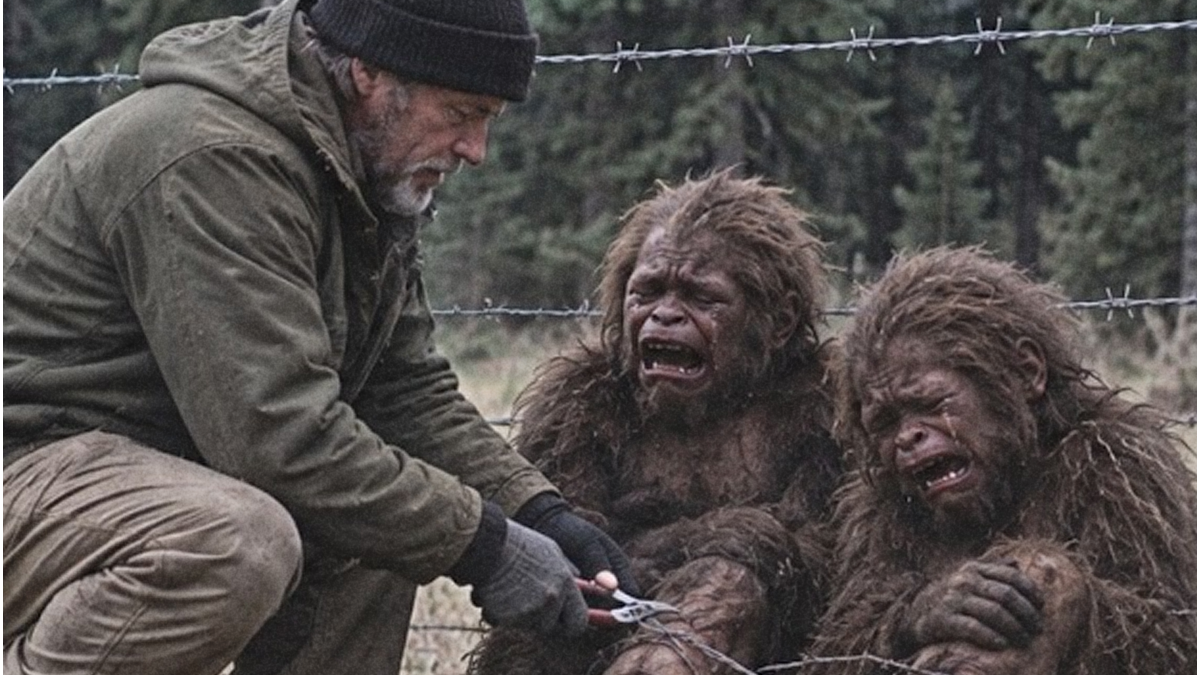
He Cut Two Baby Bigfoots Free From a Wire Fence – What Their Mother Did Next Shocked Him
I cut two Bigfoots out of a wire fence in 1984.
And what happened after that is the reason I’m telling this story now.
My name is Robert Talman.
I’m 73 years old and I’ve lived my entire life in Laflur County, Oklahoma, in the foothills of the Wittita Mountains, where the land is still rough and there aren’t enough people to fill all the space.
This is a story I never thought I’d tell, but I’m running out of time.
And there’s something about a thing like that.

You feel an obligation to say it while you can still shape the words, right?
Before we get into it, let me know where you’re watching from.
And if you’ve had an encounter like this, I’ve been a rancher for 50 years now.
That means I know cattle intimately.
I know what a spooked herd looks like, what spooks them, how they move when something predatory is in the country.
I know the difference between genuine fear and minor alarm.
I know when something doesn’t fit into the normal pattern of predator and prey that moves through ranch country.
I can read cattle the way some people read books.
I can look at a herd from a distance and know if something is wrong before I even get close enough to see details.
That skill came from my father who got it from his father before him.
It’s one of those things you don’t really learn from words.
You learn it by being around the animals day after day, year after year until you start to understand what they’re thinking and what they’re feeling.
In 1984, I was running about 200 head of Angus on a property that sat about 8 mi east of Talimea in a valley that runs between Winding Stair Mountain on the west and a series of smaller ridges to the east.
The property was about 400 acres, half cleared for grazing, half stillilled timber, mixed oak and hickory and some pines in the higher ground.
It was good land, my father’s land, his father’s land before that.
The Widas don’t give up land easily, but once you’ve worked it and maintained it and kept it operational for generations, it becomes part of you in a way that ownership doesn’t quite capture.
The work changes you.
The land changes you.
By the time I was 40 years old, I couldn’t really tell where the ranch ended and I began.
I’d inherited it from my father in 1978 and spent the first few years just keeping it operational, fixing fence, replacing rotted posts, all the work that comes with that much acreage.
When my father passed, he left the property to me with a handshake and not much else.
Words were never his strong suit.
He was a man who expressed himself through work, through keeping things maintained and functional.
But he’d written something down before he died.
A list, actually, things that needed doing on the ranch.
Work orders written in his careful handwriting.
I still have that piece of paper.
It’s in a drawer in my kitchen.
He died 3 years later without ever telling me to read it.
My mother gave it to me after the funeral, tucked it in my hand, and didn’t say anything about it.
The handwriting was his, but the advice was something deeper.
Every item on that list was something I would eventually discover on my own, some problem that would arise that he’d anticipated years earlier.
He’d left me a road map without ever saying so.
The work on a ranch is constant.
It never stops.
There’s always fence that needs repair.
There’s always equipment that needs maintenance.
There’s always some part of the land that’s suffering from weather or time.
Or the simple fact that nature is always working to return everything to its original state.
The forest taking back what man cleared.
You spend half your time fighting that tendency.
My father used to say the land and the man were in negotiation with each other.
The land wanted to go one way and the man wanted to go another and they met somewhere in the middle where work happened.
I didn’t understand that when I was young.
I thought it was just poetry.
Something he said that didn’t really mean anything.
But by 1984 I understood it completely.
The land does things to you.
It teaches you how to think about time differently.
It teaches you patience.
It teaches you that you’re not really in control of anything, that you’re just trying to influence things in a direction you prefer.
The grazing area was split into three pastures by wire fence, four strand barbed, and electric.
The electric was a relatively new addition, added maybe 15 years before by my father.
It wasn’t a barrier that would hold anything determined, but it was enough to keep cattle where they’re supposed to be, and it saved money on permanent structures.
You don’t need to stop a cow with force if you can teach it not to push on the fence in the first place.
The northern pasture ran down to a creek that flooded in spring and turned the low ground into a wash of mud and new growth every year.
The middle pasture was where I kept the breeding stock uh the cows and the one bull, a massive heraford named Pharaoh that I’d bought at auction in Oklahoma City and never regretted.
I’d driven 6 hours to that auction in 1979 to get him.
I’d seen his bloodlines were perfect.
His build was exactly what I needed for my breeding program, and he had this quality in his eyes that made me think he understood what was being asked of him.
He was a perfect specimen, broad-chested and thick-legged, with a kind of temperament that made breeding operations work smoothly.
He was reliable.
He didn’t spook easy.
He had sense about him the way some animals do.
He’s long gone now, but I still remember him the way you remember a good partner in difficult work.
The southern pasture was smaller, used for rotation, letting the grass come back after heavy grazing.
It bordered directly on the timber line where the forest started climbing toward winding stair.
I didn’t spend much time in the southern pasture.
Neither did the cattle, unless I pushed them there specifically.
The timber seemed to press inward from that direction.
That’s the only way I can describe it.
There was something about the way the forest met the cleared land that made the open pasture feel less open.
Like the timber was waiting for something.
Like the boundary between wild and worked land was active in some way.
I’d noticed it from the first year I was running the property, but I never mentioned it to anyone.
What would I have said?
That the woods felt watchful?
That I felt something observing from the treeine.
That’s the kind of thing people don’t take seriously.
People want their explanation to come with facts, not feelings.
But the land has feelings, too.
Or at least it acts like it does.
It was October 1984.
The first hard freeze had come through the week before, burned off the last of the summer insects, and turned the morning grass white with frost.
The days were still warm by afternoon, usually in the upper 50s, but the nights dropped into the high30s, and I was starting to think about winterizing the equipment, getting the generator serviced, all the November work compressed into October because winter here comes fast.
The Wittas don’t have winter the way other places do.
You don’t get snow usually, but you get cold that comes down from Canada and cuts through everything.
You get wind that follows the ridges and finds every gap in every building.
You get the kind of dampness that gets into your joints and stays there for months.
It’s not pleasant, but it’s the trade you make for living here.
My wife had been after me for years to move somewhere warmer, somewhere easier, somewhere with a gentler climate and fewer harsh seasons.
I’d always said no.
This was home.
This was the work.
You didn’t leave work just because it got hard.
I’d gotten up early, the way I always did, around 4:30 in the morning, and done the morning walk of the property.
That’s just something you do as a rancher.
You walk the fence line every few days.
Look for downed sections, places where animals have pushed through or dug under, spots where the posts are starting to rot and fail.
It takes time, but it saves money and it keeps things from falling completely apart.
The work is boring and it’s meditative at the same time.
I used to think through problems while I was walking.
My wife says I still do that.
Talking to myself about things she doesn’t understand, muttering about posts and wire and the cost of feed and hay and fuel.
But that’s the work.
You can’t think about it sitting at a desk in an office.
You have to be out there walking it, feeling it, understanding the way the land wants to be broken down and rebuilt by weather and time.
I was on the north fence line, checking a section that ran through a stand of oak, working my way east toward the corner where the fence met the creek.
The morning was clear and cold.
I could see my breath in white clouds that faded almost immediately in the still air.
The cattle were grouped about 40 yards south in the cleared pasture, already up and grazing, which was normal for the time of day.
A few of the cows lifted their heads as I passed, acknowledged me with the vague disinterest that cattle have for humans they see every single day.
They know you’re there.
They understand you’re part of the system that keeps them alive, but they don’t particularly care about you one way or the other.
The electric fence made a low hum, steady and reliable.
The posts were solid.
The wire was tight.
I was maybe 50 yard from the creek when I found it.
The northern fence line has three wooden posts every 500 ft where the electric wire runs through ceramic insulators.
They’re pressuretreated posts buried 4 ft deep in the ground and they’re good for about 15 years before the ground starts to rot them from the inside out.
One of these posts, the third one east of the creek corner, had been damaged.
The wire was torn loose from the insulators, hanging down in a tangled mess of copper and plastic.
The post itself was still standing, but the damage was fresh.
Fresh enough that I knew it had happened in the last day or two.
The wood where the insulator had been ripped off was pale and splintered, not weathered at all.
And around the base of the post about 2 ft of the fence to either side was bent and twisted where something heavy had put force on it.
The grass around the damaged section was also matted down as if something large had been pressing against the fence from the south side.
I stood there for a minute just looking at it.
Cattle don’t do this kind of damage.
Deer don’t do this.
This was something big pressing on the fence hard enough to stress the post itself.
The amount of force it would take to bend four strand barbed wire that way was substantial.
It would take something weighing several hundred lb at minimum.
I checked the clearing south of the fence.
No cattle were anywhere near this section.
They were all grouped near the water trough at the center of the northern pasture, calm, undisturbed, which ruled out any recent disturbance.
Whatever had happened here had happened the night before or earlier, not in the last few hours.
The damage was old enough that the splintered wood was already starting to dry out.
I made a mental note to get supplies to repair it and moved on, finishing the walk.
The rest of the fence was intact.
When I got back to the house, I called my neighbor Pete Harden, who lived on the adjoining property to the east.
We’d been neighbors for 6 years at that point, and we’d developed the kind of relationship that neighbors in the country have.
We’d helped each other with cattle, lent tools, warned each other about coyote presence, shared information about weather and grazing conditions and the general state of the land.
Pete had run cattle longer than I had, had seen more years of seasons and weather, and the way animals responded to change.
He’d seen things I hadn’t.
I asked him if he’d noticed anything unusual, any predators moving through the country, any reason his fence line might get stressed on the border between our properties.
He said no, nothing out of the ordinary, though he mentioned that his dogs had been acting strange the night before, wouldn’t come inside the house for their evening business, kept barking at something out in the dark toward his back property line.
He’d figured it was a raccoon or maybe a coyote and didn’t think much of it at the time.
But now that I mentioned it, his dogs had been acting off for a few days.
Just restless, wouldn’t settle.
He’d chocked it up to the season change.
The way animals get antsy when the temperature drops, but maybe there was something else moving through.
I thanked him and hung up.
I went back to the fence the next morning to do the repair.
I brought supplies, fresh wire, new insulators, a hammer and wire stretcher, the standard repair kit that any rancher keeps in his truck.
The damaged section was exactly as I’d left it.
The post was twisted harder than I’d initially realized, and when I looked closer, I found something I’d missed the day before.
There were marks on the post itself, four long grooves cut into the wood, running from just above ground level upward about 3 ft, as if something with large claws had gripped the post while putting weight on the fence.
The grooves were deep, gouging through the pressuret treated surface into the softer wood beneath, and they were fresh.
Fresh enough that the exposed wood was still pale, not yet starting to darken from exposure to air and light.
I stood there for a long time, looking at those marks.
Four parallel grooves, evenly spaced, each one at least a/4 in deep and maybe an eighth of an inch wide.
Whatever had made them had substantial claws and had pulled hard on this post while the fence was being stressed.
A black bear might leave marks like that.
The Wittas still had bears, though they were rare in the mid80s.
I’d only seen one in my life, and that was from a distance moving across a ridge line when I was hunting with my father, maybe back in 1971.
That was when I was young, maybe 25 years old.
My father pointed it out without saying anything, just a gesture.
We both just watched it disappear into the timber.
He didn’t say anything about it then.
He didn’t need to.
The sight of it was enough.
A huge dark shape moving through the high forest like it owned the place, which it did.
But the spacing on these grooves was wrong for a bear.
The grooves were too far apart.
The damage too high on the post for any bear I’d ever heard of.
I’d seen bear claw marks before on trees where they’d been scratching bark in summer looking for insects and loose wood.
This wasn’t that.
This was something with longer claws and a longer reach.
This was something holding on to the post with significant force, pulling down on it, using all its weight and leverage to stress the fence.
I ran my finger along one of the grooves.
The edges were sharp.
Whatever had made them had done so recently, within the last day or two.
The wood was still moist inside the cuts.
I repaired the fence carefully, paying attention to the post to see if it had cracked under the stress.
The wood was solid, no splits running up the grain that would suggest structural failure.
It would hold.
It would last.
I finished the repair by midm morning and drove back to the ranch.
I didn’t mention the marks to anyone, not even my wife at that point.
She was used to my silences anyway.
We’d been married 16 years by 1984, and she understood that I didn’t always share what I was thinking.
What would I have said anyway?
There was nothing concrete to prove anything, just a damaged fence and some marks on a post and a neighbor’s dogs acting strange.
Two nights later, the next section failed.
100 yards east of the first damage, another post torn and the fence twisted.
No marks this time, just straightforward damage, like something heavy had simply walked into the fence and pushed hard.
The wires were sprung outward like something had hit them from behind and kept going, moving through the barrier without stopping.
I repaired that one, too.
This time I stayed around until dark, sat in my truck about 50 yards back from the fence line with my rifle on the seat beside me.
Wanting to see what was doing this, I needed to know.
The sun set around 6:30 and the forest went from orange to blue to black as the trees ate the last of the light.
The temperature dropped fast.
I had the windows up, but I could still hear the cattle bedding down for the night.
The sound of them settling, groaning as they laid down in the pasture.
And I could hear the forest sounds, the night insects starting up, the distant call of an owl somewhere up toward winding stair.
Nothing unusual, nothing that suggested anything large was moving through the brush.
At 11 p.m., I gave it up and drove home.
Whatever was doing the damage, it had already done it and wasn’t coming back.
While someone was watching.
Animals know when they’re being observed.
They can feel it.
The third failure was on the southern pasture fence line, the one that bordered the timber.
That one was different.
The fence didn’t just break in one section.
About 200 yards of it was torn down, twisted into a tangled mass.
Posts snapped clean at the base like they were kindling.
And the damage pattern was confused, chaotic in a way that the first two weren’t.
This looked like a panic, a frantic push through an obstacle that wasn’t working.
Repeated attempts to clear or break through something that wouldn’t give.
The fence ends on either side of the damaged section were sharp and raw.
The insulation on the electric wire shredded.
Blood was on several of the twisted strands, dark and dried, old enough that I couldn’t tell if it was fresh from the previous night or older than that.
I called Pete again and told him to check his eastern fence line.
He drove over and we looked at the damage together.
Pete is a practical man, third generation rancher, has seen most of what the Wittas can throw at you over 50 years of living on the land.
He stood there looking at the destroyed fence for a long time without saying anything.
Then he said, “You know what that looks like?”
“What?”
Like something was running from something else.
Running hard.
Didn’t care about the fence.
Just needed it down and needed it down fast.
Whatever was moving had only one goal.
Get through.
I said I thought so too, but I didn’t know what to make of it.
What animal panics that badly?
Pete rubbed his jaw and said, “Whatever it was, it was big and it was scared.
It was running from something.
I’ll tell you that much.”
For the next week, nothing happened.
The cattle stayed calm.
The fences stayed intact.
I repaired the southern section, rebuilt all 200 yd, new posts, new wire, everything solid and strong.
The weather turned cold and mean.
Wind came in from the north and the temperatures dropped into the 20s at night.
Life went back to normal, or at least the normal of October turning toward November in the Wittetta foothills.
The rhythm of the ranch returned.
I stopped thinking about the fence.
That was my mistake.
Quick thing before we get into it.
I have a book coming out.
It’s called the Bigfoot Codeex.
It’s a compilation of all my research and findings.
It’s kind of my baby.
So, if you want to check it out, links down below.
Now, let’s get you back to the video.
I found the first one on the morning of October 27th.
I was doing my morning walk of the property, and I decided to check the southern pasture fence since I’d just finished the repair.
The fence was intact, the posts were solid, everything was in order.
But when I got to the far corner where the fence turned north toward Winding Stair, I found something that brought me up short.
There was a section of the fence about 15 ft where the grass beneath it was matted down hard and there was something caught on the barbed wire.
Fur thick coarse dark brown caught on the top two strands of the fence.
There was a lot of it, thigh enough to make a clump the size of a man’s fist.
I took out my pocketk knife and carefully cut a length of it from the wire, wrapped it in my handkerchief, and put it in my jacket pocket.
The fur was coarse and dense with a wiry texture that I’d never felt before.
Not cattle, not deer, not anything I could identify from any animal I’d worked with in my life.
I stood there looking at the fence and realized what I was seeing.
Whatever had come through the damaged section of fence two nights ago, it had been so panicked, so desperate to get back through the fence, to get back on the south side toward the timber that it had torn itself against the barbed wire in the process.
The first damage, the torn posts with the claw marks, that was something being stopped by the fence.
The frantic destruction of the 200yard stretch.
That was something trying to break out the bloody strands.
That was its own blood from forcing itself through.
I walked the perimeter of the southern pasture more carefully.
And I found what I was looking for about a 100 yards west of where I’d found the fur.
There was a section of fence that showed signs of something large trying to come through from the south, pushing against it over a period of time, the way an animal might push and push and push at a barrier it didn’t understand.
The posts were scarred where something had gripped them.
The wire was stretched outward rather than bent down or twisted.
And there was more blood on the wire, fresh enough that I could see it hadn’t fully oxidized, still dark red rather than brown.
I went back to the house and called Pete again.
I told him I’d found something and asked if he wanted to come look.
He said he’d be over in 20 minutes.
While I waited, I took the fur out of my handkerchief and looked at it in the daylight.
It was definitely not from any animal I could identify.
It was too coarse, too dense.
And when I held it up to the light, I could see that each hair had a structure that looked almost layered, striations running along the length of each strand, like a tree ring in miniature.
It reminded me of something I’d seen in a wildlife book years ago, an illustration of primate hair, chimpanzee, or something like that, but thicker and coarser by half.
I’d borrowed that book from the library once, back when I was trying to figure out what I’d seen on the ridge years before with my father.
Pete arrived and we walked the fence together.
I showed him the blood, the scarring on the posts, the area where the fence had been pushed outward rather than broken violently.
He was quiet for a long time.
Then he said, “Whatever that is, it’s on both sides of the fence.
It came through your southern pasture fence, spent however long in your pasture, and then went back through trying to get out.
That’s why the wire is pushed outward on the timber side.
It was trying to get back to where it came from.”
I said, “I thought so, too.”
And I showed him the fur.
He took it and looked at it carefully, rolled it between his fingers, held it up to his nose, and sniffed it the way a man will when he’s trying to get all the information he can from an object.
Then he handed it back to me and said, “I don’t know what that is.
I’ve never seen anything like it.
But I’ll tell you what worries me.
That wasn’t one animal.
That damage pattern, the amount of blood, the way the fence is torn up, that was something big and something smaller.
Two of them.
At least two.
I didn’t sleep much that night.
I kept thinking about what Pete had said.
Two of them.
Something large and something smaller.
The panic in that fence damage.
The frantic attempt to break back through and get to the timber.
I was lying in bed in the dark thinking about what animal could be that desperate that focused on escape and what it would take to make something like that happen.
Around 2:00 in the morning, I got up and went downstairs and called Pete.
I woke him up and asked him a direct question.
Have you ever heard of Bigfoot in the watchas?
There was a long silence on the line.
Then he said, “Not officially, but my grandfather had stories, old chalk stories about something in the high country, something that came down sometimes in the fall when the weather changed.”
He didn’t talk about it much, but I remember him telling me once that if you heard them, you left them alone.
They were territorial, but they weren’t aggressive unless you pushed them.
That they kept to the high ground mostly but sometimes came down when the season turned.
He said the old people called them the tall walkers.
They had their own rules.
They had their own territory and they respected it.
I asked him if he believed it.
He said he didn’t know what he believed, but he knew his grandfather didn’t lie.
The old man had never lied about anything in his life.
Never embellished, never exaggerated.
Everything he said was true as he understood it.
I thanked him and hung up.
The next morning, I saddled up a horse and rode out toward Winding Stair, working my way up into the timber that bordered my south pasture.
I wasn’t looking for anything specific.
I just wanted to see if there was any sign of what had come through, any indication of where they were.
The forest at elevation in the UAS is dense and old, mixed hickory and oak with some pine in the highest points.
The canopy blocks most of the light.
The ground is thick with decades of leaf mold and rotting logs.
There isn’t much undergrowth once you get under the canopy.
You can move through the forest without too much difficulty if you know how to step.
I rode for maybe an hour, staying on what old game trails I could find, and I didn’t see anything obvious.
No tracks, no droppings, no sign of large animals moving through the high country.
The forest was quiet in that specific way that makes you aware that something is watching, but you can’t see it.
The hair on my arms stood up without me being cold.
I was getting ready to turn back when I heard it.
A sound coming from higher up the slope, maybe a/4 mile away, like something heavy had fallen or pushed through thick brush.
The noise was muffled by distance and the canopy, but it was unmistakably the sound of something large moving through the forest.
I stopped the horse and listened.
The forest was quiet again.
The horse was tense, ears forward, nostrils flaring slightly.
It didn’t like whatever it had sensed.
The animal could feel something I couldn’t.
It was tugging at the rains to turn around.
I turned it and headed back down the slope toward the ranch.
I didn’t look back.
That afternoon, I made a decision.
I was going to trap whatever was coming through my south pasture, not to kill it.
The thought never occurred to me in those terms, but to catch it so I could see what it was, to understand it.
The damaged fence had given me an idea.
Whatever came through that fence was going to come back through it.
The pattern seemed consistent.
It was living in the timber and coming down to my pasture for a reason.
Then panicking and trying to get back.
The fence was an obstacle.
It didn’t understand.
I decided to use that against it.
I spent that afternoon and the next day building a cage trap.
I used heavy gauge welded steel pipe, the kind you use for cattle shoots.
Built a box about 8 ft x 6 ft x 6 ft with one end designed to drop a gate when the animal stepped on a pressure plate.
I rigged in the center.
It was crude, but it would work.
I’d used similar traps for smaller animals years ago, but never anything this large.
I wasn’t even sure the weight distribution would work for a large animal.
But I had to try.
I positioned it against the damaged section of the fence on my south pasture, aligned it so that anything coming through would have to go through the trap to move deeper into the pasture.
I left the gate open and baited it with hay soaked in molasses, something cattleike, and I waited.
Nothing came that night.
Nothing came the next night either.
But on the third night, October 30th, I was awakened around 3:00 in the morning by my cattle running.
Not just spooking and moving to the far end of the pasture, but running hard in panic, bawling, the sound that animals make when they’re genuinely afraid.
I got out of bed and went to the window.
The night was clear, moon nearly full, and I could see across the south pasture toward the timber line.
There was movement at the fence, large shapes moving along the fence line, and then one of them hit my trap.
I went downstairs and grabbed my rifle from the gun cabinet, not with any intention of using it, just because a man grabs his rifle when he hears sounds in the night that he doesn’t understand.
The weight of it in my hands was familiar, but in that moment, it felt foreign.
I went out onto the porch and stood there in the cold October dark, looking out toward the south pasture.
The cattle had calmed somewhat, were clustered at the far end of the pasture, still agitated, but no longer running.
The shapes at the trap were still moving.
I could see them clearly in the moonlight.
Two of them, large bipedal, moving with a kind of frantic energy that made my stomach turn.
I couldn’t see detail at that distance, just shapes.
But Pete had been right.
One was significantly larger than the other.
I went back inside and got a flashlight, and I was stupid enough to walk out across the south pasture toward the trap.
I don’t know what I was thinking.
That’s the kind of thing you do when your mind hasn’t caught up with what your eyes are showing you.
You act like it’s normal.
You approached like you would approach any other problem on your ranch.
I walked across the cleared pasture with my rifle in one hand and my flashlight in the other.
And the closer I got to the trap, the louder my heart got in my chest.
My hands were shaking.
I could feel sweat on my palms even though the temperature was in the high 20s.
The larger one saw me first.
It was in the trap, its body filling most of the interior space, its shoulder and part of its back visible through the gaps in the steel frame.
It was covered in dark brown fur, the same color as the fur I’d found caught on the fence.
Its face was oriented toward the trap opening, and when my flashlight beam hit it, the eyes reflected back at me.
Amber, bright in the flashlight glow, set in a face that was not quite animal and not quite anything I could describe.
The snout was elongated like a dog’s, but the cranium was wrong.
Too high, too developed.
The ears were pointed and alert.
I could see the edge of teeth in a partially open mouth, prominent canines.
It was terrifying.
And it was also, and I’ll try to describe this accurately because it matters, it was also desperate.
The smaller one was not in the trap.
It was just outside the trap, moving back and forth, making sounds that I couldn’t quite categorize.
Not barking, not howling, something in between, something that contained elements of distress and something else that I couldn’t identify.
It was trying to pull at the trap, its claws raking against the steel frame, trying to get inside or trying to pull the larger one out.
I couldn’t tell which.
The effort was causing sparks where the claws met the metal.
When my flashlight swung toward it, it turned its head and looked at me directly, and I felt something in my chest shift.
Those eyes, the same amber, the same intelligence, but smaller, younger, the face not fully developed.
I stood there with my rifle and my flashlight, maybe 30 ft from the trap, and I understood in that moment that I had captured something that I didn’t understand, and that the smaller one outside was experiencing something that I could recognize.
The smaller one’s distress was raw and immediate.
It pulled harder at the trap.
Its claws found purchase on the steel, and the metal rang with the force of its effort.
A sound came from it then, not aggressive, something that sounded almost like a call.
Not a howl exactly, but something that carried the same desperate quality.
The larger one inside the trap responded.
It wasn’t struggling anymore.
It was watching the smaller one and it made a low sound, something rumbling deep in its chest and I realized I was seeing something pass between them that I didn’t have language for.
Not just alarm, but communication.
The larger one was telling the smaller one something, telling it to be calm, telling it to wait.
I went back to the house and I called Pete.
And when he got to the phone, still half asleep, I said, “Come to the ranch.
Bring your truck and bring rope.”
He heard something in my voice that made him not ask questions.
He showed up 20 minutes later with just the truck and rope in the bed.
I showed him the trap and I watched his face process what he was seeing.
Pete had lived his whole life in the Uash.
His grandfather had told him stories.
He knew something about this country that most of us didn’t.
He stood there looking at the two creatures in and around my trap and he said, “We have to let them go right now.”
I asked him why, though I already knew.
He said, “Because if anyone finds out about this, they won’t be released.
They’ll be taken.
And if they’re taken, they’ll disappear and nobody will ever see them again.
I knew he was right.
It took us 3 hours to disassemble the trap.
We started with the rear panel, the side facing away from where the larger one was positioned.
The steel was heavy and awkward to handle.
We had to work carefully, undoing bolts that I’d welded and bolted for strength.
The work was slow.
My hands were shaking.
Pete’s weren’t.
He moved with a calm efficiency that I appreciated, focused on the task at hand without looking at the creatures more than necessary.
As we worked, the larger one was relatively cooperative once it understood that we weren’t a threat.
It’s strange to describe it that way, but cooperation is what it seemed like.
The moment I started removing panels from the trap, it stopped thrashing and went very still.
It was giving us a chance.
The smaller one watched us work with those intelligent amber eyes, never moving from its position just outside the trap.
Neither of them made sounds while we worked.
They were alert, but not panicked, not aggressive, just aware and waiting.
The side panels came next.
Pete unbolted them while I held them in place.
The night air was cold, our breath making clouds in the flashlight beam.
We worked methodically, panel by panel.
The larger one shifted its weight as we removed each piece of the enclosure.
Its movements were deliberate and controlled.
It was giving us space to work.
It was making this easier for us.
It understood what we were doing.
By the time we got to the last panel, it was close to dawn.
The sky was starting to lighten in the east.
The last panel came free, and the larger one moved out slowly, deliberately, moving with a kind of grace that something that large shouldn’t have been able to manage.
It was close to 8 ft tall, standing fully upright.
Its body was powerfully built, but proportioned like something that spent significant time on two legs.
Its hands were large with five fingers that were articulated and flexible in a way that suggested genuine dexterity.
The joints bent in ways that I’d never seen before.
The claws at the end of each finger were curved and dark and wickedly sharp, but in the way it moved its hands as it stepped out of the trap.
There was something gentle about them, something that suggested capability, but not immediate threat.
The smaller one moved to it immediately, and the larger one placed what could only be described as a protective arm around its shoulder.
For a moment, they just stood there.
Both of them were looking at me and Pete.
Both of them were looking at us with those amber eyes, and I felt the weight of being seen.
Really seen, not as a threat or as prey or as a rival, but as something that had made a choice in that moment.
The choice to release them, the choice to let them live.
I said something, I don’t remember what.
Something like it’s okay or go on.
Pete didn’t say anything.
He just stood there.
The smaller one looked at the larger one and the larger one turned toward the fence line and the timber beyond.
They looked at me and Pete standing there with the disassembled trap panels around us in the pre-dawn cold.
And then they moved, not running, not panicked, just walking with purpose back toward the fence line and the timber beyond.
The smaller one turned its head once as they reached the fence, looked back at me and Pete, and then they went through the fence where I had cut it down, and stepped into the timber and disappeared into the darkness.
Pete and I stood there in the pre-dawn cold without speaking for a long time.
Then Pete said, “You never saw them.
I never saw them.
Nobody saw them.”
I said, “Okay.”
He helped me reload all the panels onto his truck and we drove them to a ravine about a mile from the ranch and pushed them over the edge where they rolled down into the underbrush and disappeared.
Then Pete went home and I went back to the house.
I didn’t sleep that morning.
I sat on the porch and watched the sun come up over the eastern ridges.
The sky went from black to purple to blue.
The temperature started to climb.
By the time the sun cleared the ridges, it was warm enough that I didn’t need my jacket.
I sat there and I didn’t think about anything.
I just sat there.
The memory of those amber eyes stayed with me, though.
I kept seeing them.
Kept seeing the way the smaller one looked back before disappearing into the forest.
Kept seeing the protective way the larger one held it.
That image has stayed with me for 40 years.
Every now and then, usually at night, I’ll see those eyes again, the younger ones eyes.
They had a question in them, or maybe a kind of thanks.
I’ve never been able to decide which.
I repaired the fence the next day, put it back together the way I had built it, solid and complete.
I didn’t mention the damaged section or how I’d cut it down.
I just went back and made it all intact again.
I worked methodically, post by post, strand by strand.
The work was repetitive and familiar.
My hands knew what to do.
By the time I finished, the afternoon was turning gray.
A cold front was moving in.
Rain was coming.
I packed my tools and drove back to the house.
That was in 1984, 40 years ago.
I’ve never told anyone about this until now, except for Pete.
And Pete passed away in 2012.
Heart attack.
He was working cattle and just fell over.
They found him in the south pasture, which seems fitting somehow.
My wife doesn’t know.
My kids don’t know.
I’ve never mentioned it to anyone.
The property has changed hands twice since then.
The fence came down eventually.
There are houses on parts of it now.
The timber on Winding Stair is still there, though.
The high country is still wild.
I’ve thought about those two for four decades.
I’ve wondered what brought them down from the mountains that fall.
I’ve wondered if they were mother and child.
I’ve wondered if the panic and desperation to get back through the fence meant they were running from something or if it just meant they needed to return to where they belonged.
I’ve thought about what would have happened if I’d made a different decision that night.
If I’d called the authorities, if I’d wanted to prove what I’d seen instead of letting it go.
I’ve thought about what kind of future those two would have had if someone else had found that trap first.
There’s a part of me that wishes I’d kept the evidence.
The fur, a photograph, something concrete, but that part is small and quiet.
The bigger part of me knows that those two creatures lived because I didn’t try to prove anything.
When I’m out in the high country now, when I’m in the forest at dusk, I feel like something is aware of me.
Something is watching from a distance.
Not hostile, just aware.
Just acknowledging.
That’s all I need.
I’m old now.
I’m not going to live forever.
And I think about what Pete said in the dark.
You never saw them.
Because the truth is, I did see them.
I saw two creatures that shouldn’t exist.
I saw intelligence in those amber eyes.
I saw desperation and then relief when I dismantled that trap.
I saw a small one look back at me as it stepped into the forest.
And I felt like I was being seen in return.
I felt recognized in a way that I can’t quite explain.
The reason I’m telling this now is because I want to say it plainly while I still can.
If you encounter something in the deep woods that shouldn’t be there, something that doesn’t fit into any category you can name, I want you to think about this story.
I want you to consider that there might be good reasons to let things remain hidden.
I want you to think about what it means when a wild creature, something powerful and dangerous and utterly alien to human experience, trusts you enough to stand still while you take apart the cage it’s caught in.
There’s a responsibility that comes with seeing something like that.
A responsibility to decide what you’re going to do with what you know.
I chose to let it go.
I chose to let it live.
I chose to keep it secret.
I don’t know if that was right.
But I’ve had 40 years to live with it.
That’s more than I thought I would get.
That’s more than those two might have gotten if I’d made different choices that night.
That’s all I’ve got.
Two creatures in a wire fence in 1984 in the Witta foothills and one man’s decision to do the thing that might have been right instead of the thing that might have been provable.
When I close my eyes now, I don’t see the trap or the fence or the desperation.
I see the smaller one turning its head one last time before disappearing into the forest.
I see those amber eyes looking at me with an intelligence that matched my own.
I see an understanding passing between us in that moment.
That’s enough for me.
Heat.
Heat.








