The Insane Way This Giant Volcanic Machine Helped Grow Crops
The Insane Way This Giant Volcanic Machine Helped Grow Crops
Let’s take a trip back to the 1850s to a time when steelworks began using a massive iron cauldron that was mounted on huge pivoting arMs.
This machine was built like a loaded cannon ready to fire.
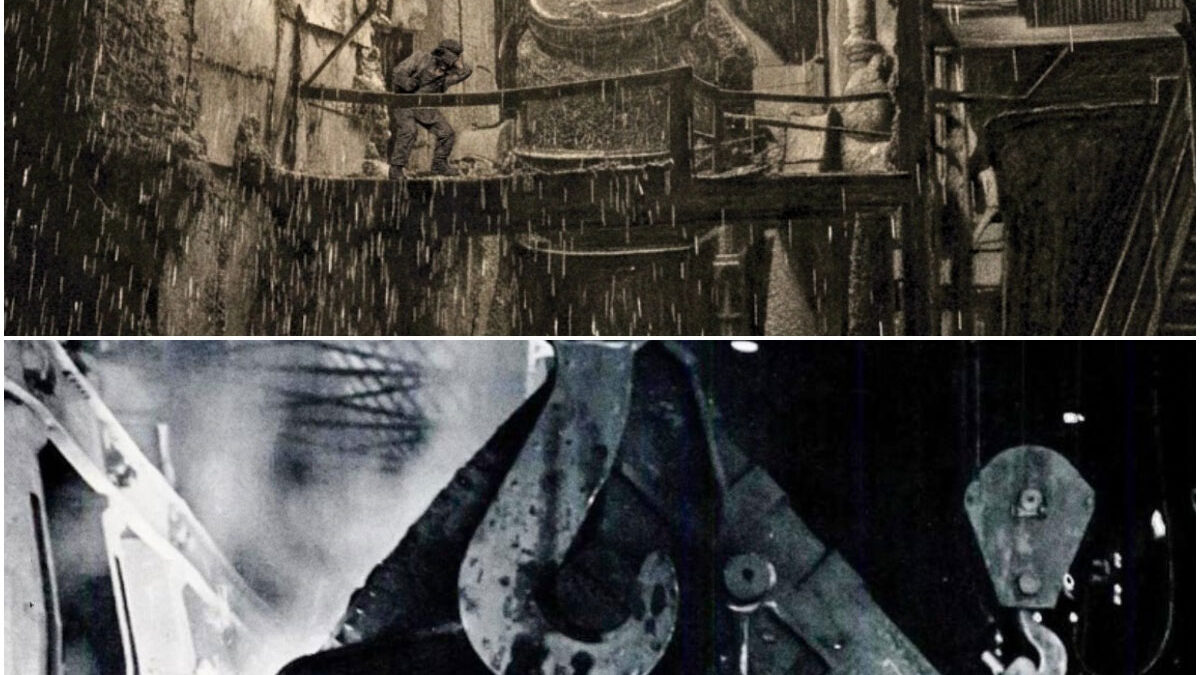
When it ran, the opening turned into a hard white glare and the flame through sharp moving shadows across the shop.
The heat at the mouth pressed forward and men worked inside the edge because the job required.
But here’s what made this machine truly unusual.

It did not just turn iron into steel.
It also left behind a dark rocky waste that looked worthless where it fell.
This is the story of the Bessemer converter, a violent steel-making process and a surprising role that it played in farming and agriculture, a twist that will absolutely shock you.
In 1856, Henry Bessemer advanced a claim that challenged the established practice in steel-making.
Steel was known for being slow, difficult, and expensive to make, but the bigger issue was speed.
Bessemer said that making small batches with repeated heats and careful handling couldn’t keep up with the rapid building of bridges, artillery, and cities.
His idea did not require a bigger furnace or new ore.
Instead, he believed the iron itself could provide most of the heat during the process as impurities burned off.
When he spoke to engineers and ironmasters, he promised malleable iron and steel without fuel.
Many were wary of this since heat usually came from fuel and from time.
Some saw it as a breakthrough, while others thought it was a risky bet that should hurt investors if it failed.
If it worked, the process would turn steel from a rare material into something widely available, changing who could buy rails, tools, and ship plates.
The push for speed and strength, driven by industry and military needs, explains why the idea got so much attention.
Speaking of attention, since I have yours, please subscribe if you enjoy stories like this.
It truly helps me to continue making more historical videos.
Thank you so much.
In the months that followed, workshops all over Britain discussed Bessemer’s promise and what it could mean, even among people who had never met him.
Then the first shop tried it, and the whole place fell completely silent, because nobody knew what would happen next.
Early trials showed what the blow could do to a confined workshop.
Blows took place in rough shops with hard floors and tight walls, leaving little room to move if the vessel acted up.
Even men used to furnaces stepped back when the process changed from steady heat to a sudden surge, since there was no time to react once it started.
Bessemer later wrote that the first trials could fling hot material outward, enough to land on clothing and ignite it.
The risk extended beyond the main heat at the mouth of the vessel, but smaller fragments could strike with little warning.
Workers usually noticed the sound first, a low rumble that grew into a harsh roar, then saw a brightness strong enough to hurt their eyes.
And in that environment, timing was crucial, so the work had to be finished before the metal cooled.
I don’t know about you, but this is already sounding like too much for me to handle.
To make things safer, they tried covering the opening with a heavy iron plate hung above it like a shield.
The goal was to catch spray and to keep it from escaping into the shop.
But in those early attempts, the risk remained and showed how hard the process was really to control.
At the time, observers offered different explanations for the violence, including the force of the air blast and the behavior of molten metal under that pressure.
And at first, this setup seemed to make things safer.
But then the plate started to change color, shifting from a dull red to a bright glow as it got hotter, until the glow itself became the warning sign.
Bessemer wrote that it became rapidly red hot.
And then that’s when the protection failed.
The plate softened, melted, and fell away, leaving only the chain hanging down into the glare, and opening was once again exposed.
For the men below, the failure had more of a practical meaning.
A device meant for safety could become an additional hazard, and the attempt to shield the mouth to create new risks in the same exact space.
People gave different reasons for why the plate failed, such as the force and the direction of the blast, or how the heat rose from the mouth.
Whatever the reason, the shield wasn’t the fix.
So crews had to accept that danger as part of the job.
Work continued because steel production requires sustained output, and crews had to operate around the opening to do their jobs.
And then once the shop learned it would have to learn with the risk, that’s when the real consequences began.
By the 1870s, the main consequence was less about the spectacle of the blow itself, but the shift that it introduced in industrial authority.
And people felt it long before they could name it.
Steelmaking was no longer a closely guarded craft that was done in small batches.
The converter let one vessel produce in minutes what skilled workers used to make with slow, careful heats.
Changing effectively what was considered to be skillful work.
This is very similar to what we’re seeing in today’s day and age with the use of AI.
In towns used to old iron working routines, this change affected people’s status and their jobs.
A worker might spend years learning how to run a furnace, only to find that experience mattered less as production became faster and more repetitive.
The converter looked plain for its important role.
Squat, heavy in weight.
When the blow started, people in Bessemer’s time called it beautiful and terrible all at once.
A contradiction that fit the changes it brought to the workers’ lives.
Owners and investors cared about what this meant for control.
They saw output as something that could be made steady and repeatable, and they knew that having lots of steel would shape big projects.
This explains why Andrew Carnegie invested in Bessemer converters at the Edgar Thomson Works.
He was betting that this technology would decide who can make steel cheaply enough to lead the market, set the rules, and leave others behind.
Workers felt the change in more subtle ways.
They still had skill, and they had pride.
But the old respect for specialists who made steel by hand faded as the machine slowly took over with more speed and more volume.
Some people called this progress, while others saw it as a loss.
Either way, both views showed that power in steel making was shifting to the converter.
What do you think?
Are you in favor of progress and advancement in new technologies, or do you prefer the old way of doing things?
Let me know in the comments below.
But in any case, as we’ll see, once money backed the converter, time then became the biggest challenge.
In 1890s, large American steel works operated on schedules that left little room for reSt. And the timetable belonged to the plant, and definitely not to the men.
The converter was at the heart of production, and when it was ready, crews had to be ready, too.
Shifts overlapped, meals were rushed or they were missed, and workers managed their fatigue so that the next blow could not be delayed.
In that environment, the scale of production showed up in daily routines.
Workers could see how big the projects were, but also knew that the real risks of keeping up the pace under constant time pressure.
A steel worker from the Homestead era summarized a long-term role in a single line.
You don’t notice any old men here.
That remark pointed to what heat, strain, and extended hours could do to bodies over time, even without a single dramatic moment to point to.
Carnegie’s investment relied on that heavy pace.
The idea was to make more steel, more quickly, and at a lower cost, so the country could use it for things like structural beams in new buildings.
For the workers on the floor, the effects were personal.
They stayed on duty during active blows, so they carried the demands of the schedule even after their shifts ended.
Overtime, the danger became less obvious as the noise and the heat turned into the background of daily work.
What followed was a new kind of danger that did not announce itself.
By the late 1890s, one of the most consistent hazards was the sensory environment itself and it shaped every decision that the men made on the floor.
On the converter floor, heat and noise were always present and the machine could be loud, it could be violent, and it could be very unpredictable.
In that setting, even the smallest mistake could be deadly before anyone could react.
So, regular routines were treated as safety measures and not just habits.
This meant that the work demanded constant attention during the heat.
Once a blow started, workers cannot let their focus slip, not even for a second, since the process changed so quickly and the area was truly unforgiving.
But, their bodies still got tired even if the work didn’t slow down.
One visitor wrote that the blow actually looked like a ferocious geyser of flame and sparks, an image meant to convey both scale and volatility.
The same account described a fluttering, humming roar that silenced all else, emphasizing how sound dominated the space as completely as the light and how little room there was for ordinary speech.
In that environment, pride showed through repetition and endurance, not through their words.
Men came back to work after seeing what heat could do to skin and what flying slag could do to an unprotected face.
So, caution became just as important as the art of being skilled.
People gave different reasons the dangers, like management pushing for speed or how molten metal acted under the forced air.
Whatever the reason, the result was the same.
Constant exposure and repeated risk could shorten a worker’s life in return for a simple paycheck.
Then came the kind of incident people remembered.
One that was incredibly fast, bright, and too close for comfort.
In 1893, witness accounts of the Bessemer blow emphasized the force of the event as it appeared to observers, and it almost sounds more like a safety report than an actual story.
Writers described the harsh brightness and a pressure that made the air seem to shake.
They also said the converter could turn and explode like a cannon or like a volcano throwing white-hot slag into the area around it.
So, the danger reached well beyond the vessel itself.
So, these conditions affected how the converter was used every day.
It was now seen as a high-risk process that needed constant teamwork and caution during each blow, and the mistakes had immediate consequences.
Despite that, production continued during this period as steel demand expanded for large construction and transport infrastructure.
The operating reality included sustained strain, injuries, and the discipline required to work alongside a process that could turn hazardous in a moment’s notice.
And once steel got cheap enough, it started appearing in places that nobody expected.
That’s because in the first years of the 1900s, steel produced in large works became visible across the country in finished structures, and the change was measured in distance and height.
Steel showed up in rail lines connecting towns and regions, and in bridge parks that carry traffic over rivers on spans that were much heavier and longer than old wooden bridges.
For people who remembered muddy roads and timber structures, this change made the landscape feel rebuilt and more permanent.
Steel also spread to shipyards, where thick plates and frames supported bigger, stronger ships.
Along the waterfront, the sound of metal work became a regular part of city life as ships were built from standard steel parts, and the ports grew busier with work that hadn’t been possible before.
In cities, steel frames made taller buildings possible with beams stacked into strong skeletons that rose above old masonry limits.
For workers, the height and exposure brought new risks, but the new frames made fast, large-scale building normal.
The change wasn’t limited to big projects.
Steel became a daily part of life through tools, nails, and miscellaneous hardware that made building stronger, and it helped on farms, even for people who never saw a furnace or converter.
The material reached far beyond the mills.
Overall, the spread of steel changed what people could build, how fast they could build it, and how everyday work was done in towns, ports, and the countryside.
But the part that most people never saw was what was left behind after the heat.
What you’re about to learn is probably the most shocking twist to this entire story.
I know it was for me, at leaSt. The end of a blow began a separate phase of handling on the converter floor, and the work shifted from the heat to the removal.
After the process ended, workers scraped out what was left, a black stony waste that built up quickly and had to be cleared before the next heat.
On the floor, it didn’t look useful, but at first it was just seen as something to get rid of.
Owners, though, didn’t always see it as trash.
In steel towns, leftover material could be weighed and sold, so the waste started to be managed as a way to make extra money.
The material didn’t stay at the mill.
It was loaded up and hauled away because buyers wanted it.
So, moving it became a regular part of the job instead of just throwing it away.
This shift was associated with a later development in steel making, the basic version of the process known as the Gilchrist-Thomas method.
It addressed ores with higher phosphorus content, a problem that could produce brittle, unreliable steel, and limit the usefulness of certain deposits, and it changed what the process left behind.
The new method pulled phosphorus into the slag.
It didn’t make the converter any safer, but it changed the byproduct, and the material can now be valuable outside the mill.
Once there was a market for it, the waste was shipped out through normal trade channels.
Selling it was one thing, but the bigger question was why it was worth buying it all.
In 1882, this major shift in steel making forced mills to choose between geography and chemistry.
That year, Sidney Gilchrist Thomas and Percy Gilchrist introduced the change that we just mentioned.
This change let steel makers use iron from ores that had been considered hard to work with.
In many areas, phosphorus in local ore made steel behave badly, so even towns with good deposits struggled to use them well.
Their breakthrough shifted the industrial bounds by letting more areas compete in steel production.
People talked about the waste from the new method differently than regular slag.
It got practical names like Thomas slag, Thomas phosphate, and basic cinder, which made it easier to trade and discuss outside the mill.
Public attention focused less on workshop details than on the commercial result.
Steelworks could sell a byproduct that had previously been discarded, and the potential buyers included farmers.
Biographies of Thomas mentioned that he tested the waste as a soil additive, and the idea caught on because it opened up a new market for mills.
This also had a geographic impact since places like Lorraine, once limited by their ore, can now grow quickly in the steel industry, changing what steel towns can effectively become.
As a result, people who had nothing to do with steelworks would later use these byproducts in everyday farming.
Away from the furnace, the same material became something that people spread by hand.
In the 1920s, basic slag from steelmaking entered agricultural use well beyond the mill districts, and it moved under ordinary farm accounting rather than industrial pride.
Farmers started buying it, crushing it into Thomas meal, and spreading it over worn-out fields.
The material looked like dark grit, but it was valued for putting phosphates back into soil that had lost them from years of use.
Farm writers at the time talked about it in practical terms, usually as a cost per acre, not because of any link to steel towns.
Vineyard and farm journals called basic slag a strong phosphate fertilizer for certain soils, listing it with other materials like bone meal and guano.
The use of this byproduct created a direct link between steel making and farm work.
Who’d have thought?
Someone who never saw a converter could still handle its leftovers as part of daily field work.
And what mattered most was how it helped the soil.
In parts of Britain and continental Europe, this fertilizer became common on grazing soils that lacked enough phosphate for good yields.
It was shipped in bulk and used regularly based on soil tests and farmers experience with what worked.
Early 20th century farm reports show that the basic slag was mainly used on pastures, clover fields, and root crops.
Farmers spread it on turnips, swedes, and hayfields, especially in areas with low phosphate levels.
Research stations found that slag worked best on heavy or acidic oils where other fertilizers were too expensive or they didn’t work as well.
When the clover grew well, pastures improved and crop rotations saw better forage for growth.
In practice, this led to more consistent yields from the same land.
While it did not always ensure success, under the right conditions, it became a regular part of farm budgets, bought, delivered, and used like other farm supplies.
By then, phosphorus had passed through two systeMs. It was taken out in the mill to keep steel quality high and then used in fields to help keep soil fertile.
Back at the mill, meanwhile, risk remained part of the job.
One steel worker recalled the conditions in plain language.
“Jesus, it was hot,” he said, and warned that wet molds could trigger an explosion that sent metal outward.
So, the same industry that produced useful residue also carried immediate physical danger.
And in that setting, steam and molten iron can turn a small mistake into sudden catastrophe.
The same industrial system that put heavy strain on workers also made a material that improved the farm fields.
Records show a time when waste became a commodity, but regular people took on both the benefits and the risks that came with it.
On farms, it came as Thomas meal, measured by the acre, spread by hand, and valued by how much the soil improved.
I hope you learned something today, and thanks again for listening and for watching.
Take care until next time.








