My Married Neighbor Left a Christmas Gift at My Door – Inside Was a Confession I Never Expected
My Married Neighbor Left a Christmas Gift at My Door – Inside Was a Confession I Never Expected
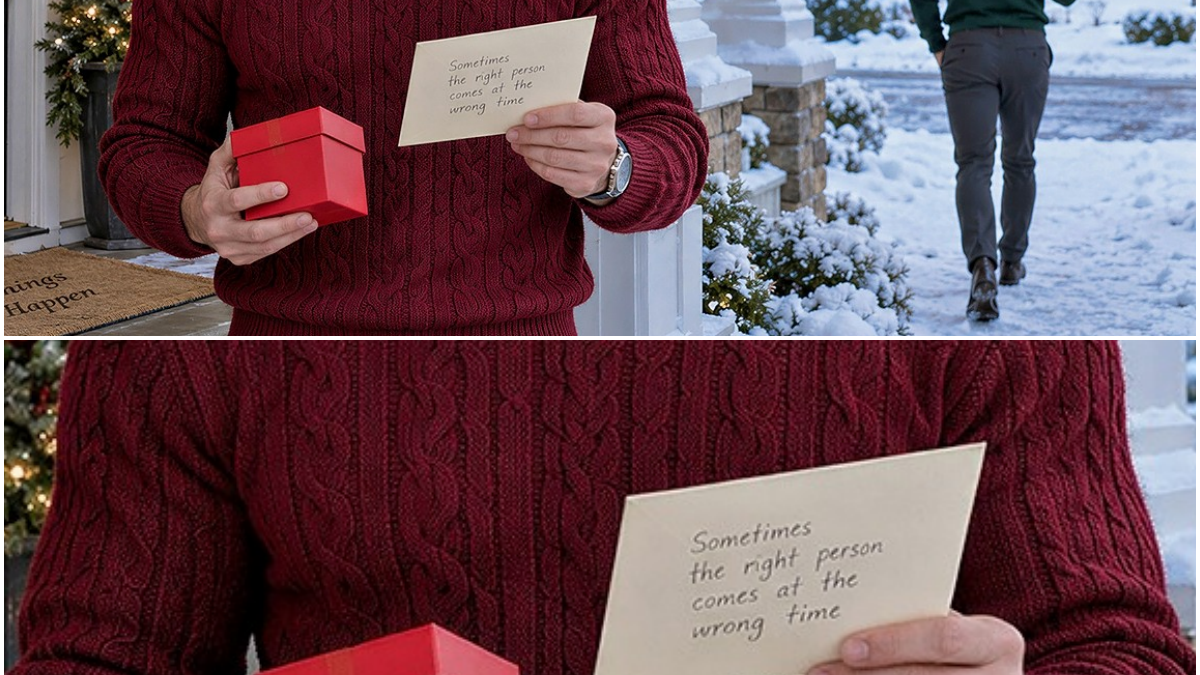
Stupidly festive in its pristine matte red paper.
A small box waited stubbornly on my welcome mat on Christmas Eve.
The neatly creased package seemed to bleed a manufactured artificial holiday cheer directly into the freezing gray concrete of my porch.
Assuming it was a cheap tin of assorted cookies, I prepared for the usual guilt-driven obligatory offering pitying neighbors thrust upon the cynical single guy living next door.

Cracking the lid, however, revealed an absolute absence of baked goods.
Resting inside was merely a worn silver lighter I had inexplicably lost months ago, pinned securely beneath a single handwritten note that effectively detonated the quiet, insulated life I had built.
My neighborhood is the kind of place where people hide their misery behind freshly painted shutters and perfectly edged lawns.
It’s a quiet, affluent suburb on the outskirts of Boston, where the most pressing issue on any given Tuesday is whose dog shhat on whose property line.
I moved here 3 years ago after a bad breakup, seeking isolation disguised as domestic peace.
I got exactly what I paid for.
Silence, solitude, and a front row seat to the slow motion train wreck living right next door.
Dean and Greg were the neighborhood’s golden couple.
They were the men everyone pointed to when they wanted to prove how progressive the HOA had become.
Greg was a corporate litigator.
He wore bespoke suits that probably cost more than my car.
And he walked with the rigid clipped stride of a man who was perpetually 15 minutes late to a very important meeting.
He was handsome in a cold angular way.
The kind of handsome that looks great in a photograph but feels like standing next to a freezer in person.
Dean was different.
Dean was the one who kept the illusion intact.
He was a former residential contractor who had spent their first year in the house tearing it down to the studs and rebuilding it into a modern architectural marvel.
While Greg was in the city billing $800 an hour, Dean was out in the yard.
He wore faded flannel shirts and jeans covered in sawdust.
He had dirt under his fingernails and a smile that never quite reached his eyes.
I’m a cynical man by nature.
You don’t get to your late 30s as a single gay freelance graphic designer without developing a thick layer of emotional calluses.
I don’t believe in soulmates.
I don’t believe in happily ever after.
And I certainly didn’t believe in the flawless facade of Dean and Greg’s marriage.
I saw the cracks because I was looking.
My home office window directly faced their driveway.
It wasn’t voyerism.
It was just geography.
But over the months, I learned the rhythm of their unhappiness.
I noticed how Dean’s shoulders would physically drop 2 in whenever Greg’s black Audi pulled into the driveway.
I noticed that they never unloaded groceries together.
I noticed the muffled sharp tones of arguments that drifted across the property line on warm summer evenings, quickly followed by the slam of a heavy oak door.
And then there were the conversations at the fence.
It started innocently enough in late September.
I was on my back patio nursing a terrible cup of coffee and a worse cigarette.
I was trying to quit smoking, which meant I was smoking constantly, just with more guilt.
Dean was on his side of the low cedar fence, aggressively pruning a row of hydrangeas that didn’t need it.
He stopped, wiped his forehead with the back of his forearm, and looked over.
“You’re going to kill those,” I said, leaning against the wood.
Dean blinked, looking down at the shears in his hand as if he’d forgotten what they were.
The flowers?
No.
Well, yes, but I meant your lungs or mine.
Secondhand smoke.
I took a drag, fully aware of my own hypocrisy.
Dean gave a short, breathless laugh.
It was a good sound, rough around the edges.
He walked over to the fence, stripping off his heavy leather gardening gloves.
He smelled like damp earth, cut stems, and expensive cedar cologne.
I could use a vice, Dean said.
His voice was low, tired.
Got an extra?
I tapped the pack against my palm and handed him a cigarette.
I pulled a cheap silver Zippo from my pocket, a flea market find I’d carried for years, and flicked it open.
Dean leaned in, cupped his hand over mine to block a wind that wasn’t blowing.
His skin was warm, calloused.
He held my hand a fraction of a second longer than necessary after the tobacco caught.
He inhaled deeply, closing his eyes.
When he opened them, he didn’t look at the sky or the trees.
He looked directly at me.
“Greg hates the smell of smoke,” Dean murmured, the cigarette dangling from his lips.
“Good thing Greg isn’t here,” I replied.
We stood there in silence for 10 minutes, two men separated by 3 ft of wood and a chasm of unspoken boundaries.
“When he finished, he handed the butt to me so I could crush it in my ashtray.”
“Thanks, Archbald,” he said.
Anytime, Dean.
That was the beginning.
Over the next two months, the fence became our confessional.
We never talked about his marriage.
Not directly.
We talked about the weather.
We talked about my stalled design projects.
We talked about the trivial, meaningless things that people use to fill the terrifying void of human connection.
But beneath the words, there was a current, a heavy electric pull that I actively tried to ignore.
I was lonely, not stupid.
You don’t sleep with married men.
You especially don’t sleep with married men who live 30 ft away and share a property line.
In November, during one of our smoke breaks in the freezing rain, I left my silver Zippo on the wooden post.
When I went back an hour later to retrieve it, it was gone.
I assumed it had fallen into the wet mulch.
I didn’t ask Dean about it.
I just bought a plastic gas station lighter and told myself to stop lingering by the fence.
I spent December actively avoiding him.
I kept my blinds drawn.
I worked late into the night with headphones on.
I convinced myself that the tension was entirely in my head, a product of isolation and a neglected libido.
Greg and Dean threw a massive catered holiday party the week before Christmas.
I received an invitation on the heavy card stock.
I threw it in the trash and spent the evening watching the caterers carry silver trays of ordurvas through their brightly lit windows.
Feeling a bitter sense of superiority, I was safe in my cynicism.
I was untouchable until Christmas Eve.
The snow started falling around 4:00 in the afternoon on the 24th.
Thick, heavy flakes that buried the streets and muted the sounds of the neighborhood.
By 8:00, the world outside was a white, frozen tomb.
I was perfectly content.
I had a bottle of 12-year-old scotch, a frozen pizza in the oven, and zero obligations to pretend I was full of holiday spirit.
I was sitting on the couch, half watching a terrible old action movie, when I heard the distinct crunch of boots on the snow covering my porch.
I muted the television.
The floorboards creaked outside, a soft thud.
Then silence.
I waited two full minutes before getting up.
I unlocked the deadbolt and pulled the heavy door open.
A blast of icy wind hitting me in the chest.
There was no one there.
The street was empty, bathed in the sickly orange glow of the street lights, but there was a set of footprints leading from my porch across my lawn and straight into Dean and Greg’s driveway.
And on my welcome mat, sitting perfectly centered, was the red box.
It was small, the size of a jewelry box.
It was wrapped meticulously in thick matte paper with a black velvet ribbon tied in a precise square knot.
I picked it up.
It was heavy for its size.
I brought it inside, kicking the door shut and locking it behind me.
I stood in my kitchen for a long time, just staring at the thing on the granite counter.
My heart was doing a slow, heavy rhythm against my ribs.
Logic told me it was a neighborly gesture.
Greg probably forced Dean to distribute gifts to the block to maintain their pristine image.
It was probably a jar of artisal jam or a heavy crystal paper weight.
I pulled the velvet ribbon.
It slid away with a soft hiss.
I tore the paper.
Inside was a plain black cardboard box.
I popped the lid off.
Resting on a bed of dark tissue paper was my silver Zippo lighter, the one I’d lost in November.
I stared at it.
I didn’t touch it.
Tucked neatly into the lid of the box was a piece of heavy cream colored stationery.
I recognized the monogram at the top.
DH.
My fingers felt numb, and it had nothing to do with the cold air I’d let in.
I unfolded the thick paper.
The handwriting was messy, jagged, completely at odds with the expensive stationary it was written on.
Archbald.
I didn’t lose this in the mulch.
I didn’t forget to give it back.
I took it.
I kept it in my pocket every day for the last 6 weeks.
Whenever Greg is talking at me about his billable hours, or whenever I’m sitting in this massive empty house he bought us, I hold it.
I keep everything you give me.
Even if it’s just 10 minutes at a fence, I am drowning over here.
My marriage isn’t a marriage.
It’s a corporate merger.
And I’m a depreciating asset.
I’m suffocating under the weight of this perfect life.
And the only time I can actually breathe is when I’m standing in the freezing cold smoking a cigarette I don’t even want just to look at you.
I know you see it.
I know you’re smart enough to see through the Tell me I’m not crazy.
Tell me you feel it, too.
I’ll be at your back door at midnight.
If the porch light is off, I’ll turn around, walk away, and never bother you again.
I swear, Dean.
I read the note three times.
The words began to blur together into a singular terrifying threat to my existence.
I looked at the clock on the stove.
10:14 p.m. “Jesus Christ,” I muttered to the empty kitchen.
I poured myself three fingers of scotch and drank it fast enough to burn my throat.
I paced the length of my living room.
I walked to the back window and parted the blinds with two fingers.
Dean and Greg’s house was ablaze with light.
Through the massive picture windows of their living room, I could see them.
They were hosting again.
Extended family, probably.
I could see Greg in a sharp navy blazer, holding a wine glass, laughing at something a woman in a sparkly dress was saying.
And then I saw Dean.
He was standing by the kitchen island away from the crowd.
He was wearing a dark sweater.
He wasn’t smiling.
He wasn’t talking.
He was just standing there staring blankly down at the marble countertop.
As if he felt me watching, he suddenly lifted his head and looked straight through his window across the dark expanse of our snowy yards, directly at my house.
I dropped the blind and stepped back as if I’d been burned.
My mind was a chaotic mess of self-preservation and suppressed desire.
This was messy.
This was a nuclear bomb wrapped in red paper.
If I left that light on, I wasn’t just inviting a man into my bed.
I was inviting a divorce, neighborhood gossip, screaming matches on the lawn, and the complete destruction of the quiet life I had built.
Turn off the light, Archabald, my brain demanded.
Go to sleep.
Throw the lighter in the trash.
You don’t want this.
But the truth, the ugly, pathetic, deeply human truth, was that I had spent the last 3 years feeling completely invisible.
And this man, this beautiful broken man next door, had been keeping a piece of cheap metal in his pocket just to feel connected to me.
11 RPM, I paced.
11:30 p.m. I sat on the floor with my head in my hands.
11:45 p.m. I walked to the back door.
My hand hovered over the light switch.
If I flipped it down, the back porch would go dark.
The signal would be sent.
Safety would be secured.
I looked at the silver lighter resting on the counter.
I didn’t touch the switch.
The yellow bulb on the back porch remained on, casting a harsh, unforgiving circle of light onto the fresh snow.
I sat down at the kitchen table, and I waited.
At 11:58 p.m., the lights in the house next door went dark, save for a single lamp in their upstairs bedroom.
The party was over.
The guests had left.
At 12:04 a.m., a shadow detached itself from the side of their garage.
I watched through the glass panes of my back door as Dean waited through the kneedeep snow.
He hadn’t bothered to put on a coat.
He was just wearing the dark cashmere sweater and dark jeans.
The snow was falling heavily now, catching in his dark hair.
He walked with a determined, desperate kind of speed, entirely focused on the yellow halo of my porch light.
He stepped onto the wooden deck.
He didn’t knock.
He just stood there looking through the glass.
His chest was heaving.
His face was pale from the biting cold.
His nose and cheeks flushed red.
I stood up.
My chair scraped loudly against the lenolium.
I walked to the door, my hand shaking slightly as I unlocked the deadbolt and turned the handle.
I pulled the door open, the winter air rushed in, carrying the smell of pine and freeze.
“You left the light on,” Dean said.
His voice was ragged, barely above a whisper.
“I forgot to turn it off,” I lied, deflecting.
Even now, standing on the edge of the cliff, I was trying to pretend I hadn’t jumped.
Dean stared at me.
He didn’t smile.
He didn’t accept the joke.
He just stepped over the threshold, forcing me to step back.
He pushed the door shut behind him.
It clicked into the frame with a heavy final sound.
The silence in the kitchen was instantly deafening.
He stood dripping melted snow onto my kitchen floor.
He looked around the room, taking in the chipped paint on the cabinets, the stack of unpaid bills on the table, the half empty bottle of scotch.
Finally, his eyes landed on the red paper and the silver lighter on the counter.
“Did you read it?”
He asked.
“I read it.”
“And and I think you’ve had a lot of wine at your Christmas party, Dean,” I said, leaning against the counter, crossing my arms over my chest defensively.
“I think you’re stressed.
I think you’re looking for a distraction, and I happen to be conveniently located.”
Dean let out a harsh breath, shaking his head.
Don’t do that.
Don’t shrink this down into some cliche.
I didn’t walk across the ice in the middle of the night for a distraction.
Archabald.
Then what did you walk over here for?
I challenged, my voice tightening.
Because from where I’m standing, you’re a married man who just snuck out of his house while his husband is upstairs brushing his teeth.
What is the endgame here, Dean?
We hook up on my couch and then you sneak back into your perfect house before sunrise.
I’m not playing the tragic other man.
Dean closed the distance between us in three strides.
He didn’t touch me, but he stood close enough that I could feel the cold radiating off his clothes mixed with the heat of his skin.
“Greg and I haven’t slept in the same bed in 14 months,” Dean said, his voice a low, fierce hiss.
“We haven’t touched in a year and a half.
I stay in the guest room.
He goes on business trips to New York every other weekend.
We’re a shell company, Archabald.
A tax bracket.
We stay together because splitting the assets would ruin his public image.
I swallowed hard.
That doesn’t make this right.
I don’t care about right.
Dean shot back his eyes, searching my face frantically.
I care about the fact that I’m dying inside that house.
And the only time my heart actually beats is when I see you walking out to get your mail.
I care about the fact that you left that light on.
He finally reached out.
He placed a cold, trembling hand flat against the center of my chest.
Right over my heart.
You left it on, he repeated, softer this time.
My resolve crumbled.
It didn’t break dramatically.
It just dissolved, washing away under the sheer weight of his honesty.
I looked at his hand on my chest.
I looked at his exhausted, terrified, beautiful face.
“You’re a mess, Dean,” I whispered.
I know, he said.
This is going to end terribly.
I know, he said again, stepping an inch closer.
I uncrossed my arMs. I reached up and grabbed the lapels of his snow damp sweater, pulling him the rest of the way in.
When our mouths met, it wasn’t a gentle cinematic kiss.
It was a collision.
It was 3 months of suppressed tension, stolen glances, and freezing fence line conversations exploding all at once.
Dean let out a sound, a choked, desperate noise from the back of his throat, and his hands were suddenly everywhere, gripping my shoulders, burying into my hair, pulling me flush against him.
His mouth tasted like red wine and winter air.
I kissed him back with a ferocity that surprised me, backing him up against the kitchen counter.
We were clumsy, knocking the empty scotch glass into the sink, our heavy breathing the only sound in the silent house.
He tasted starved.
I felt starved.
For the first time in years, the cynical voice in my head finally shut up.
We broke apart just far enough to breathe.
Dean rested his forehead against mine, his eyes closed, his chest heaving against my own.
His fingers were white knuckled where they gripped my shirt.
Stay.
I breathed, the words slipping out before my brain could filter it.
Dean opened his eyes.
They were dark, entirely unreadable in the dim kitchen light.
“I’m not going anywhere,” he promised.
But as he said it, through the kitchen window, I saw a light flick on.
Not the bedroom light of Dean’s house, the flood lights over their driveway.
I froze.
Dean felt my posture stiffen and turned his head to follow my gaze.
Standing in the snow in the middle of the driveway, illuminated by the harsh white security lights, was a figure in a heavy winter coat.
Greg, he wasn’t looking at his house.
He was looking directly across the property line, following the trail of a deep, unbroken footprints that led straight from his front door across the pristine snow to the brightly lit glass of my back porch.
He just stood there staring.
Dean’s hands slowly slipped from my shoulders.
The heat of the moment evaporated, instantly replaced by the terrifying freezing reality of what we had just done.
The bomb hadn’t just detonated.
The fallout had arrived.
We stood frozen in my kitchen, two statues bathed in the yellow glow of the porch light and the glaring white flood lights from next door.
Greg didn’t scream.
He didn’t wave his arms or charge across the lawn like a betrayed husband in a cheap soap opera.
He simply stood at the end of the footprints, his hands shoved deep into the pockets of his expensive wool overcoat, assessing the situation with the cold clinical detachment of a man calculating damages in a courtroom.
Then he started walking.
He didn’t take the driveway or the sidewalk.
He walked deliberately through the kneedeep snow, tracing Dean’s exact steps.
The slow, rhythmic crunch of his boots sounded like a metronome ticking down to a bomb blast.
Dean backed away from the window.
The heat that had been between us a moment ago vanished, replaced by a suffocating, icy dread.
He looked at me, his chest rising and falling in sharp, jagged breaths.
He looked like an animal that had just realized the cage door was closed.
“I’ll handle it,” I said quietly, though my own heart was hammering a frantic rhythm against my ribs.
No.
Dean shook his head, running a trembling hand through his dark hair.
No, he’s You don’t know him, Archbald.
He doesn’t do scenes.
He does executions.
The heavy authoritative knock on my back door echoed through the kitchen.
Three sharp wraps.
The sound of a man who fully expected the door to be opened for him.
I didn’t look at Dean.
I walked over, unlocked the deadbolt for the second time that night, and pulled the door open.
Greg stood on my porch.
Up close, the perfect illusion of his life was flawlessly intact.
Even at midnight in a blizzard, not a hair was out of place.
His jaw was locked tight, his pale blue eyes sweeping over me with an expression of mild distaste, as if he just found a roach on his baseboards.
“Archabald,” Greg said.
His voice was perfectly modulated, smooth, deep, and completely devoid of emotion.
“Greg,” I replied, blocking the doorway.
It’s late.
It is.
He agreed lightly.
He didn’t try to look past me into the house.
He didn’t have to.
I noticed my husband seemed to have wandered off my property and onto yours.
I assumed he might be confused.
He has a habit of making poor, impulsive decisions when he’s been drinking.
I’m not drunk, Greg.
Dean stepped up beside me.
He didn’t hide behind my shoulder.
He stood in the open doorway, the freezing wind whipping at his thin cashmere sweater.
He looked small compared to Greg in his heavy coat, but his jaw was set.
Greg finally shifted his gaze to Dean.
His eyes dropped to Dean’s mouth, slightly bruised from kissing me, then to his rumpled sweater.
A microscopic muscle twitched in Greg’s cheek.
“It was the only crack in his armor.”
“Are we really doing this, Dean?”
Greg asked, his tone shifting into the patronizing cadence of a disappointed parent.
In the snow on Christmas Eve.
I have partners from the firm asleep in the guest wing.
Get your coat.
We’re going home.
I’m not going back.
The words were quiet, but they hung in the freezing air like iron.
Greg let out a short, dry laugh.
He shook his head, looking down at his leather boots before looking back up.
You’re being dramatic.
You had a bad night.
You felt underappreciated at the party.
I get it.
But playing out some pathetic suburban fantasy with the neighborhood recluse isn’t going to solve anything.
My grip on the door handle tightened until my knuckles achd.
You need to step off my porch, Greg.
Greg didn’t even look at me.
Shut up, Archbald.
This has nothing to do with you.
You’re just the closest available life raft.
He focused entirely on Dean.
Listen to me very carefully, Dean.
If you stay here tonight, you don’t come back tomorrow.
You understand?
You walk out on this marriage, you walk out with exactly what you brought into it.
A duffel bag of clothes and a 2008 Honda.
The house is in my name.
The accounts are in my name.
The prenup is airtight.
You will have absolutely nothing.
It was a brilliant, vicious tactic.
Greg wasn’t fighting for love.
He was fighting for control.
He was laying out the cold, hard mathematics of survival, betting that Dean’s fear of poverty would override his desperation for freedom.
Dean stood perfectly still.
The wind howled through the small space between the houses, blowing a fine mist of snow across the porch.
I didn’t say a word.
I couldn’t.
This wasn’t my choice to make.
If I pushed him, I was no better than Greg.
Dean had to step off the ledge himself.
Dean looked at the sprawling, beautifully lit house across the yard.
The house he had rebuilt with his own hands.
The flawless kitchen, the manicured lawn, the gilded, suffocating cage.
Then he looked at Greg.
“Keep the house, Greg,” Dean said.
His voice didn’t shake.
“Keep the cars.
Keep the accounts.
I don’t give a about any of it.”
Greg’s expression hardened into a mask of pure, unadulterated fury.
For a second, I thought he was going to throw a punch.
I braced myself, shifting my weight forward.
But Greg was a man who destroyed people on paper, not with his fists.
He took a slow step back off the wooden porch and into the snow.
“You’re going to regret this,” Greg said, his voice dropping to a lethal whisper.
“When the reality of living in a dump with a mediocre freelancer sets in and you’re clipping coupons to buy groceries, “And don’t call me.”
He turned his back on us.
He walked back across the yard, stepping perfectly into his own footprints, never looking back.
The heavy oak door of his house opened and then slammed shut with a concussive thud that echoed off the frozen trees.
The security flood lights clicked off.
We were left in the dark, save for the single yellow bulb above our heads.
Dean let out a long, ragged breath, his shoulders collapsing as if a 100 lb of stone had just been lifted off them.
He swayed slightly, his hands gripping the door frame.
I reached out, grabbing his arm and pulled him inside.
I slammed the door through the deadbolt and flipped off the porch light.
The kitchen plunged into darkness, illuminated only by the faint glow of the street lamps filtering through the blinds.
Dean slid down the front of the door until he was sitting on the cold lenolium floor.
He pulled his knees to his chest and buried his face in his hands.
He wasn’t crying.
He was just breathing deep and ragged.
I walked over to the counter, grabbed the half empty bottle of scotch, and brought it over.
I slid down the wall and sat on the floor next to him.
I nudged his knee with mine and handed him the bottle.
He took it, took a long pull, and coughed as the cheap alcohol burned its way down.
He handed it back.
“Well,” I said, my voice rough in the quiet kitchen.
That was definitely a Christmas Eve.
Dean let out a weak, exhausted laugh.
He leaned his head back against the solid wood of the door, turning to look at me in the dark.
“What happens now, Archabald?”
He whispered.
I looked at the silhouette of his face.
I didn’t have any delusions.
I knew the morning was going to be a nightmare.
I knew the coming weeks were going to be ugly, filled with lawyers and moving boxes and bitter glares across the property line.
But as I looked at him, sitting on my kitchen floor with nothing to his name but the clothes on his back, I felt something foreign claw its way up through the heavy layers of my cynicism.
Hope now, I said, taking a sip from the bottle.
We go to sleep.
We deal with the wreckage tomorrow.
Christmas morning broke with a blinding, unapologetic brightness.
The snow acted as a giant reflector, blasting sunlight through the cracks in my blinds and searing my retinas.
I woke up on my couch.
Dean was asleep next to me, his legs tangled with mine beneath a thin wool blanket.
He looked awful, pale, exhausted, with dark circles stamped under his eyes.
He also looked beautiful.
There was no cinematic morning after, no softly playing jazz or breakfast in bed.
There was only the brutal pounding reality of a massive hangover in a blownup life.
I carefully extracted myself from the blanket, shivering in the cold house, and walked to the kitchen to start the coffee maker.
The red box still sat on the granite counter.
The silver Zippo gleamed in the morning light.
I put the lighter in my pocket and threw the red paper in the trash.
When I looked out the kitchen window, reality delivered its first punch.
Sitting in the snow on my front lawn were four black heavyduty garbage bags.
Next to them was a cardboard box containing a few framed photographs, a worn leather tool belt, and a pile of loose coats.
Greg had been busy at dawn.
He had literally taken out the trash.
Dean walked into the kitchen 20 minutes later.
He was wearing a pair of my sweatpants that were an inch too short and a faded gray t-shirt.
He stopped at the window, staring out at the black plastic bags resting on the pristine snow.
He stood there for a long time.
I poured a mug of black coffee and pressed it into his hands.
He kept my good boots, Dean said quietly, staring at the bags.
I’ll buy you new ones, I said.
That was the beginning of the ugliest winter of my life.
The fallout was precisely as messy as Greg had promised.
Greg didn’t just divorce Dean, he scorched the earth.
He hired a shark of a litigator from a rival firm to ensure the prenup was enforced to the letter.
Dean’s bank accounts were frozen by the 26th.
His credit cards were cancelled.
The neighborhood watched it all unfold with a morbid, ravenous fascination.
Carol from across the street suddenly started walking her golden retriever past my house four times a day, slowing down to peer through my windows.
The HOA sent me three passive aggressive notices about the garbage bags on my lawn before I finally dragged them into the garage.
Dean moved into my small cluttered house.
It was not a smooth transition.
Two fiercely independent, emotionally guarded men suddenly sharing a single bathroom and a cramped kitchen was a recipe for disaster.
We fought.
We fought about his habit of leaving wet towels on the floor.
We fought about my erratic sleep schedule.
We fought because he was grieving a 10-year relationship and a house he built.
And I was terrified that I was just a transitional rebound.
In February, during a particularly vicious argument over a stack of unpaid bills, Dean grabbed his coat and walked out the front door.
I stood in the living room, my chest heaving, waiting for him to walk across the lawn and knock on Greg’s door.
I waited for the inevitable realization that my messy, financially unstable life wasn’t worth the trouble.
He didn’t go to Greg’s.
He went to the gas station at the corner, bought a pack of cheap cigarettes, and came back 20 minutes later.
He sat on my freezing front porch, smoking in silence.
I went out, sat next to him on the icy concrete and took the cigarette from his fingers.
We didn’t apologize.
We just passed the smoke back and forth until it burned down to the filer.
It wasn’t a fairy tale.
It was work.
Hard, grinding, unglamorous work.
But there were the other moments, too.
There was the day in March when Dean finally got a job with a local commercial contracting firm.
He came home smelling like sawdust and drywall mud, his hands rough and covered in chalk.
He walked into my office, kissed the back of my neck while I was staring at a Photoshop file, and dropped a six-pack of cheap beer on my desk.
I had never seen him look happier.
There were the quiet Sunday mornings where we didn’t say a word, just read the news and drank coffee.
The silence between us no longer heavy with unspoken tension, but comfortable, settled, Greg eventually put the house next door on the market in April.
He couldn’t stand the optics of living next to his ex-husband and the mediocre freelancer.
The house sold in 3 weeks to a nice, boring hedge fund manager and his wife.
The day the moving trucks came for Greg’s things, Dean and I sat on my back patio and watched.
Dean didn’t look sad.
He just looked at the massive perfect house and then he looked at me.
“I always hated those hydrangeas,” he muttered, taking a sip of his beer.
“I laughed, a sharp, genuine sound that startled a bird off the cedar fence.
By August, the heat had baked the Boston suburbs into a heavy, humid stillness.
The dramatic snows of Christmas Eve felt like a lifetime ago.
I was sitting on the back patio late one Tuesday evening.
My laptop was open on the row iron table, the screen illuminating the dark yard, I was stuck on a logo design, frustrated and tired, the screen door winded on its hinges, and Dean walked out.
He was in just a pair of faded jeans, his chest bare in the sticky summer heat.
He carried two glasses of iced water.
He set one down next to my laptop and pulled up a chair beside me.
“Take a break, Archabald,” he said, tapping the back of my laptop screen.
You’re going to burn a hole in the monitor.
Deadline is tomorrow.
I grumbled, rubbing my eyes.
Dean didn’t argue.
He just reached into his pocket and pulled out the silver Zippo.
The metal clinkedked as he flipped it open.
He lit a cigarette, the flame briefly illuminating the sharp angles of his face and the faint scattering of drywall dust still clinging to his collarbone.
He took a drag and offered it to me.
I took it.
I leaned back in my chair, looking at him.
He wasn’t the polished, suffocated man I had watched through the window a year ago.
He was rougher now, broke, tired, and he was entirely mine.
I looked past him to the low cedar fence that still separated our property from the neighbors.
It used to be a barrier, a line I thought I would never cross.
Now it was just wood holding up the climbing ivy.
“You know,” I said, exhaling a thin stream of smoke into the warm night air.
I never did get you a Christmas gift.
Dean smiled.
It wasn’t the polite, strained smile he used to wear.
It was real.
It reached his eyes, crinkling the corners.
He reached over, taking the silver lighter from the table, and slipped it into my pocket.
He left his hand there, his thumb resting against my thigh.
“You left the light on, Archabald,” he said softly.
“That was enough.
I closed my laptop.
The yard went dark, save for the ember of the cigarette and the quiet, steady rhythm of the crickets.
I didn’t need a perfect life.
I didn’t need a pristine house or an airtight prenup.
I just needed the man sitting next to me in the dark.
For a cynic, I guess I had finally found something worth believing in.
Well, there you have it.
No fairy tales, no perfect picket fences, just two messy guys figuring it out one day at a time.
If Archabald and Dean’s story hit you right in the chest, do me a favor, hit that like button and subscribe to the channel so you never miss another wild ride.
We tell stories here for the cynics, the romantics, and everyone stuck in between.
Share this video with that friend who loves a little neighborhood drama, and drop a comment below.
Would you have left the porch light on?
Let me know.
Until next time.








