Found Bigfoot Chained Inside a Cave – What This Kid Did Next Left Everyone in Tears
Found Bigfoot Chained Inside a Cave – What This Kid Did Next Left Everyone in Tears
You ever had a grandparent tell you something so bizarre you thought they were just losing it?
Mine swore there was a creature over 7 ft tall, eyes sadder than any humans living beyond Clay Hill, a place everyone in our town called Dead Land.
I used to think it was crazy until the summer of 2007.
I didn’t see tracks.
I didn’t catch a glimpse through binoculars.
I saw it.
I touched it and I heard it breathe.
Here’s the part nobody talks about.
It wasn’t a monster.
Not really.
What I saw felt more human than some people I know.
And the real reason it’s there has nothing to do with legends and everything to do with what we’ve done.
I spent the next 8 years tracking it.
No one’s documented what I found.
Not publicly.
Anyway, in this video, you’ll learn why Ash never attacked, though it had the chance, its hidden link to a disappearance back in 98, and how its existence has been quietly covered up for over 40 years back in 2011.
I returned to Clay Hill with Daniel and my sister.
Daniel never made it out, but I brought back a recording, a single breath.
The only proof Ash is real.
If you think ghost stories are nonsense, this video might make you sleep with the lights on.
Watch it now before it disappears again.
Grey Hollow wasn’t the kind of place you found on a map.
It was the kind you stumbled upon or were sent to.
I was the latter.
14, orphaned and boxed up like a package to my grandfather.
A man only seen twice before my parents’ car kissed a tree and never let go.
He didn’t smile when I arrived.
Just a grunt, a wave toward the pickup, and a drive into silence.
The cabin was older than any house I’d ever seen, like it had held its breath through every storm of the last century.
No phone line, no cell signal, just trees taller than dreams and a porch that creaked like it wanted to confess something.
Inside, it smelled of pine, smoke, and something faintly metallic.
On the walls were photos, sepia tone, fading, memories nailed to wood.
Most were of my grandfather, younger, always with that same stone expression.
But one stopped me cold.
In the corner of the photo, behind a group of men posing in hunting gear, was a figure.
Not a man, not quite an animal.
A shadow taller than the rest, half faded like it didn’t belong.
I blinked hard.
It didn’t vanish.
The air in Gray Hollow felt different, heavier somehow, like the woods were waiting for something.
Grandpa didn’t talk much.
He didn’t say why he never looked me in the eyes.
Or why every night he locked the doors, bolted the windows, and checked them twice without a word.
Just the sound of metal on metal, and the wind howling through the chimney like it had a voice of its own.
One night, just after the first frost glazed the porch, I heard it.
Heavy deliberate steps outside my window.
Not the scurry of raccoons or the nervous feet of deer.
No, this was something else.
I held my breath as the boards creaked beneath an unseen weight.
A shape passed by the window.
Too tall, too broad.
I stayed frozen in bed, heart thumping like a drum solo in a coffin.
The next morning, Grandpa was already on the porch, pipe in hand, staring out toward the treeine.
When I asked if he heard it, he just said, “Don’t ask questions you don’t want answers to.”
Then he went back inside.
That was the first time I noticed the cracks, fine lines in the earth that spidered out from the base of Clay Hill, like veins under the skin of something ancient.
I found an old map in the attic later that day.
Clay Hill was circled in red, next to it in slanted, angry letters.
Do not follow the cracks.
That night, I couldn’t sleep.
Not because of the wind, not because of the cold, but because somehow I knew whatever had walked past my window wasn’t finished with me.
The next morning, fog clung to the trees like cobwebs, thick and heavy, as if the woods were trying to hide something.
I couldn’t stop thinking about what passed by my window.
The memory of that shape, it didn’t feel like a dream.
It felt like a warning.
While Grandpa hammered at the wood pile, I slipped into the attic again.
The map I’d found the night before was still under that old crate of rusted traps and spider nests.
Clay Hill stood out like a bruise, circled in red, all jagged lines and tension.
The words, “Do not follow the cracks.”
Look like they’d been scratched into the page by a shaking hand.
I traced the lines from the hill.
They looked like veins stretching out into the rest of the forest.
Or maybe roots or maybe scars.
That afternoon, Grandpa was quieter than usual, only speaking once to say I shouldn’t be poking around old things.
He didn’t ask if I had.
He just knew.
But I did it anyway.
Just before dusk, I headed out.
The air was dry, but the soil felt soft.
I followed the small cracks in the earth, thin and barely visible, like fractures in glass, leading me beyond the usual path, past the blackberry brambles and the forgotten treeand.
Every step felt like crossing into a memory I didn’t own.
Then I reached it.
Clay Hill.
It didn’t look like much, just a low rise dusted in fallen leaves.
But the trees leaned away from it.
The air stilled.
Birds fell silent.
And that’s when I noticed the ground was warm.
Not just warm, hot, like something beneath was breathing slow and deep, refusing to die.
I knelt down, touched the cracked soil.
That’s when I saw them.
Strange gouges in the bark of a tree.
Deep, jagged, too high for any bear.
And then I smelled it.
Smoke, faint, and bitter.
Like a fire long put out, but never forgotten.
A sound snapped the air in half behind me.
Not twigs, not branches, stone.
Grinding against stone, I spun around, but nothing moved, or rather nothing visible.
My chest tightened, I stepped back.
The heat beneath my feet pulsed once like a warning shot straight into my bones.
Back at the cabin, Grandpa was waiting on the porch, eyes narrowed, face hard as flint.
He didn’t say a word, just stared at the dirt on my boots and the map poking out of my jacket.
Then he turned, opened the door, and disappeared inside.
Later that night, the wind screamed across the roof like something tearing through the sky.
I thought I was imagining things again until the second thud came louder, closer.
And this time, I knew I wasn’t the only one awake.
By morning, the wind had died, but the silence left behind was worse.
It felt like the forest had stopped breathing.
I stepped out into the weak daylight, boots crunching the brittle frost.
Everything looked normal, but normal meant nothing in Gray Hollow.
Not anymore.
I followed the same path I had the day before, eyes scanning the undergrowth.
That was when I saw it.
The tree had been split in half, not by lightning.
There was no burn mark.
No charing, just raw.
Wet wood torn jagged like something massive had snapped it with its hands.
Drag marks stretched from the stump, clawing through moss and roots like a body had been hauled away.
They led deeper into the trees toward a slope I hadn’t dared follow.
Clay Hill loomed behind it, just out of sight.
But I could feel it breathing again, low and steady under the dirt.
I moved slowly.
Every step felt like I was being watched.
Not just seen, but measured.
The trail twisted through a patch of deadfall where the trees had collapsed on each other like broken bones.
That’s where I saw the scorch marks.
Patches of earth burnt black, but cold to the touch.
Whatever had passed here wasn’t just heavy.
It radiated something unnatural, like it had dragged night with it.
I knelt down, fingers brushing over something half buried in the ash.
A piece of thick, dark hair, coarse, longer than any bears.
I couldn’t stop my hand from shaking.
Then came the shift.
The quiet snapped like a wire pulled too tight.
Birds took off in a frenzy to my left.
I whipped around, heart pounded.
Nothing moved, but the forest had changed.
The light seemed thinner, distant.
For a moment, I swore I saw it.
A shadow too wide for a man moving between the trunks in a smooth, deliberate glide.
I didn’t run.
I don’t know why.
Maybe it was the way the air thickened again, like the woods were holding their breath.
Or maybe it was the weight of that single undeniable truth settling in my chest.
This wasn’t the first time it had been hunted.
The drag marks ended at a cluster of rocks covered in moss.
A sort of halfhidden hollow.
Something had been pulled inside.
Something that bled.
I didn’t see it.
Not yet, but I felt it.
A presence close, watching, waiting.
Not hostile.
Not yet, but hurt and cornered.
I backed away slowly, heart thutdding against my ribs like fists on a door.
As I turned to leave, I caught sight of the trees again.
The branches above weren’t just broken.
They were twisted, pulled upward, as if something had been taken or had escaped.
That night, back in the cabin, I stared at the photo on the wall.
That figure behind Grandpa, the one I’d tried to explain away, it wasn’t just a trick of the light.
I knew that now.
Something was out there.
And worse, something had tried to take it or kill it or both.
And I just stumbled into the middle of it.
It wasn’t the blood that stopped me.
It was the breath.
Slow, strained, like the woods themselves were exhaling through a cracked rib.
I itched closer to the hollow between the rocks, heart pounding so hard I could feel it in my ears.
That’s when I saw him.
Or it a body enormous and covered in matted gray fur curled in on itself like something trying to disappear.
One leg twisted unnaturally.
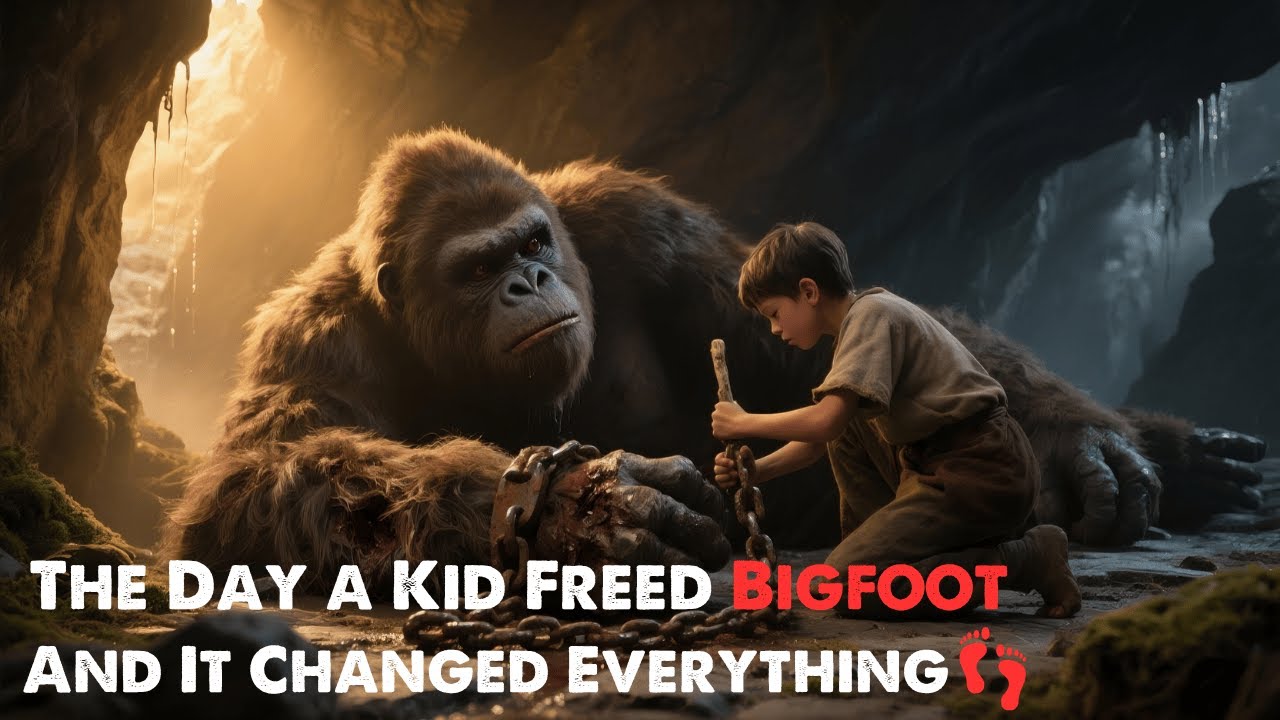
Metal gleamed at the ankle, a shackle, rusted but still locked.
The chain was snapped like it had been ripped from the ground.
The thing was barely breathing.
Each inhale rattled wet and shallow.
Its chest rose and fell with the effort of someone drowning in air.
I should have run.
My mind screamed for it, but my feet didn’t move.
The closer I got, the more I realized this wasn’t just a creature.
There was something in the way it held itself.
In the faint flicker of recognition when its eyes met mine, it didn’t snarl, didn’t lash out, just blinked slowly.
And I swear there was pain in those eyes.
Real pain.
Human pain.
My throat was dry.
I fumbled in my backpack, pulled out the bottle of water I’d packed by accident that morning.
Without thinking, I rolled it toward him.
It stopped a few inches from his massive hand.
For a moment, nothing happened.
Then slowly, his fingers uncurled, not claws, fingers thick, shaking, covered in dried blood.
He touched the bottle, dragged it closer, raised it to his mouth with both hands like a child, learning something for the first time.
Water dribbled down his chin.
He closed his eyes as if that first sip was the only thing keeping him from dying.
I stepped back.
My legs were finally listening to my brain.
I didn’t run.
I didn’t turn my back.
I just backed away into the trees, breath shallow, watching.
His eyes followed me, but not with fear, with understanding.
It hit me then.
He hadn’t run from someone.
He’d been hunted, shackled, wounded, left here to die.
By the time I made it back to the cabin, Dusk was swallowing the last light.
Grandpa was inside sharpening a blade.
He didn’t look up, but something about the way he moved told me he knew exactly where I’d been.
I didn’t sleep that night.
Not because I was scared of what I saw, but because for the first time, I wasn’t sure who the real monster was.
And I couldn’t stop thinking about those eyes.
Not wild, not mindless, eyes that had seen too much.
Eyes that remembered.
The next morning, I packed what I could.
Gauze from Grandpa’s medicine tin.
A half-used bottle of hydrogen peroxide, some beef jerky, and two bottles of water.
I didn’t even try to lie about where I was going.
Grandpa didn’t ask, just sat on the porch with his pipe clenched between his teeth, staring out at the trees like they owed him something.
His silence weighed more than any warning.
But I was past that now.
Whatever Ash was, he didn’t deserve to be left like that.
The woods felt different this time, less like I was trespassing and more like I was expected.
The frost still lingered on the leaves, crunching softly beneath my boots.
But the wind had gone still again, and every sound I made felt too loud.
I followed the route back through the rocks, through the heat rippled air until I reached the hollow.
He was still there, barely moved.
His eyes tracked me, slow but clear.
I held up the gauze and whispered, “It’s okay.
I’m not here to hurt you.
I don’t know why I spoke aloud.
Maybe I need to hear myself sound brave.
He watched as I poured water over his wound.
His leg twitched, a low rumble rising in his chest.
Not a growl, more like a gro.
His fur was caked with dried blood and pine needles, and the shackle had left raw, blistered skin beneath the matting.
I worked slowly, hands trembling as I cleaned around the wound, every motion careful, like I was touching something sacred.
He didn’t flinch, just breathed.
Minutes passed like hours.
Then, with a movement so sudden it froze me, he reached toward my hand.
Not with claws, not to strike, but to hold.
His hand, massive and warm, closed gently over my There was something in that touch, not thanks, not fear, something older, like memory.
And then I noticed a scar running across his chest just beneath the fur was a thick pale line.
Clean, surgical.
It didn’t belong in the wild.
It didn’t belong any creature.
It was the kind of scar left by someone who cuts not to heal but to learn.
My breath hitched.
Someone had operated on him, opened him, studied him not to understand but to dissect.
That night, I didn’t go straight back.
I sat in the clearing until the stars appeared.
Until the forest wrapped around me like a secret.
I knew now he wasn’t just a creature hiding from the world.
He was a survivor of it.
And someone somewhere had gone looking for him with a scalpel.
For the first time, I wasn’t afraid of what he was.
I was afraid of who knew he existed and how far they’d go to find him again.
I kept going back every day, sometimes twice.
At first, I left food a few feet away, watched from the trees as he edged forward, cautious, his movements heavy, but precise.
He never lunged, never roared, just watched me like I was something he’d seen before.
Long ago in another light, I started calling him Ash, not because of the burnt patches in the forest, though there were many, but because he felt like something that had survived fire and come out changed.
He began to respond to gestures, a nod, a hand raised in peace.
I once ran my fingers through my hair during a story and saw him mimic the motion like he was cataloging humanity piece by piece.
I’d sit there cross-legged on the moss, talking softly about things that didn’t matter.
School I no longer attended, friends who’d stopped calling my parents.
I told him about my mom’s humming while she cooked and how my dad used to let me steer the truck on empty back roads.
Ash didn’t speak, but he listened.
You could feel it in the air, thick with unspoken things.
One afternoon, while I handed him a boiled egg wrapped in napkin, I caught a strange shift in his gaze.
Not fear, not pain, something softer, recognition.
He reached down, drew in the dirt with a stick.
At first a circle, then an elongated shape, then slowly a single leaf, the same kind I had tucked behind my ear that day when I first found him, not even realizing he’d seen it.
And then I dreamed of him, not as he was now, but as a man, a man with long gray hair, eyes deep and tired, kneeling by a river.
He looked up, met my gaze, and though he never said a word, I woke up knowing it was him.
Ash before it didn’t make sense.
Not to the part of my brain that still clung to logic, but the rest of me.
The part that had sat beside a wounded creature day after day understood something ancient had broken inside him.
And something just as old was trying to mend.
Later that week, I brought paper and a pencil.
I drew a house, a tree, a dog.
Ash watched.
Then he took the pencil, held it awkwardly in his massive hand, and scribbled three shaky lines.
Not art, not letters, but lines, one tall, ones in between.
I stared at them, heartbeat rising.
He was telling me something, a memory maybe, or a warning, or both.
But I knew this much.
Ash remembered more than he let on.
And whatever he had been, someone had tried to erase it.
Not failed, but uh almost.
Grandpa had started watching me.
Not with curiosity, not even suspicion.
Just this old slow burning look like he was waiting for something to fall apart.
I think he already knew.
He always knew.
I’d come back late one evening, mud on my jeans and pine needles in my hair.
And he was sitting by the window in the dark.
No lights on, just the red glow of his cigarette.
“You keep heading toward that hill, boy,” he said without turning.
“You’ll end up like the rest of M.”
I didn’t ask what he meant.
I already felt it in my bones.
But the next day, I found the photo again.
The one of Grandpa and the hunting party.
The one of Grandpa and the hunting party.
I hadn’t noticed before, but behind the tall figure, off in the blur of trees, there was a second one, smaller, hidden, like a child peeking from behind its mother’s leg.
My stomach turned.
Later that afternoon, grandpa found me in the shed, digging through old boxes.
He didn’t yell, didn’t scold, just leaned against the door frame and said, “That thing you’re feeding, it ain’t new.”
I didn’t respond, just kept digging until I hit a stack of scorched journals, brittle and yellowed with age.
Grandpa stepped forward then, eyes darker than I’d ever seen them.
I gave one up, he muttered.
A long time ago, they paid me.
Said it was science.
Said it was just a creature.
I thought, “What harm could it do?”
I didn’t breathe.
He kept talking like the words had been trapped for decades.
They came in black trucks, took it in chains, promised it’d be studied, not hurt.
But then the fire started.
Then the woods changed.
I thought it died.
But I was wrong, I whispered.
It was ash, wasn’t it?
He didn’t answer.
He didn’t need to.
The guilt in his face carved lines no weather ever could.
He reached into his coat and pulled out something small, an old whistle, wood carved and worn smooth by ears.
It called them once, he said.
Maybe it still does.
That night, I didn’t go to the woods.
I couldn’t.
The weight of everything, his betrayal, the scars, ash silence, it pressed against my chest like a second heartbeat.
I lay in bed, the whistle tucked beneath my pillow and stared at the ceiling as the wind crept through the cracks like whispers I didn’t want to hear.
But the image wouldn’t leave me.
Ash, shackled.
Ash, bleeding, ash, watching someone he trusted turn away.
And suddenly I understood the drawings, the three lines, the smallest one, that was me.
The tallest him and the one in between wasn’t grandpa.
It was the one he lost.
The one he gave away.
It was just after sunrise when I found him tracing lines in the dirt.
His fingers, thick and calloused, moved slowly with the care of someone remembering how to use them.
I crouched beside him, trying to make sense of the shapes.
Circles, spirals, a jagged line like lightning cutting through the earth.
He paused, looked up at me, then pointed at the spiral, and tapped his chest.
I didn’t get it at first.
I just nodded like that would bridge whatever space still stood between us.
But then he drew a leaf, the same shape he’d copied before, and next to it, three smaller circles like seeds.
A kind of storytelling, a language almost.
Ash had started using symbols to speak.
And I realized it wasn’t just mimicry.
It was memory.
He hadn’t forgotten.
He just lost the words.
Over the next few days, we turned a patch of mossy ground into our slate.
I’d draw something simple.
Son, fish, house.
He’d respond with variations.
A cracked sun, a dead fish, a burning house.
I didn’t ask for meaning.
I didn’t need to.
This was how he spoke now.
Not with sounds, but with echoes.
His body still achd.
He moved slower, favoring the leg where the shackle had torn through skin and fur.
I change his bandage, bring berries and dried meat, and sit beside him while the woods hummed with a silence I was learning to understand.
Then one afternoon, he did something new.
He took a stick, drew the outline of a man, then held up his hand, mimicked holding something small, a pencil.
He copied the way I drew.
Not just the lines, but the intention behind them.
His eyes followed mine.
Not as an animal studies a threat, but the way someone listens when they’re learning how to be human again.
That night, I couldn’t sleep.
I sat outside the cabin with a blanket wrapped around my shoulders, staring out past the trees.
And the thought kept circling.
What if he wasn’t becoming something new?
What if he was remembering what he used to be?
The forest didn’t feel the same anymore.
Not hostile, but expectant, like something ancient had been stirred from sleep.
I knew now in the quiet between breath and heartbeat, I wasn’t just helping a creature heal.
I was watching a soul come back from ruin.
And it wasn’t just ash changing.
Something in me had shifted, too.
I was no longer looking for a monster.
I was looking for what was taken from him.
And maybe in some strange way from me too.
I didn’t even try to sneak back into the cabin that evening.
Grandpa was sitting by the fire sharpening his old hunting knife with slow, deliberate strokes.
The sound of metal against stone had become part of the house now, constant, steady, like a heartbeat no one could turn off.
I stood there muddy and tired, waiting for him to say something.
He didn’t, so I did.
You ever hear of something living out near Clay Hill?
Something big?
He didn’t look up, just kept sharpening.
You still going out there?
I saw something.
I said voice lower.
Something hurt.
Voice lower.
Something that’s not just He cut me off.
I know what you saw.
His voice was flat, but his hands had stopped moving.
He placed the knife on the table, leaned back in the chair like he’d just been waiting for this moment to break open.
“I was there once,” he said, eyes still not meeting mine.
“We were hunting near the ridge.
We thought we’d found something new, something big.
But it wasn’t just an animal.
It looked at me and I saw something in its eyes, something worse than pain.”
Like it knew what we were.
My mouth was dry.
I whispered.
Was it ash?
The silence between us was the loudest thing in the room.
Then he got up, walked to the back shelf, and pulled down an old tin box.
Inside were maps, torn pages, photos with creases so deep they split faces in half.
He handed me one.
There was a clearing, a cage, a figure inside, blurred, twisted, but undeniably alive.
They came with trucks.
Said it was for research.
Said it wouldn’t feel a thing.
But it did.
I said barely more than breath.
He nodded once like the weight of it had never left his spine.
I helped them take it.
And he never saw the forest the same again.
That’s when the trees started leaning the wrong way.
When animals stopped coming back.
That’s when I stopped hunting.
A long silence fell between us, filled only by the crackle of the fire and the hush of wind pushing against the cabin walls.
Finally, I asked, “Why didn’t you stop them?”
He looked at me then, really looked, and I hated how small he suddenly seemed.
I thought I was doing the right thing, providing, surviving.
His voice cracked, but I traded something I didn’t understand, something that trusted me.
That night, I stared at the ceiling, the photo still clenched in my hand.
It wasn’t just a picture.
It was proof, and it burned in my chest like a warning.
Because if Ash had survived, so had those who once came for him.
After hearing what grandpa told me after holding that photo in my hands like a piece of cursed evidence, I thought maybe I’d look at him differently, but I didn’t.
I only saw the same wounded presence sitting by the stones.
Breathing slow and shallow, eyes soft when he saw me come near, I sat beside him in silence.
The words I brought felt wrong, too human, too small.
So I said nothing, just unwrapped the cloth from my pack, revealing the things I thought he might like.
Dried fruit, a bit of cooked venison, a small carving of wood I had made of the spiral he always drew.
He took the carving gently, fingers brushing over the grooves.
Then slowly he picked up a stick and began drawing in the dirt again.
Three shapes, a tall figure, a smaller one, and a third bent low, marked with a jagged line through its center.
I stared at it, the air tightening around me.
The symbols had changed.
These weren’t memories.
They were choices.
I reached for my sketch pad, flipped to a clean page, and drew the same three.
Then I pointed to the bent one, the one with the scar, and asked, “You forgave him?”
Ash didn’t move.
Ash didn’t know, but he turned the stick upside down and gently erased the line.
“Something inside me cracked.
We spent hours there, not speaking, just drawing, sharing time.
The forest felt hushed but not empty, like it was leaning in to listen.
Just before sunset, Ash reached behind him and brought forward a stone, smooth and flat.
He etched a figure into it.
My I recognized the shape of my hoodie, the curve of my slouched shoulders.
He placed the stone at the base of a tree and looked back at me with something I never expected.
Not gratitude, not sadness, understanding.
It felt like a goodbye.
That night, I found Grandpa sitting on the steps staring at the woods.
I sat beside him and for the first time he didn’t stiffen.
He passed me a tin cup of warm cider and we listened to the cricket sing through the dark.
Then he said, “It never hated me.
That’s what eats me up.”
He took a slow breath.
I thought it would.
I deserved it.
I didn’t answer.
I just watched the trees and remembered the way Ash had erased that line.
But the next morning, he was gone.
No sign of struggle, no scent of blood, just a space where he had been.
Cool earth, quiet trees, and the faint imprint of a hand in the dirt, pointing not inward, but toward the edge of the forest where the hill cracked, where something waited.
And I knew I hadn’t been left behind.
I’d been chosen to stay.
That first morning without him felt too quiet.
The air didn’t move right.
And even the birds seemed hesitant to sing.
I walked to the clearing as if pulled by muscle memory, hoping maybe he was just nearby, just watching.
But the moss was undisturbed.
The stones untouched.
He was gone.
I stood there for a long time listening, trying to feel what I used to feel when he was near.
That weight in the trees, the hush in the branches.
But there was nothing.
Just me.
A hollow space and the faint echo of something that had moved on without sound.
I thought that was the end of it until nightfall.
Just as the last light drained from the woods and the cabin melted into shadow, I saw it not in the forest on the porch.
A fish, freshly caught, laid neatly on the step beside a bunch of wild flowers.
The kind that only grew deeper into the hills past where even deer strayed.
There was no note, no scratch of claw marks, just the quiet, deliberate arrangement of a gift.
The next day, I found more.
An arrow head placed beside my boots.
A clump of furbound moss wrapped in bark like a pouch.
Then a week later, I came home to find a wooden carving sitting on the window sill.
It was simple, unpolished, but clear.
Two figures side by side, one tall, wild, crowned in rough lines, the other smaller, human, a hand stretched between them.
A hand stretched between them.
I showed Grandpa.
He didn’t say much.
Just looked at it for a long time.
Then nodded and said quietly, “He’s not gone.”
“Not really.”
I wanted to believe it was comfort, but it wasn’t.
It was fact.
Because something was still out there, and it hadn’t left me behind.
It had simply stepped back, returned to the part of the world that humans had lost the ability to see.
But ash still saw me.
I felt it when I passed the edge of clay hill and the wind shifted.
When the birds went silent, not in fear, but in reverence.
When my feet stepped where the cracks began, and nothing pushed me back.
And the strangest part, I didn’t feel alone.
Uh, he was still here in the rhythm of the forest, in the gifts left like breadcrumbs of belief.
He wasn’t hiding.
He was watching, protecting, waiting for whatever came next.
I started leaving things for him, too.
Not because I had to, because I wanted him to know.
I remembered.
And I knew now.
He was never a myth.
He was memory made flesh.
And memories, when honored, don’t fade.
They take root.
They become legend.
Sometimes when I walked past Clay Hill, I could feel him before I saw anything.
It wasn’t like it used to be.
No heavy steps in the dark, no shape moving just beyond the trees.
It was more like a shift in the air, a weight that settled across my chest without fear.
The forest didn’t hide him anymore.
It held him like it had always been part of him.
And now he was part of it.
I started going there more often, not looking for him, just being there.
There was something sacred in the silence.
Something that made me feel less like a kid and more like someone who belonged to something older.
A watcher maybe, or just someone worth watching over.
One afternoon, a breeze kicked up from the west.
The kind that rustled only the tallest trees, and every crow in the canopy lifted at once, black wings blotting the sun for a heartbeat.
Then stillness again.
That was when I knew.
He wasn’t far.
I didn’t speak, didn’t move.
Just stood at the edge of the hill where the earth split like a scar.
And I whispered into the trees, “I’m still here.”
That night, I left the cabin door open just a crack.
A habit, maybe, or hope.
In the morning there were fresh pine boughs laid in a neat line across the porch and a smooth riverstone placed on top of my old baseball cap.
The one ash had once turned over in his hands like it was treasure.
Grandpa saw it, said nothing.
Just nodded once like he was learning how to believe again.
I started carving same as Ash had little pieces of cedar and pine.
One of him, one of me, and one I didn’t recognize at first.
It had no face, just wide shoulders and something in its shape that felt familiar.
A few days later, I found a bundle of twigs woven into a figure left at the base of the hill.
Three lions etched into the dirt beside it.
This was no goodbye.
It was a promise.
Each time I passed Clay Hill, now the wind changed.
Birds lifted just slightly, then returned.
The silence wasn’t empty.
It was listening, guarded.
And beneath it all, that pulse, slow, ancient, awake.
Back at the cabin, I carved one last thing into the wooden pillar by the door.
A shape of three figures beneath a tree, etched deep, like I wanted it to last longer than I would.
Then I stepped back and let the dusk fold in around me.
And for the first time since that summer began, I didn’t feel like I was waiting for something to return.
I felt like I had become part of what stayed.
I carved slowly, each line, a kind of vow.
The pillar outside the cabin had been marked before by wind time.
Even Grandpa’s old pocketk knife when he was younger than me.
But none of those marks felt like this one.
Intentional, deep, quiet.
I I didn’t know what name to give the figure I shaped into the wood.
I just knew it wasn’t meant to be forgotten.
Three of us stood there in that carving shoulderto-shoulder beneath a curved ark that could have been a tree or a Scott.
I didn’t try to explain it.
Some things weren’t for words anymore.
The days that followed blurred into each other like a soft drum beat beneath my ribs.
I didn’t wait for him anymore.
But every time I stepped outside, part of me listened.
And sometimes the wind answered.
Or a rock had shifted.
Or a pine cone cracked clean in half waited neatly at the edge of the porch.
Small signs that the line between our worlds hadn’t closed.
It had simply deepened like a river that runs under frost.
I started writing it all down.
Not for proof.
No one would have believed it.
Not the sheriff with his sunburned neck and dustcovered boots.
Not the librarian with her polite smile and careful silences.
No, I wrote it for me.
For the parts of me that might forget years from now, that I’d seen something real in a place where most people just saw trees.
I wrote it so I wouldn’t convince myself it had been a dream.
And then one morning, I found something I hadn’t left.
Not a fish, not flowers.
A wooden token, flat, smooth, warm in the palm, like it had been held for a long time.
On it was carved a single word, scrolled, but legible, like someone had been practicing.
Yely, I didn’t move for a long time.
The air around me felt thick, like I was being watched, but not in fear.
In memory.
Later that night, I stood at the edge of Clay Hill as the sun bled out behind the pines.
I didn’t call for him.
I didn’t have to.
I just whispered, “Thank you.”
Then I pressed the token deep into the earth where the cracks first began and covered it with my palm.
If anyone ever asks why I still come back here, why I never left Gray Hollow like I said I would, I’ll just say this.
Some stories don’t end with goodbye.
Some stay with you, stitched into your bones like the sound of a breath that was never supposed to reach you, but did.
And if you ever step too far off the trail and the woods go quiet, don’t panic.
Stop.
Breathe.
He’s still out there.
But only if you believe.
I carved his name into the last post on the porch.
Just four letters.
Nothing fancy, but deep enough that the wood groaned a little under the blade.
It wasn’t for anyone else to read.
Really, no one believed me anyway.
I told the story once to a teacher long after I left Gray Hollow, and her face had stiffened, polite and unconvinced, the way adults get when they think you’re just mourning in strange ways.
I ain’t never told it again.
But the name stay sometimes.
Even now, I I press my fingers into the grooves and whisper it under my breath like a prayer.
Years pass differently in places like that.
The trees grow but don’t age.
The wind shifts but never forgets.
I did leave for a while.
School, cities, noise.
I tried to become a person who didn’t hear things when the woods went quiet.
But I couldn’t unlearn the way the forest once held its breath around me.
So I came back.
The cabin was still there, smaller than I remembered, but steady, stubborn against time.
Grandpa’s tools hung in the same places.
The post I carved into had darkened with weather, but the name was still clear.
I brought with me a new piece of wood, soft pine, and started carving again.
This time, not for memory, but for offering.
That evening, I lit the old lantern and sat outside, watching the line of trees where the hill began.
The cracks in the earth were barely visible now, overgrown and softened by moss.
But I still knew where they ran, and something in me knew they hadn’t closed.
Before I went in, I placed the carving by the steps, a figure like him, and beside it, a smaller one that looked a little like me.
On its back, I’d scratched a question, quiet and small.
Here are you still watching?
I didn’t expect an answer.
But the next morning, there was a stone where the carving had been, smooth, warm, and on it, scratched in a trembling but familiar hand, a single line.
Three figures under a moon.
That was all.
I keep that stone with me now, in a box that holds things most people wouldn’t understand.
Feathers, bits of ash, a folded piece of bark that smells faintly of smoke.
I don’t talk about it much.
Not because I’m hiding him, but because some truths only live when they’re kept close.
But sometimes when the night is quiet and the air shifts just right, I swear I hear it again.
That breath, that weight, that memory pressed into the dark.
So if you ever find yourself lost in the woods behind Grey Hollow, don’t be afraid.
Just listen.
He’s there.
And he remembers you too.
Shannon 15.
It was the softest dusk I’d ever known.
The sky bleeding pink behind the pines.
When I knew I had to honor what had been given to me, I gathered a piece of cedar I’d been carving in secret.
A simple figure of three souls beneath an arching branch.
I carried it to the wooden post in front of the cabin, my fingers tracing the grain before I pressed it into the weathered wood, carving deeper.
For a long moment, I just stood there, watching the forest’s edge breathe in twilight.
The wind shifted as if an answer.
Somewhere in the distance, a single crow took flight.
Its silhouette, a black promise against fading light.
I understood then this was our covenant.
This is how memory becomes legend.
I did not speak aloud.
I could not because words would have broken the quiet reverence of that instant.
Instead, the forest spoke through rustling leaves and the soft creek of the old cabin walls.
There was no closure, only continuity.
A life woven into something far larger than myself.
And as night closed its eyes over gray hollow, I touched the carving gently and allowed the forest to settle around me.
Full, alive, held together by things that cannot always be seen.
If you ever wander into the woods when the air is still and the horizon softens, remember, sometimes the greatest truths live between two worlds.
They are neither lost nor hidden.
They wait for someone brave enough to quietly listen, to stand still, and to carve their presence into time.
Thank you for taking this journey with me.
If this tale resonated with you, if it stirred feelings you can’t name, please share your thoughts or memories in the comments.
If you’d like to explore more stories that linger in the hush between heartbeats, please follow and subscribe to stay connected.
Our next adventure is closer than you think.
Right around the bend, just beyond the crack in the earth.
Until then, may your footsteps be guided by curiosity, and your heart remain open to the stories carried on the wind.
Out in the places where maps fade and silence deepens, where the wind has its own language and time forgets how to count, there are truths too old to be spoken aloud.
They don’t belong in textbooks or museum glass.
They live in the hush between footsteps, in the spaces we overlook, and in the eyes of those who carry their stories without ever saying a word.
Some truths aren’t meant to be proven.
They’re meant to be felt.
They’re meant to reach quietly into us, not to impress, but to remind us.
Remind us that wonder still lives at the edges of the world.
That the things we fear might not be here to harm, but to teach.
That the line between wild and worthy is one we often draw out of fear, not understanding.
And perhaps the oldest truth of all is this.
Healing doesn’t always look the way we expect.
Sometimes it’s not loud, not triumphant.
Sometimes it’s simply a handheld out in silence, a breath shared, a decision to sit beside something different without needing to change it.
We forget how much power there is in simply staying, in being present, in listening, not with the intent to answer, but to understand.
Because when we learn to be quiet enough, we begin to hear not just others, but ourselves.
And in that stillness, something incredible happens.
The boundary between them and and use begins to disappear.
No matter how much the world races forward, there will always be corners left untouched.
Moments that exist outside logic, creatures of memory and myth, echoes of kindness from places that no longer ask to be seen but long to be respect.
So wherever you are, whether in a city that never sleeps, a town that never forgets, or somewhere in between, hold close the reminder that not everything real needs to be explained.
Some things simply ask to be honored.
And sometimes that’s more than enough.
If this story stirred something in you, if it made you pause, feel, remember, or imagine, then it’s done its work.
We hope it stays with you long after the screen fades to black.
Thank you from the heart for walking this path with us.
If you found meaning here, please consider leaving a comment, sharing your thoughts, or letting us know what moments moved you most.
And if you believe in more stories like this, stories that hold breath, carry soul, and echo something deeper, don’t forget to follow, subscribe, and stay connected.
There’s always another trail ahead.
We’ll meet you there.








