Why Steamboats Exploded Like Floating Bombs
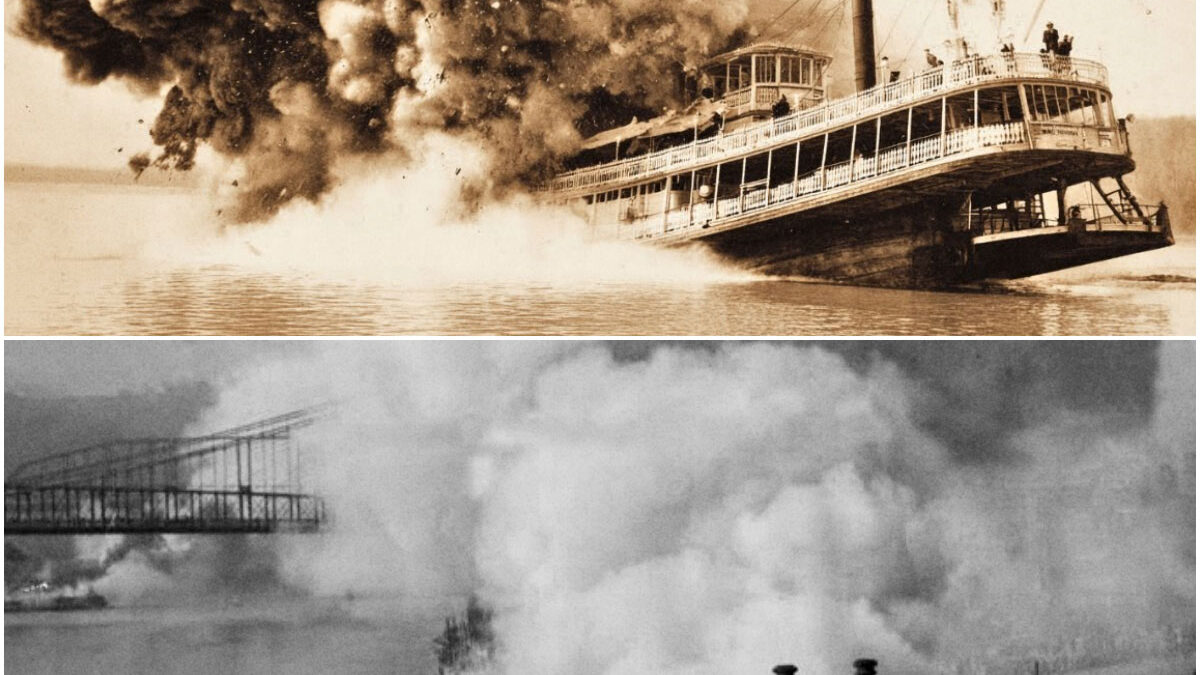
Why Steamboats Exploded Like Floating Bombs
It’s around 2:00 a.m. and the Mississippi is black glass under a sky.
On the decks above, more than 2,000 men sleep shouldertosh shoulder on a boat built for 376.
A dull boom punches through the hull.
Then a roar of steam hot enough to peel skin.
Iron fragments sighthe through bunks, timbers snap, flames race, and the river fills with screaming bodies clawing for air.
This is not an accident at sea.
It is an industry at work.
Was this a cruel fluke or the predictable price of profit?
Were passengers betrayed by fate or by design?

Let’s begin.
The gang plank drops, the dock hands shout, and a polished railing offers the comfort of something built to laSt.
By 1850, more than 536 steamboats worked the interior rivers and tributaries, an armada that moved people and goods faster than any wagon road could dream.
Posters called them modern, dependable, almost civilized, even when the hull was wood and the heart of the ship was fire.
Above deck, it could feel like a floating hotel.
Lamplight on clean linen, coffee, card tables, the soft thump of paddle wheels.
Below iron plates sweated, flames roared, and pressure climbed inside riveted seams that had no mercy for a careless minute.
Owners chased full manifests because every empty birth was lost money, and every delay meant arrival arrived firSt. When extra passengers and cargo went aboard, the boat sat lower, the engine worked harder, and the boiler room demanded more heat to keep speed.
Though whether that pressure was managed wisely depended on the men and the mood of the moment.
So why did people keep boarding even as fresh reports described boats ripping open without warning?
Because the alternative was slower, harsher, often impossible, and because danger could be explained away as rare as misfortune as someone else’s story.
The risk was not only crowding, it was confidence built on fragile instruments.
Gauges could stick.
Safety valves could be weighted or misread.
And water levels could drop when a vessel pitched or settled, exposing hot metal that should have stayed covered.
A condition known to increase the chance of violent failure.
Though each incident still had its own chain of causes in river towns, departures became theater.
Crowds on warves counting bales, listening for the first hiss from the vents.
That theater created its own pressure.
And when a boat ran late or lost a race, someone below deck felt it in the firebox.
Government records later suggested that between 1816 and 1848, boiler explosions alone killed more than 1,800 people and injured another 1,000.
Those numbers do not prove every owner was reckless, but they do show how often the public paid for speed with lives.
A ticket then was not just passage.
It was trust placed in metal, men, and money under rising pressure.
Was that trust earned by discipline and maintenance, or purchased with promises that could not survive heat and time?
Pressure is the invisible passenger that never buys a ticket, yet it decides the fate of every person on board.
In the 1850s, many steam systems were still spoken of in modest terms with typical ratings around 30 lb per square in, a force that already meant danger when trapped inside iron and rivets.
By 1890, typical ratings had climbed nearer 80 psi.
Not because nature had changed, but because commerce demanded more work from the same metal.
That number is not abstract.
It is weight applied everywhere every second pressing against seams, staybolts and plates, while fire hammers the water from below.
If a boiler is healthy, pressure becomes power.
If it is weakened, pressure becomes a verdict.
Though what weakened means can differ from boat to boat.
Midway through a run, the most dangerous moment can arrive quietly when the water line drops and a section of metal that should be cooled is left bare to the flame.
What happens when overheated iron suddenly meets incoming water again?
A harmless hiss or a violent flash into steam?
Investigators often describe this as a common pathway to disaster because hot plates can warp, crack, or fail under stress.
But a single cause rarely stands alone.
A tired pump, a clogged feed line, a distracted engineer, or a vessel listing from cargo can all shift the balance, and any report can only reconstruct so much from wreckage and rumor.
Then there is the human temptation to treat the safety valve as a suggestion.
Regulations existed in theory, yet a valve could be weighted, adjusted, or ignored when a captain demanded more speed, and the pressure gauge itself might be misread, stuck, or trusted too long, not always from malice.
Sometimes from routine and fatigue.
By 1866, federal law would declare that no boiler should be allowed under any circumstances, a greater working pressure than 150 to the square in, a line drawn in ink after far too many deaths.
But even a limit cannot heal thin metal, sloppy workmanship, or the habit of pushing past what a ship can safely bear.
So when a steamship erupts, it is tempting to blame a single moment, a single man, a single mistake.
Yet the more honest question is harder.
Was the explosion born from one bad decision or from a system that made bad decisions feel necessary?
A steamship could look like luxury and still be built like a trap.
In the mid-9th century, builders were rewarded for speed and capacity, not for hidden strength.
And the easiest place to save money was where passengers never looked.
Decorative cabins rose above decks made of timber, while below fireboxes raged inches from beams, paint, oil, and rope.
The danger was not only the flame.
It was what the flame was trying to control.
Water does not seem violent until it turns.
At 212° of it crosses a line that cannot be bargained with.
When liquid water flashes into steam, it can expand to roughly 1,700 times its original volume.
And inside a confined boiler, that change is not a release.
It is a blaSt. A ship built light could still be seaorthy on paper, and a repair could still pass a quick glance, but light construction meant less margin when something went wrong.
A thin plank or a tired joint does not cause a boiler to rupture.
Yet, when a rupture happens, flimsy framing gives way faster.
Decks fail sooner and people who might have escaped are trapped by collapsing wood and twisting iron.
Halfway through a voyage, who is really deciding the risk?
The engineer watching the water glass or the owner who demanded a cheaper hull and a faster run.
On many boats, the boiler sat low, the most dangerous machinery placed where heat, vibration, and damp air did their slow work.
Moisture invited corrosion, vibration loosened fastenings, and the constant flex of the hull could turn small weaknesses into cracks.
Though any single explosion still had its own specific chain of failures, even the normal world around the boiler carried its own threat.
Atmospheric pressure is about 14.7 psi, a quiet force we live under without thinking.
Yet, a boiler multiplies pressure beyond that baseline until the metal is holding back a hidden storm.
If that storm breaks free beneath a wooden superructure, the results are immediate.
Scalding steam, flying debris, and fire fed by varnish and dry pine.
Owners often insisted these vessels were safe because they kept moving week after week, and many did.
But the very fact that a boat could run for years did not prove it was sound.
It only proved it had not met the wrong moment yet.
So when a steamship finally erupted, it was easy to blame fate or a single careless hand.
The harder possibility is that danger had been built into the bargain from the start.
Comfort above, combustion below, and a thin line of metal asked to do the impossible.
The whistle is not a warning.
It is a dare, echoing off the riverbank as two boats surge into the current like prize fighters.
By the 1850s, a strong steamboat might make 8 mph downstream and only three upstream.
And every mile of advantage felt like a victory snatched from the water.
Schedules were promises, reputations were currency, and a late arrival could cost a line its cargo, its passengers, and its future.
Then the races came, half sport and half business war, with towns turning out to watch smoke stacks lean and paddle wheels churn.
In July 1870s, the Roberty Lee and the Natchez ran roughly 1,200 m from New Orleans to St. Louis.
And the Lee’s official time was 3 days, 18 hours, and 14 minutes.
The numbers sound like glory, but they’re also a measurement of strain.
To shave hours, crews fed the fire harder, kept steam up, and treated the machinery as if iron could be bullied into obedience.
A boiler does not know applause.
It knows heat, water level, and pressure.
And when any one of those drifts out of balance, the margin for error collapses.
Halfway through a run, when the shore is dark and the passengers are asleep, who is really in command, the engineer with his hand on the feed, or the captain listening for the rivals whistle behind him.
Accounts from the era describe how the demand for speed encouraged shortcuts, heavier firing, and decisions that placed performance ahead of caution.
Though each explosion still had its own causes, and no single habit explains them all.
Even a well-built boiler could be weakened by fatigue and repairs.
And a desperate push could turn a weakness into a rupture.
The pressure was not only in the metal.
It was in the economy.
A boat that lost its edge could be sold, scrapped, or forgotten.
And a crew that protested could be replaced at the next landing.
Men learned to swallow doubt because doubt meant unemployment and hunger, too.
So when a steam ship later tore itself open, investigators might point to a low water moment, a thin plate, a misread gauge, or a choice made under speed shadow.
But the question that haunts the river is simpler.
Were these boats failing because individuals made mistakes or because the culture demanded that they run one notch beyond safe every single trip?
The most dangerous crack on a steamship is the one nobody sees because it is hidden behind paint, behind soot, behind the confidence of routine.
In the decades after the Civil War, riverboats and coastal steamers ran on water that was rarely clean.
Minerals hardened into scale on boiler walls, and that crust did more than choke efficiency.
It trapped heat against iron, creating hot spots that could weaken plates over time.
The system might still run, the gauge might still climb, and passengers might never sense that the boiler was slowly being cooked from the inside.
Corrosion worked from the other direction.
Damp air, impurities, and constant heating and cooling ate at seams and rivets, thinning metal the way rust thins a chain link, until the boiler’s strength became an assumption instead of a fact.
Repairs were common and sometimes necessary, but repairs were also opportunities for denial.
A patch plate could be fitted over a weakened area, riveted in place and called good, and for a while it might be.
Yet every patch changed stress patterns.
Every new rivet hole altered the metal around it, and the boiler’s violence did not care whether the repair was honest workmanship or a rushed job done to meet tomorrow’s departure.
Halfway through a season, who would admit a boiler needed to be taken out of service when there were fairs waiting and a dock full of freight?
Numbers could make the temptation feel reasonable.
A steamboat boiler might hold several thousand gallons of water, and even a small portion flashing into steam could deliver catastrophic force.
At the same time, the cost of a full rebuild could dwarf a month of profits, and the pressure to make do grew heavier with every successful trip that passed without incident.
Inspectors existed, but inspection could mean many things depending on the place, the year, and the honesty of the paperwork.
A surface check might miss thinning metal, and a boat that performed well in front of witnesses could still carry hidden rot into the next run.
So when an explosion finally came, survivors would speak of a sudden roar, a tearing sound, and the sensation of the world lifting beneath their feet.
Investigators might find fragments of a patched plate, a seam that had opened, or evidence of scale, and they could argue how each factor contributed.
Yet the verdict often stayed uncertain because the boiler destroyed its own story.
And that uncertainty was part of the danger.
It allowed the next owner to believe his boat was different.
The next engineer to trust a patch one more time.
The next town to cheer as another vessel pulled away.
But the river did not only punish hidden weakness, it punished crowds.
And as boats grew more popular, one decision above deck began to press on the machinery below in a way few passengers understood.
The most dangerous crowd on a steam ship is the one that cannot move when the ship begins to move beneath it.
In the spring of 1865, one Mississippi steamer measured about 260 ft from bow to stern and only 42 ft across.
A long wooden body forced to balance weight, current, and wind.
When passengers are stacked across multiple decks, the center of gravity climbs, and a gentle roll becomes a hard list, the sort that makes men slide against railings.
Overcrowding does not ignite a boiler, but it changes the ship’s posture, and posture changes what happens below.
As the hull leans, water inside the boiler does not stay level.
It runs, exposing sections of hot metal that should remain covered, while other areas drown and cool unevenly.
What happens inside a fire hot boiler when the water drains away from the hottest plate and then surges back again a moment later?
In the 1860s, engineers watched the water glass and listened for the hiss of vents.
Yet, they also lived under orders to keep steam up.
On an overloaded boat, the deck can swing side to side as it rounds bends, and every swing can make the water line lie, showing safety in one moment and danger in the next.
Some vessels ran with multiple boilers tied into a shared system, a design that improved power, but also let water shift from one unit to another as the ship careened.
If one boiler is left short while its fire continues to burn, the metal heats past its comfort, and when water returns, it can flash into steam and slam the pressure upward faster than any hand can answer.
Crowding also slows escape, and that is its second cruelty.
When the blast comes, bodies jam stairways, railings become choke points, and the simplest route to open air can vanish behind panicked weight and falling debris.
So the question is not only why boilers failed, it is why so many people were placed where a failure could kill them all at once.
Was the true trigger the physics of shifting water or the human decision to load one more body onto a deck already trembling?
And when that pressure finally breaks free, it does not behave like fire or flood.
It behaves like a weapon.
And the next moment is the moment the steam itself begins to hunt.
It never starts as a fire.
It starts as a shock, a concussive punch that makes the ship feel as if it has struck a reef.
In an instant, the boiler does not merely split, it detonates, and the first killer is pressure.
Iron tears open like wet paper, and the blast hurls fragments through decks and bulkheads with the force of cannon shot.
Then comes the second killer, steam, a white invisible heat that can blind, scoo, and suffocate before a man even understands what happened.
Steam at boiler temperatures is not the gentle vapor from a kettle.
It is a gas carrying lethal energy.
And when it surges into confined spaces, it strips skin, floods lungs, and turns breath into pain.
Survivors of 19th century boiler disasters often described people collapsing where they stood, not from flames, but from the sudden total burn.
A single rupture can also rip open the ship’s body.
On some boats, the explosion lifts decks, breaks structural timbers, and throws passengers into the river, where darkness, current, and debris finish what the boiler began.
In one of the era’s worst steamboat disasters, roughly 2,000 people were aboard, and about 1,64 would die.
Many not from the initial blast, but from drowning and exposure after being driven into the water.
Halfway through the horror, a question forms in the mind of anyone still alive.
Do you stay with the wreck and risk fire?
Or do you jump and risk the river?
This is where steam becomes a weapon of confusion.
The blast can knock lanterns over, ignite varnished wood, and scatter burning coals from the firebox.
So fire follows the steam like a second wave.
Yet fire spreads in directions the eye can track, while steam spreads like a living thing, pouring into cabins, stairwells, and passageways, making the safest route impossible to see.
The numbers of injury reveal how indiscriminate it was.
Reports from boiler disasters often listed dozens killed in seconds, then scores more missing, presumed drowned, and on crowded vessels, the ratio of dead to survivors could be unbearable.
In the 1858 explosion of a Mississippi steamboat, more than 250 people died out of roughly 450 aboard, a scale that turned a single failure into a riverwide tragedy.
And the town watching from shore is not spared.
People on the bank hear the blast, see the flash, and then see figures in the water, separated from rescue by distance and current.
Skiffs launch, ropes are thrown, but in many cases, the river carries survivors downstream faster than hands can reach them.
The blast ends quickly, but its aftermath unfolds slowly, and that slowness creates its own pressure.
Because after the smoke clears, someone must answer the question everyone asks the next morning.
How could a modern ship do this again?
And the moment that question is spoken, another conflict rises, not in the boiler room, but in the offices that signed papers, stamped permits, and allowed the river to become a floating minefield.
After the wreckage cools, the most dangerous thing left is the story people choose to believe about it.
In the first half of the 19th century, steamboat explosions were frequent enough that newspapers treated them as both horror and routine.
A grim rhythm of charred timbers, missing passengers, and lists of the dead.
Yet, the industry kept expanding because steamships were the arteries of commerce, and stopping them meant choking the very towns that depended on them.
Rules existed, but rules are only as strong as enforcement, and enforcement was often scattered across jurisdictions, politics, and personal influence.
Before federal oversight hardened, a steamer might be inspected lightly, repaired quickly, and returned to service because the alternative was loss, and loss had loud enemies.
In 1852, Congress passed the Steamboat Act, tightening inspection requirements and setting safety expectations, a milestone born from a long trail of bodies.
But even after such laws, the gap between paper safety and real safety could remain wide because inspectors were human, owners could be persuasive, and the true condition of a boiler was not always visible from the outside.
So what does an inspection mean when the most lethal weakness can be hidden behind scale, paint, or a patch plate?
The numbers tell part of the truth.
In the decades before stronger regulation, boiler disasters killed thousands across rivers and coasts.
And even later, catastrophic failures still occurred, often described as preventable, yet difficult to prove in court once the evidence had been torn apart by the blaSt. Families demanded accountability, but witnesses contradicted each other, and the dead engineers and firemen could not testify.
Insurance added another layer of pressure.
A boat that carried coverage could be rebuilt and returned, and a boat without it might disappear quietly, its story replaced by a new hull with the same habits.
The very speed of replacement helped the culture forget.
Then there was the public’s hunger for the very danger it feared.
Towns gathered to watch departures, to cheer a fast run, to gossip about rival lines.
That attention rewarded risk, and risk rewarded shortcuts, and shortcuts created the conditions for another explosion, even if no one wanted to admit it.
In the aftermath, verdicts often remained open.
Was an owner negligent or merely operating within accepted practice?
Was an engineer reckless or trapped between an order to maintain speed and a system that punished caution?
The uncertainty was convenient because it allowed the next voyage to feel like a fresh start instead of a repeat.
But some disasters were so public, so theatrical that they forced the system into the open.
One such blast would tear a steamer apart within sight of a city.
The kind of event that makes an entire shoreline realize it is watching a bomb with a timet.
It begins as a celebration, a bright morning on the Ohio River with people close enough to wave at the railings.
In April of 1838, the steamboat Mel prepared to depart Cincinnati, and the scene on shore had the feel of a public event.
Onlookers, vendors, families, and the easy confidence that comes when danger looks distant.
The vessel carried passengers and freight, a routine job, and yet the routine was already under strain.
Witness accounts later described how the boilers were kept at high pressure as the boat sat near the landing.
A choice often linked to impatience, showmanship, or the desire to get underway without delay.
It is hard to pin down intent in a moment that ended in smoke.
But the physics are less forgiving.
A boiler held at peak pressure while stationary has no relief in motion, only heat building and metal answering with stress.
Then the ship exploded violently and in front of a crowd.
Reports from the time described four boilers rupturing, a force that shattered the boat and threw debris and bodies across the waterfront.
The death toll was commonly reported around 150 and roughly 50 more were injured, numbers that turned a departure into a mass casualty event in seconds.
Halfway through the aftermath, a terrible question hung over the riverfront.
How many of those people died aboard?
And how many died simply because they stood too close to watch?
The blast did not respect boundaries.
Iron and timber flew outward, and the shoreline, which felt safe moments earlier, became part of the kill zone.
In a single instant, spectators, who had not even boarded the vessel, were struck down by a ship’s internal failure.
Investigators and historians have debated the precise triggers: low water, overstressing, weakened metal, human error, or a combination of all of them.
The Moselle event does not offer a tidy answer because the destruction erased the most direct evidence.
What it does offer is a clear demonstration of the pressures that shaped the era, the impatience to depart, the pride in performance, and the habit of treating high steam as normal.
The public reacted with outrage and fear.
Yet, the industry’s engine did not stop.
Boats were rebuilt, roots reopened, and passengers continued to buy tickets because the Ohio and Mississippi systems were too central to ignore.
A spectacular blast could shock a city, but Commerce had a short memory, and the deeper conflict remained, even when the ruins were cleared away.
If a captain could keep boilers straining at the landing, and a crowd could stand within lethal range without realizing it, what chance did a sleeping passenger have in the middle of a dark run?
Because the next pressure point was not a crowd on shore.
It was a packed deck on open water where the boat’s failure would not be witnessed by hundreds, but would instead unfold far from help, leaving the river to decide who returned.
The river is calm, and then it is screaming as if the Mississippi has been split open from below.
On June 13th, 1858, the Sidewheel Steamer Pennsylvania was pushing up river near Memphis when the sound came.
A hard internal crack followed by a surge of steam through the cabins.
Sleeping passengers jolted awake to darkness, heat, and the taste of smoke.
There were about 450 people aboard, immigrants, families, and crewmen packed into a vessel that promised speed and comfort.
When the boilers failed, no fewer than 250 were reported dead, a loss so sudden that witnesses struggled to describe it as anything but slaughter.
The blast was not a single rupture.
Accounts described four boilers giving way in quick sequence.
Each failure multiplying the next.
Iron fragments ripping through woodworks and railings.
Almost immediately the ship caught fire, flames feeding on varnish, drapes, and dry pine as the hull began to drift.
In the first minutes, the choices were primitive.
Do you stay and burn or leap into black water filled with wreckage and bodies?
Those who jumped met a river that did not pause for grief.
The current pulled survivors away as the burning wreck moved, and rescuers who launched skiffs chased voices through smoke, hauling in the living while others slipped under unseen.
Any verdict on why it happened has to live with uncertainty because the explosion destroyed the best evidence.
Later testimony hinted at human error and lapses in attention, and engineers of the era feared a familiar chain.
Water dropping low enough to expose hot metal, pressure rising too far, then water returning and flashing into steam.
Yet no single cause can be proven beyond doubt.
What is certain is what the steam did to people.
Superheated vapor, scolded skin where men lay, burned lungs with every breath, and turned the cabins into chambers no one could cross.
The catastrophe also carried a quieter sorrow that would echo beyond the river trade.
Among the injured was Henry Clemens, the younger brother of river pilot Samuel Clemens, later known as Mark Twain.
The Pennsylvania became a warning towns tried to absorb and move past because commerce demanded it.
But the forces that packed its decks and strained its machinery would return once again.
And the next time an overcrowded steamer exploded in the dark, the nation would learn how large a floating bomb could be.
It is after midnight and the river carries a crowded steamer through darkness like a lantern made of wood.
In late April 1865, the Sultana left the South with men who believed the war was behind them.
Union soldiers newly freed from prison camps, exhausted, underfed, and desperate to reach home.
The boat was built to carry about 376.
Yet, it departed with more than 2,000 aboard.
Bodies layered across decks until there was scarcely room to lie down.
Three days earlier, a boiler had been repaired, a patch fitted to keep the vessel running, because stopping would cost money and time.
It is impossible to prove what that repair truly meant inside the metal, whether it was an honest fix or a rushed compromise.
But the risk was already there, a crowded ship, a boiler system under strain, and a river that punished any mistake.
At about 2:00 a.m. on April 27th, three of the four boilers exploded.
The blast tore open the ship’s center, hurling men into the water and into the air, breaking decks apart like kindling.
The shock was followed by steam that scolded those still aboard, then fire that spread through the broken wooden structure.
Roughly, people died.
One of the worst maritime disasters in American history.
Not only from the explosion, but from the river itself.
Cold water, exhaustion, and the inability to swim after months of captivity.
Rescue boats arrived, but the current scattered survivors along miles of darkness, and many slipped under before help could reach them.
Halfway through the tragedy, the terrible question was no longer what caused the blast, but how many could be saved before the river finished its work.
The causes have been debated ever since.
Some accounts point to low water and overheating, others to weakened metal, a flawed repair, or a pressure surge amplified by an overloaded vessel listing in the current.
Each explanation contains plausibility, yet the exact chain cannot be reconstructed with absolute certainty, because the boilers destroyed the evidence in the same instant they destroyed the ship.
What is certain is the human pressure behind it.
Tickets were not the only currency.
Government contracts paid by the head and men charged with logistics were tempted to treat bodies as numbers and numbers as profit.
The ship became a ledger entry and then it became a grave.
The most haunting part came after the civil war had ended days earlier and national attention was consumed by Lincoln’s assassination and the collapse of the Confederacy.
The Sultana disaster, enormous as it was, became a story that did not fit the headlines and so it faded.
But fading did not mean the danger was gone.
The explosion forced the public to ask who should be held responsible.
And in that question lay the next conflict.
Because when blame becomes the battleground, truth is often the first casualty.
When the smoke clears, the dead do not speak and the living argue.
In the late 1860s, the pattern after a boiler disaster became almost as familiar as the disaster itself.
Survivors gave conflicting testimony.
Officials assembled inquiries and newspapers printed accusations with as much heat as they had printed the flames.
Yet time and distance worked in favor of the industry because rivers move on, wrecks sink, and evidence rusts away.
A boiler explosion leaves wreckage, but it also erases the most important proof.
Riveted plates are torn apart, valves vanish, gauges shatter, and the men who understood the machinery best, the engineers and firemen, are often among the first killed.
Without them, blame becomes a contest of reputation rather than a reconstruction of cause.
So, who gets blamed when the only witnesses are terrified passengers and grieving families?
Owners could claim the explosion was unforeseeable, an act of God, a hidden floor no one could detect.
Engineers could be described as careless or drunk, even when they were dead and could not defend themselves.
Captains might insist they never demanded unsafe pressure, while crewmen, fearing unemployment, stayed silent or softened their words.
Official numbers rarely captured the full human coSt. Passenger lists could be incomplete, especially on crowded boats, and the river made identification difficult.
Bodies were recovered miles away, if at all, and towns recorded the dead as unknown, a word that reduced lives to paperwork.
Even when culpability seemed obvious, consequences were often small.
A company might lose a vessel, but a new one could replace it.
A captain might be dismissed, then hired elsewhere.
An owner might pay damages, yet continue in business because the market was hungry and the roots were profitable.
By the 19th century’s end, inspections and laws existed, but enforcement could still be uneven, and penalties could fail to match the scale of catastrophe.
Boiler explosions had killed thousands across decades.
Yet the legal system often treated each blast as an isolated episode rather than a symptom of a broader culture.
Halfway through the public’s anger, another question emerged.
Did these inquiries exist to uncover the truth or to create a story that allowed shipping to resume?
What made the aftermath so bitter was the tension between necessity and justice?
Steam ships fed towns, carried mail, moved crops, transported the sick and the hopeful.
Stopping them entirely felt impossible.
And that impossibility softened outrage into resignation.
But resignation did not solve the engineering problem.
If people could not reliably assign blame, they would try something else.
They would try to control the machine itself through stronger rules, stricter oversight, and harsher limits.
And the next pressure point would not be on a riverbank or in a courtroom.
It would be in Washington, where the government attempted to regulate a technology that had already proven it could kill on a national scale.
Every law written about steamships was written after someone burned, drowned, or vanished into the river.
By the early 1850s, the United States had already witnessed enough boiler carnage to make inaction feel like complicity.
In 1852, Congress passed the Steamboat Act, a federal attempt to impose inspections, licensing, and safety discipline on a sprawling industry that had grown faster than oversight could follow.
The promise was simple.
Fewer explosions, fewer funerals, fewer boats leaving with hidden rot beneath polished railings.
Yet, a law does not cool a firebox.
It does not scrape scale from iron.
It does not change a captain’s temperament or an owner’s appetite for profit.
Inspectors were empowered, but inspectors were also human.
Sometimes overworked, sometimes pressured, sometimes isolated in distant ports where boatmen and businessmen knew each other by name.
A certificate could be a true judgment.
Or it could become a ritual, an object passed across desks so the next departure could happen on time.
What does regulation mean when the machine can fail between inspections and when the people closest to the danger may be the least able to refuse an order?
The numbers behind the effort were grim.
Across the first half of the 19th century, boiler explosions killed thousands.
And after major disasters, public outrage demanded action.
The Steamboat Act introduced requirements for inspections and operator licensing.
And it imposed penalties for certain violations, an effort to make safety more expensive to ignore than to obey.
But regulation also introduced new pressure.
Once the government declared a vessel safe, passengers trusted the stamp and owners used it as a selling point.
That trust could be deserved.
Yet, it could also become a shield because when the next explosion happened, the owner could point to the certificate and say it passed.
Technology shifted, too.
As the decades moved toward the late 1800s and early 1900s, boilers became more powerful, roots expanded, and the public’s appetite for speed did not shrink.
A law written for one generation of steamships could be outpaced by the next.
Halfway through this struggle, the central problem remained the same.
Could rules change behavior fast enough, or would behavior always find a way around rules?
In some places, oversight improved and many boats ran safely, which made the dangers seem more exceptional than they truly were.
In other places, enforcement lagged and shortcuts survived in the shadows of paperwork.
And even when the government tightened the net, another force was waiting to add pressure from a different direction.
It was not the threat of fines or inspectors, but the threat of financial ruin, a pressure that would create a new kind of oversight, one driven by people who hated explosions for a reason even colder than compassion.
The most powerful safety reformer was not always the government.
It was the ledger.
In 1866 in Hartford, Connecticut, a group of businessmen formed the Hartford Steam Boiler Inspection and Insurance Company.
Built on a blunt understanding, boiler explosions were not rare freaks.
They were recurring financial catastrophes.
Every shattered plate and every burned hull meant payouts, lawsuits, ruined cargo, and reputations dragged through headlines.
Insurance did something regulation struggled to do.
It turned safety from a moral choice into a condition of survival.
If a vessel wanted coverage, it had to accept scrutiny.
And scrutiny went deeper than a casual glance.
Inspectors demanded records, examined construction, questioned repairs, and treated boilers as machines that could be measured, not mysteries to be trusted.
Numbers shaped their urgency.
One explosion could kill scores, destroy a ship worth tens of thousands of dollars, and disrupt trade for weeks.
Multiply that across a river system and an era and the economics became impossible to ignore.
Yet even this pressure had limits because not every owner sought coverage and not every port had equal enforcement.
Some operators could gamble avoiding strict inspection to save costs, betting that disaster would strike someone else firSt. So the question becomes, did insurance improve safety because it revealed hidden risk or because it punished those who refused to admit risk?
Inspection culture also collided with pride.
Engineers who had run boilers for years without incident could resent a stranger’s questions.
Captains could see delays as sabotage.
Owners could view demanded repairs as theft of profit.
Every safety demand became a negotiation, and negotiations have winners and losers, even when the stakes are life.
Still, this new layer of oversight helped shift the narrative from fatalism to preventability.
It encouraged better maintenance, more consistent standards, and a growing belief that explosions were not inevitable.
They were the result of identifiable weaknesses, scale, corrosion, flawed repairs, poor workmanship, and reckless operation.
But the machine itself did not care who inspected it.
Pressure still built, metal still tired, and human beings still made choices under stress.
Even in the early 1900s, when engineering improved and standards tightened, steam disasters did not vanish.
They evolved, sometimes less frequent, sometimes more complex, often involving new technology and new roots.
Halfway through this transition, a deeper truth emerges.
No matter how many rules were written or policies issued, the final judge remained the same.
The laws of heat and pressure.
And that truth points to the ending.
Because the story of steamship explosions is not only a story of machines.
It is a story of what happens when an entire era convinces itself that risk can be managed by habit, by paperwork, and by optimism.
Right up until the instant the boiler decides otherwise.
The last sound many passengers heard was not an explosion.
It was the steady heartbeat of machinery they had trusted all night.
By the early 20th century, steam travel felt ordinary, a sign of progress rather than peril.
Engineering had improved, inspections had hardened, and companies spoke the language of standards and safety with greater confidence than their predecessors in the 1840s ever could.
Yet even then, the same fundamental bargain remained in place.
Human life placed near a vessel carrying controlled violence.
A boiler is a promise made of metal.
It promises to hold back pressure long enough to turn it into motion.
And when that promise is kept, the ship feels miraculous.
But the promise is temporary because every rivet, every plate, every seam is aging the moment it’s fired, expanding, contracting, flexing, enduring fatigue that cannot be seen by a passenger leaning on a rail.
So when a steamship erupts, it is tempting to search for a single villain.
A greedy owner, a careless engineer, a reckless captain.
Sometimes those villains exist and sometimes they do not.
Because disasters can come from compounded small failures, scale that thickens unseen, corrosion that thins a plate, a patch that changes stress, a waterline that lies during a roll, a decision made in a hurry, a delayed maintenance, a culture that rewards speed.
Halfway through this story, the most unsettling question is not why one vessel exploded, but why the era tolerated so many close calls without changing faster.
Was it ignorance or resignation or the quiet belief that catastrophe was the cost of modern life?
The statistics that haunted the century were never just numbers.
They were proof that risk was systemic.
Thousands killed across decades.
Individual disasters taking 150 here, 250 there, then more than 1800 in a single night.
And all of it tied to the same principle.
Water turned into steam inside a confined shell.
Even the best oversight could not remove human temptation.
Regulations could be bent, inspections could be rushed, repairs could be postponed, and the public, hungry for movement and commerce, often accepted reassurance because the alternative was to admit that travel itself carried an invisible threat.
What steamships revealed more clearly than almost any machine of their time is that pressure is patient.
It waits behind iron until the moment the margin disappears.
Then it does not argue.
It does not warn.
It simply takes what it can.
So here is the final truth.
These were not merely accidents.
They were collisions between physics and human desire.
Was the steamship era a tragic run of misfortune or a predictable result of profit and pride?
And when people stepped onto those decks, were they trusting progress or boarding a floating bomb?








