Why Did Factories Explode So Often in the Early 1900s? | Disaster Documentary
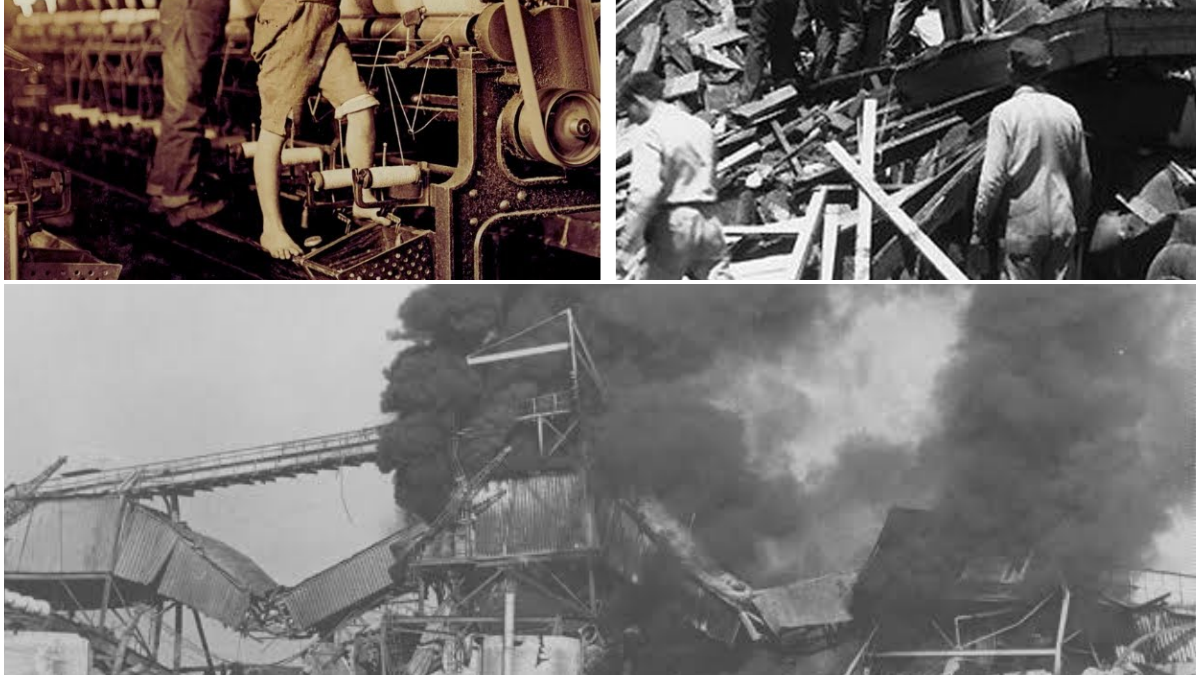
Why Did Factories Explode So Often in the Early 1900s? | Disaster Documentary
Factories from the late 19th and early 20th centuries once stood as symbols of progress.
Yet inside their walls lived a danger most people never fully understood.
A normal work day could turn violent in a single breath, leaving streets shattered and towns changed forever.
What makes these events so unsettling is that they were never acts of fate.

The signs were always there, written in pressure gauges, storage rooms, and decisions made long before the blast.
When you learn how these disasters formed, the picture becomes impossible to forget.
So, if you’ve ever wondered why factories exploded so often, this story will take you deeper than the ruins they left behind.
If stories like this matter to you, consider subscribing to our channel so we can keep preserving the hard-earned lessons and memories of the people who built the modern world.
Let’s get started by unraveling the industrial era’s deadly secrets.
The rise of steam power created hidden pressures.
In the early decades of the Industrial Revolution, steam was the lifeblood of nearly every working landscape.
It roared through pipes, settled beneath iron plates, and filled great cylinders that pushed factories into a new age.
Yet behind the promise of progress was a force that most engineers were still learning to control.
A force that carried more danger than the public realized.
Steam power came fast, faster than the science behind it.
Many of the men who built these early boilers were trained as blacksmiths or millwrights, not physicists.
They understood heat and metal, but not always the invisible pressures forming inside their creations.
Gauges were crude, welds varied in quality, and the mathematics that would later guide safe operation were still in their infancy.
Every factory owner wanted more horsepower.
Few wanted the delays that came with safety.
By the mid-19th century, boilers sat in textile mills, lumber yards, paper plants, coal mines, and riverboats.
They burned day and night, fed by workers who learned procedures through repetition rather than education.
When a boiler groaned or rattled, a foreman might chalk it up to wear.
When it leaked, someone patched the seam with whatever was on hand.
The idea that a single flaw could trigger a blast powerful enough to flatten buildings had not yet settled into the public mind.
Newspaper reports from the era read like warnings no one knew how to follow.
In 1854, the Fales and Gray Car Works in Hartford erupted in a roar that was heard miles away.
Witnesses described iron plates flying through the air like leaves.
Only a year later, a mill in Massachusetts came apart so violently that investigators believed the boiler had turned into shrapnel the moment internal pressure topped its limits.
These were not isolated events.
They were monthly, then weekly, and sometimes daily reminders that steam was not tame.
The government was slow to intervene.
Inspection laws remained inconsistent and rarely enforced.
Many states left safety entirely in the hands of factory owners, some of whom believed that a powerful boiler was a sign of a modern business.
The more energy it produced, the more money it earned, and that financial incentive often ran miles ahead of caution.
Workers paid the price.
When a boiler burst, it did not fail gently.
It tore through walls, hurled debris across streets, and filled entire towns with smoke and splinters.
People began to fear the sound of a whistle that changed pitch.
They feared the sudden silence of a machine that had been running moments earlier.
Families living near factories grew accustomed to tremors in the ground and to funeral processions that followed.
The rhythm of industry was unstoppable.
Yet no one ignored the feeling that the heart of every factory was a bomb waiting for the wrong moment.
This era marked the beginning of a deadly pattern that would continue for decades.
Steam offered speed and power, but each improvement came with a cost that workers understood long before the rest of society.
The rise of boilers set the stage for a century where progress often outran responsibility, creating dangers that would shape the industrial world in ways no one fully anticipated.
Industry pushed machines beyond their limits.
As factories multiplied across Europe and the United States, a new culture took hold inside their walls.
It was a culture built on deadlines, production quotas, and the belief that machinery should be pushed to its absolute limit.
Owners measured success in output, not restraint, and the machines they relied on bore the strain of that mindset.
Every hour a boiler sat idle was an hour of lost profit.
Every pause in production was seen as a failure rather than a precaution.
The workforce felt this pressure at every turn.
Boiler operators were encouraged to increase steam whenever orders surged, even if that meant running at levels far beyond the manufacturer’s recommendations.
Some were told to block safety valves to prevent them from releasing pressure too early.
Others were reprimanded for shutting down equipment that sounded unstable.
The message was clear: keep the machines running no matter the cost.
Industrial manuals of the mid-19th century warned of fatigue in boiler plates, corrosion from poor water quality, and the dangers of rising internal pressure.
Yet these manuals often stayed on office shelves while the reality on the floor looked very different.
Men who spoke up about cracks or unusual vibrations were dismissed as nervous or inexperienced.
Supervisors, under pressure from owners, saw caution as an obstacle.
Many believed that boilers would only explode if someone was careless, and they assumed experience alone prevented disaster.
The pace of industrial production intensified after the Civil War.
Railroads expanded, mills grew larger, and the demand for manufactured goods soared.
Machines were expected to operate continuously through winters that froze pipes and summers that overheated every workspace.
Factories often lacked spare boilers or backup systeMs. When one unit faltered, the solution was not maintenance.
It was to push the others harder until repairs became unavoidable.
But repairs often came too late.
Catastrophic failures multiplied.
In 1870, a refinery in Pennsylvania lost two boilers in the same year because foreman insisted they continue operating despite visible bulging in the iron.
In 1881, a woolen mill in Wisconsin kept its boiler running even though workers reported water levels that fluctuated wildly.
The explosion killed eight men and sent fragments across the nearby river.
Investigators later noted that the unit had been producing more steam than its design allowed.
These tragedies should have acted as alarMs. Instead, they became footnotes in an era obsessed with production.
The workers understood the risks better than anyone.
Many described hearing boilers pant like living creatures when demand spiked.
Some recalled feeling the machinery vibrate through the floorboards, a reminder that pressure was building faster than it could be released.
Still, few had the authority to halt operations.
Their livelihoods depended on silence, obedience, and hope that the strain held for one more shift.
The push for output created a world where danger lived in plain sight.
Every increase in production meant another turn of the valve, another rise in pressure, another gamble with physics no one fully mastered.
Early industry rarely slowed down long enough to consider the consequences, and the machines built to power the modern age were forced to work in conditions that guaranteed failure.
The pattern would only grow more deadly as factories embraced chemical processes that introduced new forms of instability no steam engine could rival.
Early chemical manufacturing outpaced understanding.
As the 19th century faded into the 20th, factories no longer relied only on steam.
They began working with chemicals that were new, powerful, and poorly understood.
What had once been a world of gears, belts, and boilers was quickly becoming a landscape of acids, nitrates, solvents, dyes, and unstable compounds whose behavior shifted with temperature, purity, and even the humidity in the air.
Industry had opened the door to a new age, but it stepped through without fully knowing what waited on the other side.
Chemical manufacturing grew rapidly because the world demanded it.
Farmers needed fertilizers, militaries needed explosives, cities needed fuels, and consumers wanted products that required synthetic materials.
Each new chemical brought opportunity, yet each also carried risks that early chemists were only beginning to map.
Laboratories could test reactions in small batches, but once those formulas were scaled to factory size, their properties changed.
Heat built faster, impurities multiplied, minor miscalculations turned into runaway events.
Ammonium nitrate was one of the most famous examples.
In small amounts, it was stable enough to handle safely, but in bulk, it became unpredictable.
Moisture could cause it to clump, and workers often broke those clumps apart with picks and shovels.
Friction from those tools created sparks.
Contamination from other materials altered its behavior completely.
By the early 1900s, plants that produced or stored ammonium nitrate had suffered multiple deadly explosions, yet many businesses continued using it without fully grasping the potential scale of its destruction.
Nitroglycerin posed an even more terrifying challenge.
It was sensitive to shock and temperature, yet it became a cornerstone of mining and construction.
Early factories stored it in wooden sheds that swayed in the wind.
Workers were sometimes asked to move containers by hand, hoping the liquid remained calm.
Historical accounts described deliveries that froze during winter transport, only to detonate when warmed too quickly near stoves.
Every step of the process demanded precision that most industrial environments could not guarantee.
Other chemicals created dangers more subtle, but equally deadly.
Benzene and toluene filled the air in dye works and munitions plants, forming vapor clouds that drifted into corners where lanterns hung or furnaces burned.
Acids corroded pipes from the inside out and weakened joints that appeared stable until the moment they failed.
Even flour mills, lumber yards, and sugar refineries discovered that fine dust could behave like an explosive when suspended in air.
The threat did not always come from a single substance.
More often, it came from combinations no one had yet studied.
Historical investigations from this era revealed a recurring problem.
Chemical knowledge advanced faster than industrial safety.
A discovery might move from laboratory to factory floor within months, long before guidelines existed to handle it properly.
Workers received instructions that were based on limited experimentation, and supervisors relied on habits rather than science.
The result was a workplace filled with hazards that were invisible until they erupted.
The communities surrounding these factories lived with the consequences.
Towns near chemical plants often felt a faint scent of solvents drifting across their streets.
Residents grew used to occasional rumbles or sudden plumes rising from industrial roofs.
Accidents were explained as unfortunate, but inevitable, the price of progress in an age trying to fuel its own growth.
Chemical manufacturing offered the world unprecedented power, but it also introduced risks that industry was not prepared to control.
The rules that governed these materials were still being written, and the factories of the early 20th century unknowingly operated at the edge of chemical understanding.
It was a new frontier, full of promise and peril, and the lessons learned from this era would shape industrial safety for generations.
Industrial shortcuts amplified every risk.
By the turn of the 20th century, factories had grown into sprawling systems of steam lines, conveyor belts, chemical vats, and storage sheds.
They ran from dawn until long after dusk, driven by the promise of expanding markets and relentless competition.
But beneath the clang of machinery and the glow of furnace light, another force operated quietly.
It was not mechanical, and it was not chemical.
It was human.
It was the steady erosion of safety in the name of saving time and money.
Industrial shortcuts appeared in ways that seemed small at first.
A supervisor ordered workers to bypass a faulty gauge rather than repair it.
A foreman delayed a scheduled cleaning because production needed to stay ahead of a competitor shipment.
Storage rooms became overcrowded because the company did not want to rent additional space.
Each choice seemed harmless alone, yet each one weakened a system that already sat close to its limits.
Records from the era show how often maintenance was postponed.
Boiler plates corroded from years of mineral buildup.
Pipes rattled when the pressure surged.
Valves leaked, releasing vapors that hung in the air like forgotten warnings.
But repairs required shutting down operations, and shutdowns cost money.
Many owners believed that if a machine had run this long, it would run a little longer.
They gambled on durability without understanding how stress accumulated within their equipment.
Cost-cutting also showed up in construction.
Some factories used cheaper steel or reused older components to reduce expenses.
Others added extensions without updating ventilation or reinforcing foundations.
Chemical plants expanded storage yards, even though their spacing regulations had not been designed for such growth.
In a munitions facility in New Jersey, investigators discovered that explosive materials were stored only a few feet from heat sources because space was limited and production schedules were tight.
Decisions like these transformed ordinary structures into fragile systems that only appeared stable.
Inspections often offered little protection.
Some were conducted by employees who feared punishment if they reported probleMs. Others lacked the training to identify early signs of mechanical fatigue or chemical instability.
Government inspectors, when they existed at all, faced pressure from businesses that wielded significant political influence.
Many factories passed inspections simply because no one looked closely enough.
Workers knew the hazards, but rarely had the authority to correct them.
Oral histories from the early 20th century described men who felt vibrations beneath their feet and suspected that a boiler was close to failure.
Others noticed strange odors drifting through production floors, but hesitated to speak up.
Jobs were scarce.
Families depended on wages, and employers were quick to replace anyone who stood in the way of production.
Silence became a survival strategy.
Chemical factories faced an even greater challenge.
As new compounds entered the market, storage rules were improvised rather than standardized.
Tanks holding acids or volatile liquids were placed near wooden structures because that was where space existed.
Barrels leaked onto floors, creating slippery films that masked contamination.
Workers sometimes mixed chemicals in open rooms to increase output, unaware that fumes could ignite with a single spark.
These shortcuts often created conditions where disasters unfolded with little warning.
The consequences reached far beyond the factory gate.
Communities near industrial centers learned to live with the risks created by shortcuts.
They understood that a single oversight, a delayed repair, or a poorly stored chemical could send shock waves through streets lined with homes and businesses.
They heard stories from neighboring towns and prayed that their own factories avoided similar fates.
Industrial shortcuts were seldom the sole cause of catastrophic explosions, yet they amplified every weakness already present.
They turned routine operations into precarious balancing acts.
They hid dangers until they combined into forces no one could control.
This pattern, repeated in countless factories across the world, became one of the most enduring and deadly legacies of the industrial age.
Boiler explosions revealed the power of pressure.
For much of the 19th and early 20th centuries, the boiler was both the pride and the peril of industrial progress.
These massive iron vessels delivered the power that kept factories alive.
They heated dye works, drove sawmills, spun cotton, pumped water from mines, and pushed locomotives across growing nations.
Yet beneath their riveted shells was a volatile energy that few fully grasped.
When a boiler failed, it did not simply malfunction.
It unleashed a force so violent that witnesses often compared it to artillery fire.
Boilers operated in a delicate balance between heat, water, and pressure.
A slight drop in water level could expose the iron crown sheet, causing it to overheat and rupture.
Scale buildup reduced heat transfer, forcing firemen to burn hotter in order to maintain steam.
Weak seams, corrosion, or sudden spikes in demand could push internal pressure beyond safe limits.
And once a boiler reached that breaking point, the result was never a small release.
It was a detonation.
The newspapers of the era tell a story that modern readers find difficult to imagine.
In 1860, a boiler at a sawmill in New Hampshire exploded with such force that it launched pieces of iron more than a quarter mile away.
In 1886, a Michigan flour mill vanished in a cloud of steam and debris that could be seen from neighboring towns.
One observer recalled that the building seemed to lift off its foundation before it came apart in a roar that shook the countryside.
These accounts were not exaggerations.
Engineers later calculated that a ruptured boiler released the equivalent energy of several hundred pounds of gunpowder.
Factories and riverboats were not the only victiMs. The 1865 Sultana tragedy, one of the deadliest maritime disasters in American history, occurred when overstrained boilers on an overcrowded steamship failed while navigating the Mississippi River.
More than 1,000 passengers died.
Investigators found evidence of weakened patches and ignored warnings.
The explosion was not an accident.
It was the result of cumulative stress and poor maintenance, two elements that plagued industrial boilers everywhere.
Workers lived with these risks every day.
They learned to read subtle cues, like the tremble of a firebox or the faint hiss of escaping steam.
They tapped gauges, listening for a rattle that suggested a needle was stuck.
They watched water glasses for erratic movement that hinted at blockages.
But even the most experienced operator could be caught off guard.
A hidden crack might widen at the wrong moment.
A valve could stick.
A sudden surge in production could demand more steam than the system could provide.
Communities near factories felt the danger as well.
Entire streets could be damaged when a mill boiler exploded.
In one Ohio incident, iron fragments tore through homes and shattered windows blocks away.
Town residents learned to recognize the sound of a boiler running too hot.
They understood that a momentary lapse in attention could mean disaster.
Local newspapers often included small columns detailing the latest explosion in another town, almost as if they were weather reports.
Engineers and reformers eventually pushed for standards, and organizations like the Hartford Steam Boiler Inspection and Insurance Company emerged to enforce safer practices.
But these changes came only after decades of tragedies.
Boiler explosions have become so common that some states recorded several per month.
Each one served as a reminder that industrial progress carried a price paid first by workers and then by the communities around them.
Boilers powered the rise of modern industry, but they also revealed how fragile that progress truly was.
They showed that speed, ambition, and economic pressure could obscure the dangers hidden inside the machines society relied upon.
Their failures offered a brutal education in the physics of pressure, one written in shattered iron and lives lost long before the world understood how to control the forces it had unleashed.
Scaling chemistry transformed stability into danger.
When chemistry moved from benchtop experiments to full-scale production, the risks multiplied faster than the profits.
A reaction that behaved predictably in a glass flask could become violent when mixed by the ton.
Heat built up differently.
Impurities spread through batches.
And the sheer volume of material increased instability in ways early chemists had not foreseen.
Factories embraced these new methods because the world demanded fertilizers, fuels, dyes, plastics, and explosives.
Yet the science that governed these processes lagged behind the speed of expansion.
In small laboratories, reactions were controlled by careful observation.
Temperatures could be adjusted second by second, and glassware offered visual clues when something went wrong.
But inside industrial vats, visibility vanished.
Workers monitored gauges rather than liquid.
They relied on experience rather than laboratory precision.
A clogged cooling pipe, a contaminated shipment, or a momentary lapse in attention could transform a stable mixture into a chain reaction.
The danger grew with every effort to scale production, and many factories crossed thresholds they did not recognize until it was too late.
Fertilizer plants faced some of the greatest hazards.
Ammonium nitrate, a compound that revolutionized agriculture, became unpredictable when stored in bulk.
In large quantities, it generated heat, and if that heat could not escape, the chemical began to decompose.
The decomposition created more heat, accelerating the process until it crossed into runaway territory.
Several early 20th century plants learned this lesson through disaster.
In 1921 at Oppau, Germany, workers attempted to break up caked ammonium nitrate with small charges of dynamite, a practice they had done safely hundreds of times.
But the mixture had shifted composition that week.
The resulting explosion destroyed much of the town and killed hundreds.
Investigators concluded that the same material behaved differently depending on humidity and impurities, factors few factories monitored closely.
Explosives manufacturers faced similar challenges.
Nitroglycerin reacted strongly to heat and shock, yet demand for dynamite soared as mining expanded worldwide.
Plants mixed it in wooden buildings to minimize hazards, but even small temperature fluctuations could destabilize it.
One Swedish account described workers who carried trays of nitroglycerin across yards at dawn when the air was cool, only to find that a warm afternoon caused the same batch to tremble inside its containers.
Scaling the process meant mixing larger amounts at once, increasing the risk that a single miscalculation could destroy an entire facility.
Even industries not associated with explosives faced dangers from scale.
Dye manufacturers used volatile solvents that released flammable vapors.
Rubber plants stored barrels of benzene and toluene in long rows where vapors drifted between them.
In warm weather, the air grew thick with invisible clouds that could ignite with a lantern or friction spark.
Chemical soap factories, paint manufacturers, and early plastics plants all discovered that reactions which seemed harmless in small quantities could behave violently when industrialized.
Another problem lay in the pace of expansion.
Chemical knowledge advanced quickly, but regulation moved slowly.
New discoveries reached factory floors before best practices were fully established.
Workers mixed compounds based on procedures that had been tested only on small batches.
Supervisors often assumed that consistent output meant safe output, unaware that each shift introduced variables that altered the reaction.
The more factories produced, the more they unknowingly approached dangerous thresholds.
Communities surrounding these plants lived in a constant state of uneasy coexistence.
Some remembered minor incidents, like smoke rising unexpectedly or small fires that workers extinguished quickly.
Others experienced far worse.
Entire neighborhoods were shattered when a chemical reactor failed or a storage tank overheated.
Local residents often said they smelled trouble before they heard it.
The air carried faint hints of chemicals, reminders that their prosperity came with risks they did not control.
Chemical plants symbolized progress, but their growth exposed the limits of industrial understanding.
They showed that scaling up was not simply a matter of building larger equipment or producing more product.
It introduced new physics, new chemistry, and new hazards that few anticipated.
The lessons learned from these early plants reshaped industrial safety, but many of those lessons arrived through catastrophes that revealed how quickly controlled reactions could turn into overwhelming forces.
Explosive dust turned ordinary workplaces deadly.
Long before chemical plants dominated industrial landscapes, another danger settled quietly across factory floors.
It coated rafters, lodged in vents, drifted through beams of sunlight, and gathered in corners where no broom ever reached.
This danger was dust.
To the untrained eye, it looked harmless, a byproduct of flour, coal, wood, sugar, cotton, or grain.
Yet suspended in the air, it became one of the most explosive forces in the industrial world.
Many factories never realized they were working inside fuel clouds until the moment those clouds erupted.
Dust explosions followed a simple but unforgiving pattern.
Fine particles mixed with oxygen, forming a combustible atmosphere.
All that was needed was confinement and an ignition source, both common in industrial environments.
A spark from a machine, a slipping metal tool, or even a static discharge could ignite the suspended particles.
The initial flash disturbed settled dust, sending more into the air and feeding a second, much larger blast.
This phenomenon, known today as a secondary explosion, was responsible for some of the deadliest industrial accidents of the late 19th and early 20th centuries.
Flour mills were among the first to learn this lesson.
In 1878, the Washburn A Mill in Minneapolis was considered one of the most advanced flour mills in the world.
It also became one of the earliest examples of catastrophic dust ignition.
A spark inside a grinding machine set off a blast that ripped through the building and destroyed nearby structures.
Witnesses described fire racing across the riverfront as if the air itself had caught flame.
Investigators later found that flour dust had settled in thick layers throughout the facility.
When the first explosion hit, it stirred these layers into a dense cloud that ignited instantly.
Coal mines faced similar dangers beneath the earth.
Coal dust, when finely ground and suspended, became highly explosive.
Many mine operators underestimated this risk, assuming methane gas was the primary threat.
But in some cases, gas explosions served only as triggers.
The Courrières disaster of 1906, which killed more than a thousand miners in France, is believed to have involved coal dust that ignited after a smaller explosion traveled through the galleries.
The force multiplied as dust lifted and combusted, turning narrow passageways into lethal channels of fire and pressure.
Woodworking plants, textile mills, and paper factories all carried their own forms of combustible dust.
In sawmills, air grew thick with wood particles that clung to belts and machinery.
Even routine tasks like sanding produced clouds invisible to workers accustomed to the atmosphere.
In cotton mills, fibers floated through workrooms where oil lamps burned and friction built inside fast-moving machines.
Many of these factories lacked proper ventilation.
They relied on open windows or outdated exhaust fans that could not capture the volume of debris created during peak production.
One of the most overlooked factors was that dust accumulated slowly.
Its dangers were not obvious until conditions aligned perfectly.
A mill that operated safely for years could become deadly after a week of heavy production.
Dust settled on beams and platforms where no one cleaned.
Workers swept floors, but rarely reached the places where particles collected in dangerous concentrations.
By the time conditions were ripe for ignition, there were few visible signs of the risk.
Communities near these facilities often felt the vibrations of explosions before they understood what caused them.
Newspapers described mills reduced to fragments and fireballs rising where warehouses once stood.
Survivors sometimes spoke of hearing a soft thump followed by a roar that shook the ground.
Investigators who sifted through debris noted how little fuel was needed to produce such destruction.
A thin layer of dust provided more energy than most people imagined.
Dust was not new to industry, but understanding its explosive power required a level of scientific awareness the early factories did not possess.
This blind spot turned countless workplaces into unrecognized hazards.
The danger lay not in what workers could see, but in what floated invisibly above their heads or rested quietly on structures they never touched.
Dust explosions became a stark reminder that even the most ordinary materials could unleash extraordinary destruction when left unchecked in the evolving industrial age.
Poor storage practices created constant threats.
As industry expanded, storage yards and warehouse rooms became the overlooked backbones of production.
They held the fuels, chemicals, powders, oils, and tools that kept factories working around the clock.
Yet these spaces were rarely designed with safety in mind.
They evolved haphazardly as businesses grew, squeezed into unused corners or added as afterthoughts to aging buildings.
What resulted were storage areas where incompatible materials sat only feet apart, where ventilation was inadequate, and where a single spark or leak could trigger destruction that spread through entire towns.
Many factories stored materials in ways that reflected convenience rather than caution.
Barrels of kerosene lined wooden walls.
Solvents sat near furnaces because the space was available.
Timber was stacked close to power lines, and acids were placed in rooms with metal shelving that corroded slowly with each passing week.
Workers became accustomed to walking past containers that swelled in the summer heat, unaware that the pressure inside was rising to dangerous levels.
The industrial world often treated storage as an afterthought, but it was in these quiet spaces that many disasters began.
Reports from early investigators reveal how common poor storage practices were.
In some dye works, flammable vapors collected in low areas because ventilation was inadequate.
In munitions factories, explosives were stacked in piles far larger than recommended.
Their only barrier, a thin wooden wall.
Warehouses that held ammonium nitrate or sulfur often had open flames nearby because workers used lanterns to inspect inventory.
Ignition sources were everywhere.
Sparks from metal tools, friction from moving barrels, static electricity from dry air, and even sunlight magnified through glass windows could ignite materials that had been stored without proper safeguards.
Moisture created dangers of its own.
Chemicals such as nitrates absorbed humidity, altering their stability.
Coal stored outdoors could react slowly with oxygen and generate heat that smoldered within large piles.
Composting effects developed in grain storage, producing gases that ignited when exposed to open air.
Many factory owners did not understand these processes.
They interpreted unusual smells or slight warmth near storage piles as minor nuisances rather than early warnings.
The scale of storage yards also magnified risk.
As factories grew, they needed more raw materials on hand.
Tanks expanded from hundreds to thousands of gallons.
Warehouses grew deeper and taller.
This increase in volume changed the behavior of the substances inside.
Tanks holding volatile liquids built up vapors that no longer dissipated naturally.
Barrels stacked too tightly trapped heat between them.
Bulk storage carried bulk consequences, turning small misjudgments into events that could level entire districts.
Historical tragedies illustrate how quickly poor storage could escalate.
In 1917, the Silvertown explosion in London began with volatile chemicals held in a plant that operated beyond its safe capacity.
In 1923, an explosion in Lexington, Kentucky, destroyed dozens of buildings when stored petroleum vapors ignited.
In each case, investigators found combinations of flammable materials, inadequate ventilation, and shortages of proper safety equipment.
The materials themselves were not inherently unsafe.
The way they were stored made them deadly.
Workers who managed these storage areas faced constant uncertainty.
Many learned to identify signs of trouble by smell alone, detecting the faint sweetness of escaping gas or the acidic tang of leaking chemicals.
Others noticed barrels that warped in summer months or bags that felt warm to the touch.
But even when concerns were raised, supervisors often dismissed them.
They believed that long-standing procedures were safe simply because they had not yet caused a catastrophe.
Tradition, rather than science, guided many storage practices.
The communities surrounding industrial districts lived with the consequences of this neglect.
Homes bordered warehouses filled with unknown materials.
Children played near tanks that contained fuels heavier than air, vapors that could drift silently along the ground.
When explosions occurred, they rarely stayed confined within factory lines.
Fire traveled quickly through storage yards, jumped across streets, and consumed neighborhoods within minutes.
Poor storage practices remained one of the most persistent and underestimated threats of early industry.
They revealed how fragile progress could be when convenience overshadowed caution.
In the quiet rooms where materials rested, unseen reactions continued hour after hour, waiting for the moment when chemistry, temperature, and negligence aligned.
It was in these forgotten spaces that many of the industrial era’s most devastating explosions were born.
Workers and communities bore the cost of disaster.
For the workers on the floor and the families living nearby, industrial danger was not an abstract concept.
It was a part of daily life.
The men who fired boilers, shoveled coal, hauled barrels, or mixed chemicals understood that each shift carried risks that could not be seen.
They heard the groan of metal under strain, smelled vapors drifting from storage rooms, and felt vibrations beneath their boots that told them more about a machine’s condition than any document ever could.
Their knowledge was instinctive, earned through repetition and survival, yet it rarely translated into meaningful protection.
The communities surrounding these plants lived in a similar state of uneasy acceptance.
Entire towns grew up around mills, mines, refineries, and chemical works.
The factory whistle marked the passing hours, and the glow of furnaces lit the night sky.
People took pride in the industries that paid their wages, but that pride carried a shadow.
They understood that a single spark, leak, or structural failure could send a shockwave through their streets.
Newspapers carried stories of explosions in distant cities, and every family hoped the next headline would not come from their own town.
When disaster struck, its impact reached far beyond the factory gate.
Windows shattered blocks away.
Roofs collapsed under falling debris.
Fires spread quickly through tightly packed neighborhoods.
Survivors often described a moment of bright light or a sudden silence before the blast.
Some recalled being thrown from their feet.
Others remembered searching through smoke-filled streets for loved ones who had been working the morning shift.
These accounts, preserved in letters and local archives, show how deeply these tragedies cut into the fabric of working-class life.
In 1890, an explosion at the Mill River Mill Complex in Massachusetts sent timber and iron across homes that lined the riverbank.
Families who’d lived in those homes for generations found themselves suddenly displaced.
In 1916, a blast at a chemical plant in Canada shook the surrounding region so violently that townspeople believed an earthquake had struck.
Similar scenes unfolded across Europe and the United States as factories grew larger and the materials they handled became more volatile.
Each explosion left behind not only physical ruins, but also a lingering sense of vulnerability.
Rescue efforts often unfolded in the same factories where workers had spent their lives.
Firefighters struggled against dense smoke and collapsing structures.
Volunteers dug through debris with shovels and bare hands.
In mining towns, families waited at the mouth of the shaft listening for faint taps that signaled trapped workers below.
Communities came together with remarkable resolve, but their strength could not erase the grief that followed.
Funerals filled local churches.
Streets lined with black armbands served as a reminder that progress had come at a steep cost.
Investigations after these disasters revealed patterns that workers had long recognized.
Faulty equipment had been ignored.
Storage practices had violated basic safety standards.
Training had been insufficient or outdated.
Yet, accountability was uneven.
Some companies compensated families modestly, while others claimed the accidents were unavoidable.
The workers who survived often returned to the same jobs within days because they needed the income.
Danger remained woven into the rhythm of their lives because the industrial age left little room for alternatives.
Over time, these repeated tragedies shaped public opinion.
Communities began demanding stricter inspections, stronger construction standards, and better training for operators.
Reformers wrote articles detailing the human toll of industrial negligence.
Newspapers called for legislation that would protect workers and nearby residents.
These voices added pressure to governments and companies slowly steering society toward a recognition that progress could no longer come at the expense of safety.
Still, for decades, the people who lived closest to industry bore the weight of its failures.
Their stories formed the human landscape behind every explosion, reminding future generations that industrial power came with real consequences.
The lessons extracted from their suffering eventually influenced reform, but those improvements arrived only after communities endured losses that could never be restored.
Their resilience kept factories running, but their tragedies reshaped the conscience of an industrial world learning, often too late, what happens when danger is allowed to grow unchecked.
Reforms emerged from tragedies and collective loss.
By the early 20th century, the industrial world could no longer ignore the destruction that had marked its rise.
Boiler explosions, chemical reactions got out of control, storage failures, and dust ignitions had left behind a trail of shattered buildings and grieving communities.
Each disaster exposed weaknesses that engineers, lawmakers, and reformers knew had to be addressed.
The era of unchecked experimentation was fading.
In its place grew a cautious recognition that progress required standards strong enough to withstand the pressures of modern production.
One of the earliest breakthroughs came from the field of boiler safety.
After decades of deadly failures, insurance companies and engineers collaborated to establish inspection rules that forced factories to update equipment and maintain consistent oversight.
Organizations such as the Hartford Steam Boiler Inspection and Insurance Company helped create a code that required regular testing, reliable pressure gauges, and construction standards based on scientific principles rather than guesswork.
States began adopting these rules, and slowly the rate of boiler explosions declined.
The changes did not reverse the tragedies of the past, but they marked a turning point in understanding that safety could not be optional.
Chemical plants followed their own path toward reform, though the journey was longer and more complex.
Catastrophes like the Oppau explosion in 1921, the Texas City disaster in 1947, and the Nitro incident decades later revealed how volatile industrial chemistry remained even with growing scientific knowledge.
These events pushed governments and companies to establish guidelines for chemical storage, reaction control, and ventilation.
Engineers developed cooling systems, containment vessels, and monitoring equipment capable of detecting subtle signs of instability.
Training programs emerged to ensure workers understood the materials they handled.
Over time, the most dangerous improvisations disappeared from factory floors.
The danger of dust received overdue attention as well.
Researchers studied how fine particles behaved in confined spaces, discovering patterns that earlier generations had never imagined.
Their findings led to ventilation standards, dust collection systems, and zoning requirements that separated ignition sources from airborne particulates.
Mills and factories learned to control the accumulation of powder in rafters, ducts, and equipment.
These improvements reduced the likelihood of the secondary explosions that destroyed countless facilities.
The shift was gradual, but each step forward came from understanding the mistakes that had defined the past.
Storage practices improved as companies learned how materials interacted with heat, moisture, and one another.
Facilities redesigned warehouses to separate volatile compounds.
Fireproof construction replaced aging wooden structures.
Tanks gained pressure relief valves, and ventilation systems grew more sophisticated.
Government codes required spacing between containers and prohibited lanterns or open flames near sensitive materials.
These regulations saved lives, but they were often inspired by the memory of disasters that had shown the world what happened when storage was left to chance.
Most importantly, public awareness changed.
Communities that had once accepted industrial danger as part of life began demanding accountability.
Newspapers documented failures with increasing scrutiny.
Labor unions fought for rights that included safer working conditions.
Survivors testified before commissions, providing first-hand accounts that shaped new laws.
The collective weight of these stories created momentum that industry could no longer resist.
By mid-century, the landscape of factories and mills had shifted from one defined by risk to one shaped by regulation and engineering.
The machines were stronger, the chemicals better understood, and the storage yards more carefully managed.
Yet, the legacy of earlier generations remained visible.
Historical markers, memorials, and archives preserved the memory of those who paid the price for progress.
Their experiences formed the foundation of modern safety standards, reminding society that every rule was built on the lessons of past losses.
Industry had not become risk-free.
It never would.
But the reforms carved from decades of tragedy reshaped the balance between ambition and responsibility.
The factories that once operated on the edge of disaster learned, through hardship and reflection, that progress must be tempered with caution.
The modern world inherited the benefits of these reforms, along with the obligation to remember the cost.
The story of industrial safety is not simply one of innovation.
It is the story of a world that learned, step by step, that the power it sought to harness demanded respect, vigilance, and a commitment to never repeat the mistakes that once turned factories into fields of ruin.








