Crying Mother Bigfoot Hands Her Albino Baby to Man – The Next Moment Will Leave You In Awe
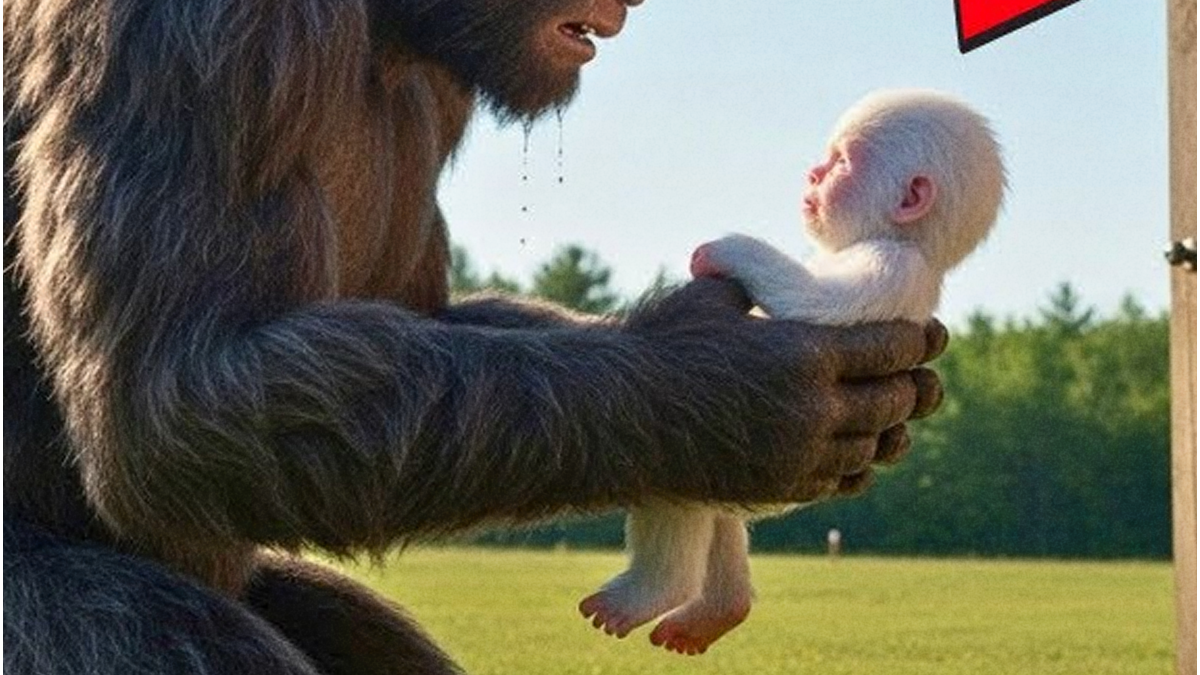
Crying Mother Bigfoot Hands Her Albino Baby to Man – The Next Moment Will Leave You In Awe
Have you ever felt like the only one of your kind?
Misunderstood, out of place, invisible?
One stormy night in the Blue Ridge Mountains, a giant creature appeared at the cabin of a grieving man and placed its snow-white child into his arms before vanishing into the woods.

That creature was a Bigfoot, an albino outcast rejected by its own kind for being different.
But it wasn’t a monster.
It was a mirror reflecting what it means to be abandoned and what it means to heal.
Inspired by forgotten Appalachian legends, this story isn’t about fear.
It’s about compassion, about how a lonely man, a quiet woman, and a voiceless creature found each other and reminded us that kindness can cross any boundary, even between species.
The child they called Solace learned to trust, to feel, to say goodbye without ever speaking.
And years later, it returned with a scarred guardian, a weathered harmonica, and a song played not with notes, but with breath.
If you’ve ever felt lost, this story might find you.
Where are you watching from tonight?
How far can this story of quiet love and second chances travel if we share it gently, like a whisper in the woods?
From the bottom of our hearts, thank you for being here.
The storm had been circling since late afternoon, dragging its heavy lungs across the ridges until night swallowed the trees whole.
Thunder cracked in the distance like the bones of the sky snapping under strain.
Rain fell in sheets, soaking the moss and stirring up that deep musky scent of wet pine, iron-rich soil, and old bark.
Wind curled low around the cabin like an animal that had found something worth guarding.
Inside, the oil lamp on the windowsill flickered against the pane, its golden glow the only thing resisting the dark.
Harold Benton hadn’t expected a knock, not after a dozen years of no visitors, not since the world had thinned out around him like the hair at the crown of his head.
The grief had rearranged his life quietly, like rot beneath a floorboard.
He’d stopped answering questions, stopped needing them.
The woods gave him everything he asked for, stillness, a place to sleep, something warm in the cup.
He’d carved a quiet, predictable rhythm here, and no one ever disturbed it.
Until now.
It wasn’t a knock, not exactly.
More like a presence, a shift in pressure outside the door that made the dog-eared curtains tremble.
Something large moved beyond the porch light.
The boards moaned under a weight that wasn’t wind.
Then the lantern flame bowed low, flickering once, then held.
Harold opened the door slow.
Rain swept across the threshold, cold and uninvited.
And standing in it, or maybe leaning into it like it had come farther than it should have, was a figure that didn’t belong to any memory he could explain.
Massive, drenched.
It had shoulders like a collapsed barn beam and fur clinging to its frame like bark after a fire.
One arm cradled something to its chest, something smaller, curled, motionless.
And the face, God help him.
The face wasn’t a mask of snout and fangs.
It wasn’t beast, it wasn’t animal.
It was human-like, not human, but worn and aware, shaped by weather and time, not biology.
Eyes amber dark, lit from inside with the kind of grief that had walked the same roads Harold had.
It looked at him, not past him, not through him, but at him.
With urgency, not aggression.
A plea without sound.
Harold didn’t breathe.
He just stared as the thing knelt on one knee like a man in pain and placed the small form gently at his feet.
The little body was covered in white fur, so light it shimmered even in the gray rain.
Its limbs were too long for a child, too delicate for a beast.
It didn’t move.
Its face, nestled in the crook of Harold’s old wool sweater, looked like something born from fog and lost before it could speak.
The creature looked up at Harold again.
Water streamed from its jawline.
The short beard under its chin clung in strands to the fur along its throat.
Its breathing hitched once, then steadied.
There was a depth behind those eyes, like it remembered something it couldn’t name but trusted anyway.
Then, without sound, it rose, turned, and disappeared into the rain with the same silence it had arrived with.
Harold hadn’t moved.
He didn’t call out, didn’t ask what it was or why it came.
He stood barefoot on the cabin’s warped threshold, cradling something impossibly warm and trembling.
And for the first time in years, he whispered aloud without shame, “You’re not going to be alone tonight.”
The wind picked up behind him as he closed the door.
He brought the child, or whatever it was, closer to the stove, careful not to jar its breathing.
The fur along its ribs was damp and smelled of cedar bark and something faintly metallic, like river stone.
Its skin underneath, where he could see it through thin patches of white hair, was pale and paper thin, glowing faintly pink in the firelight.
He found the old wool blanket from his army footlocker, wrapped it twice, and tucked it around the small frame like he’d once done with something too precious to lose.
He boiled water, then stirred in the last of the sweetened condensed milk from a forgotten can behind the flower jar.
He tested the heat with the inside of his wrist.
The touch reminded him of something he’d forgotten on purpose.
The child stirred faintly, eyelids fluttering.
Ears, small and pink like the new skin of a pup, twitched once at the sound of the kettle clicking.
It didn’t cry.
It didn’t moan.
Just pressed closer into his chest as if it already knew this place wasn’t meant to hurt it.
Harold held the chipped enamel cup near the tiny mouth and let it sniff, then drip just a little onto its lips.
A tongue appeared, cautious and unsure.
Then the smallest sip.
It blinked slowly, and for a breathless second, its eyes opened fully.
Amber, just like the one who brought it.
Not wild, not blank, curious, trusting.
He kept whispering soft things he didn’t know he still remembered how to say.
“Easy now.
You’re all right.
We’ll figure this out.”
The storm rattled the chimney.
But inside the cabin, the warmth spread slow and quiet, like it had found something to wrap around.
Harold didn’t ask himself what it meant.
He didn’t think about the laws or the explanations.
He just kept his hand pressed gently to its chest, counting the tiny, irregular breaths.
The creature hadn’t knocked, hadn’t begged.
It had just known where to go.
Outside, the rain poured without pause, soaking the porch and hissing against the stovepipe.
But inside, it was just the two of them.
A man who’d forgotten how to care for anything and a child who’d never been taught to ask for help.
Somewhere before dawn, Harold found himself sitting on the old rocker by the stove, still holding the small form against his ribs.
The oil lamp had burned low.
His back ached.
His mind flickered like the shadows on the wall, trying to piece together the enormity of what had just passed through his door.
The child shifted in his arms and released a faint, breathy sound.
Not quite a word, not quite a cry, just presence.
Harold lowered his forehead gently against its head.
He stayed like that until the rain slowed, until the thunder faded into memory, until the world beyond the window was still again.
He didn’t sleep, but for the first time in a long while, he didn’t want to forget.
Somewhere in the woods, something massive moved between trees, unseen, watching, waiting, but not in anger, only in hope.
The wind pulled at the edge of the shutters, but the cabin held, and so did Harold.
By the time the first color crept into the sky, faint and slow as a healing bruise, the child had curled tighter in his arMs. Its small fingers curled against his shirt, and its breathing had found a rhythm.
Harold whispered again, this time without trembling, “You’ve got a name now, little one.
Solace.”
And something in the room shifted, not the air, not the sound, but the sense of it, as if the very walls had leaned closer to listen.
He didn’t know where this would go, what questions would come, but he knew this.
The forest had given him something not to answer, but to keep.
And for now, that was enough.
By morning, the storm had retreated, leaving behind a wet hush that clung to the cabin like old smoke.
The clouds hung low and pale over the ridgeline, soft as milk glass, and the fields around the clearing steamed gently as if the earth itself had exhaled.
Rainwater ticked off the eaves.
The porch boards glistened.
In that stillness, the forest wasn’t silent.
It was holding its breath.
Inside the cabin, the kettle hissed low on the stove, while Harold moved with a kind of reverent caution, the way you’d move in a room where someone was still sleeping.
The child, Solace now, that word spoken into the room like a prayer the night before, was wrapped in the wool blanket, curled into a loose question mark on the old cot by the fire.
Steam curled from the enamel mug in Harold’s hand as he tested the warmth against the skin of his wrist, again and again, until the memory told him it was safe.
He hadn’t named anything in years, not even the deer that sometimes watched him from the tree line.
But the name had come to him like it had always been there, like the boy, or whatever he was, had brought it with him.
Solace.
That’s what it felt like, settling into the walls.
Not comfort, not peace, but a space that hurt a little less.
The light that crept in through the window was thin and sharp.
Harold pulled the curtain tighter, then took one of the heavier wool throws from the cedar chest and draped it over the window frame to block out the slice of glare.
He caught himself shielding the child’s eyes with the back of his hand whenever the sun shifted too fast.
The skin was sensitive, thin, like parchment under candlelight.
Even the morning felt too loud for it.
The little one stirred, eyes fluttering beneath lids that twitched like leaves in wind.
When the lashes parted, those amber eyes returned.
Not blank, not glassy, but real, present, watching him.
Harold crouched, careful not to loom.
Easy, he said, not even sure if the child understood words.
He dipped his fingers into the warm milk and let a drop fall to the corner of its mouth.
Solace flinched at first, then licked at the taste slowly.
Another drop.
Then another.
Harold offered the rim of the cup next, and this time the child reached with both hands, awkward, unsteady, fingers longer than human, but still small, and pulled it close, drinking in slow, hesitant sips.
The rhythm of care returned like muscle memory.
Stirring milk, checking heat, wiping a spill from the corner of a mouth with a hem of his sleeve.
He hadn’t done this since long before the grief, long before the fire, but the hands remembered, and somehow, so did the silence, the way it held them both.
He watched Solace lift one hand, then the other, and reach toward the hem of his flannel, not pulling, just holding, holding on.
The fur along the boy’s arms was white, but soft, thinner at the wrists, thicker at the shoulders, and the face, still not quite boy, not quite beast, shifted with each blink and tilt of the head like it was learning him, too.
The human-like wildman face didn’t speak, but it expressed.
It listened.
A wind pushed across the roof, and the child flinched.
Harold set down the mug and wrapped the blanket tighter.
You’re okay, he murmured.
You’re all right.
The words didn’t feel like they were coming from his mouth, more like they’d risen up from the floorboards.
Later, when the rain had faded to a memory on the pine needles outside, Harold found his old workbench tucked against the far wall.
He hadn’t used it in years, but the lamp still worked.
He unearthed an old thermometer, cracked but functional, and used it to test the milk again.
Then he started sketching out a loose feeding schedule in his head, same way he had when raising that first runt foal with the clubbed leg out near Maynard’s pasture.
Warmth, small meals, no sudden movements, plenty of quiet.
The cabin had never been meant for more than one person, but Harold found himself rearranging things anyway.
He cleared the cluttered corner where a pile of old fishing gear had gathered dust.
He folded a spare wool shirt to line the cot.
He set a tin basin of water beside the hearth, not sure if Solace would understand it, but still wanting it there.
Even the way he moved changed, slower, softer, like a house adjusting to the weight of new breath.
Afternoon light filtered in muted and gold, the kind of light that made things look like they belonged in memory.
Harold sat on the front step, letting the door hang open just enough to keep an eye inside.
In his hands, the old harmonica felt like a stranger.
He hadn’t played it since.
He couldn’t even remember.
It had outlived everything else.
He brought it to his lips and let a single note breathe out.
Low, drawn, sad in a way only things without words could be.
He played it once, then again, a slow pattern like rain on canvas, like wind through dry grass.
Inside the doorway, Solace sat up and tilted his head, eyes narrowing like he was listening beyond the notes themselves.
Harold played until the light thinned into blue, until the fire inside crackled against the hush.
Solace crawled forward on his palms, then sat cross-legged, hands pressed to his knees.
His face was tilted, eyes locked on the music.
Then, in the smallest breath, the boy made a sound, a soft, trembling imitation of a chord, not from the lips, but from somewhere deep in the chest.
A hum, a mimicry, enough to make Harold stop playing and stare, not in fear, but in something close to awe.
The boy blinked slowly, then reached out and placed his hand on Harold’s knee.
No words passed, just the sound of the stove clicking, the fire shifting, the harmonica cooling in his palm, but in that gesture, soft, deliberate, familiar, Harold felt something in his chest unclench.
That night, after the lamps were dimmed and the dishes washed in silence, Harold sat in the rocker again, the boy asleep just 10 feet away, chest rising and falling in slow rhythm.
The air smelled like smoke and milk and pine bark.
He didn’t bother trying to explain it.
There wasn’t anyone to explain it to, but something had changed.
The cabin no longer felt like a refuge from the world.
It felt like a border, a space between.
He found himself watching the shadows more closely, listening for the hush between the owls and the coyotes, wondering if the one who’d brought Solace was still out there, watching, waiting.
In the dark, he whispered to the ceiling, not sure if it was prayer or promise.
I’m not going to let him go hungry.
I’m not going to let him get cold.
You hear me?
There was no reply, only the sound of a log splitting in the fire and the boy’s breath.
By the third day, Solace had learned to walk in short bursts, legs wobbling, knees unsure, but determined.
He leaned on Harold’s forearm for balance, holding on just tight enough to trust.
The child winced at sudden noise, at slanting light, but he smiled, Harold could have as he crouched beside the hearth, tapping the cast iron stove with one long finger like it was some mysterious relic.
When the harmonica appeared again, he hummed under his breath.
He remembered the sound.
There was music in him already, and Harold, for all his years alone, had begun to believe that was something worth staying alive to hear.
The forest beyond the window watched them both, and somewhere in its dark, damp belly, something else stirred.
Summer came in quiet this year, like it didn’t want to disturb what had taken root behind the cedar walls.
The forest grew thick and warm, breathing sap and clover, and the cabin sat tucked under a canopy of green so deep it hummed when the wind passed through.
Morning light filtered in gold and green, touching everything with a kind of hush.
Even the floorboards creaked softer, like they’d come to understand this wasn’t just a house for one anymore.
Solace was stronger now.
His legs, once unsure beneath him, held his weight better with each passing day.
He learned by watching Harold, how to move slow, how to crouch near the hearth, how to place a log just so into the stove without letting the flame choke.
He mimicked without fuss.
His small hands reached for the broom, the bucket, the rag.
Sometimes he worked too hard, trying to make himself useful before Harold even asked.
Other times, he’d just sit beneath the open window, nose twitching at the scent of pine or bread baking or the musk of rain before it hit.
He didn’t speak, but he listened.
He didn’t laugh the way a child might.
But when Harold played a long, gentle note on the harmonica, Solace would hum low in his chest, pressing his palm against the old man’s thigh like a response.
He clung to patterns.
Sunlight falling on the same corner of the room each morning, the sound of kindling cracking in the early hours, the smell of Harold’s wool shirt warmed by sweat and ash.
Every small routine became something sacred.
When Harold reached for his flannel before stepping out onto the porch, Solace would hold up the soft green cap with a frayed brim and offer it up with both hands.
He couldn’t wear it himself, not with the shape of his skull and those high-set ears, but he understood it meant something, that it mattered, that out back Harold had cleared a patch of space beneath the oaks for walking practice.
Soft pine needles made it easy on Solace’s feet.
They worked their way from slow standing to halting steps, one hand on Harold’s belt loop, the other swinging wide for balance.
Sometimes he stumbled and dropped to all fours, breathing hard, but he always got up.
Every day, a little farther.
Every day, a little more steady.
He was small for his kind.
Harold could tell that much.
And not just in size.
There was something delicate about the way he moved, something too open.
He blinked slowly, like he’d never had to blink fast.
His eyes stayed on Harold’s face long after most people would have looked away.
He didn’t shy from touch.
He leaned into it.
Pressed his forehead into Harold’s shoulder or his chest and stayed there, breathing, remembering.
One afternoon, while they were sitting on the porch waiting for bread to rise, a hawk screamed across the sky.
Solace stiffened.
His shoulders hunched and his hands shot up to grip the collar of Harold’s coat.
It wasn’t just a startle.
It was fear, primal and tight.
Harold could feel it in the way the boy’s ribs pressed in and held.
He didn’t say anything.
Just placed a hand on Solace’s spine and kept it there until the hawk’s call faded into the treetops.
After a minute, Solace relaxed again.
But the way he leaned into Harold afterward, quiet, watchful, made something ache deep in the older man’s chest, as if the child had known danger once, known it in the sky.
The sun rolled over noon and dragged the wind behind it.
The smell of fresh clover drifted in from the edges of the clearing.
They sat together on the steps, listening.
Sometimes that was enough.
And then, one morning, Lydia Ray arrived.
She came up the path with a basket on her hip and mud on the hem of her skirt.
Her voice, when she called Harold’s name, was steady and casual, like she did this kind of thing often.
She didn’t.
But she’d heard through the valley that Harold had gone into town for a tin of condensed milk and hadn’t spoken to anyone, that he looked thinner, stranger.
When she rounded the bend and saw the cabin, the dog sleeping under the porch, and Harold sitting with a strange, white-furred child beside him, she didn’t blink.
She just walked up slow, placed the basket on the railing, and said, “Looks like you’ve got company.”
Harold didn’t flinch, didn’t explain.
He looked her square in the face and said, “He’s called Solace.”
Lydia didn’t ask what he was.
She looked at the child, took in the white fur, the high ears, the amber eyes, and then pulled a jar from her basket.
“This will help with skin that burns easy,” she said.
“Sun’ll catch him quick looking like that.”
Solace stayed close to Harold, half behind him, but his eyes never left Lydia.
Not wary, not afraid, just cautious, like someone trying to remember a face from a long time ago.
Lydia crouched down.
“You okay, sweetheart?”
Her voice softened, but she didn’t reach out.
Just opened the jar and set it on the step.
“It’s just balm.
Smells like sage, but it cools fast.”
She straightened, brushed her palms against her skirt, and turned to Harold.
“You feeding him enough?”
“Trying to,” he said.
“I brought oats and honey.”
They moved inside without ceremony.
Lydia opened windows that hadn’t been touched in weeks.
She adjusted the curtain where the sun hit too hard.
She wiped the sill with the corner of her sleeve.
Solace watched her with quiet interest, nose twitching when she set the basket down and started unpacking it.
Bread, herbs, dried apples, more balm.
She didn’t talk much, and Harold was grateful.
By late afternoon, Lydia had made herself comfortable on the porch rail, sipping from a tin cup and watching the trees shift in the breeze.
Solace sat at her feet, just close enough to feel her presence.
When Harold brought out the harmonica again, she didn’t comment, just tilted her head like she was listening for something under the music.
Solace hummed along, low and steady.
Then, carefully, slowly, he mimicked the sound again from his throat.
Lydia smiled, but didn’t speak.
That small sound, that echo of music, was more than enough.
The sun dipped behind the ridge.
Shadows stretched across the porch like long fingers, and somewhere deeper in the forest, an owl started to stir.
The air cooled.
Lydia stood, dusted the back of her jeans, and handed Harold a small bundle wrapped in cloth.
“Salve,” she said.
“Keep his skin covered when you can.
I can bring a softer cap next week.”
Harold nodded, but his voice caught for a second before he could say thanks.
She paused at the bottom of the porch steps, then turned and looked at him, steady.
“You ever think,” she said, “that maybe what makes us human isn’t how we look or talk, but how we care for something smaller than ourselves?”
Harold didn’t answer, not out loud, but he looked down at the hand Solace had placed on his knee, and he knew what he would have said.
Later that night, when the forest exhaled again and the stars pressed in close, Harold sat by the fire, watching Solace sleep.
The balm smelled faintly of cedar and wild mint.
The boy’s breathing was steady.
The night was quiet.
But outside the window, the trees rustled, not in warning, not in threat, but in acknowledgement, as if the forest itself had noticed something had changed.
And from somewhere out beyond the clearing, a pair of eyes blinked once, then vanished into the dark.
Fall crept in like something that had been watching from the edge of the clearing all along, waiting for its turn to speak.
The trees began their slow surrender, their leaves turning brittle and gold, the wind sharpening just enough to wake you in the morning.
The air carried a quiet weight that made even the stove pop a louder at night.
Summer’s warmth hadn’t vanished.
It had simply moved deeper underground, curled in the roots and waiting for spring.
Harold felt it first in the bones, a deeper ache when he stood from the porch swing, a longer pause between chords on the harmonica.
But Solace didn’t seem to notice the shift in seasons the same way.
He moved with the same careful steps, still pressed his forehead to Harold’s shoulder when he was tired, still curled his toes against the warm planks of the porch in the late morning sun.
But something in him had changed, too, subtle as moss growing over a stone.
He wandered more.
He watched the tree line longer.
He listened.
Lydia came every Saturday now.
Sometimes she brought new balm or a scrap of cloth she’d stitched into a makeshift hood.
Sometimes it was dried beans or a bundle of kindling wrapped tight with twine.
She never asked questions.
She never touched Solace unless he reached first.
And he had started to, little by little, brushing her sleeve, leaning near her knee when she read aloud by the fire.
Once, he curled beside her in the leaves out back and fell asleep with his head on her lap.
She hadn’t moved for over an hour.
Still, Harold watched the woods.
Something had shifted out there, too.
The signs were small at first, a fresh scuff on the path to the creek, a wet print on the stone where no one had stepped.
Then, one morning, a line of scratches across the garden fence.
Nothing violent, just intentional.
A curve to them, not made in panic, not made by accident.
Solace noticed, too.
He’d stop short on the path, head tilting, nose twitching.
Then he’d glance toward the deeper brush and go still.
Harold didn’t say anything, but he started locking the cabin door at night again, just in case.
It wasn’t fear, not exactly.
It was something older, like knowing a page was about to turn before the story did.
One afternoon, Solace wandered toward the edge of the clearing and stopped near the creek.
The leaves had started to fall in lazy spirals, gathering on the rocks where the water slipped thin and fast.
Harold was splitting kindling when he heard a shift, barely a sound, but enough to make him stand and look.
Solace stood near the edge of the water, unmoving, his shoulders hunched, his arms slack at his sides.
The sun hit the back of his white fur like a ghost had stepped out of the trees.
Then Harold saw it.
On the far side of the creek, across the slick stones and fallen limbs, stood something massive.
Still, watching.
It wasn’t the same as before.
This one was broader, darker, standing not hunched but tall, like a tree that had learned how to walk.
The face was hard to see, half shadowed by the low branches, but the eyes, those were unmistakable.
Human-like.
Burning.
Not hostile, but sharp, cautious, protective.
It was watching Solace with the intensity of something that had been searching a long time and suddenly found what it lost.
Then, in one brutal flash, Solace stepped too close to the edge.
The rock beneath his foot slid, and before Harold could shout, the boy was gone, slipped into the current like a leaf.
Harold dropped the axe.
His knees hit mud before he felt the sting.
He slid down the bank, arms out, lungs full of air and panic.
The creek wasn’t deep, but it was fast this time of year, dragging branches and cold with it.
Solace’s small shape tumbled once, then bobbed, then vanished beneath a sweep of foamy water.
Harold plunged in.
The chill slapped his spine, tore the breath from his throat.
His boots filled, his shoulder hit stone, but he didn’t stop.
He reached once, missed, reached again, fingers grazing fur, and then grabbed tight, yanking the boy up, chest heaving, coughing water.
Solace’s eyes were wide, his mouth open but silent.
Harold hauled them both to the bank, slipping, swearing, pulling with every bit of weight left in his arMs. He collapsed onto the moss, soaked and shaking.
His palms bled, his right sleeve was torn.
Solace clung to his side like breath to glass.
He looked up, and the figure was still there, just across the creek, still watching.
Their eyes met, and in that one moment, Harold understood something he hadn’t dared to before.
This one was the guardian, the protector.
Solace hadn’t been abandoned.
He had been entrusted.
The big one gave a slow nod, almost imperceptible, then turned and melted into the trees like smoke.
Harold wanted to call out, to ask something, anything, but his voice stayed buried in his chest.
That night, as Lydia cleaned the cuts on his palms and wrapped his fingers in clean cloth, neither of them said much.
Solace slept beside the fire, curled into the shape of safety.
His breathing was steady again.
His hair smelled like river stone and wood smoke.
Harold sat on the edge of the bed, watching the shadows flicker on the wall.
“It was him,” he said finally.
“The one from before.
He pulled Solace back once.
Now he’s just watching.”
Lydia folded the rag in her lap.
“Maybe he’s waiting.”
“For what?”
“For you to prove you deserve him.”
The fire popped.
Outside, the wind shifted again, bringing with it the smell of damp leaves and something older, like bark or bones.
Harold looked at his wrapped hands.
He almost died, but he didn’t.
There wasn’t anything else to say, not then.
The next morning, Harold checked the creek again.
The stones were dry.
The water had dropped, and on the far side, pressed into the mud where the figure had stood, was a single footprint, too large, too defined, too deliberate, a message.
Solace stayed close for the next few days.
No more wandering.
No more watching the tree line.
He tucked himself into Harold’s side whenever they sat.
He reached for Lydia’s hand when she arrived.
He slept deeper.
He hummed when the harmonica played, but every now and then, when the wind blew a certain way or the trees cracked just right, his eyes would lift, and he’d listen.
Harold started listening, too.
The forest wasn’t just a place anymore.
It was a presence, and it had started paying attention.
The fog came in low that morning, wrapping around the cabin like a warning wrapped in wool.
It clung to the porch beams and hung beneath the window ledges, turning everything soft and close and damp.
Harold stood in the doorway with a mug of bitter coffee, watching the mist turn the clearing into something unfamiliar.
He could hear birds, somewhere distant, but their calls were muffled, like they didn’t quite trust the morning, either.
Inside, the fire had been coaxed back to life, slow and steady.
Solace curled beside the stove, wrapped in the old green blanket Lydia had stitched tighter at the edges.
He was breathing evenly, mouth slightly open, one foot twitching like he was dreaming of walking again.
Harold hadn’t wanted to wake him, not yet.
There was something about the stillness of the boy’s sleep that reminded him of a pond unbroken by wind, too rare to disturb.
Lydia had arrived the evening before, arms full of dried herbs, old flannel, and another jar of salve.
She’d stayed through supper, patching a rip in Harold’s coat, and then sitting quiet near the hearth while Solace dozed with his hand draped over her ankle like a tether.
She didn’t ask about the creek or the blood or the way Harold’s fingers still trembled when he reached for his spoon.
She just stayed.
And when the fire burned down to coals, she’d spread a thick quilt on the floor and slept without complaint.
Now, as Harold stepped out onto the porch, coffee warming his palm, he noticed something that hadn’t been there yesterday.
Not a footprint, not a sound, just a feeling, like something had been moved.
He walked down the steps slow, boots sinking into the damp soil.
The grass was flattened near the corner of the porch, a long, shallow curve pressed into the ground as if something wide and heavy had been dragged from beneath the cabin and hauled toward the trees.
He followed it, heart low and tight, past the rain barrel and around the back.
Near the base of the wall, under the plank where the crawl space opened, he found the edge of it, a streak of dark, dried mud, parallel lines, a sweep of flattened moss.
He crouched, reached out.
His fingers brushed a smear of something that wasn’t just dirt.
It was mixed with iron, with grease, something thick and old.
He didn’t call for Lydia right away, didn’t want to, but when he stood and looked at the trees, at the way they stood too still, like something was holding its breath out there, he turned and went back inside.
She was already up, boiling water for oats.
Solace sat blinking on the floor, still wrapped in his blanket, rubbing sleep from his eyes.
“Something was dragged out from under the house,” Harold said.
Lydia didn’t look surprised.
“Bait?”
“Maybe,” he hesitated, “or something worse.”
She set down the tin pot, wiped her hands on her jeans.
“Show me.”
They walked the edge of the trail in silence, Lydia crouching beside him when they reached the spot, fingers tracing the grooves in the earth.
She leaned closer to the mud, sniffed once, then stood.
“That’s steel,” she said.
“Old?”
“Like trap oil.”
Harold swallowed hard.
“You thinking someone set one?”
She looked at the line again.
“I’m thinking they set it for something bigger than deer.”
He didn’t speak, but the knot in his stomach pulled tighter.
His mind went back to the guardian by the creek, the wound on its leg, the way it had limped, the steel glinting like a snake’s mouth.
“They’re hunting,” Harold said.
“They’re trying,” Lydia corrected.
“Might have only caught the one.”
“We don’t know that.”
“We don’t, but we know enough.”
They stood in the quiet a moment longer, letting the fog wrap around their ankles, letting the truth sink its teeth in.
Back at the cabin, Lydia pulled Harold’s boots from the corner and slid them on over her socks.
They were too big, but she stuffed the toes with fabric, found one of Harold’s old shirts, tied it around her waist, then lifted the old jug of linseed oil from beside the stove and splashed a few drops on the sleeves.
“I’ll walk the marsh line,” she said.
Harold turned.
“Alone?”
“You’ll stay here with him.”
He didn’t argue, couldn’t.
She bent to tighten the laces, pulled a wool cap low over her ears.
“I’ll make a false trail through the sedge.
If someone’s watching, they’ll follow the smell.”
“You think it’ll work?”
“I think it’s worth a try.”
Harold stepped close, adjusted the collar of her coat like it mattered.
“Be careful.
I’m not trying to be brave, just useful.”
And then she was gone, boots crunching through wet leaves, vanishing into the fog like she belonged there.
Harold stayed by the window, watching until the forest swallowed her whole.
Solace stood beside him, small fingers pressed against the glass.
He didn’t ask where she’d gone.
He just looked, long and silent.
Then reached up and rested his palm on Harold’s hand.
They spent the afternoon close to the fire.
Harold boiled water and soaked the cloth Lydia had left behind.
He cleaned the gash on his arm again, re-wrapped it slow.
Solace helped in his quiet way, bringing the bandage roll, holding the tin steady.
By dusk, the fog had thinned, peeling back like a curtain to reveal the dark line of pines at the far edge of the field.
The air smelled of smoke and damp moss.
Somewhere distant, a dog barked twice, then went quiet.
Lydia came back just before nightfall, walking slow, boots covered in muck, her braid unraveling at the nape.
She didn’t speak until she’d stripped off the coat and dropped onto the porch step.
“They followed it,” she said.
“You were right, there’s a trail, deep.”
“Did you see anyone?”
“No, but they’re out there.”
Harold sat beside her, shoulders brushing.
The porch creaked beneath them.
“They set steel,” she said.
“That’s not for food, that’s for trophies.”
He nodded, jaw tight.
She turned to him, voice low.
“We’re not just hiding him anymore, Harold.
We’re protecting something they’re afraid of.”
He looked through the trees, where the night was gathering like smoke.
Solace sat just inside the doorway, bathed in firelight, watching them both.
His amber eyes wide, unblinking, his small fingers curled into the edge of the wool rug.
And for the first time, Harold saw him not as a child, but as a bridge between what lived in the woods and what feared the dark.
He didn’t say it, but he knew Lydia already understood.
That night, as the wind pressed against the cabin walls and the fire snapped inside the hearth, Harold woke to a sound he couldn’t place.
Not footsteps, not wind, something dragging.
He slipped from bed, grabbed the axe by the stove, and moved to the window.
Nothing.
But when he looked down, he saw it, a line in the dirt.
Not fresh, not deep, but deliberate.
And it led toward the trees, toward the place they didn’t go.
The storm rolled in fast, heavy, and low, like it had been waiting just beyond the mountains for the right moment to crawl in and bring the whole sky down with it.
The first rumble came deep and wide, shaking the tin roof and rattling the stovepipe.
By the time Harold lit the oil lamp and locked the back door, the wind was already pushing sideways across the clearing, turning leaves into missiles and the rain into a wall.
It wasn’t just weather, it was a warning, a message that something was about to break.
The fire snapped behind the grate, flames high and angry.
Solace sat tucked close to the hearth, his arms around his knees, head low.
He hated thunder.
It didn’t matter how strong he’d grown these past months.
Some sounds went deeper than memory.
Lydia was folding blankets at the foot of the bed, moving like she’d done this before, like her hands knew how to brace a house against the kind of night that tried to come inside.
Harold was at the window when it happened.
Three sharp knocks.
Not on wood, not on the door, on the porch boards.
Heavy, wet.
He froze.
So did Solace.
The sound came again.
One knock, two fast, then silence.
Harold grabbed the lantern and unlatched the door.
Rain rushed in like a voice too big for the throat that held it.
The wind hit his chest and shoved hard, but he leaned into it, stepped outside, and raised the lantern high.
They were already there.
Three of them.
Tall as young pines, broad-shouldered, fur soaked dark with rain.
The one in front was the mother.
No doubt about it.
Her arms hung low, but steady.
Her back curved with exhaustion, but not fear.
Mud and leaves clung to her like armor.
Her human-like wildman face, rain-slick, open, trembling, looked at Harold with something too wide to name.
Not just grief, not just trust, something desperate.
And behind her, half-crouched, half-guarding, stood the male.
The one Harold had seen before.
His left leg was twisted out, wrong, bent.
Even in the blur of rain, Harold could see the gleam of metal where it didn’t belong.
A trap.
Its steel jaws still half-clamped around the bone.
Blood ran in long black lines down his calf, mixing with water and mud.
And the way he stood, gritting against it, fists clenched, shoulders raised, it was like watching someone hold up a roof with their back.
Every breath in his chest was a thunderclap.
But he didn’t fall.
The third was younger, smaller, half-hidden behind the others.
Maybe a sister, maybe something else.
She stayed back, head bowed, arms locked around herself like rope.
Harold didn’t speak, didn’t move, but something in him broke loose.
He turned and shouted for Lydia.
She came fast, barefoot and steady, eyes already wide before she saw the figures.
She dropped the blanket and grabbed the thick wool quilt from the bed.
No words, just motion.
The male flinched as they stepped forward.
Not fear, just the sharp recoil of a thing that’s been hurt too many times to believe in rescue.
But the mother reached out.
One hand, open, shaking.
She placed it flat against her chest, then toward Harold.
A gesture not borrowed from humans, but echoed in them.
A plea, not for help, but for mercy.
Harold lifted the lantern higher, rain soaking through his collar.
His boots slipped on the boards.
Lydia reached the male first.
She dropped to her knees on the flooded porch and spread the blanket across the boards like a tablecloth.
Then she opened her arms, slow, and showed her empty hands.
The male didn’t move.
Not until Solace stepped into the doorway.
Small, white, barefoot.
He didn’t speak, just looked.
And then, as if it were nothing, he stepped down into the rain, past Harold, past Lydia, and walked straight to the mother.
She lowered her massive body until her face met his.
They touched foreheads just once.
And in that moment, the male stepped forward, half-falling, half-standing.
His breath like thunderclouds.
He didn’t look at Harold.
He dropped to one knee, placed his wounded leg out in front of him, and waited.
The trap was old, rusted, handmade.
Iron teeth still curled around the bone, half-swallowed by blood and fur.
It had clamped down so long ago that the skin had started to rot around it.
Harold knelt.
Rain ran down his spine.
He reached into the tool bin, pulled out the bolt cutters, hands already shaking from cold and knowing.
Lydia pressed the blanket against the wood, then took the male’s hand.
Not squeezing, just holding.
He didn’t pull away.
Harold found the hinge.
His fingers slipped twice.
The metal sang with each bump.
Then he counted.
One, two.
The snap of the spring echoed like a gunshot.
The trap fell open.
Blood poured fast and hot, steaming against the rain.
The male didn’t cry out.
He just breathed once, hard, then slumped.
The mother caught him, pulled his weight toward her.
Her hand, massive and shaking, found Harold’s chest, pressed there.
Not forceful, not soft, just present, like she was telling his heart to remember this.
Lydia wrapped the leg fast.
Thick cloth, oil and gauze.
She worked like someone born in war.
Solace crouched by the doorway, watching every move.
Inside, the fire was still going.
Harold didn’t know how the cabin held them all, but it did.
The mother stayed by the male’s side, breathing slow, eyes fixed on the flames.
She didn’t sit, didn’t sleep, just watched.
The third figure, now clearer in the light, sat by the back wall.
Young, but not a child.
Her eyes were wide and too old.
And Solace, caught between both worlds, moved between them all, bringing water, pushing the blanket closer, placing his small hand on the male’s arm like a promise.
Lydia sat near the hearth, her hair dripping, her hands raw, her face calm in that kind of way that only comes after you’ve chosen the right thing and let go of what it might cost.
The storm raged outside, but the cabin held.
And in the dark, something shifted.
Not fear, not danger, but recognition.
Like the forest had sent its own to test the humans inside, and they had passed.
When the fire dropped low and the last of the wind curled against the chimney, the mother rose.
She moved to Harold, stood tall, and in one slow gesture, she placed her palm over his heart again, then stepped back.
Solace walked to her.
She knelt.
They pressed their foreheads once more.
And without sound, without signal, she turned.
The younger one followed.
The male, still limping, stood last.
He turned before he left, looked at Harold.
Not in gratitude, in understanding.
Then they vanished.
Rain still fell, but it was gentler now.
Like the storm had seen what it needed and moved on.
Harold closed the door slow.
Lydia sat back against the wall, finally letting her shoulders drop.
Solace climbed into Harold’s lap and curled there, hand pressed over the old man’s chest where the mother had touched.
Neither spoke.
Neither needed to.
The cabin was warm and the night had finally stopped trying to tear it open.
The morning after the storm was the kind that didn’t speak above a whisper.
Fog blanketed the clearing like a slow breath held over the land and the trees stood silent, dripping softly, their bark dark from the rain.
Not a single leaf moved.
No birdsong yet.
Just the hush that came when something had passed through and left the world a little quieter.
Harold stood barefoot on the porch cradling a mug of coffee gone cold.
The boards under his feet were damp and slick with mist, but he didn’t move.
His eyes were fixed on the woods ahead, not searching, not afraid, just listening.
There was no sign of the three who’d come in the night.
No prints in the mud, no broken branches, but he knew they had been real.
He could still feel the weight of her hand pressed to his chest, still see the wound in the male’s leg, the way he had stood guard with blood in his fur.
And he could still feel the shift that had taken place inside the cabin, like some line had been crossed and nothing could go back to the way it was.
Behind him, the old harmonica lay on the windowsill just where he’d set it.
He hadn’t touched it since.
The sound felt too small now, too simple.
It been a way to keep loneliness at bay, but the house wasn’t quiet in that same way anymore.
Inside, Solas stirred under the quilt, blinking in the gray light.
His white fur glowing faintly in the dimness.
He rose slow, bare feet padding across the cabin floor, and stood beside Harold at the open door.
No words, just presence.
The kind that made silence feel full.
Harold set the cup down.
“I think it’s time,” he said softly.
Solas didn’t react right away, but then he nodded once, almost imperceptibly, and pressed his hand into Harold’s.
That afternoon, they prepared without speaking much.
Harold packed what little he had, a few jars of food, a thick scarf, the leather pouch of carved tools he hadn’t opened in years.
Lydia arrived just after midday with her sleeves rolled and her eyes tired in a way that meant she hadn’t slept.
She didn’t ask why.
She saw the bundle on the table, saw the harmonica laid out beside it, and she just gave one slow nod.
“I’ll stay behind,” she said.
“You’re not the one they’re watching for anymore.
He is.”
They ate a quiet meal, bread, warm milk, and dried berries from the shelf.
Solas sat close to Lydia, his hand wrapped loosely in hers.
She smoothed his hair once, then twice, and whispered something in his ear that made him blink slow and press his forehead to hers.
He stayed there a long time.
When they finally stepped out into the clearing, the sky was still pale, the clouds thinned but not gone.
Harold led the way, Solas beside him, small pack slung over one shoulder.
They didn’t speak.
They didn’t need to.
The forest received them like it had always expected this return.
The leaves no longer whispered warnings.
They opened like doors.
They passed the creek, now running low after the storm.
Solas paused at the spot where he’d fallen months ago, where the guardian had lifted him from the edge.
He crouched, touched the stone, then looked up at the far bank.
Nothing was there, but his shoulders straightened.
Farther in, the path narrowed.
The trees thickened.
The light dimmed into that deep green hush that only old woods can hold.
Birds moved overhead but didn’t sing.
Wind drifted low, brushing the grass, lifting the ends of Harold’s coat.
They came to a small rise where the land opened into a clearing hemmed by birch and red pine.
There, Harold stopped.
“This is where,” he said, but the words fell like dry leaves.
Solas stepped forward.
His gaze swept the space, scanning bark, sky, shadow.
Then he moved, quick, certain, toward a fallen log near the edge.
He crouched, touched the moss, lifted a smooth stone no bigger than his palm.
Underneath it, perfectly set, was a row of three acorns, not scattered, not dropped, left.
Harold approached slow.
He knelt beside Solas, looked at the pattern.
His hand trembled slightly as he reached down and placed the harmonica on the log beside the gift.
He didn’t say anything, just looked at Solas, who turned and watched him for a long, still moment.
Then, from the far side of the clearing, movement.
The brush parted.
No sound, just the shift of something large passing through.
The mother emerged first, taller now in the daylight than Harold remembered, her fur dry, thick, shining like tree bark in the sun.
Her face was calmer this time.
The wildness in her eyes had softened into something closer to knowing.
She stepped into the light, but stopped at the edge of the circle, waiting.
Behind her, the young female.
And finally, limping but upright, the male.
He stood still, weight shifted, but alert.
His leg was bandaged with bark and cloth, clean.
He had healed, at least in part.
Solas rose.
He stepped forward slowly, hands open, chin lifted.
No one spoke.
No one moved.
And then he did something Harold hadn’t expected.
He reached into his coat pocket and pulled out the small slingshot Lydia had carved for him.
He held it in both hands, looked at it once, then walked forward and placed it on the ground between them.
A return.
The mother stepped forward.
She and Solas faced each other, barely breathing.
Then she knelt, slowly, carefully, and touched her forehead to his.
It was longer this time, softer.
And when she pulled back, the lines in her face changed.
Her hand reached out and brushed the edge of his jaw.
Not to claim, not to take, but to welcome.
Solas turned, looked back once at Harold.
His eyes, still amber, had changed.
No longer wide, no longer seeking, they had learned to hold memory.
Harold gave a single nod.
The boy stepped into the trees.
The others followed.
And just like that, the clearing returned to stillness.
Harold stood for a long time, not moving, not blinking.
Then, at the edge of the log, he placed the old metal harmonica on the moss beside the acorns.
He turned and left it there.
As he walked back toward the cabin, the wind shifted.
Behind him, from somewhere deep in the green, came a sound.
Not a howl, not a cry, but a breath, a low, trembling hum, like a memory carried on the throat.
The same melody he’d played that first summer evening, sitting on the porch with a boy who had no name.
It rose slow, then faded.
He didn’t turn back.
He didn’t need to.
The forest knew now, and so did he.
The mountain was quiet that night, the kind of quiet that settles in after a long rain, when even the wind seems too tired to move.
A clean cold had crept in behind the front, drawing sharp edges on the porch rail, and leaving the creek whispering soft over stone.
Up on the ridge, the sky was clear and endless, and the moon hung low and round like it had been waiting its turn.
Inside the cabin, the old stove ticked slow, casting flickers of orange on the walls.
The scent of charred cedar lingered in the rafters, sweet and smoky.
Lydia moved through the kitchen with quiet hands, folding one of the wool throws, smoothing the corners the way she used to when she tucked in her nephew back home in Idaho Springs.
The boy, now six, sat in Harold’s old rocker, legs swinging free, eyes wide.
He’d never been this far into the mountains before.
Lydia had promised him stars he could count with his own fingers, and she had delivered.
Harold sat on the porch, elbows on knees, a wool cap pulled low, shoulders a little more stooped than last year.
The cold didn’t seem to bother him as much as it once did.
Or maybe it did, and he just didn’t mind anymore.
His breath curled into the night in soft little clouds.
He watched the tree line, not waiting for anything, just remembering.
The cabin looked the same, but it wasn’t.
The brooms still leaned behind the door.
The old coffee pot still whistled just before the boil.
The wood pile still leaned against the eastern wall, just where he’d stacked it since ’92.
But something beneath all that had changed.
Not on the surface, underneath.
The way a riverbed shifts, stone by stone, even when the water looks calm.
It had been a full year, the kind of year that doesn’t write itself down, but etches things deep.
He didn’t mark the days, didn’t need to.
The land kept its own rhythm.
Wildflowers came and went.
The birds returned and sang louder.
Solace hadn’t come back, not until tonight.
It happened the way these things always did, without warning.
Just as the boy inside asked Lydia if Bigfoot ever howled, the woods outside fell into a silence too perfect to ignore.
Harold stood without realizing it, stepping to the edge of the porch, hand resting on the railing.
His ears tuned past the crackle of the fire, past the creak of the trees.
Something shifted out there, not a threat, a presence.
From the darkest fold of the tree line, a shape moved, slow, upright, not hidden, but not on display either.
The boy was the first to see it through the window.
He gasped once, breath sharp, then stilled.
Lydia rose behind him and placed one hand on his shoulder.
The figure stepped forward.
Moonlight found him.
Solace, grown.
His white fur caught the pale light, glowing silver at the tips like hoarfrost.
His arms were longer now, shoulders wider, chest filled out.
He stood taller than Harold remembered, but still held that same tilt in his head, that same gaze that reached beyond the moment.
His human-like wild man face had matured, but the lines were soft, earnest, quiet, watching.
His amber eyes reflected the lantern glow from inside the cabin, and in his hand he held something.
Harold stepped off the porch without a word, boots pressing into the frostbitten grass.
He didn’t rush, didn’t breathe too hard, just moved forward, slow and steady, until they stood just a few paces apart.
Solace knelt.
He set the object gently on the porch step, the harmonica, the same one Harold had left in the clearing, unharmed, polished, carried all this way.
Solace stood again, and for a moment, neither moved.
Behind them, Lydia watched from the doorway, hand still resting on the boy’s shoulder.
No one spoke.
The night held its breath.
Solace looked into Harold’s face, not as a child looking for rescue, as something equal, something remembering.
And Harold, old hands cold, breath shallow, felt a weight leave his chest he hadn’t known he was still carrying.
He didn’t reach out, didn’t try to hold, but his voice, when it came, was steady.
“You found your way.”
Solace blinked once, then took a single step back.
The trees behind him parted, though nothing moved.
And for just a beat, Harold thought he saw the edge of another figure, taller, broader, half hidden in the black.
The guardian, alive, watching.
Solace turned his head slightly, listening to something only he could hear.
Then, softly, almost too soft to catch, he opened his mouth, and from deep in his chest came a sound, a low, breathy hum.
The melody, the one Harold had played that first summer on the porch.
Off-key, cracked, broken, now whole, now remembered.
The boy inside the cabin whispered, “He’s singing.”
Lydia didn’t correct him.
Harold stood rooted in place, throat tight, eyes burning.
Solace finished the phrase, let the silence settle behind it.
Then he stepped backward and disappeared into the trees.
No footsteps, no break in the brush, just gone.
But not lost.
Harold walked back to the porch, sat down, picked up the harmonica, held it in both hands.
The metal was cool, smooth, the same nicks in the same places, but it felt new somehow, lighter.
He looked to Lydia.
She nodded once, her eyes shining.
Inside, the boy pressed his palms to the window, watching the trees.
The cabin settled.
The fire crackled low.
Harold lifted the harmonica to his lips and played, soft, slow, the same tune, a little more worn, a little more sure.
Outside, the wind picked it up, carried it deep into the woods.
And for just a moment, he thought he heard something answer, not close, but not far either.
Some bonds don’t stretch thin, they stretch wide, and they hold, even when you can’t see what’s on the other end.
That night, Harold slept without the fire.
The cabin didn’t feel cold.
And in the morning, when he stepped onto the porch, he found three small stones lined up on the railing, perfect, evenly spaced, and warm from the sun.
Some stories are too quiet to be told with words alone.
They move like wind through tall trees, or the hush that follows a long-held breath.
You don’t hear them, you feel them, in your chest, in your bones, in the way you look at the world afterward and realize something has softened without breaking.
This was a story like that, not just about creatures in the woods, or the spaces between what we know and what we choose to believe, but about the threads that hold us together, fragile, unseen, and yet impossibly strong.
It’s a story about what happens when we stop asking what something is and start asking who it is, about what it means to extend kindness first, not because we have proof, but because we remember what it means to be lost, or lonely, or scared.
Sometimes the greatest strength is not in what we build to protect ourselves, but in what we lay down to welcome another.
A hand outstretched, a door left open, a name given to a silence we once feared.
There are moments, fleeting, precious, when the world shows us that connection is not earned by being the same, but by choosing to care even when we don’t understand, that the measure of our humanity isn’t how loud we speak, but how closely we listen to the things that speak without language.
The woods, the wild, the unknown, they aren’t what we should be running from.
Maybe they’re what we’ve been missing, not places of danger, but places of memory, of return, of something older than fear, and quieter than truth.
Something that watches and waits and hopes.
And in the end, maybe that’s what matters most, that even in a world full of noise, full of doubt, there are still those who remember the value of stillness, of watching the trees, of listening for the low, unspoken notes that echo far beyond what we see.
Because somewhere out there, beyond the last fence line, beyond the last trail on the map, kindness still echoes, and someone is listening.
If this story moved you in any way, we invite you to share your thoughts in the comments.
Let us know what you felt, what stayed with you, or what memories it brought back.
And if you’d like to walk with us a little farther down this path, don’t forget to follow, subscribe, and stay close.
We’ve got more stories to tell, the kind that live in the quiet and stay with you long after the last word fades.
Mhm.








