Ranger Found Dangling Helpless In The Woods – Bigfoot’s Next Move Left Everyone Speechless!
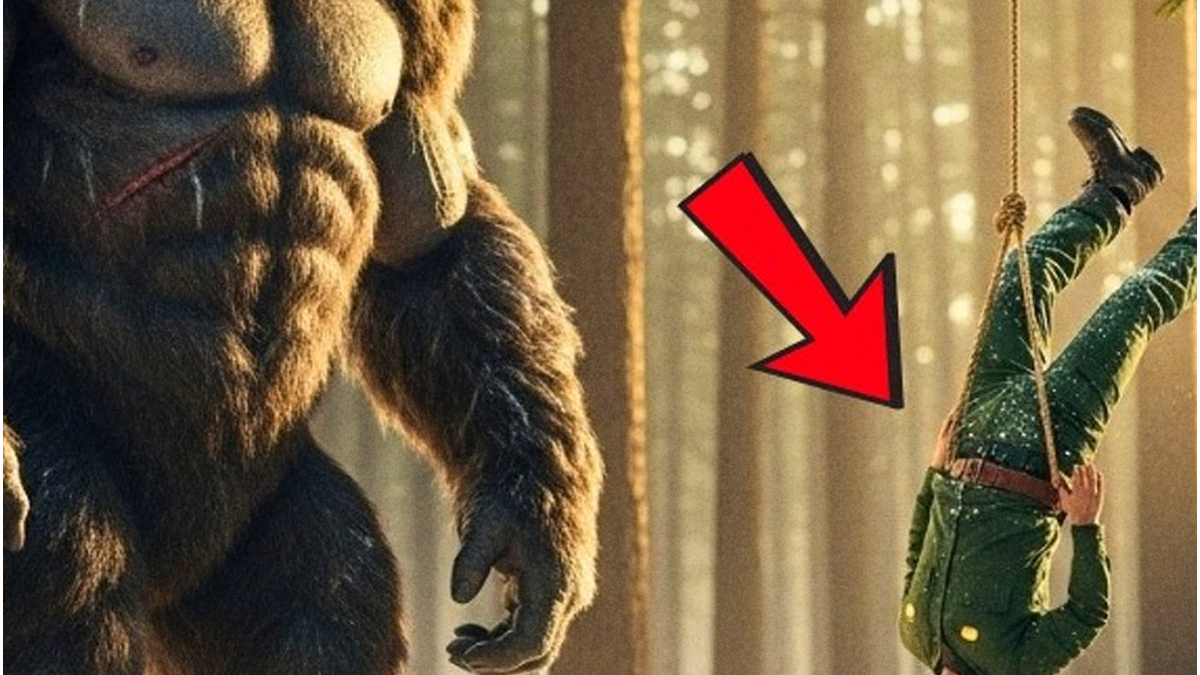
Ranger Found Dangling Helpless In The Woods – Bigfoot’s Next Move Left Everyone Speechless!
What would you do if you were betrayed?
Left hanging upside down in the middle of a forest, waiting to die.
And the only thing that saved you was a creature the world calls a monster.

The truth is, it wasn’t a rescue team, nor a fellow ranger.
It was Bigfoot.
A towering scarred giant stepped out of legend, cut him down, and carried him through wolves and wilderness without asking for anything in return.
While humans set the trap, the so-called monsters saved him.
This story comes from the mysterious Black Hills of South Dakota, told by Calder Wyn, a former Gulf War soldier turned forest ranger and the only man to ever live through such an encounter.
How one man broken by loss found a silent friend in the unlikeliest of places.
And why even the smallest good deed can change everything.
A blurry photo once made headlines.
A man kneeling beside a wounded creature thought to be myth.
But the story behind that photo is far more powerful.
Calder didn’t just survive.
He wrote the pact beneath the pines.
The first treaty between man and legend.
If you’ve ever felt like the good in this world is vanishing, don’t look away.
Because maybe, just maybe, Bigfoot is real.
And maybe he’s been quietly protecting us all along.
The sound came first.
A slow creek above his ears, low and unnatural, like timber straining against itself.
Calder opened his eyes and saw the world upside down.
Pine needles filled the sky.
The blood had rushed to his head.
His vision pulsed red at the edges.
Every breath was shallow.
A cold wind licked across his cheek, but the pain in his shoulders drowned it out.
He was hanging from a high limb of a ponderosa pine.
Rope cinched tight around his ankles.
His arms dangled toward the earth 30 ft below.
His ranger uniform soaked in morning frost, ripped across the back.
His service belt was gone.
His sidearm gone.
He blinked hard, trying to remember.
Last thing he recalled was stepping off the patrol trail in Cathedral Hollow, answering a call about illegal blaze marks near the western fire line.
District ranger Sloan had handed him a folded map that morning.
Said it was a newer boundary update.
Told him to head out alone.
Said, “Just a quick look when you know the land better than anyone.”
Calder grunted against the pressure building in his skull and reached into the chest pocket of his coat.
The map was still there.
His name was scrolled along the margin above a supposed signature, but the loop in the W wasn’t his.
It was a fake.
He went still.
The branches above him cracked again.
Below movement.
The soft patter of paws on dry needles.
Several sets.
Coyotes thin, ribbed, drawn by blood.
He could hear them breathing, circling.
He couldn’t see them, not clearly, just yellow flickers between trees, just the sound of gravel shifting under claw.
His hands clenched into fists, wrists trembling.
A low growl drifted up.
He closed his eyes, gritted teeth.
Then everything fell silent.
No wind, no coyotes, no bird song, just silence.
And from that silence, a shape emerged.
Massive, dark, walking on two legs, limbs impossibly long, moving through the fog like a ghost out of the earth.
It stopped near the base of the tree, still hidden partially by the mist.
Calder tried to focus, but his vision swam.
The figure was tall, taller than a doorway, its shoulders wider than any human frame.
Fur dark as coal, damp, and clumped near the joints.
A long scar, white and raw, curved down its ribs.
He couldn’t speak, couldn’t move, just hung there, helpless and upside down, eyes wide.
The figure raised one hand.
The claws glinted, then a swift slice.
The rope gave.
Calder crashed to the ground like dead weight.
The air punched from his lungs.
Pain exploded in his ribs.
He rolled over, gasping, mud on his face, chest heaving.
The creature didn’t approach.
It stood over him, silent, unmoving like a monument carved from night.
He expected it to roar, to strike, to vanish.
But it didn’t.
Instead, it lifted its hand, placed it slowly on its own chest, then turned its massive palm down and lowered it toward the earth, steady, deliberate, until the fingers hovered above the pine needles.
A gesture, not a threat, something older than language, something sacred.
Calder lay in the dirt, shivering, coughing.
He couldn’t explain it.
Not the scar, not the silence, not the way the thing moved.
But the gesture lingered in his bones, a hand to the heart, a hand to the earth, not a promise, but a pact.
The creature stepped back into the fog just as a distant noise broke the stillness.
A human sound.
The shriek of a metal whistle, sharp and short, bouncing off the canyon walls like a warning flare.
Then the unmistakable click of a rifle bolt chambering.
Calder looked toward the sound.
When he turned back, the figure hadn’t fled.
It had knelt beside him.
Massive back rising and falling with breath.
Then it did something Calder would never forget.
It turned, lowered one shoulder, and offered him its back.
For a long second, Calder didn’t move, didn’t breathe.
He stared at the creature’s broad shoulders.
The scar running down its side.
The subtle strength in every inch of muscle beneath fur.
Coyotes had scattered.
Gunfire was coming.
And here was this this thing lowering itself like a horse waiting for its rider.
He had a choice.
He staggered to his knees, clutching his ribs, and climbed on, not because he trusted it, but because something in that gesture, hand to chest, hand to earth, told him it had already trusted him first.
The ground disappeared beneath them as the creature rose.
Calder gripped the matted fur, cold wind slapping against his face as they moved through the trees, fast, silent, like a ghost returning to where it came from.
Far behind them, the sound of boots crunching gravel echoed through Cathedral Hollow.
But in that deep pine silence, all Calder could hear was the wind through branches and the beat of a giant heart, steady and close, carrying him out of the valley like a vow not yet broken.
Not yet.
The mist hadn’t lifted.
It just changed color.
At first, it had been pale and blue, like breath held too long.
Now it was darker, folding into itself with a quiet gray of morning just before the sun decides whether to rise.
Calder clung to the coarse fur before him, the smell of wet pine and earth rising with every jolt.
His ribs achd with every step the creature took, but he didn’t cry out.
He couldn’t.
He didn’t want to disturb the silence.
The creature moved fast.
Not human fast, not horse fast, something older.
It threaded through narrow switchbacks and rocky ledges as if it had walked this path for generations.
The thud of its massive feet hit the ground with weight, but not violence.
Calder felt every impact in his spine.
One arm around the creature’s neck for balance, the other clutching the inside of his coat where the forged map still lay.
His knuckles were white against the fabric.
They crossed the bed of a dry stream first, boulders slick with moss.
The creature didn’t slow.
Calder looked over his shoulder and caught the soft glint of yellow eyes disappearing in the trees.
Coyotes had kept their distance now.
And he knew why.
They kept climbing up a slope of shale and ice thinned grass, across a gap where a fallen birch served as a bridge, and then down again into the narrow chasm between two cliffs.
The sound of the forest returned in fragments.
The crack of distant branches, the warble of a raven circling above, the faint hum of something mechanical far away.
Then the howling started.
Not close, not far either.
Wolves.
Not the lone kind.
The pack kind, the deep- chested, northern blooded kind that could take down an elk without flinching.
Calder’s fingers dug deeper into the creature’s fur.
Ahead, the trail narrowed, flanked by walls of granite.
The creature stopped.
Calder could feel its breath shift.
A low rumble built in its chest.
Not quite a growl, not quite a hum.
And then it rose into something Calder couldn’t describe.
A sound, not loud, but full.
It echoed off the canyon walls and rolled into the mist like a storm kept inside the ribs of a mountain.
The howling stopped.
The forest went still again.
Calder had no idea how long they stood there.
Both of them listening.
But then, without turning, the creature started moving again.
One hand braced him gently, and the other parted thick ferns and damp cedar boughs as they emerged onto an old mining road, long abandoned, carved along the ridge like a scar.
It was there Calder first saw the lights, not natural light, artificial, a sweeping, swinging beam slicing through fog.
Headlights.
A flatbed truck, military green, crawling up the service road below.
Behind it, another, this one narrower, with sidemounted spotlights and twin exhausts.
Someone stood in the bed, holding a long metal pole.
Calder ducked instinctively behind the creature’s shoulder.
The creature crouched low, melting into the rocks.
Calder watched the trucks pass.
He recognized the first driver.
Keller, heavy set, dark beard, a ball cap pulled low, and beside him on the passenger side, Riggsby, long rifle resting across his lap, eyes scanning the woods like he knew what he was hunting for.
Behind them, barely visible through the trees, came the hum of another vehicle, and something else, a faint orange mark painted on the trunk of a pine blaze.
Trail marker, but it was wrong.
Too low, too fresh, and shaped like a backwards zed.
A fake, just like the map.
Calder’s stomach turned.
Someone was manipulating the forest.
Not just maps, the trails themselves, sending him off course, baiting him toward places no one should walk alone.
It wasn’t a mistake.
It was a design.
The creature shifted beneath him and began to descend again.
This time, slower, more deliberate.
The rocks turned to gravel.
Gravel to wet moss.
The road dropped into a draw where a creek once cut through ancient stone.
Eventually, they reached the edge of a frozen lake.
Pacola.
He’d known it since the beginning.
The shimmer of the shoreline, the crooked dock, the way the trees opened wide like a hush falling over everything.
The creature stopped beside a flat rock that jutted out above the water line.
It knelt.
Calder climbed off slowly, boots crunching on snow dusted pine needles.
He could barely stand.
The pain in his ribs flared every time he moved, but he didn’t say a word.
The creature turned toward him.
For a long moment, they just stared.
It raised one massive hand, careful, slow, and placed it against his chest, not pushing, just resting, as if to say, “You’re still here.”
Then it helped him stand.
One thick arm around his back, bracing him like a tree that didn’t bend in wind.
Calder didn’t flinch.
Something in him shifted.
Not belief, not awe, but understanding.
He limped toward the clearing beyond the lake, where a familiar shape began to take form through the early light.
A cabin, metal roof, old forest service marker near the porch, the Pacola station, Mystic Ranger District, safe ground.
Maybe.
He staggered across the last 50 ft alone, boots dragging, blood dried across one cheek, fingers shaking.
The porch creaked under his weight.
He fumbled the latch.
Behind him, the creature didn’t leave.
It stood tall and still just beyond the fence, watching, not like a threat, more like a guard.
Calder turned his head and looked back, hand still on the doornob.
The mist curled around its legs.
The scar on its ribs caught a faint flicker of light.
It didn’t move.
It didn’t run.
It just stood there as if it belonged.
As if it had always been part of the forest, only now stepping forward.
The door swung open.
The warmth of the station hit his face.
Coffee grounds, old paper, the faint buzz of a heater that hadn’t shut off all night.
He didn’t speak.
He just stepped inside.
But in the seconds before the door closed behind him, he could still feel its presence through the fog, still hear the faint rhythm of something wild and kind, waiting beyond the edge of human understanding.
And for the first time in days, Cder wind didn’t feel alone.
Not entirely, not anymore.
The moment the door shut behind him, the world didn’t feel any safer, just smaller, just quieter.
Inside the Pacola station, the scent of propane heat and dried sweat clung to the walls.
The emergency light above the first aid cabinet flickered once, then held.
Calder leaned against the nearest filing cabinet, his breath shallow, ribs still on fire, blood crusted under his shirt.
His left leg throbbed.
But none of it mattered.
Not really.
Not when the air behind the door still felt alive, like something enormous was holding its breath out there.
He didn’t have to look through the window.
He already knew it hadn’t left.
Footsteps echoed from the back hall.
Boots quick, cautious, too familiar.
May Donovan appeared first, her Ranger jacket half zipped, face pale, holding a flashlight in one hand and a radio in the other.
Behind her, Dr. Ruth Pennington.
Sleeves rolled.
Latex gloves already on.
A bottle of iodine in her front pocket.
Their eyes flicked to Calder, then to the glass.
No one spoke.
He didn’t say how he got back.
Didn’t explain the bruises or the tears in his coat.
He just pointed once slowly toward the front of the station.
May followed his hand, flashlight beam trembling across the window, and stopped cold.
Outside, through the dripping glass pane, the figure stood just beyond the wooden fence, motionless, massive, steam curling off its shoulders in the misting rain.
Its back was straight, arms at its sides, head tilted slightly down as if listening.
Not crouched, not hiding, just there guarding.
May froze, lips parted, her breath caught in her throat.
Ruth moved to the side window and blinked hard.
“It’s real,” she whispered.
“Jesus, Mary, and Joseph Calder sank into the chair behind the front desk, every bone in his body groaning.”
“It saved me,” he murmured.
“Sloan, he sent me out alone.
The map was fake.
It was a setup.”
May turned toward him, flashlight lowering.
What are you saying?
He reached into his coat and pulled the damp, half-to map from his inner pocket, smoothing it over the desk with shaking hands.
The signature looked just like his almost.
But the ink was fresh, and the loops were wrong.
Forgery, Calder said.
Barrett Sloan signed it, or made someone sign it.
Then he sent me into Cathedral Hollow, unarmed.
May took the map, eyes narrowing.
She traced the blazes on the page with her fingertip.
This isn’t our root log.
These tree marks don’t match last week’s patrol.
Ruth knelt beside him, pulling open the first aid kit.
Let me see your side.
You’re bleeding through.
Calder winced as she lifted his shirt.
Her hands were fast but gentle.
The antiseptic stung deep, and the stitches came with heavy thread and silence.
Outside, the rain thickened.
No one moved the blinds.
No one wanted to break the moment.
The creature didn’t leave.
It stood back lit by the flood light over the entrance.
Shoulders rising and falling with steady breath.
Its fur hung wet and heavy rainwater running down its spine in silver rivullets.
It looked like something carved from a myth and left to rot in the timber line.
But it was breathing.
It was real.
Calder kept stealing glances.
He didn’t understand why it hadn’t run or why it followed him here, but somewhere deep in his ribs.
Beneath the bruising and the panic was a thread of something else.
Gratitude.
Not blind, not simple.
Earned.
Ruth stitched him in silence.
When she finished, she looked up.
You’re lucky that fall didn’t break your back.
Calder didn’t answer.
May moved toward the record shelf behind the desk and yanked open the log drawer.
Her fingers flew across the index tabs, eyes sharp.
Sloan’s been checking in after hours, past midnight some nights, and there’s a half day missing from last Thursday.
No reason given.
Calder looked past her toward the rain smeared glass.
Still there, still watching.
No movement, no threat, just presence.
Something about that kind of stillness was worse than violence because it meant it had nothing to prove.
It wasn’t showing off.
It wasn’t afraid.
It was waiting.
He pulled out his wallet.
Inside, folded and worn.
Was a letter.
Edges curled, ink smudged by time.
He didn’t read it.
He didn’t have to.
He knew every word.
It was from Mave.
Her handwriting still felt like a voice in his chest.
Her last letter before the storm took her.
Written in a hospital room in Bismar.
The words were short, but they were heavy.
When you can’t fix the big thing, she’d written, “Do the next small good thing in front of you.”
He folded it back, tucked it away.
Something clattered outside.
May spun, flashlight beam slicing through the dark.
Just rain.
Ruth stood slowly, back popping.
“We need a decision.
Do we call it in?
Do we report what we saw?”
Calder shook his head.
“What would you say?”
A giant carried me back from a trap set by our district ranger.
That it stood outside the station like a damn bodyguard.
That I believe it understands more than we do.
May’s voice cracked.
We saw it.
Yeah.
And who else will believe us?
No one spoke.
Outside, the figure shifted just slightly.
It turned its head toward the treeine.
The movement was slow, deliberate.
Its hand rose halfway, then fell again, almost like a signal.
Then it stilled again.
The phone lines went dead first.
Just a soft pop, then nothing.
The desk phone blinked twice and went dark.
May picked up the receiver.
No tone.
Calder moved to the radio, static.
Ruth’s flashlight flickered.
Then the porch creaked.
Boots on gravel.
Slow measured coming closer.
Calder stepped to the window and leaned forward.
Through the glass, shapes moved in the dark.
Human shapes.
Flashlights off.
Rifles slung.
He saw a wide-brimmed hat, heavy coat.
Movement near the truck gate.
Sloan, his jaw clenched.
May back toward the filing cabinet.
That’s his truck, Ruth whispered.
Why come at night?
Calder didn’t answer.
His hand found the old shotgun in the supply locker.
Dust on the barrel.
Cold steel.
The thing had been used last during the 2008 wildfire response to scare off bears.
Now it would have to scare off men.
The glass beside the door pulsed with motion.
Shadows moved behind the blinds.
Voices outside.
Give it up.
Win.
Hand over the beast.
Rick’s boo.
Another voice slower meaner.
Don’t make us burn it out.
Keller called her didn’t flinch.
He moved to the door.
Racked the shotgun once, then behind him, a deeper sound.
Glass cracking.
Not from the outside, from the back.
A window splintered.
Something flew through.
A rag soaked in kerosene.
Flames bloomed near the corner of the records room.
Smoke curled upward, bitter and sharp.
Ruth kicked it away, stomping the cloth under a metal bin.
May grabbed the fire extinguisher.
Then in the middle of the chaos, it happened.
The window burst open in the front room and it came through.
A creature.
Shards of glass tore its shoulders.
Rain washed down its back.
But it didn’t stop.
It entered the station without hesitation.
Not charging, not roaring, just stepping between them in the dark.
And standing tall, it turned toward the door.
Its eyes burned gold.
And called her for once.
Didn’t feel like the one doing the protecting.
The storm didn’t come from the sky.
It came from boots, breath, and gunmetal nerves.
The kind that knew where to step and how loud to shout.
It came in the form of men who had already decided what kind of story this night would become.
And outside that small ranger station, in the middle of Black Hills rain, and forest rot, they wrote their version of it in the gravel with gasoline and gun barrels.
The station’s power was gone.
Wires cut clean.
Probably upstream near the road fork.
No backup generator.
Just the hiss of lamp oil and the ticking of Ruth’s watch.
Shadows stretched against the walls like fingers trying to escape.
The creature stood still in the center of the room, steam rising from its shoulders, the wounds on its back oozing slow against matted fur.
It didn’t growl.
It didn’t roar.
It simply stood there, chest rising, arms at its sides, too large to ignore, too calm to make sense.
The broken window behind it framed the rain falling in diagonal lines, glass crunching beneath its feet.
Calder stood in front of it, one hand on the shotgun, the other wrapped tight around the edge of the desk.
May was to his right, clutching the radio mic that spat only static.
Ruth stayed near the back door, where the hallway narrowed and the first aid shelves leaned under years of dust.
The air inside the station had grown warm from the creature’s breath, but the tension sucked all heat out of their bones.
Outside, flashlights slashed across the yard.
“You’ve got till 3.”
Keller’s voice came muffled through the door.
“Then we light the place up.
Bring us the damn animal!”
Riggsby shouted.
“You hear me when?”
Calder didn’t answer.
He watched the creature’s face instead.
The way its eyes tracked the door.
The way its chest stayed steady.
No flinch, no panic.
Just waiting, May whispered.
We can’t fight them off.
We don’t need to, Calder said.
They’re not here to fight.
They’re here to capture.
He turned toward the creature.
It looked down at him.
Not in fear, not in hope, just waiting for him to decide something it couldn’t.
The first blow came fast, the butt of a rifle striking the window beside the main door, cracking but not breaking.
Calder stepped forward, raising the shotgun.
May grabbed a file cabinet and dragged it in front of the doorway, metal shrieking across the tile.
Ruth kicked the mop bucket aside and shoved a chair under the back knob.
Another voice outside.
One called her hadn’t heard in hours.
Sloan, stand down, win, he called, calm and low.
You’re not thinking clearly.
That thing’s dangerous.
Let us handle it before someone else gets hurt.
He said it like he was offering help.
Like this was cleanup.
Like this wasn’t something he started in the first place.
Calder stepped toward the window and shouted, “You sent me into that hollow with a fake map and no backup.
You left me to die.”
No response, but the crunch of boots on gravel grew louder.
A shadow passed across the blind.
Keller, he was carrying something.
Metal and soaked in kerosene.
Calder saw the fuse hanging limp.
Molotov.
He didn’t even yell.
He just stepped back.
The bottle smashed against the exterior wall.
Fire licked the wood.
Smoke billowed under the eaves.
And then the pounding started.
Fists against the door.
Rifle stocks hammering glass one after another.
May grabbed the extinguisher.
Ruth shouted, “Back window.”
They weren’t trying to break in.
They were trying to smoke it out.
The creature didn’t move.
Not when the first window shattered.
Not when a beam cracked from heat.
Not when the desk started to smolder at the edges.
It only moved when Calder did.
He turned, coughed through the smoke, and looked it in the eyes.
Not as a thing, not as a myth, as a choice.
Stay or go, he said.
Your call.
The creature tilted its head, then stepped toward the door, toward the danger.
Calder opened his mouth to say something, but never got the chance.
The door blew open in a gust of wind and ash and shouting.
Keller surged through first, bandana over his face, rifle raised.
Riggsby came behind him.
Then a third man called her didn’t recognize.
The creature moved fast, faster than any of them expected.
It grabbed Keller by the chest and threw him across the room.
Not to kill, not to crush, just to stop.
Keller hit the back wall and slumped.
Rigs by swung the butt of his rifle, but the creature caught it, twisted, and sent him flying into the file cabinet.
Then it turned to Calder, eyes meeting his.
Waiting.
Sloan stepped into the doorway, gundrawn, aiming at Calder.
Not the creature.
You don’t get it.
Sloan said, “You were never supposed to make it out of that valley.”
His voice wasn’t angry.
It was tired, like someone explaining paperwork.
Calder raised the shotgun.
Sloan stepped forward one pace.
Two, then stopped because the creature moved between them again.
Not fast, just placed itself there like a wall of bone.
An instinct and something ancient.
It stood with its back to Calder, facing the gun, unarmed, unmoving.
May screamed, “No!”
Ruth shouted something else, but all Calder heard was the sound of his own breath.
He lowered the shotgun.
Sloan hesitated, then stepped left, trying to get a better angle.
Calder stepped right and tackled him.
They crashed into the wall.
Sloan’s shot going wild into the ceiling.
Plaster fell.
The creature didn’t flinch.
It just turned once to make sure Calder was okay.
May grabbed Keller’s dropped rifle and kicked it under the desk.
Rigsby tried to rise, groaned, and slumped again.
Calder pinned Sloan, breathing hard.
“No more lies,” he said.
“No more traps.
Behind them,” Ruth knelt beside the creature, already pulling out gauze, trembling but steady.
“Get me the big needle,” she whispered.
May didn’t question it.
She just moved.
They cleared the desk, wiped it clean with a shirt, and the creature, without being asked, lay down across it, exhausted, bleeding, but not afraid.
Calder didn’t speak.
Not when Ruth started stitching.
Not when the creature winced.
Not when the blood pulled again.
He just stood there watching, holding pressure on the side wounds with one bare hand.
Later, they’d find the rest.
In Sloan’s truck, beneath a tarp, they’d uncover a set of reinforced snares, bait cages, cameras, all custom-designed, all humansized.
It hadn’t been about protection.
It had been about profit.
And Calder had been nothing more than a decoy.
Someone to draw it out, someone expendable.
But now it was here, and it had chosen to stay.
The fire was out.
The attackers were down.
But the station and everything it stood for had changed.
Ruth finished the last stitch and looked up.
Her hands were shaking, but her eyes were clear.
Now, she said, “We clean up.”
No one moved for a while.
The only sound was the ticking of the extinguisher cooling on the floor in the slow wet breath of the creature lying on the desk.
Not broken, not defeated, just healing.
And Calder, standing beside it, one hand on its shoulder, knew this wasn’t the end of anything.
It was only the start.
Blood sllicked the floorboards like rain that forgot it was supposed to fall outside.
It wasn’t everywhere, but it was enough.
Enough to smell.
Enough to see the shine of it across the wooden grain where light shouldn’t reach.
Calder stepped over a shattered drawer.
One boot slipping slightly, catching just in time on the corner of the old radio desk.
His shotgun was empty now, just weight in his hands, useless, but familiar.
Rigsby B lay motionless against the far wall, one leg twisted under the other.
The rifle may had kicked under the filing cabinet was still there, but no one was reaching for it anymore.
Not with the creature still standing.
It bled, but not like a man.
Not like anything they’d ever seen before.
The wound in its side had soaked through Ruth’s makeshift gauze, staining the denim she’d used as pressure wrap.
Each breath it took made the blood pulse higher.
Calder could see where the bullet had entered low and left below the ribs, and he knew if it had gone deeper, they’d be mourning instead of debating.
May knelt beside Keller, who’d been knocked out cold against the coat rack.
His nose was broken, blood pooling near the threshold.
She’d bound his wrists with zip ties and duct tape torn from the emergency kit, but her hands were shaking.
Not from fear, from fury.
The creature hadn’t moved since the last shot.
It stood in the center of the room, chest rising slow, eyes locked on Cder like it was waiting for something, for permission, maybe, or judgment.
Its fur was soaked through, clinging to muscle, heavy with rain and smoke and now blood.
Not its first scar.
Not even its worst.
But this one had come from a rifle fired by a man who didn’t care what it was, only what it was worth.
Keller groaned half conscious.
Ruth pressed a damp cloth to the creature’s wound, whispering to no one in particular.
It’s still breathing steady.
That’s something.
Calder didn’t answer.
He walked to the open station door.
Rain still coming down in quiet sheets.
A flashlight lay in the gravel outside.
Dropped probably when the scuffle started.
He picked it up, flicked it on, and turned the beam toward the treeine.
Nothing.
No more voices.
No more boots.
Just a long silence, deep and thick, like the woods had swallowed the world whole.
Behind him.
May said it was waiting.
He turned.
She didn’t look at him, just at the creature.
It could have killed Keller.
Could have killed all of us, but it didn’t.
It waited for you.
Calder didn’t argue.
He didn’t have to.
The blood on the creature’s side told the story already.
One of restraint, of purpose, of a choice to stand between danger and the people who just days ago feared it enough to call it legend.
Ruth stepped back, pulled her hands free.
That’s all I can do without surgical tools.
I packed the wound deep.
It’ll need rest.
Might scar worse.
The creature looked at her just for a second.
Then nodded.
Not a twitch.
Not an accident.
A real nod.
Called her.
Whispered.
You understand us, don’t you?
It didn’t nod again.
Didn’t have to.
May stood, wiped her hands on her jeans.
We need to make a report.
We need to call someone.
No, Calder said.
She frowned.
He walked to Sloan’s truck, still idling in the yard, left running when everything went sideways, and opened the back door.
The rain had already washed half the windshield clean.
Inside, it smelled of oil and dust and something colder.
Something wrong.
Beneath a tarp, he found what he expected.
Snares made for upright frames.
Not deer, not bear.
Tripod rigs, trigger lines, restraints coiled like steel snakes.
And photographs, grainy polaroids of the station fence, of the trail leading to Cathedral Hollow, of that scarred silhouette standing between pine trunks, notes scrolled in permanent marker, timelines, roots, patrol shifts.
It wasn’t about evidence.
It was about a trophy.
He carried the whole mess back inside and dropped it on the floor.
May stared at it.
They were hunting it.
No, Calder said.
They were selling it.
Ruth stepped closer, eyes narrowing as she sifted through the gear.
This is government issue.
Look at the stamp here.
Serial numbers removed, but I know that paint code.
These weren’t bought at a hardware store.
Calder turned to the creature.
Its eyes met his.
They used me to lure you out.
The creature didn’t blink, didn’t deny it.
It had known.
The station felt too small now, too human.
The rain pressing against the windows couldn’t drown out the sound of Calder’s pulse in his ears.
His whole life he’d sworn to protect this forest, measured trail width with a ruler, filed risk assessments, bandaged bear traps shut with his own hands.
And yet, the most important thing he’d ever guarded, had guarded him first, May broke the silence.
“So, what do we do?”
Ruth answered before Calder could.
“We keep it alive.”
“Then what?”
May asked.
“Do we just let it walk?”
Calder looked toward the open door.
Rain washed the gravel clean, carving small rivers between stones.
The trees swayed, but nothing stirred beyond them.
“Maybe we stop pretending we own this place,” he said, “and start asking what it’s willing to share.”
The creature stepped forward.
Its gate was slower now, pained, but not faltering.
It moved to the fire map on the back wall, the one with pins and notes and burn zones marked in yellow.
It placed one hand on a ridge line near Cathedral Hollow.
Not forceful, just enough to smudge the edge of the paper.
Then it turned and looked at Calder.
Not a warning, an offering.
Calder placed a hand on its shoulder.
The fur was damp, still warm, he whispered.
We’ll figure it out.
And for the first time, the creature did something entirely unexpected.
It exhaled long and deep, like it had been holding its breath since the day it was born.
The headlines came fast, but none of them said what really happened.
Giant beasttorms ranger station.
Local ranger survives bear attack.
Black Hills mystery fuels online frenzy.
In the photo, they ran on the front page of the Rapid City Journal.
Calder was kneeling beside the creature, one hand resting on its shoulder, blood on both of them.
They’d captured it from a distance, a telephoto lens probably hidden behind some thicket just before dawn.
The light hadn’t fully returned to the sky.
Mist still hung low over the trees.
And behind the fence, just barely visible, was the creature’s face.
Not snarling, not charging, watching.
The press labeled it a hoax within 48 hours.
The Forest Service labeled it a misidentified grizzly.
Some senator from North Dakota called for a wildlife audit.
And the governor’s office issued a single statement.
No known species matching that description exists in the Black Hills.
But Calder didn’t care.
Not anymore.
They’d moved the creature to the old horse shelter behind the Pacola station.
It wasn’t much.
Four aluminum walls and a lean-to- roof, but it gave them space to clean the wound and keep eyes off the forest.
Ruth converted the tack room into a supply closet, stacked gauze next to fish antibiotics, and tied a privacy curtain from a wool blanket and two trekking poles.
Calder took first watch.
He didn’t sleep.
He just sat in a folding chair, boots in the mud, notebook on his knee, and read aloud.
The creature didn’t look at him, not for 3 days.
But on the fourth, as Calder read a paragraph from the old man in the sea, the creature’s head turned just slightly.
Not toward him, just toward the sound.
Calder kept reading.
On the sixth day, it placed its hand on his shoulder.
No pressure, just presents.
May built the feeding schedule.
Nothing special.
Eggs, rice, some leftover stew.
But the creature accepted it all.
Never ate in front of them.
Just waited.
Then returned the empty tin, clean and silent.
By the 10th day, it stood without staggering.
Ruth examined the scar and whispered, healing faster than it should.
Calder just nodded.
He’d stopped trying to explain things.
Some truths didn’t need to be dissected.
They just needed to be carried.
May drafted the first version of the proposal late one night while everyone else was pretending to sleep.
She called it the pact beneath the pines.
Calder found the print out on his cot the next morning, three pages long, typed single space with margins full of edits in blue pen.
No contact unless invited, no training, no sedatives, no cameras, mutual consent only.
Co- patrol within designated boundaries.
And at the center of it all, one clause written in May’s hand.
No captivity under any circumstance, even in exchange for peace.
Calder signed first, May second, then Ruth.
Three names.
Three people who’d seen what everyone else refused to see.
They submitted it to the forest supervisor’s office without commentary, without appendices, without preamble.
The reply came 40 hours later in the form of a formal test authorization order stamped in red.
One season trial ongoing observation.
Immediate termination upon violation.
The air inside the station felt different after that.
Not lighter, just still like the forest was waiting to see what kind of humans they were going to be.
That evening, Ruth left a pot of bone broth inside the leanto just beside the creature’s cod.
Next to it, a folded piece of paper.
She didn’t say anything, but Calder saw her hesitate at the door, fingers gripping the frame, back rising with a long breath.
Later, after she’d gone in for the night, Calder found the paper sitting untouched on the window sill.
It read in her handwriting, “If strength is to mean anything at all, let it be used to protect, not to punish.”
The creature hadn’t touched the soup yet, but Calder swore it stood just a little straighter the next morning.
And when he looked at its eyes, he thought for the first time that it might have smiled, just barely.
The days bled forward.
The story died down.
The press found a new outrage to chase.
Hunters backed off after the state closed certain trails for erosion control.
Rigsby and Keller never returned.
No charges, no statements.
Sloan was placed on administrative reassignment.
No one ever said to wear.
Calder kept his post.
He walked the tree lines in the mornings, boots soft on the moss, eyes scanning for signs of intruders.
At night, he logged everything.
Weather, behavior, distance covered.
He noted the creature’s gate, the way it stopped at certain trees as if listening, the way it traced the line of blaze marks without touching them, the way it waited when deer passed through the trail, not out of fear, out of courtesy.
And every day, just before dusk, the two of them would stand beside the fence line and look east toward Cathedral Hollow, toward where it all started.
Calder would speak in a low voice.
Not commands, just thoughts.
Sometimes memories, sometimes regrets.
The creature never replied, but it never left.
He started leaving the gate open, just a crack at first, then wider.
No one gave the order.
It just felt right.
By week three, the creature stepped beyond it.
Slowly, head turning every few feet, checking, waiting.
Calder stayed at the porch, coffee in hand, shotgun resting behind the door, but untouched.
It didn’t run, didn’t vanish, just walked the perimeter and returned.
That night, Calder placed a second tin cup on the steps.
Didn’t say anything, didn’t explain.
The creature sat beside him, knees bent, one hand resting on the ground like an anchor.
They watched the sun fade behind the pines.
The trees held their breath and Calder whispered, “Thank you for coming back.
It didn’t answer.
It just looked at him, then placed its hand on its chest and slowly, gently turned its palm toward the earth like always, like a ritual, like a promise.”
The fog didn’t roll in that morning.
It settled like something that had never really left.
It clung low to the grass and the gravel, to the steps of the station, to the shoulders of the pine trees that bordered the fence like quiet sentries.
Calder stood with one hand on the gate latch, the other around a warm enamel mug, watching breath rise from both their mouths.
He didn’t say anything.
He didn’t have to.
The creature stood beside him, massive and calm, its fur brushed by early wind.
A slow exhale misting from its nostrils between them.
The gate creaked once as Cder unlatched it.
No orders, no commands, just the sound of the world breathing through both of them.
The creature stepped forward out, not fast, not proud, just steady, into the mist.
Not a single backward glance.
It walked between trees Calder had known for 30 years.
Past the naughty pine that always leaned a little too far west.
Past the stump where hikers used to sit to lace their boots.
Past the fallen log he’d measured a dozen times for rot.
It didn’t slow.
It didn’t stumble.
It didn’t come back that day or the next.
The station felt bigger without it.
Quieter.
Too quiet.
Calder kept doing the same things.
Coffee in the morning, rounds at dawn, checking traps they’d long since removed just for routine’s sake.
May stopped by every third day with new trail reports.
Ruth kept a set of sterile tools lined up on the back bench like maybe something would still need fixing.
But each of them walked slower now, like they were listening for something that never quite called back.
The gate stayed open, not wide, but enough.
Calder left a second mug on the porch every evening.
Never touched.
One week later, he was hiking the west ridge when he saw it.
Just a shadow at first, then more.
A tall figure at the treeine, unmoving, framed by low mist and birch trunks.
It didn’t step forward, just watched.
Calder raised a hand.
The figure vanished.
But in that quiet, something else flickered.
Hope maybe, or just memory playing tricks.
That night, as he poured fresh water into the second tin cup, he whispered into the trees, “Anytime.”
The next morning, there were bootprints in the mud, too big to be human.
By week’s end, new signs had started showing up.
Old trails cleared, stacked stones near the creek bed that hadn’t been there before.
Pine cones arranged in a line across the dry bend of Cathedral Hollow.
Facing west, evenly spaced like some kind of signal, May found the first trap.
It had been freshly laid, a cable snare hidden under a loose pile of brush, placed just off trail, right where the southern fire break narrowed.
She called her voice tense.
Someone’s hunting again, smart enough to make it look like forestry work, but it’s not ours.
He checked it himself, then followed the tracks.
Steel towed boots, old truck tires, a cigarette stub still smoldering in a patch of dry leaves.
Keller was out.
Lack of evidence, no trial, no hearing, of course.
The next morning, Calder found a gouge mark on a birch tree 20 ft from the station.
Long, diagonal, deliberate.
Not an accident, a sign.
The creature had come back and it was asking him to follow.
He strapped on his boots before dawn, packed the old canvas bag he hadn’t touched since deployment, filled a canteen, and clipped a fresh flare to his belt.
He didn’t take the shotgun.
Didn’t need it.
The air felt heavier in Cathedral Hollow, not from threat, just from knowing.
Like the ground itself had seen everything that passed through and still chose silence over judgment.
The trail was marked in the same gouges, one every 50 ft or so, always fresh, always clear.
The pattern led northeast toward a part of the forest Calder had only hiked once years ago before budget cuts, before digital maps replaced in topographies and instinct.
Halfway there, he saw the shape, tall, still standing between two boulders where the valley opened wide and the mist clung to the edge of dawn like a veil.
The creature waited.
No motion, no sound.
When Calder reached it, he didn’t speak.
The creature turned and they walked side by side over rock and fallen timber through brush flattened by earlier steps down into a clearing that hadn’t existed on any map.
Not even the old paper ones from the 70s.
And there in that open space stood the remains of a camp.
Not a hunter’s camp, not just boots and bait.
A whole operation.
Ladders, tripod traps, folding cages, MRE wrappers, and satellite prints taped to a clipboard.
In the dirt, a Polaroid, wrinkled and damp, but clear.
It showed the Pacola fence, the creature at the edge.
Calder standing beside it.
The flash had caught them mid-motion, his hand resting on the creature’s back.
The moment frozen.
Beside the photo, a small generator, a car battery rigged to a trip wire, a box trap baited with something Calder didn’t want to identify.
And the worst part, still fresh, still warm, he turned to the creature.
Keller.
The creature didn’t nod, but it stepped forward and gently, without force, tipped the trap over.
The trip wire snapped harmlessly.
The battery sparked once, then died.
They dismantled everything in silence.
Calder kicked the tripod frame loose and folded it until the joint screamed.
The creature wrapped steel cable into tight rings and buried them beneath loose shale.
Calder burned the papers one by one, watching faces disappear into smoke.
When it was over, the air felt cleaner.
They stood in the clearing a while longer, not because they had to, because the forest deserved to breathe again.
Back at the station, Calder poured two mugs of coffee and sat on the porch.
He didn’t look toward the gate this time.
Didn’t have to.
The creature appeared after nightfall.
No announcement, no pause, just a shape returning like it had never left.
It sat beside him.
The mug was accepted without ceremony, and for the first time in weeks, Calder smiled without flinching.
From the woods an owl called once, then silence.
The fire inside the station crackled low, and on the nearest tree, a fresh mark had been carved.
Not a warning, an invitation.
It started the way the first chapter had.
Calder with his feet in the dirt, breath shallow, eyes wide.
But this time, he wasn’t hanging upside down and bleeding in fear.
He was upright, alert, and ready.
The harness he wore dug into his shoulders with familiar weight, the kind of quiet pressure he hadn’t felt since his old unit days in the desert.
But instead of sand and sun, it was pine and frost now.
And instead of soldiers beside him, it was something else entirely.
Something that didn’t speak, something that knew.
He climbed onto its back without words.
No gesture, no permission needed, just trust.
The creature bent low, massive shoulders rolling like a river under his legs, and Calder settled into the rhythm of its stride as they crossed out of Pacola and into the heart of the forest, deep, deeper than any marked trail, beyond any place still named on a government map.
Cathedral Hollow opened in front of them like the inside of a breath held too long.
Still wide, choked in fog.
The old trees leaned in like they were listening.
They didn’t stop.
Not this time.
Not until the trees began to change.
More broken branches, bark stripped low.
Old charred logs shoved off to the side like something big had been moving through and didn’t care who noticed.
And then they found it.
The camp was bigger than the last.
Professional embedded five-man rig minimum.
Heavy tripods, custom cages, tranquilizer rifles, car batteries linked to steel cable, and in the center of it all, a photo pinned to a tree trunk with a hunting knife.
It was called again.
Same station porch, same silhouette beside him, but this one had a bounty marker written in red Sharpie across the bottom.
$350,000 alive, no damage.
He stepped forward slowly, the creature beside him, both of them watching the shadows.
That’s when Keller emerged alone, mud on his boots, gun in his hands.
“Been waiting for you,” he said.
“Didn’t think you’d come with your dog.
Calder didn’t answer.”
He looked past the man to the generator clicking in a low hum to the snare wires running between stumps like veins in a body with no heart.
Keller raised his rifle.
You know how many zeros were on the last call I got?
All I had to do was bring it in breathing.
The creature stepped between them.
Keller laughed.
Still playing protector, huh?
You think they won’t shoot you the second you show up on another front page?
Wake up.
Calder stepped closer.
Quiet.
Measured.
He could feel the creature’s breath pulsing near his arm.
Steady like it wasn’t afraid.
Like it already knew the outcome.
Put it down, Keller.
No.
Calder didn’t flinch.
“Then don’t say I didn’t warn you.”
He stepped to the right, just enough to put the generator at his back.
One move.
That’s all it took.
He kicked the tripod.
The whole trap collapsed.
Steel cables went slack.
The battery sparked once and failed.
Keller turned to fire.
Too slow.
The creature surged forward.
One arm sweeping the barrel wide, the other knocking Keller down in a single brutal motion.
Not a kill, not even a crack of bone, just a takedown.
Deliberate, controlled.
Calder moved in fast, ripped the rifle from Keller’s hands, threw it into the brush.
Keller cursed, spit blood, but didn’t rise.
He didn’t have to.
It was over.
They stood there a moment.
Man, beast, hunter, all of them breathing the same wild air.
Then Calder pulled the old canteen from his belt, unscrewed the cap, and poured water onto the dirt where the cables had run.
“Bury it,” he said.
“Bury the whole thing.”
The creature crouched, massive hands scooping earth like it had done it a hundred times before.
Calder watched in silence.
By the time they were done, Keller was gone.
No sign of struggle, no prince, just absence.
Maybe he ran.
Maybe he was taken.
But either way, Calder didn’t chase.
Some dead settled themselves.
They left the clearing before the wind changed.
Walked back the same way they came, slower now, like the land itself was letting out a long breath it hadn’t dared release until now.
By dusk they reached the edge of the ridge.
Paka’s roof line barely visible through the trees.
But the creature didn’t stop.
Not yet.
Calder followed through the bend in the path where the moss grew thicker into the space he hadn’t dared return since the first time.
The place he almost died, Cathedral Hollow.
It looked different now, not less dangerous, just more known.
The creature stepped to the same tree where Calder had hung upside down.
Kneeling, it pressed its hand to the bark, then to its own chest, then to the ground.
The same gesture as before, only this time it stayed longer.
Palm open, fingers spled, resting against the roots like it was leaving something behind.
Calder stepped beside it and laid a battered tin cup at the base of the trunk, filled it with clean water.
No words, just the small good thing in front of him, and when the creature rose, it placed a hand on his shoulder, rough, calloused, massive.
Calder leaned into it, closed his eyes.
From higher up the ridge, something moved.
Branches swayed and then they heard it.
Footsteps.
Not one, not two, many.
Measured, soft.
The creature turned toward the sound, but didn’t flinch.
Didn’t growl, didn’t move to protect, just waited.
Calder opened his eyes.
They stood at the ridgeeline.
Tall, quiet, gray furred, darkeyed.
Some smaller, one limping, one with moss tangled in its hair.
All of them still watching.
He realized it wasn’t the only one.
It had never been.
And it had chosen to bring him here now for this moment, for this showing.
Not as an outsider, but as witness, he didn’t speak.
He couldn’t.
But he stepped back, lowered his head, hands open, and they accepted him.
Not with words, with silence, with stillness, with trust.
The creature looked at him one last time, then walked toward them, merging into the others, becoming part of something larger than any single shape.
And slowly they disappeared into the trees.
Footfalls muffled by earth softened from rain.
Fur catching last light like riverstone.
He stood there long after they were gone.
Wind brushing through the cedar.
Owl calls rising in pairs.
A branch creaked.
Far off.
A shape moved.
Then stillness.
Only then did Calder turn and walk home.
Sometimes the most powerful stories are the ones told in silence.
Not in headlines or history books, but in quiet places.
Where the wind carries memory and the trees remember who walked among them.
Where the soil holds the weight of every step and the shadows don’t just hide things, they keep them safe.
In a world that often rewards noise and spectacle, it’s easy to forget the value of stillness.
Easy to overlook the unseen kindness, the sacrifices that go unspoken, the connections that grow in the space between words.
But maybe the truest kind of strength isn’t found in control or conquest.
Maybe it lives in the choice to protect when no one’s watching.
To trust without needing proof, to forgive even when it’s hard.
This story was never about answers.
It was about presence.
About what happens when someone something refuses to leave, even when the world gives them every reason to disappear.
It was about the silent agreements we make when we decide to care.
About honoring life, not because it looks like ours, but because it has the same right to exist, to feel, to heal.
And sometimes what saves us isn’t the loudest voice or the strongest arm.
Sometimes it’s a hand placed gently on the earth, a gesture shared, a promise kept, a small good thing done with no audience, just faith.
Thank you for being here, for walking with this story, for listening with your heart.
If something in it stayed with you, if it reminded you of your own silent battles, your small kindnesses, your quiet courage, please let us know.
Leave a comment below.
Share your thoughts, or simply mark your presence with a word, a memory, or even just a symbol.
And if you believe there’s still good in the world worth standing beside, please consider liking, subscribing, and staying connected.
There are more stories waiting in the trees.
We’ll be right here when you’re ready to hear them.








