Bigfoot Left Her a Child. She Never Knew Why Until They Returned
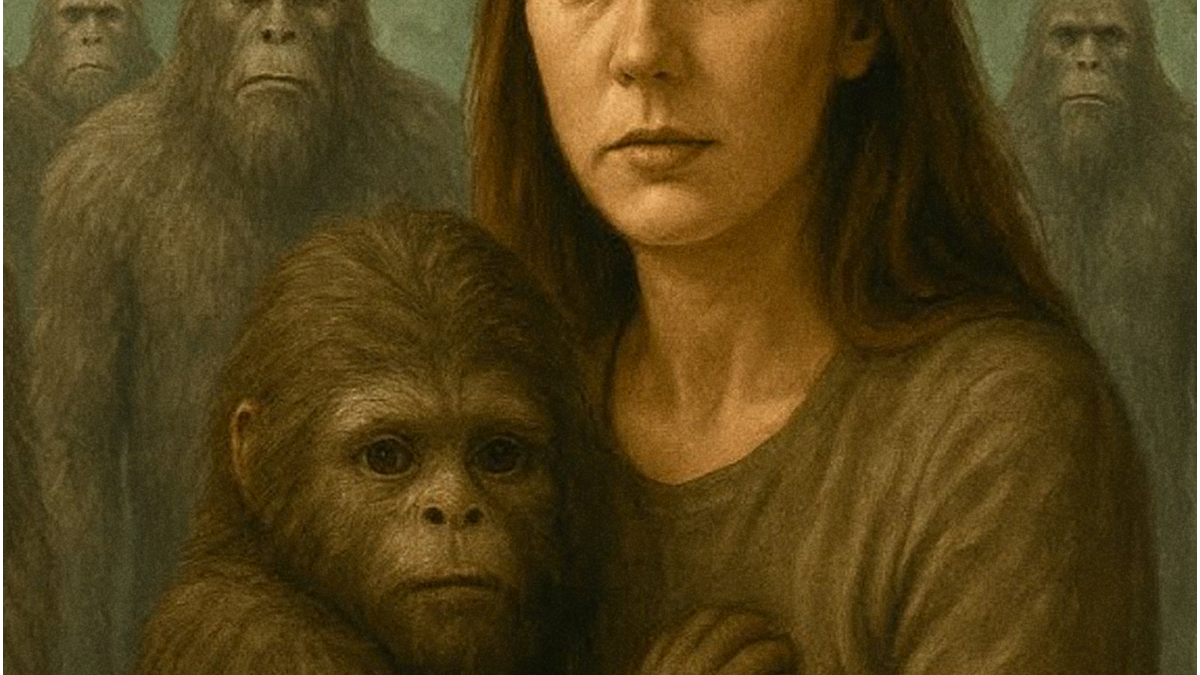
Bigfoot Left Her a Child. She Never Knew Why Until They Returned
Have you ever held a newborn in your arms knowing it wasn’t human?
One stormy night deep in Ridgepine Hollow, a woman named Clara Whitlow witnessed something no one would believe.
A massive creature giving birth by the creek.
The baby wasn’t breathing.

Moments later, the mother vanished, leaving her behind.
Clara ran through the rain, lifted the lifeless body, and did what she knew best.
Revived it.
She named the baby Naomi.
But Naomi didn’t cry, didn’t speak, and grew at a terrifying pace.
Clara didn’t know it then.
But Naomi wasn’t just a baby.
She was an offering, a forest’s way of saying sorry.
This story was found in a hidden journal inside Claraara’s cabin.
And for the first time ever, it’s being revealed.
Watch to discover why Bigfoot left a child in the care of a human.
What really happened to Claraara’s husband, who vanished in a plane crash, and the sacred truth the forest has kept hidden for decades years later.
The new owners of the cabin reported seeing something at dusk.
A small woman walking hand in hand with her daughter, surrounded by giants, not abducted, not rejected, but accepted as part of something older, wilder, and holy.
There are some kinds of silence that feel like memory.
The kind that seeps through pine needles after rain, that claims to cabin walls like breath long exhaled, that waits not like something absent, but like something watching.
Claraara Whitlo knew that silence too well.
It had become the background hum of her days at Rididgepine Hollow.
Four years since the crash.
Four years since Jonas plane never returned from its mapping run over the national forest.
Four years since anyone dared say he might be alive.
And even longer since Clara believed that hope was anything more than a trick light plays on shadows.
She didn’t leave Ridgepine anymore.
The trail down to the county road had overgrown.
No phone lines ran up this far.
Even the ranger station had stopped sending annual check-ins.
She preferred it that way.
No one needed to see what she had become.
The days were slow and purposeful.
Wake with the frost, stoke the stove, walk to the spring with a pale, avoid the mirror, write a little, feed the birds even though they never came close anymore.
There had been a time she held lives in her hands, breathing, kicking newborns, and terrified mothers clutching her shirt front.
Now she could barely touch her own skin without flinching.
The strange things began last autumn.
At first, it was just shapes in the woods, twigs bent too high for deer.
Stones stacked in small spirals near the steps, as if someone had arranged them with fingers much bigger than any humans.
A bird feather twisted into a braid she didn’t make.
And that one morning, a sprig of fireweed left gently on her porch rail.
Still dewy, still alive.
She didn’t tell anyone.
There was no one to tell.
But she started writing again.
October 3rd.
Another spiral of stones outside the window.
This one had seven coils.
Same number of miscarriages I’ve had.
Am I projecting or am I being spoken to?
It wasn’t fear.
Not at first.
It was something quieter.
Like being seen for the first time in years and not having to pretend.
But then came the sound.
That deep low hum just after nightfall.
Like a cello bow dragging against bark.
No wind, no echo, just vibration.
It didn’t come from the house.
It didn’t even come from inside her ears.
It came from the trees.
That was when she began locking the door.
One afternoon, walking back from the spring, she spotted it.
Half sunken in the soft mud by the waterline.
A footprint.
Three toes, each wide and spled.
The depth of it shocked her.
The heel mark sank a good 3 in deep, heavier than any bear, and the space between steps nearly 6 ft.
Clara stared at it for a long time, then carefully stepped around it like one might do with a grave.
That night, she couldn’t sleep, not because she was afraid, because she wasn’t.
That was the part that scared her.
She’d stopped speaking aloud in the house years ago.
But that evening, as she stood by the window, the stars reflecting faintly on the dark glass, she whispered something she hadn’t in a very long time.
Is someone there?
No answer, but she felt it.
Eyes between the pines.
She didn’t hang her laundry much anymore.
What was the point?
But that night, she did.
She washed a flannel shirt she hadn’t worn since Jonas disappeared.
Hung it from the porch line.
Maybe it was a ritual.
Maybe it was a signal.
By morning, the shirt was gone.
In its place, laid precisely across the porch rail, was a bundle of wild flowers, not the kind she had growing nearby.
These were marsh orchids and ghost pipe, braided together with something dark and coarse.
She touched it gently.
It was a strand of hair or fur, black, almost blue in the early morning light, longer than any animal she knew, smooth but tangled at the end.
She sat down on the steps, the bundle resting in her lap, her hands trembling.
October 17th, I cried.
For the first time in 6 years, I cried.
Not because I was scared, but because someone or something hurt me.
It wasn’t pity.
It was presence.
That’s the word I wrote down today.
Presence.
She didn’t move for a long time.
Only watched the edge of the forest.
Watched as the trees breathe in the fog.
Watched as morning peeled away the veil of night.
She thought of Jonas, of the last fight they had before his final flight.
He’d said she was slipping away.
That the house was becoming a tomb.
That he couldn’t reach her anymore.
Not after the last loss, not after she threw the tiny booties into the stove without a word.
And now all that remained of them, him, her, the children that never were, was a silent house, a lion of laundry with no clothes, and a bouquet left by something that should not understand grief.
And yet did.
She didn’t tell herself it was Bigfoot.
She didn’t use names.
It didn’t matter what name the world gave it.
It mattered that it saw.
It mattered that it had listened.
She began leaving things, too.
An apple, a strip of cloth, a polished stone from her dresser drawer, and they never stayed long.
Each time something else appeared in return, a pine cone carved with lines.
A small pile of riverglass.
Once a single feather dipped in sap and marked with a tiny red flower.
October 28th.
I’m not alone.
I don’t think I ever was.
The forest has teeth.
Yes, but it also has hands.
And maybe, just maybe, it has a heart, too.
The days grew colder.
The silence stretched thinner like skin pulled taut.
But Clara no longer felt buried inside it.
She felt tethered, not to the world she’d known, but to something older, something that knew what it was to lose, and still returned to the edge of someone else’s sorrow, just to be near it.
She stopped locking the door.
She began speaking aloud again, quietly, to no one, or maybe to the one behind the pines.
And sometimes when the wind died completely, she thought she heard breathing.
Not threatening.
Not threatening.
Not close.
The flannel shirt never came back.
But she didn’t need it.
The forest had given her something else.
A conversation that didn’t require words.
A communion made of eyes in the dark.
Flowers in the frost.
And an ache so ancient it didn’t ask for healing, only for witness.
And so Clara watched the woods.
And the woods watched back, not to threaten, not to claim, but simply to stay.
The storm came in just after midnight.
Not a gentle roll of thunder, not a whisper through the eaves.
No, this was the kind of storm that split the sky like old bark, kind that pressed down on the roof so hard it made the old wood creek like it remembered every winter it had survived.
Clara sat by the stove, arms folded, one lamp burning low.
She hadn’t slept much lately.
Not since the flowers.
Not since the strand of black fur.
She told herself she was okay.
She told herself this was just how grief moved like wind through a hollow.
It didn’t knock.
It howled.
But even she didn’t believe that anymore.
Not after the Not after what she’d begun to feel when she stepped outside.
Not alone, not hunted, just watched.
The rain was heavy now.
The kind that eats sound, but there was something underneath it.
Not a coyote, not an owl, not a bear, something else.
A scream, long, distant, but close enough to shake the glass on the shelf above the sink.
Clara stood without knowing why.
Her hand brushed the windowsill, her eyes squinting into the downpour.
Nothing but trees.
Branches bent by the weight of wind.
Then again, there sound.
It didn’t sound like pain.
It sounded like grief.
She grabbed her coat and flashlight.
Though the beam barely reached past the porch rail, her boots sunk deep into the wet soil as she crossed the path behind her cabin.
The rain was bitter, slashing her cheeks, soaking through her sleeves.
But she kept moving down the slope toward the spring toward whatever that was.
She didn’t have a weapon, just her breath.
Just the kind of ache that makes people go looking for something they’re not sure they want to find.
Then through the curtain of rain, movement down by the bend in the creek, something large, hunched, trembling.
It was crouched beside the rocks, its body rising and falling with panicked breaths.
At first, she thought it was a bear, but then the arm moved, not on four legs, on two, covered in thick, matted fur, dark and soaked through, shoulders like stone.
Hands human-shaped but massive, cradling something tiny in its lap.
And the face, the eyes were shut tight, the mouth wide in a silent whale.
Not a monster, not a creature, a mother.
The thing in her arms didn’t move.
Clara stepped closer, heart slamming in her chest, barely able to breathe through the shock.
The figure rocked forward, lifting the limp form of a baby for a still slick umbilical cord trailing like wet string.
She dipped her hand into the freezing creek, scooped water, splashed it over the infant’s chest.
Once again, a third time.
Then she screamed so loud it felt like the trees would split open.
It wasn’t rage, it was mourning.
And then silence.
The mother laid the baby on a flat rock, its tiny limbs stiff, belly unmoving.
She stayed there a moment just staring.
Then slowly, with her massive shoulders curled inward, she stood, turned, walked back toward the treeine.
She didn’t look back.
November 2nd.
I don’t remember deciding to run.
Only that the rain was in my eyes.
My chest was burning, and I couldn’t let it end like that.
Clara slipped on the wet moss, caught herself on her hands, then lunged toward the rock.
The baby was hot, too hot.
Its fur steamed in the rain, but its chest didn’t move.
No breath, no cry.
Clara scooped it up, the warmth shocking her.
Pressing against her palms like a coal.
She pressed her mouth to its nose, breathed in, exhaled again, rubbed its back, her fingers slipping across wet hair and bones too soft for any human infant, she whispered, not even knowing what.
“Come back!
Come back, please!”
Then it shuddered.
A sudden jolt like a branch snapping, a gasp, and the cry sharp, high-pitched, raw, Clara fell to her knees.
The baby clung to her shirt with its small fists, making a sound like a wounded bird.
Its breath came in wheezes, its chest fluttering.
But it was alive.
It was alive.
November 2nd, second entry.
I held a life tonight.
Not just a heartbeat, but a will.
Something that wanted to stay.
And for the first time since Jonas disappeared, I said it out loud.
I want to protect something again.
The rain slowed.
The scream in the woods had stopped.
The trees around her now felt still watching, listening.
She cradled the infant closer.
It was heavy, heavier than it looked, warm and wild smelling.
A scent of earth and bark and blood.
Its eyes blinked open for the first time and locked with hers.
Golden, reflective, impossibly deep.
She whispered, “I’ve got you.”
It didn’t respond.
But it didn’t respond.
But it didn’t cry again either.
Clara rose slowly.
The baby pressed to her chest.
She didn’t know what she was walking toward, only what she was walking away from.
She didn’t look back toward the trees.
Not yet.
She didn’t ask where the mother had gone or if she was watching or if this had been a test.
She only knew the infant hadn’t been left behind.
It had been entrusted.
The storm passed before dawn.
The clouds peeled away slowly like skin from light.
The house welcomed her back like something halfforgotten.
Walls damp, windows fogged, stove gone cold.
She laid the baby on a towel by the fire, wrapped it in one of Jonah’s flannel shirts.
She boiled water, ground drager, pulled out an old box marked midwife kit from beneath the stairs.
She worked like muscle memory, like someone who remembered what to do with a newborn, even if it didn’t belong to her kind.
November 3rd.
I don’t know what it is.
I don’t care.
I watched its mother scream until her throat broke.
And now it’s breathing in my home.
So, it’s mine now, even if just for tonight.
Outside, the woods were still dripping.
But inside, Clara felt something shift, something open.
A door she thought had closed forever creaked just slightly, letting in the scent of pine, the heat of new breath, and a cry that reminded her how strong life could be, even when born in sorrow.
She didn’t name it yet.
That would come later.
But as the fire crackled and the child slept curled beneath her old quilt, Clara watched the window and she swore.
Something in the trees was watching too.
Not angry, not mourning, waiting.
She named her Naomi on the third morning.
It wasn’t planned.
The name came out of Claraara’s mouth like breath after drowning.
She had been holding the baby.
No, the child.
The creature that ever she was trying to wipe mud from her furred feet when the word slipped through her lip.
Unthinking natural Naomi.
And the child blinked at her like she recognized it.
She was unlike anything Clara had ever held.
Sturdier than a human infant, but not beastly.
Her bones were solid.
Her body dense with muscle already forming under thick grayish fur.
Her hands, though crude, curled around Claraara’s thumb with purpose.
Her eyes were always watching, wide set and a kind of golden green that shimmerred in low light.
She didn’t babble like a baby.
Her noises came from deeper places.
Clicks, hums, strange churs like a bird, trying to remember a song it had never heard.
But she responded to touch, to rhythm, to warmth.
And Clara found her days rearranged around this presence.
She boiled goats milk, mashed cooked berries, used pieces of deer hide and rags for diapers, carved small wooden utensils from spoons Jonas had once made for a nephew who never came to visit.
Naomi hated bright light, slept curled into herself under blankets during the day, and prowled the cabin at dusk, murmuring to shadows in that odd throat deep cadence.
Still, Clara never locked the doors again.
November 7th.
There’s a wildness in her, not violent, just unfiltered.
When I cradle her, she purr, not like a cat, like something older.
A lullaby in muscle and breath.
I’m afraid to love her too much, but I think I already have.
Naomi grew fast.
Within days, she doubled in weight.
By the end of the second week, she stood on unsteady legs, gripping the bed posts for balance.
Her gate was uneven, her limbs long and slightly bowed.
But she moved with purpose, never crying, never clinging.
Claraara had raised human babies before.
They whimpered, groped, searched for the center of attention.
Naomi didn’t.
She watched.
She tracked everything with unnerving focus, tilting her head at bird song, flinching at thunder, sometimes mimicking the low creek of floorboards or the soft thump of Clara’s feet.
And the drawings began, not on paper.
She used the heart, the wall.
Once Clara found Naomi crouched by the window ledge, smearing soot and water into crude lines.
Shapes emerged.
Broad figures, small dots, arcs that might have been trees or claw marks or neither.
Then one morning, Clara found it.
A picture scratched into the cabin wall made with a bit of charcoal Naomi must found under the stove.
A tall creature, furred, arms like tree limbs, standing beside a smaller one.
Human-shaped, hair loose, face featureless, but undeniably Claraara.
They stood side by side, no bars between them, no threat, just proximity.
Clara traced the figures with her fingertip, throat tight.
Naomi watched her, silent, breathing steady.
November 10th.
She doesn’t need to say it.
I can feel it in my bones like Maro remembering.
She doesn’t want to leave, but she knows she isn’t mine to keep.
Not completely.
Clara began taking her outside more often, only at dusk when the sun had sunk below the treetops and the air turned blue with that soft, unsettled cold.
Naomi moved like she belonged out there among the underbrush, the damp cedar, the crooked light slicing through pine.
She sniffed everything, touched everything, and sometimes she would stop, look toward the ridge, stand still for minutes.
Clara never asked what she was hearing, but she started hearing it, too.
That low call, not a word, not a sound.
Exactly.
More like memory vibrating under her skin.
It wasn’t just Naomi who’d come from that forest.
Something had come with her.
One night, Clara couldn’t sleep.
She sat by the wood stove, journal in her lap.
Naomi curled in a makeshift bed of layered quilts.
The fire had burned low.
The wind was soft but steady, pushing the cabin’s breath against the rafters.
She turned a page and paused.
There it was again, that hum.
Not outside, inside her.
Or maybe both, she wrote slowly.
November 13th, she drew us together.
That wasn’t a child’s scroll.
That wasn’t a child’s scrawl.
That was a promise and maybe a plea.
She is not choosing a side.
She’s asking if I will.
That night, Clara dreamed of hands.
Not human, not monstrous, just large, lined with dirt, lifting her from the ground gently, setting her beside something ancient and breathing.
She woke with her palm outstretched and Naomi was holding it.
Days blurred into rituals.
Naomi bathed in the creek now.
Eight foraged roots, climbed halfway up the split pine behind the house, and hung there like a shadow with its own weight.
Clara no longer questioned the strangeness.
She recorded everything.
Every weight change, every vocalization, every new behavior.
Her notebooks were filling fast, but the emotion, the emotion she wrote somewhere else.
A smaller hidden journal.
The one she kept under the mattress.
November 16th.
I know what it feels like to hold a life that shouldn’t exist.
To carry something between worlds.
She didn’t choose to be left behind.
But she’s not surviving.
She’s blooming.
Clara couldn’t say exactly when it changed.
Only that one morning, Naomi reached out and touched Clara’s cheek.
Not randomly, not curious, with intention, with care.
Her hand rested there for several seconds, fingers cooled against skin that hadn’t been touched with love in years.
And Claraara, she broke, not loudly, just a crack along the heart’s floorboards.
Silent, final.
She wrapped Naomi in her arms, held her to her chest like she had that first night in the rain, and whispered through clenched teeth, “I won’t let them take you.
I won’t let you disappear.”
Naomi made a soft sound, almost approval.
Not a word, but almost.
Outside, the wind carried leaves like whispers across the clearing.
The forest didn’t knock.
It waited.
And Clara finally understood.
This wasn’t about claiming or keeping.
It was about saying yes to something you never thought you could love and letting it change you.
The first gift came with the frost.
A trout, still cold, its gills stained with creek silk, left gently on the porch rail, not torn or clawed, but placed as if by someone who understood offering, not hunger.
Clara stepped outside with Naomi in her arms, squinting at the shape, glinting in the morning haze.
The fish was perfect, still moist, still fresh, still warm at the belly.
She knelt, touched it.
No tag, no hook wound.
Its eyes were clear, alive just hours ago.
Naomi didn’t flinch.
She only watched.
Clara scanned the treeine.
Nothing moved, but it didn’t feel empty.
It felt patient.
She took the fish inside, cooked it in a cast iron pan with cedar smoke curling low around the room.
Naomi sniffed once, ate all of it, licked the plate, then curled up by the fire, content that night.
Clara left a jar of honey on the steps.
One she had rationed for the winter.
She set it down without a word and walked back in.
By morning, it was gone in its place.
A bundle of sweet grass tied with pine thread and clover stem.
November 18th.
This isn’t bartering.
It’s a conversation and they speak in offerings, food, light, scent.
Like a family that doesn’t knock, but leaves things at your door when words feel too heavy.
It didn’t stop there.
Every evening, something new.
A clutch of river berries still damp.
Birch bark folded into a bowl.
Once a sliver of obsidian smoothed along one edge like it had been shaped by careful fingers.
Clara began to expect them, but she never saw who left them until the night she waited.
She left no lights on.
Naomi slept soundly, her back rising and falling in the rhythm of dreaMs. Claraara sat by the window, wrapped in a wool coat, mug cooling in her hands, heart pacing slower than usual.
She told herself it was just a ritual, a curiosity, but she knew it was something more.
Just past midnight they came.
At first she thought it was wind.
Branches shifting unnaturally.
Then a tall silhouette moved between two trees.
Then another.
Then another.
Not close, not advancing, just standing.
Four of them far enough not to startle.
Close enough to be seen in moonlight.
Massive, upright, fur catching silver on their shoulders and backs.
Their heads tilted in slow, coordinated intervals, like they were waiting for something.
Naomi stirred in her sleep.
Clara didn’t move.
Her breath was so shallow it felt borrowed.
The figures didn’t speak, didn’t approach.
They simply watched.
And somehow in that stillness, Clara felt no fear, only recognition.
Naomi began growling the next morning, not with an with unease.
The kind of growl that comes from the chest, low and unsure, like a memory trapped behind the rib cage.
She paced the cabin, knocking over her own bowl, crouching by the door.
Her limbs trembled.
Her eyes flicked toward the woods.
She didn’t want to stay inside anymore.
Clara didn’t stop her.
Not completely.
But she opened the door slowly, stood in the frame, and whispered, “Not yet.”
That afternoon, Clara walked the boundary of her property for the first time in weeks.
The trees felt closer now.
The wind had a scent to it, wet moss and old smoke.
She knelt near a trail of crushed ferns and followed.
It led her to a clearing, circular, marked with stones, the same spiral pattern as the ones left outside her window.
There were claw marks in the dirt, not wild, not chaotic, deliberate, and in the center, pressed into the earth like a seal, was a handprint.
Twice the size of her own.
November 22nd.
They’ve been here all along.
I think I always knew.
Jonas used to say, “The forest keeps what it wants, but I wonder now.
Maybe it also gives back what it knows we’ve lost.”
The voices started the next night.
Not out loud.
Not exactly.
They came when she was drifting, eyes half shut, lamp flickering.
A murmur in the chest, like thunder caught between ribs.
Clara.
She snapped upright.
Naomi didn’t stir.
Clara.
It wasn’t English.
Not truly, but the meaning settled in her anyway.
Returner, not enemy, not broken agreement.
The lamp hissed, the window fogged, and somewhere inside her head, a door creaked open.
She pressed her palms to her eyes, trying to breathe through the weight of it.
Not threat, not command, invitation.
She didn’t sleep.
The next morning, she found Naomi drawing again, this time on the cabin floor using ash and berry pulp.
Four large figures, one smaller, and Clara all standing in a ring.
A hand reached toward her from one of the tall figures.
Clara traced it, her throat clenched.
November 23rd, she knows they’re calling her, but she’s not afraid.
She looks at me like I’m the one trembling.
And maybe I am, because it’s not about losing her.
It’s about becoming someone who can still choose love.
Even when it leads me away from everything I thought made me whole.
The snow came early that year, only a light dusting, but enough to soften the trail.
Enough to silence the world beneath its weight.
Clara stood at the edge of the porch, Naomi beside her.
She wasn’t ready.
But the forest didn’t ask for readiness, only presence.
Clara wrote one last letter that night, folded it neatly, set it in the drawer where Jonas used to keep his maps.
Jonas, if you see me walking into the dark, it’s not because I’ve forgotten the light.
It’s because I’m holding something that needs me more than I need safety.
You once told me I couldn’t save everyone.
Maybe that’s true.
But I can save one.
And maybe that’s enough.
She folded Naomi into her coat, stepped down into the snow, and walked toward the line where forest swallowed field, where silence breathed.
She didn’t know what lay ahead, but she felt the weight of small fingers around hers.
And knew this wasn’t the end of her story, only the place where it had stopped being hers alone.
The forest didn’t speak in commands.
It whispered in patterns, in the shape of stones, in a quiet tremble of wind through hollow trees.
Clara had begun to understand that.
But this this felt different.
The call came not through voice, not even through Naom’s eyes, but through silence itself, an ache in the air, a knowing in the bones.
Clara stood on a Porsche with a child pressed to her hip and felt it like a pull just beyond the ribs.
It was time.
She packed a satchel, bare essentials, dried meat, a carving of Naomi she’d made, the charcoal drawing Naomi had done of them standing beside the others, and an old compass Jonas had once carried, even though he never used it.
She slipped it into her coat pocket like a piece of him might still point her somewhere true.
Naomi didn’t resist.
She clung tightly as they walked through the underbrush, her fingers gripping Claraara’s shoulder like she’d done it a thousand times in another life.
They crossed beyond the familiar trails, past the spring, beyond the boundary where Claraara once found stone spirals.
The forest deepened there, not in danger, but in weight.
Trees wider, light thinner, air pressed against skin like old breath.
And then she saw a ring of stones in a perfect circle, blackened at the base, as if scorched, but cool to the touch.
Moss grew along one edge.
In the center, a hollow dip in the ground lined with fern and broken pine needles.
It felt old.
Older than the cabin, older than grief.
Naomi walked ahead, stepping inside the circle without hesitation.
She crouched low, placed both hands on the earth.
Then Clara felt her.
From the trees the shape emerged, shoulders broader than any human, arms long, heavy, draped in dark fur like wet curtains.
Her face, while wild, bore no malice, only an understanding.
Wisdom carved into her brow like weather into stone.
She stood tall, taller than Claraara imagined, and yet not threatening.
Her gaze held sadness, familiar, deeply familiar.
Claraara instinctively stepped in front of Naomi, but the creature lifted a hand.
Not to strike, to offer.
In her palm, a to jet black, polished to a shine, small enough to rest in Claraara’s hand, but sharp as obsidian.
The root was wrapped in woven grass and ash string.
Clara hesitated.
The creature spoke, but not allowed.
The sound came from somewhere between belongs to both.
Claraara’s eyes stung.
She couldn’t explain why.
She reached forward and the moment her fingers touched the tooth.
An image flashed behind her eyes.
Jonas, but not as she last remembered him.
Not cold, not broken, alive, wounded, but breathing.
Carried by large arms through mist and blood and pine.
A fire in the distance, hands tending to his wounds.
A low huml like Lullabi sung into bone.
Time passed.
He limped.
He healed.
He smiled at something she couldn’t see.
Then one day, he lay beneath a tree alone.
Still, the image disappeared as quickly as it came.
Clara dropped to her knees.
The forest didn’t steal him.
It saved him.
And when it couldn’t save him anymore, it buried him the way it knew best.
She turned to the creature.
Her chest hollowed, flooded, cracked in a hundred ways, and whispered, “Where?”
The figure turned slightly, raised one arm, pointed, and Clara followed.
They walked for nearly an hour in silence.
Naomi stayed close, quiet.
No birds sang, no wind stirred, just the faint crunch of frost under boots.
Then the tree appeared.
Unlike any around it, unlike any around it, its trunk twisted in slow spirals like smoke turned solid.
Vines wound up its bark like veins.
And at the base, half hidden beneath a curtain of roots, stones, flat, placed, carved.
Clara knelt.
One stone bore a single phrase etched not with letters but with clawlike grooves that somehow still said the words.
He stayed.
He became one of us.
Her hands shook.
She pressed her palm to the ground and wept.
Not loudly, not for long.
Just enough.
Enough to wet the roots.
Enough to say goodbye.
November 27th.
You didn’t vanish into thin air.
You didn’t leave without reason.
You followed something ancient and it held you when I couldn’t.
You left me a daughter.
You left me the reason to keep breathing.
Naomi reached out and touched the dirt beside Claraara’s hand.
She wasn’t crying, but her body stilled, as if she understood exactly what lay beneath.
The creature, Urea, Claraara would later call her, though she never said the name aloud, stood across the clearing, watching.
She didn’t come closer.
She didn’t speak again.
But Clara felt the message clear as a bell ringing inside her chest.
This was not the end.
This was the offering.
Not Naomi, not a trade, a bridge, a belonging.
Uria turned, disappeared between trees with a grace too large for her frame.
Branches swayed in her wake like curtains in an open window.
Clara stayed for a long time.
She lit a match and placed it on a small pile of bark and dried fern.
Let the fire crackle.
Let the smoke rise.
Let it carry the scent of closure to whatever sky Jonas now belonged to.
When she finally stood, Naomi reached for her hand.
They walked back together.
No words, only footsteps.
The path behind them didn’t vanish.
But the woman who had walked it now carried something new in her spine.
Not just a child, but a promise.
That grief didn’t end a life.
Sometimes it began one.
It didn’t happen like Clara imagined it would.
There was no miracle moment, no bolt of light or sudden burst of understanding.
Just the slow hum of breath between two living beings, a rhythm that had become familiar, a language without words.
And then on a morning where the air smelled like thawing cedar and the snow had almost vanished, Naomi spoke.
Not a sentence, not even a word, not the way humans use them, but it wasn’t animal either.
It was closer to music, raw, tonal, soft in one breath, sharp in the next.
Her mouth formed it carefully, like the sound had been waiting somewhere in her chest for a long time, and only now found its way to the surface.
And what she said, if you could call it that, was stay.
Clara froze.
The wooden spoon in her hand clattered to the floor.
She turned slowly, not wanting to break whatever fragile bridge had just been built in the stillness.
Naomi stood barefoot by the fire, one hand resting on her own chest, eyes wide but steady.
Stay, she repeated, softer this time, like a heartbeat slipping through leaves.
Claraara knelt, her voice barely more than air.
I’m here.
Naomi didn’t smile.
She didn’t need to.
Her face was still, but her shoulders dropped.
And then she walked forward, arms open, not to be held, but to hold.
They stayed there for a long time.
Just being.
December 2nd.
She doesn’t call me mother.
She doesn’t need to.
What she calls me is something deeper.
A place.
A promise.
She said stay and meant it like a root means the earth.
Naom’s voice came more often after that.
Not fluent.
Not fluent in any language Clara knew, but full of intent.
A hybrid of notes and gesture, as if bird song had learned to mean something more than warning or joy.
There were words that weren’t words, cherups that meant food, a throat hum for safe, a single long whistle for listen, and then came the drawing.
Naomi had taken to using coal, mud, crushed berries.
She smeared them on bark, on stone, on the floor when Clara wasn’t watching.
But this time, she asked first with a sound, half word, half question, then gestured toward Claraara’s journal.
Clara handed her a page.
Naomi drew quickly, her hands moved with certainty.
First came the tall ones, four of them, their silhouettes massive, fur detailed with careful slashes of charcoal.
Then came smaller ones, Naomi Then Clara and then a ring of fire around all of them, not engulfing, encircling.
Claraara traced the circle with her fingertip.
What is this?
Naomi tapped her own chest.
Then Claraara’s, then the fire.
Then she made the sound again.
Stay.
And Claraara understood.
Naomi wasn’t asking permission.
She was asking for a future, a place where she could belong that didn’t tear her in half.
December 5th.
She doesn’t want to leave, but she won’t stay if it means choosing between herself and me.
She’s seen both sides now, the wild and the warm, and she’s asking if she can live in the space between them.
She’s asking me if I can, too.
Something shifted in the house that day.
The silence wasn’t so sharp anymore.
The shadows felt less like watchers, more like guardians.
Naomi wandered in and out freely.
Her limbs moved with more confidence.
Her eyes lost some of the guarded shimmer they had carried since birth.
She began humming to herself.
Echoes of forest sounds, rhythmic and ancient.
Clara realized it wasn’t mimicry.
It was memory.
One night, Naomi sat on the porch with Clara wrapped in a blanket beside her.
Snowflakes hung in the air but didn’t fall.
The forest beyond was quiet but not dead.
And then Naomi pointed to the sky.
Stars, dozens, bright, cold.
She made a soft wine.
Low pulled from the belly.
Then looked at Clara.
Home?
She asked.
It was the first true English word she had used outside of stay.
Claraara didn’t answer right away because it wasn’t just a question.
It was an offering, a dare.
She finally said, “If you want it to be.”
Naomi blinked, then nodded once.
December 9th, she chose this.
And in doing so, she’s made me choose, too.
Not between her world and mine, but between fear and trust.
She isn’t halfway between monster and girl.
She’s all of both.
And maybe I am, too.
That night, Clara brought out the old wooden bowl.
Jonah’s favorite.
Carved from chestnut, and worn smooth by time.
She filled it with what they had.
Bits of dried trout, wild herbs, a little honey.
She left it on the porch with Naomi beside her.
They didn’t say anything.
They didn’t have to.
By morning, the bowl was empty.
And beside it, a feather long and black, tied with a single red thread.
No noise, no knock, no ceremony.
Just answer.
The forest had spoken back.
The world had widened.
Naomi was no longer just a child taken from the wild.
She was a voice between two worlds.
And now she had started using it.
She didn’t need directions.
Not really.
The forest had its own way of guiding her now.
Naomi led quietly, gracefully, as if every root and stone remembered the weight of Jonas’s steps, as if every turn in the trail had been shaped by his absence.
Clara followed, breath deep, heart unsure, her fingers brushing against trunks like they might answer back.
The morning was cold, but soft.
No birds, no wind, just that strange sense of welcome that sometimes rose up from the moss like an old friend who no longer needed to speak out loud.
It had been nearly a month since Urea gave her the tooth, since the fire at the offering r since Naomi said the word home and made Clara realize she was never going back to how things used to be.
She thought she was ready for this, but the tree still took her breath away.
It stood taller than the rest, twisted like time had gripped it by the shoulders, and rung something out.
Its bark spiraled upward in thick ridges, veins of green curling through the cracks.
Stone, that’s what the old folks called it.
The tree that grew with rock inside it.
Roots wrapped around buried boulders like hands clinging to truth.
At its base, the soil was dark and undisturbed, but not untouched.
Carved deep into the smoothest route was a sentence.
No ink, no names.
Just claw gouged lines that read, “He stayed.
He became one of us.”
Clara knelt slowly.
The air around the tree felt heavier, not in a suffocating way.
Like a hush in a chapel, Naomi didn’t speak.
She stood close, her hand resting gently on Claraara’s shoulder, as if to say, “This is yours now.”
Claraara’s fingers traced the letters.
Rough, deep, purposeful.
December 17th.
He didn’t leave me.
He was just on a path I wasn’t meant to follow until now.
She placed her palm on the soil.
Cool.
Damp.
She could almost feel a heartbeat in it.
Or maybe it was hers echoing back.
The memories came slow, not vivid, not clear, but enough.
Jonas limping through trees, held up by large arms, fur pressed to his face, a mouth whispering sounds not meant for humans.
Shelter in caves, roots soaked in crushed herbs.
A hand across his brow, a fire burning low, surrounded by figures who had nothing but silence and care.
He wasn’t afraid.
He stayed, not because he had to, because something in him saw something in them and called it kin.
Clara wept, but only a little.
Her tears fell with intention.
They hit the ground like seeds.
Naomi knelt beside her.
Then stood, and from the trees another figure emerged.
Not Urea.
This one was younger, leaner, but tall, broad shoulders, amber eyes that shimmerred like wet stone.
His gaze was steady, curious.
Then when he stepped into full light, Claraara’s breath caught.
He had Jonas eyes.
Not exactly, but close enough to knock something loose in her chest.
She stood slowly.
The young one didn’t approach.
He didn’t need to.
He raised his hand once, palm forward, then turned back toward the woods, vanishing behind a veil of needles and frost.
December 17th, second entry.
Jonas, you didn’t leave me empty.
Jonas, you didn’t leave me empty.
You left a thread.
A child, maybe a spirit.
A reminder that even when the body fails, the love we pour into the world finds its way into something else.
Clara placed one stone at the base of the tree, flat, smooth, not carved, just present, a mark of witness.
Naomi crouched beside her and for the first time pressed her forehead to the bark.
No words, just breath.
Clara watched her and something in her loosened.
This wasn’t about burial.
This wasn’t goodbye.
This was inheritance.
The forest accepted Jonas not as an intruder, not as prey, but as one of its own.
Not because of what he was, but because of what he became.
And now Clara understood why Naomi looked at her the way she did, with recognition, with quiet expectation.
Not because Clara was her mother by birth.
But because she had chosen to stay, December 18th, I didn’t bury the man I loved beneath the ground.
I planted him in the heart of the woods, and what grew from him still breathes.
She stood, dried her hands on her coat.
The air had warmed slightly, just enough to make the frost on the branches drip like the woods were exhaling.
She looked once more at the carvet, then whispered, “You’re not gone.
You just changed shape.”
Naomi looked up, her face unreadable, but calm, and Claraara knew this journey wasn’t closing.
It was branching, like roots beneath soil, reaching places unseen.
The wind picked up again, but it didn’t carry cold.
It carried something gentler, like an old voice long buried, humming from the other side of the trees.
Clara didn’t leave in the middle of the night.
That wasn’t her style.
She left with the morning, slow, intentional, with every drawer closed gently, and every hinge oiled the night before.
The cabin stood still behind her.
Would warm by the last fire she lit.
Floor swept clean, blankets folded one last time on the bed that had held grief and dreams in equal measure.
On the small table by the window, she left a note for whoever found the place next.
No instructions, just this.
If the wind ever feels like breath and the shadows don’t seem empty, don’t be afraid.
Listen to the trees.
They remember us all.
She didn’t pack much.
Just what could be carried without needing to be explained.
Naomi stood at the edge of the clearing, her hair now wild and full, eyes wide but calm.
A necklace of riverstones hung from her neck.
Clara had made it from pieces they’d found together around Naomi’s wrist.
A loop of dried vine and black fur.
Her first gift from the hollow ones.
She never took it off.
The forest was different now.
It didn’t feel like a wall, like a looming mystery waiting to judge her.
It felt open, like a path.
Not paved, not promised, just possible.
They walked without speaking.
By now, the silence between them had turned into something deeper than language.
Naomi glanced back only once, and Clara knew what she was looking at.
The house, the garden, the chimney built by Jonah’s hands.
And though Claraara’s throat achd, she nodded.
That chapter was done.
And some goodbyes don’t need words.
January 3rd.
I used to think if I left the house, I’d lose the last pieces of Jonas.
Now I know is not in the floorboards.
He’s in the trees.
In Naomi’s hands, in the way, the stars linger longer through the branches.
They crossed into deeper woods where no path had ever been marked.
But Naomi knew exactly where to go.
The air grew thicker, not with fear, but with something sacred.
The kind of space where time folds in on itself, and everything smells like memory.
At the riverbend, she saw them, the hollow ones, not hiding, waiting.
Ura stood at the front.
Her posture didn’t change.
She didn’t open her arms or smile or bow, but her chest rose just slightly like she’d exhaled something she’d been holding since that rainy night Naomi had been born.
There were more now.
Tall ones, small shapes blurred into mist, then reappeared in sharper form.
One of them, broad shoulders, calm eyes, watched Clara longer than the rest.
Something about the way he stood reminded her of Jonas.
Not him, but of him.
Naomi stepped forward.
Her hand touched Juria’s forearm.
It wasn’t formal.
It wasn’t ritual.
It was family.
Clara didn’t cry.
She thought she might, but there was nothing to mourn.
She stepped beside Naomi and waited.
No one spoke, but the feeling was loud, a pulse in the air.
A kind of welcome that didn’t need translation.
For the first time in her life, Clara didn’t feel like a guest in the world.
She felt chosen.
January 4th.
I am not the same woman who locked her doors at night.
I am not the same woman who wept into the fire and wondered if the woods wanted me dead.
They never wanted anything.
They only waited for me to stop being afraid of being known.
She moved with them now.
Not every day.
Not every moment.
Some days she walked alone to the glade where Jonas had been laid.
Some days she stayed with Naomi and taught her how to boil roots properly or patch a torn piece of hide.
Some nights she sat near the fire while the hollow ones sang sounds she didn’t understand but didn’t need to.
She didn’t need to become them.
They hadn’t asked her to.
She only had to be fully herself and open.
Once during a dusk heavy with fog, Clara heard rustling behind her.
She turned and saw a young woman, eyes wide, skin pale, clothes too clean for the forest.
She and wandered close from the edge of the valley.
The girl froze when she saw Clara.
Behind Clara, two hollow ones stood tall, protective, motionless.
Clara raised her hand slowly.
“It’s all right,” she said, her voice low, grounded.
“No one’s going to hurt you.”
The girl stepped forward barely.
Her lips parted, but her voice cracked.
“I thought I saw monsters,” Clara shook her head gently.
“No,” she said, a faint smile pressing into her face.
“You saw old things, older than fear.”
The girl didn’t move.
So Clara added, Claraara told me not to be afraid.
The girl flinched.
Who?
But Clara didn’t answer.
She only turned back to the trees.
January 11th.
They’ll call it myth.
They’ll say I was taken.
They’ll say I lost myself.
But I’ve never been more whole.
If anyone ever asks where I went, tell them I went inward.
Tell them the woods gave me back to myself.
No one heard from Clara again in town.
But stories started to spread.
A woman seen walking among giants in the pines.
Not running, not hiding, just walking, calm, barefoot sometimes.
Sometimes with Naomi beside her, sometimes alone.
She didn’t wave, but she always looked directly at those who saw her, as if she knew they were watching, as if to say, “I see you, too.”
And then she vanished between the trees, but the feeling remained.
Sometimes what we fear in the dark isn’t danger, it’s recognition.
It’s the quiet knowing that someone or something out there might see us not as what we pretend to be, but as who we truly are underneath it all, raw, tired, tender, still holding pieces of old pain like they matter more than breath.
And maybe they do, because grief isn’t just a wound.
It’s a map, a record of where we’ve been, of what we were brave enough to love and terrified to lose.
And in some rare corners of the world, deep in forests untouched by time or noise, grief echoes.
It doesn’t fade, it finds company.
Not every bond needs words.
Sometimes the loudest truths are exchanged in silence, in gestures, in the way a hand is offered, or the way someone simply stays when they could have walked away.
What we call wild might simply be what refuses to forget.
And what we call monstrous might be something ancient reaching for connection in the only way it knows how.
Through small gifts left in the snow, through long gazes from the trees, through the reverent stillness of watching someone break and not look away.
In the end, healing doesn’t always look like fixing what’s broken.
Sometimes it looks like learning how to carry the break differently with more gentleness, more reverence, more grace, and love.
True love, the kind that doesn’t demand to be named, rarely shouts, it lingers, it listens.
It returns in unfamiliar forms and asks only that we open the door.
This story, like many worth telling, wasn’t about happy endings.
It was about becoming, about what happens when someone who is lost decides not to be found, but to root.
To belong, not in a place, but in a purpose.
Sometimes we don’t need saving.
Sometimes we just need to be remembered by something that still believes we matter.
Even when we don’t speak, even when we’ve forgotten the sound of our own voice.
Thank you for staying until the end.
If this story stirred something in you, even just for a moment, we would love to hear what it was.
Drop a comment below.








