Hunter Rescued an Injured Baby Bigfoot From a Steel Trap – Bigfoot Family Surrounded Him
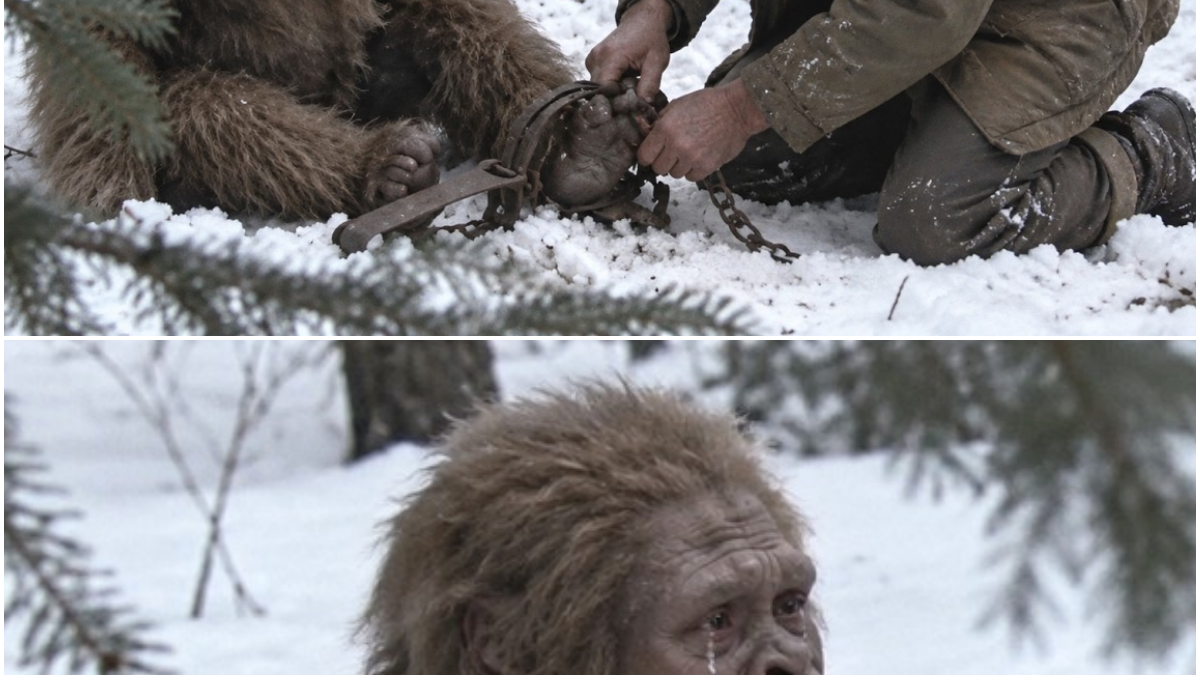
Hunter Rescued an Injured Baby Bigfoot From a Steel Trap – Bigfoot Family Surrounded Him
The trap had teeth.
Not my trap.
Mine were smooth jawed foothold sets sized for fox and bobcat, and I ran them clean and legal for 36 years.
This was a tooththed bear trap, 40 lb of rusted steel with a jaw spread wider than my two hands, the kind that’s been outlawed in West Virginia since before I was born.
And clamped in those teeth, screaming in a voice that was part child and part wild thing, was a young one, 4 and 1/2 ft tall, covered head to heel in chestnut hair, black eyes wide with pain, and a broad handshaped foot caught at the ankle in a machine built to break a bear.
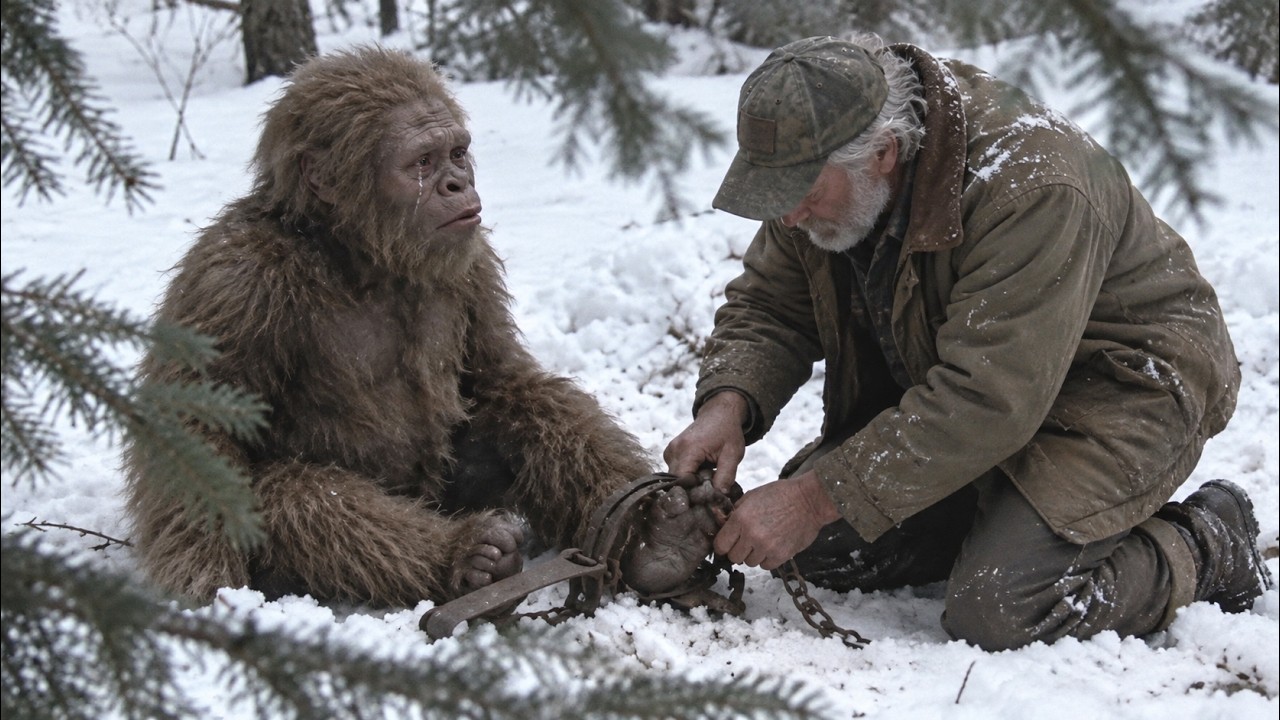
I was 48 years old, and I knelt in the snow beside a living Bigfoot, and I pried that steel open while he screamed against my shoulder.
And then I hauled him home through falling weather on my fur tobogen because I didn’t know what else to do with him.
And by full dark that night, my cabin, four rooms at the end of a dead-end hollow in Pocahontas County, stood surrounded on three sides by his family.
This is what happened.
Before I go any further, if you’re enjoying these stories, hit that subscribe button so you never miss a new one and tell me in the comments where in the world you’re listening from.
I read every single one and it means more than you know.
My name is Roy Dixon and I was born in 1938 in a house my grandfather raised on Stony Creek a few miles outside Marlington, West Virginia.
My father ran trap lines through the tail end of the depression and taught me the trade the winter I turned 12, which would have been 1950.
He taught me to read a creek bank like other men read a newspaper, to boil and wax steel so it carried no man smell, how to set a pan so light that a fox’s front foot would spring it, but a falling leaf wouldn’t.
By the time these events took place in the fall and winter of 1986, I’d been working those mountains for 36 years, and I believed there wasn’t a track, a scat, a den, or a sound in the Manonga National Forest that I couldn’t put a name to.
A man can be wrong about a thing for 36 years and never know it until the woods decide to correct him.
The country I trapped sits northwest of Marlington, up in the high ground around the Williams River and the Tea Creek drainage, hard against the edge of the Cranberry Wilderness.
They’d made that wilderness official just 3 years earlier in 1983, and it closed off better than 35,000 acres to roads and machines, which suited me fine since it pushed fur toward the edges where I worked.
That’s red spruce country up top, better than 4,000 ft in places with yellow birch and beach and hemlock choking the drainages below.
Snow comes early there and stays late.
There are hollows in that country where the sun doesn’t touch the ground from November to March.
And there are laurel thicket so tight a man crawls them on his belly.
And there are places, I’ll say it plain, where even a woodsman born to it feels like a visitor who’s overstayed.
I need to tell you about Loretta because you can’t understand that winter without her.
Loretta and I married in 1959 when I was 21 and she was 19 and we had 25 years together before her heart quit on a Sunday morning in June of 1984 while she was pinning wash to the line.
Our daughter Connie was 25 by the winter I’m telling about married and living up in Columbus, Ohio.
And she called me every Sunday evening and begged me every third call to come stay with her through the cold months.
I always told her the fur wouldn’t catch itself.
The truth ran harder and simpler than that.
The cabin still smelled like her mother.
Leaving it felt like leaving Loretta twice.
So I stayed on alone at the end of our hollow off Route 39 with an old red bone hound named Duke.
And I ran my line, and I let the work fill the hours that grief would have flooded otherwise.
Trapping was still a living then, though a thinner one than it had been.
The fur boom of the late7s had cooled, but a prime bobcat still brought real money, and red fox held its price.
And a man who worked hard and skinned careful could clear enough between Thanksgiving and February to carry him through the year, especially a man with no mortgage, and nobody left to feed but a dog.
I ran close to 60 sets that season, strung over about 11 mi of drainage, and I checked them every day the law required.
I carried my catch out on a homemade toboggan, ash frame, and oak slats that my father built in 1961, and that I’d relashed so many times there was more of my cordage in it than his.
The season opened the first week of November, and for 10 days everything ran just as 36 years had taught me to expect.
Then the woods commenced their instruction.
On the 12th of November, I came up the Tea Creek side and found three sets in a row sprung with nothing in them.
Now, a sprung trap with no catch isn’t strange by itself.
Deer step in them.
Squirrels rob bait.
A possum can pull free of a set meant for fox if the pan cover shifts.
But these three were dug out.
The whole set was excavated.
Trap flipped over.
Jaws snapped shut on air.
And the dirt laid aside in a pile, almost neat, the way a man spades a garden.
Raccoons scatter dirt.
Skunks scatter dirt.
Nothing I’d ever trapped in my life set the dirt aside in a pile.
I blamed a poacher first, because a poacher was the only thing that fit.
Somebody walking my line, springing my steel out of spite or mischief.
But a poacher leaves boot tracks, and there were none.
And a poacher doesn’t usually leave the trap itself, which was worth $8 or $9 new.
Over the next week, it kept on sets dug out and sprung.
Bait stations stripped, and I mean stripped clean, the wired down bait gone, and the wire unwound.
Not chewed through, unwound.
One morning, I found a drag stone I’d wired to a bobcat set.
A stone I’d guess at 70 moved 40 ft up the bank and sat on top of a stump sat on top.
I stood there looking at that stone on that stump for a long while and I remember Duke wouldn’t come up the bank at all.
He sat down at the creek edge with his ears flat and a low sound rolling in his chest and Duke was a dog that had bailed up bears.
The knocking started the third week of November.
I’d be finishing the line at dusk, which comes around 5:00 that time of year in those hollows.
And from up on the ridge would come a single hard knock, wood on wood, sharp as a mall on a fence post.
A minute later, from the far side of the drainage, another would answer it.
Two knocks, then quiet.
I told myself it was hunter signaling, though buck season hadn’t opened, and I never once cut a boot track.
I told myself it was trees popping in the cold, though the cold wasn’t hard enough yet to pop timber.
A man can tell himself a good deal at dusk with a mile still to walk.
What I couldn’t explain away was the pattern.
The knocks moved when I moved.
Whatever made them was keeping pace with me, ridge to ridge, all the way down to where my truck sat at the gate.
The first real snow fell on the 29th of November, 4 in of dry powder, and the next morning the woods gave up their secrets as fresh snow always makes them do.
Half a mile up tea creek, crossing a bench of open beachwoods, I cut a line of tracks that stopped me the way a wall stops you.
Barefoot tracks, five toes, a wide heel, a flat arch pressed better than an inch deep into snow that my own boots barely dented.
I carry a cloth tape in my pack basket for measuring pelts, and I laid it along the clearest print with my hands none too steady, 17 in heel to toe, almost 8 in across the ball.
The stride, track to track, ran 54 in on level ground.
I wear a size 10 boot and I stand 5’9.
And when I stretched my legs to match that stride, I near about pulled a muscle and I still came up short.
I want to be honest about what I did next because it matters to the rest of this.
I told no one.
Not the Department of Natural Resources office in Marlington, not the sheriff, not so much as a word dropped at the feed store.
Men in Pocahontas County had talked about such things for generations.
Always at the edge of a story, always about a cousin’s neighbor or a hunting camp 40 years back.
And the men who talked loudest were the men nobody much believed about anything.
I had a fur buyer who trusted my honesty and a county full of people who’d known me all my life, and I wasn’t going to trade that for a snow track, no matter what my tape measure claimed.
I followed the line of prince until they crossed the creek on a downed hemlock using it like a foot bridge and went up into Laurel where I had no business crawling alone.
Then I went home and sat by the stove and didn’t sleep much.
Now I hadn’t grown up in a county empty of stories.
The old men of my father’s generation, the ones who’d logged the virgin spruce off these mountains in the 20s with steam and oxen.
They’d had their tales told low around stoves after the women went to bed about wood knocks that answered the mill whistle.
About a smell in certain hollows that turned the horses about camp cooks up on Cheat Mountain who’d wake to find the biscuit stores gone and tracks in the mud too big for any man in camp.
Wood boogers, the old people called them, and they spat when they told it, half in fun and half not.
And my own father, who feared nothing I ever witnessed, wouldn’t run a line up one drainage off the WilliaMs. And when I asked him why, the winter I was 13, he looked at me a while and told me that some ground was spoken for, and a smart trapper honored other folks lines.
I’d taken it for superstition all my life.
Standing over a 17-in track with a cloth tape in my hand, I commenced to take it for county history.
Two days into December, I smelled it for the first time.
I’d come up on a flat where I kept two blind sets in a foxt trail, and the wind swung out of the north, and it hit me like walking into a wall of it.
Musk, heavy and warm and sweet rank at once.
The smell of a wet animal crossed with turned earth and crushed ferns, but bigger than any of that, thicker.
The smell of a large body that lives outdoors in all weathers.
I’d smelled bear at close range plenty of times.
Bear is sharp and sour.
this rolled.
It filled the whole flat, and it had a warmth to it, which frightened me worse than the size of it, because a smell only carries warmth when the body making it is near.
Duke pressed himself against the back of my knees.
This old hound, who feared nothing on four legs, and shook.
I never saw what made the smell that day, but I felt watched the whole climb out.
And I’ll tell you what being watched feels like to a man who spent his life in timber.
The birds go first, the chickades and nuthatches that follow a man through winter woods, scolding and flitting.
They were gone, and the squirrels quit cutting, and the whole drainage held still like a room where somebody stopped talking mid-sentence.
Twice I heard rock click on rock up in the boulder field above me.
A measured clack clack like a man idly knocking two stones together while he waits on you.
I didn’t run.
Running felt like an answer to a question I didn’t want asked.
I walked out steady and at the gate I sat in the truck a full 5 minutes before my hands would work the key.
Through that first week of December, I quit lighting the porch lamp of an evening.
And I’ll not pretend it was thrift.
I’d taken to sitting at the dark kitchen window after supper with my coffee, watching the upper meadow where the moon laid its silver down.
And twice that week I saw what I saw.
A shadow at the meadow’s far edge, upright, tall past reason that held so still my eyes would lose it against the timber.
And then it would be 10 yards along from where it had stood, and I’d never caught the moving.
The second night the wind was combing the broom’s edge all one direction, every stem of it bowing east, and the shadow crossed against that wind without a stem’s worth of sway to it.
And a shadow that moves against the wind while the whole meadow bows the other direction will re-educate a man about his own eyes.
I never told Duke’s ears about it either.
He knew before I did, every time, and he’d already quit the porch by dark.
The following Saturday, I stopped at the little store at Edray for coffee and cartridges, and that’s where Chester Powell comes into it.
Chester was a bear hunter from up towards Slatty Fork, my age, near enough, a bigvoiced man who ran a pack of plot hounds, and had a reputation for taking his bears wherever he found them.
Seasons and boundaries be hanged.
He was holding court by the stove with three other men when I came in.
And what he was holding court about set my stomach down through the floor.
Giant tracks, he was telling them, barefoot tracks 17, 18 in long up the Williams Riverside, and his dogs striking a trail and then quitting it.
Quitting cold, tucking tail, and coming back to the truck, which those dogs had never once done on bear.
Somebody laughed at him, and Chester didn’t laugh back.
He leaned in toward the stove and told them all what he aimed to do about it.
His granddad had left him some old steel, he told them.
Real steel, the big tooththed traps men used on bear before the state shut that down, and he’d oiled three of them up, and he was going to hang whatever was walking around up there on 18-in feet, and when he did, he’d be selling tickets.
The other men laughed like it was stove talk.
I knew Chester Powell well enough to know it wasn’t.
Going out, I stopped by his shoulder and told him quiet that tooththed bear traps had been illegal since the 30s, and that steel like that would break a man’s leg, same as anything else’s.
And Chester looked up at me with that flat grin of his, and asked me, “Since when did Roy Dixon warden for the state?”
I let it lie.
I’ve wished a thousand times since that I hadn’t.
That next week, the weather came in raw gray sky, stacked on gray sky, the smell of real snow hanging over the high country.
I pulled half my line, the sets farthest up the drainage, and told myself it was because fur moves less in deep cold, which is true, and not because I’d started dreading the upper stretch of Tea Creek, which was truer.
The knocks had kept on.
The dugout sets had kept on.
And once in the middle of the night, from the ridge behind my own cabin, 3 mi from the trap line, there had come a call, long, low, rising at the end, more voice than howl, a sound with a chest behind it, bigger than a bull’s.
Duke wedged himself under my bed, and wouldn’t come out till daylight.
I lay there listening to that call roll down the hollow, and I understood that whatever was up there knew where I lived.
On the 9th of December, I went up to pull the last of my high sets.
6 in of old snow lay under the spruce, with more promised by evening, and I meant to be down and done by 2:00.
I was working the second to last set, a bobcat cubby under a leaning rock, when the sound reached me, screaming, thin with distance, but steady, coming off the bench above the forks of Tea Creek, a half mile up and across from where I stood.
My first thought was bobcat in a trap, because a cat in steel can scream like a burned child.
But I had no steel up on that bench, and the longer I listened, the less it sounded like any cat, because underneath the screaming ran a second sound, lower horse rhythmic, the sound a child makes between screams when it’s been crying so long its voice is going.
Whatever was up there was in steel, and it wasn’t mine, and it had been in it a while.
I’d like to tell you, I went straight up that bench at a run.
The truth is, I didn’t.
For a long minute, I stood there with the screaming coming down through the spruce.
And everything in me that had been counting knocks and measuring tracks for a month told me exactly what I’d find and told me to walk the other way.
It was the child sound that moved me.
A man can talk himself out of nearly anything, but not out of a child crying in the cold, no matter what shape the child turns out to wear.
I left the toboggan, took the pack basket and my belt axe, and climbed.
The screaming got bigger the whole way, and by the last 100 yards, it had gone horsearo and broken, more sobb than scream, and I could hear the chain, steel chain, snapping tort and falling slack over and over, something heaving against an anchor.
I came up over the lip of the bench through a screen of young spruce, and I saw him.
And I’m going to slow down here because you deserve to see what I saw.
An open pocket in the timber, maybe 40 ft across, floored in trampled bloody snow.
Every sapling within reach of the chain snapped off white.
A drag log the size of my leg plowed sideways through the snow to where it had wedged between two rocks.
And fighting at the end of that chain on the ground was a young one.
Chestnut brown hair, dense as a bear’s coat, but longer, finer, lying flat with wet, the size of a boy of 10 or 11, but built wider, deeper through the chest, arms too long for the body, and a face when it whipped around toward me that took the strength out of my knees.
Heavy brow, broad flat nose, skin the color of walnut hulls, and eyes black, huge, ringed white with terror that met mine and held them, and there was a person behind them.
That’s the only way I know to put it.
I’d looked into the eyes of every wild thing this state holds, and nothing had ever looked back at me from inside its eyes like that.
The trap had him by the left leg, just above that broad graysold foot.
Chester’s granddad’s steel.
I knew it at a glance.
A tooththed bear trap with a jaw spread past 16 in.
Offset teeth punched down through hair and hide.
Dark blood frozen in beads along the steel and soaked black into the snow beneath.
He’d been fighting it for hours by the look of the ground, maybe since the night before.
When he saw me, he went wild, screaming fresh, hurling himself against the chain hard enough that the drag log ground against the rocks, and the noise of it filled the whole bench.
And then, from somewhere north, out of the wilderness, a call came back, long getting louder isn’t the honest word for it.
Getting closer is.
I did with him what I’d done all my life.
With a hound hurt and scared past reason, I got low.
Right down in the snow I sat at the edge of his reach, laid the belt axe behind me out of my hands, and I talked.
Just talk low and even and endless.
The price of fur and the weather coming and Loretta’s biscuit recipe.
It didn’t matter.
Only the sound mattered.
It took a long time.
My feet went from cold to gone.
But the screaming wore down to that horse child sobb.
And the sobb wore down to hard breathing, and the black eyes stopped rolling white and settled on me and stayed.
When I finally slid forward a foot at a time, he shook all over, a shudder running under that wet hair like wind over water.
But he’d quit fighting the chain.
Up close, his breath came in clouds, and his smell was the smell from the fox flat, and his hands, and they were hands, long gray fingers with dark nails, were wrapped around his own leg above the steel, squeezing the way anything in pain holds itself.
Opening a tooththed bear trap alone is a job men used to do in pairs, with clamps made for the purpose.
What I had was rope, my axe, and the woods.
I cut two green maple poles thick as my wrist, and I got my weight onto the first of the two long springs, boot heel driving it down, and it sank slow and hard.
And the whole time that young one watched my hands, not my face, my hands.
When the spring bottomed, I lashed the pole across it tight to the frame to hold it compressed.
He screamed once when the jaw shifted.
A sound that went through me like the cold, and from the north the answering call came again, close now.
Close enough that the spruce top seemed to hold still under it, and I made myself keep working.
Second spring, all my weight, the steel biting through my boots sole lash it down, and the jaws sagged open, and that torn leg pulled free.
And he scrambled back the full length of his reach before he remembered there was no more chain, and sat there in the bloody snow, holding his leg, staring at me.
The leg was bad, torn open in punctures above the ankle joint.
The flesh around them swollen, shiny, and tight.
The foot held at an angle that made me wse to see.
I didn’t think the bone was clean broke because he’d been standing on the other three limbs to fight.
Knuckles and one foot, but it couldn’t bear weight.
He tried.
He rose up on both legs like a man rising.
And the left one folded, and he went down with a grunt and a sound after it, low and wobbling, that I’d swear to this day was despair.
The light was going.
The snow the sky had promised all morning was starting, fine, and dry and serious.
And whatever had been calling from the north had gone quiet, which was somehow worse.
A hurt young one alone, unable to walk, with dark coming on and a foot of snow coming behind it.
I knew what the cold would do to that torn leg by morning.
I’d found enough winterkilled things in my life to know exactly.
I went back down for the toboggan.
That halfmile round trip took most of my nerve because I was certain the whole way that I’d come back to an empty bench, or worse, to a bench that wasn’t empty in a different way.
But he was there, curled small against the drag log, and when I came dragging that toboggan up through the spruce, he raised his head and made a sound I hadn’t heard yet.
Two soft notes falling, almost a coup.
I spread my spare wool blanket on the slats.
Getting him onto it was a negotiation conducted in inches and murmurss.
My hands under his arms, his hands gripping my coat sleeves with a strength that left bruises I’d find for a week.
He may have weighed 90 lb.
He felt like 120 and hot.
That’s what I remember most.
Heat pouring off him through the wet hair like off a stove, so that my half-frozen hands achd with it.
The hall down took better than 2 hours in failing light and thickening snow, and I’ll carry those two hours with me into whatever comes after this life.
The runners hissing, snow ticking down through the spruce, and behind me on the toboggan, wrapped to the chin in a dead woman’s blanket, a young Bigfoot humming.
That’s what it was, a low, broken hum, rising and falling.
And after the first mile, I understood it wasn’t random, because when the toboggan lurched or the pain caught him, the hum would climb and crack, and I’d talk to him, and it would settle.
We went down out of the dark timber like that.
An old widowerower and a hurt child of another people talking to each other in two languages neither one of us knew and both of us understanding enough.
It was full dusk when I got him to the cabin.
I couldn’t lift him up the porch steps, so I brought the lantern and my doctoring box out to the woodshed, a solid little building with a plank floor where I stored split oak and hung fur.
I bedded the empty half deep in hay from the bail I kept for Duke’s box, and I got him onto it.
And then, by lantern light, I did for that leg what I would have done for the best hound I ever owned.
Warm water first, boiled on the cook stove, and carried out, washing the punctures till the water ran pink instead of red.
He cried through it, that horse wble, but he never once raised a hand to me.
and I want you to sit with that, a wild thing, a child in pain, and a stranger of another kind, digging at his wounds.”
And he gripped the hay and cried and let me work.
The punctures needed more than washing, but stitching was past what he’d bear, and past what I trusted my hands to do on him.
So I packed them with the sulfur powder I kept for the dogs.
Wound the leg in clean flannel torn from an old shirt of mine and splined it ankle to knee with basswood slats padded in more flannel and tied firm.
Then I fed him venison from the smokehouse which he took careful from my fingers with those long gray hands and ate slow watching me dried apples.
And here his whole face changed, the brow lifting, a rapid soft grunting like a happy hog, and he ate a winter’s worth of my dried apples in about 4 minutes.
I fetched him water in Duke’s spare pan, and he drank it dry three times.
Then he lay back in the hay, breathing long and deep, black eyes going to slits.
And I banked the hay around him, and took my lantern, and went to the cabin to heat my own supper.
And that’s when the first call came down off the ridge.
It came from the north knob behind the cabin, long and low and rising, the same voice I’d heard in the night weeks before, but there was no distance in it now.
It came from just up the hollow, near enough that the window panes gave a faint buzz at the bottom of it, and before it finished, a second voice answered from the ridge to the east, higher pitched, sharper, and a third from across the creek to the west.
three sides.
Duke didn’t go under the bed this time.
He stood in the middle of the floor with every hair on his spine standing and made no sound at all, which from that dog was the most frightening thing yet.
I stood at the window with my supper going cold, and watched the last gray go out of the sky, and the calls kept on back and forth, circling, and underneath them came the knocks, wood on wood, hard and fast now.
And then something heavy went through the brush at the treeine behind the garden, 40 yards from my porch, moving on two feet.
You can tell a four-legged thing in brush rustles.
A two-legged thing strides, and the ground carries it.
I own three guns, and I never once that night put a hand on any of them, and people have asked me since not.
The few people I’ve told, here’s why.
Standing at that window, listening to them circle, I ran it through the only sense I had.
They hadn’t come to my cabin in all the weeks they’d shadowed me.
They came the night I had their child in my woodshed.
Everything out there in the dark, the calls, the knocks, the shape pacing my treeine.
Every bit of it was a family standing around the place their boy was held, working out what to do about it.
And if I understood that much, then the worst thing I could do was meet them holding a rifle, and the second worst was to make them come take him.
Some doors you want opened from the inside.
So I lit both lanterns, and I put on my coat, and I went out to the woodshed, and I gathered up that young one, hay, blanket, splint, and all, staggering under him.
And I carried him around to the front of the cabin and set him down easy on the porch boards in the full light of the lanterns where everything in that darkness could see him and see me and see my empty hands.
Then I stepped back to the door and waited to find out what I’d started.
The clearing went quiet.
The calls stopped.
The knock stopped.
Even the creek seemed to pull its noise in.
And for the length of 10 heartbeats, nothing in the hollow moved but the snow coming down through lantern light.
Then the young one on my porch lifted his head and sent two soft falling notes out into the dark.
The same coup he’d given me on the bench, and the dark answered him from the treeine in a voice so deep I felt it in the porch boards through my boots.
The brush at the garden edge opened, and he came out.
I’d measured his footprint.
I’d stretched my legs against his stride.
None of it readied me for the size of him walking into my lantern light.
8 ft, I judge, near 500, hair black as stove iron, shot through gray at the shoulders, and he came across my garden through the falling snow without one wasted motion, without hurry, the way weather comes, and stopped at the foot of my porch steps with his eyes already on mine.
I stood in my doorway with my empty hands open at my sides.
And what he did next, I’ll be turning over in my mind on the last day I draw breath.
He didn’t take his boy and go.
He bent over him, filling half my porch, and he looked at that leg, looked at it the way I’d looked at it, close and careful, big gray fingers hovering over the flannel wrap, the splint, the knots, touching nothing.
The young one talked at him the whole time, soft popping grunts and hums, and the big one rumbled back down in his chest, and I stood 4 ft away inside that sound like a man standing inside a running engine.
Then he straightened up, and his head came around, and he studied me, my face, my hands, the lantern, my doorway behind me.
The longest minute of my life passed in that study, and I looked back at him, because looking away felt like a lie, and what I saw in those deep set eyes under that shelf of brow wasn’t rage, and it wasn’t animal blankness.
It was a father doing arithmetic, weighing a torn leg, a warm shed, a splint tied by hands that could have hurt his boy and hadn’t.
When the arithmetic came out, he made a low double grunt to the young one, laid one enormous hand a moment on the boy’s chest, soft as you’d touch a sleeping baby, and then he turned and walked back across my garden into the dark and the snow.
He left him.
He left his hurt son on my porch, in my care, in my light, and from the black timber all around the hollow.
One by one, the voices spoke and moved off up the ridge.
All but one.
One stayed, and it stayed all night, and it stayed every night after, and my life, as I’d known it, was over, though I didn’t yet understand how completely.
I woke the next morning before light, with the certain feeling a man gets when his house isn’t the only occupied building on his property, and I lay there a minute, letting the whole of it come back to me.
And then I got up and fried extra eggs.
He was awake in the hay when I came out, sitting up with the blanket pulled around his shoulders like an old woman at a stove.
And when he saw the plate, his brow went up and the happy hog grunting started before I was through the door.
He took the eggs one at a time, careful as a deacon, passing the plate, and while he ate, I checked the leg by daylight, swollen still, hot around the punctures, but no red streaks running up from them, and the flannel had stayed put, and the splint had stayed tied, which told me he’d understood some way what the wrappings were for.
A hound will chew a splint off by morning.
He’d left his alone.
The one who stayed that first night was the mother.
I pieced that together over the following days because they didn’t stay hidden from me.
Not exactly.
They stayed at the edge of things one shape or another always in the timber past the garden come evening, and the shape that held the post most nights was smaller than the big male, 6 and 1/2 ft maybe, with dark brown hair gone heavily silver down the back, and she stood her watch in the same gap in the treeine every night, still as a woman at a kitchen window.
The first week she never came closer than the garden fence.
She’d call to the boy at dusk, three low notes, even and unhurried, and from the shed would come his two falling notes back.
And that exchange happened every single evening like grace before supper.
And I got so I’d wait for it.
And the nights it came a little late, I’d catch myself standing at the window, ftting like a grandmother.
Somewhere in that first week, I started calling him Moses.
And I’ll own the reasons were half foolishness and half not.
Loretta had kept a Bible on the shelf by the stove and read it more than I ever did.
But a man alone gets to reaching for things.
And one evening watching him eat dried apples out of my hand.
It came to me that I’d pulled him out of a place he’d never have gotten out of alive.
And Moses was the name that floated up, and it stuck.
He learned it, too.
Learned it inside of days.
I’d say it from the cabin door, and there’d come the double coup from the shed before I’d finished the second syllable.
He had a whole store of sounds, and I came to know a fair number.
The falling coup meant all’s well, or come here.
Hard to say which, maybe both.
A single sharp pop of the lips meant he wanted a thing he could see, usually food, usually apples.
And there was a hum he made at night, long and low and wandering, that I decided was nothing but the sound of him keeping himself company, because I’d hum in an empty cabin, too, and did.
Duke took 11 days to make his peace, and he did it in his own time and his own manner.
He’d growled from the porch the first days, hackled up, all bluff, and Moses had watched him with what I can only call amusement, that brow up, head tipped.
Then one morning I came out and Duke was lying in the shed doorway, not inside.
In the doorway, a hounds compromise, and Moses was dangling a strip of venison over him, just out of reach, popping his lips, and Duke’s tail was going.
By Christmas, they were sharing the hay.
I’d hear them out there some nights, the dogs groan as he shifted, the boy’s wandering hum, two old souls in a woodshed, and I’d lie in my bed in the house where my wife had died and feel the strangest thing I’d felt in 2 and 1/2 years, which was that the place was full again.
The mother crossed the garden fence on the 14th night.
I watched it happen from the dark of my kitchen window.
No lantern, just moonlight on old snow.
She came over the top rail, the way you or I would step over a broom handle, and she crossed my garden, bent low, quiet as smoke for all her size.
And she stood at the shed door a long time.
I could hear the talk between them, even through the cabin wall, her low, even notes, his climbing chatter, a boy telling his mother everything at once.
When she left, she stopped in the middle of the yard and turned her head to my dark window, dead onto it, though I’d have sworn no light touched me, and she looked at the shape of me behind the glass for a slow count of five.
Then she went over the fence and up into the timber.
In the morning there was a pile on the flat stump by the shed, fresh hemlock brows, and a heap of red winter berries, teabberry and holly, both stripped clean of twigs, and dug wild roots I couldn’t name, washed, washed clean, food for her son, delivered to the man feeding him.
And if there’s a plainer way for one parent to say to another, “I know what you’re doing, and here is my share, I’ve never heard it.”
We settled.
The whole strange lot of us into a winter routine that I’d have called impossible in November and by January called Tuesday mornings I doctorred the leg and it healed the way everything about those people ran fast faster than any hound I’d ever patched the punctures closing clean the swelling gone inside two weeks till the day came I unwrapped it and found nothing but pink scars in shaved looking hair and a foot that could take weight again days he grew restless as the leg came back he’d hop walk the yard on it testing always a hitch in the stride where the joint had stiffened and he took over the wood pile of his own accord and I mean took it over I’d split he’d stack he stacked cordwood tighter and truer than my father ever had and he’d stand back and look at a finished rank with his hands on his hips exactly and I do mean exactly the way I stood because he’d learned it from watching me.
And the first time I caught him doing it, I laughed out loud for the first time since June of 1984.
His strength, even hurt, even half grown, kept stopping me cold.
The mall I split with ran 8, and he’d pick it up one-handed like a soup spoon, though he never got the knack of the swing, and gave it up in favor of just breaking billets over his knee.
green oak billets thick as my calf, snapping them like carrots.
One afternoon, the truck wouldn’t start with the cold, and I was leaning into the fender, cussing at it, and Moses came hopping over and leaned in beside me to see what the fuss was.
And then he reached in and closed his hand around the frozen fan blade and turned the whole engine over by hand, slow, curious, just to feel it move.
And I stood there with my jumper cables hanging out of my fists and made my peace all over again with how far past my old world I’d wandered.
Christmas came and Connie called the store at Edray, which would send a boy up with messages wanting me to drive to Columbus, and I told her the weather wouldn’t allow it, which that year was even true.
Christmas Eve, I did what I’d done both years since Loretta passed, which was sit by the stove with her Bible unopened in my lap and let the dark come.
Only this year, along about full dark, the two falling notes came from the shed.
Come here.
And I put on my coat and went out.
And Moses was sitting up in the hay with Juke’s head in his lap.
And he patted the hay beside him with one long hand.
And I sat down in my own woodshed like a guest.
We sat a long while.
He hummed his wandering hum, and up on the ridge the family called their slow calls one to another, and the snow came down past the doorway.
And I talked about Loretta, all of it, out loud.
The wash on the line, and the biscuits, and the 25 years, things I’d never said to a living soul, because the living souls who’d have understood were gone.
He couldn’t follow a word.
He followed everything else.
When my voice went to pieces, he leaned his warm bulk over against my shoulder and left it there.
And that was Christmas of 1986, the finest I’ve had before or since.
His curiosity, once the pain let go of him, ran ahead of his leg.
Every object I carried into that shed got the full treatment, turned over, smelled, tested against his teeth, softlike, held up to the lantern.
The door latch owned him for a whole afternoon.
Lift, drop, lift, drop, till I thought I’d go simple listening to it.
But the mirror is the one I’ll tell my maker about.
I had a little shaving glass in my doctoring box, and one morning he fished it out, and looked into it, and dropped it in the hay, and looked behind himself quick.
And there commenced 20 minutes of the finest theater, a man ever watched free, peeking at it, sneaking up on it, holding it out at arms length, and coming around it sly, to catch the stranger hiding at the back.
And then he went still, looking in it, and he raised one hand to his own face, slow, and watched the hand in the glass do it, too.
And his eyes came up over the rim of that mirror to me, asking, and I nodded at him, and he looked a long, quiet time at himself.
First one of his people, I’d wager, that ever did.
The mother came to the shed while I was in it, just once.
On an evening in the middle of January, with the cold ringing like a struck rail, I was kneeling at the leg, retying the wrap, when the light from the doorway went out of the hay, and I turned on my knees, and she filled the whole frame, stooped under the header, close enough to touch.
Up close, her face held me the same as her sons had that first day on the bench.
Broad, deeplined, the hair around it going silver, and a scar through one eyebrow old and long healed.
And her eyes went from my hands to the wrap to the boy and back to my hands.
And she watched me finish the knots the whole while, the two of us breathing steam into the lantern light.
When I’d done, she reached past me slow and laid the back of one great gray finger against the boy’s cheek, and he leaned into it, and then that same finger came over and touched the back of my hand where it rested on the splint once, light as laying down a playing card.
Then she was gone out the door, and I knelt in the hay a long while, with my hand feeling branded, understanding I’d just been spoken to, as plain as anybody ever spoke to me.
Somewhere past the new year, I got down the harmonica.
It was a little Honer my brother sent me from Germany after the war, and Loretta had loved it, and I hadn’t had the stomach to play it since June of 84.
But one bright cold afternoon with Moses stacking wood and me splitting, the mood came on me, and I sat on the chopping block and worked through wildwood flour, about as well as cold fingers allow.
Moses froze with a billet in each hand.
Down went the billets, and over he came in three hops, and he put his face a foot from my hands, and watched the music come out of them, with his brow up under his hair.
And when I finished, he took my wrist, gentle as you please, and moved it back toward my mouth.
Play it again.
So I played it again, and a third time, and on the third time, from up on the north knob in broad daylight, a voice took up underneath the tune, low and rolling, holding one note like a church organ pedal, and I sat on my chopping block in the cold sunshine, and played Wildwood Flower in harmony with the mountain.
And if id died right then, I’d have died a finished man.
January turned hard and stayed hard, and in the third week of it, Chester Powell came back into the story, the way a splinter works back out of her hand.
I’d pulled my whole line by then, done with fur for that season, and glad to be, but I still walked the drainage every few days, because the family had gotten to expecting me.
And on one of those walks up the Williams Riverside, I smelled fresh boiled steel.
Any trapper will know a set from 20 ft if he’s looking.
And I was looking, and there it was, under a rock overhang, baited with half a beaver carcass, a tooththed bear trap, the twin of the one I’d pried off, Moses, new oiled, chained to a railroad tie buried under rock.
Chester hadn’t quit.
Chester had seen those 17-in tracks, and Chester meant to hang one of them on steel and make his name off it, and he had two more traps like it somewhere out there.
I stood over that set for a long spell, doing my own arithmetic.
Tampering with another man’s gear was a crime in this state, even gear that was itself a crime.
Then I thought about a foot the size of a boy’s caught down through the bone, and I cut a pole and sprang the jaws, and I dug out the whole works.
Tie and all, and pitched it down the bank into the river, and went hunting the other two.
I found the second the next day, in a gap along a beach ridge where the tracks had run all winter, and I just finished heaving it into a sinkhole, when Chester Powell stepped out of the timber below me, with his rifle in the crook of his arm, and his face the color of raw beef.
He’d been sitting his own set, waiting on bigger game than me.
The things we called each other on that ridge don’t need repeating.
What needs repeating is the end of it.
Because I made a decision on that ridge, standing between a man I’d known 40 years and a family he meant to sell tickets to.
I told him what was up there.
Told him near everything, the tracks, the calls, the boy in the trap.
And I told him that what he was setting steel for walked on two legs and carried its children and grieved.
And that if he caught one, God forbid, he wouldn’t be famous.
He’d be a murderer, whatever the law made of it.”
Chester listened with that flat grin, dying slow off his face, and when I finished, he told me, quiet, that I’d gone soft-headed since Loretta died.
Everybody thought so, and that his third trap was already set, and he’d be running his hounds through that country come the weekend, and if I touched another piece of his gear, he’d see me charged.
Then he walked off down the ridge, and I stood there in the wind, knowing I’d made it worse, and I hunted that third trap every daylight hour till the weekend, and I never found it.
Chester put his hounds in on Saturday morning, the 24th of January, with a storm flag flying over the whole state that any man raised in that county knew better than to ignore.
I heard the pack strike from my own porch miles off north, that ringing ball coming faint down the wind.
And I stood listening, with my coffee going cold, as the voices climbed toward the high country, till the wind swung hard northwest and shut the sound off like a door.
And by noon the snow had come in sideways.
It snowed the rest of Saturday and all Saturday night, a foot and a half in the low ground, no telling up high.
Sunday morning, a DNR officer named Glenn Turner came up my hollow in a green pickup with chains on, asking every soul on that road the same question.
Chester Powell’s truck sat at the Tea Creek trail head under a foot of drift with three of his plot hounds huddled in the dog box half froze and the tailgate down and no Chester.
The dogs had come back on their own.
Their pads were split and bloody.
Turner told me all three of them like they’d run flat out over rock and ice a long way.
Dogs run like that from exactly one thing and it isn’t bare.
I joined the search, of course.
Every able man in that end of the county joined, better than 40 of us with the state police and a national guard helicopter when the ceiling lifted Monday.
I want to be careful and honest about the next part because it’s the part I understand least and the part that changed the last of my thinking.
We tracked what could be tracked which after that snow was nothing.
Two full days grid work through drifted laurel men calling his name into country where sound goes to die.
I searched with my heart in two pieces and I’ll confess the meaner piece.
Some part of me feared finding him and feared what finding him might bring down on the hollow.
Cameras and biologists and men with rifles.
The end of everything.
Monday evening, with the search winding down toward dark.
I stood apart from the other men, and I looked up at the black line of the high timber, and I did a thing I’d never done.
I called to them, not words.
I sent up the closest copy I could make of the mother’s three even notes, and my voice cracked and thinned in the cold, and the men down the road never heard me, and I don’t know to this day if anything else did, but I said it in my head while I called, plain as prayer.
He’s a fool, but his people are grieving.
If you can find him, give him back.
The Monday night of the search, I never went to bed at all.
The mountains were working.
That’s the only word I’ve got for what I lay listening to from my porch.
Wrapped in Loretta’s quilt with the thermometer nailed by the door reading four above.
Calls crossing the high country all night.
Ridge answering ridge answering ridge short clipped urgent.
None of the long evening music I’d come to know.
And knocks traveling in strings.
And the whole of it moving through the dark in patterns, sweeping east along the drainages.
And doubling back.
And it came to me somewhere past midnight what I was hearing.
A grid.
They were running a search grid.
Same as 40 men with lanterns, only faster and wider, and in country no man could cross.
And I sat in my quilt with tears freezing on my face.
For a man I didn’t even like, because his own kind had mostly quit for the night, and theirs hadn’t.
Tuesday morning, first light.
A state trooper running the Highland Scenic Highway to the winter gate found Chester Powell lying in the middle of the plowed turnaround at the gate itself.
7 mi by the shortest line from where his truck sat across two drainages.
A healthy man couldn’t cross in that snow in two days.
His left ankle was snapped clean.
He was frostbit in the fingers and one ear.
And he was alive.
And here’s what the trooper put in his report because I’ve read it.
Chester lay on a bed of hemlock boughs a foot thick cut boughs laid crosswise like a mattress and he was covered over with more of the same and packed along both sides of his body.
Under the boughs close against him were rocks, river rocks big as bread loaves and every one of them warm warm rocks at first light in January at 4,000 ft.
The report called it evidence that the victim had sheltered himself in an unknown location before crawling to the road.
Chester Powell never crawled 7 mi over two drainages on a snapped ankle.
And he never once, to the trooper, to the doctors at the hospital in Marlington, to his own hunting partners, to anybody said a single word about how he came to be at that gate.
That’s the part I’d have you weigh.
A man who’d talk your ear off his whole life about every bear he ever tried came out of those mountains with the story of the century.
And he sealed his mouth over it like a jar lid and kept it sealed.
He sold his dogs in February.
Sold his place at Slatty Fork in the spring and moved in with his sister’s people over in Elkins.
And the one time our paths crossed after at the farm store in Marlington in April, he looked at me across a pallet of fence wire with a face I’d never seen him wear.
Not shame exactly and not fear exactly, more like a man who’d been shown the true size of a thing and would spend the rest of his days getting used to the measurement.
He gave me one nod.
I gave him one back.
We never spoke again.
And Chester Powell went to his grave in 1998 without ever telling.
And whatever they did for him in that storm or to him, he carried it the same as I’m carrying this.
And I’ve come to believe the mountains sought men into keepers of their secret by their own ways of choosing.
Two weeks after they pulled Chester off that mountain, I came out one morning to a weight of iron on my porch, and I stood over it a long time before my mind would accept what my eyes were reporting.
His third trap, the one I’d hunted for, and never found.
It lay on my porch boards in front of the door, and it had been destroyed, and I don’t use that word loose.
Both long springs were twisted off true, like a child twists a licorice stick.
The jaws had been bent backward past their hinges until the cast frame cracked through.
Steel that two strong men couldn’t flex with their whole weight had been taken in a pair of hands and rung out like wash rag.
And then it had been carried down out of the wilderness and laid at my door, not thrown in a river where it would have just been gone.
Laid at my door.
They wanted me to see it.
To this day, I can’t tell you whether that ruined trap was a thank you or a warning or a report from the field, one soldier to another.
And I’ve decided it was likely all three.
And I kept it.
It’s in my barn right now under a feed sack, and it’s the only proof of any of this I own, and no one will ever get it from me while I breathe.
The leg came sound as February wore out.
The hitch stayed, that small hesitation on the left side, but he could run on it, and lord could he run, a bounding, grounde-ing lope around my yard, that Duke chased hollering with joy, and he could climb again, straight up the big shag bark by the smokehouse to swing and hoot at us below.
And as the leg came back, the mountain began to call him home.
The family had never left.
All that winter their calls had walked the ridges around my hollow at night, and the mother had come to the fence line, more evenings than not, and now the dusk conversations between her and the boy grew longer, and a new note came into his side of them.
A rising note, a leaning toward note.
He’d stand at the garden fence at twilight, staring up at the black timber, with his whole body pointed north like a compass needle.
And I’d watch him from the porch and feel the sweet particular ache that every parent of every kind is issued at the factory.
He was well.
Well means leaving.
I’d known it since the first jar of sulfur powder, and knowing it helped not at all.
They came for him on the 9th of March, and they did me the honor, and I used that word with my whole chest of coming in the light.
Sundown.
The sky still banded orange over the western ridge and the mother stepped out of the treeine first and then the big male behind her and then one at a time out of the timber.
The rest and I finally saw the whole of what had camped around my winter.
Five of them.
The father, the silverbacked mother, a young female near the mother’s size, a half-grown male bigger than Moses, and a little one that couldn’t have stood past 4 feet, peeking out from behind the mother’s leg at the cabin, at the truck, at Duke, at me on my porch, with its thumb.
I swear this before God, hooked in the corner of its mouth.
Moses went across that garden like water going downhill.
The reunion was a pile.
All of them at once, grunting and cooing and pressing their foreheads together, hands running over his leg, over the scars, the little one climbing him like a tree.
And I stood on my porch with my hat in my hands, the way you stand when a thing deserves it.
Then the big male left the pile and came across the garden to my steps, the second time he’d ever done it, and up onto the porch itself, filling it close enough that his heat touched my face, and his smell wrapped the whole cabin, and I stood my ground, not out of courage, out of a winter’s worth of earned understanding.
He looked at me the long way he had.
Then he raised one hand, that hand that had rung a bear trap like a dish rag, and he set it down on my shoulder, the whole warm weight of it, fingers wrapping past my shoulder blade, careful as a man cupping a chick.
And he bent his head down level with mine, and made a sound I’d never heard in all that winter.
Quiet, only for me, a low, pulsing rumble with a rhythm in it.
Three beats, a pause, three beats.
I couldn’t tell you its meaning in words because it didn’t come in words.
I can tell you I’ve been thanked by men in church clothes with both my hands in theirs and never felt a tenth as thanked.
Then he took his hand back and turned and the family folded around Moses and moved up the yard.
And at the treeine the boy stopped and turned around and gave me my two falling notes one last time.
Come here.
All’s well, both at once.
And the timber took them, and the dusk came down, and Duke and I stood on that porch until it was full, dark, and cold as iron, neither one of us willing to be the first to go inside.
That first spring alone came harder than I’d braced for.
April greened the hollow, and the woodshed stood empty, and I couldn’t bring myself to fill his half with oak again.
So the hay stayed and stayed the next year too.
And the truth is that hay lay in that shed until it went to dust because a man keeps a room ready or he doesn’t.
And I did.
In May I drove clear to a nursery in Lewisburg and came home with two apple whips good keeping stock.
And I planted them on the upper garden line, the far line, the neighbor’s side.
And my nearest human neighbor, if he’d ever noticed, would have wondered why a widowerower planting for himself set his new trees 40 yards uphill of the fence in the worst frost pocket on the place.
They weren’t for the frost pocket.
They were for the ones who shopped by moonlight.
And by the time those trees came into bearing, years on, the high apples went every October, clean picked, and I never once tasted one, and I never once minded.
You’d think the story ends there and for years at a stretch it nearly did.
Life ran on.
I trapped a few more winters, smaller lines each year, and gave it up for good in 1992 when my knees outvoted me.
Duke died in 90, old and fat and happy, and I buried him at the garden edge in sight of the woodshed.
And the morning after I buried him, there were hemlock boughs laid on the grave.
I’ll leave that where it sits.
Conniey’s boys grew up spending summer weeks with their granddad, and I taught them the creek and the timber, and held my tongue about the rest, though her oldest, Wade, came in one August evening when he was nine, and told me matter of fact, that a hairy man had watched him fish the beaver dam, and had thrown an apple to him, thrown it underhand, gentle, right to his hands.
I told him some neighbors are shy and it was our family’s manners not to talk about them to strangers and Wade nodded like that settled it and in our family it did.
The signs never fully quit.
Apples went from the tree in October.
Always the high ones, always cleanpicked, never a broken branch.
Every few winters a line of 17in tracks would cross the upper garden in fresh snow, pause at the woodshed door, and go on.
And some nights, not often, once a year, twice, a call would come down off the north knob, long and low and rising, and I’d get up whatever the hour, light the porch lantern, and stand out in the cold a while.
And that was a conversation, too.
I’m here.
I’m here as well.
Go on to sleep.
The mountains kept their own calendar on me is what I’m saying.
And I came to feel through my 60s and into my 70s that I was a man with two families, one that called on Sundays from Ohio and one that called on winter nights from the ridge, and I was rich past deserving in both.
The last time was the 21st of October, 2019.
I was 81, moving slow, sitting out the warm end of an afternoon on the porch with coffee, and the light was going gold, the way it does when the leaves are down to the oaks.
And the treeine opened at the same gap in the brush where a father had once come to look at his son’s splint, and a figure stepped out into my garden, fullgrown, 7 and 1/2 ft, if an inch, chestnut brown gone darker across the shoulders, wide as my truck door, and he came across the dead garden toward the porch, with a bounding smoothness that hitched every left stride, just a small catch, an old stiffness in the ankle, and my coffee cup started ed rattling on its saucer, and I set it down and stood up, and my eyes were already spilling before he reached the steps.
33 years, 33 years, and he’d grown into the size of his father, and passed it, and he came up my steps, boards crying under him, and stood over me close enough that his heat wrapped me like the shed hay used to wrap him.
And he looked down into my face a long, long time, studying, finding the young man inside the old one.
Then his brow went up, that same lift, and the soft happy hog grunting started low in his chest, and he knew me.
And I said his name, the name only I had ever called him.
And the grunting rolled up into the two falling notes.
And I put my old hand flat against his chest, and felt the furnace of him, and the great slow heart walloping away in there, and we stood like that on my porch in the gold light, the two of us, as long as we wanted, because there was nobody in the world to tell us not to.
He didn’t stay long.
His kind’s errands run on their own clock.
And I think myself that he’d come because word travels in the timber the same as in a county, and the word on me was old man, and he wanted his look while looking was to be had.
Before he went, he did a thing that finished me entirely.
He reached into the crook of his arm, where he’d been carrying something the whole visit, and he took out apples, wild apples, from some ridge orchard gone feral 50 years.
A dozen of them cradled against him like eggs.
And he bent and set them in a row on my porch rail, one at a time, careful, in a straight line, the way a boy stacks stovewood true, because an old man taught him things are worth doing square.
Then he touched the back of my hand, one finger, light as a moth, and he went down my steps and across the garden, and the treeine closed over him like water closing over a stone.
And I sat down by my row of apples and cried like a well-loved child, which is, I’ve decided, exactly what I was.
I’m 88 years old now.
I still live in the cabin at the end of the hollow over the protests of everyone who loves me.
And Connie finally got the whole account out of me two winters back, sitting right at Loretta’s kitchen table.
And when I finished, she didn’t laugh, and she didn’t call the doctor.
She went out to the barn and lifted the feed sack and looked a long time at a rungout bear trap.
And then she came in and put her arms around my neck and told me it was time other people heard it, the ones who’d hear it right.
So this telling is her doing as much as mine.
And I’ve changed nothing and dressed up nothing.
And every date in it you could check against a calendar.
And every road in it you could drive tomorrow.
Though I’d ask you friend to friend to drive on past our hollow and let the north knob keep its own company.
Here’s what I know that I didn’t know before the winter of 1986.
There’s a people in those mountains older than our roads, older than our claim to the ground, patient past our imagining, and they owe us nothing.
And we’ve given them steel and rifles and reasons to hate us for 200 years.
And instead of hating us, they’ve chosen to be quiet and let us grow up.
A father among them saw his hurt child in the hands of the very kind that hurt him.
And he read the splint and the flannel and the empty hands and chose trust.
And then his people turned around and hauled the man who’ trapped their boy off a killing mountain and packed warm riverstones against his body till daylight.
Measure us against that any day you’re feeling proud.
I was given one winter inside their regard and 30 years at its edge.
And it was the privilege of my life, worth more to me than every pelt I ever sold.
And every year I spent being certain I knew what walked those hollows.
The knowing I’ve got now keeps me warm nights, the same as a boy’s fever hot shoulder once did, leaned against mine in a woodshed while the snow came down.
They’re up there tonight.
the old man of that family and the silver mother and a big chestnut fellow with a hitch in his left stride who once ate my whole winter’s dried apples and learned to stack wood square.
I hope the winds at their backs.
I hope the apples are sweet on the high ridges and I hope when my lantern goes out for good somebody thinks to tell the northnob because I believe I truly do that they’d want to know.
If this story stayed with you, the way it stayed with me for 40 years, remember what it comes down to.
Mercy you show when nobody’s watching is the only kind that’s ever weighed.
And it has a way of walking back out of the timber to find you.
Hit that subscribe button so you never miss a story like this one.
And tell me in the comments where in the world you’re listening from tonight.
I read every single one and it means more than you know.
Heat.
Heat.








