Baby Bigfoot Cries And Begs Old Man To Follow, What Happened Next Was Unthinkable
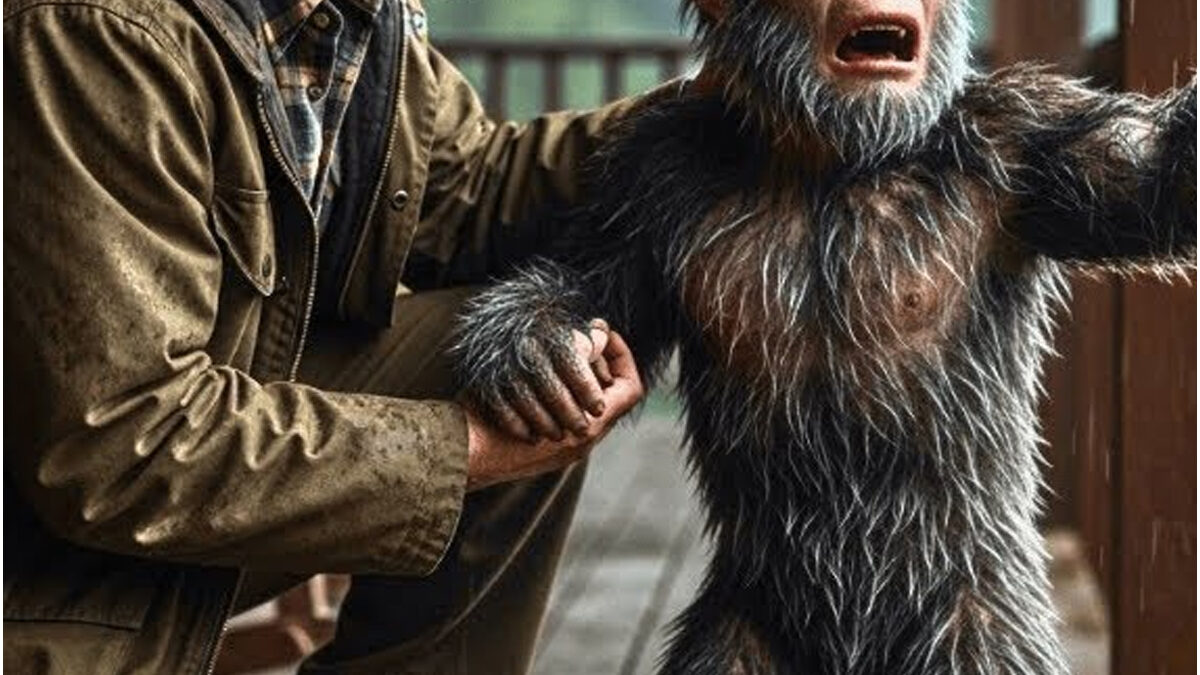
Baby Bigfoot Cries And Begs Old Man To Follow, What Happened Next Was Unthinkable
What would you do if a soaked, trembling creature knocked on your cabin door in the middle of a storm?
Its amber eyes almost human.
Its cries desperate yet gentle.
And it took your hand.

It didn’t come to save itself.
It came for its mother.
A Bigfoot trapped beneath a landslide, crushed by a boulder.
Minutes from death.
I was Henry Vance, a forest ranger who had once lost his family to fire and lost a young life because I was 3 minutes too late.
That night, I swore I wouldn’t be late again.
We fought the rain, the mud, and the fear.
A human and a beast side by side, lifting that stone with nothing but a tree branch and desperate faith.
And when we did it, they didn’t roar.
They didn’t run.
They placed a hand on my chest, warm, gentle, as if to say thank you.
The next morning, the rescue team found nothing but giant footprints and silence.
Only one young ranger had seen them, too, and chose, like me, to keep the secret.
I left Pine Ridge with nothing but a red maple leaf and the understanding that sometimes the most sacred connection isn’t built on fear, but compassion.
So now, wherever you’re watching from, whether it’s a quiet apartment in the city or somewhere deep in the woods, I want to ask, how far can this story travel?
And who might need to hear it today from the deepest forest of Washington to your screen.
Thank you for listening.
A soft cold mist curled around the shuttered eaves of the Pine Ridge fire lookout like breath from the throat of an old foreSt. Rain didn’t fall heavy.
Not yet.
It danced instead in a quiet drizzle against the single dusty window.
The dim yellow glow from the oil lamp flickered over the wooden walls, casting restless shadows that moved with the wind.
Henry Vance sat slouched in a weathered chair, elbows resting on a chipped desk, pen loose between his fingers, his other hand curled around a ceramic mug of cooling coffee, untouched.
Outside, the cascade stretched wide and silent under the weight of October’s breath.
But something felt different tonight.
The air didn’t hum like usual.
It trembled.
Henry was 52, with a face like cracked earth, creased deep around the eyes, jaw rough with a salt and pepper beard that had outlived a barber’s touch for too many seasons.
He wore flannel, faded and soft from years of wear, the same green checkered shirt he’d had when the smoke took his family 10 years back.
Most nights the silence of the ridge was a comfort.
Tonight it pressed too hard on the windows.
Then it came.
Three knocks, gentle, uncertain.
The kind a child might make, not to be heard, but hoping to be found.
Not fists, fingertips, he froze, didn’t breathe.
The radio crackled once and died.
No wind, just that slow creek of the old pine frame reacting to something it hadn’t felt in years.
Henry set the mug down.
It clicked against the wood like a heartbeat too loud.
A second of stillness.
Then he stood.
His joints achd like rusted hinges.
But he moved quiet, stepping toward the door with practiced calm.
Rangers weren’t supposed to open their doors after dark to the unknown.
But rules don’t mean much when the knock sounds like it comes from someone who’s lost more than their way.
He pulled the latch.
The cold came in firSt. sharp and smelling of wet bark and moss.
Then came the thing that stood on the stoop.
It wasn’t tall.
Four feet, maybe less.
Drenched from head to toe, black fur clinging to thin limbs.
It shook like a soaked bird.
Chest heaving with little sounds that weren’t quite sobs, but weren’t anything else either.
Its eyes, those stopped him cold.
Amber, bright as flame behind smoke, wide and human in their sorrow.
The thing didn’t run.
It didn’t growl.
It whimpered.
One step back would have closed the door.
Protocol demanded it.
Call it in.
Log the sighting.
Lock down.
But those eyes, they weren’t wild.
They were desperate and familiar.
Too damn familiar.
Henry had seen that look once years ago through a wall of smoke.
His daughter Jenny staring out from the backseat of their truck as the fire turned the world red.
He’d never reached her.
She’d screamed once, then silence.
Now those same eyes stared up at him from a face not quite animal, not quite human.
The thing raised a hand, trembling, and touched his wriSt. Its fingers were long, skin rough beneath the sparse fur, nails chipped, dirty.
It didn’t pull him.
It only made contact, like checking if he was real.
Then it turned.
It stepped off the stoop into the rain.
Small feet slapping against wet pine needles.
After a few paces, it looked back.
Waiting.
Henry didn’t move.
The wind blew harder, shaking droplets from the eaves.
His radio hissed and went quiet again.
Another memory rose.
Uninvited.
His last rescue op.
Young recruit.
First storm, mountain slide.
Henry had made the call too late.
3 minutes.
That was all it took to lose a life.
That boy died with Henry’s name on his lips, slumped across his back.
Not this time.
He grabbed the old medkit from the hook by the door, slipped on his coat, and stepped out into the dark.
The cold hit like a slap.
The wind came in from the northeast, carrying a scent he didn’t recognize.
Something earthy, musky, like wet bark and decay, but deeper, alive, he followed.
The creature moved fast for its size, but not so fast he couldn’t keep it in view.
It stayed within the flickering range of his oil lantern, just barely, pausing every few dozen yards to make sure he followed.
Its shoulders hunched forward, arms too long for a human child, swinging low at its sides.
The way it moved wasn’t quite animal.
There was awareness in every glance back.
The trail narrowed through furs and hemlocks, moss thick as carpet underfoot.
Rain soaked his boots in minutes, and the mud sucked at every step.
The trail was faint, barely there.
He could make out small tracks where the forest floor had been disturbed.
Tiny toes, then bigger ones, the outlines already blurring from the rain.
Something else had come through earlier, something much larger.
Henry’s breath came louder now, fogging in the cold, and every so often he thought he heard something behind the trees, a faint echo of breath, not his own, low and slow like bellows.
He kept the light low.
The oil was running thin already.
The last refill had been 3 days ago.
The creature paused near a fallen log, turned to look at him, then ducked under.
Henry had to crouch, water dripping from his coat sleeve as he followed.
On the other side, the ground dropped steeply.
They were heading down into one of the narrow hollows, slick with wet leaves and lined with stones.
He braced himself on branches as he descended, boots slipping more than once.
At the bottom, the creature froze.
Henry stopped, heart knocking hard now.
The silence here was absolute.
Then it came, a sound low and guttural, like thunder stuck in a throat, a growl, but not of warning.
Not yet.
It came from ahead, behind a wall of ferns and rock.
The little one whimpered.
A shape moved in the dark.
First just a ripple between trees, then a breath, visible white steam curling into the rain.
Then it stepped forward, massive, easily 8 and 1/2 ft, maybe more, with arms that reached below the knees and shoulders wide enough to block the path.
Its fur was soaked, clinging to a broad chest that rose and fell like a bellows.
Its eyes caught the lantern light, amber again, but deeper, older, and full of something he didn’t expect.
Fear.
No, not fear.
Fury shaped by worry.
Henry didn’t move.
The lantern hung from his hand like dead weight.
The creature’s breath came faster now, nostrils flaring.
It bared no teeth, but it lifted its chin, chest puffing.
The little one rushed toward Henry, grabbed his hand again, tugged, then turned to the larger creature, and let out a high, keening noise, somewhere between a plea and a sob.
The big one didn’t attack, didn’t charge.
It just stood there, a wall of soaked fur and shadow, studying the man who had followed its child into the foreSt. Henry slowly lowered his lantern to the wet earth, letting the light spill upward instead of in the eyes.
Then he knelt, not out of fear, out of respect.
The creature blinked once, then stepped forward.
Each footall silent despite the weight.
Its face came into view, close enough now that the lantern cast flickers across its features.
Not animal, not a mask, a face.
A face shaped like no man’s, but still bearing the marks of thought, of time, of loss.
Heavy brow, flat, wide nose, thin lips barely visible under a beard that faded into the cheSt. And eyes, those same embercoled eyes, locked on him now.
For a breathless second, neither moved.
Then from somewhere behind the big one, another sound rose.
A moan, faint, wet, pained.
The big creature flinched.
It turned its head sharply, listening, then looked back to Henry with a different urgency.
It made no sound, only turned, pushed through the rock wall, and vanished into the gap.
The small one tugged harder at Henry’s sleeve.
No words passed between them.
None needed.
Henry stood, picked up the lantern, and followed.
The rain was heavier now.
The forest held its breath, and Henry Vance, retired rescuer, broken man, keeper of the lonely watch, stepped into the dark behind a creature that had knocked, not with force, but with hope.
It was a hope he wasn’t ready to carry, but he carried it anyway.
Because sometimes the forest doesn’t call with noise.
It calls with silence and waits to see if someone is still listening.
The forest closed in tighter with every step.
Branches dripping from the weight of cold rain.
The path beneath Henry’s boots soft with rot and mud.
The little one moved ahead like a shadow barely tethered to the light, pausing just long enough for Henry to catch up, then darting forward again, as if torn between urgency and fear he might turn back.
The oil lantern in Henry’s grip wobbled, its flame guttering with every gust, casting narrow beams through the thick wet of cascade undergrowth.
Nothing about this made sense.
Not the child’s presence at his door.
Not the sheer silence of the trees now.
Not the memory that kept flashing in his head.
His daughter’s eyes framed in flame.
And how helpless he’d been when it counted moSt. He followed because he couldn’t not.
Because if he stopped, if he turned back, there’d be no saving whatever this was.
His breath was tight in his chest, fogging the glass of the lantern.
The old canvas of his coat hung heavy, soaked through the shoulders.
Pine needles stuck to his boots, and somewhere back behind them, the firewatch tower had vanished into the fog.
There was no trail anymore, just soft ruts in the lom, filled with rain and fading too faSt. He bent low once to see more clearly, squinting into the pooling mud.
Tiny footprints ran beside something bigger, much bigger.
The rain had almost wiped the larger tracks clean, but the shape of one still remained.
Deep, wide, nearly twice the size of his own boot, with toes spread like a bare human foot.
The heel was buried inches down.
Whatever left that mark was no deer, no bear, and it was close.
The child turned again, locking eyes with him in the dim.
Its face was clearer now in the flicker of fire light.
A mix of features that unsettled something primal in Henry’s gut.
Human, but not familiar in some echoing way, and yet impossible to place.
The fur on its face was thin, revealing patches of dark skin beneath, and its mouth trembled, parting just enough to show a row of teeth too small for menace, too uncertain for words.
It wanted something from him.
Not just help, truSt. Henry adjusted the strap of the medkit slung over his shoulder and pressed on.
The air grew colder as the trees thickened.
Soaked needles slick beneath his soles.
The trail, if it ever had been one, wound downhill now, following the natural curve of the land.
The forest groaned above them.
Wind stirred the branches overhead in sudden surges, sending down wet leaves in bursts that slapped his face and stuck to his arMs. It felt like the woods were watching, he thought of protocol.
Of the line in the rers’s handbook that said, “Never leave the station without backup.
Never step into the woods alone during a storm.”
But rules like that were made for situations where things made sense.
And this didn’t.
Something deeper pulled him forward now.
A hum he couldn’t name.
A pressure behind his ribs that said, “This is the moment.
Don’t be late again.”
Somewhere in the distance, thunder rolled low.
More a groan than a crack.
Henry blinked rain from his lashes and pushed through a curtain of vine maples, following the glint of the child’s eyes.
It stopped suddenly, one foot raised midstep, body frozen.
Henry did the same.
The silence was thick and it didn’t feel empty.
It felt loaded.
His ears strained.
That’s when he heard it.
A low pulsing sound just under the pitch of thunder.
Not wind, not storm.
A thrum.
It came again, heavier this time, like a chest vibrating from the inside.
Then a deep exhale, long and weighted, cutting through the stillness like a warning before the blow.
The child dropped low, eyes wide, and let out a sound, short and sharp, almost like a whistle, but choked with fear.
From somewhere to their right, barely 20 yards through the dark, a shape unccurled from the trees.
It was vast, for a heartbeat, it was just outline, shoulders higher than Henry’s head, arms that swung long and heavy with fur matted from the rain.
Then it stepped forward and the lantern caught its chest, dark, slick with water, rising and falling slow and steady.
Steam curled from its mouth with each breath.
The air around it seemed to bend slightly like heat over asphalt, even in the chill.
Henry didn’t move.
He didn’t breathe.
The creature didn’t charge.
It stood still as the trees.
The child whimpered and backed against Henry’s legs, its hand gripping his coat tight enough to wrinkle the canvas.
Henry looked down, then slowly back up.
Meeting the creature’s eyes, Amber, just like the child’s, but older, sharper, no confusion there, no pleading, only a guarded warning.
The two stared at each other across the distance, neither moving.
Henry didn’t lift the lantern any higher, letting the light cast sideways rather than direct.
He knew better than to show dominance, better than to hold eye contact too long.
His heart drumed in his chest like it wanted to bolt ahead of him, but he held steady, knees slightly bent, every instinct screaming caution.
The creature’s nostrils flared.
Its gaze dropped briefly to the child, then back to Henry.
It exhaled once more, and the sound was almost tired.
Then something shifted.
Not in the creature, but in the woods.
A cry, weak, faint, almost a whisper of pain carried on the wind from farther ahead.
The big one’s head snapped toward it.
Its muscles tensed.
Every line of its body pulled tight.
It made a low sound deep in its chest, and without waiting, it turned and moved toward the sound, parting the branches with ease.
The child let go of Henry’s coat and scrambled after it.
Henry stood there for a second longer, soaked to the bone, lantern flickering.
Then he moved too.
The path narrowed into a clif between two outcroppings of stone, slick with moss and shadow.
The earth sloped deeper, funneling them into a hollow, where water pulled in the low ground.
The rain had turned it to sludge, and his boots sank an inch with each step.
The flickering lantern barely touched the walls of rock on either side.
Now ahead, the silhouettes paused.
That’s when Henry saw her down at the base of a shallow incline, half hidden beneath a slanted slab of stone.
The female lay sprawled on her side.
She was massive, nearly as tall as the male.
But something about the way she was positioned made her seem small.
Her left arm was pinned beneath the rock, shoulder twisted at an unnatural angle, her fur was soaked and clumped with mud, her chest rising and falling with shallow breaths.
The rain ran in rivullets over her face, and her eyes half-litted glassy turned to the child as it approached.
Henry dropped to one knee, his hand already reaching into the medkit.
The wound looked bad.
Not open, not bleeding, but the pressure had clearly cut off circulation.
The muscle around the shoulder was swollen.
Skin beneath the fur modeled blue and black.
It had been too long.
Minutes mattered now.
He looked to the big one.
It stood rigid, watching him, ready, but not hostile.
Henry held up both hands, then pointed to the rock, then to his cheSt. He mimed, lifting, then pointed at the creature.
You and me.
The big one didn’t respond at first, just watched.
Then slowly, it stepped closer.
The stone was massive.
No way he could shift it alone, but together maybe.
He grabbed a thick branch nearby, wedged it into a narrow gap under the slab, and leaned in with his shoulder.
Mud slid beneath his boots, but he held firm.
He looked up.
The creature stepped in beside him.
Its hand, larger than a dinner plate, gripped the branch without a word.
Henry felt the warmth of its body closed beside him.
Heat radiating even in the storm.
One breath, then two.
They pushed.
The rock groaned, shifted an inch, then slid back.
Henry grunted, muscles burning, heart hammering again.
They braced, pushed.
This time it moved farther.
The stone slid just enough to free her arm.
It dropped limp in the mud as she let out a weak, pained cry and went still.
Henry nearly collapsed, his shoulder screaming from the strain.
But then, without warning, one massive hand caught him under the elbow, steadying him.
The big one had moved fast, catching him just as he slipped.
Henry’s breath caught in his throat.
For a second, they stayed like that.
Two figures, man and myth, shoulderto-shoulder in the pouring rain, each holding up the other.
Then the big one turned to its mate, knelt down beside her, and brushed the mud from her face.
The child crawled to her side and pressed its forehead to hers, and Henry, breathless and aching, stood in the flicker of the lantern light and watched something sacred unfold.
Something not meant for words, only for witness.
The storm hadn’t eased, but in that hollow, for a moment, it didn’t matter.
Nothing else did.
Because some things aren’t found on maps.
They’re found when you’re willing to follow the sound of a heart that isn’t yours.
And trust that maybe this time you won’t be too late.
The lantern flame fluttered low in Henry’s grip, fighting wind and water as the storm thickened, a quiet war of fire against the cold.
He stood chest deep in tension, shoes sunk in the black soil where rain had turned the forest floor into a slow churning sludge.
The shape that loomed in front of him held its breath just like he did.
The Bigfoot father had returned, towering, soaked, muscles twitching beneath layers of slick fur.
Each breath rising in clouds that caught the dim light.
It had come back the moment it heard her cry.
Now it blocked the path between Henry and the creature he couldn’t stop seeing as a child, a daughter, a soul worth saving.
Henry didn’t move.
The weight of his own breath felt too loud.
The silence around them throbbed, too full, a moment too sharp for any motion.
The child pressed against his hip.
Both small hands gripping the side of Henry’s coat like it was tethered to him, begging him not to back down, but not to step forward either.
It whimpered short and high in the throat.
A sound that wasn’t human, but wasn’t far from it.
The kind of sound that made you want to kneel and shelter something.
The kind of sound Jenny had made the night she skinned her knee and couldn’t find her mother to run to.
He hadn’t thought about that memory in years.
The father’s chest rose and swelled, a slow flex that made his outline feel even larger.
The low growl he let out didn’t rattle the ground.
It passed through it, a warning, not a threat.
It wasn’t fear, Henry felt.
It was all stripped bare and humming under his skin.
The creature wasn’t challenging him.
It was asking a question.
Are you going to hurt us?
Are you going to break the last thing I have?
Henry lowered the lantern slowly.
Without dropping his eyes all the way, he eased his knees, body tilting downward until he stood in a half crouch, legs bent, arms slack, not surrender, not fear, just one message drawn from years in the woods.
I’m not here to fight.
The Bigfoot blinked.
It stepped closer.
Its bare feet didn’t make a sound, but Henry could feel the weight of each step in the earth under him.
The child didn’t retreat.
It looked up at the massive shape, then at Henry, then let go of his coat.
A shudder ran down its narrow frame.
It moved toward the father, but halfway there it turned again, looked back, reached a small hand toward Henry just briefly before retreating behind the towering figure.
It wasn’t ready to let go.
The lantern flickered again, the oil sputtering low.
The rain had eased for the moment, but the air hung heavy, filled with the wet breath of trees and the smell of stone and something deeper, something wild and clean.
The father studied Henry again, this time without posturing.
His arms hung still.
His chest didn’t puff.
The brow lowered slightly, just enough to soften what had seconds ago looked like rage.
And then a sound rose from the rocks behind them.
A moan, wet, weak, barely audible over the wind, but enough to break whatever standstill had formed.
The father jerked his head toward the noise.
His whole body responded like a string had been pulled tight.
He turned, no hesitation.
The child bolted after him, small feet pattering in the mud.
Henry didn’t wait.
He grabbed the lantern and followed, slipping once, catching himself on a root slick with rain.
They cut between boulders now into a crevice that narrowed and bent, half hidden by twisted fur and crumbling stone.
On the other side, the hollow opened wide again, revealing a slope washed out by water, a slick shelf of shale leading into a depression where the female still lay.
From above, her body looked smaller now, sunken, her arm still pinned beneath the slab, her head tilted at an unnatural angle.
The father let out a sharp grunt, a kind of rumble that echoed low through the rocks.
He stepped carefully down to her side, crouched low.
One hand hovering over her ribs as if afraid to press.
The child moved close, touched her forehead with its own.
No response.
Henry approached slowly, sliding the last few feet.
He could see her chest moving, but barely.
Her breath was shallow.
Too shallow.
Blood hadn’t returned to that arm yet.
It had gone long enough without it that shock was setting in.
If she passed out too deep, they might lose her before the stone could be lifted.
They were running out of time.
He glanced at the father.
The creature didn’t stop him, didn’t growl, didn’t bear its teeth.
It stepped back just a little.
Henry set the lantern down and knelt beside the stone.
The edge was jagged, and the weight of it pressed deep into the forest floor, rain pooling at the base.
No good hand holds, no leverage.
But the gap underneath was wider now, enough to slide a branch through.
He scanned the ground, found a fallen limb thick as his forearm, wedged it into the space.
The father moved closer, breathing heavy, watching, Henry pointed.
You hear me here together.
The Bigfoot didn’t nod, didn’t need to.
It understood.
They positioned themselves opposite each other.
Henry bracing his feet in the mud, one hand on the branch, the other on the rock itself.
The father mirrored him.
Massive arms flexing, fingers curling around the stone.
The child backed up, eyes darting between them.
Henry counted in his head.
1 2 3.
They pushed.
The stone didn’t budge.
He felt the pain shoot up his side immediately.
His left shoulder protesting tendons flaring muscles.
Remembering their age again.
They pressed harder.
A crack echoed through the ground as something shifted.
Not the rock.
A root beneath its snapping.
The stone dipped a fraction.
Henry slipped.
Boot sliding in the muck.
The weight of the rock turned inward.
For a second it was coming toward him faSt. A blur of panic.
Then a hand caught him.
Fast, rough, but deliberate.
The Bigfoot father had reached out with one arm, yanked Henry backward before the slab could crush his leg.
The strength of it left Henry gasping.
He landed hard on his hip, shoulder jarring, pain flaring bright in his ribs.
But alive, he blinked up at the figure above him.
The father breathing hard, still between him and the stone, eyes locked on his, and something passed between them.
Not words, not even thoughts, just acknowledgement.
That was the moment Henry knew this wasn’t just a wild thing.
This was someone.
The silence hung thick for a second more.
Then the father turned back to the rock, repositioned, waited.
Henry stood, knees shaky, jaw tight.
He took the branch again, nodded once.
They tried again.
This time the sound was different.
A slow shift.
The scrape of stone against stone.
A groan deep and low.
The slab rose an inch.
Then too, Henry braced.
The father let out a sound that wasn’t a growl, wasn’t a roar, but something primal.
His whole body trembling with the force of it.
Muscles straining, rain dripping down his arMs. The stone tipped, and then it moved.
Not much, but just enough.
The arm slipped free.
The mother let out a whimper.
Her fingers twitched.
Then she passed out cold.
The rock fell to the side with a final crash, sending up a splash of mud and water.
Henry collapsed again, chest heaving, his arms trembled, every breath hurt.
But she was alive.
He scrambled to her side, checking her pulse, lifting her wriSt. Still weak.
But there he grabbed strips of gauze from his medkit, wrapped the limb, massaged the shoulder.
Rain mixed with blood and dirt and something that looked like sap.
The wound wasn’t clean, but it could heal.
And then he felt it.
A hand large, rough, resting gently on his shoulder.
Henry froze.
The Bigfoot father stood behind him, silent.
The hand didn’t push, didn’t pull.
It rested there, heavy, warm.
Then it moved to the center of its own cheSt. Pressed once and held.
Not a salute, not a warning, just a gesture.
Thank you.
Henry didn’t speak.
Couldn’t.
His throat closed tight.
He just nodded.
The child moved beside them, curling against its mother’s side.
And for a few seconds, the forest didn’t feel like a place at all.
It felt like something breathing, waiting, holding its own heart in stillness.
Because sometimes the ones we fear most are the ones who’ve lost the moSt. And in the quiet after the pain, when hands meet, not to strike, but to lift, there’s no more wild left between us.
Just the rain and something older than fear.
Still listening, still watching, still waiting to see if we understand.
The wind had softened, but the rain kept whispering, drizzling through branches overhead, landing on moss and stone in a rhythm too quiet to call sound.
It was a breath more than a storm now, slow and cold and steady.
Down in the hollow, the silence pressed thicker than fog.
Henry knelt beside her.
This giant mother, this myth that bled real pain, watching the rain trace lines through the dark fur matted across her arm.
The fingers on that limb had begun to twitch faintly.
The circulation was returning, but barely.
She hadn’t woken.
The Bigfoot father stood close, not looming now, just there, like a boulder shaped by centuries of wind.
His hands hung loose, but alert.
His eyes never left Henry.
They didn’t burn.
They watched.
The weight of them wasn’t threat anymore.
It was something older, something closer to calculation.
Trust and hesitation nodded together in amber.
The child hovered behind its father’s leg, peeking out with those wide, wet eyes, breath puffing soft as a sleeping birds.
It looked like it didn’t know where to stand.
With her, with him, with Henry.
So it stayed in between, always glancing both ways.
Henry shifted.
His knee cracked against a stone, sharp and cold.
But he didn’t flinch.
He reached carefully for the bag, unzipped it slow to avoid the scrape of nylon.
He’d packed the basics: gauze, antiseptic, splints, pain meds if they had mouths that could take them.
But he wasn’t sure what counted here.
This wasn’t a human shoulder.
But it wasn’t fully something else either.
The joint was close enough.
The bruising looked right.
He touched the muscle gently.
Still tight.
The skin beneath the fur had darkened to a deep wine colored swelling.
It had to be addressed soon or risk turning septic.
He reached for a branch.
Long, straight, wet, but not rotted.
He tested the bend.
Just enough give.
It would do.
The father watched every movement, every flick of Henry’s fingers, every motion of his wrists.
When Henry lifted the branch to the wound, the father tensed slightly, just a pulse through his shoulders.
But he didn’t step in.
Henry broke his silence.
I need your help.
His voice came out, almost drowned by the hush of the rain.
He doubted they understood the words, but maybe tone mattered more.
He pointed to the stone, then the limb, then to himself, then to the father, then together.
His hands made the shape of lifting, pushing, bracing.
The father tilted his head.
Not much, just enough.
Then he moved.
Not fast, not slow.
Deliberate, he stepped beside Henry and placed one enormous hand flat against the slab again.
The other gripped the base of the stone’s edge.
Henry braced his foot.
Then together they lifted, just a little.
The rock didn’t move much.
It didn’t have to, just enough to shift weight to ease the pressure.
Henry slid the branch between the ground and the injured arm, working it underneath carefully, adjusting by feel.
The mother groaned low, like a sound pulled from the bottom of a well.
Her eyes fluttered open.
Not fully, just enough for the whites to flash beneath lids.
Her mouth opened, teeth gritting around a wet gasp.
She didn’t scream.
It was worse than that.
The sound was too tired to fight.
The father let out a guttural hum.
Not panic, not alarm, just a presence, a call, a sound that said, “I’m here.”
And she stopped trying to rise.
Henry leaned in, reached under the arm, and started to work the limb loose.
The skin was cold, the muscles slack.
It moved like it didn’t remember itself.
The branch helped raise the arm slightly.
He massaged gently from shoulder to elbow, trying to coax the blood back.
She winced once, but didn’t resiSt. The child crept closer now, inch by inch, like a leaf moving in a hesitant breeze.
It stopped beside Henry, just outside his reach, and looked down at the mother’s face.
She turned her head slowly toward it.
Their foreheads touched just briefly.
Then she closed her eyes again.
Henry tied the branch loosely to support the limb, not as a splint, but a brace, temporary, enough to keep the blood flowing.
He wrapped the arm in strips of fabric torn from his own shirt.
He didn’t know how they’d interpret it, but he had no other choice.
When he finished, he sat back, breathing hard, soaked to the bone.
His breath fogged the air in front of him.
His ribs achd from the lift.
His fingers shook, not from cold, but from something deeper, that quiet line between adrenaline and reverence.
The father stepped around him now, moved closer to his mate.
He knelt beside her and placed his palm gently against her face.
His fingers dwarfed her skull, but his touch was impossibly gentle.
He brushed rainwater away from her eyes, leaned down, and rested his forehead against hers for a long, still moment.
Henry looked away.
Some things weren’t for him to witness.
He turned toward the trees instead, letting the rain hit his face, wash the sweat and dirt from his jaw.
The lantern still burned behind them, but weak, flickering.
The oil wouldn’t last much longer.
He had maybe an hour of light before it was just them in the dark.
And he didn’t know how to get back.
Not in this light.
Not in this foreSt. Not after what had happened.
He could try, but leaving didn’t feel right.
Not yet.
He glanced back and saw the child watching him.
It tilted its head, same as the father had.
Then slowly it took one step toward him.
Its hand reached out, hesitant, not afraid.
Not anymore.
It touched his knee, just once, then pulled back.
That was all.
But Henry felt something break loose in his cheSt. Something old, rusted, heavy.
He reached out, too.
Not to grab, just to be near.
And for a second they sat like that.
Not man and creature, just two beings, both a little lost, both holding something they didn’t know how to say.
The storm had quieted to a miSt. The clouds thinned just enough to let moonlight smear faintly across the treetops.
The branches above swayed with less force now, just a rustle.
The breath of a forest easing its grip.
The mother stirred.
She opened her eyes again, this time wider.
She saw him.
Henry didn’t move, didn’t blink.
He just waited.
Her gaze lingered, flicked to the bandage, to his hands, then to her mate, then to the child.
She didn’t speak, but her hand moved just slightly toward him, then back to her cheSt. Just one touch, one rhythm, like a heartbeat.
Henry nodded once.
No words.
No need.
The father turned to him, stepped forward again, and this time when he reached out and placed a hand on Henry’s shoulder, he didn’t pull away.
He left it there, warm, solid, a gesture not of protection, not of possession, of gratitude, of something closer to bond.
The hand lifted, then moved to his own chest, pressed once, firm.
Henry mirrored it.
Didn’t know why.
Did it anyway.
Then the hand withdrew.
The forest breathed in again, the light flickered behind them.
The mother sighed once and slipped into sleep, her chest rising softer now, not shallow.
The child curled beside her.
The father stepped back to sit near the lantern, watching it burn.
And Henry sat where he was, the mud soaking into his jeans, the cold no longer a bite, just a hum.
There was nothing left to do tonight.
No trail to chase, no call to answer, just the rain, just the breathing, just the quiet rhythm of something ancient returning to stillness.
And somewhere deep inside him, the part of Henry that had stayed frozen since that fire 10 years ago, moved a fraction, a hairline crack in the ice.
He didn’t smile, but he didn’t ache quite the same.
Not right then.
Not with the forest holding them.
Not with that hand still warm on his shoulder.
The flame bent once more, almost gone.
But the dark didn’t feel like danger anymore.
It felt like night.
And night, Henry realized, was a kind of mercy, too.
The rain hadn’t stopped, but it changed.
Less of a downpour now, more like a steady whisper across the stones and pine needles, tapping lightly on the leaves overhead like it was trying not to wake the woods.
Dawn was still a long way off.
The world was gray with exhaustion.
Henry’s clothes clung heavy to his back, the left shoulder of his flannel screaming every time he shifted his weight.
Something inside had slipped wrong.
He could feel it grinding when he breathed deep.
But he stayed quiet.
Pain was background noise out here.
It had been for years.
He stood beside the Bigfoot father again.
Both of them kneedeep in mud, bracing their feet against the shifting ground, shoulders hunched under the weight of that same stone they’d moved once before.
Only this time, they weren’t trying to save her.
Now they had to lift it clear, fully, get it away from the body, away from the child, away from the place she almost died.
Henry tightened his grip on the makeshift lever.
A thick tree limb they jammed under one edge.
His palms burned with splinters.
His left arm barely worked, shaking each time he tried to raise it higher than his cheSt. The father waited for his signal, watching him, not the stone.
Rain dripped from his jaw, the fur on his arm sllicked back, veins bulging under the skin.
There was a tension in him now that hadn’t been there before.
Not fear, not rage, something more urgent, something closer to resolve.
They nodded and pushed.
The ground gave first, slippery beneath their weight.
Henry’s boots slid.
The branch twisted.
The stone jerked up half an inch, then slammed back down, jarring his spine like a jolt of lightning.
He cried out without meaning to.
Just a sharp sound from the gut.
The pain behind his shoulder blade lit up white hot.
His vision blurred for a second.
He didn’t fall, but he almost did.
And then something grabbed him faSt. A massive fur-covered arm swung around his back.
Not rough, not panicked, just steady.
The Bigfoot had caught him, held him there.
Henry didn’t breathe for a second.
The pain pulsed down his side like a drum beat, but he let it wash through.
He stood still, letting the rain cool his face, the hand still holding him like a brace between collapse and grit.
Then the pressure eased.
The father stepped back, released him.
Henry staggered once, then straightened.
He turned his head slowly, met those amber eyes through the rain.
The creature didn’t look away.
Neither did Henry.
They didn’t speak.
Couldn’t, but both knew the other would try again.
He repositioned his hands, took one deep breath, then one, two, three.
They pushed.
This time, the branch didn’t snap.
It groaned.
The stone shifted slowly, grinding over wet earth and brittle roots.
Mud sucked at their feet, the rain making everything twice as slick, but the weight lifted.
Not far, not fast, but enough.
Henry leaned his full body into it, gasping with the effort.
The muscles in his side screamed, his shoulder throbbed so bad it made his vision pulse, but he didn’t stop.
The father let out a sound.
Not a roar, not a shout, just a low, guttural cry that trembled in Henry’s ribs.
It wasn’t angry.
It wasn’t wild.
It was the kind of sound a man makes when he’s carrying too much for too long and finally lets it go.
The stone toppled sideways, slamming into the wet ground with a splash and a thud.
And then everything was still.
The clearing was quiet, save for the rain ticking down around them.
Henry let the branch drop and stumbled back two steps before he sank to one knee, clutching his side, sucking air through clenched teeth.
Across from him, the Bigfoot exhaled hard, and stepped away from the fallen stone.
He turned his eyes to Henry and then to the mother, who lay still against the mud, her arm finally free, her breathing slow but steady.
Henry dragged himself closer.
He peeled the wet fabric from her shoulder, checked the color of the skin.
Less purple now, less stiff.
The blood was moving again.
He didn’t smile, but something inside him relaxed just slightly, like a cord had uncoiled inside his cheSt. He was wiping mud from her wrist when he felt it again.
That presence behind him.
The father had moved closer, not towering, not posturing, just standing near.
A large hand extended, not toward the stone.
Toward Henry, he froze, looked up.
The hand hovered, palm open, rainwater trailing from the fingers, the pads thick and calloused, fur clinging to muscle.
No thread in it, no demand, just a gesture.
Henry stared for a second, then reached up with his right hand, the one that still worked.
And placed it lightly against the other’s palm.
Their hands touched, not gripped, just pressed together, still in the space between pain and understanding.
Then the creature pulled its hand back, and placed it on its chest again.
One beat, Henry mirrored it without thinking, and that was enough.
The father turned, crouched beside his mate again, eyes scanning her face, brushing back the soaked hair that clung to her skin.
The child crept closer.
It sat beside her, quiet now, eyes following every breath, every twitch.
Henry backed away, one arm wrapped tight across his ribs.
He found a dry patch beneath an overhang and sat down hard, mud squatchching under his jeans.
His body trembled, not from fear or pain, but something looser, a kind of release.
The rain still hadn’t stopped, but it had changed again.
Lighter now, gentler, like the forest had decided they’d passed some unspoken teSt. He leaned back against the stone wall and let his eyes drift closed for just a second.
When he opened them again, the child was standing beside him, holding something, a vine, braided, rough, made of something like rivergrass, twisted in a pattern too deliberate to be chance.
At the end of it, a single smooth stone, flat, dark, round like a coin, was tied in place.
The child held it out.
Henry blinked, then reached up and took it.
It wasn’t a toy.
It wasn’t random.
It felt old in his hand.
He looked at the child.
Its eyes were unreadable, not afraid, not sad, just watching.
Then it turned and went back to its mother.
Henry stared at the token.
Rain ran over his fingers down the carved edges of the stone.
He didn’t know what it meant, but he knew what it felt like.
A thank you, a sign, a weight shared.
His chest tightened again, this time from something softer.
Grief, memory, grace.
He closed his hand around the token and held it there.
The Bigfoot family huddled together across the hollow, their bodies curled into each other in quiet.
And Henry sat nearby, wrapped in silence, the air around them thick with breath and earth and something deeper, something sacred.
The forest didn’t move.
The trees didn’t whisper.
Even the rain seemed to hold still.
And in that hush, Henry realized he wasn’t on the outside anymore.
Not fully.
Not tonight.
He’d been led in.
Not with words.
Not with rules, but with weight, with mercy, and with the press of a giant hand against his broken shoulder.
The rain had slowed to a whisper by the time they moved.
Not stopped, just softened into something the forest could breathe with again.
It dripped from high branches like fingers tapping gently on the tin, and everything below shimmerred in the wet hush of early dawn.
Light hadn’t broken yet.
Not really, but the dark no longer pressed in like a threat.
It receded quietly, giving shape back to the trees, the rocks, the damp walls of the hollow where the stone had fallen.
Henry stood with one arm crossed tight over his ribs.
Every step sending a dull throbb through his shoulder and spine.
The brace of pain grounded him more than it slowed him.
He kept close to the Bigfoot father, who now carried the mother in both arMs. Her body curled against his chest as if she weighed nothing.
She was breathing better, slower.
The arm once trapped beneath the slab, rested across her stomach.
Fur darker near the wound, but no longer tight with bruising.
The child walked behind them, holding close to Henry’s side like a ghost that didn’t want to let go.
They were headed uphill now, away from the place of stone and earth and blood.
Not rushed, just steady.
Like a tide drawing back from something too full.
The father moved with quiet strength, his steps sure.
Each foot falls silent on the soaked ground.
He knew the way.
That much was clear.
He glanced back only once when the trail grew narrow and the earth sloped toward a ridge of mosscovered rock.
Henry met his gaze without a word.
No signal passed between them, but something invisible shifted.
The father slowed just enough for Henry to catch up, letting him walk beside them again.
The trail turned and the forest opened a little.
A higher ledge, ringed by stones and low trees bent in the direction of the wind.
They came to a kind of overhang, a natural shelter formed by a wall of bassalt and the sweep of branches arching overhead.
The rock above jutted like a roof, keeping most of the rain from falling directly inside.
Dry leaves littered the floor, tucked in corners, blown here over time.
A nest, maybe a home, in the language of those who don’t build with nails.
The father stepped inside first, crouched low.
He lay her down carefully on a bed of moss and bark that had been shaped into something more intentional than random, not soft, but layered, thoughtful.
The child moved to her side instantly, curling up with its back pressed to hers.
The father stepped back, his chest still rising deep, eyes flicking across the stone, the brush, the corners.
Checking, listening, Henry entered slowly.
The space felt too quiet to fill with movement.
He dropped to his knees near the opening, head bowed slightly.
The smell of the place was earthy and rich.
Wet soil, pine resin, old fur.
It didn’t feel foreign.
It felt lived in.
Then his legs gave.
Not all at once, but enough to make him sit harder than intended.
He leaned against the stone wall, breath short, the cold finally reaching through the layers of flannel and skin.
His arm hung limp across his lap.
His shirt stuck to him, torn at the elbow, stre with mud and something darker.
He wasn’t sure when he’d stopped shivering.
That worried him more than the bruises.
He wasn’t sure how long he sat there, listening to the rhythm of their breathing.
The child had gone quiet.
The father sat cross-legged near the mother, his hands resting on his knees, eyes half closed.
He didn’t sleep, but he didn’t watch Henry either.
Not now.
They were both just there, sharing the same air, the same silence.
Then Henry felt something near his chest, a warmth.
Not pressure, not weight, a hand massive, open, placed gently on the center of his sternum.
He looked up.
The Bigfoot father knelt in front of him, studying his face.
Not with curiosity, but with something gentler, a kind of gravity.
The hand didn’t press, just rested there, fingers spled wide.
Heat radiated from the palm, even through the damp fabric.
Then the creature moved slightly, tilting its head, eyes narrowing, not in warning, but focus.
It was listening to something inside him.
Henry’s breath caught.
He didn’t speak.
Couldn’t.
The ache in his chest swelled.
Not pain.
Something else.
The stillness of it made his eyes burn.
The hand lifted.
The father shifted, reached for something beside the bed of moss.
A strip of bark tied with coarse fiber.
He lifted it slowly, unwrapped it, and revealed a small leaf curled at the edges, but red as flame.
A maple leaf, perfectly shaped, delicate despite the weather.
He reached again, this time toward Henry’s wriSt. Henry didn’t stop him.
The father placed the leaf gently over the gauze wrapped around his arm, pressing it down as if it belonged there, as if it had always belonged there.
Then he pulled back and sat in silence.
The gesture wasn’t a gift.
It wasn’t a ritual Henry could explain, but it struck him so deeply he had to close his eyes.
He felt the weight of that leaf more than the bandage, more than the shoulder, more than the years between who he’d been and who he was trying to become.
He didn’t realize he drifted until something rustled beside him.
He opened his eyes.
The child sat near now, holding the lantern, his old oil lamp, still burning, dim, flickering.
The last threads of flame fighting against the wick.
Someone had relit it.
Someone had set it beside him.
Its glow painted the stone in soft gold, a flicker of warmth against the cold gray of the world outside.
Henry stared at the lamp, then at the child.
The creature held it like a treasure, arms wrapped tight around the base, shielding it from the wind.
Henry reached out slow.
The child handed it over.
No words, no need.
The flame wobbled once, steadied, he set it on the ground between them, and for a moment they all sat around it, man, myth, memory, bathed in the same light, bound by the same silence.
Outside, the forest was shifting again.
Wind rustled through the trees, but it no longer sounded harsh.
It sounded like breath, like the world was holding them in its cheSt. Just for a little while longer, they didn’t speak.
They didn’t move.
And when Henry finally laid his head back against the stone, eyes fluttering shut, the pain softened under the hum of exhaustion, he didn’t dream, but he felt a shape near him.
Warmth, something watching over him in the dark, and the last thing he remembered before sleep took him was the sound of breathing.
Not his own, not alone.
Together, as if the forest itself had drawn them in, and decided for tonight they would all be allowed to reSt. Morning came in pieces.
First, as silver mist clinging to the canopy, then as a hush rolling through the trees, quieting even the crows.
Light hadn’t fully cracked the ridge yet, but it crept forward one pine at a time, pale and trembling, touching wet bark and fern tips and the lowslung opening of the stone shelter where Henry Vance stirred awake for the first time in what felt like a decade.
He didn’t remember falling asleep.
One moment he’d been listening to breath, his own, the child’s the forests, and the next it was dawn.
The pain in his side hadn’t vanished, but it had settled into something dull and deep.
The kind that keeps a man moving, but reminds him he isn’t made of steel.
He blinked slowly, unsure whether the warmth on his cheek was sunlight or fever.
Then he saw the lantern, still burning.
It sat just inches away, its glow, now pale in the growing light, wicked down to a whisper.
And beside it, the child curled around it like a cat, arms wrapped tight, forehead resting on its knees.
The braided vine was still tied around its wrist, and the little stone charm clinkedked softly against the glass when it shifted.
It looked up when it heard him breathe, eyes wide and alert like it had been waiting.
Henry didn’t speak.
He sat up slow, the muscles in his neck pulling tight as he turned to look past the opening.
The mother still slept, curled near the back wall.
The father crouched beside her, motionless, face calm, but watchful.
He looked older in daylight, more worn than wild.
His fur glistened in the morning damp, sllicked down by a night of cold and rain.
His gaze moved from the woman to Henry without tension, just acknowledgment.
Henry nodded once.
Something in the air had shifted.
There was peace here, but not permanence.
The father stood without ceremony, without sound.
He rose to his full height and turned toward the woods.
His head tilted.
He was listening.
Henry followed his gaze far off, barely audible.
A sound, not thunder, not wind.
A distant hum, thin, metallic, rhythmic.
Henry’s pulse jumped.
Rescue.
He crawled to the edge of the shelter and looked out.
The slope dipped toward a clearing rimmed with red stemmed huckleberry and alder scrub.
Between the trees, a flicker of orange, a jacket, a glint of glass, then the shape of a human head bobbing along behind a pair of raised binoculars, a radio clipped to the shoulder, crackled faintly.
Ruthie Hail, young, fast-talking, sharpeyed, one of the new seasonal hires.
She was good, better than the brass gave her credit for, and she was walking straight toward the clearing, mouth slightly open, probably tracking his last known direction.
Henry’s heart seized.
He scrambled to his feet.
The father hadn’t moved.
He stood still in the doorway, eyes on the edge of the trees, not tense, but alert.
Henry looked from him to the mother, then to the child still curled around the lamp.
He held up both hands.
Wait here.
He pointed to the shelter, to the stone, to the child, then to himself.
I’ll go, just me.
He didn’t know if they understood, but the father nodded.
It was small, barely more than a blink, but it was enough.
Henry stepped outside.
The forest was soaked and quiet.
His boots sunk into soft moss and leaves, water clinging to the hem of his jeans.
He limped slightly, ribs still tight, shoulder stiff, but he moved faSt. He met Ruthie at the edge of the clearing.
She startled when she saw him.
“Jesus, Henry,” her voice was a whisper and a gasp all at once.
She reached for him instinctively, eyes flicking over the mud, the soaked clothes, the bruises blooming under his collar.
“We thought you were dead.
Your last check-in was 12 hours ago.
I’m okay,” he said.
His voice was rough, like it had forgotten how to speak.
“I slipped during the storm.
Got stuck low in a ravine.”
She stared at him.
“You slipped?”
“Bad shoulder.”
“Took me a while to get out, but I’m good.”
Her eyes narrowed slightly.
“Where’s your gear?”
He hesitated.
“Dropped it in the water.
Lost the radio.”
She looked past him toward the trees.
“There’s smoke up that ridge.
Somebody’s fire.”
No, he said quickly.
Rocklide might have turned something over.
It’s nothing.
Already settled.
She studied him again, slower this time, then nodded.
Henry knew she didn’t buy it.
Not fully, but she didn’t press.
She tilted her head.
You want evac?
Henry looked over his shoulder toward the ridge.
Toward the shelter tucked behind the rocks, half hidden in shadow.
No, he said.
I’ll walk it.
Sure.
Yeah.
I just need a minute.
You go on.
Let Bass know I’m okay.
She hesitated, then gave a short nod.
All right, I’ll loop back.
She stepped away, quiet on her feet, her orange jacket disappearing into the trees.
Henry waited until her footsteps faded, then turned back.
The father was gone from the doorway, but the child was still there watching.
Henry walked back into the clearing, slower this time.
The father stepped out from behind a tree as he approached.
No sound, no warning, just there, eyes locked on Henry, still waiting, Henry stopped a few paces away.
He opened his mouth, but nothing came.
He didn’t know what to say.
Didn’t know how to say it.
So, he did the only thing that felt honeSt. He stepped forward and placed his hand on his own chest one beat, held it there, then extended that hand open, palm up.
The father looked at it, then reached out, pressed his palm against Henry’s one last time, then let go.
Henry nodded, turned, walked.
He didn’t look back right away.
He didn’t have to, but when he reached the edge of the treeine, something pulled at him.
A thread, a breath.
He turned and there they were, the mother sitting upright now, her arms supported by moss, her eyes clear and deep, the child beside her, holding the lantern and the father watching, not as a warning, but as a farewell.
Henry raised one hand, and for the first time in 10 years, he smiled just a little.
The kind of smile that doesn’t need teeth, just heart.
Then he stepped into the trees and the light behind him flickered, then faded like a story that had finally found its breath, but hadn’t yet told its end.
One week later, the forest looked different.
Not because it had changed, but because Henry had.
The ridge line still curved the same, and the pine still whispered with wind like they always did.
But something in the weight of the silence had shifted.
It no longer pressed on him.
It opened like a door that had always been there, just waiting for the right moment to let someone pass through.
He stood at the threshold of the ranger station with a box tucked under one arm.
The same box he’d packed twice before, but never had the nerve to carry out.
This time there was no hesitation.
He’d filled it that morning carefully, silently, with the only things he still cared to keep.
The rest he left behind.
Maps, radios, manuals, logs, gone.
The only things that made it into the box were the lantern, still flecked with dried mud, and the red maple leaf, pressed flat inside a folded bandage.
His resignation letter was already signed and sealed.
He’d slid it under the door of the district supervisor’s office without fanfare.
He knew what they’d say.
He also knew he didn’t care.
Outside, the sky was clear, but the air still held the cold breath of late October.
Pine needles blanketed the gravel in front of the station, and the mist hadn’t fully lifted from the lower hills.
The valley stretched quiet beneath him, as if the land itself was waiting for what came next.
He stepped down from the porch and walked toward the overlook.
There was a rocky ledge behind the cabin, where the slope dropped fast into a deep fold of foreSt. You couldn’t see the bottom, not fully, just layers of green rising into shadow.
It was the last place he’d stood with Jenny before the fire took her.
The last place they’d shared something without needing words.
He reached the edge and set the box down at his feet.
The scarf he pulled from his coat pocket was wool, handk knit, faded with time, gray and teal, with one thread at the corner that had always unraveled.
His wife had worn it the fall Jenny was born.
She’d left it in the truck during their last drive up here.
It had sat in the glove compartment until the fire came, and somehow, by some stubborn twist of luck, it had survived.
He unfolded it now and held it in both hands.
Then he stepped forward slowly and tied it to a broken pine branch that jutted out toward the valley.
The wind caught it gently, made it flutter once.
Not a flag, not a goodbye, just a touch, a thank you, he didn’t speak.
He stood there with the wind on his face and the echo of old breath in his lungs, and then something moved at the edge of the trees.
He turned far below, across the first stretch of slope, half shrouded in mist and light.
A shape stood still among the trees.
Tall, broad, not a silhouette, not a shadow.
Real fur damp from morning fog, shoulders rising and falling slowly, and a face just clear enough to see what mattered.
The same wild man face, humanlike, weathered, lined with amber eyes that caught the sun like glass.
They didn’t wave, they didn’t speak, they only looked.
And Henry looked back.
His hand moved to his chest, pressed once, held it.
The shape did the same, then turned and vanished into the trees.
Henry didn’t chase it, didn’t call.
He stood still until the wind quieted again, until the forest settled around him like a blanket laid gently across old bones.
He picked up the box and turned back toward the station.
Ruthie was waiting by the gate.
She didn’t say anything at first, just looked at him.
Then at the scarf dancing on the ridge behind him.
You sure?
She asked.
He nodded.
She opened the gate.
They walked down together, boots crunching soft on the gravel.
At the edge of the trail head, she paused.
I’m not going to ask, she said.
I know, Henry replied.
She smiled, then handed him a folded piece of paper.
Drew this from memory.
That night you came back.
Something about your face.
Like you saw something that changed you.
He unfolded it slowly.
It was a sketch, rough, pencil smudged, but true.
A face, not human, not beast, drawn with the kind of care that only comes from someone who wanted to understand it.
Broad brow, deep set eyes, the same quiet behind them that Henry had seen, the same hurt, the same grace.
He held it like something sacred, then slipped it inside his coat pocket.
They parted at the fork.
Her back toward the station.
Him down the path that curved toward the foothills.
The road ahead didn’t promise much.
No markers, no destination, but he didn’t need one.
Somewhere in the woods, a child with wide amber eyes still remembered the way he reached out firSt. A mother still healed beneath stone and moss, a father still stood watch in the shadow of cedar and wind.
And somewhere deeper still, the forest itself remembered.
It always did.
It remembered every kindness that was offered without expectation, every silence held with care, every breath shared by two souls who didn’t speak the same tongue, but still chose not to run.
Henry walked until the sound of gravel faded beneath his boots, and only leaves crunched underfoot.
He walked until the sun rose high enough to warm the back of his neck and dry the cuffs of his sleeves.
And when he passed under a bent pine near a clearing he didn’t recognize, he stopped.
Something was tied to the lowest branch, a strip of bark braided with rivergrass, and in the middle of it, a smooth dark stone polished by hand and rain.
He reached out, touched it, and didn’t take it.
Just left it swinging gently in the morning breeze, the way you leave a note behind for someone who knows how to read between the lines.
There was no need to carry it.
He already had everything he needed pressed to his chest, tucked in his coat, etched somewhere deep in the marrow of his ribs.
Because what happened that night when the storm broke and the child knocked and the forest asked if he still remembered how to listen wasn’t something you told.
It was something you kept and he would always.
Because kindness doesn’t need a language.
It just needs someone brave enough to listen.
There are stories that speak with words and others that speak with silence.
Some echo loud with action, while others settle quietly into the corners of your heart, unfolding long after the last line is told.
What you’ve just heard is not a tale of monsters or myths.
It’s a reminder that even in a world full of fear, misunderstanding, and distance, there are still moments where we choose compassion instead of control.
Still places where the human instinct to help outweighs the instinct to hide.
This story reminds us that there is a kind of language that doesn’t require speaking.
It lives in the small things, in a hand extended, a glance held just long enough, a breath shared when no one else is watching.
It lives in the decision to stop running, to listen instead of judge, to see instead of turn away.
And sometimes the bravest thing we can do isn’t to fight what we don’t understand, but to stand beside it quietly and choose to care anyway.
Maybe that’s the oldest truth there is.
That empathy is not something earned, but something given freely, especially when it’s hardest to give.
Maybe kindness isn’t a weakness or a risk.
Maybe it’s a kind of remembering, a way of saying, “I see you and I’m still here.”
In a world that often moves too fast, that asks us to shout louder, push harder, or look away when something doesn’t make sense, this story is a small act of resistance, a whisper against the noise, a reminder that sometimes the most powerful gesture isn’t a grand act, but a quiet decision made in the dark with no one watching.
And perhaps the woods in all their silence and shadow still hold space for those choices.
Perhaps they remember those who didn’t turn away.
And perhaps we in our own way can too.
Thank you for walking this journey with us, for allowing yourself to feel, to imagine, to remember.
If this story touched something in you, share your thoughts in the comments.
Tell us what it made you feel or what it made you remember.
If you believe there’s still room in the world for stories like this, stories told with reverence, with heart, with hope, consider subscribing to this channel.
Follow along.
Be part of the conversation.
And above all, keep listening because kindness even now still echoes.








