She Stood By Television’s Most Powerful Man for 30 Years. He Wasn’t There: Babe Paley
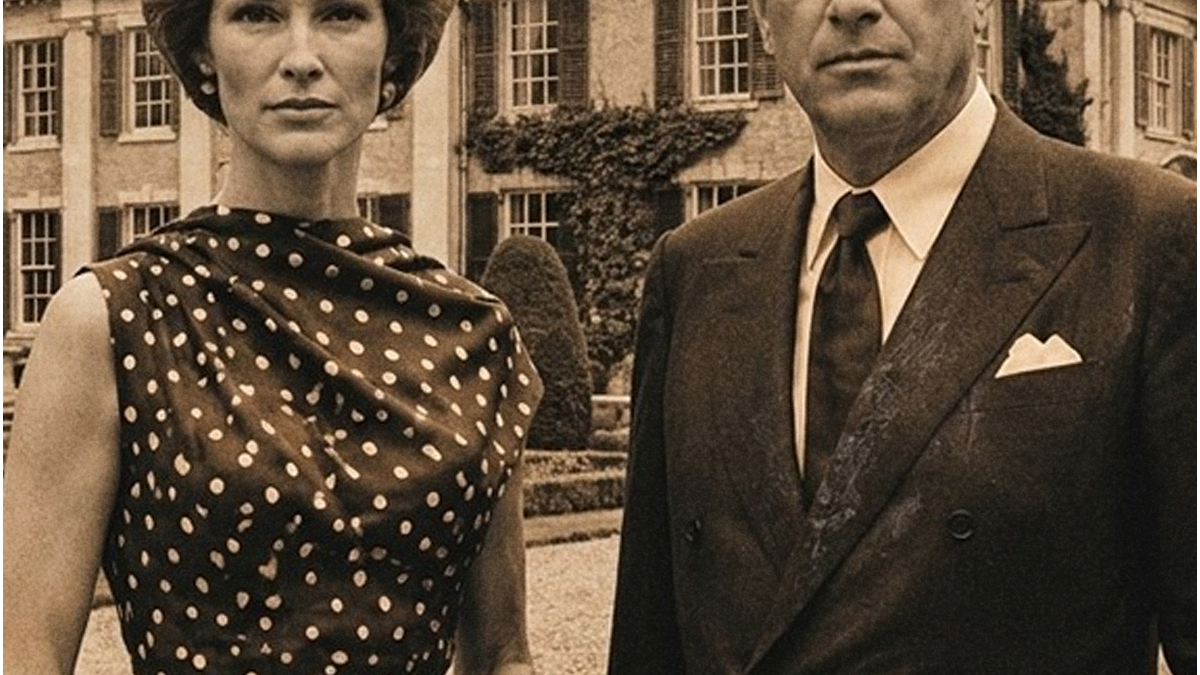
She Stood By Television’s Most Powerful Man for 30 Years. He Wasn’t There: Babe Paley
On the morning of July 6th, 1978, a woman died alone in her New York City apartment one day after her 63rd birthday.
She had spent the previous weeks carefully wrapping her jewelry in tissue paper, writing instructions on each parcel in her precise hand, detailing which piece should go to which person, and in what order.
She had planned the lunch on menu for after the funeral.
She had chosen the wines.
She had done everything that was required of her right up until the end with the composure of a woman who had been performing composure her entire life.

Her name was Barbara Kushing Paley.
The world knew her as Babe.
And for 31 years, she had been the wife of the most powerful man in American broadcasting, the founder of CBS, the man who had built a small radio operation into one of the defining media institutions of the 20th century.
She had stood beside him at every dinner, every opening night, every transatlantic crossing.
She had hosted the parties where the country’s most powerful people decided what the country would believe.
She had worn with a quietness that made it look inevitable the life he required of her.
He was not at her side when she died.
This is the story of Babe Paley, the woman Truman Capote once described as having only a single floor.
The floor was perfection.
The thing he did not say and perhaps did not see until too late was what perfection of that kind costs the person who performs it every day.
Welcome.
She was born Barbara Kushing on July 5th, 1915 in Boston, Massachusetts, the youngest of three daughters, and in the reckoning of that particular social world, perhaps the most fortunate.
Her father was Dr. Harvey Kushing, one of the preeminent neurosurgeons of his generation, a professor at Harvard, Yale, and John’s Hopkins, and a Pulit surprise winner.
He was brilliant exacting and largely absent in the way that brilliant men of that era often were.
Her mother, Katherine Stone Croll Kushing, was a woman of fierce social ambition, who understood, with the clarity of someone who had studied the landscape very carefully, that her daughters were her most valuable capital.
The family lived in Brookline, Massachusetts, in a house that was comfortable but not lavish, the respectability of academic medicine rather than the ease of inherited wealth.
What the Cushings had was name, bearing, and a mother who ran the household as a kind of finishing school for greatness.
Barbara attended the Windsor School in Boston and later the Westover School in Middbury, Connecticut.
She was tall, long limbmed, and possessed of a stillness that people would spend decades describing in terms of statues and porcelain and other things that are beautiful and do not move.
The sisters married first and they married well.
Minnie, the eldest, married Vincent Aster.
Betsy, the middle one, married James Roosevelt, the son of the president of the United States.
In New York’s Cafe Society, the three of them were known collectively as the fabulous Cushing Sisters, a designation that was less a compliment than a description of a strategy.
They had been trained not unkindly but thoroughly to understand that the right marriage was not a romantic decision.
It was a professional one.
It was in fact the only profession available to a woman of their class and time.
Barbara debuted in Boston in October of 1934 at a party where several of Roosevelt’s sons were present.
And in the photographs from that evening, she already has the quality she would carry for the rest of her life.
A kind of composed radiance, a face that offers everything and reveals nothing.
She was 19 years old.
She would not remain Barbara much longer.
Somewhere in those early years, the nickname attached itself, as nicknames sometimes do, without ceremony or permission.
Babe.
It was a dimminionative that flattered and diminished in equal measure.
The world would not let her be anything more formal.
In 1938, she took a position as a fashion editor at Vogue, a role she held for nearly a decade, and one that gave her for the first time something that was genuinely hers.
She had an eye, not merely for beauty, but for the small subversions within beauty, the unexpected detail that transforms a correct outfit into a memorable one.
She mixed fine jewels with cheap costume pieces from the five and dime, and made the combination look like intentional philosophy.
She let her hair go gray at an age when every other woman her age was reaching for the bottle, and somehow made gray seem like the more glamorous choice.
One afternoon, leaving a Manhattan restaurant, she looped a silk scarf around the handle of her handbag, and the paparazzi captured it, and within months women across the country were doing the same.
She had not meant it as a statement.
She had simply improvised, but that was the nature of her authority.
It was off hand and therefore unchallengeable.
The gold notebook at her side, the detail that would surface later in accounts of her marriage had not appeared yet.
She was still in the years when her world was primarily her own.
She married for the first time in 1940.
Stanley Grafton Mortimer Jr. was an oil heir, handsome in the manner of men whose photographs appear in glossy magazines at boating regatas, and he came from the kind of family whose name required no explanation at the right dinner table.
They married at St.
Luke’s Episcopal Church in East Hampton.
Baba wore a wedding dress by Mabel Mackelvin DS.
They had two children, a son Stanley III and a daughter Amanda, who would grow up to become the New York City planning commissioner and a driving force behind the creation of the High Line.
The marriage lasted 6 years and collapsed in the wreckage of the war.
Stanley returned from naval service changed, moody, erratic, drinking more than was reasonable, and eventually more than was manageable.
He would later be diagnosed with manic depression, though the language for that then was less precise and more damning.
Babe divorced him in May of 1946.
The settlement was $40,000.
She received custody of the children, a thread of gossip trailing behind her and her freedom.
She was 30 years old.
She was by any account still at the beginning.
William S.
Paley had been building CBS since 1928 when his father’s cigar company acquired a small radio network and gave the 27year-old the task of running it.
He had a gift for talent.
He understood before most of his competitors that broadcasting was not a delivery mechanism for advertisements.
It was a delivery mechanism for feeling.
The feeling was what people tuned in for.
The advertisements were merely the shadow it cast.
By 1947, the year he met Babe Cushing Mortimer at a party in New York.
He had transformed CBS into one of the two dominant radio networks in the country and was positioning it for the coming age of television.
He was 45 years old.
He was a man who radiated a certain animal confidence, not classically handsome, with what one biographer described as a pugn nose and a slightly crooked grin that promised mischief, but compelling in the way that power, worn comfortably, tends to be compelling.
He had been married since 1932 to Dorothy Hartthurst, and he divorced her just 4 days before he married Babe.
There was not a great deal of space between the two.
The story of why William Paley wanted Babe Kushing is at one level quite simple.
He had conquered the business world but had not conquered New York society.
He was the son of a Ukrainian immigrant cigar manufacturer.
And despite his wealth and his success and his very good suits from Huntsman of Savile Row, certain doors in that city were still not open to him.
Not because of what he had done, but because of what he was.
Jewish, new money, ambitious in the particular way that old money New York found slightly uncomfortable in mixed company.
Babe Cushing was the key to every one of those doors.
She was the fabulous Cushing sister who had not yet been taken.
She had the lineage, the name, the connections, the bearing.
She was in the frank arithmetic of that world exactly what he needed.
And what did Babe need?
She needed what she had always needed, security.
Not in the small sense, in the architectural sense.
A life that would not suddenly shift beneath her.
A man powerful enough that no external force could dislodge him, and therefore her.
She had seen one marriage collapse into instability, and she did not intend to see another.
The biographer Lawrence Lemur, who wrote about the couple extensively, described their arrangement plainly.
Bill gave Babe the wealth to live the way her mother had always believed she was born to live.
Babe gave Bill his entrance to the world that had until then held him at arms length.
It was, as Lemur put it, less a romance than a business deal, but that framing misses something.
These arrangements rarely survive without feeling, and Babe Paley, whatever her practical calculations, loved her husband.
She admired him.
She found him fascinating in the way that driven complicated men are often found fascinating by women who have been trained to make others comfortable because such men offer at least at the beginning the exhilarating impression that they cannot be managed.
They married in 1947.
They had two children together, a son William and a daughter Kate.
And for a certain period of years, the marriage looked the way the world wanted it to look.
William Paley building his empire at CBS.
Babe Paley building the world around it.
The apartments, the houses, the entertaining, the collecting, the social architecture that allowed a man who had once been held at the threshold of high society to become one of its undisputed masters.
The paleies had properties that would have seemed like invention if they had appeared in a novel.
There was the apartment on Fifth Avenue.
There was Kuna Farm, their estate on Long Island, with its white clapboard house and its acres of gardens that Babe tended with the same exacting attention she brought to everything else.
There was the villa in Jamaica, Round Hill, where Slim Aarons photographed her by the pool in 1959.
Her legs crossed with the ease of a woman who had made serenity a discipline.
There was a house in Nassau.
In later years there were the art pieces, a matis, a manet, others that they collected together, one of the few domains where their desires ran in the same direction without negotiation.
Babe ran all of it.
She was the logistics officer of a social campaign of extraordinary ambition.
She knew which guest should not be seated next to which other guest and why.
She knew how to make a dinner table of 12 people feel intimate enough that the powerful men at it said things they had not quite meant to say.
She understood that the real work of the room was never what happened during the courses.
It was what happened in the pauses between them.
Bill was aware of what she gave him.
His friends later said he was devoted to her in his way.
But there was also something in him.
The quality that had driven his first marriage to failure, the restless appetite that his first wife, Dorothy, had once described by saying he was cold as ice, that could not be satisfied by any single arrangement, no matter how elegant.
He took other women, not once, not secretly, but habitually, and with a carelessness about concealment that suggested he did not entirely distinguish between what he deserved and what he was simply accustomed to receiving.
Babe knew, she had always known.
It was not a secret that arrived late in the marriage and rewrote the earlier chapters.
It was a condition she had accepted or learned to manage from somewhere close to the beginning.
She kept a gold notebook.
It was later reported at her side a private ledger of the things that had been said to her.
The humiliations large and small, a record kept by a woman who was not allowed to speak them aloud.
She saw a therapist.
She smoked.
By the time the worst years were upon her, she was smoking two packs a day.
The question that the historical record cannot fully answer and the question that makes her story something more than a cautionary tale about a bad husband is why she stayed.
The answer she gave to Truman Capot, who was then her closest friend and confidant was one she had perhaps repeated to herself so many times it had taken on the texture of truth.
When she once mentioned to Capote that she might leave, that she was considering it, that the weight of what she was enduring had become almost physical in its pressure, Capote talked her out of it.
He told her, in terms that were both loving and ruthless, to think of being Mrs. William S.
Paley as a job, the best job in the world perhaps, but a job, one she had been hired to perform and which paid very well, and from which she should not resign.
She did not resign.
Truman Capot had entered their lives in the early 1950s, and had never quite left.
He was small, theatrical, highvoiced, and possessed of an intelligence so acute that the powerful men of New York, who usually dismissed anyone who could not help them make money or win elections, found themselves charmed in spite of themselves.
He had published other voices, other rooms at 23.
He was working on something he described as his masterpiece.
In the meantime, he made himself indispensable to the women of a certain social stratum, the ones he nicknamed his swans by being the one person with whom they could say true things.
He called babe the leader of them all.
He understood her as he believed no one else did.
He wrote that she had only a single flaw.
She was perfect.
It was a line that sounded like praise and was actually, if you held it up to the light, something more complex, a description of a woman who had submerged herself so thoroughly into performance that the performance had become indistinguishable from the person.
What Babe gave Capote was the intimacy of total confidence.
She told him about Bill’s infidelities.
She told him about the gold notebook.
She told him, according to Lemur, about the suicide attempts, the moments when the elegance had failed and something raw had come through.
She told him things that she had never told anyone else.
She trusted him with the private record of the marriage that the public version had been built to conceal.
And CapTe not in malice, or at least not only in malice, but in the compulsive way of the writer for whom other people’s pain is primarily material, did not keep it.
He was working on a novel he called answered prayers.
It was meant to be his p, his great reckoning with the world he had moved through for 30 years.
He missed deadline after deadline at Random House.
He drank, he stopped writing for weeks at a time.
And then in 1975 he did something that seemed to solve the problem of the missing novel.
He sent an excerpt to Esquire magazine.
The excerpt was called Lacot Basque 1965.
It ran in the November issue.
On an autumn morning shortly after the issue appeared, Babe Paley picked up the telephone and called her friend Slim Keith.
“Have you seen Esquire?”
She said, and her voice, by all accounts, was shaking.
It was the only outward sign she gave.
The story was a Roman arclair, fiction in the technical sense, inhabited by characters who were, to anyone who knew their world, transparently real.
The character of Sydney Dylan was William S.
Paley, rendered in detail intimate enough to be cruel.
The story exposed his affairs.
It aired the particulars of a marriage that Babe had spent 30 years maintaining as a private matter.
It took what she had given Capot in the sanctuary of friendship and put it on a magazine page for the entertainment of strangers.
She did not call him.
She did not write.
She did not send a message through mutual friends.
She simply closed the door.
In the social world she moved through, this was not silence.
And the others followed.
Slim Keith Cz guest Lee Radzy.
Every woman in that circle understood what had happened.
Because they understood in ways that the men around them rarely appreciated what it cost a woman to confide.
Capote had taken the currency of their trust and spent it publicly.
They did not forgive him.
They did not need to explain why.
Capot was devastated.
He had not anticipated or had anticipated and told himself he was wrong that they would actually leave.
He drank more.
He stopped writing entirely.
The masterpiece was never finished.
He died in August of 1984 of liver failure at the age of 59, having never spoken to Babe Paley again.
By then, she had been dead for 6 years.
In 1974, before the Esquire piece ran, before the door closed on Capote, before any of the final reckoning, Babe had received a diagnosis, lung cancer.
She was 58 years old.
She had been smoking two packs a day for as long as the people closest to her could remember, and the mathematics of it were not difficult to follow.
She received the news in the same manner she received everything that threatened her composure.
She did not collapse.
She was the daughter of a neurosurgeon.
She knew in a specific and clinical sense what a cancer diagnosis meant, and she chose not to pretend otherwise.
When the chemotherapy made her hair fall out, she tied a silk turban around her head.
The same silk, the same knot, the same off-hand elegance with which she had once looped a scarf around a handbag and set a trend that millions of women followed.
The gesture was not vanity.
It was the last form of control available to her.
She lived four more years.
In 1978, when her doctors told her she had perhaps 6 months remaining, she began to prepare.
She planned the lunchon.
She chose the wine.
She wrapped her jewelry in tissue paper and wrote on each package in her careful hand.
The scarf she had once tied to her purse, or pieces of jewelry like it, the Jong Schlumbberger starfish brooch, the Verdura pieces, the mixing of precious and cheap that had always been her signature.
These she distributed among the people she had loved, each one accounted for, each one accompanied by a note.
Bill Paley was not with her when she died on July 6th, 1978, one day after her birthday, the day she turned 63.
The accounts differ on the precise details of the final days, but it is clear that by then the marriage had reached a kind of exhausted terminus.
She had lived through enough.
She was for the first time permitted to be done.
Her funeral was held at Christ Episcopal Church in Manhasset, Long Island.
Truman Capot was not invited.
Whatever grief he carried, he was not permitted to lay it there.
Bill Paley was 77.
He did not remarry.
He lived another 12 years, dying in October of 1990 at the age of 89.
His name on the Paley Center for Media, his legacy in the broadcasting institution he had built.
In 1985, 5 years before his death, Cosmopolitan magazine listed him among America’s 10 most eligible bachelors.
He remained to the end someone the world found interesting.
There is a quality that runs through Babe Paleley’s story that is harder to name than her tragedy.
It is not exactly loss, though loss is present.
It is not exactly waste, though there is something in it of talent redirected.
It is closer to the particular grief of a person who spends their life building something that belongs in the most essential sense to someone else.
She was not powerless.
That is the important reframing.
She was not a passive figure draped decoratively over a powerful man’s life.
She was the architect of a social world that he could not have constructed without her.
The dinner tables she arranged were where the decisions happened.
The relationships she maintained were the ones that kept CBS insulated from the shifts in Washington, in advertising, in cultural fashion that might otherwise have exposed it.
The world she built for him was a professional asset of the First Order, and she built it with the precision and knowledge of someone who understood exactly what she was doing.
The power did not belong to the man with his name on the network.
It belonged in no small part to the woman who managed the human architecture around it.
But she received none of the formal credit that power usually demands.
She kept a gold notebook.
She smoked two packs a day.
She confided in a writer who used what she told him as material.
And at the end of her life, when the composure finally loosened, when she called CBS and asked the operator what the old so was doing today, using language that no one who knew her as Mrs. William S.
Paley would have expected.
There was something in it that was not bitterness exactly.
It was closer to relief.
The relief of a woman who had finally in the very last chapter stopped performing for an audience that had never quite deserved the performance.
She organized her own memorial with the same care she had given every other gathering she had overseen.
She chose what would be served.
She distributed her things.
She tied up the loose ends.
It was, if you consider it carefully, the most revealing act of her life.
When she finally had the occasion to plan something entirely for herself, she planned it with the same attention to other people’s comfort that she had always brought to everything else.
That is the thing about Babe Paley that the photographs and the best dressed lists and the scarf on the handbag legend do not quite capture.
She was not merely elegant.
She was rigorous and the thing she was most rigorous about, the thing she maintained under the greatest possible pressure across the longest possible stretch of time was her commitment to making those around her feel that the world was a gracious place and that being in it near her was a privilege.
The tragedy is not that she was wasted.
It is that she knew and perhaps had always known that the grace was real and the audience was insufficient.
There is a question that lives at the center of every life like hers, whether anyone asks it aloud or not.
The question is not whether it was worth it, that calculus is irreducible and anyone who offers a clean answer is lying.
The question is what we do with the knowledge that extraordinary competence turned entirely toward the maintenance of another person’s life is still extraordinary competence.
That the gift is real even when the recipient does not merit it.
That the scarf tied to the handbag started a trend that lasted decades and the woman who tied it was by then already managing the private grief of a marriage that was bleeding her quietly out.
Babe Paley’s life leaves behind something that is not easily named.
It is the trace of a woman who moved through the world with total mastery and chose or was shaped to choose which is a different thing to spend that mastery on someone else’s behalf.
It is the gold notebook kept and never read aloud.
It is the jewelry wrapped in tissue paper, each piece going to someone who had been thought of even at the end.
It is the party planned for after the funeral, the last hostess act of a woman who had made hospitality her medium and her armor.
She was perfect.
The question her story leaves us with is who that perfection belonged to.
And on a July morning in New York City, one day after her 63rd birthday, she died having answered that question in the only way available to her, by finally and with great care putting down the arrangement that had never been entirely her own.
If you found her story worth knowing, consider subscribing.
There are more lives like hers waiting to be told.








