600+ Dead – How Ammonium Nitrate Destroyed an Entire City | Disaster Documentary
600+ Dead – How Ammonium Nitrate Destroyed an Entire City | Disaster Documentary
April 16th, 1947.
Texas City, Texas.
At 9:12 a.m., the harbor erupted in light.
A white flash split the Gulf horizon, brighter than the sun, followed by a sound that shattered windows 40 mi away.

Steel melted, ships vanished, and the air itself seemed to ignite.
The blast wave flattened a thousand buildings in a single heartbeat.
A shock so immense it registered on seismographs across the nation.
People thought the atom had come to Texas.
But there was no bomb here, only a ship, a fire, and a mistake that mimicked the fury of the nuclear age.
If this wasn’t nuclear, then what was powerful enough to make America think it was?
That’s what we’ll explore together in this video.
If stories like this move you, consider subscribing to help preserve the forgotten stories of those who built our world.
Now, let’s set the stage for today’s story.
In the spring of 1947, Texas City was a portrait of postwar optimism.
The war had ended less than two years before, and the Gulf Coast pulsed with renewed purpose.
Refineries lined the horizon, chimneys whispering white smoke into the sky.
Ships arrived from Europe and South America, their holds filled with raw materials for rebuilding a broken world.
The hum of machinery was the sound of peace turning back into progress.
To the 15,000 residents who called it home, industry meant identity.
Men in denim jackets walked the same roads their fathers had, heading for the docks before dawn.
The refineries provided steady wages, and every whistle that blew from the port marked another day closer to a better future.
Children played beneath the refinery towers without fear, their laughter mingling with the hiss of steam and the calls of gulls.
In a world still haunted by atomic headlines, Texas City believed its power came from honest labor, not laboratories.
It was the kind of town that trusted its chemistry and its luck in equal measure.
But in the heart of that trust waited a ship whose cargo held a power no one yet understood, a power equal to the bomb itself.
The cargo that looked like life itself.
The French freighter Grand Camp arrived in Texas City on April 11th, 1947, carrying a cargo that seemed entirely ordinary.
Inside her holds were 2,300 tons of ammonium nitrate fertilizer packed in brown paper sacks and stacked like grain.
The substance was familiar to dock workers who handled it daily.
A postwar miracle that turned ruined soil into harvest.
Its pale yellow crystals looked harmless, even dull, and no one questioned how much energy slept inside them.
To the men loading the ship, it was just cargo for Europe’s recovery.
France was rebuilding its farms, and Texas City supplied the fuel for that renewal.
Labels marked the cargo, fertilizer grade, a reassurance that masked its danger.
Few knew that under heat and pressure, those same crystals could release oxygen fast enough to rival explosives used in war.
By 1947, ammonium nitrate had already destroyed factories in Germany and ports in England.
But those warnings felt distant.
The chemical that fed the land could not, they believed, destroy it.
On that warm gulf morning, as the Grand Camp took on her final load, no one realized they were stacking a substance that could, under the right conditions, release the energy of a small nuclear weapon.
When chemistry met complacency, the morning of April 16th began quietly.
A light wind came in from the Gulf, carrying the smell of salt and oil.
At the docks, Long Shoreman moved in steady rhythm, hoisting crates and tightening ropes.
Inside the Grand Camp’s number two hold, a faint wisp of smoke began to rise between the stacked paper sacks.
It smelled of burnt sugar, the kind of small smolder that never caused much alarm in a port used to heat and friction.
When crewmen reported the smoke to their captain, he followed routine.
Water could ruin the shipment, so he ordered steam pumped into the sealed hold, hoping to starve the fire of air.
The decision seemed practical, even wise.
But inside, the ammonium nitrate began to break down, releasing oxygen faster than the steam could smother it.
Temperature climbed silently past 800°.
On the dock above, no one sensed danger.
Workers joked that the French ship was cooking breakfast.
The plume of orange smoke drifting from her vents drew curious glances, not fear.
In the comfort of routine, the town’s faith in procedure remained unbroken.
Yet below the deck, chemistry had crossed a threshold.
What had been fertilizer was becoming fuel for a catastrophe.
The fire that drew a crowd.
By 8:30 that morning, the smoke above the Grand Camp had turned a deep orange, curling lazily against the blue sky.
The sight was strange but beautiful, and it caught the attention of everyone along the waterfront.
Workers stepped out of warehouses to watch.
Housewives paused their chores, shading their eyes toward the docks.
Children walking to school pointed and laughed, thinking the ship was testing its engines.
The volunteer fire department arrived a few minutes later, their brass helmets gleaming in the sun.
They rolled hoses onto the pier, confident that another routine dock fire would soon be out.
Captain Paul Smith climbed aboard with his men, calling out instructions over the hiss of steam.
Cameras clicked as onlookers gathered, drawn by curiosity more than concern.
No one realized the danger in the hold below them.
The heat had reached the point where the chemical could no longer be controlled.
Paper bags split open, releasing molten crystals that burned brighter with each passing minute.
The steelhole trembled like something alive.
At 9:10 a.m., witnesses felt a strange stillness, as if the air itself had stopped.
2 minutes later, the harbor erupted in light, and Texas City ceased to exist as it had been.
The blast that rivaled the bomb.
At 9:12 a.m., the Grand Camp exploded.
The flash was so bright that witnesses miles away thought the sun had fallen into the bay.
For an instant, every shadow vanished.
Then came the sound, a deep rolling concussion that tore across the Gulf like thunder, breaking the earth in half.
People in Galveastston, 10 mi across the water, felt the ground heave beneath them.
Windows shattered in Houston, 40 mi inland.
The explosion was recorded by seismographs as far away as Louisiana and Oklahoma.
The ship did not merely burn.
It ceased to exist.
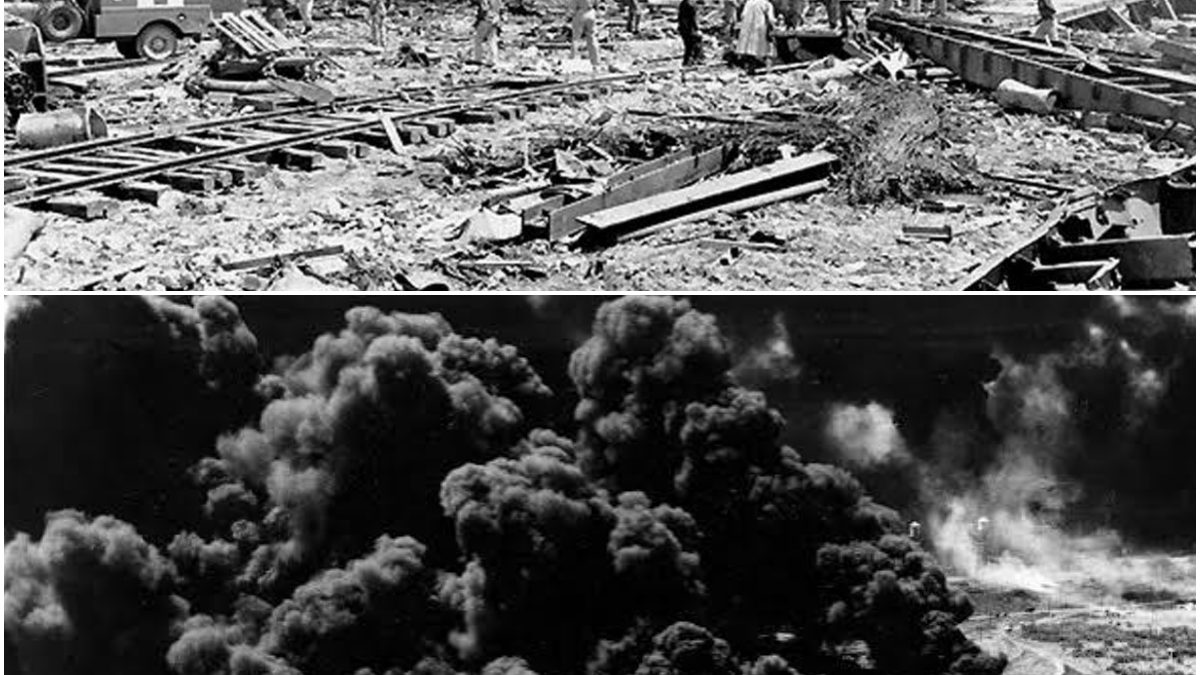
A column of fire rose nearly 2,000 ft into the sky, the base of it white hot, its crown boiling into a dark mushroom cloud.
In those seconds, the boundary between chemical and atomic, seemed to blur.
The blast released the energy of 2,000 tons of TNT, equivalent to some of the smaller atomic tests conducted in New Mexico 2 years earlier.
Men who had served in the Pacific swore the flash was identical to what they had seen at Hiroshima.
At the docks, the crowd of onlookers disappeared in an instant.
Firefighters, sailors, refinery workers, and curious towns people were vaporized or hurled beyond recognition.
Where the Grand Camp had floated moments earlier, there was now a crater in the harbor floor 30 ft deep and 100 ft wide.
A piece of her propeller landed across the bay in Galveastston, embedded in a field.
The ship’s two-tonon anchor was thrown more than a mile in land, where it buried itself in the clay.
The shockwave raced outward faster than thought.
Every building within a mile collapsed.
Rail cars lifted from their tracks.
Storage tanks exploded one by one as if following an unseen command.
A cler standing at his desk in the Monsanto plant found himself outside in open air a second later.
The office gone.
A school teacher several blocks away saw the windows implode before the blast even reached her ears.
The heat rolled through the streets in waves, igniting clothes, paint, and flesh.
For those caught at the edge of the blast, survival was measured in inches.
A cafe near the port disintegrated, but a man in the back corner lived, shielded by the angle of a brick wall.
Another man driving a truck across town saw the light hit the brakes and watched his windshield melt before the sound arrived.
He woke up in a ditch, his truck nowhere in sight.
The firestorm fed on itself.
Burning oil from ruptured tanks flowed through the gutters like rivers of flame.
Smoke turned the sky orange and then black.
The air was thick with ash, dust, and something metallic that coated the tongue.
People staggered through the streets, dazed and half deaf, calling names that could not be heard.
A few believed the world was ending.
From the air, pilots reported a column of smoke 15,000 ft high.
It spread outward like the clouds over a test site curling in layers of gray and brown.
The site was so similar to the atomic tests at Alamagordo that the Civil Aeronautics Authority briefly suspected an accidental detonation of nuclear material.
Even the pattern of destruction matched.
A ground zero of absolute annihilation surrounded by widening circles of shattered glass and broken walls.
In those moments, Texas city had become an unintentional mirror of the atomic age.
The same nation that had unleashed the power of the atom overseas now watched it mimic itself at home.
Not through uranium or plutonium, but through the chemistry of fertilizer.
The difference mattered little to those who lay in the rubble.
The scale of devastation was indistinguishable.
Galveastston hospitals overflowed within an hour.
Trains brought in doctors from Houston.
The injured arrived wrapped in sheets, many unable to speak, their skin burned away by heat rather than flame.
Survivors described a silence after the blast that felt wrong, as if the air itself had been torn open.
Everything was red, one man said later.
“Not fire, just red.”
The city that had once thrived on the industry now burned with its own ambition.
Nearly a thousand buildings were destroyed.
Hundreds of vehicles melted to metal shells.
The refineries, those proud symbols of progress, became sources of new explosions as tanks ruptured and pipes burst.
From the waters edged to the heart of town, nothing was untouched.
By late morning, the column of smoke could be seen from more than a 100 miles away.
Airplanes circled above the ruins, unsure whether they were looking at an attack or an accident.
For a few hours, no one outside Texas City knew what had happened.
Radio operators in nearby towns relayed the first message at 10:30 a.m. Texas City blown up.
Need help.
Everything gone.
The day that began with the calm rhythm of labor ended in silence.
The men who had trusted their chemistry, the women who had hung laundry by the sea, the children who had pointed at the orange smoke, all were now part of a single moment that bridged two eras.
The industrial age had collided with the atomic.
And in that collision, a small American port town became the unintentional epicenter of the modern world’s most terrifying truth.
That progress in the wrong conditions could release power no human hand could control.
The physics of an impossible explosion.
In the days that followed, scientists and engineers arrived in Texas City to study what was left.
The blast zone resembled the aftermath of a weapon test, not an industrial accident.
At its center lay the harbor’s crater, half filled with boiling water and debris.
Around it.
Every surface was twisted or scorched.
Steel girders bent into shapes that seemed impossible.
Bricks fused together under heat so intense that glass melted into ribbons along the street gutters.
To those who had studied the atomic age, the parallels were immediate and chilling.
The first official measurements stunned even the investigators.
Instruments in nearby states had registered seismic activity equivalent to a magnitude 3.4 earthquake.
The over pressure readings calculated from shattered glass and bent beams matched those recorded in the outer rings of Hiroshima.
Engineers estimated that the blast released the energy of roughly 2,000 tons of TNT, rivaling the smallest atomic bombs tested at Alamagordo in 1945.
This was no conventional fire.
It was a chain reaction born not of atoms splitting but of molecules tearing themselves apart.
Ammonium nitrate is a simple compound.
Nitrogen, hydrogen, and oxygen bound together in a fragile balance.
Under normal conditions, it lies dormant, feeding crops and replenishing soil.
But when heated and confined, that balance breaks.
The nitrogen seeks release, and the oxygen feeds the fire that triggers it.
Within seconds, chemical bonds rupture by the millions, producing gases that expand faster than any container can hold.
The explosion is not nuclear, yet its physics mimic one.
Sudden energy, instant heat, and a shock wave that moves faster than sound.
The Grand Camp’s hold had created the perfect chamber for that transformation.
When the crew sealed the hatches and pumped in steam, they built a bomb without realizing it.
The fire within consumed its limited air, then drew oxygen from the decomposing fertilizer itself.
As the temperature climbed, the reaction became self- sustaining, unstoppable.
At 850° F, the crystals liquefied and began releasing pure oxygen, feeding their own destruction.
By the time the steel walls started to bulge, the chemical reaction had become a runaway event, an implosion of order into chaos.
To understand the violence of what followed, scientists compared the detonation velocity of ammonium nitrate with that of TNT.
TNT expands at about 22,000 ft pers.
In the Grand Camp, the reaction reached nearly that speed, compressing air and debris into a pressure wave so dense it behaved like a solid wall.
The shock wave struck the surrounding city with a force greater than any conventional bomb dropped during the war.
It did not simply knock buildings down.
It crushed them as if the air itself had weight.
Investigators from the US Army Corps of Engineers walked the ruins with notebooks and measuring tapes, mapping blast radi, and studying how energy had dispersed through the port.
Their diagrams looked eerily like those drawn at nuclear test sites.
They charted concentric rings of destruction, each corresponding to known over pressure values.
Complete annihilation at the center, severe structural damage at a half mile, broken glass at 10 miles.
From those calculations came the conclusion that the Grand Camp’s explosion had produced a fireball exceeding 4,000° F.
At that temperature, copper wiring turned to vapor and steel softened like wax.
Even the color of the initial flash matched atomic reports.
Witnesses described a brilliant white core surrounded by a halo of orange and violet followed by a rising mushroom cloud.
That formation, long associated with nuclear detonations, was not unique to them.
It is the signature of any blast powerful enough to pull hot gases upward into cooler air, creating a vortex that shapes the column.
Yet for a nation that had only recently seen photographs of Hiroshima and Nagasaki, the resemblance was uncanny and unsettling.
In the days after the disaster, the US Coast Guard dispatched physicists from military laboratories to rule out any possibility of nuclear material.
Their Ge counters clicked quietly over the rubble, but found nothing unusual.
The horror was entirely chemical, man-made through ignorance rather than intention.
Still, the shock lingered.
The United States had discovered that it did not need an atomic weapon to experience atomic devastation.
The energy released from the Grand Camp was staggering, but not mysterious.
Each ton of ammonium nitrate, when detonated, can unleash roughly 1.3 tons of TNT equivalent.
Multiply that by the ship’s full cargo, 2,300 tons, and the math becomes terrifying.
The explosion consumed itself in less than a second, converting tons of solid matter into gas and light.
That conversion generated enough heat to ignite everything it touched, from refinery tanks to passing automobiles.
What remained of the ship’s hole disintegrated into fragments no larger than a hand.
For the scientists, this was both a lesson and a warning.
The chemical age had entered a realm once reserved for atomic power.
The same principles that govern nuclear energy, pressure, confinement, chain reaction, were now mirrored in ordinary industry.
The line between a factory and a weapon had blurred, and the people of Texas City, who had trusted that progress was harmless, paid the price for that illusion.
When the military team filed its report weeks later, it read less like an investigation than a confession.
The effects of the explosion, it concluded, were of a magnitude comparable to that of a low-yield atomic device.
It was the only time in American history that such words appeared in a non-military document.
The blast had not split atoms, but it had split the nation’s confidence in its own safety.
What happened in that harbor was more than an accident of chemistry.
It was a glimpse into a future where mankind’s tools, unchecked, could rival the forces of the sun.
The city that vanished in a breath.
When the fireball rose over Texas City, the blast tore through more than steel and stone.
It erased memory itself.
In an instant, the harbor that had once been alive with whistles and shouts turned into a wasteland of smoke and flame.
Entire neighborhoods disappeared.
Houses were lifted from their foundations and carried blocks away.
The ground burned so hot that sand melted into glass.
From above, pilots saw nothing but fire and rising ash.
A gray wound spreading over the gulf.
The blast had consumed the heart of the town.
Almost every building near the port was gone, replaced by debris piled stories high.
What had been the refinery district now burned like a single continuous furnace.
The air shimmerred from heat carrying the acrid scent of oil and scorched metal.
Telephone poles lay twisted across the roads and every window from the courthouse to the schoolhouse had shattered inward.
People stumbled through the ruins half blind and bleeding, their faces ghostly with dust.
Hospitals filled within minutes.
Nurses treated the wounded on sidewalks using bed sheets for bandages and doors for stretchers.
Many of the injured could not hear.
The shockwave had ruptured their eard druMs. Others were burned by the heat so fierce that skin had peeled away without fire ever touching it.
It looked like the end of the world, a refinery worker recalled.
You couldn’t tell where the sky stopped and the ground began.
Farther from the harbor, chaos rained.
Cars had been flipped like toys, their engines still running, wheels spinning in the air.
The high school roof had caved in.
At the train depot, passengers lay scattered across the platform, thrown down by the concussion.
The mayor pulled from the wreckage of city hall, looked around, and whispered to no one in particular, “It’s all gone.”
By midday, survivors began to understand the scale of what had happened.
Reports spread that a second ship, the high-f flyier, also carried ammonium nitrate and was burning.
Firefighters hesitated to approach, knowing now what such cargo could do.
But the flames reached it anyway.
That night, shortly after 1:00 a.m., the high-f flyier exploded with a force nearly equal to the first blast, igniting the nearby Wilson B.
Keen and sending another shock wave across the city.
Windows shattered again and wolves that had survived the morning fell.
The few remaining rescuers were thrown to the ground.
Those still standing realized that the nightmare was not over.
The destruction defied comprehension.
The explosion’s over pressure reached more than 5 lb per square in at distances where most structures could not endure too.
Roofs were torn from houses a mile away.
A two-tonon anchor had flown through the air for more than a mile.
Fragments of hull plating rained down across 30 square miles.
When investigators later drew maps of the city, they struggled to find fixed points of reference.
Streets had been obliterated, landmarks erased.
Aerial photographs showed a circular zone of annihilation surrounded by bands of partial ruin, eerily similar to those seen in Hiroshima.
What separated Texas City from the atomic cities overseas was intention.
There had been no warning, no siren, no ideology behind the blast, only human error and the quiet faith that science could be trusted.
Yet to those who lived through it, the difference meant little.
In their eyes, the devastation was identical.
The sky had turned white, the air had burned, the world had ended, and then kept on burning.
Rescue efforts began within hours.
Fire crews from Galveastston and Houston raced down the coastal road, their sirens echoing through the haze.
They found the city unrecognizable.
Streets they had driven for years no longer existed.
The harbor was a boiling cauldron.
Smoke blocked out the sun, turning midday into twilight.
Men searched for survivors by touch, guided only by the faint cries that drifted from beneath the rubble.
In those first days, no one knew how many had died.
The estimates rose with every sunrise.
At first 200, then four, then six.
By the end of the week, the number settled around 600, though many bodies were never found.
Thousands more were injured or left homeless.
The fire had consumed every home within sight of the docks.
Churches, schools, and warehouses became shelters for the living and morgs for the dead.
What astonished those who arrived to help was not the destruction, but the silence.
The noise of industry that had defined Texas city was gone.
No engines, no horns, no hum of machinery.
Only the distant crackle of fire, and the moan of wind through twisted metal.
Survivors spoke little.
They moved with mechanical purpose, digging, carrying, searching.
A Red Cross nurse described them as people working inside a photograph.
For weeks the ground remained hot beneath their feet.
The air shimmerred with oily haze, and at night the horizon glowed faintly orange from the still burning refineries.
Each dawn revealed new wreckage, new names to be written on makeshift boards outside the relief stations.
Those who lived carried burns that never healed, not all of them visible.
The children learned to tell time by the rhythm of explosions that still echoed from collapsing tanks.
The city had vanished in a breath, but its echo would last for generations.
In the crater where the Grand Camp had once floated, the Gulf lapped quietly at the edges, as if erasing the evidence of what it had seen.
Birds returned before people did.
By the time the fires died out, the survivors had begun the long, impossible task of rebuilding a place that no longer existed on any map.
The investigation that redefined safety.
When the last flames died, the investigation began.
What remained of the Grand Camp was a collection of fragments scattered across the bay.
There was no hull to study, no machinery to inspect, only twisted metal buried in the harbor mud.
The United States Coast Guard led the inquiry, joined by chemists, engineers, and military officers who had studied bomb damage in Europe and Japan.
They arrived wearing hard hats and clipboards, their faces drawn with disbelief.
It looked less like a port accident than the aftermath of an air raid.
The first task was to measure the unmeasurable.
Investigators paced the crater that marked ground zero, counting steps to estimate its size.
It was 30 ft deep and 100 wide, lined with glassy residue where seawater had fused with molten steel.
Around it, they found objects so distorted they defied identification.
Cables fused into rods, brass fixtures melted into green puddles, concrete that had flowed like liquid.
Even the grain of wooden pilings had been imprinted in the underside of twisted steel, a detail only heat of thousands of degrees could preserve.
The physical evidence told a story of impossible energy.
From those artifacts, scientists reconstructed the sequence of the disaster.
They concluded that the fire in the hold had likely burned for nearly an hour before detonation.
The steam intended to smother it had instead accelerated decomposition, turning the fertilizer into an unstable oxygen source.
As the pressure rose, the ship became a sealed bomb casing.
When it finally gave way, the reaction released more energy than any chemical explosion previously recorded on American soil.
The findings reached Washington within weeks.
Officials struggled to believe that something so catastrophic could result from something as common as fertilizer.
Yet the calculations were undeniable.
The Grand Camp had produced a blast equal to 2 kotons of TNT, the same energy as a small atomic bomb.
Military analysts confirmed that over pressure readings in the surrounding area match those measured at similar distances from Hiroshima.
A new term began circulating among the investigators.
Non-nuclear nuclear yield.
That phrase carried more weight than anyone wanted to admit.
In the years after World War II, the United States had defined its confidence through control of the atom.
The nuclear age belonged to scientists in laboratories and soldiers at test sites, not to dock workers loading cargo in the sun.
But Texas City had shown that ordinary industry could summon a comparable force, not through ambition, but through ignorance.
The line between civilian and military danger was thinner than anyone had imagined.
The Coast Guard’s final report read like a treatise on humility.
It identified no single villain, no act of sabotage, no criminal intent.
Every man aboard the Grand Camp had followed procedure.
The firemen who responded had done what training told them.
The tragedy was not caused by recklessness, but by the assumption that progress was safe simply because it was familiar.
The investigators described a chain of small, reasonable decisions that together formed the mechanism of disaster.
The conclusions had global reach.
American fertilizer plants rewrote their safety protocols.
European ports imposed strict regulations on ammonium nitrate handling.
Fire departments across the country began new training for chemical emergencies, introducing breathing masks, protective suits, and evacuation perimeters for materials previously thought harmless.
Out of the ashes of Texas City came the early framework for what would later be known as hazardous materials management.
The investigator’s work also produced something less tangible but equally significant, a reckoning with the cost of progress.
In Washington, congressional hearings questioned whether rapid industrial expansion had outpaced understanding.
Senators held up photographs of the harbor, pointing to the mushroom-shaped cloud and the crater that looked like a test site.
One remarked, “If this is peace, it looks too much like war.”
The phrase appeared in headlines across the country.
Insurance companies sent their own scientists to study the blast patterns.
Realizing that no existing policy could account for destruction of such scale, chemical engineers re-examined plant designs, adding ventilation systems and temperature monitors.
Manufacturers introduced new labels that warned of explosive potential when heated.
Every change from the wording on their bag to the sink and spacing between storage tanks traced back to the lessons written in smoke over the gulf that April morning.
But the reforms came too late for those who had lived through it.
Many survivors felt abandoned by the very government whose materials had caused the blast.
The ammonium nitrate had been produced in federal facilities intended for Europe’s recovery.
Lawsuits began almost immediately with families filing claims against the United States for negligence.
It was the first major test of the new federal tort claims act which allowed citizens to sue the government.
Years later, after endless appeals, the courts awarded limited compensation but stopped short of full responsibility.
The ruling recognized fault yet denied guilt.
A bureaucratic echo of the explosion itself, immense yet hollow.
Still, the event changed the national conscience.
It forced Americans to see their own vulnerability in the mirror of their triumphs.
The technologies that built prosperity were capable of unleashing devastation equal to the weapons they feared.
In the boardrooms of refineries, in the classrooms of engineers, and in the policies of regulators, Texas City became a ghost that whispered caution.
By the end of the investigation, one truth was clear.
The Grand Camp had not introduced a new danger to the world.
It had only revealed the one that already existed.
The danger of forgetting that power in any form must be respected.
The scientists who walked the crater left with more than data.
They left with a sentence that would appear understated in the final report.
This event demonstrates the capacity of ordinary materials to produce extraordinary consequences.
It was the simplest possible summary of a disaster that had momentarily turned a quiet American harbor into something that looked like the end of the world.
The day America saw its reflection in fire.
When news reels reached theaters in the weeks that followed, many Americans did not believe what they were seeing.
The footage showed a city flattened, ships vaporized, and a column of smoke curling upward into a shape everyone recognized from wartime headlines.
For a country only 2 years removed from Hiroshima and Nagasaki, the resemblance was disturbing.
The explosion in Texas City was not an act of war.
Yet, it looked like one.
It was as though the bomb had come home.
Newspapers called it the blast that shook the world.
Reporters who had covered the Manhattan Project wrote that the devastation was nearly identical to that of a low-yield atomic test.
The phrase unsettled readers who had believed that the new atomic age existed safely beyond their reach.
For the first time, Americans saw that the boundaries between peace and peril were not geographic or political.
They were scientific, invisible, and fragile.
Scientists and philosophers alike wrestled with what the disaster implied.
The atomic bomb had been born of intention, precision, and secrecy.
The Grand Camp had been born of faith, habit, and negligence.
Yet the outcome was indistinguishable.
In both cases, human invention had overrun human control.
“We witnessed,” one investigator wrote, “the principle of total release.
The sudden conversion of potential into ruin.
Across the country, sermons filled with uneasy parallels.
Preachers spoke of hubris, of humanity’s race toward mastery of creation.
Editorials questioned whether technology was advancing faster than morality.
A pastor in Houston told his congregation that the fire of Texas City burned with the same arrogance as the fire of the atom.
He meant that the root of both was the same belief that progress left to itself would never betray its maker.
For many, the lesson was personal.
The workers who rebuilt the refineries did so with a different reverence.
They learned to read warning signs not as inconveniences, but as guardians.
They wore helmets, gloves, and masks because the air itself had proven it could turn lethal.
The city rose again, but under the shadow of a new understanding.
That power, whether chemical or nuclear, carries no conscience.
The blast forced America to confront the mirror it had been avoiding.
The images from Texas City revealed that the force once confined to secret deserts and laboratories could be conjured in a common harbor by men simply doing their jobs.
It blurred the line between progress and peril, reminding a victorious nation that its genius could be its undoing.
The fire burned out, but its reflection lingered in policy, in science, and in the collective memory of a country learning that destruction does not always arrive with malice.
Sometimes it comes disguised as work wrapped in paper sacks marked fertilizer.
When the siren sound, we remember the atom in us.
Each year on April 16th, the sirens of Texas city whail at 9:12 a.m., one long solemn note that echoes across the refineries and over the calm waters of the bay.
Work halts.
Cars pull to the side of the road.
Children in classrooms bow their heads.
The sound lasts only 60 seconds.
But in that minute, the city stands still, remembering the instant when the sky turned white.
For the people who live there, remembrance has never been about fear.
It is about respect.
Respect for power, for fragility, for the balance between creation and destruction that defines the modern age.
The harbor that once vanished in fire hums again with ships and cranes, its tanks gleaming in the sunlight.
But beneath every whistle and every spark of machinery lies an unspoken vow.
Never again through ignorance.
Never again through complacency.
The legacy of that morning reaches far beyond the Gulf.
Every warning label on a chemical drum, every safety drill in a factory, every temperature gauge in a cargo hold bears the quiet fingerprint of Texas city.
The disaster taught the world that control is not the same as mastery, that even the simplest substances can hold the power of stars when mishandled.
It gave birth to new laws, new sciences, and a new humility that shaped how nations approached their most dangerous materials.
Yet, memory fades, as it always does.
New generations grow up seeing the photographs without feeling the heat, hearing the stories without sensing the weight of suddenness that followed the blast.
The challenge for those who remain is to keep the lesson alive, to remind the living that progress is never free, and that every comfort of modern life rests on a fragile covenant of caution.
When the siren’s note fades into the distance, the city resumes its rhythm.
Men and women return to their work, the sound of engines replacing the echo of remembrance.
The Gulf breeze carries the scent of salt and diesel, the same blend that once marked the morning of the explosion.
Life continues, steady and unremarkable.
But the past never fully disappears.
It lives in the bronze plaque at the port listing the names of the lost.
In the anchor of the Grand Camp mounted upright in a quiet park, in the stories passed from grandparents to grandchildren about the day the sky burned.
Those stories are not told to terrify but to preserve wisdom.
A reminder that the line between light and destruction is drawn by human hands.
When the sirens sound each April, the people of Texas City remember that power, whether nuclear or chemical, is never separate from the people who wield it.
They remember that the same spark that builds can also unmake.
And in that remembrance, beneath the hum of industry and the cry of gulls, America hears a quiet truth first learned in the smoke of its own harbor.
The atom is not only in our science but in








